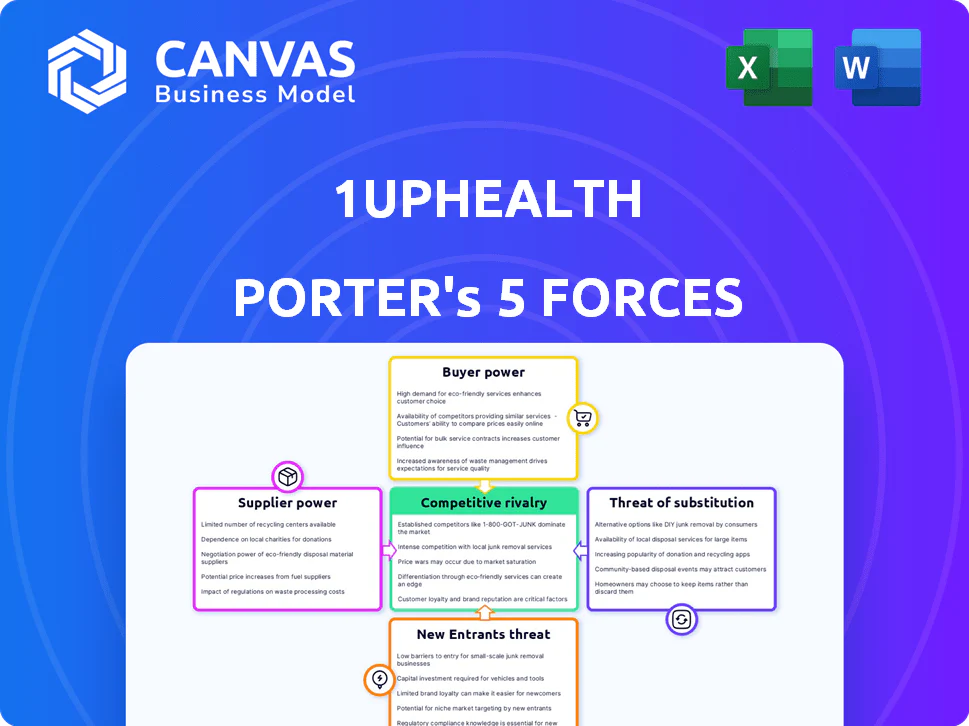
1UPHEALTH PORTER'S FIVE FORCES TEMPLATE RESEARCH
What is included in the product
 Detailed Word Document
Evaluates control held by suppliers and buyers, and their influence on pricing and profitability.

 Customizable Excel Spreadsheet
Customize pressure levels based on new data or evolving market trends.
Same Document Delivered
1upHealth Porter's Five Forces Analysis
This preview showcases the complete 1upHealth Porter's Five Forces analysis. The document you see here is the exact report you will receive immediately after your purchase.

Porter's Five Forces Analysis Template

From Overview to Strategy Blueprint
1upHealth faces moderate rivalry due to a fragmented market and evolving technologies. Buyer power is relatively high, with healthcare providers seeking cost-effective solutions. Supplier power is moderate, depending on data sources and platform integrations. The threat of new entrants is low, given industry regulations and switching costs. Substitute products pose a moderate threat.
This brief snapshot only scratches the surface. Unlock the full Porter's Five Forces Analysis to explore 1upHealth’s competitive dynamics, market pressures, and strategic advantages in detail.
Suppliers Bargaining Power

Limited Number of Specialized Healthcare Data Vendors
The healthcare data market's concentration—few specialized vendors—boosts supplier power. These vendors, providing crucial data and tech, hold leverage in negotiations. This impacts 1upHealth's costs and flexibility. In 2024, the healthcare data market was valued at $68.7 billion, reflecting supplier influence.
High Dependency on Technology Providers for Data Integration
1upHealth's data integration core function is heavily reliant on tech providers, including Electronic Health Records (EHRs). The complexity and cost of integrating with numerous systems give these providers significant bargaining power. In 2024, the healthcare IT market was valued at over $170 billion, highlighting the scale and influence of these providers. This dependency can lead to higher costs and potential delays for 1upHealth.

Proprietary Technology and Algorithms Held by Key Suppliers
Major EHR vendors, key healthcare data suppliers, wield significant bargaining power due to proprietary technology. In 2024, companies like Epic and Cerner (Oracle Health) control a large share of the EHR market. This dominance gives them leverage over data access, potentially impacting smaller firms like 1upHealth. Their proprietary algorithms and tech dictate data accessibility terms, influencing pricing and partnerships.

Data Silos and Lack of Standardized Data Formats
The healthcare industry grapples with fragmented data and inconsistent formats, a situation that impacts companies like 1upHealth. This lack of standardization forces 1upHealth to expend resources on data aggregation and normalization, which increases operational complexity and costs. The entities controlling data in various formats indirectly gain more power, influencing 1upHealth's ability to efficiently access and utilize critical information. In 2024, the cost to integrate various data formats can increase operational expenses by up to 20%.
- Data integration costs can rise by 15-20% due to data format disparities.
- Approximately 30% of healthcare data is in unstructured formats.
- Data normalization efforts can consume up to 40% of data processing time.
- The fragmented data landscape increases the risk of data breaches.
Regulatory Requirements for Data Sharing and Interoperability
Regulatory requirements, like the 21st Century Cures Act and FHIR standards, impact supplier power. Suppliers compliant with these standards gain an advantage, influencing negotiation. Compliance costs affect negotiations, potentially increasing supplier bargaining power. This shifts the dynamics in healthcare data management. The market is expected to reach $68.7 billion by 2024.
- 21st Century Cures Act and FHIR standards drive data interoperability.
- Compliant suppliers hold a stronger negotiation position.
- Compliance costs affect overall bargaining dynamics.
- Healthcare data management market is valued at $68.7 billion in 2024.
Healthcare Data's Supplier Dynamics: High Stakes
Supplier power in healthcare data is high due to market concentration and tech dependence.
EHR vendors and data format complexities increase costs and limit flexibility for companies like 1upHealth.
Regulatory compliance further influences supplier bargaining power. The healthcare IT market was valued at over $170 billion in 2024.
| Aspect | Impact on 1upHealth | 2024 Data |
|---|---|---|
| Market Concentration | Higher costs, less flexibility | Healthcare data market: $68.7B |
| Tech Dependency | Increased integration costs | Healthcare IT market: $170B+ |
| Data Fragmentation | Higher operational costs | Integration costs up to 20% |
Customers Bargaining Power

Diverse Customer Base with Varying Needs
1upHealth caters to a diverse customer base, including patients, providers, payers, and developers, each with unique demands. This variety dilutes the influence any single customer segment holds. In 2024, the healthcare IT market showed this trend, with no single buyer dominating. This distribution helps 1upHealth maintain pricing power.
Influence of Large Healthcare Organizations and Payers
Large healthcare systems and national payers are key potential customers for 1upHealth. Their size and the data volume they manage provide significant bargaining power. For instance, UnitedHealth Group reported revenues of $371.6 billion in 2023, highlighting their financial clout. They can negotiate favorable terms or demand customized solutions. This leverage is due to the substantial revenue these organizations represent.

Customer Need for Seamless Data Integration and Actionable Insights
Customers, mainly healthcare providers and payers, demand easy data integration and actionable insights. 1upHealth's platform tackles these needs, potentially reducing customer power. Switching to less capable alternatives could be costly; in 2024, data integration costs rose by 7%, affecting provider budgets. A comprehensive platform is key.

Availability of Alternative Data Aggregation Solutions
Customers of 1upHealth possess bargaining power due to alternative data aggregation solutions. This includes building in-house systems or using competitors. The existence of choices like these influences pricing and service expectations. For example, the market for healthcare data integration is estimated at $2.8 billion in 2024.
- Market size for healthcare data integration in 2024: $2.8 billion.
- Percentage of healthcare providers using multiple data integration vendors: 35%.
- Average cost of in-house data integration per year: $500,000.
Regulatory Mandates Driving Customer Demand for Interoperability
Regulatory mandates are significantly shaping customer demand for interoperability. The push for data sharing, fueled by regulations like the 21st Century Cures Act, directly impacts platforms such as 1upHealth. This creates a need for solutions that meet these requirements, thus increasing customer interest.
The regulatory environment influences customer behavior by making compliance a priority. As customers seek solutions to meet these mandates, their individual bargaining power may decrease. This shift underscores the importance of interoperability in the healthcare sector.
- 21st Century Cures Act: Mandates data access and exchange.
- Increased demand for interoperable platforms.
- Compliance needs reduce customer bargaining power.
- Healthcare providers prioritize interoperability solutions.
Healthcare Data Integration: $2.8B Market
1upHealth's customer base includes diverse players, reducing any single group's influence. Large payers and systems wield considerable bargaining power due to their size and revenue. The need for data integration and regulatory compliance, like the 21st Century Cures Act, shapes customer demand. The market for healthcare data integration was $2.8 billion in 2024.
| Aspect | Details | Impact |
|---|---|---|
| Market Size (2024) | Healthcare data integration: $2.8B | Influences pricing and choices. |
| Key Regulations | 21st Century Cures Act | Drives demand for interoperability. |
| Customer Demand | Easy data integration, compliance | Shapes platform features. |
Rivalry Among Competitors

Presence of Established and Emerging Competitors
The healthcare data platform market is bustling with both established and new competitors. Firms providing data aggregation and interoperability solutions, along with those offering healthcare analytics and consulting, fuel the competition. This creates a diverse landscape, suggesting a moderate to high level of rivalry. In 2024, the health IT market is estimated to reach $240 billion.
Differentiation Based on Technology and Service Offerings
In the healthcare data integration sector, firms differentiate through technology and service offerings. 1upHealth leverages its FHIR-native platform and API capabilities. Differentiation, like superior analytics or compliance support, shapes competitive intensity. For example, the global healthcare IT market was valued at $313.8 billion in 2023.

Impact of Regulatory Compliance on Competition
Adhering to changing healthcare data regulations substantially impacts competition. Those excelling at compliance, like 1upHealth, gain an edge. The costs of compliance, such as those tied to HIPAA, can be a barrier. For instance, HIPAA fines hit $250,000 in 2024 for major violations.

Competition from In-House Solutions and Traditional Methods
Healthcare organizations often weigh building in-house data solutions against using external platforms like 1upHealth, or sticking with older methods. This internal development or reliance on traditional methods presents indirect competition. 1upHealth must showcase its superiority through cost-effectiveness, improved efficiency, and advanced features. For example, in 2024, the average cost to build an in-house data integration platform was $1.2 million, while 1upHealth's solutions offer similar capabilities at a fraction of the cost.
- In 2024, the average time to develop an in-house data integration platform was 18 months, compared to 1upHealth's quicker implementation.
- Traditional methods often lack the interoperability and scalability of modern platforms, costing healthcare providers in long run.
- 1upHealth can highlight its compliance with industry standards (e.g., FHIR) that in-house solutions may struggle to meet.
- The company should focus on the value of data-driven insights and real-time analytics.
Market Growth and the Potential for Collaboration
The healthcare data interoperability market is thriving, fueled by the demand for data-driven healthcare solutions. This expansion is expected to create opportunities for various companies, but it also invites more competition. The market's growth, projected to reach $5.1 billion by 2029, encourages new entrants. Collaboration is key, with partnerships increasing data access and service capabilities.
- Market growth is projected at a CAGR of 10.5% from 2022 to 2029.
- The interoperability solutions segment held the largest revenue share of over 40% in 2023.
- Cloud-based solutions are expected to grow the fastest.
- Partnerships and acquisitions are common for market expansion.
Healthcare Data Platforms: Market Dynamics
Competitive rivalry in healthcare data platforms is intense, driven by a growing market and diverse competitors. Differentiation through technology and compliance, like 1upHealth's FHIR-native platform, is key. The market's value was $313.8B in 2023, increasing competition.
| Aspect | Details | 2024 Data |
|---|---|---|
| Market Size | Healthcare IT Market | $240 billion |
| Compliance Costs | HIPAA Fines for Violations | Up to $250,000 |
| In-house Platform Cost | Average Development Cost | $1.2 million |
Original: $10.00
-65%$10.00
$3.501UPHEALTH PORTER'S FIVE FORCES TEMPLATE RESEARCH
What is included in the product
Detailed Word Document
Evaluates control held by suppliers and buyers, and their influence on pricing and profitability.
Customizable Excel Spreadsheet
Customize pressure levels based on new data or evolving market trends.
Same Document Delivered
1upHealth Porter's Five Forces Analysis
This preview showcases the complete 1upHealth Porter's Five Forces analysis. The document you see here is the exact report you will receive immediately after your purchase.
Porter's Five Forces Analysis Template
From Overview to Strategy Blueprint
1upHealth faces moderate rivalry due to a fragmented market and evolving technologies. Buyer power is relatively high, with healthcare providers seeking cost-effective solutions. Supplier power is moderate, depending on data sources and platform integrations. The threat of new entrants is low, given industry regulations and switching costs. Substitute products pose a moderate threat.
This brief snapshot only scratches the surface. Unlock the full Porter's Five Forces Analysis to explore 1upHealth’s competitive dynamics, market pressures, and strategic advantages in detail.
Suppliers Bargaining Power
Limited Number of Specialized Healthcare Data Vendors
The healthcare data market's concentration—few specialized vendors—boosts supplier power. These vendors, providing crucial data and tech, hold leverage in negotiations. This impacts 1upHealth's costs and flexibility. In 2024, the healthcare data market was valued at $68.7 billion, reflecting supplier influence.
High Dependency on Technology Providers for Data Integration
1upHealth's data integration core function is heavily reliant on tech providers, including Electronic Health Records (EHRs). The complexity and cost of integrating with numerous systems give these providers significant bargaining power. In 2024, the healthcare IT market was valued at over $170 billion, highlighting the scale and influence of these providers. This dependency can lead to higher costs and potential delays for 1upHealth.
Proprietary Technology and Algorithms Held by Key Suppliers
Major EHR vendors, key healthcare data suppliers, wield significant bargaining power due to proprietary technology. In 2024, companies like Epic and Cerner (Oracle Health) control a large share of the EHR market. This dominance gives them leverage over data access, potentially impacting smaller firms like 1upHealth. Their proprietary algorithms and tech dictate data accessibility terms, influencing pricing and partnerships.
Data Silos and Lack of Standardized Data Formats
The healthcare industry grapples with fragmented data and inconsistent formats, a situation that impacts companies like 1upHealth. This lack of standardization forces 1upHealth to expend resources on data aggregation and normalization, which increases operational complexity and costs. The entities controlling data in various formats indirectly gain more power, influencing 1upHealth's ability to efficiently access and utilize critical information. In 2024, the cost to integrate various data formats can increase operational expenses by up to 20%.
- Data integration costs can rise by 15-20% due to data format disparities.
- Approximately 30% of healthcare data is in unstructured formats.
- Data normalization efforts can consume up to 40% of data processing time.
- The fragmented data landscape increases the risk of data breaches.
Regulatory Requirements for Data Sharing and Interoperability
Regulatory requirements, like the 21st Century Cures Act and FHIR standards, impact supplier power. Suppliers compliant with these standards gain an advantage, influencing negotiation. Compliance costs affect negotiations, potentially increasing supplier bargaining power. This shifts the dynamics in healthcare data management. The market is expected to reach $68.7 billion by 2024.
- 21st Century Cures Act and FHIR standards drive data interoperability.
- Compliant suppliers hold a stronger negotiation position.
- Compliance costs affect overall bargaining dynamics.
- Healthcare data management market is valued at $68.7 billion in 2024.
Healthcare Data's Supplier Dynamics: High Stakes
Supplier power in healthcare data is high due to market concentration and tech dependence.
EHR vendors and data format complexities increase costs and limit flexibility for companies like 1upHealth.
Regulatory compliance further influences supplier bargaining power. The healthcare IT market was valued at over $170 billion in 2024.
| Aspect | Impact on 1upHealth | 2024 Data |
|---|---|---|
| Market Concentration | Higher costs, less flexibility | Healthcare data market: $68.7B |
| Tech Dependency | Increased integration costs | Healthcare IT market: $170B+ |
| Data Fragmentation | Higher operational costs | Integration costs up to 20% |
Customers Bargaining Power
Diverse Customer Base with Varying Needs
1upHealth caters to a diverse customer base, including patients, providers, payers, and developers, each with unique demands. This variety dilutes the influence any single customer segment holds. In 2024, the healthcare IT market showed this trend, with no single buyer dominating. This distribution helps 1upHealth maintain pricing power.
Influence of Large Healthcare Organizations and Payers
Large healthcare systems and national payers are key potential customers for 1upHealth. Their size and the data volume they manage provide significant bargaining power. For instance, UnitedHealth Group reported revenues of $371.6 billion in 2023, highlighting their financial clout. They can negotiate favorable terms or demand customized solutions. This leverage is due to the substantial revenue these organizations represent.
Customer Need for Seamless Data Integration and Actionable Insights
Customers, mainly healthcare providers and payers, demand easy data integration and actionable insights. 1upHealth's platform tackles these needs, potentially reducing customer power. Switching to less capable alternatives could be costly; in 2024, data integration costs rose by 7%, affecting provider budgets. A comprehensive platform is key.
Availability of Alternative Data Aggregation Solutions
Customers of 1upHealth possess bargaining power due to alternative data aggregation solutions. This includes building in-house systems or using competitors. The existence of choices like these influences pricing and service expectations. For example, the market for healthcare data integration is estimated at $2.8 billion in 2024.
- Market size for healthcare data integration in 2024: $2.8 billion.
- Percentage of healthcare providers using multiple data integration vendors: 35%.
- Average cost of in-house data integration per year: $500,000.
Regulatory Mandates Driving Customer Demand for Interoperability
Regulatory mandates are significantly shaping customer demand for interoperability. The push for data sharing, fueled by regulations like the 21st Century Cures Act, directly impacts platforms such as 1upHealth. This creates a need for solutions that meet these requirements, thus increasing customer interest.
The regulatory environment influences customer behavior by making compliance a priority. As customers seek solutions to meet these mandates, their individual bargaining power may decrease. This shift underscores the importance of interoperability in the healthcare sector.
- 21st Century Cures Act: Mandates data access and exchange.
- Increased demand for interoperable platforms.
- Compliance needs reduce customer bargaining power.
- Healthcare providers prioritize interoperability solutions.
Healthcare Data Integration: $2.8B Market
1upHealth's customer base includes diverse players, reducing any single group's influence. Large payers and systems wield considerable bargaining power due to their size and revenue. The need for data integration and regulatory compliance, like the 21st Century Cures Act, shapes customer demand. The market for healthcare data integration was $2.8 billion in 2024.
| Aspect | Details | Impact |
|---|---|---|
| Market Size (2024) | Healthcare data integration: $2.8B | Influences pricing and choices. |
| Key Regulations | 21st Century Cures Act | Drives demand for interoperability. |
| Customer Demand | Easy data integration, compliance | Shapes platform features. |
Rivalry Among Competitors
Presence of Established and Emerging Competitors
The healthcare data platform market is bustling with both established and new competitors. Firms providing data aggregation and interoperability solutions, along with those offering healthcare analytics and consulting, fuel the competition. This creates a diverse landscape, suggesting a moderate to high level of rivalry. In 2024, the health IT market is estimated to reach $240 billion.
Differentiation Based on Technology and Service Offerings
In the healthcare data integration sector, firms differentiate through technology and service offerings. 1upHealth leverages its FHIR-native platform and API capabilities. Differentiation, like superior analytics or compliance support, shapes competitive intensity. For example, the global healthcare IT market was valued at $313.8 billion in 2023.
Impact of Regulatory Compliance on Competition
Adhering to changing healthcare data regulations substantially impacts competition. Those excelling at compliance, like 1upHealth, gain an edge. The costs of compliance, such as those tied to HIPAA, can be a barrier. For instance, HIPAA fines hit $250,000 in 2024 for major violations.
Competition from In-House Solutions and Traditional Methods
Healthcare organizations often weigh building in-house data solutions against using external platforms like 1upHealth, or sticking with older methods. This internal development or reliance on traditional methods presents indirect competition. 1upHealth must showcase its superiority through cost-effectiveness, improved efficiency, and advanced features. For example, in 2024, the average cost to build an in-house data integration platform was $1.2 million, while 1upHealth's solutions offer similar capabilities at a fraction of the cost.
- In 2024, the average time to develop an in-house data integration platform was 18 months, compared to 1upHealth's quicker implementation.
- Traditional methods often lack the interoperability and scalability of modern platforms, costing healthcare providers in long run.
- 1upHealth can highlight its compliance with industry standards (e.g., FHIR) that in-house solutions may struggle to meet.
- The company should focus on the value of data-driven insights and real-time analytics.
Market Growth and the Potential for Collaboration
The healthcare data interoperability market is thriving, fueled by the demand for data-driven healthcare solutions. This expansion is expected to create opportunities for various companies, but it also invites more competition. The market's growth, projected to reach $5.1 billion by 2029, encourages new entrants. Collaboration is key, with partnerships increasing data access and service capabilities.
- Market growth is projected at a CAGR of 10.5% from 2022 to 2029.
- The interoperability solutions segment held the largest revenue share of over 40% in 2023.
- Cloud-based solutions are expected to grow the fastest.
- Partnerships and acquisitions are common for market expansion.
Healthcare Data Platforms: Market Dynamics
Competitive rivalry in healthcare data platforms is intense, driven by a growing market and diverse competitors. Differentiation through technology and compliance, like 1upHealth's FHIR-native platform, is key. The market's value was $313.8B in 2023, increasing competition.
| Aspect | Details | 2024 Data |
|---|---|---|
| Market Size | Healthcare IT Market | $240 billion |
| Compliance Costs | HIPAA Fines for Violations | Up to $250,000 |
| In-house Platform Cost | Average Development Cost | $1.2 million |
Product Information
Product Information
Shipping & Returns
Shipping & Returns
Description
What is included in the product
Detailed Word Document
Evaluates control held by suppliers and buyers, and their influence on pricing and profitability.
Customizable Excel Spreadsheet
Customize pressure levels based on new data or evolving market trends.
Same Document Delivered
1upHealth Porter's Five Forces Analysis
This preview showcases the complete 1upHealth Porter's Five Forces analysis. The document you see here is the exact report you will receive immediately after your purchase.
Porter's Five Forces Analysis Template
From Overview to Strategy Blueprint
1upHealth faces moderate rivalry due to a fragmented market and evolving technologies. Buyer power is relatively high, with healthcare providers seeking cost-effective solutions. Supplier power is moderate, depending on data sources and platform integrations. The threat of new entrants is low, given industry regulations and switching costs. Substitute products pose a moderate threat.
This brief snapshot only scratches the surface. Unlock the full Porter's Five Forces Analysis to explore 1upHealth’s competitive dynamics, market pressures, and strategic advantages in detail.
Suppliers Bargaining Power
Limited Number of Specialized Healthcare Data Vendors
The healthcare data market's concentration—few specialized vendors—boosts supplier power. These vendors, providing crucial data and tech, hold leverage in negotiations. This impacts 1upHealth's costs and flexibility. In 2024, the healthcare data market was valued at $68.7 billion, reflecting supplier influence.
High Dependency on Technology Providers for Data Integration
1upHealth's data integration core function is heavily reliant on tech providers, including Electronic Health Records (EHRs). The complexity and cost of integrating with numerous systems give these providers significant bargaining power. In 2024, the healthcare IT market was valued at over $170 billion, highlighting the scale and influence of these providers. This dependency can lead to higher costs and potential delays for 1upHealth.
Proprietary Technology and Algorithms Held by Key Suppliers
Major EHR vendors, key healthcare data suppliers, wield significant bargaining power due to proprietary technology. In 2024, companies like Epic and Cerner (Oracle Health) control a large share of the EHR market. This dominance gives them leverage over data access, potentially impacting smaller firms like 1upHealth. Their proprietary algorithms and tech dictate data accessibility terms, influencing pricing and partnerships.
Data Silos and Lack of Standardized Data Formats
The healthcare industry grapples with fragmented data and inconsistent formats, a situation that impacts companies like 1upHealth. This lack of standardization forces 1upHealth to expend resources on data aggregation and normalization, which increases operational complexity and costs. The entities controlling data in various formats indirectly gain more power, influencing 1upHealth's ability to efficiently access and utilize critical information. In 2024, the cost to integrate various data formats can increase operational expenses by up to 20%.
- Data integration costs can rise by 15-20% due to data format disparities.
- Approximately 30% of healthcare data is in unstructured formats.
- Data normalization efforts can consume up to 40% of data processing time.
- The fragmented data landscape increases the risk of data breaches.
Regulatory Requirements for Data Sharing and Interoperability
Regulatory requirements, like the 21st Century Cures Act and FHIR standards, impact supplier power. Suppliers compliant with these standards gain an advantage, influencing negotiation. Compliance costs affect negotiations, potentially increasing supplier bargaining power. This shifts the dynamics in healthcare data management. The market is expected to reach $68.7 billion by 2024.
- 21st Century Cures Act and FHIR standards drive data interoperability.
- Compliant suppliers hold a stronger negotiation position.
- Compliance costs affect overall bargaining dynamics.
- Healthcare data management market is valued at $68.7 billion in 2024.
Healthcare Data's Supplier Dynamics: High Stakes
Supplier power in healthcare data is high due to market concentration and tech dependence.
EHR vendors and data format complexities increase costs and limit flexibility for companies like 1upHealth.
Regulatory compliance further influences supplier bargaining power. The healthcare IT market was valued at over $170 billion in 2024.
| Aspect | Impact on 1upHealth | 2024 Data |
|---|---|---|
| Market Concentration | Higher costs, less flexibility | Healthcare data market: $68.7B |
| Tech Dependency | Increased integration costs | Healthcare IT market: $170B+ |
| Data Fragmentation | Higher operational costs | Integration costs up to 20% |
Customers Bargaining Power
Diverse Customer Base with Varying Needs
1upHealth caters to a diverse customer base, including patients, providers, payers, and developers, each with unique demands. This variety dilutes the influence any single customer segment holds. In 2024, the healthcare IT market showed this trend, with no single buyer dominating. This distribution helps 1upHealth maintain pricing power.
Influence of Large Healthcare Organizations and Payers
Large healthcare systems and national payers are key potential customers for 1upHealth. Their size and the data volume they manage provide significant bargaining power. For instance, UnitedHealth Group reported revenues of $371.6 billion in 2023, highlighting their financial clout. They can negotiate favorable terms or demand customized solutions. This leverage is due to the substantial revenue these organizations represent.
Customer Need for Seamless Data Integration and Actionable Insights
Customers, mainly healthcare providers and payers, demand easy data integration and actionable insights. 1upHealth's platform tackles these needs, potentially reducing customer power. Switching to less capable alternatives could be costly; in 2024, data integration costs rose by 7%, affecting provider budgets. A comprehensive platform is key.
Availability of Alternative Data Aggregation Solutions
Customers of 1upHealth possess bargaining power due to alternative data aggregation solutions. This includes building in-house systems or using competitors. The existence of choices like these influences pricing and service expectations. For example, the market for healthcare data integration is estimated at $2.8 billion in 2024.
- Market size for healthcare data integration in 2024: $2.8 billion.
- Percentage of healthcare providers using multiple data integration vendors: 35%.
- Average cost of in-house data integration per year: $500,000.
Regulatory Mandates Driving Customer Demand for Interoperability
Regulatory mandates are significantly shaping customer demand for interoperability. The push for data sharing, fueled by regulations like the 21st Century Cures Act, directly impacts platforms such as 1upHealth. This creates a need for solutions that meet these requirements, thus increasing customer interest.
The regulatory environment influences customer behavior by making compliance a priority. As customers seek solutions to meet these mandates, their individual bargaining power may decrease. This shift underscores the importance of interoperability in the healthcare sector.
- 21st Century Cures Act: Mandates data access and exchange.
- Increased demand for interoperable platforms.
- Compliance needs reduce customer bargaining power.
- Healthcare providers prioritize interoperability solutions.
Healthcare Data Integration: $2.8B Market
1upHealth's customer base includes diverse players, reducing any single group's influence. Large payers and systems wield considerable bargaining power due to their size and revenue. The need for data integration and regulatory compliance, like the 21st Century Cures Act, shapes customer demand. The market for healthcare data integration was $2.8 billion in 2024.
| Aspect | Details | Impact |
|---|---|---|
| Market Size (2024) | Healthcare data integration: $2.8B | Influences pricing and choices. |
| Key Regulations | 21st Century Cures Act | Drives demand for interoperability. |
| Customer Demand | Easy data integration, compliance | Shapes platform features. |
Rivalry Among Competitors
Presence of Established and Emerging Competitors
The healthcare data platform market is bustling with both established and new competitors. Firms providing data aggregation and interoperability solutions, along with those offering healthcare analytics and consulting, fuel the competition. This creates a diverse landscape, suggesting a moderate to high level of rivalry. In 2024, the health IT market is estimated to reach $240 billion.
Differentiation Based on Technology and Service Offerings
In the healthcare data integration sector, firms differentiate through technology and service offerings. 1upHealth leverages its FHIR-native platform and API capabilities. Differentiation, like superior analytics or compliance support, shapes competitive intensity. For example, the global healthcare IT market was valued at $313.8 billion in 2023.
Impact of Regulatory Compliance on Competition
Adhering to changing healthcare data regulations substantially impacts competition. Those excelling at compliance, like 1upHealth, gain an edge. The costs of compliance, such as those tied to HIPAA, can be a barrier. For instance, HIPAA fines hit $250,000 in 2024 for major violations.
Competition from In-House Solutions and Traditional Methods
Healthcare organizations often weigh building in-house data solutions against using external platforms like 1upHealth, or sticking with older methods. This internal development or reliance on traditional methods presents indirect competition. 1upHealth must showcase its superiority through cost-effectiveness, improved efficiency, and advanced features. For example, in 2024, the average cost to build an in-house data integration platform was $1.2 million, while 1upHealth's solutions offer similar capabilities at a fraction of the cost.
- In 2024, the average time to develop an in-house data integration platform was 18 months, compared to 1upHealth's quicker implementation.
- Traditional methods often lack the interoperability and scalability of modern platforms, costing healthcare providers in long run.
- 1upHealth can highlight its compliance with industry standards (e.g., FHIR) that in-house solutions may struggle to meet.
- The company should focus on the value of data-driven insights and real-time analytics.
Market Growth and the Potential for Collaboration
The healthcare data interoperability market is thriving, fueled by the demand for data-driven healthcare solutions. This expansion is expected to create opportunities for various companies, but it also invites more competition. The market's growth, projected to reach $5.1 billion by 2029, encourages new entrants. Collaboration is key, with partnerships increasing data access and service capabilities.
- Market growth is projected at a CAGR of 10.5% from 2022 to 2029.
- The interoperability solutions segment held the largest revenue share of over 40% in 2023.
- Cloud-based solutions are expected to grow the fastest.
- Partnerships and acquisitions are common for market expansion.
Healthcare Data Platforms: Market Dynamics
Competitive rivalry in healthcare data platforms is intense, driven by a growing market and diverse competitors. Differentiation through technology and compliance, like 1upHealth's FHIR-native platform, is key. The market's value was $313.8B in 2023, increasing competition.
| Aspect | Details | 2024 Data |
|---|---|---|
| Market Size | Healthcare IT Market | $240 billion |
| Compliance Costs | HIPAA Fines for Violations | Up to $250,000 |
| In-house Platform Cost | Average Development Cost | $1.2 million |











