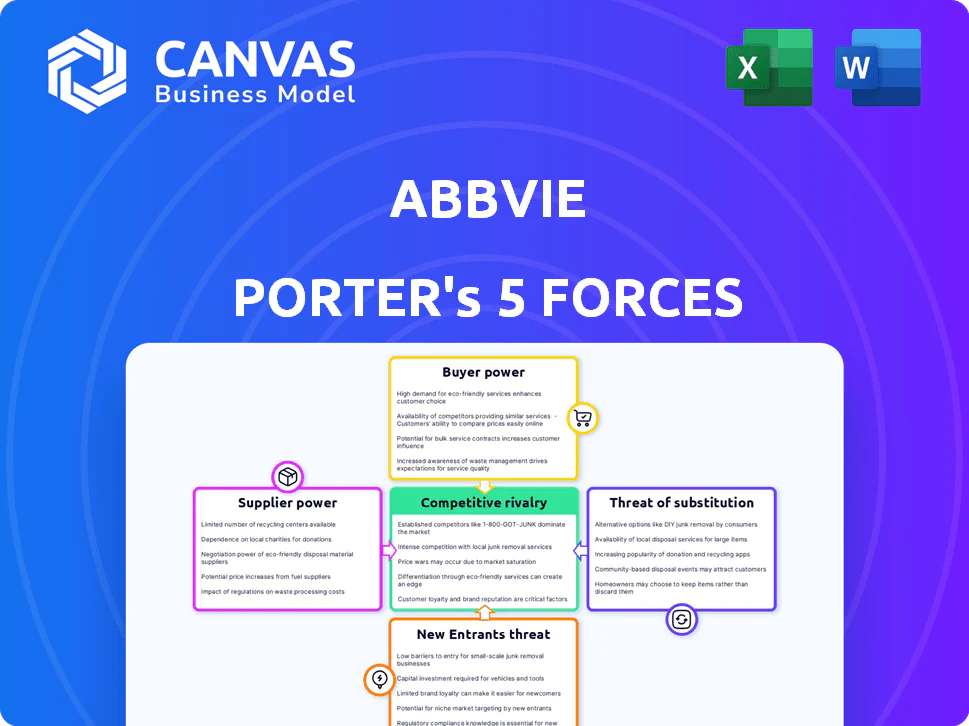
ABBVIE PORTER'S FIVE FORCES TEMPLATE RESEARCH

Go Beyond the Preview-Access the Full Strategic Report
AbbVie faces moderate supplier power, high buyer scrutiny on pricing, stiff rivalry from Big Pharma and biotech innovators, and a manageable threat from new entrants due to heavy R&D barriers.
This brief snapshot only scratches the surface. Unlock the full Porter's Five Forces Analysis to explore AbbVie's competitive dynamics, market pressures, and strategic advantages in detail.
Suppliers Bargaining Power

Specialized Raw Material Providers
AbbVie relies on a narrow set of specialized suppliers for active pharmaceutical ingredients and biologics, making switching costly; in 2025 AbbVie spent $8.3bn on COGS supporting biologics, so suppliers hold moderate leverage.
Contract Manufacturing Organizations
As AbbVie scales ADC production, it depends on a handful of high-end contract manufacturing organizations (CMOs) with sterile biologics sites; only ~10-15 global facilities meet FDA biologics standards, constraining options.
In FY2025 AbbVie spent about $1.2B on external manufacturing and CMO services, so a 10% CMO price rise could shave ~ $120M from gross margins.
Any CMO disruption-shutdowns, capacity constraints, or quality holds-can force AbbVie to delay launches or incur premium spot fees, directly squeezing production margins and timelines.

Highly Skilled Scientific Talent
In 2025 AbbVie paid $7.2B in R&D (fiscal 2025), and scarce immunology/neuroscience talent tightened supply, raising hiring costs by ~18% as biotech rebounded; top PhD researchers and data scientists now command salaries and signing bonuses that push operating R&D expense higher. AbbVie must offer premium packages to protect its pipeline and sustain clinical progress.

Logistics and Cold-Chain Providers
AbbVie's flagship biologics like Skyrizi need cold-chain shipping, tying the company to a small set of specialized logistics providers; this raises supplier leverage as IATA and FDA cold-chain rules tighten and fuel-driven freight rates rose ~18% in 2024-2025.
AbbVie's limited switching options boost providers' negotiation power, increasing contract costs and service-vetting demands.
- Skyrizi: biologic cold-chain requirement
- Freight rates: +18% (2024-2025)
- Few qualified providers → higher contract leverage
- Regulatory compliance (IATA/FDA) raises switching costs
Regulatory Compliance and Quality Standards
Suppliers of lab equipment and quality-control software gain leverage because AbbVie faces integration and validation costs-for example, system revalidation can exceed $2m and take 6-12 months-making vendor switch costly due to FDA/EMA re-certification requirements, creating lock-in that lets suppliers raise prices for updates and maintenance.
- Revalidation cost > $2,000,000
- Switch time 6-12 months
- Regulatory re-certification required (FDA/EMA)
- Suppliers can increase update/maintenance pricing
AbbVie's CMO squeeze: $1.2B spend, few suppliers, $120M hit from 10% price rise
Suppliers hold moderate-to-high leverage: AbbVie spent $8.3B on biologics COGS and $1.2B on CMOs in FY2025, with ~10-15 qualified sterile biologics CMOs globally; a 10% CMO price rise ≈ $120M margin hit, revalidation costs >$2M (6-12 months) and freight +18% (2024-25) raise switching costs.
| Metric | 2025 Value |
|---|---|
| Biologics COGS | $8.3B |
| CMO spend | $1.2B |
| Qualified CMOs | ~10-15 |
| CMO 10% price rise impact | ~$120M |
| Revalidation cost/time | >$2M / 6-12m |
| Freight change (2024-25) | +18% |
What is included in the product
 Detailed Word Document
Tailored for AbbVie, this Porter's Five Forces overview uncovers competitive intensity, buyer and supplier leverage, threat of new entrants and substitutes, and identifies disruptive forces and strategic barriers shaping AbbVie's pricing power and long-term profitability.

 Customizable Excel Spreadsheet
A concise Porter's Five Forces snapshot for AbbVie-clarifying supplier, buyer, rivalry, entrant, and substitute pressures to speed strategic decisions and investor reviews.
Customers Bargaining Power

Pharmacy Benefit Managers and Insurers
In the US, a handful of massive Pharmacy Benefit Managers and insurers control formularies, forcing AbbVie to give rebates that cut net price-PBMs like CVS Caremark and Express Scripts managed ~70% of covered lives by 2025, forcing AbbVie rebates often above 40% on key drugs.
Government Payers and the Inflation Reduction Act
The Inflation Reduction Act (IRA) gives the US government new leverage to negotiate drug prices, and by 2026 AbbVie faces negotiations or potential caps on key drugs-Humira (2025 US net sales $11.5B), Skyrizi ($4.2B) and Rinvoq ($3.1B)-shifting pricing from market-driven to regulated and permanently boosting public-sector bargaining power.

Large Hospital Systems and GPOs
The consolidation into US mega-hospital systems-top 20 systems now control ~30% of admissions (2024 AHA)-lets buyers demand volume discounts on physician‑administered drugs, cutting AbbVie's margins on oncology and neuroscience products.
Group Purchasing Organizations, representing >60,000 facilities, drive price pressure; GPO-negotiated rebates can exceed 15-25% on high-cost biologics, forcing AbbVie to match or exceed such discounts to retain formulary position.
AbbVie reported $54.7B revenue in FY2025, so ceding 10-20% margin on key hospital-administered portfolios materially reduces EBIT; the company therefore deploys tiered pricing, rebates, and service contracts to stay preferred within mega-systems.

Global Health Systems and Tendering
Outside the US, nationalized health systems in Europe and Asia use centralized tendering to push drug prices down; for example, EU tenders cut entry prices by 20-50% on average and Japan's government procurement saved ¥400 billion in 2024.
Governments pit manufacturers against each other and can delist drugs; AbbVie reported 2025 international net sales of $10.2 billion, constrained by such tender-driven pricing.
AbbVie's growth faces collective state bargaining that forces steep rebates and limits price-setting power, lowering global gross margins by several percentage points versus US business.
- EU tenders average 20-50% price cuts
- Japan procurement saved ¥400B in 2024
- AbbVie 2025 international sales $10.2B
- State tenders compress margins vs US
Wholesale Distributors
Wholesale distributors McKesson, AmerisourceBergen, and Cardinal Health control ~85% of U.S. pharmaceutical distribution for AbbVie, giving them strong leverage to demand favorable payment terms and service fees that compress AbbVie's gross margins.
Their inventory management shifts-buying patterns or buy-ins-can swing AbbVie's quarterly revenue recognition; in 2025 AbbVie reported ~$39.5B U.S. revenue, so distributor ordering volatility can move quarter revenue by hundreds of millions.
- ~85% U.S. distribution share
- Distributors set payment terms, affect margins
- Inventory shifts can alter quarterly revenue by $100M+
Buyers' leverage slashes drug prices-PBMs, IRA, tenders squeeze AbbVie's margins
Buyers (PBMs, insurers, GPOs, hospitals, distributors) hold strong price leverage-US PBMs covered ~70% of lives in 2025, forcing rebates >40% on key drugs; IRA adds federal negotiating power versus Humira ($11.5B US net 2025), Skyrizi ($4.2B), Rinvoq ($3.1B). Global tenders cut prices 20-50%; AbbVie FY2025 revenue $54.7B (US ~$39.5B; Intl $10.2B), so margin pressure from rebates and distributor terms is material.
| Buyer | Key stat 2025 | Impact |
|---|---|---|
| PBMs | ~70% covered lives; rebates >40% | Reduces net price |
| Govt (IRA) | Negotiation 2026; Humira US $11.5B | Shifts pricing power |
| Distributors | ~85% US share | Payment terms, revenue timing |
| Intl tenders | 20-50% price cuts | Compresses intl margins |
What You See Is What You Get
AbbVie Porter's Five Forces Analysis
This preview shows the exact AbbVie Porter's Five Forces analysis you'll receive immediately after purchase-no surprises, no placeholders; it covers competitive rivalry, supplier and buyer power, threats of substitution and entry, and practical implications for strategy and valuation.

Original: $10.00
-65%$10.00
$3.50ABBVIE PORTER'S FIVE FORCES TEMPLATE RESEARCH
Go Beyond the Preview-Access the Full Strategic Report
AbbVie faces moderate supplier power, high buyer scrutiny on pricing, stiff rivalry from Big Pharma and biotech innovators, and a manageable threat from new entrants due to heavy R&D barriers.
This brief snapshot only scratches the surface. Unlock the full Porter's Five Forces Analysis to explore AbbVie's competitive dynamics, market pressures, and strategic advantages in detail.
Suppliers Bargaining Power
Specialized Raw Material Providers
AbbVie relies on a narrow set of specialized suppliers for active pharmaceutical ingredients and biologics, making switching costly; in 2025 AbbVie spent $8.3bn on COGS supporting biologics, so suppliers hold moderate leverage.
Contract Manufacturing Organizations
As AbbVie scales ADC production, it depends on a handful of high-end contract manufacturing organizations (CMOs) with sterile biologics sites; only ~10-15 global facilities meet FDA biologics standards, constraining options.
In FY2025 AbbVie spent about $1.2B on external manufacturing and CMO services, so a 10% CMO price rise could shave ~ $120M from gross margins.
Any CMO disruption-shutdowns, capacity constraints, or quality holds-can force AbbVie to delay launches or incur premium spot fees, directly squeezing production margins and timelines.
Highly Skilled Scientific Talent
In 2025 AbbVie paid $7.2B in R&D (fiscal 2025), and scarce immunology/neuroscience talent tightened supply, raising hiring costs by ~18% as biotech rebounded; top PhD researchers and data scientists now command salaries and signing bonuses that push operating R&D expense higher. AbbVie must offer premium packages to protect its pipeline and sustain clinical progress.
Logistics and Cold-Chain Providers
AbbVie's flagship biologics like Skyrizi need cold-chain shipping, tying the company to a small set of specialized logistics providers; this raises supplier leverage as IATA and FDA cold-chain rules tighten and fuel-driven freight rates rose ~18% in 2024-2025.
AbbVie's limited switching options boost providers' negotiation power, increasing contract costs and service-vetting demands.
- Skyrizi: biologic cold-chain requirement
- Freight rates: +18% (2024-2025)
- Few qualified providers → higher contract leverage
- Regulatory compliance (IATA/FDA) raises switching costs
Regulatory Compliance and Quality Standards
Suppliers of lab equipment and quality-control software gain leverage because AbbVie faces integration and validation costs-for example, system revalidation can exceed $2m and take 6-12 months-making vendor switch costly due to FDA/EMA re-certification requirements, creating lock-in that lets suppliers raise prices for updates and maintenance.
- Revalidation cost > $2,000,000
- Switch time 6-12 months
- Regulatory re-certification required (FDA/EMA)
- Suppliers can increase update/maintenance pricing
AbbVie's CMO squeeze: $1.2B spend, few suppliers, $120M hit from 10% price rise
Suppliers hold moderate-to-high leverage: AbbVie spent $8.3B on biologics COGS and $1.2B on CMOs in FY2025, with ~10-15 qualified sterile biologics CMOs globally; a 10% CMO price rise ≈ $120M margin hit, revalidation costs >$2M (6-12 months) and freight +18% (2024-25) raise switching costs.
| Metric | 2025 Value |
|---|---|
| Biologics COGS | $8.3B |
| CMO spend | $1.2B |
| Qualified CMOs | ~10-15 |
| CMO 10% price rise impact | ~$120M |
| Revalidation cost/time | >$2M / 6-12m |
| Freight change (2024-25) | +18% |
What is included in the product
Detailed Word Document
Tailored for AbbVie, this Porter's Five Forces overview uncovers competitive intensity, buyer and supplier leverage, threat of new entrants and substitutes, and identifies disruptive forces and strategic barriers shaping AbbVie's pricing power and long-term profitability.
Customizable Excel Spreadsheet
A concise Porter's Five Forces snapshot for AbbVie-clarifying supplier, buyer, rivalry, entrant, and substitute pressures to speed strategic decisions and investor reviews.
Customers Bargaining Power
Pharmacy Benefit Managers and Insurers
In the US, a handful of massive Pharmacy Benefit Managers and insurers control formularies, forcing AbbVie to give rebates that cut net price-PBMs like CVS Caremark and Express Scripts managed ~70% of covered lives by 2025, forcing AbbVie rebates often above 40% on key drugs.
Government Payers and the Inflation Reduction Act
The Inflation Reduction Act (IRA) gives the US government new leverage to negotiate drug prices, and by 2026 AbbVie faces negotiations or potential caps on key drugs-Humira (2025 US net sales $11.5B), Skyrizi ($4.2B) and Rinvoq ($3.1B)-shifting pricing from market-driven to regulated and permanently boosting public-sector bargaining power.
Large Hospital Systems and GPOs
The consolidation into US mega-hospital systems-top 20 systems now control ~30% of admissions (2024 AHA)-lets buyers demand volume discounts on physician‑administered drugs, cutting AbbVie's margins on oncology and neuroscience products.
Group Purchasing Organizations, representing >60,000 facilities, drive price pressure; GPO-negotiated rebates can exceed 15-25% on high-cost biologics, forcing AbbVie to match or exceed such discounts to retain formulary position.
AbbVie reported $54.7B revenue in FY2025, so ceding 10-20% margin on key hospital-administered portfolios materially reduces EBIT; the company therefore deploys tiered pricing, rebates, and service contracts to stay preferred within mega-systems.
Global Health Systems and Tendering
Outside the US, nationalized health systems in Europe and Asia use centralized tendering to push drug prices down; for example, EU tenders cut entry prices by 20-50% on average and Japan's government procurement saved ¥400 billion in 2024.
Governments pit manufacturers against each other and can delist drugs; AbbVie reported 2025 international net sales of $10.2 billion, constrained by such tender-driven pricing.
AbbVie's growth faces collective state bargaining that forces steep rebates and limits price-setting power, lowering global gross margins by several percentage points versus US business.
- EU tenders average 20-50% price cuts
- Japan procurement saved ¥400B in 2024
- AbbVie 2025 international sales $10.2B
- State tenders compress margins vs US
Wholesale Distributors
Wholesale distributors McKesson, AmerisourceBergen, and Cardinal Health control ~85% of U.S. pharmaceutical distribution for AbbVie, giving them strong leverage to demand favorable payment terms and service fees that compress AbbVie's gross margins.
Their inventory management shifts-buying patterns or buy-ins-can swing AbbVie's quarterly revenue recognition; in 2025 AbbVie reported ~$39.5B U.S. revenue, so distributor ordering volatility can move quarter revenue by hundreds of millions.
- ~85% U.S. distribution share
- Distributors set payment terms, affect margins
- Inventory shifts can alter quarterly revenue by $100M+
Buyers' leverage slashes drug prices-PBMs, IRA, tenders squeeze AbbVie's margins
Buyers (PBMs, insurers, GPOs, hospitals, distributors) hold strong price leverage-US PBMs covered ~70% of lives in 2025, forcing rebates >40% on key drugs; IRA adds federal negotiating power versus Humira ($11.5B US net 2025), Skyrizi ($4.2B), Rinvoq ($3.1B). Global tenders cut prices 20-50%; AbbVie FY2025 revenue $54.7B (US ~$39.5B; Intl $10.2B), so margin pressure from rebates and distributor terms is material.
| Buyer | Key stat 2025 | Impact |
|---|---|---|
| PBMs | ~70% covered lives; rebates >40% | Reduces net price |
| Govt (IRA) | Negotiation 2026; Humira US $11.5B | Shifts pricing power |
| Distributors | ~85% US share | Payment terms, revenue timing |
| Intl tenders | 20-50% price cuts | Compresses intl margins |
What You See Is What You Get
AbbVie Porter's Five Forces Analysis
This preview shows the exact AbbVie Porter's Five Forces analysis you'll receive immediately after purchase-no surprises, no placeholders; it covers competitive rivalry, supplier and buyer power, threats of substitution and entry, and practical implications for strategy and valuation.
Product Information
Product Information
Shipping & Returns
Shipping & Returns
Description
Go Beyond the Preview-Access the Full Strategic Report
AbbVie faces moderate supplier power, high buyer scrutiny on pricing, stiff rivalry from Big Pharma and biotech innovators, and a manageable threat from new entrants due to heavy R&D barriers.
This brief snapshot only scratches the surface. Unlock the full Porter's Five Forces Analysis to explore AbbVie's competitive dynamics, market pressures, and strategic advantages in detail.
Suppliers Bargaining Power
Specialized Raw Material Providers
AbbVie relies on a narrow set of specialized suppliers for active pharmaceutical ingredients and biologics, making switching costly; in 2025 AbbVie spent $8.3bn on COGS supporting biologics, so suppliers hold moderate leverage.
Contract Manufacturing Organizations
As AbbVie scales ADC production, it depends on a handful of high-end contract manufacturing organizations (CMOs) with sterile biologics sites; only ~10-15 global facilities meet FDA biologics standards, constraining options.
In FY2025 AbbVie spent about $1.2B on external manufacturing and CMO services, so a 10% CMO price rise could shave ~ $120M from gross margins.
Any CMO disruption-shutdowns, capacity constraints, or quality holds-can force AbbVie to delay launches or incur premium spot fees, directly squeezing production margins and timelines.
Highly Skilled Scientific Talent
In 2025 AbbVie paid $7.2B in R&D (fiscal 2025), and scarce immunology/neuroscience talent tightened supply, raising hiring costs by ~18% as biotech rebounded; top PhD researchers and data scientists now command salaries and signing bonuses that push operating R&D expense higher. AbbVie must offer premium packages to protect its pipeline and sustain clinical progress.
Logistics and Cold-Chain Providers
AbbVie's flagship biologics like Skyrizi need cold-chain shipping, tying the company to a small set of specialized logistics providers; this raises supplier leverage as IATA and FDA cold-chain rules tighten and fuel-driven freight rates rose ~18% in 2024-2025.
AbbVie's limited switching options boost providers' negotiation power, increasing contract costs and service-vetting demands.
- Skyrizi: biologic cold-chain requirement
- Freight rates: +18% (2024-2025)
- Few qualified providers → higher contract leverage
- Regulatory compliance (IATA/FDA) raises switching costs
Regulatory Compliance and Quality Standards
Suppliers of lab equipment and quality-control software gain leverage because AbbVie faces integration and validation costs-for example, system revalidation can exceed $2m and take 6-12 months-making vendor switch costly due to FDA/EMA re-certification requirements, creating lock-in that lets suppliers raise prices for updates and maintenance.
- Revalidation cost > $2,000,000
- Switch time 6-12 months
- Regulatory re-certification required (FDA/EMA)
- Suppliers can increase update/maintenance pricing
AbbVie's CMO squeeze: $1.2B spend, few suppliers, $120M hit from 10% price rise
Suppliers hold moderate-to-high leverage: AbbVie spent $8.3B on biologics COGS and $1.2B on CMOs in FY2025, with ~10-15 qualified sterile biologics CMOs globally; a 10% CMO price rise ≈ $120M margin hit, revalidation costs >$2M (6-12 months) and freight +18% (2024-25) raise switching costs.
| Metric | 2025 Value |
|---|---|
| Biologics COGS | $8.3B |
| CMO spend | $1.2B |
| Qualified CMOs | ~10-15 |
| CMO 10% price rise impact | ~$120M |
| Revalidation cost/time | >$2M / 6-12m |
| Freight change (2024-25) | +18% |
What is included in the product
Detailed Word Document
Tailored for AbbVie, this Porter's Five Forces overview uncovers competitive intensity, buyer and supplier leverage, threat of new entrants and substitutes, and identifies disruptive forces and strategic barriers shaping AbbVie's pricing power and long-term profitability.
Customizable Excel Spreadsheet
A concise Porter's Five Forces snapshot for AbbVie-clarifying supplier, buyer, rivalry, entrant, and substitute pressures to speed strategic decisions and investor reviews.
Customers Bargaining Power
Pharmacy Benefit Managers and Insurers
In the US, a handful of massive Pharmacy Benefit Managers and insurers control formularies, forcing AbbVie to give rebates that cut net price-PBMs like CVS Caremark and Express Scripts managed ~70% of covered lives by 2025, forcing AbbVie rebates often above 40% on key drugs.
Government Payers and the Inflation Reduction Act
The Inflation Reduction Act (IRA) gives the US government new leverage to negotiate drug prices, and by 2026 AbbVie faces negotiations or potential caps on key drugs-Humira (2025 US net sales $11.5B), Skyrizi ($4.2B) and Rinvoq ($3.1B)-shifting pricing from market-driven to regulated and permanently boosting public-sector bargaining power.
Large Hospital Systems and GPOs
The consolidation into US mega-hospital systems-top 20 systems now control ~30% of admissions (2024 AHA)-lets buyers demand volume discounts on physician‑administered drugs, cutting AbbVie's margins on oncology and neuroscience products.
Group Purchasing Organizations, representing >60,000 facilities, drive price pressure; GPO-negotiated rebates can exceed 15-25% on high-cost biologics, forcing AbbVie to match or exceed such discounts to retain formulary position.
AbbVie reported $54.7B revenue in FY2025, so ceding 10-20% margin on key hospital-administered portfolios materially reduces EBIT; the company therefore deploys tiered pricing, rebates, and service contracts to stay preferred within mega-systems.
Global Health Systems and Tendering
Outside the US, nationalized health systems in Europe and Asia use centralized tendering to push drug prices down; for example, EU tenders cut entry prices by 20-50% on average and Japan's government procurement saved ¥400 billion in 2024.
Governments pit manufacturers against each other and can delist drugs; AbbVie reported 2025 international net sales of $10.2 billion, constrained by such tender-driven pricing.
AbbVie's growth faces collective state bargaining that forces steep rebates and limits price-setting power, lowering global gross margins by several percentage points versus US business.
- EU tenders average 20-50% price cuts
- Japan procurement saved ¥400B in 2024
- AbbVie 2025 international sales $10.2B
- State tenders compress margins vs US
Wholesale Distributors
Wholesale distributors McKesson, AmerisourceBergen, and Cardinal Health control ~85% of U.S. pharmaceutical distribution for AbbVie, giving them strong leverage to demand favorable payment terms and service fees that compress AbbVie's gross margins.
Their inventory management shifts-buying patterns or buy-ins-can swing AbbVie's quarterly revenue recognition; in 2025 AbbVie reported ~$39.5B U.S. revenue, so distributor ordering volatility can move quarter revenue by hundreds of millions.
- ~85% U.S. distribution share
- Distributors set payment terms, affect margins
- Inventory shifts can alter quarterly revenue by $100M+
Buyers' leverage slashes drug prices-PBMs, IRA, tenders squeeze AbbVie's margins
Buyers (PBMs, insurers, GPOs, hospitals, distributors) hold strong price leverage-US PBMs covered ~70% of lives in 2025, forcing rebates >40% on key drugs; IRA adds federal negotiating power versus Humira ($11.5B US net 2025), Skyrizi ($4.2B), Rinvoq ($3.1B). Global tenders cut prices 20-50%; AbbVie FY2025 revenue $54.7B (US ~$39.5B; Intl $10.2B), so margin pressure from rebates and distributor terms is material.
| Buyer | Key stat 2025 | Impact |
|---|---|---|
| PBMs | ~70% covered lives; rebates >40% | Reduces net price |
| Govt (IRA) | Negotiation 2026; Humira US $11.5B | Shifts pricing power |
| Distributors | ~85% US share | Payment terms, revenue timing |
| Intl tenders | 20-50% price cuts | Compresses intl margins |
What You See Is What You Get
AbbVie Porter's Five Forces Analysis
This preview shows the exact AbbVie Porter's Five Forces analysis you'll receive immediately after purchase-no surprises, no placeholders; it covers competitive rivalry, supplier and buyer power, threats of substitution and entry, and practical implications for strategy and valuation.











