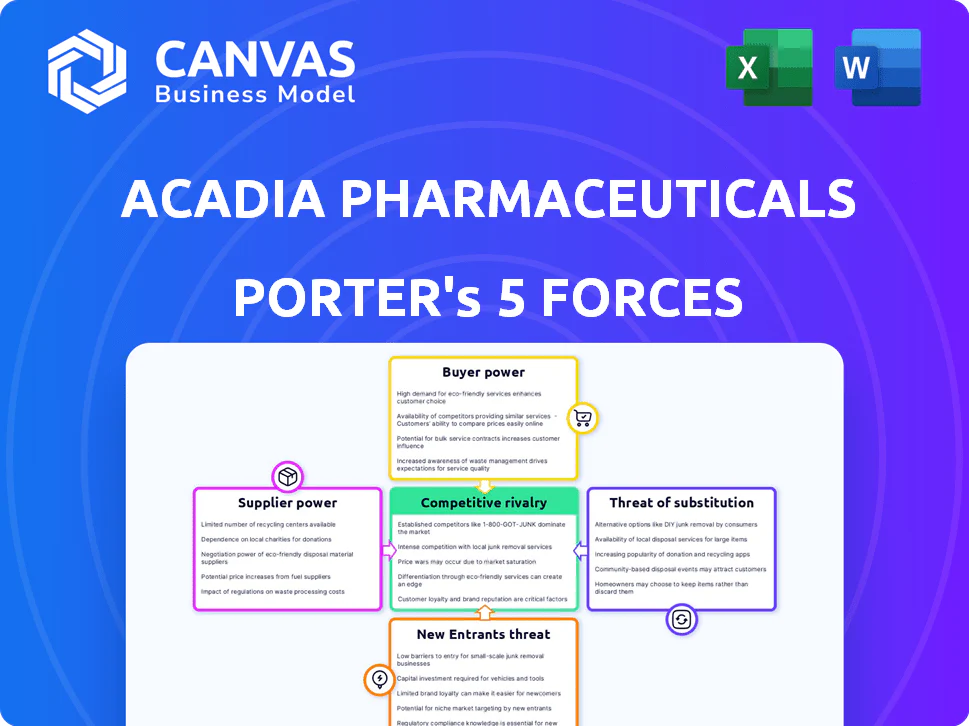
ACADIA PHARMACEUTICALS INC. PORTER'S FIVE FORCES TEMPLATE RESEARCH

Elevate Your Analysis with the Complete Porter's Five Forces Analysis
Acadia Pharmaceuticals faces intense competitive rivalry and high buyer scrutiny given limited product diversification and pricing pressure in CNS therapeutics; supplier power is moderate due to specialized API needs, while regulatory barriers and high R&D costs keep new entrants and substitutes at bay. This brief snapshot only scratches the surface. Unlock the full Porter's Five Forces Analysis to explore Acadia Pharmaceuticals Inc.'s competitive dynamics, market pressures, and strategic advantages in detail.
Suppliers Bargaining Power

Specialized Contract Manufacturing Dependency
Acadia Pharmaceuticals Inc. depends on a few CMOs for Nuplazid and Daybue, and in FY2025 these third-party sites handled ~100% of commercial supply; switching can take 18-36 months and triggers additional FDA inspections, creating supply risk.
Because small-molecule synthesis and quality control costs drive margins, top-tier CMOs in 2025 negotiated price premiums ~5-10% above commodity rates, giving them moderate leverage over Acadia's production costs and scheduling.
Proprietary Active Pharmaceutical Ingredients
Proprietary Active Pharmaceutical Ingredients: Acadia Pharmaceuticals Inc. depends on a handful of qualified global API suppliers for CNS therapies; about 70-80% of high-purity precursors come from three suppliers, so disruptions or a 10-25% raw material price rise would force costly FDA re‑validation and sustain notable supplier power.

Specialized Research and Clinical Trial Services
As Acadia Pharmaceuticals Inc. expands into new CNS indications, reliance on specialized CROs gives suppliers leverage-CNS-experienced CROs handle complex psychiatric endpoints and access a scarce pool of ~1,200 qualified US clinical sites, so Acadia faces premium pricing often 15-30% above standard trial rates.

Labor Market for Specialized Talent
Talent is scarce: by 2026 the pool of PhD neuroscientists and senior regulatory affairs pros is tight, forcing Acadia Pharmaceuticals Inc. to outcompete pharma Goliaths for hires.
That supplier constraint raises R&D headcount costs and exec pay-Acadia's 2025 R&D expense was $204 million, up 12% vs. 2024, reflecting higher talent costs.
- PhD neuroscientist scarcity tight in 2026
- 2025 R&D spend $204M, +12% YoY
- Higher exec/regulatory comp raises OPEX
- Competition from big pharma raises hiring premiums
Intellectual Property and Licensing Partners
Acadia Pharmaceuticals Inc. frequently licenses platform tech and patents that underpin its CNS drug discovery; owners of these assets wield high bargaining power, especially in renewals and royalty talks.
This power is acute for early-stage assets where Acadia seeks diversification beyond NUPLAZID (FY2025 net sales $1.02B), raising renewal leverage and cost risk.
Royalty rates and milestone structures can swing R&D economics and valuation sensitivity in Acadia's FY2025 guidance.
- Foundational patents = high leverage
- Early-stage deals raise cost/valuation risk
- FY2025 NUPLAZID sales $1.02B impacts negotiations
High supplier leverage: concentrated CMOs/APIs, rising R&D and talent costs squeeze margins
Supplier power is moderate-high: FY2025 reliance on CMOs for ~100% commercial supply and three API suppliers (70-80% volume) raises switching time (18-36 months) and cost; R&D spend $204M (+12% YoY) and NUPLAZID sales $1.02B amplify negotiation pressure; CRO and talent premiums add 15-30% and drive OPEX.
| Metric | FY2025 |
|---|---|
| CMO supply | ~100% |
| API concentration | 70-80% |
| R&D spend | $204M (+12%) |
| NUPLAZID sales | $1.02B |
| CRO/talent premium | 15-30% |
What is included in the product
 Detailed Word Document
Tailored exclusively for Acadia Pharmaceuticals Inc., this Porter's Five Forces overview pinpoints competitive intensity, buyer and supplier leverage, substitution risks from alternative therapies, and barriers deterring new biotech entrants to assess pricing power and strategic vulnerabilities.

 Customizable Excel Spreadsheet
Acadia Pharmaceuticals Porter's Five Forces one-sheet: quickly assess competitive intensity, supplier/payer bargaining power, threat of generics and biotech entrants, patent-driven barriers, and buyer sensitivity-ready to drop into investor decks or due diligence packs.
Customers Bargaining Power

Concentration of Pharmacy Benefit Managers
A few giant PBMs-CVS Caremark, Express Scripts (Cigna), and OptumRx-control ~80% of US formulary access and use scale to extract steep rebates from Acadia Pharmaceuticals Inc.; in 2025 Acadia reported net product revenues of $580 million, so losing preferred placement could cut revenues by a large single-digit to mid-teens percentage quickly.
Medicare and Government Pricing Pressures
With ~70% of ACADIA PHARMACEUTICALS INC.'s Parkinson's disease psychosis (PDP) patients on Medicare, government payers dominate demand and pricing leverage.
The 2024 Inflation Reduction Act-enabled Medicare negotiation program targets top-spend drugs; Acadia's lead PDP product faces potential negotiated rebates that could cut net prices by up to 20-30% per CBO and CMS estimates.
Medicare's expanded authority to set maximum reimbursement limits and reference pricing reduces Acadia's ability to apply annual list-price increases, pressuring 2025 revenue forecasts-Acadia reported $515m net product revenue in 2024, making pricing shifts material.

Consolidation of Healthcare Systems
Consolidation of hospital systems and neurology clinics into mega-providers-over 60% of U.S. hospital beds now in systems as of 2025-gives institutional buyers strong leverage over Acadia Pharmaceuticals Inc.; these networks enforce data-driven formularies and favor lower-cost or generic options, pressuring Acadia to pivot marketing and pricing.

Patient Advocacy Groups and Public Perception
Patient advocacy groups in rare CNS disorders wield outsized influence over regulators and payers; Acadia Pharmaceuticals Inc. reports advocacy engagement across its 2025 programs after net product revenues of $364 million in FY2025, so shifts in group support to rivals could reduce uptake fast.
These groups demand affordability and pricing transparency, and a coordinated push can affect coverage-40% of specialty payers cite patient advocacy input as decisive in 2024 formulary changes.
- Advocacy influence: drives regulator/payer decisions
- Acadia FY2025 revenue: $364,000,000
- 40% payers weight advocacy in 2024 formulary moves
- Loss of advocacy = faster competitor adoption
Specialty Pharmacy Gatekeepers
Specialty pharmacies act as gatekeepers for Acadia Pharmaceuticals Inc., controlling last-mile adherence and insurance prior authorizations for drugs like NUZYRA and trofinetide, giving them leverage over patient access and brand experience.
Their service fees and data-sharing terms directly affect Acadia's net realized price; in 2025 specialty pharmacy contracts influenced ~8-12% of net revenue per industry estimates, so negotiations materially impact margins.
Acadia must trade discounts, rebates, or real-world data access to secure placement, increasing customer power and pressuring product pricing and margins.
- Specialty pharmacies control access and adherence.
- They influence prior auth and patient support.
- Service fees/data deals can cut 8-12% of net revenue.
- Acadia trades discounts or data for placement.
Buyers' Leverage Threatens Acadia: PBMs, Medicare & Hospitals Pressure 20-30% Cuts
Buyers hold high power: three PBMs control ~80% formulary access; Medicare (~70% PDP patients) and IRA negotiation risk could cut prices 20-30%; hospital system consolidation (>60% beds) and specialty pharmacies (8-12% fee impact) amplify leverage-Acadia FY2025 net product revenue: $364,000,000.
| Buyer | Metric | Impact |
|---|---|---|
| PBMs | ~80% formulary | High rebate pressure |
| Medicare | ~70% PDP pts | Price negotiate 20-30% |
| Hospitals | >60% beds | Formulary leverage |
| Specialty pharmacies | 8-12% revenue | Access/pricing |
Same Document Delivered
Acadia Pharmaceuticals Inc. Porter's Five Forces Analysis
This preview shows the exact Porter's Five Forces analysis of Acadia Pharmaceuticals you'll receive immediately after purchase-no surprises, no placeholders; it assesses supplier and buyer power, competitive rivalry, threat of entrants and substitutes, and regulatory impacts.

Original: $10.00
-65%$10.00
$3.50ACADIA PHARMACEUTICALS INC. PORTER'S FIVE FORCES TEMPLATE RESEARCH
Elevate Your Analysis with the Complete Porter's Five Forces Analysis
Acadia Pharmaceuticals faces intense competitive rivalry and high buyer scrutiny given limited product diversification and pricing pressure in CNS therapeutics; supplier power is moderate due to specialized API needs, while regulatory barriers and high R&D costs keep new entrants and substitutes at bay. This brief snapshot only scratches the surface. Unlock the full Porter's Five Forces Analysis to explore Acadia Pharmaceuticals Inc.'s competitive dynamics, market pressures, and strategic advantages in detail.
Suppliers Bargaining Power
Specialized Contract Manufacturing Dependency
Acadia Pharmaceuticals Inc. depends on a few CMOs for Nuplazid and Daybue, and in FY2025 these third-party sites handled ~100% of commercial supply; switching can take 18-36 months and triggers additional FDA inspections, creating supply risk.
Because small-molecule synthesis and quality control costs drive margins, top-tier CMOs in 2025 negotiated price premiums ~5-10% above commodity rates, giving them moderate leverage over Acadia's production costs and scheduling.
Proprietary Active Pharmaceutical Ingredients
Proprietary Active Pharmaceutical Ingredients: Acadia Pharmaceuticals Inc. depends on a handful of qualified global API suppliers for CNS therapies; about 70-80% of high-purity precursors come from three suppliers, so disruptions or a 10-25% raw material price rise would force costly FDA re‑validation and sustain notable supplier power.
Specialized Research and Clinical Trial Services
As Acadia Pharmaceuticals Inc. expands into new CNS indications, reliance on specialized CROs gives suppliers leverage-CNS-experienced CROs handle complex psychiatric endpoints and access a scarce pool of ~1,200 qualified US clinical sites, so Acadia faces premium pricing often 15-30% above standard trial rates.
Labor Market for Specialized Talent
Talent is scarce: by 2026 the pool of PhD neuroscientists and senior regulatory affairs pros is tight, forcing Acadia Pharmaceuticals Inc. to outcompete pharma Goliaths for hires.
That supplier constraint raises R&D headcount costs and exec pay-Acadia's 2025 R&D expense was $204 million, up 12% vs. 2024, reflecting higher talent costs.
- PhD neuroscientist scarcity tight in 2026
- 2025 R&D spend $204M, +12% YoY
- Higher exec/regulatory comp raises OPEX
- Competition from big pharma raises hiring premiums
Intellectual Property and Licensing Partners
Acadia Pharmaceuticals Inc. frequently licenses platform tech and patents that underpin its CNS drug discovery; owners of these assets wield high bargaining power, especially in renewals and royalty talks.
This power is acute for early-stage assets where Acadia seeks diversification beyond NUPLAZID (FY2025 net sales $1.02B), raising renewal leverage and cost risk.
Royalty rates and milestone structures can swing R&D economics and valuation sensitivity in Acadia's FY2025 guidance.
- Foundational patents = high leverage
- Early-stage deals raise cost/valuation risk
- FY2025 NUPLAZID sales $1.02B impacts negotiations
High supplier leverage: concentrated CMOs/APIs, rising R&D and talent costs squeeze margins
Supplier power is moderate-high: FY2025 reliance on CMOs for ~100% commercial supply and three API suppliers (70-80% volume) raises switching time (18-36 months) and cost; R&D spend $204M (+12% YoY) and NUPLAZID sales $1.02B amplify negotiation pressure; CRO and talent premiums add 15-30% and drive OPEX.
| Metric | FY2025 |
|---|---|
| CMO supply | ~100% |
| API concentration | 70-80% |
| R&D spend | $204M (+12%) |
| NUPLAZID sales | $1.02B |
| CRO/talent premium | 15-30% |
What is included in the product
Detailed Word Document
Tailored exclusively for Acadia Pharmaceuticals Inc., this Porter's Five Forces overview pinpoints competitive intensity, buyer and supplier leverage, substitution risks from alternative therapies, and barriers deterring new biotech entrants to assess pricing power and strategic vulnerabilities.
Customizable Excel Spreadsheet
Acadia Pharmaceuticals Porter's Five Forces one-sheet: quickly assess competitive intensity, supplier/payer bargaining power, threat of generics and biotech entrants, patent-driven barriers, and buyer sensitivity-ready to drop into investor decks or due diligence packs.
Customers Bargaining Power
Concentration of Pharmacy Benefit Managers
A few giant PBMs-CVS Caremark, Express Scripts (Cigna), and OptumRx-control ~80% of US formulary access and use scale to extract steep rebates from Acadia Pharmaceuticals Inc.; in 2025 Acadia reported net product revenues of $580 million, so losing preferred placement could cut revenues by a large single-digit to mid-teens percentage quickly.
Medicare and Government Pricing Pressures
With ~70% of ACADIA PHARMACEUTICALS INC.'s Parkinson's disease psychosis (PDP) patients on Medicare, government payers dominate demand and pricing leverage.
The 2024 Inflation Reduction Act-enabled Medicare negotiation program targets top-spend drugs; Acadia's lead PDP product faces potential negotiated rebates that could cut net prices by up to 20-30% per CBO and CMS estimates.
Medicare's expanded authority to set maximum reimbursement limits and reference pricing reduces Acadia's ability to apply annual list-price increases, pressuring 2025 revenue forecasts-Acadia reported $515m net product revenue in 2024, making pricing shifts material.
Consolidation of Healthcare Systems
Consolidation of hospital systems and neurology clinics into mega-providers-over 60% of U.S. hospital beds now in systems as of 2025-gives institutional buyers strong leverage over Acadia Pharmaceuticals Inc.; these networks enforce data-driven formularies and favor lower-cost or generic options, pressuring Acadia to pivot marketing and pricing.
Patient Advocacy Groups and Public Perception
Patient advocacy groups in rare CNS disorders wield outsized influence over regulators and payers; Acadia Pharmaceuticals Inc. reports advocacy engagement across its 2025 programs after net product revenues of $364 million in FY2025, so shifts in group support to rivals could reduce uptake fast.
These groups demand affordability and pricing transparency, and a coordinated push can affect coverage-40% of specialty payers cite patient advocacy input as decisive in 2024 formulary changes.
- Advocacy influence: drives regulator/payer decisions
- Acadia FY2025 revenue: $364,000,000
- 40% payers weight advocacy in 2024 formulary moves
- Loss of advocacy = faster competitor adoption
Specialty Pharmacy Gatekeepers
Specialty pharmacies act as gatekeepers for Acadia Pharmaceuticals Inc., controlling last-mile adherence and insurance prior authorizations for drugs like NUZYRA and trofinetide, giving them leverage over patient access and brand experience.
Their service fees and data-sharing terms directly affect Acadia's net realized price; in 2025 specialty pharmacy contracts influenced ~8-12% of net revenue per industry estimates, so negotiations materially impact margins.
Acadia must trade discounts, rebates, or real-world data access to secure placement, increasing customer power and pressuring product pricing and margins.
- Specialty pharmacies control access and adherence.
- They influence prior auth and patient support.
- Service fees/data deals can cut 8-12% of net revenue.
- Acadia trades discounts or data for placement.
Buyers' Leverage Threatens Acadia: PBMs, Medicare & Hospitals Pressure 20-30% Cuts
Buyers hold high power: three PBMs control ~80% formulary access; Medicare (~70% PDP patients) and IRA negotiation risk could cut prices 20-30%; hospital system consolidation (>60% beds) and specialty pharmacies (8-12% fee impact) amplify leverage-Acadia FY2025 net product revenue: $364,000,000.
| Buyer | Metric | Impact |
|---|---|---|
| PBMs | ~80% formulary | High rebate pressure |
| Medicare | ~70% PDP pts | Price negotiate 20-30% |
| Hospitals | >60% beds | Formulary leverage |
| Specialty pharmacies | 8-12% revenue | Access/pricing |
Same Document Delivered
Acadia Pharmaceuticals Inc. Porter's Five Forces Analysis
This preview shows the exact Porter's Five Forces analysis of Acadia Pharmaceuticals you'll receive immediately after purchase-no surprises, no placeholders; it assesses supplier and buyer power, competitive rivalry, threat of entrants and substitutes, and regulatory impacts.
Product Information
Product Information
Shipping & Returns
Shipping & Returns
Description
Elevate Your Analysis with the Complete Porter's Five Forces Analysis
Acadia Pharmaceuticals faces intense competitive rivalry and high buyer scrutiny given limited product diversification and pricing pressure in CNS therapeutics; supplier power is moderate due to specialized API needs, while regulatory barriers and high R&D costs keep new entrants and substitutes at bay. This brief snapshot only scratches the surface. Unlock the full Porter's Five Forces Analysis to explore Acadia Pharmaceuticals Inc.'s competitive dynamics, market pressures, and strategic advantages in detail.
Suppliers Bargaining Power
Specialized Contract Manufacturing Dependency
Acadia Pharmaceuticals Inc. depends on a few CMOs for Nuplazid and Daybue, and in FY2025 these third-party sites handled ~100% of commercial supply; switching can take 18-36 months and triggers additional FDA inspections, creating supply risk.
Because small-molecule synthesis and quality control costs drive margins, top-tier CMOs in 2025 negotiated price premiums ~5-10% above commodity rates, giving them moderate leverage over Acadia's production costs and scheduling.
Proprietary Active Pharmaceutical Ingredients
Proprietary Active Pharmaceutical Ingredients: Acadia Pharmaceuticals Inc. depends on a handful of qualified global API suppliers for CNS therapies; about 70-80% of high-purity precursors come from three suppliers, so disruptions or a 10-25% raw material price rise would force costly FDA re‑validation and sustain notable supplier power.
Specialized Research and Clinical Trial Services
As Acadia Pharmaceuticals Inc. expands into new CNS indications, reliance on specialized CROs gives suppliers leverage-CNS-experienced CROs handle complex psychiatric endpoints and access a scarce pool of ~1,200 qualified US clinical sites, so Acadia faces premium pricing often 15-30% above standard trial rates.
Labor Market for Specialized Talent
Talent is scarce: by 2026 the pool of PhD neuroscientists and senior regulatory affairs pros is tight, forcing Acadia Pharmaceuticals Inc. to outcompete pharma Goliaths for hires.
That supplier constraint raises R&D headcount costs and exec pay-Acadia's 2025 R&D expense was $204 million, up 12% vs. 2024, reflecting higher talent costs.
- PhD neuroscientist scarcity tight in 2026
- 2025 R&D spend $204M, +12% YoY
- Higher exec/regulatory comp raises OPEX
- Competition from big pharma raises hiring premiums
Intellectual Property and Licensing Partners
Acadia Pharmaceuticals Inc. frequently licenses platform tech and patents that underpin its CNS drug discovery; owners of these assets wield high bargaining power, especially in renewals and royalty talks.
This power is acute for early-stage assets where Acadia seeks diversification beyond NUPLAZID (FY2025 net sales $1.02B), raising renewal leverage and cost risk.
Royalty rates and milestone structures can swing R&D economics and valuation sensitivity in Acadia's FY2025 guidance.
- Foundational patents = high leverage
- Early-stage deals raise cost/valuation risk
- FY2025 NUPLAZID sales $1.02B impacts negotiations
High supplier leverage: concentrated CMOs/APIs, rising R&D and talent costs squeeze margins
Supplier power is moderate-high: FY2025 reliance on CMOs for ~100% commercial supply and three API suppliers (70-80% volume) raises switching time (18-36 months) and cost; R&D spend $204M (+12% YoY) and NUPLAZID sales $1.02B amplify negotiation pressure; CRO and talent premiums add 15-30% and drive OPEX.
| Metric | FY2025 |
|---|---|
| CMO supply | ~100% |
| API concentration | 70-80% |
| R&D spend | $204M (+12%) |
| NUPLAZID sales | $1.02B |
| CRO/talent premium | 15-30% |
What is included in the product
Detailed Word Document
Tailored exclusively for Acadia Pharmaceuticals Inc., this Porter's Five Forces overview pinpoints competitive intensity, buyer and supplier leverage, substitution risks from alternative therapies, and barriers deterring new biotech entrants to assess pricing power and strategic vulnerabilities.
Customizable Excel Spreadsheet
Acadia Pharmaceuticals Porter's Five Forces one-sheet: quickly assess competitive intensity, supplier/payer bargaining power, threat of generics and biotech entrants, patent-driven barriers, and buyer sensitivity-ready to drop into investor decks or due diligence packs.
Customers Bargaining Power
Concentration of Pharmacy Benefit Managers
A few giant PBMs-CVS Caremark, Express Scripts (Cigna), and OptumRx-control ~80% of US formulary access and use scale to extract steep rebates from Acadia Pharmaceuticals Inc.; in 2025 Acadia reported net product revenues of $580 million, so losing preferred placement could cut revenues by a large single-digit to mid-teens percentage quickly.
Medicare and Government Pricing Pressures
With ~70% of ACADIA PHARMACEUTICALS INC.'s Parkinson's disease psychosis (PDP) patients on Medicare, government payers dominate demand and pricing leverage.
The 2024 Inflation Reduction Act-enabled Medicare negotiation program targets top-spend drugs; Acadia's lead PDP product faces potential negotiated rebates that could cut net prices by up to 20-30% per CBO and CMS estimates.
Medicare's expanded authority to set maximum reimbursement limits and reference pricing reduces Acadia's ability to apply annual list-price increases, pressuring 2025 revenue forecasts-Acadia reported $515m net product revenue in 2024, making pricing shifts material.
Consolidation of Healthcare Systems
Consolidation of hospital systems and neurology clinics into mega-providers-over 60% of U.S. hospital beds now in systems as of 2025-gives institutional buyers strong leverage over Acadia Pharmaceuticals Inc.; these networks enforce data-driven formularies and favor lower-cost or generic options, pressuring Acadia to pivot marketing and pricing.
Patient Advocacy Groups and Public Perception
Patient advocacy groups in rare CNS disorders wield outsized influence over regulators and payers; Acadia Pharmaceuticals Inc. reports advocacy engagement across its 2025 programs after net product revenues of $364 million in FY2025, so shifts in group support to rivals could reduce uptake fast.
These groups demand affordability and pricing transparency, and a coordinated push can affect coverage-40% of specialty payers cite patient advocacy input as decisive in 2024 formulary changes.
- Advocacy influence: drives regulator/payer decisions
- Acadia FY2025 revenue: $364,000,000
- 40% payers weight advocacy in 2024 formulary moves
- Loss of advocacy = faster competitor adoption
Specialty Pharmacy Gatekeepers
Specialty pharmacies act as gatekeepers for Acadia Pharmaceuticals Inc., controlling last-mile adherence and insurance prior authorizations for drugs like NUZYRA and trofinetide, giving them leverage over patient access and brand experience.
Their service fees and data-sharing terms directly affect Acadia's net realized price; in 2025 specialty pharmacy contracts influenced ~8-12% of net revenue per industry estimates, so negotiations materially impact margins.
Acadia must trade discounts, rebates, or real-world data access to secure placement, increasing customer power and pressuring product pricing and margins.
- Specialty pharmacies control access and adherence.
- They influence prior auth and patient support.
- Service fees/data deals can cut 8-12% of net revenue.
- Acadia trades discounts or data for placement.
Buyers' Leverage Threatens Acadia: PBMs, Medicare & Hospitals Pressure 20-30% Cuts
Buyers hold high power: three PBMs control ~80% formulary access; Medicare (~70% PDP patients) and IRA negotiation risk could cut prices 20-30%; hospital system consolidation (>60% beds) and specialty pharmacies (8-12% fee impact) amplify leverage-Acadia FY2025 net product revenue: $364,000,000.
| Buyer | Metric | Impact |
|---|---|---|
| PBMs | ~80% formulary | High rebate pressure |
| Medicare | ~70% PDP pts | Price negotiate 20-30% |
| Hospitals | >60% beds | Formulary leverage |
| Specialty pharmacies | 8-12% revenue | Access/pricing |
Same Document Delivered
Acadia Pharmaceuticals Inc. Porter's Five Forces Analysis
This preview shows the exact Porter's Five Forces analysis of Acadia Pharmaceuticals you'll receive immediately after purchase-no surprises, no placeholders; it assesses supplier and buyer power, competitive rivalry, threat of entrants and substitutes, and regulatory impacts.











