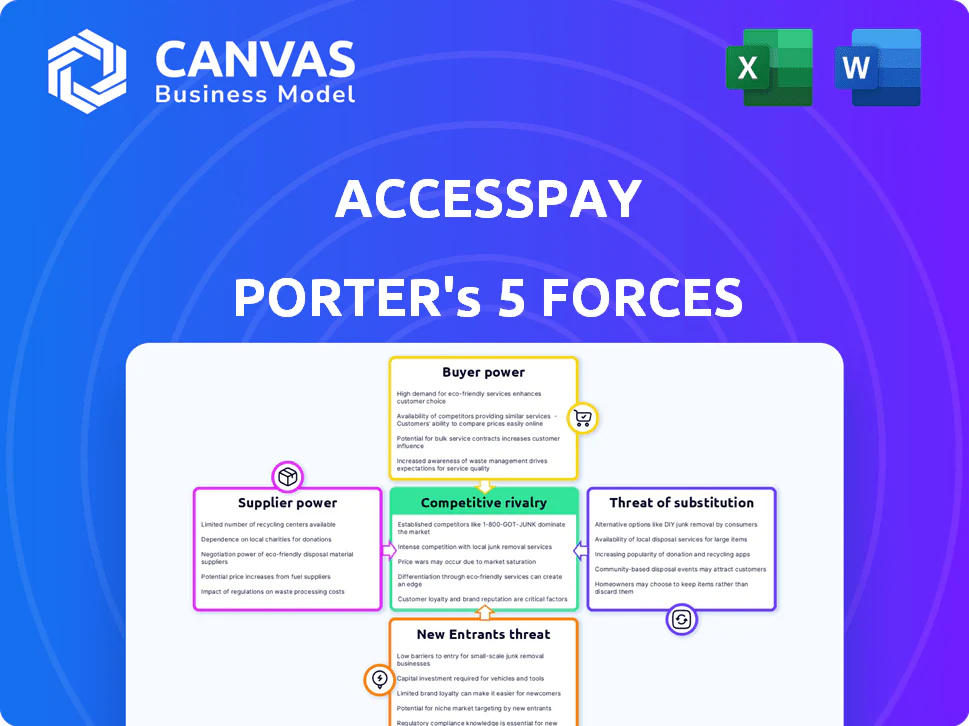
ACCESSPAY PORTER'S FIVE FORCES TEMPLATE RESEARCH
What is included in the product
 Detailed Word Document
Tailored exclusively for AccessPay, analyzing its position within its competitive landscape.

 Customizable Excel Spreadsheet
Instantly visualize competitive forces with interactive charts to inform strategic decisions.
Same Document Delivered
AccessPay Porter's Five Forces Analysis
This preview presents the complete Porter's Five Forces analysis of AccessPay. The document displayed here is the same comprehensive analysis you’ll receive instantly after purchase. It details all five forces impacting AccessPay's market position, providing a clear understanding. This is a fully formatted, ready-to-use analysis; there are no additional steps. You will get instant access after buying.

Porter's Five Forces Analysis Template

Don't Miss the Bigger Picture
AccessPay operates within a dynamic FinTech landscape, facing pressures from established players and emerging competitors. Buyer power is moderate, influenced by platform choices and the value of payment solutions. Supplier influence, particularly from banking partners, is a key consideration. The threat of new entrants is significant due to the low barriers to entry in this space. Substitute products, like traditional banking services, represent a constant challenge.
Ready to move beyond the basics? Get a full strategic breakdown of AccessPay’s market position, competitive intensity, and external threats—all in one powerful analysis.
Suppliers Bargaining Power

Reliance on Banking Infrastructure
AccessPay's operations heavily depend on banking infrastructure, including Bacs, Faster Payments, SWIFT, and SEPA. This dependence on banks for essential services grants them considerable bargaining power. In 2024, banks processed approximately £7.5 trillion in Bacs payments, underscoring their critical role. This reliance impacts AccessPay's operational costs and service capabilities.
Importance of Bank Relationships
AccessPay's success hinges on its bank relationships. Connecting to many banks is a core offering. This network is a key selling point, giving AccessPay an advantage. While banks have power, AccessPay's aggregation gives it leverage. In 2024, AccessPay's ability to connect to around 200 banks was a critical competitive factor.

Technology and Data Providers
AccessPay's reliance on technology and data providers, including cloud services and fraud prevention tools, creates a supplier power dynamic. The availability and uniqueness of these technologies, like advanced AI for payment processing, impact vendor power. In 2024, the global cloud computing market is projected to reach $678.8 billion, offering AccessPay choices but also potentially increasing costs. The bargaining power hinges on the specific technology and the vendor landscape.

Talent Pool
AccessPay, like other FinTech firms, faces supplier power from its talent pool. Skilled professionals in software, cybersecurity, and finance are crucial for success. This high demand allows employees to negotiate better compensation packages.
- In 2024, the average salary for software developers in the UK reached £55,000, reflecting the high demand.
- Cybersecurity specialists' salaries saw an average increase of 8% in 2024 due to rising threats.
- FinTech firms often offer perks like flexible work and stock options to attract talent.
Regulatory Bodies
Regulatory bodies, though not suppliers in the traditional sense, wield considerable influence over AccessPay. Compliance with regulations, such as Bacs approval and ISO 20022 standards, is non-negotiable. These requirements dictate operational standards and can necessitate substantial investments for adaptation. Changes in regulatory landscapes can therefore significantly impact AccessPay's costs and strategies.
- Bacs, the UK's main payment clearing system, processed 6.7 billion transactions in 2023.
- ISO 20022 is becoming increasingly prevalent, with adoption rates growing annually.
- Regulatory compliance costs can represent a significant portion of operational expenditure, varying based on the specific industry and jurisdiction.
Supplier Power Dynamics: A Look at Key Influences
AccessPay faces supplier power from various sources, including banks, tech providers, and talent. Banks, essential for payment processing, hold significant power, with Bacs processing trillions in transactions. Technology vendors also influence costs, with the cloud market reaching $678.8 billion in 2024.
The talent pool, especially in software and cybersecurity, can negotiate favorable terms due to high demand. Regulatory bodies like Bacs and ISO 20022 also wield influence, dictating operational standards and potentially increasing costs. These dynamics impact AccessPay's operations and financial strategies.
| Supplier Type | Bargaining Power | 2024 Data/Impact |
|---|---|---|
| Banks | High | Bacs processed £7.5T |
| Tech Providers | Moderate | Cloud market at $678.8B |
| Talent | Moderate | Avg. dev salary: £55K |
Customers Bargaining Power

Enterprise Customer Base
AccessPay's enterprise customer base, including corporations and financial institutions, wields considerable bargaining power. These clients, managing significant transaction volumes, can negotiate favorable terms. For example, in 2024, large corporate clients often demand discounts of 5-10% on payment processing fees.
Availability of Alternatives
Customers of AccessPay have several choices for payment solutions, such as traditional banks and other FinTech firms. This variety strengthens their ability to negotiate terms or even shift providers. In 2024, the FinTech market saw over $100 billion in investments globally, indicating ample alternatives. The availability of these options lets customers compare services and pricing, giving them an edge.

Integration Complexity
Integrating AccessPay's platform into a company's systems can be complex. This complexity may increase switching costs. This potentially reduces customer bargaining power. In 2024, a survey showed that 60% of businesses found such integrations challenging.

Need for Efficiency and Cost Reduction
Businesses are actively seeking ways to boost efficiency and cut costs in their financial processes. AccessPay's value lies in its ability to deliver these benefits, but this also increases customer scrutiny. Customers will expect clear proof of cost savings and operational enhancements to justify their investment. This demand for demonstrable value influences the bargaining power dynamics.
- The global fintech market was valued at $112.5 billion in 2023.
- Companies aim to reduce operational costs by 15-20% through automation.
- Customer churn rates in SaaS can rise if value isn't consistently proven.
- AccessPay offers automated payment solutions to reduce manual errors by 25%.
Demand for Specific Features
Customers' demand for specific features, such as robust fraud prevention and seamless compliance management, significantly impacts AccessPay. In 2024, the rising frequency of cyberattacks and financial regulations, like GDPR in Europe and CCPA in California, increased the need for these features. AccessPay's success hinges on its ability to meet these demands, influencing customer satisfaction and negotiation power.
- Fraud prevention is a top priority, with losses from payment fraud estimated to reach $40 billion globally in 2024.
- Compliance management is critical; businesses face substantial penalties for non-compliance with payment regulations.
- Support for various payment types, including ACH, SWIFT, and cards, is essential for global operations.
- Customer satisfaction scores are directly linked to the availability and effectiveness of these features.
FinTech's Bargaining Power: Over $100B in Play!
AccessPay's customers, including large corporations, have significant bargaining power due to their transaction volumes and available alternatives. In 2024, the FinTech market saw over $100 billion in investments, offering numerous choices. This allows customers to negotiate favorable terms and demand demonstrable value, such as cost savings.
| Factor | Impact | 2024 Data |
|---|---|---|
| Market Competition | High | FinTech investment: $100B+ |
| Switching Costs | Moderate | 60% find integrations challenging |
| Value Demand | High | Reduce operational costs by 15-20% |
Rivalry Among Competitors

Presence of Multiple Competitors
The payment automation market is bustling. AccessPay faces rivals like Bottomline and FIS, plus banks expanding their services. In 2024, the FinTech sector saw over $100 billion in investment globally. This intense rivalry pressures pricing and innovation.
Differentiation through Specialization
Differentiation through specialization is a key competitive strategy. For example, some firms focus on specific sectors, intensifying rivalry. This strategy is evident in the FinTech sector, where niche players compete fiercely. The global FinTech market was valued at $112.5 billion in 2023.

Focus on Innovation and Features
Competitive rivalry in AccessPay's market is intense. Companies vie on platform features like automation, fraud tools, and payment types. This drives constant innovation; for instance, the FinTech sector saw $51.7B in funding in H1 2024, reflecting this competition. Firms invest heavily in R&D to stay ahead.

Pricing Strategies
Competitive rivalry can also involve pricing strategies. AccessPay's fixed yearly fee model contrasts with competitors who might offer tiered or usage-based pricing. This pricing diversity directly affects customer decisions and market share dynamics. For instance, in 2024, the fintech sector saw a 15% shift in customer preference towards cost-effective solutions.
- AccessPay's pricing: Fixed yearly fee.
- Competitor pricing: Tiered or usage-based.
- Market impact: Influences customer choice.
- 2024 data: 15% shift towards cost-effective solutions.
Geographic Expansion
AccessPay and its rivals are broadening their geographic footprints, especially in the US. This expansion intensifies competition in these areas. Consider the US fintech market, which is projected to reach $463 billion by 2025. This growth attracts more players, heightening rivalry.
- Geographic expansion increases competition.
- US fintech market is a key battleground.
- Increased market size attracts more rivals.
Payment Automation: A Competitive Landscape
Competitive rivalry in payment automation is fierce, impacting AccessPay. Competitors use varied pricing models, influencing customer choices and market share. The US fintech market, projected to $463B by 2025, intensifies competition. Geographic expansion further fuels this rivalry.
| Aspect | Details | Impact |
|---|---|---|
| Pricing Strategies | Fixed yearly fees vs. tiered/usage-based | Influences customer decisions |
| Market Growth | US fintech market to $463B by 2025 | Attracts more rivals |
| Geographic Expansion | Focus on US market | Heightens competition |
Original: $10.00
-65%$10.00
$3.50ACCESSPAY PORTER'S FIVE FORCES TEMPLATE RESEARCH
What is included in the product
Detailed Word Document
Tailored exclusively for AccessPay, analyzing its position within its competitive landscape.
Customizable Excel Spreadsheet
Instantly visualize competitive forces with interactive charts to inform strategic decisions.
Same Document Delivered
AccessPay Porter's Five Forces Analysis
This preview presents the complete Porter's Five Forces analysis of AccessPay. The document displayed here is the same comprehensive analysis you’ll receive instantly after purchase. It details all five forces impacting AccessPay's market position, providing a clear understanding. This is a fully formatted, ready-to-use analysis; there are no additional steps. You will get instant access after buying.
Porter's Five Forces Analysis Template
Don't Miss the Bigger Picture
AccessPay operates within a dynamic FinTech landscape, facing pressures from established players and emerging competitors. Buyer power is moderate, influenced by platform choices and the value of payment solutions. Supplier influence, particularly from banking partners, is a key consideration. The threat of new entrants is significant due to the low barriers to entry in this space. Substitute products, like traditional banking services, represent a constant challenge.
Ready to move beyond the basics? Get a full strategic breakdown of AccessPay’s market position, competitive intensity, and external threats—all in one powerful analysis.
Suppliers Bargaining Power
Reliance on Banking Infrastructure
AccessPay's operations heavily depend on banking infrastructure, including Bacs, Faster Payments, SWIFT, and SEPA. This dependence on banks for essential services grants them considerable bargaining power. In 2024, banks processed approximately £7.5 trillion in Bacs payments, underscoring their critical role. This reliance impacts AccessPay's operational costs and service capabilities.
Importance of Bank Relationships
AccessPay's success hinges on its bank relationships. Connecting to many banks is a core offering. This network is a key selling point, giving AccessPay an advantage. While banks have power, AccessPay's aggregation gives it leverage. In 2024, AccessPay's ability to connect to around 200 banks was a critical competitive factor.
Technology and Data Providers
AccessPay's reliance on technology and data providers, including cloud services and fraud prevention tools, creates a supplier power dynamic. The availability and uniqueness of these technologies, like advanced AI for payment processing, impact vendor power. In 2024, the global cloud computing market is projected to reach $678.8 billion, offering AccessPay choices but also potentially increasing costs. The bargaining power hinges on the specific technology and the vendor landscape.
Talent Pool
AccessPay, like other FinTech firms, faces supplier power from its talent pool. Skilled professionals in software, cybersecurity, and finance are crucial for success. This high demand allows employees to negotiate better compensation packages.
- In 2024, the average salary for software developers in the UK reached £55,000, reflecting the high demand.
- Cybersecurity specialists' salaries saw an average increase of 8% in 2024 due to rising threats.
- FinTech firms often offer perks like flexible work and stock options to attract talent.
Regulatory Bodies
Regulatory bodies, though not suppliers in the traditional sense, wield considerable influence over AccessPay. Compliance with regulations, such as Bacs approval and ISO 20022 standards, is non-negotiable. These requirements dictate operational standards and can necessitate substantial investments for adaptation. Changes in regulatory landscapes can therefore significantly impact AccessPay's costs and strategies.
- Bacs, the UK's main payment clearing system, processed 6.7 billion transactions in 2023.
- ISO 20022 is becoming increasingly prevalent, with adoption rates growing annually.
- Regulatory compliance costs can represent a significant portion of operational expenditure, varying based on the specific industry and jurisdiction.
Supplier Power Dynamics: A Look at Key Influences
AccessPay faces supplier power from various sources, including banks, tech providers, and talent. Banks, essential for payment processing, hold significant power, with Bacs processing trillions in transactions. Technology vendors also influence costs, with the cloud market reaching $678.8 billion in 2024.
The talent pool, especially in software and cybersecurity, can negotiate favorable terms due to high demand. Regulatory bodies like Bacs and ISO 20022 also wield influence, dictating operational standards and potentially increasing costs. These dynamics impact AccessPay's operations and financial strategies.
| Supplier Type | Bargaining Power | 2024 Data/Impact |
|---|---|---|
| Banks | High | Bacs processed £7.5T |
| Tech Providers | Moderate | Cloud market at $678.8B |
| Talent | Moderate | Avg. dev salary: £55K |
Customers Bargaining Power
Enterprise Customer Base
AccessPay's enterprise customer base, including corporations and financial institutions, wields considerable bargaining power. These clients, managing significant transaction volumes, can negotiate favorable terms. For example, in 2024, large corporate clients often demand discounts of 5-10% on payment processing fees.
Availability of Alternatives
Customers of AccessPay have several choices for payment solutions, such as traditional banks and other FinTech firms. This variety strengthens their ability to negotiate terms or even shift providers. In 2024, the FinTech market saw over $100 billion in investments globally, indicating ample alternatives. The availability of these options lets customers compare services and pricing, giving them an edge.
Integration Complexity
Integrating AccessPay's platform into a company's systems can be complex. This complexity may increase switching costs. This potentially reduces customer bargaining power. In 2024, a survey showed that 60% of businesses found such integrations challenging.
Need for Efficiency and Cost Reduction
Businesses are actively seeking ways to boost efficiency and cut costs in their financial processes. AccessPay's value lies in its ability to deliver these benefits, but this also increases customer scrutiny. Customers will expect clear proof of cost savings and operational enhancements to justify their investment. This demand for demonstrable value influences the bargaining power dynamics.
- The global fintech market was valued at $112.5 billion in 2023.
- Companies aim to reduce operational costs by 15-20% through automation.
- Customer churn rates in SaaS can rise if value isn't consistently proven.
- AccessPay offers automated payment solutions to reduce manual errors by 25%.
Demand for Specific Features
Customers' demand for specific features, such as robust fraud prevention and seamless compliance management, significantly impacts AccessPay. In 2024, the rising frequency of cyberattacks and financial regulations, like GDPR in Europe and CCPA in California, increased the need for these features. AccessPay's success hinges on its ability to meet these demands, influencing customer satisfaction and negotiation power.
- Fraud prevention is a top priority, with losses from payment fraud estimated to reach $40 billion globally in 2024.
- Compliance management is critical; businesses face substantial penalties for non-compliance with payment regulations.
- Support for various payment types, including ACH, SWIFT, and cards, is essential for global operations.
- Customer satisfaction scores are directly linked to the availability and effectiveness of these features.
FinTech's Bargaining Power: Over $100B in Play!
AccessPay's customers, including large corporations, have significant bargaining power due to their transaction volumes and available alternatives. In 2024, the FinTech market saw over $100 billion in investments, offering numerous choices. This allows customers to negotiate favorable terms and demand demonstrable value, such as cost savings.
| Factor | Impact | 2024 Data |
|---|---|---|
| Market Competition | High | FinTech investment: $100B+ |
| Switching Costs | Moderate | 60% find integrations challenging |
| Value Demand | High | Reduce operational costs by 15-20% |
Rivalry Among Competitors
Presence of Multiple Competitors
The payment automation market is bustling. AccessPay faces rivals like Bottomline and FIS, plus banks expanding their services. In 2024, the FinTech sector saw over $100 billion in investment globally. This intense rivalry pressures pricing and innovation.
Differentiation through Specialization
Differentiation through specialization is a key competitive strategy. For example, some firms focus on specific sectors, intensifying rivalry. This strategy is evident in the FinTech sector, where niche players compete fiercely. The global FinTech market was valued at $112.5 billion in 2023.
Focus on Innovation and Features
Competitive rivalry in AccessPay's market is intense. Companies vie on platform features like automation, fraud tools, and payment types. This drives constant innovation; for instance, the FinTech sector saw $51.7B in funding in H1 2024, reflecting this competition. Firms invest heavily in R&D to stay ahead.
Pricing Strategies
Competitive rivalry can also involve pricing strategies. AccessPay's fixed yearly fee model contrasts with competitors who might offer tiered or usage-based pricing. This pricing diversity directly affects customer decisions and market share dynamics. For instance, in 2024, the fintech sector saw a 15% shift in customer preference towards cost-effective solutions.
- AccessPay's pricing: Fixed yearly fee.
- Competitor pricing: Tiered or usage-based.
- Market impact: Influences customer choice.
- 2024 data: 15% shift towards cost-effective solutions.
Geographic Expansion
AccessPay and its rivals are broadening their geographic footprints, especially in the US. This expansion intensifies competition in these areas. Consider the US fintech market, which is projected to reach $463 billion by 2025. This growth attracts more players, heightening rivalry.
- Geographic expansion increases competition.
- US fintech market is a key battleground.
- Increased market size attracts more rivals.
Payment Automation: A Competitive Landscape
Competitive rivalry in payment automation is fierce, impacting AccessPay. Competitors use varied pricing models, influencing customer choices and market share. The US fintech market, projected to $463B by 2025, intensifies competition. Geographic expansion further fuels this rivalry.
| Aspect | Details | Impact |
|---|---|---|
| Pricing Strategies | Fixed yearly fees vs. tiered/usage-based | Influences customer decisions |
| Market Growth | US fintech market to $463B by 2025 | Attracts more rivals |
| Geographic Expansion | Focus on US market | Heightens competition |
Product Information
Product Information
Shipping & Returns
Shipping & Returns
Description
What is included in the product
Detailed Word Document
Tailored exclusively for AccessPay, analyzing its position within its competitive landscape.
Customizable Excel Spreadsheet
Instantly visualize competitive forces with interactive charts to inform strategic decisions.
Same Document Delivered
AccessPay Porter's Five Forces Analysis
This preview presents the complete Porter's Five Forces analysis of AccessPay. The document displayed here is the same comprehensive analysis you’ll receive instantly after purchase. It details all five forces impacting AccessPay's market position, providing a clear understanding. This is a fully formatted, ready-to-use analysis; there are no additional steps. You will get instant access after buying.
Porter's Five Forces Analysis Template
Don't Miss the Bigger Picture
AccessPay operates within a dynamic FinTech landscape, facing pressures from established players and emerging competitors. Buyer power is moderate, influenced by platform choices and the value of payment solutions. Supplier influence, particularly from banking partners, is a key consideration. The threat of new entrants is significant due to the low barriers to entry in this space. Substitute products, like traditional banking services, represent a constant challenge.
Ready to move beyond the basics? Get a full strategic breakdown of AccessPay’s market position, competitive intensity, and external threats—all in one powerful analysis.
Suppliers Bargaining Power
Reliance on Banking Infrastructure
AccessPay's operations heavily depend on banking infrastructure, including Bacs, Faster Payments, SWIFT, and SEPA. This dependence on banks for essential services grants them considerable bargaining power. In 2024, banks processed approximately £7.5 trillion in Bacs payments, underscoring their critical role. This reliance impacts AccessPay's operational costs and service capabilities.
Importance of Bank Relationships
AccessPay's success hinges on its bank relationships. Connecting to many banks is a core offering. This network is a key selling point, giving AccessPay an advantage. While banks have power, AccessPay's aggregation gives it leverage. In 2024, AccessPay's ability to connect to around 200 banks was a critical competitive factor.
Technology and Data Providers
AccessPay's reliance on technology and data providers, including cloud services and fraud prevention tools, creates a supplier power dynamic. The availability and uniqueness of these technologies, like advanced AI for payment processing, impact vendor power. In 2024, the global cloud computing market is projected to reach $678.8 billion, offering AccessPay choices but also potentially increasing costs. The bargaining power hinges on the specific technology and the vendor landscape.
Talent Pool
AccessPay, like other FinTech firms, faces supplier power from its talent pool. Skilled professionals in software, cybersecurity, and finance are crucial for success. This high demand allows employees to negotiate better compensation packages.
- In 2024, the average salary for software developers in the UK reached £55,000, reflecting the high demand.
- Cybersecurity specialists' salaries saw an average increase of 8% in 2024 due to rising threats.
- FinTech firms often offer perks like flexible work and stock options to attract talent.
Regulatory Bodies
Regulatory bodies, though not suppliers in the traditional sense, wield considerable influence over AccessPay. Compliance with regulations, such as Bacs approval and ISO 20022 standards, is non-negotiable. These requirements dictate operational standards and can necessitate substantial investments for adaptation. Changes in regulatory landscapes can therefore significantly impact AccessPay's costs and strategies.
- Bacs, the UK's main payment clearing system, processed 6.7 billion transactions in 2023.
- ISO 20022 is becoming increasingly prevalent, with adoption rates growing annually.
- Regulatory compliance costs can represent a significant portion of operational expenditure, varying based on the specific industry and jurisdiction.
Supplier Power Dynamics: A Look at Key Influences
AccessPay faces supplier power from various sources, including banks, tech providers, and talent. Banks, essential for payment processing, hold significant power, with Bacs processing trillions in transactions. Technology vendors also influence costs, with the cloud market reaching $678.8 billion in 2024.
The talent pool, especially in software and cybersecurity, can negotiate favorable terms due to high demand. Regulatory bodies like Bacs and ISO 20022 also wield influence, dictating operational standards and potentially increasing costs. These dynamics impact AccessPay's operations and financial strategies.
| Supplier Type | Bargaining Power | 2024 Data/Impact |
|---|---|---|
| Banks | High | Bacs processed £7.5T |
| Tech Providers | Moderate | Cloud market at $678.8B |
| Talent | Moderate | Avg. dev salary: £55K |
Customers Bargaining Power
Enterprise Customer Base
AccessPay's enterprise customer base, including corporations and financial institutions, wields considerable bargaining power. These clients, managing significant transaction volumes, can negotiate favorable terms. For example, in 2024, large corporate clients often demand discounts of 5-10% on payment processing fees.
Availability of Alternatives
Customers of AccessPay have several choices for payment solutions, such as traditional banks and other FinTech firms. This variety strengthens their ability to negotiate terms or even shift providers. In 2024, the FinTech market saw over $100 billion in investments globally, indicating ample alternatives. The availability of these options lets customers compare services and pricing, giving them an edge.
Integration Complexity
Integrating AccessPay's platform into a company's systems can be complex. This complexity may increase switching costs. This potentially reduces customer bargaining power. In 2024, a survey showed that 60% of businesses found such integrations challenging.
Need for Efficiency and Cost Reduction
Businesses are actively seeking ways to boost efficiency and cut costs in their financial processes. AccessPay's value lies in its ability to deliver these benefits, but this also increases customer scrutiny. Customers will expect clear proof of cost savings and operational enhancements to justify their investment. This demand for demonstrable value influences the bargaining power dynamics.
- The global fintech market was valued at $112.5 billion in 2023.
- Companies aim to reduce operational costs by 15-20% through automation.
- Customer churn rates in SaaS can rise if value isn't consistently proven.
- AccessPay offers automated payment solutions to reduce manual errors by 25%.
Demand for Specific Features
Customers' demand for specific features, such as robust fraud prevention and seamless compliance management, significantly impacts AccessPay. In 2024, the rising frequency of cyberattacks and financial regulations, like GDPR in Europe and CCPA in California, increased the need for these features. AccessPay's success hinges on its ability to meet these demands, influencing customer satisfaction and negotiation power.
- Fraud prevention is a top priority, with losses from payment fraud estimated to reach $40 billion globally in 2024.
- Compliance management is critical; businesses face substantial penalties for non-compliance with payment regulations.
- Support for various payment types, including ACH, SWIFT, and cards, is essential for global operations.
- Customer satisfaction scores are directly linked to the availability and effectiveness of these features.
FinTech's Bargaining Power: Over $100B in Play!
AccessPay's customers, including large corporations, have significant bargaining power due to their transaction volumes and available alternatives. In 2024, the FinTech market saw over $100 billion in investments, offering numerous choices. This allows customers to negotiate favorable terms and demand demonstrable value, such as cost savings.
| Factor | Impact | 2024 Data |
|---|---|---|
| Market Competition | High | FinTech investment: $100B+ |
| Switching Costs | Moderate | 60% find integrations challenging |
| Value Demand | High | Reduce operational costs by 15-20% |
Rivalry Among Competitors
Presence of Multiple Competitors
The payment automation market is bustling. AccessPay faces rivals like Bottomline and FIS, plus banks expanding their services. In 2024, the FinTech sector saw over $100 billion in investment globally. This intense rivalry pressures pricing and innovation.
Differentiation through Specialization
Differentiation through specialization is a key competitive strategy. For example, some firms focus on specific sectors, intensifying rivalry. This strategy is evident in the FinTech sector, where niche players compete fiercely. The global FinTech market was valued at $112.5 billion in 2023.
Focus on Innovation and Features
Competitive rivalry in AccessPay's market is intense. Companies vie on platform features like automation, fraud tools, and payment types. This drives constant innovation; for instance, the FinTech sector saw $51.7B in funding in H1 2024, reflecting this competition. Firms invest heavily in R&D to stay ahead.
Pricing Strategies
Competitive rivalry can also involve pricing strategies. AccessPay's fixed yearly fee model contrasts with competitors who might offer tiered or usage-based pricing. This pricing diversity directly affects customer decisions and market share dynamics. For instance, in 2024, the fintech sector saw a 15% shift in customer preference towards cost-effective solutions.
- AccessPay's pricing: Fixed yearly fee.
- Competitor pricing: Tiered or usage-based.
- Market impact: Influences customer choice.
- 2024 data: 15% shift towards cost-effective solutions.
Geographic Expansion
AccessPay and its rivals are broadening their geographic footprints, especially in the US. This expansion intensifies competition in these areas. Consider the US fintech market, which is projected to reach $463 billion by 2025. This growth attracts more players, heightening rivalry.
- Geographic expansion increases competition.
- US fintech market is a key battleground.
- Increased market size attracts more rivals.
Payment Automation: A Competitive Landscape
Competitive rivalry in payment automation is fierce, impacting AccessPay. Competitors use varied pricing models, influencing customer choices and market share. The US fintech market, projected to $463B by 2025, intensifies competition. Geographic expansion further fuels this rivalry.
| Aspect | Details | Impact |
|---|---|---|
| Pricing Strategies | Fixed yearly fees vs. tiered/usage-based | Influences customer decisions |
| Market Growth | US fintech market to $463B by 2025 | Attracts more rivals |
| Geographic Expansion | Focus on US market | Heightens competition |











