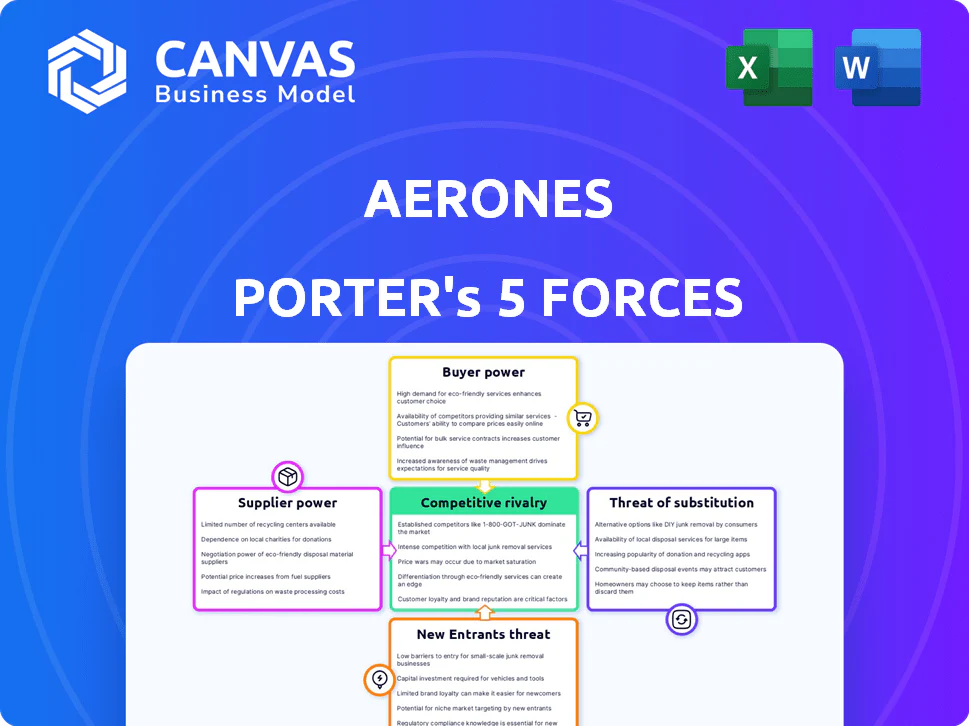
AERONES PORTER'S FIVE FORCES TEMPLATE RESEARCH
What is included in the product
 Detailed Word Document
Detailed analysis of each competitive force, supported by industry data and strategic commentary.

 Customizable Excel Spreadsheet
Instantly visualize competitive pressure with dynamic charts for a clearer strategic view.
What You See Is What You Get
Aerones Porter's Five Forces Analysis
This preview presents Aerones' Porter's Five Forces analysis, offering insights into industry competition, threat of new entrants, and more. The document details supplier and buyer power dynamics, covering key aspects of market analysis. The displayed analysis is the full, complete report. Once purchased, you will receive this exact document instantly.

Porter's Five Forces Analysis Template

Don't Miss the Bigger Picture
Aerones faces diverse competitive pressures. Buyer power stems from cost sensitivity. Supplier bargaining power includes specialized component providers. The threat of new entrants appears moderate due to technological complexities. Substitute threats involve alternative inspection methods. Rivalry among existing competitors is intense.
This brief snapshot only scratches the surface. Unlock the full Porter's Five Forces Analysis to explore Aerones’s competitive dynamics, market pressures, and strategic advantages in detail.
Suppliers Bargaining Power

Availability of specialized components
Aerones, producing aerial robots, depends on specialized components like advanced sensors and robotic arms. The availability and cost of these parts directly influence Aerones' production expenses and operational capabilities. The market's supply of these high-tech components, potentially with few suppliers, could increase supplier bargaining power. For example, in 2024, the cost of specialized drone sensors increased by 12% due to supply chain issues.
Software and technology providers
Aerones' robotic solutions rely on sophisticated software and control systems. Suppliers of proprietary or hard-to-replicate technology could wield significant bargaining power. In 2024, the software market is valued at over $670 billion, with specialized robotics software seeing rapid growth. This gives suppliers leverage to influence pricing and terms.

Skilled labor for manufacturing and development
Aerones, reliant on skilled labor, faces supplier power from engineers and technicians. The demand for robotics expertise is high, with the US Bureau of Labor Statistics projecting a 6% growth for robotics engineers from 2022 to 2032. This limited supply can drive up labor costs, impacting profitability. For instance, average annual salaries for robotics engineers were $102,980 in May 2023.

Access to funding and investment
Investors significantly impact Aerones by providing essential capital for operations and growth. Funding terms and availability affect Aerones' tech development and scalability, granting investors influence. Aerones has successfully raised substantial funding, which can moderate individual investor power. However, the overall funding landscape remains a key factor.
- Aerones secured $30M in Series A funding in 2021.
- Investment rounds influence Aerones' strategic decisions.
- Availability of capital affects research and development.
- Investor influence depends on funding round terms.
Providers of raw materials
The bargaining power of suppliers of raw materials for Aerones involves the cost and availability of metals and plastics. These materials are vital for robot construction and component manufacturing. Aerones' costs are affected by price fluctuations and supply chain issues. In 2024, steel prices increased by 10%, and plastic by 7%, influencing production costs.
- Fluctuating Material Costs: Metals and plastics price changes impact Aerones.
- Supply Chain Vulnerabilities: Disruptions can affect availability and raise costs.
- Cost Impact: Price hikes directly influence Aerones' production expenses.
- 2024 Data: Steel and plastic prices rose, affecting profitability.
Supplier Dynamics Impacting Aerones' Operations
Aerones contends with supplier power in several areas, including specialized components, proprietary software, and skilled labor. Increased costs of advanced sensors, up 12% in 2024, and robotic software, a $670B market, highlight supplier influence. The demand for robotics engineers, with a projected 6% growth from 2022-2032, also drives up costs.
| Supplier Type | Impact on Aerones | 2024 Data |
|---|---|---|
| Specialized Components | Production Costs, Operational Capabilities | Sensor cost +12% |
| Software Providers | Pricing & Terms | Robotics Software Market >$670B |
| Skilled Labor | Labor Costs, Profitability | Avg. Robotics Engineer Salary $102,980 (2023) |
Customers Bargaining Power

Concentration of major wind farm operators
Aerones faces powerful customers, including major wind farm operators. These operators control a substantial part of global wind capacity. Their size gives them leverage in negotiating prices for services.
Cost savings offered by robotic maintenance
Aerones Porter's value proposition centers on cutting operational costs and downtime for wind farm operators. Substantial cost savings, like a potential 30% reduction in maintenance expenses, can give customers more negotiation power. This could lead to pressure on Aerones to offer competitive pricing. Customer leverage is heightened if alternative maintenance solutions exist, influencing pricing negotiations.

Availability of alternative maintenance methods
Customers can choose rope access, robotics, or drones for wind turbine maintenance. These options, alongside Aerones Porter, impact the bargaining power of customers. For instance, the global drone services market was valued at $19.9 billion in 2023, showing a growing alternative. This availability reduces Aerones Porter's pricing power.

Customer knowledge and expertise
Wind farm operators, armed with deep knowledge of their turbines, hold considerable bargaining power. Their expertise in turbine maintenance enables them to assess Aerones' offerings critically. This allows them to negotiate favorable terms based on specific needs and performance expectations. In 2024, the global wind turbine market was valued at $80.5 billion, indicating the scale of operations.
- Operators can leverage their understanding of turbine lifecycles and maintenance costs.
- They can demand customized service packages.
- They can compare Aerones' proposals against internal capabilities and alternative providers.
- This drives competition and pricing pressure.
Switching costs for customers
Switching costs significantly affect customer bargaining power. If switching to a new maintenance provider, like a competitor of Aerones, is cheap and easy, customers hold more power. Conversely, if there are high switching costs, Aerones can retain more control over pricing and terms. Implementing new robotic systems may require initial investment and training, potentially raising these costs.
- The average cost to switch vendors in the IT sector is about $14,000, according to a 2024 study.
- Training costs for new robotic systems might add to switching expenses.
- Contract terms can lock in customers, reducing their ability to switch.
- Customer power is stronger when switching is simple and inexpensive.
Wind Farm Operators Hold the Cards
Aerones faces strong customer bargaining power due to wind farm operators' size and market knowledge. Operators leverage their understanding of turbine maintenance and the availability of alternative solutions, such as drone services, which were valued at $19.9 billion in 2023. Switching costs also influence this power dynamic; a 2024 study showed the average cost to switch vendors in the IT sector is about $14,000.
| Factor | Impact on Customer Bargaining Power | Data Point (2024) |
|---|---|---|
| Market Concentration | High concentration increases power | Global wind turbine market: $80.5 billion |
| Alternative Solutions | Availability reduces Aerones' power | Drone services market: $19.9 billion (2023) |
| Switching Costs | Low costs increase power | Avg. IT vendor switch cost: ~$14,000 |
Rivalry Among Competitors

Number and capability of direct competitors
Aerones faces competition from companies like Rope Robotics and BladeBUG in the wind turbine maintenance sector. These competitors offer robotic and automated solutions, increasing rivalry. The presence of capable rivals intensifies the competition. In 2024, the wind turbine inspection market was valued at approximately $4.5 billion. The landscape is dynamic, with new entrants emerging.
Presence of traditional maintenance providers
Traditional wind turbine maintenance, dominated by human technicians, presents significant competitive rivalry. These established providers compete directly with robotic solutions like Aerones Porter. The market share held by traditional methods in 2024 was around 70%, indicating substantial competition. This rivalry impacts pricing, service offerings, and market access for new entrants.

Differentiation of robotic solutions
Robotic maintenance firms compete by offering unique tech, services, and efficiency. Aerones' patented tech and wide service range set it apart. This differentiation impacts rivalry, as unique offerings reduce direct competition. In 2024, the global industrial robotics market was valued at $61.6 billion.

Market growth rate
The wind turbine maintenance market is expanding rapidly, driven by a growing global fleet and the need for upkeep. This growth, while attractive, intensifies rivalry by drawing in new participants. However, the expanding market size can also provide opportunities for multiple companies to thrive. For example, the global wind power capacity increased by 13% in 2023, reaching 1,048 GW. This growth indicates a robust market.
- Market growth in 2023 was approximately 13% worldwide.
- The total global wind power capacity reached 1,048 GW in 2023.
- This expansion attracts new competitors.
- Increasing demand supports multiple market players.
Potential for price competition
As the market grows and tech advances, Aerones faces price competition. Their efficiency could offer a cost advantage. Competition may drive down prices, impacting profit margins. Aerones' tech and operational prowess are key. Efficiency is crucial for maintaining profitability.
- Market growth may attract more competitors.
- Technological advancements often lead to price reductions.
- Aerones' operational efficiency directly impacts pricing strategies.
- Maintaining profitability in a competitive market is a challenge.
Aerones Faces Stiff Competition in $4.5B Wind Turbine Market
Aerones competes with firms like Rope Robotics and BladeBUG, intensifying rivalry in the $4.5B wind turbine inspection market of 2024. Traditional methods, holding about 70% market share in 2024, increase competition. Aerones' tech differentiation impacts rivalry, with the industrial robotics market valued at $61.6B in 2024.
| Aspect | Details | Impact |
|---|---|---|
| Market Growth (2023) | ~13% increase in global wind power capacity | Attracts new competitors, increasing rivalry. |
| Market Size (2024) | Wind turbine inspection market valued at $4.5B | Supports multiple players, but intensifies competition. |
| Traditional Methods (2024) | ~70% market share | Significant competition for robotic solutions like Aerones. |
Original: $10.00
-65%$10.00
$3.50AERONES PORTER'S FIVE FORCES TEMPLATE RESEARCH
What is included in the product
Detailed Word Document
Detailed analysis of each competitive force, supported by industry data and strategic commentary.
Customizable Excel Spreadsheet
Instantly visualize competitive pressure with dynamic charts for a clearer strategic view.
What You See Is What You Get
Aerones Porter's Five Forces Analysis
This preview presents Aerones' Porter's Five Forces analysis, offering insights into industry competition, threat of new entrants, and more. The document details supplier and buyer power dynamics, covering key aspects of market analysis. The displayed analysis is the full, complete report. Once purchased, you will receive this exact document instantly.
Porter's Five Forces Analysis Template
Don't Miss the Bigger Picture
Aerones faces diverse competitive pressures. Buyer power stems from cost sensitivity. Supplier bargaining power includes specialized component providers. The threat of new entrants appears moderate due to technological complexities. Substitute threats involve alternative inspection methods. Rivalry among existing competitors is intense.
This brief snapshot only scratches the surface. Unlock the full Porter's Five Forces Analysis to explore Aerones’s competitive dynamics, market pressures, and strategic advantages in detail.
Suppliers Bargaining Power
Availability of specialized components
Aerones, producing aerial robots, depends on specialized components like advanced sensors and robotic arms. The availability and cost of these parts directly influence Aerones' production expenses and operational capabilities. The market's supply of these high-tech components, potentially with few suppliers, could increase supplier bargaining power. For example, in 2024, the cost of specialized drone sensors increased by 12% due to supply chain issues.
Software and technology providers
Aerones' robotic solutions rely on sophisticated software and control systems. Suppliers of proprietary or hard-to-replicate technology could wield significant bargaining power. In 2024, the software market is valued at over $670 billion, with specialized robotics software seeing rapid growth. This gives suppliers leverage to influence pricing and terms.
Skilled labor for manufacturing and development
Aerones, reliant on skilled labor, faces supplier power from engineers and technicians. The demand for robotics expertise is high, with the US Bureau of Labor Statistics projecting a 6% growth for robotics engineers from 2022 to 2032. This limited supply can drive up labor costs, impacting profitability. For instance, average annual salaries for robotics engineers were $102,980 in May 2023.
Access to funding and investment
Investors significantly impact Aerones by providing essential capital for operations and growth. Funding terms and availability affect Aerones' tech development and scalability, granting investors influence. Aerones has successfully raised substantial funding, which can moderate individual investor power. However, the overall funding landscape remains a key factor.
- Aerones secured $30M in Series A funding in 2021.
- Investment rounds influence Aerones' strategic decisions.
- Availability of capital affects research and development.
- Investor influence depends on funding round terms.
Providers of raw materials
The bargaining power of suppliers of raw materials for Aerones involves the cost and availability of metals and plastics. These materials are vital for robot construction and component manufacturing. Aerones' costs are affected by price fluctuations and supply chain issues. In 2024, steel prices increased by 10%, and plastic by 7%, influencing production costs.
- Fluctuating Material Costs: Metals and plastics price changes impact Aerones.
- Supply Chain Vulnerabilities: Disruptions can affect availability and raise costs.
- Cost Impact: Price hikes directly influence Aerones' production expenses.
- 2024 Data: Steel and plastic prices rose, affecting profitability.
Supplier Dynamics Impacting Aerones' Operations
Aerones contends with supplier power in several areas, including specialized components, proprietary software, and skilled labor. Increased costs of advanced sensors, up 12% in 2024, and robotic software, a $670B market, highlight supplier influence. The demand for robotics engineers, with a projected 6% growth from 2022-2032, also drives up costs.
| Supplier Type | Impact on Aerones | 2024 Data |
|---|---|---|
| Specialized Components | Production Costs, Operational Capabilities | Sensor cost +12% |
| Software Providers | Pricing & Terms | Robotics Software Market >$670B |
| Skilled Labor | Labor Costs, Profitability | Avg. Robotics Engineer Salary $102,980 (2023) |
Customers Bargaining Power
Concentration of major wind farm operators
Aerones faces powerful customers, including major wind farm operators. These operators control a substantial part of global wind capacity. Their size gives them leverage in negotiating prices for services.
Cost savings offered by robotic maintenance
Aerones Porter's value proposition centers on cutting operational costs and downtime for wind farm operators. Substantial cost savings, like a potential 30% reduction in maintenance expenses, can give customers more negotiation power. This could lead to pressure on Aerones to offer competitive pricing. Customer leverage is heightened if alternative maintenance solutions exist, influencing pricing negotiations.
Availability of alternative maintenance methods
Customers can choose rope access, robotics, or drones for wind turbine maintenance. These options, alongside Aerones Porter, impact the bargaining power of customers. For instance, the global drone services market was valued at $19.9 billion in 2023, showing a growing alternative. This availability reduces Aerones Porter's pricing power.
Customer knowledge and expertise
Wind farm operators, armed with deep knowledge of their turbines, hold considerable bargaining power. Their expertise in turbine maintenance enables them to assess Aerones' offerings critically. This allows them to negotiate favorable terms based on specific needs and performance expectations. In 2024, the global wind turbine market was valued at $80.5 billion, indicating the scale of operations.
- Operators can leverage their understanding of turbine lifecycles and maintenance costs.
- They can demand customized service packages.
- They can compare Aerones' proposals against internal capabilities and alternative providers.
- This drives competition and pricing pressure.
Switching costs for customers
Switching costs significantly affect customer bargaining power. If switching to a new maintenance provider, like a competitor of Aerones, is cheap and easy, customers hold more power. Conversely, if there are high switching costs, Aerones can retain more control over pricing and terms. Implementing new robotic systems may require initial investment and training, potentially raising these costs.
- The average cost to switch vendors in the IT sector is about $14,000, according to a 2024 study.
- Training costs for new robotic systems might add to switching expenses.
- Contract terms can lock in customers, reducing their ability to switch.
- Customer power is stronger when switching is simple and inexpensive.
Wind Farm Operators Hold the Cards
Aerones faces strong customer bargaining power due to wind farm operators' size and market knowledge. Operators leverage their understanding of turbine maintenance and the availability of alternative solutions, such as drone services, which were valued at $19.9 billion in 2023. Switching costs also influence this power dynamic; a 2024 study showed the average cost to switch vendors in the IT sector is about $14,000.
| Factor | Impact on Customer Bargaining Power | Data Point (2024) |
|---|---|---|
| Market Concentration | High concentration increases power | Global wind turbine market: $80.5 billion |
| Alternative Solutions | Availability reduces Aerones' power | Drone services market: $19.9 billion (2023) |
| Switching Costs | Low costs increase power | Avg. IT vendor switch cost: ~$14,000 |
Rivalry Among Competitors
Number and capability of direct competitors
Aerones faces competition from companies like Rope Robotics and BladeBUG in the wind turbine maintenance sector. These competitors offer robotic and automated solutions, increasing rivalry. The presence of capable rivals intensifies the competition. In 2024, the wind turbine inspection market was valued at approximately $4.5 billion. The landscape is dynamic, with new entrants emerging.
Presence of traditional maintenance providers
Traditional wind turbine maintenance, dominated by human technicians, presents significant competitive rivalry. These established providers compete directly with robotic solutions like Aerones Porter. The market share held by traditional methods in 2024 was around 70%, indicating substantial competition. This rivalry impacts pricing, service offerings, and market access for new entrants.
Differentiation of robotic solutions
Robotic maintenance firms compete by offering unique tech, services, and efficiency. Aerones' patented tech and wide service range set it apart. This differentiation impacts rivalry, as unique offerings reduce direct competition. In 2024, the global industrial robotics market was valued at $61.6 billion.
Market growth rate
The wind turbine maintenance market is expanding rapidly, driven by a growing global fleet and the need for upkeep. This growth, while attractive, intensifies rivalry by drawing in new participants. However, the expanding market size can also provide opportunities for multiple companies to thrive. For example, the global wind power capacity increased by 13% in 2023, reaching 1,048 GW. This growth indicates a robust market.
- Market growth in 2023 was approximately 13% worldwide.
- The total global wind power capacity reached 1,048 GW in 2023.
- This expansion attracts new competitors.
- Increasing demand supports multiple market players.
Potential for price competition
As the market grows and tech advances, Aerones faces price competition. Their efficiency could offer a cost advantage. Competition may drive down prices, impacting profit margins. Aerones' tech and operational prowess are key. Efficiency is crucial for maintaining profitability.
- Market growth may attract more competitors.
- Technological advancements often lead to price reductions.
- Aerones' operational efficiency directly impacts pricing strategies.
- Maintaining profitability in a competitive market is a challenge.
Aerones Faces Stiff Competition in $4.5B Wind Turbine Market
Aerones competes with firms like Rope Robotics and BladeBUG, intensifying rivalry in the $4.5B wind turbine inspection market of 2024. Traditional methods, holding about 70% market share in 2024, increase competition. Aerones' tech differentiation impacts rivalry, with the industrial robotics market valued at $61.6B in 2024.
| Aspect | Details | Impact |
|---|---|---|
| Market Growth (2023) | ~13% increase in global wind power capacity | Attracts new competitors, increasing rivalry. |
| Market Size (2024) | Wind turbine inspection market valued at $4.5B | Supports multiple players, but intensifies competition. |
| Traditional Methods (2024) | ~70% market share | Significant competition for robotic solutions like Aerones. |
Product Information
Product Information
Shipping & Returns
Shipping & Returns
Description
What is included in the product
Detailed Word Document
Detailed analysis of each competitive force, supported by industry data and strategic commentary.
Customizable Excel Spreadsheet
Instantly visualize competitive pressure with dynamic charts for a clearer strategic view.
What You See Is What You Get
Aerones Porter's Five Forces Analysis
This preview presents Aerones' Porter's Five Forces analysis, offering insights into industry competition, threat of new entrants, and more. The document details supplier and buyer power dynamics, covering key aspects of market analysis. The displayed analysis is the full, complete report. Once purchased, you will receive this exact document instantly.
Porter's Five Forces Analysis Template
Don't Miss the Bigger Picture
Aerones faces diverse competitive pressures. Buyer power stems from cost sensitivity. Supplier bargaining power includes specialized component providers. The threat of new entrants appears moderate due to technological complexities. Substitute threats involve alternative inspection methods. Rivalry among existing competitors is intense.
This brief snapshot only scratches the surface. Unlock the full Porter's Five Forces Analysis to explore Aerones’s competitive dynamics, market pressures, and strategic advantages in detail.
Suppliers Bargaining Power
Availability of specialized components
Aerones, producing aerial robots, depends on specialized components like advanced sensors and robotic arms. The availability and cost of these parts directly influence Aerones' production expenses and operational capabilities. The market's supply of these high-tech components, potentially with few suppliers, could increase supplier bargaining power. For example, in 2024, the cost of specialized drone sensors increased by 12% due to supply chain issues.
Software and technology providers
Aerones' robotic solutions rely on sophisticated software and control systems. Suppliers of proprietary or hard-to-replicate technology could wield significant bargaining power. In 2024, the software market is valued at over $670 billion, with specialized robotics software seeing rapid growth. This gives suppliers leverage to influence pricing and terms.
Skilled labor for manufacturing and development
Aerones, reliant on skilled labor, faces supplier power from engineers and technicians. The demand for robotics expertise is high, with the US Bureau of Labor Statistics projecting a 6% growth for robotics engineers from 2022 to 2032. This limited supply can drive up labor costs, impacting profitability. For instance, average annual salaries for robotics engineers were $102,980 in May 2023.
Access to funding and investment
Investors significantly impact Aerones by providing essential capital for operations and growth. Funding terms and availability affect Aerones' tech development and scalability, granting investors influence. Aerones has successfully raised substantial funding, which can moderate individual investor power. However, the overall funding landscape remains a key factor.
- Aerones secured $30M in Series A funding in 2021.
- Investment rounds influence Aerones' strategic decisions.
- Availability of capital affects research and development.
- Investor influence depends on funding round terms.
Providers of raw materials
The bargaining power of suppliers of raw materials for Aerones involves the cost and availability of metals and plastics. These materials are vital for robot construction and component manufacturing. Aerones' costs are affected by price fluctuations and supply chain issues. In 2024, steel prices increased by 10%, and plastic by 7%, influencing production costs.
- Fluctuating Material Costs: Metals and plastics price changes impact Aerones.
- Supply Chain Vulnerabilities: Disruptions can affect availability and raise costs.
- Cost Impact: Price hikes directly influence Aerones' production expenses.
- 2024 Data: Steel and plastic prices rose, affecting profitability.
Supplier Dynamics Impacting Aerones' Operations
Aerones contends with supplier power in several areas, including specialized components, proprietary software, and skilled labor. Increased costs of advanced sensors, up 12% in 2024, and robotic software, a $670B market, highlight supplier influence. The demand for robotics engineers, with a projected 6% growth from 2022-2032, also drives up costs.
| Supplier Type | Impact on Aerones | 2024 Data |
|---|---|---|
| Specialized Components | Production Costs, Operational Capabilities | Sensor cost +12% |
| Software Providers | Pricing & Terms | Robotics Software Market >$670B |
| Skilled Labor | Labor Costs, Profitability | Avg. Robotics Engineer Salary $102,980 (2023) |
Customers Bargaining Power
Concentration of major wind farm operators
Aerones faces powerful customers, including major wind farm operators. These operators control a substantial part of global wind capacity. Their size gives them leverage in negotiating prices for services.
Cost savings offered by robotic maintenance
Aerones Porter's value proposition centers on cutting operational costs and downtime for wind farm operators. Substantial cost savings, like a potential 30% reduction in maintenance expenses, can give customers more negotiation power. This could lead to pressure on Aerones to offer competitive pricing. Customer leverage is heightened if alternative maintenance solutions exist, influencing pricing negotiations.
Availability of alternative maintenance methods
Customers can choose rope access, robotics, or drones for wind turbine maintenance. These options, alongside Aerones Porter, impact the bargaining power of customers. For instance, the global drone services market was valued at $19.9 billion in 2023, showing a growing alternative. This availability reduces Aerones Porter's pricing power.
Customer knowledge and expertise
Wind farm operators, armed with deep knowledge of their turbines, hold considerable bargaining power. Their expertise in turbine maintenance enables them to assess Aerones' offerings critically. This allows them to negotiate favorable terms based on specific needs and performance expectations. In 2024, the global wind turbine market was valued at $80.5 billion, indicating the scale of operations.
- Operators can leverage their understanding of turbine lifecycles and maintenance costs.
- They can demand customized service packages.
- They can compare Aerones' proposals against internal capabilities and alternative providers.
- This drives competition and pricing pressure.
Switching costs for customers
Switching costs significantly affect customer bargaining power. If switching to a new maintenance provider, like a competitor of Aerones, is cheap and easy, customers hold more power. Conversely, if there are high switching costs, Aerones can retain more control over pricing and terms. Implementing new robotic systems may require initial investment and training, potentially raising these costs.
- The average cost to switch vendors in the IT sector is about $14,000, according to a 2024 study.
- Training costs for new robotic systems might add to switching expenses.
- Contract terms can lock in customers, reducing their ability to switch.
- Customer power is stronger when switching is simple and inexpensive.
Wind Farm Operators Hold the Cards
Aerones faces strong customer bargaining power due to wind farm operators' size and market knowledge. Operators leverage their understanding of turbine maintenance and the availability of alternative solutions, such as drone services, which were valued at $19.9 billion in 2023. Switching costs also influence this power dynamic; a 2024 study showed the average cost to switch vendors in the IT sector is about $14,000.
| Factor | Impact on Customer Bargaining Power | Data Point (2024) |
|---|---|---|
| Market Concentration | High concentration increases power | Global wind turbine market: $80.5 billion |
| Alternative Solutions | Availability reduces Aerones' power | Drone services market: $19.9 billion (2023) |
| Switching Costs | Low costs increase power | Avg. IT vendor switch cost: ~$14,000 |
Rivalry Among Competitors
Number and capability of direct competitors
Aerones faces competition from companies like Rope Robotics and BladeBUG in the wind turbine maintenance sector. These competitors offer robotic and automated solutions, increasing rivalry. The presence of capable rivals intensifies the competition. In 2024, the wind turbine inspection market was valued at approximately $4.5 billion. The landscape is dynamic, with new entrants emerging.
Presence of traditional maintenance providers
Traditional wind turbine maintenance, dominated by human technicians, presents significant competitive rivalry. These established providers compete directly with robotic solutions like Aerones Porter. The market share held by traditional methods in 2024 was around 70%, indicating substantial competition. This rivalry impacts pricing, service offerings, and market access for new entrants.
Differentiation of robotic solutions
Robotic maintenance firms compete by offering unique tech, services, and efficiency. Aerones' patented tech and wide service range set it apart. This differentiation impacts rivalry, as unique offerings reduce direct competition. In 2024, the global industrial robotics market was valued at $61.6 billion.
Market growth rate
The wind turbine maintenance market is expanding rapidly, driven by a growing global fleet and the need for upkeep. This growth, while attractive, intensifies rivalry by drawing in new participants. However, the expanding market size can also provide opportunities for multiple companies to thrive. For example, the global wind power capacity increased by 13% in 2023, reaching 1,048 GW. This growth indicates a robust market.
- Market growth in 2023 was approximately 13% worldwide.
- The total global wind power capacity reached 1,048 GW in 2023.
- This expansion attracts new competitors.
- Increasing demand supports multiple market players.
Potential for price competition
As the market grows and tech advances, Aerones faces price competition. Their efficiency could offer a cost advantage. Competition may drive down prices, impacting profit margins. Aerones' tech and operational prowess are key. Efficiency is crucial for maintaining profitability.
- Market growth may attract more competitors.
- Technological advancements often lead to price reductions.
- Aerones' operational efficiency directly impacts pricing strategies.
- Maintaining profitability in a competitive market is a challenge.
Aerones Faces Stiff Competition in $4.5B Wind Turbine Market
Aerones competes with firms like Rope Robotics and BladeBUG, intensifying rivalry in the $4.5B wind turbine inspection market of 2024. Traditional methods, holding about 70% market share in 2024, increase competition. Aerones' tech differentiation impacts rivalry, with the industrial robotics market valued at $61.6B in 2024.
| Aspect | Details | Impact |
|---|---|---|
| Market Growth (2023) | ~13% increase in global wind power capacity | Attracts new competitors, increasing rivalry. |
| Market Size (2024) | Wind turbine inspection market valued at $4.5B | Supports multiple players, but intensifies competition. |
| Traditional Methods (2024) | ~70% market share | Significant competition for robotic solutions like Aerones. |











