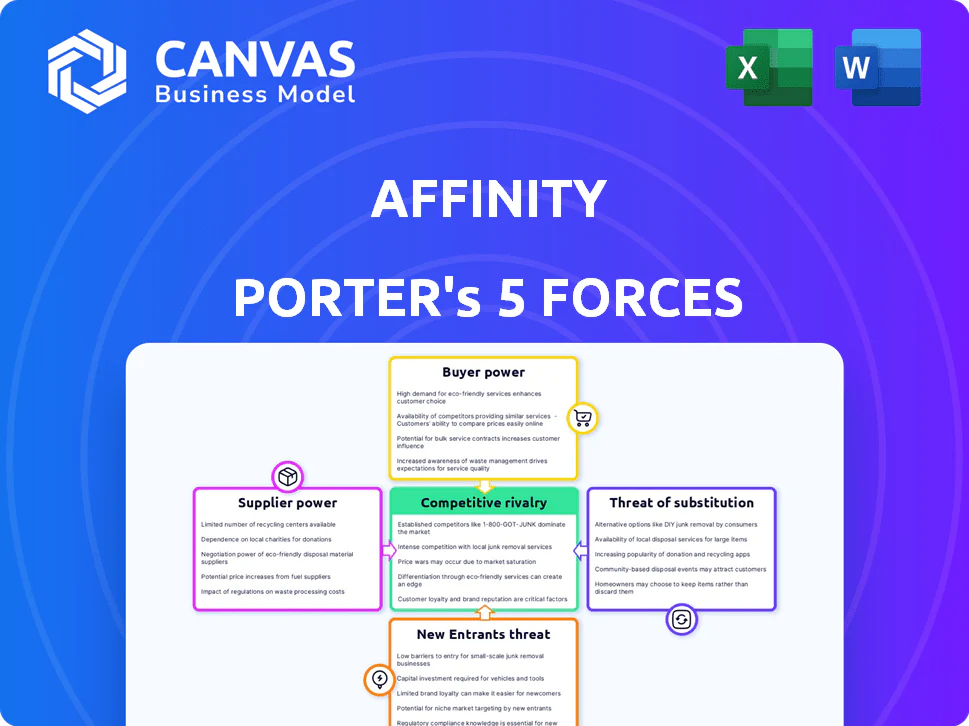
AFFINITY PORTER'S FIVE FORCES TEMPLATE RESEARCH
What is included in the product
 Detailed Word Document
Tailored exclusively for Affinity, analyzing its position within its competitive landscape.

 Customizable Excel Spreadsheet
Highlight opportunities and threats by visualizing data that changes with real-time market shifts.
What You See Is What You Get
Affinity Porter's Five Forces Analysis
This preview showcases the complete Affinity Porter's Five Forces analysis. The document presented here is the same comprehensive report you'll receive immediately after your purchase. It's ready to download and fully formatted for immediate use. This ensures you get the complete analysis, without any alterations or hidden content. The entire, professionally written file is what you will get.

Porter's Five Forces Analysis Template

A Must-Have Tool for Decision-Makers
Affinity's competitive landscape is complex, shaped by the interplay of five key forces. Buyer power, stemming from customer choices, influences profitability. Threat of new entrants, driven by barriers to entry, impacts market share. Substitute products offer alternative solutions, affecting pricing. Supplier power, determined by input costs, shapes cost structures. Lastly, the intensity of rivalry among existing competitors dictates market competition.
Unlock key insights into Affinity’s industry forces—from buyer power to substitute threats—and use this knowledge to inform strategy or investment decisions.
Suppliers Bargaining Power

Dependence on Cloud Computing & Specialized Hardware
Affinity, as a SaaS company, is significantly reliant on cloud services and specialized hardware. This dependence on providers like Amazon Web Services (AWS) or Microsoft Azure grants these suppliers substantial bargaining power. For example, in 2024, AWS's revenue reached $90.7 billion, highlighting their dominance and influence over companies like Affinity. This means suppliers can dictate pricing and terms.
Scarcity of AI Talent
Affinity, focusing on AI and machine learning, faces a challenge: scarcity of AI talent. The demand for skilled AI professionals is high, driving up their bargaining power. In 2024, the average salary for AI specialists reached $150,000, reflecting their value. This impacts Affinity's ability to manage costs and develop their platform.

Proprietary Data Sources
Affinity's reliance on proprietary data sources to enhance network insights impacts supplier bargaining power. Limited availability of unique data could increase supplier leverage. Consider data providers like Dun & Bradstreet, which had $2.2 billion in revenue in 2023, indicating their market influence.

Integration with Third-Party Services
Affinity's integration with third-party services, like email and calendar platforms, introduces supplier power considerations. Reliance on these services' APIs means that changes, such as pricing adjustments or service disruptions, can directly affect Affinity's operations. For instance, if a major email provider increases API costs, Affinity's expenses would rise. This dependency necessitates careful management to mitigate risks.
- API costs can fluctuate; for example, Google's API services had a 15% price increase in 2024.
- Service disruptions from providers like Microsoft or Google can halt operations.
- Changes in data privacy regulations could limit the functionality of integrated services.
- Dependence on third-party services creates vendor lock-in issues.
Software Component Providers
Affinity depends on software component providers, which impacts its supplier power. These providers offer various essential software libraries and tools. Their power is determined by how unique and critical their components are, and if there are available alternatives. For example, the global software market was valued at $672.36 billion in 2023, showing the industry's significant influence.
- Highly specialized or proprietary components increase supplier power.
- The availability of open-source alternatives can reduce supplier power.
- If switching costs are high, suppliers gain more influence.
- The number of suppliers in the market also plays a role.
Affinity's Supplier Power Dynamics: A Deep Dive
Affinity faces supplier power challenges due to reliance on cloud, AI talent, and data sources. AWS, with $90.7B in 2024 revenue, dictates terms. High AI specialist salaries, averaging $150,000 in 2024, also raise costs. Dependence on third-party APIs and software components further impacts supplier power.
| Supplier Type | Impact on Affinity | 2024 Data Point |
|---|---|---|
| Cloud Services (AWS, Azure) | Pricing & Terms | AWS Revenue: $90.7 Billion |
| AI Talent | Cost Management | Avg. AI Specialist Salary: $150,000 |
| Data Providers (Dun & Bradstreet) | Data Access & Costs | Dun & Bradstreet Revenue (2023): $2.2 Billion |
Customers Bargaining Power

Availability of Alternatives
The CRM market is saturated with choices. Customers can easily switch between different CRM systems and relationship intelligence platforms. This wide array of options, including platforms like Salesforce and HubSpot, boosts customer bargaining power. In 2024, the global CRM market size was valued at approximately $71.5 billion, showing intense competition.
Switching Costs
Switching costs significantly affect customer bargaining power. If switching to a new CRM is easy due to data export and import tools, customer power increases. In 2024, the average cost to switch CRM systems was between $2,000 and $10,000, making it a consideration for customers. Easier transitions mean customers can more readily negotiate or switch to competitors, enhancing their influence.

Customer Concentration
If Affinity serves a few major clients, those clients gain substantial influence. They can push for better deals, special services, or lower prices. For example, in 2024, if 80% of Affinity's revenue comes from just three customers, those customers wield considerable power.

Price Sensitivity
Price sensitivity is a significant factor for Affinity's customers, particularly for small to medium-sized businesses. These customers often compare prices across different CRM platforms, influencing their purchasing decisions. The CRM market is competitive, with various vendors offering products at diverse price levels. This competitive landscape necessitates Affinity to provide attractive pricing to maintain its market position. In 2024, the average CRM software cost for SMBs ranged from $12 to $150 per user monthly, underscoring price as a key differentiator.
- SMBs often switch CRM providers for better pricing, with churn rates influenced by cost.
- Competitive pricing is crucial to attract and retain price-sensitive customers.
- Affinity must balance competitive pricing with maintaining profitability.
- Market research shows a 10-15% price sensitivity among CRM users.
Demand for Customization and Integration
Customers' ability to dictate terms increases with demand for customized CRM solutions and seamless tech integration. Businesses with unique needs can sway Affinity's offerings. In 2024, the CRM market grew, with customization and integration services rising by 15%. Customers with complex requirements have leverage in negotiations.
- Customization demands drive customer influence.
- Integration needs increase bargaining power.
- CRM market growth boosts customer leverage.
- Complex needs create negotiation advantages.
CRM Market Dynamics: Customer Power & Price
Customer bargaining power in the CRM market is notably high due to abundant choices and ease of switching. The global CRM market reached $71.5 billion in 2024, fueling competition. Price sensitivity, particularly for SMBs, is a key factor.
| Factor | Impact | 2024 Data |
|---|---|---|
| Market Competition | High customer choice | $71.5B CRM market |
| Switching Costs | Lowers customer power | $2,000-$10,000 to switch |
| Price Sensitivity | Influences decisions | SMBs pay $12-$150/user/month |
Rivalry Among Competitors

Number and Diversity of Competitors
The CRM market is intensely competitive. There are many competitors, from giants like Salesforce to specialized firms. This diversity fuels rivalry, with firms constantly vying for market share. In 2024, Salesforce held about 23.8% of the CRM market share.
Market Growth Rate
The CRM market is booming, with a projected value of $128.97 billion in 2024. Rapid growth typically supports more competitors. However, high growth attracts new firms and pushes existing ones to compete more intensely. This environment often intensifies rivalry, as companies fight for market share.

Product Differentiation
Affinity, while focusing on relationship intelligence, competes with CRMs like Salesforce, which also offer contact management. The intensity of rivalry hinges on how uniquely valuable Affinity's features are perceived. In 2024, Salesforce held about 23.8% of the CRM market share. If Affinity's differentiation isn't clear, rivalry intensifies as customers may easily switch.

Switching Costs for Customers
Switching costs significantly influence competitive rivalry in the CRM market. Low switching costs empower customers to change vendors, intensifying competition as businesses vie for customer loyalty. This dynamic forces companies to offer better pricing, features, and customer service to retain clients. In 2024, the CRM market saw a churn rate of approximately 15% due to ease of switching.
- Low switching costs lead to fierce competition.
- Businesses must improve offerings to retain customers.
- Churn rates are higher when switching is easy.
- 2024 CRM churn rate was about 15%.
Industry Concentration
Industry concentration significantly impacts competitive rivalry in the CRM market. While numerous companies exist, a few large players control a substantial market share. For instance, Salesforce dominates with about 24% of the market share as of late 2024. This concentration creates a competitive landscape where smaller vendors, like Affinity, must navigate against established giants. The dominance of these major companies influences pricing, innovation, and customer acquisition strategies.
- Salesforce held around 24% of the CRM market share.
- Microsoft Dynamics 365 held roughly 18% of the CRM market share.
- Smaller vendors face challenges due to the market's concentration.
- Market concentration affects pricing and innovation dynamics.
CRM Market: Fierce Competition Ahead!
Competitive rivalry in the CRM market is high due to many competitors and the market's growth. In 2024, the CRM market was valued at approximately $128.97 billion. Low switching costs exacerbate the competition, with an estimated 15% churn rate in 2024.
| Factor | Impact | 2024 Data |
|---|---|---|
| Market Growth | Attracts more competitors, intensifying rivalry | $128.97B Market Value |
| Switching Costs | Low costs increase competition | 15% Churn Rate |
| Market Concentration | Dominance by major players | Salesforce ~24% market share |
Original: $10.00
-65%$10.00
$3.50AFFINITY PORTER'S FIVE FORCES TEMPLATE RESEARCH
What is included in the product
Detailed Word Document
Tailored exclusively for Affinity, analyzing its position within its competitive landscape.
Customizable Excel Spreadsheet
Highlight opportunities and threats by visualizing data that changes with real-time market shifts.
What You See Is What You Get
Affinity Porter's Five Forces Analysis
This preview showcases the complete Affinity Porter's Five Forces analysis. The document presented here is the same comprehensive report you'll receive immediately after your purchase. It's ready to download and fully formatted for immediate use. This ensures you get the complete analysis, without any alterations or hidden content. The entire, professionally written file is what you will get.
Porter's Five Forces Analysis Template
A Must-Have Tool for Decision-Makers
Affinity's competitive landscape is complex, shaped by the interplay of five key forces. Buyer power, stemming from customer choices, influences profitability. Threat of new entrants, driven by barriers to entry, impacts market share. Substitute products offer alternative solutions, affecting pricing. Supplier power, determined by input costs, shapes cost structures. Lastly, the intensity of rivalry among existing competitors dictates market competition.
Unlock key insights into Affinity’s industry forces—from buyer power to substitute threats—and use this knowledge to inform strategy or investment decisions.
Suppliers Bargaining Power
Dependence on Cloud Computing & Specialized Hardware
Affinity, as a SaaS company, is significantly reliant on cloud services and specialized hardware. This dependence on providers like Amazon Web Services (AWS) or Microsoft Azure grants these suppliers substantial bargaining power. For example, in 2024, AWS's revenue reached $90.7 billion, highlighting their dominance and influence over companies like Affinity. This means suppliers can dictate pricing and terms.
Scarcity of AI Talent
Affinity, focusing on AI and machine learning, faces a challenge: scarcity of AI talent. The demand for skilled AI professionals is high, driving up their bargaining power. In 2024, the average salary for AI specialists reached $150,000, reflecting their value. This impacts Affinity's ability to manage costs and develop their platform.
Proprietary Data Sources
Affinity's reliance on proprietary data sources to enhance network insights impacts supplier bargaining power. Limited availability of unique data could increase supplier leverage. Consider data providers like Dun & Bradstreet, which had $2.2 billion in revenue in 2023, indicating their market influence.
Integration with Third-Party Services
Affinity's integration with third-party services, like email and calendar platforms, introduces supplier power considerations. Reliance on these services' APIs means that changes, such as pricing adjustments or service disruptions, can directly affect Affinity's operations. For instance, if a major email provider increases API costs, Affinity's expenses would rise. This dependency necessitates careful management to mitigate risks.
- API costs can fluctuate; for example, Google's API services had a 15% price increase in 2024.
- Service disruptions from providers like Microsoft or Google can halt operations.
- Changes in data privacy regulations could limit the functionality of integrated services.
- Dependence on third-party services creates vendor lock-in issues.
Software Component Providers
Affinity depends on software component providers, which impacts its supplier power. These providers offer various essential software libraries and tools. Their power is determined by how unique and critical their components are, and if there are available alternatives. For example, the global software market was valued at $672.36 billion in 2023, showing the industry's significant influence.
- Highly specialized or proprietary components increase supplier power.
- The availability of open-source alternatives can reduce supplier power.
- If switching costs are high, suppliers gain more influence.
- The number of suppliers in the market also plays a role.
Affinity's Supplier Power Dynamics: A Deep Dive
Affinity faces supplier power challenges due to reliance on cloud, AI talent, and data sources. AWS, with $90.7B in 2024 revenue, dictates terms. High AI specialist salaries, averaging $150,000 in 2024, also raise costs. Dependence on third-party APIs and software components further impacts supplier power.
| Supplier Type | Impact on Affinity | 2024 Data Point |
|---|---|---|
| Cloud Services (AWS, Azure) | Pricing & Terms | AWS Revenue: $90.7 Billion |
| AI Talent | Cost Management | Avg. AI Specialist Salary: $150,000 |
| Data Providers (Dun & Bradstreet) | Data Access & Costs | Dun & Bradstreet Revenue (2023): $2.2 Billion |
Customers Bargaining Power
Availability of Alternatives
The CRM market is saturated with choices. Customers can easily switch between different CRM systems and relationship intelligence platforms. This wide array of options, including platforms like Salesforce and HubSpot, boosts customer bargaining power. In 2024, the global CRM market size was valued at approximately $71.5 billion, showing intense competition.
Switching Costs
Switching costs significantly affect customer bargaining power. If switching to a new CRM is easy due to data export and import tools, customer power increases. In 2024, the average cost to switch CRM systems was between $2,000 and $10,000, making it a consideration for customers. Easier transitions mean customers can more readily negotiate or switch to competitors, enhancing their influence.
Customer Concentration
If Affinity serves a few major clients, those clients gain substantial influence. They can push for better deals, special services, or lower prices. For example, in 2024, if 80% of Affinity's revenue comes from just three customers, those customers wield considerable power.
Price Sensitivity
Price sensitivity is a significant factor for Affinity's customers, particularly for small to medium-sized businesses. These customers often compare prices across different CRM platforms, influencing their purchasing decisions. The CRM market is competitive, with various vendors offering products at diverse price levels. This competitive landscape necessitates Affinity to provide attractive pricing to maintain its market position. In 2024, the average CRM software cost for SMBs ranged from $12 to $150 per user monthly, underscoring price as a key differentiator.
- SMBs often switch CRM providers for better pricing, with churn rates influenced by cost.
- Competitive pricing is crucial to attract and retain price-sensitive customers.
- Affinity must balance competitive pricing with maintaining profitability.
- Market research shows a 10-15% price sensitivity among CRM users.
Demand for Customization and Integration
Customers' ability to dictate terms increases with demand for customized CRM solutions and seamless tech integration. Businesses with unique needs can sway Affinity's offerings. In 2024, the CRM market grew, with customization and integration services rising by 15%. Customers with complex requirements have leverage in negotiations.
- Customization demands drive customer influence.
- Integration needs increase bargaining power.
- CRM market growth boosts customer leverage.
- Complex needs create negotiation advantages.
CRM Market Dynamics: Customer Power & Price
Customer bargaining power in the CRM market is notably high due to abundant choices and ease of switching. The global CRM market reached $71.5 billion in 2024, fueling competition. Price sensitivity, particularly for SMBs, is a key factor.
| Factor | Impact | 2024 Data |
|---|---|---|
| Market Competition | High customer choice | $71.5B CRM market |
| Switching Costs | Lowers customer power | $2,000-$10,000 to switch |
| Price Sensitivity | Influences decisions | SMBs pay $12-$150/user/month |
Rivalry Among Competitors
Number and Diversity of Competitors
The CRM market is intensely competitive. There are many competitors, from giants like Salesforce to specialized firms. This diversity fuels rivalry, with firms constantly vying for market share. In 2024, Salesforce held about 23.8% of the CRM market share.
Market Growth Rate
The CRM market is booming, with a projected value of $128.97 billion in 2024. Rapid growth typically supports more competitors. However, high growth attracts new firms and pushes existing ones to compete more intensely. This environment often intensifies rivalry, as companies fight for market share.
Product Differentiation
Affinity, while focusing on relationship intelligence, competes with CRMs like Salesforce, which also offer contact management. The intensity of rivalry hinges on how uniquely valuable Affinity's features are perceived. In 2024, Salesforce held about 23.8% of the CRM market share. If Affinity's differentiation isn't clear, rivalry intensifies as customers may easily switch.
Switching Costs for Customers
Switching costs significantly influence competitive rivalry in the CRM market. Low switching costs empower customers to change vendors, intensifying competition as businesses vie for customer loyalty. This dynamic forces companies to offer better pricing, features, and customer service to retain clients. In 2024, the CRM market saw a churn rate of approximately 15% due to ease of switching.
- Low switching costs lead to fierce competition.
- Businesses must improve offerings to retain customers.
- Churn rates are higher when switching is easy.
- 2024 CRM churn rate was about 15%.
Industry Concentration
Industry concentration significantly impacts competitive rivalry in the CRM market. While numerous companies exist, a few large players control a substantial market share. For instance, Salesforce dominates with about 24% of the market share as of late 2024. This concentration creates a competitive landscape where smaller vendors, like Affinity, must navigate against established giants. The dominance of these major companies influences pricing, innovation, and customer acquisition strategies.
- Salesforce held around 24% of the CRM market share.
- Microsoft Dynamics 365 held roughly 18% of the CRM market share.
- Smaller vendors face challenges due to the market's concentration.
- Market concentration affects pricing and innovation dynamics.
CRM Market: Fierce Competition Ahead!
Competitive rivalry in the CRM market is high due to many competitors and the market's growth. In 2024, the CRM market was valued at approximately $128.97 billion. Low switching costs exacerbate the competition, with an estimated 15% churn rate in 2024.
| Factor | Impact | 2024 Data |
|---|---|---|
| Market Growth | Attracts more competitors, intensifying rivalry | $128.97B Market Value |
| Switching Costs | Low costs increase competition | 15% Churn Rate |
| Market Concentration | Dominance by major players | Salesforce ~24% market share |
Product Information
Product Information
Shipping & Returns
Shipping & Returns
Description
What is included in the product
Detailed Word Document
Tailored exclusively for Affinity, analyzing its position within its competitive landscape.
Customizable Excel Spreadsheet
Highlight opportunities and threats by visualizing data that changes with real-time market shifts.
What You See Is What You Get
Affinity Porter's Five Forces Analysis
This preview showcases the complete Affinity Porter's Five Forces analysis. The document presented here is the same comprehensive report you'll receive immediately after your purchase. It's ready to download and fully formatted for immediate use. This ensures you get the complete analysis, without any alterations or hidden content. The entire, professionally written file is what you will get.
Porter's Five Forces Analysis Template
A Must-Have Tool for Decision-Makers
Affinity's competitive landscape is complex, shaped by the interplay of five key forces. Buyer power, stemming from customer choices, influences profitability. Threat of new entrants, driven by barriers to entry, impacts market share. Substitute products offer alternative solutions, affecting pricing. Supplier power, determined by input costs, shapes cost structures. Lastly, the intensity of rivalry among existing competitors dictates market competition.
Unlock key insights into Affinity’s industry forces—from buyer power to substitute threats—and use this knowledge to inform strategy or investment decisions.
Suppliers Bargaining Power
Dependence on Cloud Computing & Specialized Hardware
Affinity, as a SaaS company, is significantly reliant on cloud services and specialized hardware. This dependence on providers like Amazon Web Services (AWS) or Microsoft Azure grants these suppliers substantial bargaining power. For example, in 2024, AWS's revenue reached $90.7 billion, highlighting their dominance and influence over companies like Affinity. This means suppliers can dictate pricing and terms.
Scarcity of AI Talent
Affinity, focusing on AI and machine learning, faces a challenge: scarcity of AI talent. The demand for skilled AI professionals is high, driving up their bargaining power. In 2024, the average salary for AI specialists reached $150,000, reflecting their value. This impacts Affinity's ability to manage costs and develop their platform.
Proprietary Data Sources
Affinity's reliance on proprietary data sources to enhance network insights impacts supplier bargaining power. Limited availability of unique data could increase supplier leverage. Consider data providers like Dun & Bradstreet, which had $2.2 billion in revenue in 2023, indicating their market influence.
Integration with Third-Party Services
Affinity's integration with third-party services, like email and calendar platforms, introduces supplier power considerations. Reliance on these services' APIs means that changes, such as pricing adjustments or service disruptions, can directly affect Affinity's operations. For instance, if a major email provider increases API costs, Affinity's expenses would rise. This dependency necessitates careful management to mitigate risks.
- API costs can fluctuate; for example, Google's API services had a 15% price increase in 2024.
- Service disruptions from providers like Microsoft or Google can halt operations.
- Changes in data privacy regulations could limit the functionality of integrated services.
- Dependence on third-party services creates vendor lock-in issues.
Software Component Providers
Affinity depends on software component providers, which impacts its supplier power. These providers offer various essential software libraries and tools. Their power is determined by how unique and critical their components are, and if there are available alternatives. For example, the global software market was valued at $672.36 billion in 2023, showing the industry's significant influence.
- Highly specialized or proprietary components increase supplier power.
- The availability of open-source alternatives can reduce supplier power.
- If switching costs are high, suppliers gain more influence.
- The number of suppliers in the market also plays a role.
Affinity's Supplier Power Dynamics: A Deep Dive
Affinity faces supplier power challenges due to reliance on cloud, AI talent, and data sources. AWS, with $90.7B in 2024 revenue, dictates terms. High AI specialist salaries, averaging $150,000 in 2024, also raise costs. Dependence on third-party APIs and software components further impacts supplier power.
| Supplier Type | Impact on Affinity | 2024 Data Point |
|---|---|---|
| Cloud Services (AWS, Azure) | Pricing & Terms | AWS Revenue: $90.7 Billion |
| AI Talent | Cost Management | Avg. AI Specialist Salary: $150,000 |
| Data Providers (Dun & Bradstreet) | Data Access & Costs | Dun & Bradstreet Revenue (2023): $2.2 Billion |
Customers Bargaining Power
Availability of Alternatives
The CRM market is saturated with choices. Customers can easily switch between different CRM systems and relationship intelligence platforms. This wide array of options, including platforms like Salesforce and HubSpot, boosts customer bargaining power. In 2024, the global CRM market size was valued at approximately $71.5 billion, showing intense competition.
Switching Costs
Switching costs significantly affect customer bargaining power. If switching to a new CRM is easy due to data export and import tools, customer power increases. In 2024, the average cost to switch CRM systems was between $2,000 and $10,000, making it a consideration for customers. Easier transitions mean customers can more readily negotiate or switch to competitors, enhancing their influence.
Customer Concentration
If Affinity serves a few major clients, those clients gain substantial influence. They can push for better deals, special services, or lower prices. For example, in 2024, if 80% of Affinity's revenue comes from just three customers, those customers wield considerable power.
Price Sensitivity
Price sensitivity is a significant factor for Affinity's customers, particularly for small to medium-sized businesses. These customers often compare prices across different CRM platforms, influencing their purchasing decisions. The CRM market is competitive, with various vendors offering products at diverse price levels. This competitive landscape necessitates Affinity to provide attractive pricing to maintain its market position. In 2024, the average CRM software cost for SMBs ranged from $12 to $150 per user monthly, underscoring price as a key differentiator.
- SMBs often switch CRM providers for better pricing, with churn rates influenced by cost.
- Competitive pricing is crucial to attract and retain price-sensitive customers.
- Affinity must balance competitive pricing with maintaining profitability.
- Market research shows a 10-15% price sensitivity among CRM users.
Demand for Customization and Integration
Customers' ability to dictate terms increases with demand for customized CRM solutions and seamless tech integration. Businesses with unique needs can sway Affinity's offerings. In 2024, the CRM market grew, with customization and integration services rising by 15%. Customers with complex requirements have leverage in negotiations.
- Customization demands drive customer influence.
- Integration needs increase bargaining power.
- CRM market growth boosts customer leverage.
- Complex needs create negotiation advantages.
CRM Market Dynamics: Customer Power & Price
Customer bargaining power in the CRM market is notably high due to abundant choices and ease of switching. The global CRM market reached $71.5 billion in 2024, fueling competition. Price sensitivity, particularly for SMBs, is a key factor.
| Factor | Impact | 2024 Data |
|---|---|---|
| Market Competition | High customer choice | $71.5B CRM market |
| Switching Costs | Lowers customer power | $2,000-$10,000 to switch |
| Price Sensitivity | Influences decisions | SMBs pay $12-$150/user/month |
Rivalry Among Competitors
Number and Diversity of Competitors
The CRM market is intensely competitive. There are many competitors, from giants like Salesforce to specialized firms. This diversity fuels rivalry, with firms constantly vying for market share. In 2024, Salesforce held about 23.8% of the CRM market share.
Market Growth Rate
The CRM market is booming, with a projected value of $128.97 billion in 2024. Rapid growth typically supports more competitors. However, high growth attracts new firms and pushes existing ones to compete more intensely. This environment often intensifies rivalry, as companies fight for market share.
Product Differentiation
Affinity, while focusing on relationship intelligence, competes with CRMs like Salesforce, which also offer contact management. The intensity of rivalry hinges on how uniquely valuable Affinity's features are perceived. In 2024, Salesforce held about 23.8% of the CRM market share. If Affinity's differentiation isn't clear, rivalry intensifies as customers may easily switch.
Switching Costs for Customers
Switching costs significantly influence competitive rivalry in the CRM market. Low switching costs empower customers to change vendors, intensifying competition as businesses vie for customer loyalty. This dynamic forces companies to offer better pricing, features, and customer service to retain clients. In 2024, the CRM market saw a churn rate of approximately 15% due to ease of switching.
- Low switching costs lead to fierce competition.
- Businesses must improve offerings to retain customers.
- Churn rates are higher when switching is easy.
- 2024 CRM churn rate was about 15%.
Industry Concentration
Industry concentration significantly impacts competitive rivalry in the CRM market. While numerous companies exist, a few large players control a substantial market share. For instance, Salesforce dominates with about 24% of the market share as of late 2024. This concentration creates a competitive landscape where smaller vendors, like Affinity, must navigate against established giants. The dominance of these major companies influences pricing, innovation, and customer acquisition strategies.
- Salesforce held around 24% of the CRM market share.
- Microsoft Dynamics 365 held roughly 18% of the CRM market share.
- Smaller vendors face challenges due to the market's concentration.
- Market concentration affects pricing and innovation dynamics.
CRM Market: Fierce Competition Ahead!
Competitive rivalry in the CRM market is high due to many competitors and the market's growth. In 2024, the CRM market was valued at approximately $128.97 billion. Low switching costs exacerbate the competition, with an estimated 15% churn rate in 2024.
| Factor | Impact | 2024 Data |
|---|---|---|
| Market Growth | Attracts more competitors, intensifying rivalry | $128.97B Market Value |
| Switching Costs | Low costs increase competition | 15% Churn Rate |
| Market Concentration | Dominance by major players | Salesforce ~24% market share |











