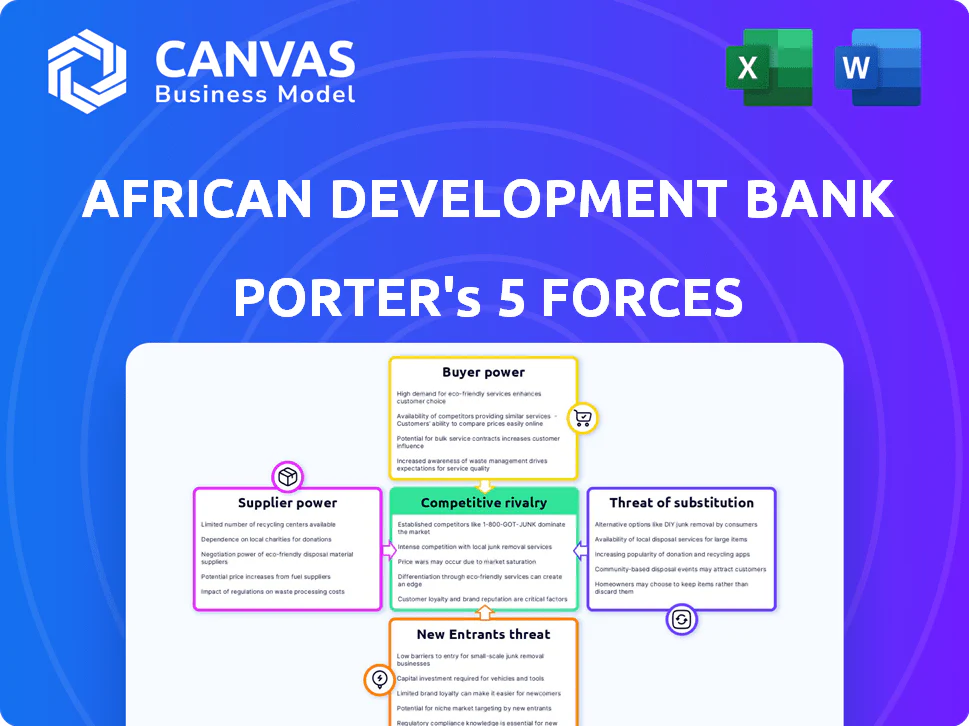
AFRICAN DEVELOPMENT BANK PORTER'S FIVE FORCES TEMPLATE RESEARCH
What is included in the product
 Detailed Word Document
Analyzes competition, supplier/buyer power, & new entrant threats for AfDB.

 Customizable Excel Spreadsheet
Swap in your own data, labels, and notes to reflect current business conditions.
Full Version Awaits
African Development Bank Porter's Five Forces Analysis
This preview presents the complete African Development Bank Porter's Five Forces analysis. The document's detailed analysis of competitive forces is fully visible.
You're viewing the same professionally crafted report you'll download after purchase.
It's ready for your immediate use, offering insights without needing further editing or changes.
The formatting and content are identical to the version you'll receive.
This is your deliverable: a fully prepared analysis, accessible instantly after purchase.

Porter's Five Forces Analysis Template

Go Beyond the Preview—Access the Full Strategic Report
Understanding the African Development Bank requires examining its competitive landscape. Our analysis explores the forces shaping its industry. Key elements include supplier power, threat of substitutes, and competitive rivalry. These insights inform strategic planning and investment decisions.
This brief snapshot only scratches the surface. Unlock the full Porter's Five Forces Analysis to explore African Development Bank’s competitive dynamics, market pressures, and strategic advantages in detail.
Suppliers Bargaining Power

Dependence on Member Countries' Contributions
The African Development Bank (AfDB) is significantly influenced by its member countries' contributions, crucial for its financial operations. These contributions, from both regional and non-regional members, directly affect the AfDB's financial health. In 2024, the AfDB's capital stock was over $200 billion, largely from member states. The ability and willingness of these members to provide funds shape the AfDB’s capacity to undertake projects.
Influence of Capital Market Conditions
The African Development Bank (AfDB) heavily relies on international capital markets for funding. In 2024, the AfDB issued bonds worth approximately $8.5 billion to support its development projects across Africa. Fluctuations in interest rates impact the bank's borrowing costs, directly affecting its project financing capabilities. Investor confidence, influenced by global economic trends, also plays a critical role in the bank's ability to secure favorable funding terms.

Donor Funding for Concessional Lending
The African Development Bank (AfDB) faces supplier power through its reliance on donor funding, particularly for concessional lending via the African Development Fund (ADF). These international donors, like the UK and Germany, provide grants that directly influence the AfDB's capacity to offer low-interest loans to low-income countries. In 2024, donor contributions significantly impacted the AfDB's lending capabilities, with specific figures reflecting the dependence on external financial support.

Technical Expertise and Specialized Services
The African Development Bank (AfDB) relies on consultants, contractors, and suppliers for its projects. Suppliers with unique technical expertise or specialized services gain bargaining power, especially in areas with limited competition. For example, firms offering renewable energy solutions or infrastructure development in specific African regions might have an advantage. This dynamic influences project costs and timelines. In 2024, the AfDB approved $8.9 billion in new financing for infrastructure projects across Africa.
- Specialized expertise in renewable energy projects gives suppliers power.
- Infrastructure development firms in specific regions have an advantage.
- This impacts project costs and the time it takes to complete them.
- In 2024, the AfDB financed $8.9 billion in infrastructure.
Geopolitical Factors and Donor Priorities
The African Development Bank (AfDB) faces supplier power from its non-regional member countries, particularly those that are major donors. These countries' priorities and foreign policy goals influence the types of projects the AfDB supports and where they are located. For instance, in 2024, geopolitical tensions led to shifts in donor funding towards projects aligned with strategic interests. This dynamic gives donors leverage, impacting the AfDB's project selection and resource allocation.
- In 2024, the AfDB's total approvals reached $10.1 billion, with significant contributions from non-regional members.
- Donor countries, like the US and European nations, often prioritize projects in specific sectors or regions based on their foreign policy objectives.
- This influence is evident in the allocation of funds towards infrastructure and energy projects in politically stable areas.
AfDB's Supplier Dynamics: Donors & Experts
The AfDB's supplier power is shaped by donors and specialized service providers. Donors, like the UK and Germany, influence the bank's concessional lending. Firms with unique skills, such as renewable energy experts, have leverage. This affects project costs and timelines; in 2024, the AfDB approved $8.9 billion for infrastructure.
| Supplier Type | Influence | 2024 Impact |
|---|---|---|
| Donors (UK, Germany) | Concessional Lending | Impacted low-interest loan offerings |
| Specialized Firms | Project Costs & Timelines | $8.9B in infrastructure financing |
| Non-Regional Members | Project Selection | Total approvals reached $10.1B |
Customers Bargaining Power

African Governments' Development Priorities
African governments, the AfDB's primary customers, hold significant bargaining power. Their national development plans shape project funding requests. In 2024, infrastructure projects remained a top priority, reflecting government focus. The AfDB's loan approvals in 2024 totaled $10.5 billion, influenced by these government priorities.
Access to Alternative Financing Sources
African nations aren't solely reliant on the African Development Bank (AfDB) for funding; they have options. They can turn to other multilateral institutions, such as the World Bank, or seek aid from bilateral donors. In 2024, the World Bank approved $47.5 billion in financing for Africa. The rise of private sector finance and domestic resource mobilization further enhances this bargaining position. This diversification gives borrowing countries more leverage.

Project Ownership and Implementation Capacity
The African Development Bank (AfDB) faces customer bargaining power challenges, as project success hinges on recipient countries' implementation skills. Nations with robust project management can negotiate favorable terms. In 2024, the AfDB approved $8.5 billion in new projects. Effective implementation is key for project success.

Demand for Concessional vs. Non-Concessional Financing
African countries' financial situations vary, impacting their negotiation strength for loans. Poorer nations needing financial aid often have less leverage when seeking favorable terms. Debt sustainability and income levels affect the type of financing sought, with low-income countries leaning towards concessional options. This influences their bargaining position with lenders like the African Development Bank.
- In 2024, Sub-Saharan Africa's debt-to-GDP ratio was around 60%, with significant variation across countries.
- Concessional loans typically have interest rates below market rates and longer repayment periods.
- Countries with high debt levels and low income often rely more on concessional financing.
- The African Development Bank approved $8.3 billion in new financing in 2023.
Regional Integration and Collective Bargaining
African nations boost customer power via coordinated development strategies and regional economic blocs, negotiating with the African Development Bank (AfDB). This unified front helps prioritize projects and advocate for specific needs. For example, in 2024, the AfDB approved $9.7 billion in financing for various projects across Africa, highlighting the significance of collaborative engagement. Countries leveraging regional bodies gain leverage in these negotiations.
- AfDB financing in 2024 reached $9.7 billion.
- Regional economic blocs enhance negotiation power.
- Coordination of development strategies is key.
- Prioritization of projects through collective efforts.
AfDB's $10.5B Loans: Governments in Control
African governments, the AfDB's primary customers, hold considerable bargaining power, shaping project funding. In 2024, the AfDB's loan approvals totaled $10.5 billion, influenced by government priorities. Their financial situations vary, affecting negotiation strength.
| Factor | Impact | 2024 Data |
|---|---|---|
| Government Priorities | Influence project funding | $10.5B AfDB loan approvals |
| Debt Levels | Affect negotiation | Sub-Saharan Africa ~60% debt-to-GDP |
| Regional Blocs | Enhance bargaining | AfDB approved $9.7B in 2024 |
Rivalry Among Competitors

Presence of Other Multilateral Development Banks
The African Development Bank (AfDB) faces rivalry from other multilateral development banks (MDBs). Key competitors include the World Bank, Islamic Development Bank (IsDB), and other regional banks. These institutions also offer financial and technical support across Africa. The World Bank committed $8.8 billion to Africa in fiscal year 2024. The IsDB approved $2.5 billion for projects in Africa in 2023.
Bilateral Donors and Development Agencies
Bilateral donors and development agencies, like the U.S. and China, compete with the AfDB. They offer aid with specific goals, influencing project choices. In 2024, the U.S. committed $1.8 billion in development aid to Africa. This competition can affect the AfDB's project selection and influence. These partners' priorities shape Africa's development landscape.

Increasing Role of Private Sector Finance
The African Development Bank (AfDB) faces increasing competition from private sector financiers. The AfDB's strategy to mobilize private capital for African projects means competing directly with private investors. In 2024, private equity investments in Africa reached $6.2 billion, showcasing robust competition. This rivalry intensifies the battle for funding, impacting project financing dynamics.

Emergence of New Financial Institutions
The African Development Bank (AfDB) faces increased competition as new financial institutions emerge. BRICS nations and other non-traditional partners are expanding their development finance activities, potentially challenging the AfDB's dominance. This shift can intensify rivalry, especially in sectors like infrastructure and energy. For instance, in 2024, China's financing for African infrastructure projects reached $10 billion, highlighting this competitive landscape.
- Increased Competition: New players challenge AfDB's role.
- BRICS Influence: BRICS nations are major development financiers.
- Sectoral Impact: Competition is high in key sectors like infrastructure.
- Financial Data: China's 2024 infrastructure financing was $10B.
Competition for High-Quality Projects and Expertise
Development finance institutions like the AfDB fiercely compete for top-tier projects and the specialized skills needed to execute them. Securing funding alone isn't enough; identifying and managing successful projects is key to staying ahead. The AfDB's competitiveness hinges on its project quality and implementation capabilities. This impacts its ability to attract both financial backing and talent.
- In 2024, the AfDB approved $8.5 billion in new financing for projects across Africa.
- The competition for projects is intense, with numerous DFIs vying for the same opportunities.
- Skilled project managers and sector experts are in high demand, increasing recruitment challenges.
- High-quality projects are crucial for ensuring loan repayment and attracting further investment.
AfDB's Rivals: A Funding Face-Off
The AfDB faces intense competition from various sources. Rivals include MDBs, bilateral donors, and private financiers. New financial institutions like BRICS nations also intensify competition. This rivalry impacts project selection and funding dynamics.
| Competition Type | Competitors | 2024 Data |
|---|---|---|
| MDBs | World Bank, IsDB | World Bank: $8.8B to Africa; IsDB: $2.5B to Africa |
| Bilateral Donors | U.S., China | U.S. aid: $1.8B to Africa; China infrastructure: $10B |
| Private Sector | Private Equity | Private equity in Africa: $6.2B |
Original: $10.00
-65%$10.00
$3.50AFRICAN DEVELOPMENT BANK PORTER'S FIVE FORCES TEMPLATE RESEARCH
What is included in the product
Detailed Word Document
Analyzes competition, supplier/buyer power, & new entrant threats for AfDB.
Customizable Excel Spreadsheet
Swap in your own data, labels, and notes to reflect current business conditions.
Full Version Awaits
African Development Bank Porter's Five Forces Analysis
This preview presents the complete African Development Bank Porter's Five Forces analysis. The document's detailed analysis of competitive forces is fully visible.
You're viewing the same professionally crafted report you'll download after purchase.
It's ready for your immediate use, offering insights without needing further editing or changes.
The formatting and content are identical to the version you'll receive.
This is your deliverable: a fully prepared analysis, accessible instantly after purchase.
Porter's Five Forces Analysis Template
Go Beyond the Preview—Access the Full Strategic Report
Understanding the African Development Bank requires examining its competitive landscape. Our analysis explores the forces shaping its industry. Key elements include supplier power, threat of substitutes, and competitive rivalry. These insights inform strategic planning and investment decisions.
This brief snapshot only scratches the surface. Unlock the full Porter's Five Forces Analysis to explore African Development Bank’s competitive dynamics, market pressures, and strategic advantages in detail.
Suppliers Bargaining Power
Dependence on Member Countries' Contributions
The African Development Bank (AfDB) is significantly influenced by its member countries' contributions, crucial for its financial operations. These contributions, from both regional and non-regional members, directly affect the AfDB's financial health. In 2024, the AfDB's capital stock was over $200 billion, largely from member states. The ability and willingness of these members to provide funds shape the AfDB’s capacity to undertake projects.
Influence of Capital Market Conditions
The African Development Bank (AfDB) heavily relies on international capital markets for funding. In 2024, the AfDB issued bonds worth approximately $8.5 billion to support its development projects across Africa. Fluctuations in interest rates impact the bank's borrowing costs, directly affecting its project financing capabilities. Investor confidence, influenced by global economic trends, also plays a critical role in the bank's ability to secure favorable funding terms.
Donor Funding for Concessional Lending
The African Development Bank (AfDB) faces supplier power through its reliance on donor funding, particularly for concessional lending via the African Development Fund (ADF). These international donors, like the UK and Germany, provide grants that directly influence the AfDB's capacity to offer low-interest loans to low-income countries. In 2024, donor contributions significantly impacted the AfDB's lending capabilities, with specific figures reflecting the dependence on external financial support.
Technical Expertise and Specialized Services
The African Development Bank (AfDB) relies on consultants, contractors, and suppliers for its projects. Suppliers with unique technical expertise or specialized services gain bargaining power, especially in areas with limited competition. For example, firms offering renewable energy solutions or infrastructure development in specific African regions might have an advantage. This dynamic influences project costs and timelines. In 2024, the AfDB approved $8.9 billion in new financing for infrastructure projects across Africa.
- Specialized expertise in renewable energy projects gives suppliers power.
- Infrastructure development firms in specific regions have an advantage.
- This impacts project costs and the time it takes to complete them.
- In 2024, the AfDB financed $8.9 billion in infrastructure.
Geopolitical Factors and Donor Priorities
The African Development Bank (AfDB) faces supplier power from its non-regional member countries, particularly those that are major donors. These countries' priorities and foreign policy goals influence the types of projects the AfDB supports and where they are located. For instance, in 2024, geopolitical tensions led to shifts in donor funding towards projects aligned with strategic interests. This dynamic gives donors leverage, impacting the AfDB's project selection and resource allocation.
- In 2024, the AfDB's total approvals reached $10.1 billion, with significant contributions from non-regional members.
- Donor countries, like the US and European nations, often prioritize projects in specific sectors or regions based on their foreign policy objectives.
- This influence is evident in the allocation of funds towards infrastructure and energy projects in politically stable areas.
AfDB's Supplier Dynamics: Donors & Experts
The AfDB's supplier power is shaped by donors and specialized service providers. Donors, like the UK and Germany, influence the bank's concessional lending. Firms with unique skills, such as renewable energy experts, have leverage. This affects project costs and timelines; in 2024, the AfDB approved $8.9 billion for infrastructure.
| Supplier Type | Influence | 2024 Impact |
|---|---|---|
| Donors (UK, Germany) | Concessional Lending | Impacted low-interest loan offerings |
| Specialized Firms | Project Costs & Timelines | $8.9B in infrastructure financing |
| Non-Regional Members | Project Selection | Total approvals reached $10.1B |
Customers Bargaining Power
African Governments' Development Priorities
African governments, the AfDB's primary customers, hold significant bargaining power. Their national development plans shape project funding requests. In 2024, infrastructure projects remained a top priority, reflecting government focus. The AfDB's loan approvals in 2024 totaled $10.5 billion, influenced by these government priorities.
Access to Alternative Financing Sources
African nations aren't solely reliant on the African Development Bank (AfDB) for funding; they have options. They can turn to other multilateral institutions, such as the World Bank, or seek aid from bilateral donors. In 2024, the World Bank approved $47.5 billion in financing for Africa. The rise of private sector finance and domestic resource mobilization further enhances this bargaining position. This diversification gives borrowing countries more leverage.
Project Ownership and Implementation Capacity
The African Development Bank (AfDB) faces customer bargaining power challenges, as project success hinges on recipient countries' implementation skills. Nations with robust project management can negotiate favorable terms. In 2024, the AfDB approved $8.5 billion in new projects. Effective implementation is key for project success.
Demand for Concessional vs. Non-Concessional Financing
African countries' financial situations vary, impacting their negotiation strength for loans. Poorer nations needing financial aid often have less leverage when seeking favorable terms. Debt sustainability and income levels affect the type of financing sought, with low-income countries leaning towards concessional options. This influences their bargaining position with lenders like the African Development Bank.
- In 2024, Sub-Saharan Africa's debt-to-GDP ratio was around 60%, with significant variation across countries.
- Concessional loans typically have interest rates below market rates and longer repayment periods.
- Countries with high debt levels and low income often rely more on concessional financing.
- The African Development Bank approved $8.3 billion in new financing in 2023.
Regional Integration and Collective Bargaining
African nations boost customer power via coordinated development strategies and regional economic blocs, negotiating with the African Development Bank (AfDB). This unified front helps prioritize projects and advocate for specific needs. For example, in 2024, the AfDB approved $9.7 billion in financing for various projects across Africa, highlighting the significance of collaborative engagement. Countries leveraging regional bodies gain leverage in these negotiations.
- AfDB financing in 2024 reached $9.7 billion.
- Regional economic blocs enhance negotiation power.
- Coordination of development strategies is key.
- Prioritization of projects through collective efforts.
AfDB's $10.5B Loans: Governments in Control
African governments, the AfDB's primary customers, hold considerable bargaining power, shaping project funding. In 2024, the AfDB's loan approvals totaled $10.5 billion, influenced by government priorities. Their financial situations vary, affecting negotiation strength.
| Factor | Impact | 2024 Data |
|---|---|---|
| Government Priorities | Influence project funding | $10.5B AfDB loan approvals |
| Debt Levels | Affect negotiation | Sub-Saharan Africa ~60% debt-to-GDP |
| Regional Blocs | Enhance bargaining | AfDB approved $9.7B in 2024 |
Rivalry Among Competitors
Presence of Other Multilateral Development Banks
The African Development Bank (AfDB) faces rivalry from other multilateral development banks (MDBs). Key competitors include the World Bank, Islamic Development Bank (IsDB), and other regional banks. These institutions also offer financial and technical support across Africa. The World Bank committed $8.8 billion to Africa in fiscal year 2024. The IsDB approved $2.5 billion for projects in Africa in 2023.
Bilateral Donors and Development Agencies
Bilateral donors and development agencies, like the U.S. and China, compete with the AfDB. They offer aid with specific goals, influencing project choices. In 2024, the U.S. committed $1.8 billion in development aid to Africa. This competition can affect the AfDB's project selection and influence. These partners' priorities shape Africa's development landscape.
Increasing Role of Private Sector Finance
The African Development Bank (AfDB) faces increasing competition from private sector financiers. The AfDB's strategy to mobilize private capital for African projects means competing directly with private investors. In 2024, private equity investments in Africa reached $6.2 billion, showcasing robust competition. This rivalry intensifies the battle for funding, impacting project financing dynamics.
Emergence of New Financial Institutions
The African Development Bank (AfDB) faces increased competition as new financial institutions emerge. BRICS nations and other non-traditional partners are expanding their development finance activities, potentially challenging the AfDB's dominance. This shift can intensify rivalry, especially in sectors like infrastructure and energy. For instance, in 2024, China's financing for African infrastructure projects reached $10 billion, highlighting this competitive landscape.
- Increased Competition: New players challenge AfDB's role.
- BRICS Influence: BRICS nations are major development financiers.
- Sectoral Impact: Competition is high in key sectors like infrastructure.
- Financial Data: China's 2024 infrastructure financing was $10B.
Competition for High-Quality Projects and Expertise
Development finance institutions like the AfDB fiercely compete for top-tier projects and the specialized skills needed to execute them. Securing funding alone isn't enough; identifying and managing successful projects is key to staying ahead. The AfDB's competitiveness hinges on its project quality and implementation capabilities. This impacts its ability to attract both financial backing and talent.
- In 2024, the AfDB approved $8.5 billion in new financing for projects across Africa.
- The competition for projects is intense, with numerous DFIs vying for the same opportunities.
- Skilled project managers and sector experts are in high demand, increasing recruitment challenges.
- High-quality projects are crucial for ensuring loan repayment and attracting further investment.
AfDB's Rivals: A Funding Face-Off
The AfDB faces intense competition from various sources. Rivals include MDBs, bilateral donors, and private financiers. New financial institutions like BRICS nations also intensify competition. This rivalry impacts project selection and funding dynamics.
| Competition Type | Competitors | 2024 Data |
|---|---|---|
| MDBs | World Bank, IsDB | World Bank: $8.8B to Africa; IsDB: $2.5B to Africa |
| Bilateral Donors | U.S., China | U.S. aid: $1.8B to Africa; China infrastructure: $10B |
| Private Sector | Private Equity | Private equity in Africa: $6.2B |
Product Information
Product Information
Shipping & Returns
Shipping & Returns
Description
What is included in the product
Detailed Word Document
Analyzes competition, supplier/buyer power, & new entrant threats for AfDB.
Customizable Excel Spreadsheet
Swap in your own data, labels, and notes to reflect current business conditions.
Full Version Awaits
African Development Bank Porter's Five Forces Analysis
This preview presents the complete African Development Bank Porter's Five Forces analysis. The document's detailed analysis of competitive forces is fully visible.
You're viewing the same professionally crafted report you'll download after purchase.
It's ready for your immediate use, offering insights without needing further editing or changes.
The formatting and content are identical to the version you'll receive.
This is your deliverable: a fully prepared analysis, accessible instantly after purchase.
Porter's Five Forces Analysis Template
Go Beyond the Preview—Access the Full Strategic Report
Understanding the African Development Bank requires examining its competitive landscape. Our analysis explores the forces shaping its industry. Key elements include supplier power, threat of substitutes, and competitive rivalry. These insights inform strategic planning and investment decisions.
This brief snapshot only scratches the surface. Unlock the full Porter's Five Forces Analysis to explore African Development Bank’s competitive dynamics, market pressures, and strategic advantages in detail.
Suppliers Bargaining Power
Dependence on Member Countries' Contributions
The African Development Bank (AfDB) is significantly influenced by its member countries' contributions, crucial for its financial operations. These contributions, from both regional and non-regional members, directly affect the AfDB's financial health. In 2024, the AfDB's capital stock was over $200 billion, largely from member states. The ability and willingness of these members to provide funds shape the AfDB’s capacity to undertake projects.
Influence of Capital Market Conditions
The African Development Bank (AfDB) heavily relies on international capital markets for funding. In 2024, the AfDB issued bonds worth approximately $8.5 billion to support its development projects across Africa. Fluctuations in interest rates impact the bank's borrowing costs, directly affecting its project financing capabilities. Investor confidence, influenced by global economic trends, also plays a critical role in the bank's ability to secure favorable funding terms.
Donor Funding for Concessional Lending
The African Development Bank (AfDB) faces supplier power through its reliance on donor funding, particularly for concessional lending via the African Development Fund (ADF). These international donors, like the UK and Germany, provide grants that directly influence the AfDB's capacity to offer low-interest loans to low-income countries. In 2024, donor contributions significantly impacted the AfDB's lending capabilities, with specific figures reflecting the dependence on external financial support.
Technical Expertise and Specialized Services
The African Development Bank (AfDB) relies on consultants, contractors, and suppliers for its projects. Suppliers with unique technical expertise or specialized services gain bargaining power, especially in areas with limited competition. For example, firms offering renewable energy solutions or infrastructure development in specific African regions might have an advantage. This dynamic influences project costs and timelines. In 2024, the AfDB approved $8.9 billion in new financing for infrastructure projects across Africa.
- Specialized expertise in renewable energy projects gives suppliers power.
- Infrastructure development firms in specific regions have an advantage.
- This impacts project costs and the time it takes to complete them.
- In 2024, the AfDB financed $8.9 billion in infrastructure.
Geopolitical Factors and Donor Priorities
The African Development Bank (AfDB) faces supplier power from its non-regional member countries, particularly those that are major donors. These countries' priorities and foreign policy goals influence the types of projects the AfDB supports and where they are located. For instance, in 2024, geopolitical tensions led to shifts in donor funding towards projects aligned with strategic interests. This dynamic gives donors leverage, impacting the AfDB's project selection and resource allocation.
- In 2024, the AfDB's total approvals reached $10.1 billion, with significant contributions from non-regional members.
- Donor countries, like the US and European nations, often prioritize projects in specific sectors or regions based on their foreign policy objectives.
- This influence is evident in the allocation of funds towards infrastructure and energy projects in politically stable areas.
AfDB's Supplier Dynamics: Donors & Experts
The AfDB's supplier power is shaped by donors and specialized service providers. Donors, like the UK and Germany, influence the bank's concessional lending. Firms with unique skills, such as renewable energy experts, have leverage. This affects project costs and timelines; in 2024, the AfDB approved $8.9 billion for infrastructure.
| Supplier Type | Influence | 2024 Impact |
|---|---|---|
| Donors (UK, Germany) | Concessional Lending | Impacted low-interest loan offerings |
| Specialized Firms | Project Costs & Timelines | $8.9B in infrastructure financing |
| Non-Regional Members | Project Selection | Total approvals reached $10.1B |
Customers Bargaining Power
African Governments' Development Priorities
African governments, the AfDB's primary customers, hold significant bargaining power. Their national development plans shape project funding requests. In 2024, infrastructure projects remained a top priority, reflecting government focus. The AfDB's loan approvals in 2024 totaled $10.5 billion, influenced by these government priorities.
Access to Alternative Financing Sources
African nations aren't solely reliant on the African Development Bank (AfDB) for funding; they have options. They can turn to other multilateral institutions, such as the World Bank, or seek aid from bilateral donors. In 2024, the World Bank approved $47.5 billion in financing for Africa. The rise of private sector finance and domestic resource mobilization further enhances this bargaining position. This diversification gives borrowing countries more leverage.
Project Ownership and Implementation Capacity
The African Development Bank (AfDB) faces customer bargaining power challenges, as project success hinges on recipient countries' implementation skills. Nations with robust project management can negotiate favorable terms. In 2024, the AfDB approved $8.5 billion in new projects. Effective implementation is key for project success.
Demand for Concessional vs. Non-Concessional Financing
African countries' financial situations vary, impacting their negotiation strength for loans. Poorer nations needing financial aid often have less leverage when seeking favorable terms. Debt sustainability and income levels affect the type of financing sought, with low-income countries leaning towards concessional options. This influences their bargaining position with lenders like the African Development Bank.
- In 2024, Sub-Saharan Africa's debt-to-GDP ratio was around 60%, with significant variation across countries.
- Concessional loans typically have interest rates below market rates and longer repayment periods.
- Countries with high debt levels and low income often rely more on concessional financing.
- The African Development Bank approved $8.3 billion in new financing in 2023.
Regional Integration and Collective Bargaining
African nations boost customer power via coordinated development strategies and regional economic blocs, negotiating with the African Development Bank (AfDB). This unified front helps prioritize projects and advocate for specific needs. For example, in 2024, the AfDB approved $9.7 billion in financing for various projects across Africa, highlighting the significance of collaborative engagement. Countries leveraging regional bodies gain leverage in these negotiations.
- AfDB financing in 2024 reached $9.7 billion.
- Regional economic blocs enhance negotiation power.
- Coordination of development strategies is key.
- Prioritization of projects through collective efforts.
AfDB's $10.5B Loans: Governments in Control
African governments, the AfDB's primary customers, hold considerable bargaining power, shaping project funding. In 2024, the AfDB's loan approvals totaled $10.5 billion, influenced by government priorities. Their financial situations vary, affecting negotiation strength.
| Factor | Impact | 2024 Data |
|---|---|---|
| Government Priorities | Influence project funding | $10.5B AfDB loan approvals |
| Debt Levels | Affect negotiation | Sub-Saharan Africa ~60% debt-to-GDP |
| Regional Blocs | Enhance bargaining | AfDB approved $9.7B in 2024 |
Rivalry Among Competitors
Presence of Other Multilateral Development Banks
The African Development Bank (AfDB) faces rivalry from other multilateral development banks (MDBs). Key competitors include the World Bank, Islamic Development Bank (IsDB), and other regional banks. These institutions also offer financial and technical support across Africa. The World Bank committed $8.8 billion to Africa in fiscal year 2024. The IsDB approved $2.5 billion for projects in Africa in 2023.
Bilateral Donors and Development Agencies
Bilateral donors and development agencies, like the U.S. and China, compete with the AfDB. They offer aid with specific goals, influencing project choices. In 2024, the U.S. committed $1.8 billion in development aid to Africa. This competition can affect the AfDB's project selection and influence. These partners' priorities shape Africa's development landscape.
Increasing Role of Private Sector Finance
The African Development Bank (AfDB) faces increasing competition from private sector financiers. The AfDB's strategy to mobilize private capital for African projects means competing directly with private investors. In 2024, private equity investments in Africa reached $6.2 billion, showcasing robust competition. This rivalry intensifies the battle for funding, impacting project financing dynamics.
Emergence of New Financial Institutions
The African Development Bank (AfDB) faces increased competition as new financial institutions emerge. BRICS nations and other non-traditional partners are expanding their development finance activities, potentially challenging the AfDB's dominance. This shift can intensify rivalry, especially in sectors like infrastructure and energy. For instance, in 2024, China's financing for African infrastructure projects reached $10 billion, highlighting this competitive landscape.
- Increased Competition: New players challenge AfDB's role.
- BRICS Influence: BRICS nations are major development financiers.
- Sectoral Impact: Competition is high in key sectors like infrastructure.
- Financial Data: China's 2024 infrastructure financing was $10B.
Competition for High-Quality Projects and Expertise
Development finance institutions like the AfDB fiercely compete for top-tier projects and the specialized skills needed to execute them. Securing funding alone isn't enough; identifying and managing successful projects is key to staying ahead. The AfDB's competitiveness hinges on its project quality and implementation capabilities. This impacts its ability to attract both financial backing and talent.
- In 2024, the AfDB approved $8.5 billion in new financing for projects across Africa.
- The competition for projects is intense, with numerous DFIs vying for the same opportunities.
- Skilled project managers and sector experts are in high demand, increasing recruitment challenges.
- High-quality projects are crucial for ensuring loan repayment and attracting further investment.
AfDB's Rivals: A Funding Face-Off
The AfDB faces intense competition from various sources. Rivals include MDBs, bilateral donors, and private financiers. New financial institutions like BRICS nations also intensify competition. This rivalry impacts project selection and funding dynamics.
| Competition Type | Competitors | 2024 Data |
|---|---|---|
| MDBs | World Bank, IsDB | World Bank: $8.8B to Africa; IsDB: $2.5B to Africa |
| Bilateral Donors | U.S., China | U.S. aid: $1.8B to Africa; China infrastructure: $10B |
| Private Sector | Private Equity | Private equity in Africa: $6.2B |











