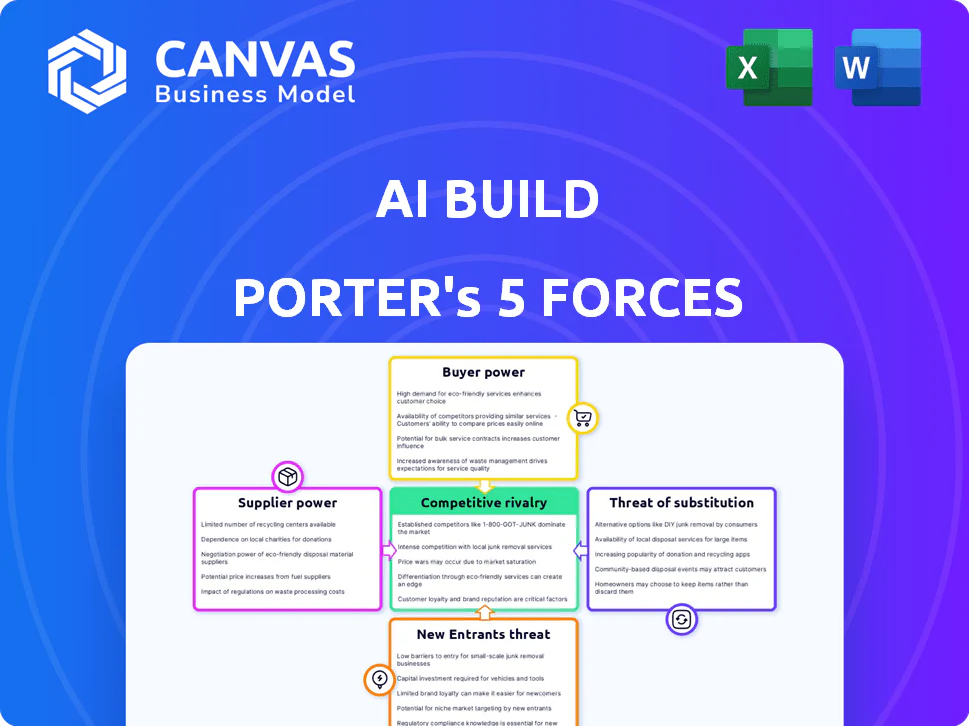
AI BUILD PORTER'S FIVE FORCES TEMPLATE RESEARCH
What is included in the product
 Detailed Word Document
Tailored exclusively for Ai Build, analyzing its position within its competitive landscape.

 Customizable Excel Spreadsheet
Instantly identify risks & opportunities with a dynamic, interactive Porter's Five Forces analysis.
Full Version Awaits
Ai Build Porter's Five Forces Analysis
This preview offers the complete Porter's Five Forces analysis. It meticulously examines Ai Build's competitive landscape. The document details threats of new entrants, bargaining power of suppliers and buyers, and rivalry. You're seeing the actual, final report you’ll receive immediately upon purchase.

Porter's Five Forces Analysis Template

Elevate Your Analysis with the Complete Porter's Five Forces Analysis
Ai Build faces a complex market landscape, shaped by various competitive forces. The threat of new entrants is moderate, given existing industry barriers. Supplier power is likely low due to diverse material sources. Buyer power varies by project size and client type, impacting pricing. Substitute products like traditional construction pose a constant challenge. Finally, existing competitors create strong rivalry.
This brief snapshot only scratches the surface. Unlock the full Porter's Five Forces Analysis to explore Ai Build’s competitive dynamics, market pressures, and strategic advantages in detail.
Suppliers Bargaining Power

Supplier Concentration
Supplier concentration is crucial; fewer suppliers mean more power. Consider specialized hardware, AI tools, and raw materials. If only a handful exist, they control pricing. For example, NVIDIA, a key AI hardware supplier, saw its revenue grow 265% in 2024.
Switching Costs
Switching costs significantly impact Ai Build's supplier bargaining power. If changing suppliers involves substantial expenses, like new software integration, this increases supplier influence. For instance, retraining staff on new materials can cost a lot. In 2024, software integration costs averaged $10,000-$50,000 for many businesses.

Supplier's Threat of Forward Integration
Assess if suppliers could enter the AM software market. If they can, their bargaining power over Ai Build rises. Consider if suppliers like material providers have the resources and know-how. In 2024, the 3D printing materials market was valued at $3.1 billion, showing supplier influence. Their forward integration would intensify competition.

Importance of Supplier's Input to Ai Build
Ai Build's reliance on suppliers significantly shapes its operations. If key components or software are sourced from a limited number of suppliers, those suppliers wield considerable power. This dependence can impact costs and innovation speed. Consider that in 2024, the AI hardware market, a critical supplier area, reached $30 billion, highlighting the stakes.
- High supplier concentration increases supplier power.
- Essential, unique components boost supplier influence.
- Supplier switching costs impact Ai Build's flexibility.
- Supplier-driven price hikes affect profitability.
Uniqueness of Supplier Offerings
The uniqueness of supplier offerings significantly impacts their bargaining power. If suppliers provide specialized inputs or hold proprietary technology, they gain substantial leverage. This is particularly true when alternatives are scarce or difficult to obtain. Suppliers with unique offerings can dictate terms and potentially increase prices. Consider the semiconductor industry, where specialized chip manufacturers wield significant power.
- Intel's dominance in CPUs allows it to influence pricing.
- ASML's monopoly on EUV lithography gives it pricing power.
- In 2024, the global semiconductor market is projected to reach $580 billion.
Supplier Power: A Critical Factor for Success
Supplier bargaining power is substantial if they are concentrated or offer unique components. High switching costs and potential forward integration by suppliers also increase their influence. Ai Build's reliance on key suppliers impacts costs and innovation.
| Factor | Impact on Ai Build | 2024 Data |
|---|---|---|
| Concentration | Higher supplier power | AI hardware market: $30B |
| Switching Costs | Reduced flexibility | Software integration: $10K-$50K |
| Uniqueness | Price control by suppliers | 3D printing materials: $3.1B |
Customers Bargaining Power

Customer Concentration
Customer concentration significantly impacts Ai Build's bargaining power. If a few major clients generate most of its revenue, those customers gain substantial leverage. For instance, if 70% of Ai Build's sales come from only three key clients, those clients can dictate prices. This can lead to reduced profit margins for Ai Build.
Switching Costs for Customers
Switching costs significantly impact customer bargaining power. If it's easy for customers to switch from Ai Build to a competitor, their power increases. Lower switching costs give customers more leverage to negotiate prices or demand better service. For example, in 2024, the average customer churn rate in the SaaS industry, which Ai Build operates in, was around 15%, reflecting moderate switching costs.

Customer's Threat of Backward Integration
Customers' bargaining power rises if they can create their own AI solutions. This threat is especially relevant for large manufacturers. For instance, in 2024, companies invested $15.9 billion in AI-driven manufacturing, suggesting a growing internal development capacity. If a company like Boeing decides to develop its AI in-house, it diminishes the need to buy from external providers like AI Build, thus increasing the bargaining power of customers.

Customer Information and Price Sensitivity
Customer information and price sensitivity are crucial. Customers' knowledge of alternatives and pricing greatly influences their bargaining power. Informed customers are highly price-sensitive, enabling them to negotiate better terms. For example, in 2024, the rise of online price comparison tools has significantly increased customer awareness. This shift has intensified price competition across various sectors, including e-commerce and travel.
- The proliferation of online reviews and comparison sites has empowered customers with instant access to pricing data.
- Industries with easily comparable products face higher customer bargaining power.
- Customer loyalty programs can mitigate price sensitivity to some extent.
- Businesses must differentiate their offerings to reduce customer price sensitivity.
Importance of Ai Build's Product to Customers
Ai Build's products can be critical for customers, especially if they drive significant efficiency and cost reductions. If customers are highly reliant on Ai Build's solutions for their manufacturing, their bargaining power might be somewhat limited. However, the availability of alternative solutions in the market plays a crucial role in influencing customer bargaining power. The competitive landscape is important.
- High reliance on Ai Build's tech can reduce customer bargaining power.
- Availability of alternatives in the market is key.
- Efficiency and cost savings are primary factors.
- Competitive landscape plays a crucial role.
Client Power Dynamics: Pricing at Risk
Customer concentration affects Ai Build's pricing power; few major clients increase their leverage. Easy switching and alternative options boost customer bargaining power. Informed, price-sensitive customers with options gain negotiating strength.
| Factor | Impact | Example (2024 Data) |
|---|---|---|
| Customer Concentration | High concentration = Higher customer power | If 3 clients = 70% revenue, they dictate prices. |
| Switching Costs | Low switching costs = Higher customer power | SaaS churn rate ~15%, moderate switching. |
| Alternatives | Availability of alternatives = Higher customer power | 2024: $15.9B in AI manufacturing investment. |
Rivalry Among Competitors

Number and Capability of Competitors
Key additive manufacturing AI competitors include Autodesk and Stratasys. A higher number of strong competitors increases competitive pressure. In 2024, Autodesk reported revenues of $5.5 billion. Ai Build actively competes, offering specialized solutions.
Industry Growth Rate
Industry growth significantly influences competitive rivalry. The additive manufacturing and AI markets are experiencing considerable expansion. The AI in construction market is forecasted to reach $2.8 billion by 2024. Rapid growth can lessen rivalry, while slow growth intensifies competition.

Product Differentiation
Ai Build's product differentiation is key in reducing price wars. Their focus on automating 3D printing for ease and sustainability sets them apart. The global 3D printing market was valued at $21.3 billion in 2023. Ai Build's intelligent solutions offer a unique advantage. This helps them compete without solely relying on price.

Switching Costs for Customers
Switching costs significantly impact competitive rivalry. When customers face low switching costs, rivalry intensifies because they can easily switch to competitors. This dynamic is evident in the airline industry, where frequent flyer programs offer incentives, but price remains a key driver. For instance, in 2024, budget airlines like Spirit and Frontier saw increased market share, highlighting the impact of low switching costs. Conversely, high switching costs, such as those in enterprise software with data migration complexities, can reduce rivalry.
- Low switching costs increase rivalry.
- High switching costs decrease rivalry.
- Budget airlines' market share increased in 2024.
- Enterprise software often has high switching costs.
Exit Barriers
Exit barriers significantly influence competitive rivalry. High barriers, like specialized assets or long-term contracts, keep firms in the market, even with low profits. This intensifies competition as companies fight for survival. For example, the airline industry faces high exit barriers due to aircraft ownership and lease agreements, contributing to fierce price wars. In 2024, the global airline industry's profitability remained under pressure, reflecting these challenges.
- High exit barriers increase competition.
- Specialized assets create difficulties.
- Long-term contracts also play a role.
- Airline industry is a great example.
Additive Manufacturing AI: Competitive Dynamics
Competitive rivalry in the additive manufacturing AI sector is shaped by several factors. The presence of strong competitors like Autodesk, which reported $5.5 billion in revenue in 2024, increases competitive pressure. Industry growth, with the AI in construction market projected to reach $2.8 billion by the end of 2024, can either ease or intensify this rivalry. Differentiation, such as Ai Build's focus on automation, helps avoid price wars.
| Factor | Impact on Rivalry | Example |
|---|---|---|
| Number of Competitors | More competitors increase rivalry | Autodesk, Stratasys |
| Industry Growth | Rapid growth can lessen rivalry | AI in construction market |
| Product Differentiation | Reduces price wars | Ai Build's automation focus |
AI BUILD PORTER'S FIVE FORCES TEMPLATE RESEARCH
What is included in the product
Detailed Word Document
Tailored exclusively for Ai Build, analyzing its position within its competitive landscape.
Customizable Excel Spreadsheet
Instantly identify risks & opportunities with a dynamic, interactive Porter's Five Forces analysis.
Full Version Awaits
Ai Build Porter's Five Forces Analysis
This preview offers the complete Porter's Five Forces analysis. It meticulously examines Ai Build's competitive landscape. The document details threats of new entrants, bargaining power of suppliers and buyers, and rivalry. You're seeing the actual, final report you’ll receive immediately upon purchase.
Porter's Five Forces Analysis Template
Elevate Your Analysis with the Complete Porter's Five Forces Analysis
Ai Build faces a complex market landscape, shaped by various competitive forces. The threat of new entrants is moderate, given existing industry barriers. Supplier power is likely low due to diverse material sources. Buyer power varies by project size and client type, impacting pricing. Substitute products like traditional construction pose a constant challenge. Finally, existing competitors create strong rivalry.
This brief snapshot only scratches the surface. Unlock the full Porter's Five Forces Analysis to explore Ai Build’s competitive dynamics, market pressures, and strategic advantages in detail.
Suppliers Bargaining Power
Supplier Concentration
Supplier concentration is crucial; fewer suppliers mean more power. Consider specialized hardware, AI tools, and raw materials. If only a handful exist, they control pricing. For example, NVIDIA, a key AI hardware supplier, saw its revenue grow 265% in 2024.
Switching Costs
Switching costs significantly impact Ai Build's supplier bargaining power. If changing suppliers involves substantial expenses, like new software integration, this increases supplier influence. For instance, retraining staff on new materials can cost a lot. In 2024, software integration costs averaged $10,000-$50,000 for many businesses.
Supplier's Threat of Forward Integration
Assess if suppliers could enter the AM software market. If they can, their bargaining power over Ai Build rises. Consider if suppliers like material providers have the resources and know-how. In 2024, the 3D printing materials market was valued at $3.1 billion, showing supplier influence. Their forward integration would intensify competition.
Importance of Supplier's Input to Ai Build
Ai Build's reliance on suppliers significantly shapes its operations. If key components or software are sourced from a limited number of suppliers, those suppliers wield considerable power. This dependence can impact costs and innovation speed. Consider that in 2024, the AI hardware market, a critical supplier area, reached $30 billion, highlighting the stakes.
- High supplier concentration increases supplier power.
- Essential, unique components boost supplier influence.
- Supplier switching costs impact Ai Build's flexibility.
- Supplier-driven price hikes affect profitability.
Uniqueness of Supplier Offerings
The uniqueness of supplier offerings significantly impacts their bargaining power. If suppliers provide specialized inputs or hold proprietary technology, they gain substantial leverage. This is particularly true when alternatives are scarce or difficult to obtain. Suppliers with unique offerings can dictate terms and potentially increase prices. Consider the semiconductor industry, where specialized chip manufacturers wield significant power.
- Intel's dominance in CPUs allows it to influence pricing.
- ASML's monopoly on EUV lithography gives it pricing power.
- In 2024, the global semiconductor market is projected to reach $580 billion.
Supplier Power: A Critical Factor for Success
Supplier bargaining power is substantial if they are concentrated or offer unique components. High switching costs and potential forward integration by suppliers also increase their influence. Ai Build's reliance on key suppliers impacts costs and innovation.
| Factor | Impact on Ai Build | 2024 Data |
|---|---|---|
| Concentration | Higher supplier power | AI hardware market: $30B |
| Switching Costs | Reduced flexibility | Software integration: $10K-$50K |
| Uniqueness | Price control by suppliers | 3D printing materials: $3.1B |
Customers Bargaining Power
Customer Concentration
Customer concentration significantly impacts Ai Build's bargaining power. If a few major clients generate most of its revenue, those customers gain substantial leverage. For instance, if 70% of Ai Build's sales come from only three key clients, those clients can dictate prices. This can lead to reduced profit margins for Ai Build.
Switching Costs for Customers
Switching costs significantly impact customer bargaining power. If it's easy for customers to switch from Ai Build to a competitor, their power increases. Lower switching costs give customers more leverage to negotiate prices or demand better service. For example, in 2024, the average customer churn rate in the SaaS industry, which Ai Build operates in, was around 15%, reflecting moderate switching costs.
Customer's Threat of Backward Integration
Customers' bargaining power rises if they can create their own AI solutions. This threat is especially relevant for large manufacturers. For instance, in 2024, companies invested $15.9 billion in AI-driven manufacturing, suggesting a growing internal development capacity. If a company like Boeing decides to develop its AI in-house, it diminishes the need to buy from external providers like AI Build, thus increasing the bargaining power of customers.
Customer Information and Price Sensitivity
Customer information and price sensitivity are crucial. Customers' knowledge of alternatives and pricing greatly influences their bargaining power. Informed customers are highly price-sensitive, enabling them to negotiate better terms. For example, in 2024, the rise of online price comparison tools has significantly increased customer awareness. This shift has intensified price competition across various sectors, including e-commerce and travel.
- The proliferation of online reviews and comparison sites has empowered customers with instant access to pricing data.
- Industries with easily comparable products face higher customer bargaining power.
- Customer loyalty programs can mitigate price sensitivity to some extent.
- Businesses must differentiate their offerings to reduce customer price sensitivity.
Importance of Ai Build's Product to Customers
Ai Build's products can be critical for customers, especially if they drive significant efficiency and cost reductions. If customers are highly reliant on Ai Build's solutions for their manufacturing, their bargaining power might be somewhat limited. However, the availability of alternative solutions in the market plays a crucial role in influencing customer bargaining power. The competitive landscape is important.
- High reliance on Ai Build's tech can reduce customer bargaining power.
- Availability of alternatives in the market is key.
- Efficiency and cost savings are primary factors.
- Competitive landscape plays a crucial role.
Client Power Dynamics: Pricing at Risk
Customer concentration affects Ai Build's pricing power; few major clients increase their leverage. Easy switching and alternative options boost customer bargaining power. Informed, price-sensitive customers with options gain negotiating strength.
| Factor | Impact | Example (2024 Data) |
|---|---|---|
| Customer Concentration | High concentration = Higher customer power | If 3 clients = 70% revenue, they dictate prices. |
| Switching Costs | Low switching costs = Higher customer power | SaaS churn rate ~15%, moderate switching. |
| Alternatives | Availability of alternatives = Higher customer power | 2024: $15.9B in AI manufacturing investment. |
Rivalry Among Competitors
Number and Capability of Competitors
Key additive manufacturing AI competitors include Autodesk and Stratasys. A higher number of strong competitors increases competitive pressure. In 2024, Autodesk reported revenues of $5.5 billion. Ai Build actively competes, offering specialized solutions.
Industry Growth Rate
Industry growth significantly influences competitive rivalry. The additive manufacturing and AI markets are experiencing considerable expansion. The AI in construction market is forecasted to reach $2.8 billion by 2024. Rapid growth can lessen rivalry, while slow growth intensifies competition.
Product Differentiation
Ai Build's product differentiation is key in reducing price wars. Their focus on automating 3D printing for ease and sustainability sets them apart. The global 3D printing market was valued at $21.3 billion in 2023. Ai Build's intelligent solutions offer a unique advantage. This helps them compete without solely relying on price.
Switching Costs for Customers
Switching costs significantly impact competitive rivalry. When customers face low switching costs, rivalry intensifies because they can easily switch to competitors. This dynamic is evident in the airline industry, where frequent flyer programs offer incentives, but price remains a key driver. For instance, in 2024, budget airlines like Spirit and Frontier saw increased market share, highlighting the impact of low switching costs. Conversely, high switching costs, such as those in enterprise software with data migration complexities, can reduce rivalry.
- Low switching costs increase rivalry.
- High switching costs decrease rivalry.
- Budget airlines' market share increased in 2024.
- Enterprise software often has high switching costs.
Exit Barriers
Exit barriers significantly influence competitive rivalry. High barriers, like specialized assets or long-term contracts, keep firms in the market, even with low profits. This intensifies competition as companies fight for survival. For example, the airline industry faces high exit barriers due to aircraft ownership and lease agreements, contributing to fierce price wars. In 2024, the global airline industry's profitability remained under pressure, reflecting these challenges.
- High exit barriers increase competition.
- Specialized assets create difficulties.
- Long-term contracts also play a role.
- Airline industry is a great example.
Additive Manufacturing AI: Competitive Dynamics
Competitive rivalry in the additive manufacturing AI sector is shaped by several factors. The presence of strong competitors like Autodesk, which reported $5.5 billion in revenue in 2024, increases competitive pressure. Industry growth, with the AI in construction market projected to reach $2.8 billion by the end of 2024, can either ease or intensify this rivalry. Differentiation, such as Ai Build's focus on automation, helps avoid price wars.
| Factor | Impact on Rivalry | Example |
|---|---|---|
| Number of Competitors | More competitors increase rivalry | Autodesk, Stratasys |
| Industry Growth | Rapid growth can lessen rivalry | AI in construction market |
| Product Differentiation | Reduces price wars | Ai Build's automation focus |
Product Information
Product Information
Shipping & Returns
Shipping & Returns
Description
What is included in the product
Detailed Word Document
Tailored exclusively for Ai Build, analyzing its position within its competitive landscape.
Customizable Excel Spreadsheet
Instantly identify risks & opportunities with a dynamic, interactive Porter's Five Forces analysis.
Full Version Awaits
Ai Build Porter's Five Forces Analysis
This preview offers the complete Porter's Five Forces analysis. It meticulously examines Ai Build's competitive landscape. The document details threats of new entrants, bargaining power of suppliers and buyers, and rivalry. You're seeing the actual, final report you’ll receive immediately upon purchase.
Porter's Five Forces Analysis Template
Elevate Your Analysis with the Complete Porter's Five Forces Analysis
Ai Build faces a complex market landscape, shaped by various competitive forces. The threat of new entrants is moderate, given existing industry barriers. Supplier power is likely low due to diverse material sources. Buyer power varies by project size and client type, impacting pricing. Substitute products like traditional construction pose a constant challenge. Finally, existing competitors create strong rivalry.
This brief snapshot only scratches the surface. Unlock the full Porter's Five Forces Analysis to explore Ai Build’s competitive dynamics, market pressures, and strategic advantages in detail.
Suppliers Bargaining Power
Supplier Concentration
Supplier concentration is crucial; fewer suppliers mean more power. Consider specialized hardware, AI tools, and raw materials. If only a handful exist, they control pricing. For example, NVIDIA, a key AI hardware supplier, saw its revenue grow 265% in 2024.
Switching Costs
Switching costs significantly impact Ai Build's supplier bargaining power. If changing suppliers involves substantial expenses, like new software integration, this increases supplier influence. For instance, retraining staff on new materials can cost a lot. In 2024, software integration costs averaged $10,000-$50,000 for many businesses.
Supplier's Threat of Forward Integration
Assess if suppliers could enter the AM software market. If they can, their bargaining power over Ai Build rises. Consider if suppliers like material providers have the resources and know-how. In 2024, the 3D printing materials market was valued at $3.1 billion, showing supplier influence. Their forward integration would intensify competition.
Importance of Supplier's Input to Ai Build
Ai Build's reliance on suppliers significantly shapes its operations. If key components or software are sourced from a limited number of suppliers, those suppliers wield considerable power. This dependence can impact costs and innovation speed. Consider that in 2024, the AI hardware market, a critical supplier area, reached $30 billion, highlighting the stakes.
- High supplier concentration increases supplier power.
- Essential, unique components boost supplier influence.
- Supplier switching costs impact Ai Build's flexibility.
- Supplier-driven price hikes affect profitability.
Uniqueness of Supplier Offerings
The uniqueness of supplier offerings significantly impacts their bargaining power. If suppliers provide specialized inputs or hold proprietary technology, they gain substantial leverage. This is particularly true when alternatives are scarce or difficult to obtain. Suppliers with unique offerings can dictate terms and potentially increase prices. Consider the semiconductor industry, where specialized chip manufacturers wield significant power.
- Intel's dominance in CPUs allows it to influence pricing.
- ASML's monopoly on EUV lithography gives it pricing power.
- In 2024, the global semiconductor market is projected to reach $580 billion.
Supplier Power: A Critical Factor for Success
Supplier bargaining power is substantial if they are concentrated or offer unique components. High switching costs and potential forward integration by suppliers also increase their influence. Ai Build's reliance on key suppliers impacts costs and innovation.
| Factor | Impact on Ai Build | 2024 Data |
|---|---|---|
| Concentration | Higher supplier power | AI hardware market: $30B |
| Switching Costs | Reduced flexibility | Software integration: $10K-$50K |
| Uniqueness | Price control by suppliers | 3D printing materials: $3.1B |
Customers Bargaining Power
Customer Concentration
Customer concentration significantly impacts Ai Build's bargaining power. If a few major clients generate most of its revenue, those customers gain substantial leverage. For instance, if 70% of Ai Build's sales come from only three key clients, those clients can dictate prices. This can lead to reduced profit margins for Ai Build.
Switching Costs for Customers
Switching costs significantly impact customer bargaining power. If it's easy for customers to switch from Ai Build to a competitor, their power increases. Lower switching costs give customers more leverage to negotiate prices or demand better service. For example, in 2024, the average customer churn rate in the SaaS industry, which Ai Build operates in, was around 15%, reflecting moderate switching costs.
Customer's Threat of Backward Integration
Customers' bargaining power rises if they can create their own AI solutions. This threat is especially relevant for large manufacturers. For instance, in 2024, companies invested $15.9 billion in AI-driven manufacturing, suggesting a growing internal development capacity. If a company like Boeing decides to develop its AI in-house, it diminishes the need to buy from external providers like AI Build, thus increasing the bargaining power of customers.
Customer Information and Price Sensitivity
Customer information and price sensitivity are crucial. Customers' knowledge of alternatives and pricing greatly influences their bargaining power. Informed customers are highly price-sensitive, enabling them to negotiate better terms. For example, in 2024, the rise of online price comparison tools has significantly increased customer awareness. This shift has intensified price competition across various sectors, including e-commerce and travel.
- The proliferation of online reviews and comparison sites has empowered customers with instant access to pricing data.
- Industries with easily comparable products face higher customer bargaining power.
- Customer loyalty programs can mitigate price sensitivity to some extent.
- Businesses must differentiate their offerings to reduce customer price sensitivity.
Importance of Ai Build's Product to Customers
Ai Build's products can be critical for customers, especially if they drive significant efficiency and cost reductions. If customers are highly reliant on Ai Build's solutions for their manufacturing, their bargaining power might be somewhat limited. However, the availability of alternative solutions in the market plays a crucial role in influencing customer bargaining power. The competitive landscape is important.
- High reliance on Ai Build's tech can reduce customer bargaining power.
- Availability of alternatives in the market is key.
- Efficiency and cost savings are primary factors.
- Competitive landscape plays a crucial role.
Client Power Dynamics: Pricing at Risk
Customer concentration affects Ai Build's pricing power; few major clients increase their leverage. Easy switching and alternative options boost customer bargaining power. Informed, price-sensitive customers with options gain negotiating strength.
| Factor | Impact | Example (2024 Data) |
|---|---|---|
| Customer Concentration | High concentration = Higher customer power | If 3 clients = 70% revenue, they dictate prices. |
| Switching Costs | Low switching costs = Higher customer power | SaaS churn rate ~15%, moderate switching. |
| Alternatives | Availability of alternatives = Higher customer power | 2024: $15.9B in AI manufacturing investment. |
Rivalry Among Competitors
Number and Capability of Competitors
Key additive manufacturing AI competitors include Autodesk and Stratasys. A higher number of strong competitors increases competitive pressure. In 2024, Autodesk reported revenues of $5.5 billion. Ai Build actively competes, offering specialized solutions.
Industry Growth Rate
Industry growth significantly influences competitive rivalry. The additive manufacturing and AI markets are experiencing considerable expansion. The AI in construction market is forecasted to reach $2.8 billion by 2024. Rapid growth can lessen rivalry, while slow growth intensifies competition.
Product Differentiation
Ai Build's product differentiation is key in reducing price wars. Their focus on automating 3D printing for ease and sustainability sets them apart. The global 3D printing market was valued at $21.3 billion in 2023. Ai Build's intelligent solutions offer a unique advantage. This helps them compete without solely relying on price.
Switching Costs for Customers
Switching costs significantly impact competitive rivalry. When customers face low switching costs, rivalry intensifies because they can easily switch to competitors. This dynamic is evident in the airline industry, where frequent flyer programs offer incentives, but price remains a key driver. For instance, in 2024, budget airlines like Spirit and Frontier saw increased market share, highlighting the impact of low switching costs. Conversely, high switching costs, such as those in enterprise software with data migration complexities, can reduce rivalry.
- Low switching costs increase rivalry.
- High switching costs decrease rivalry.
- Budget airlines' market share increased in 2024.
- Enterprise software often has high switching costs.
Exit Barriers
Exit barriers significantly influence competitive rivalry. High barriers, like specialized assets or long-term contracts, keep firms in the market, even with low profits. This intensifies competition as companies fight for survival. For example, the airline industry faces high exit barriers due to aircraft ownership and lease agreements, contributing to fierce price wars. In 2024, the global airline industry's profitability remained under pressure, reflecting these challenges.
- High exit barriers increase competition.
- Specialized assets create difficulties.
- Long-term contracts also play a role.
- Airline industry is a great example.
Additive Manufacturing AI: Competitive Dynamics
Competitive rivalry in the additive manufacturing AI sector is shaped by several factors. The presence of strong competitors like Autodesk, which reported $5.5 billion in revenue in 2024, increases competitive pressure. Industry growth, with the AI in construction market projected to reach $2.8 billion by the end of 2024, can either ease or intensify this rivalry. Differentiation, such as Ai Build's focus on automation, helps avoid price wars.
| Factor | Impact on Rivalry | Example |
|---|---|---|
| Number of Competitors | More competitors increase rivalry | Autodesk, Stratasys |
| Industry Growth | Rapid growth can lessen rivalry | AI in construction market |
| Product Differentiation | Reduces price wars | Ai Build's automation focus |











