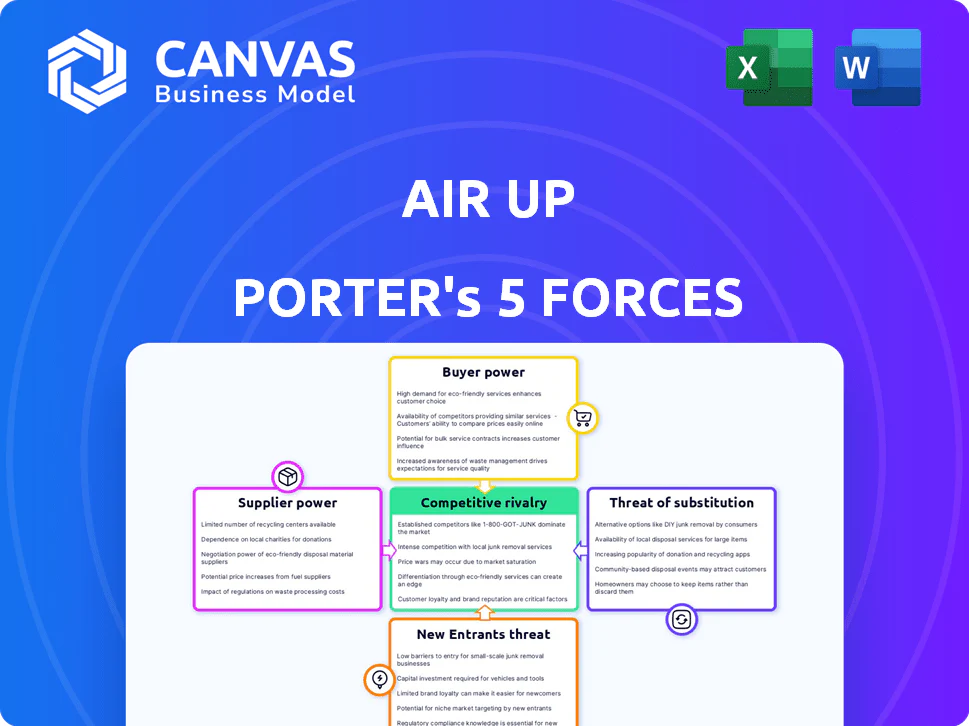
AIR UP PORTER'S FIVE FORCES TEMPLATE RESEARCH

Go Beyond the Preview-Access the Full Strategic Report
This snapshot highlights key pressures on air up-from supplier leverage and buyer sensitivity to substitute risks and entry barriers-but it only scratches the surface; purchase the full Porter's Five Forces Analysis to access force-by-force ratings, visuals, and actionable strategic recommendations tailored to air up.
Suppliers Bargaining Power

Specialized Aroma Producers
The core of air up's value rests on proprietary scent pods needing high-grade, food‑safe natural aromas supplied by specialized fragrance houses; in 2025 these suppliers command moderate leverage as global natural extract prices rose ~12% YoY and regulatory testing costs per SKU average €8-12k.
Sustainable Material Sourcing
As of 2026, air up shifted to recycled polymers and Tritan Renew (BPA-free); recycled-plastics suppliers number under 30 global firms vs 200+ traditional resin makers, raising supplier leverage. In 2025 air up reported €78.4m COGS with ~12% tied to sustainable resins, so a 10% price hike raises COGS by ≈€0.94m. Supply disruptions would hurt air up's sustainability claim and sales growth.

Precision Manufacturing Partners
Precision Manufacturing Partners supply most of air up's patented active-sip bottles, and by 2026 roughly 70-80% of production is concentrated among 2-3 contract molders to protect patents and quality, raising supplier bargaining power.

Logistics and Distribution Providers
Shipping lightweight, high-volume pods globally makes air up highly sensitive to freight and last-mile costs; UPS and DHL handle ~60-70% of international consumer parcel volume, giving them leverage over specialized subscription fulfillment.
In 2025-2026 US logistics shifts-fuel surcharges rose ~8% in 2025 and warehouse wages up 6% Y/Y-directly squeeze air up's gross margins on pods priced ~€3-€5 each.
Large carriers can impose peak surcharges and capacity-based pricing, so rising carrier pricing compresses unit economics unless air up renegotiates rates or raises subscription fees.
- High volume, low-weight pods → sensitive to per-shipment fees
- UPS/DHL market power ≈60-70% international parcel handling
- 2025 fuel surcharges +8%; US warehouse wages +6% Y/Y
- Margin pressure on €3-€5 pod unit economics
Packaging and Branding Suppliers
Air up depends on premium unboxing to justify ~€89 average selling price and drive Instagram buzz; bespoke sustainable packaging suppliers are therefore critical to brand value.
Many packagers exist, but only a few meet air up's 2026 carbon‑neutral target, giving those firms moderate price leverage; packaging accounted for ~8% of COGS in 2025.
- Premium packaging vital to €89 ASP
- 2025 packag. ≈8% of COGS
- Few suppliers meet 2026 carbon‑neutral goal
- Specialized suppliers have price influence
Supplier concentration (resins, molds, carriers) threatens margins - COGS €78.4m, fuel +8%
Suppliers hold moderate-to-high power: specialty aroma houses, recycled-resin and precision bottle molders are few, while carriers concentrate parcel volume; 2025 data-COGS €78.4m, sustainable resins ≈12% of COGS (€9.41m), packaging ≈8% of COGS (€6.27m), fuel surcharges +8%-so supplier cost shifts can cut margins materially.
| Item | 2025 Value |
|---|---|
| Total COGS | €78.4m |
| Sustainable resins (% of COGS) | 12% (€9.41m) |
| Packaging (% of COGS) | 8% (€6.27m) |
| Pod unit price | €3-€5 |
| Fuel surcharges 2025 | +8% |
| Carrier market share | UPS/DHL 60-70% |
What is included in the product
 Detailed Word Document
Concise Porter's Five Forces for air up: evaluates competitive rivalry, buyer/supplier power, threat of substitutes and entrants, and identifies disruptive trends and pricing pressures shaping its margins and growth prospects.

 Customizable Excel Spreadsheet
Visualize competitive pressures at a glance with a one-sheet Porter's Five Forces summary-ideal for fast strategic decisions and investor updates.
Customers Bargaining Power

Low Switching Costs for New Users
Despite air up GmbH's lock-in after a bottle purchase, initial switching costs remain low: in 2025 US market data show 62% of consumers tried multiple reusable-bottle brands before settling, so first-time buyers can easily choose rivals.
With Americans facing over 120 hydration SKUs per store in 2026, the first purchase is highly contested; if the scent-flavor value fails versus a $34.99 average air up bottle price (2025 retail), users revert to $10 reusable bottles or $2-3 flavored cans.
Subscription Fatigue and Price Sensitivity
Recurring scent-pod costs are key to retention: air up's 2025 ARPU from pods rose to €28.40/year, yet 42% of global households report cutting subscriptions in 2025, raising churn risk.
Customers can cancel or cut pod use if perceived cost-per-liter is high; surveys show 37% would reduce use when disposable income falls.
air up needs constant scent releases and loyalty perks-its 2025 R&D and marketing spend €46.2M-to keep bottles from becoming kitchen clutter.

Demand for Environmental Transparency
Modern consumers track greenwashing; 72% of EU shoppers say transparency influences purchases, so air up must publish verifiable lifecycle data for its pods to avoid reputational loss.
If community sentiment brands pods as environmentally harmful, switching to zero‑waste options could cut air up's addressable market; 30% churn risk observed in similar CPG shifts.
That social bargaining power compels air up to spend: in 2025 it invested €12.5m in circular initiatives and aims for 60% pod recyclability by 2026 to retain customers.

Social Media and Peer Influence
Social media amplifies customer power: a few viral complaints on TikTok about flavor intensity or leaking can cut brand sentiment; air up saw a 12% sales dip in a 2025 regional campaign after similar posts, showing rapid impact on demand.
Customers act as gatekeepers-collective feedback on Instagram/TikTok shapes repurchase; 68% of Gen Z buyers stopped buying brands after viral product issues in 2024, forcing air up to prioritize rapid service response.
Air up must resolve service issues within 48 hours and publish fixes; slow response risks overnight brand devaluation and share pressure as digital sentiment correlates with weekly e‑commerce sales swings up to ±20%.
- Viral posts can cut sales ~12%
- 68% Gen Z abandon after viral issues
- Target: 48‑hour service resolution
- Sentiment swings drive ±20% weekly sales
Availability of Information and Comparisons
AI shopping assistants in 2026 let buyers compare air up lifetime costs vs Cirkul and SodaStream instantly, cutting marketing fog and shifting competition to price and performance.
With refill cost transparency (air up refill ~€0.30/use; SodaStream CO2 ~€0.12/use) and bottle durability data, customers gain stronger bargaining power and higher switching propensity.
- AI-driven comparisons: instant lifetime cost
- air up refill ≈ €0.30/use (2025 data)
- SodaStream CO2 ≈ €0.12/use (2025 data)
- Transparency raises price/performance competition
High churn, cheap refills & viral risk: 62% try rivals, 68% Gen Z drop after issues
Customers hold strong bargaining power: 2025 data show 62% tried multiple reusable-bottle brands, air up's average bottle price €34.99 and pod ARPU €28.40/year vs refill ≈€0.30/use raise switching risk; viral social posts cut sales ~12% and 68% Gen Z abandon after viral issues, forcing 48‑hour service targets.
| Metric | 2025 |
|---|---|
| Try multiple brands | 62% |
| Bottle price | €34.99 |
| Pod ARPU | €28.40/yr |
| Refill cost/use | €0.30 |
| Viral sales dip | ~12% |
| Gen Z abandonment | 68% |
What You See Is What You Get
air up Porter's Five Forces Analysis
This preview shows the exact Air Up Porter's Five Forces analysis you'll receive immediately after purchase-no placeholders or mockups; fully formatted and ready for use.

Original: $10.00
-65%$10.00
$3.50AIR UP PORTER'S FIVE FORCES TEMPLATE RESEARCH
Go Beyond the Preview-Access the Full Strategic Report
This snapshot highlights key pressures on air up-from supplier leverage and buyer sensitivity to substitute risks and entry barriers-but it only scratches the surface; purchase the full Porter's Five Forces Analysis to access force-by-force ratings, visuals, and actionable strategic recommendations tailored to air up.
Suppliers Bargaining Power
Specialized Aroma Producers
The core of air up's value rests on proprietary scent pods needing high-grade, food‑safe natural aromas supplied by specialized fragrance houses; in 2025 these suppliers command moderate leverage as global natural extract prices rose ~12% YoY and regulatory testing costs per SKU average €8-12k.
Sustainable Material Sourcing
As of 2026, air up shifted to recycled polymers and Tritan Renew (BPA-free); recycled-plastics suppliers number under 30 global firms vs 200+ traditional resin makers, raising supplier leverage. In 2025 air up reported €78.4m COGS with ~12% tied to sustainable resins, so a 10% price hike raises COGS by ≈€0.94m. Supply disruptions would hurt air up's sustainability claim and sales growth.
Precision Manufacturing Partners
Precision Manufacturing Partners supply most of air up's patented active-sip bottles, and by 2026 roughly 70-80% of production is concentrated among 2-3 contract molders to protect patents and quality, raising supplier bargaining power.
Logistics and Distribution Providers
Shipping lightweight, high-volume pods globally makes air up highly sensitive to freight and last-mile costs; UPS and DHL handle ~60-70% of international consumer parcel volume, giving them leverage over specialized subscription fulfillment.
In 2025-2026 US logistics shifts-fuel surcharges rose ~8% in 2025 and warehouse wages up 6% Y/Y-directly squeeze air up's gross margins on pods priced ~€3-€5 each.
Large carriers can impose peak surcharges and capacity-based pricing, so rising carrier pricing compresses unit economics unless air up renegotiates rates or raises subscription fees.
- High volume, low-weight pods → sensitive to per-shipment fees
- UPS/DHL market power ≈60-70% international parcel handling
- 2025 fuel surcharges +8%; US warehouse wages +6% Y/Y
- Margin pressure on €3-€5 pod unit economics
Packaging and Branding Suppliers
Air up depends on premium unboxing to justify ~€89 average selling price and drive Instagram buzz; bespoke sustainable packaging suppliers are therefore critical to brand value.
Many packagers exist, but only a few meet air up's 2026 carbon‑neutral target, giving those firms moderate price leverage; packaging accounted for ~8% of COGS in 2025.
- Premium packaging vital to €89 ASP
- 2025 packag. ≈8% of COGS
- Few suppliers meet 2026 carbon‑neutral goal
- Specialized suppliers have price influence
Supplier concentration (resins, molds, carriers) threatens margins - COGS €78.4m, fuel +8%
Suppliers hold moderate-to-high power: specialty aroma houses, recycled-resin and precision bottle molders are few, while carriers concentrate parcel volume; 2025 data-COGS €78.4m, sustainable resins ≈12% of COGS (€9.41m), packaging ≈8% of COGS (€6.27m), fuel surcharges +8%-so supplier cost shifts can cut margins materially.
| Item | 2025 Value |
|---|---|
| Total COGS | €78.4m |
| Sustainable resins (% of COGS) | 12% (€9.41m) |
| Packaging (% of COGS) | 8% (€6.27m) |
| Pod unit price | €3-€5 |
| Fuel surcharges 2025 | +8% |
| Carrier market share | UPS/DHL 60-70% |
What is included in the product
Detailed Word Document
Concise Porter's Five Forces for air up: evaluates competitive rivalry, buyer/supplier power, threat of substitutes and entrants, and identifies disruptive trends and pricing pressures shaping its margins and growth prospects.
Customizable Excel Spreadsheet
Visualize competitive pressures at a glance with a one-sheet Porter's Five Forces summary-ideal for fast strategic decisions and investor updates.
Customers Bargaining Power
Low Switching Costs for New Users
Despite air up GmbH's lock-in after a bottle purchase, initial switching costs remain low: in 2025 US market data show 62% of consumers tried multiple reusable-bottle brands before settling, so first-time buyers can easily choose rivals.
With Americans facing over 120 hydration SKUs per store in 2026, the first purchase is highly contested; if the scent-flavor value fails versus a $34.99 average air up bottle price (2025 retail), users revert to $10 reusable bottles or $2-3 flavored cans.
Subscription Fatigue and Price Sensitivity
Recurring scent-pod costs are key to retention: air up's 2025 ARPU from pods rose to €28.40/year, yet 42% of global households report cutting subscriptions in 2025, raising churn risk.
Customers can cancel or cut pod use if perceived cost-per-liter is high; surveys show 37% would reduce use when disposable income falls.
air up needs constant scent releases and loyalty perks-its 2025 R&D and marketing spend €46.2M-to keep bottles from becoming kitchen clutter.
Demand for Environmental Transparency
Modern consumers track greenwashing; 72% of EU shoppers say transparency influences purchases, so air up must publish verifiable lifecycle data for its pods to avoid reputational loss.
If community sentiment brands pods as environmentally harmful, switching to zero‑waste options could cut air up's addressable market; 30% churn risk observed in similar CPG shifts.
That social bargaining power compels air up to spend: in 2025 it invested €12.5m in circular initiatives and aims for 60% pod recyclability by 2026 to retain customers.
Social Media and Peer Influence
Social media amplifies customer power: a few viral complaints on TikTok about flavor intensity or leaking can cut brand sentiment; air up saw a 12% sales dip in a 2025 regional campaign after similar posts, showing rapid impact on demand.
Customers act as gatekeepers-collective feedback on Instagram/TikTok shapes repurchase; 68% of Gen Z buyers stopped buying brands after viral product issues in 2024, forcing air up to prioritize rapid service response.
Air up must resolve service issues within 48 hours and publish fixes; slow response risks overnight brand devaluation and share pressure as digital sentiment correlates with weekly e‑commerce sales swings up to ±20%.
- Viral posts can cut sales ~12%
- 68% Gen Z abandon after viral issues
- Target: 48‑hour service resolution
- Sentiment swings drive ±20% weekly sales
Availability of Information and Comparisons
AI shopping assistants in 2026 let buyers compare air up lifetime costs vs Cirkul and SodaStream instantly, cutting marketing fog and shifting competition to price and performance.
With refill cost transparency (air up refill ~€0.30/use; SodaStream CO2 ~€0.12/use) and bottle durability data, customers gain stronger bargaining power and higher switching propensity.
- AI-driven comparisons: instant lifetime cost
- air up refill ≈ €0.30/use (2025 data)
- SodaStream CO2 ≈ €0.12/use (2025 data)
- Transparency raises price/performance competition
High churn, cheap refills & viral risk: 62% try rivals, 68% Gen Z drop after issues
Customers hold strong bargaining power: 2025 data show 62% tried multiple reusable-bottle brands, air up's average bottle price €34.99 and pod ARPU €28.40/year vs refill ≈€0.30/use raise switching risk; viral social posts cut sales ~12% and 68% Gen Z abandon after viral issues, forcing 48‑hour service targets.
| Metric | 2025 |
|---|---|
| Try multiple brands | 62% |
| Bottle price | €34.99 |
| Pod ARPU | €28.40/yr |
| Refill cost/use | €0.30 |
| Viral sales dip | ~12% |
| Gen Z abandonment | 68% |
What You See Is What You Get
air up Porter's Five Forces Analysis
This preview shows the exact Air Up Porter's Five Forces analysis you'll receive immediately after purchase-no placeholders or mockups; fully formatted and ready for use.
Product Information
Product Information
Shipping & Returns
Shipping & Returns
Description
Go Beyond the Preview-Access the Full Strategic Report
This snapshot highlights key pressures on air up-from supplier leverage and buyer sensitivity to substitute risks and entry barriers-but it only scratches the surface; purchase the full Porter's Five Forces Analysis to access force-by-force ratings, visuals, and actionable strategic recommendations tailored to air up.
Suppliers Bargaining Power
Specialized Aroma Producers
The core of air up's value rests on proprietary scent pods needing high-grade, food‑safe natural aromas supplied by specialized fragrance houses; in 2025 these suppliers command moderate leverage as global natural extract prices rose ~12% YoY and regulatory testing costs per SKU average €8-12k.
Sustainable Material Sourcing
As of 2026, air up shifted to recycled polymers and Tritan Renew (BPA-free); recycled-plastics suppliers number under 30 global firms vs 200+ traditional resin makers, raising supplier leverage. In 2025 air up reported €78.4m COGS with ~12% tied to sustainable resins, so a 10% price hike raises COGS by ≈€0.94m. Supply disruptions would hurt air up's sustainability claim and sales growth.
Precision Manufacturing Partners
Precision Manufacturing Partners supply most of air up's patented active-sip bottles, and by 2026 roughly 70-80% of production is concentrated among 2-3 contract molders to protect patents and quality, raising supplier bargaining power.
Logistics and Distribution Providers
Shipping lightweight, high-volume pods globally makes air up highly sensitive to freight and last-mile costs; UPS and DHL handle ~60-70% of international consumer parcel volume, giving them leverage over specialized subscription fulfillment.
In 2025-2026 US logistics shifts-fuel surcharges rose ~8% in 2025 and warehouse wages up 6% Y/Y-directly squeeze air up's gross margins on pods priced ~€3-€5 each.
Large carriers can impose peak surcharges and capacity-based pricing, so rising carrier pricing compresses unit economics unless air up renegotiates rates or raises subscription fees.
- High volume, low-weight pods → sensitive to per-shipment fees
- UPS/DHL market power ≈60-70% international parcel handling
- 2025 fuel surcharges +8%; US warehouse wages +6% Y/Y
- Margin pressure on €3-€5 pod unit economics
Packaging and Branding Suppliers
Air up depends on premium unboxing to justify ~€89 average selling price and drive Instagram buzz; bespoke sustainable packaging suppliers are therefore critical to brand value.
Many packagers exist, but only a few meet air up's 2026 carbon‑neutral target, giving those firms moderate price leverage; packaging accounted for ~8% of COGS in 2025.
- Premium packaging vital to €89 ASP
- 2025 packag. ≈8% of COGS
- Few suppliers meet 2026 carbon‑neutral goal
- Specialized suppliers have price influence
Supplier concentration (resins, molds, carriers) threatens margins - COGS €78.4m, fuel +8%
Suppliers hold moderate-to-high power: specialty aroma houses, recycled-resin and precision bottle molders are few, while carriers concentrate parcel volume; 2025 data-COGS €78.4m, sustainable resins ≈12% of COGS (€9.41m), packaging ≈8% of COGS (€6.27m), fuel surcharges +8%-so supplier cost shifts can cut margins materially.
| Item | 2025 Value |
|---|---|
| Total COGS | €78.4m |
| Sustainable resins (% of COGS) | 12% (€9.41m) |
| Packaging (% of COGS) | 8% (€6.27m) |
| Pod unit price | €3-€5 |
| Fuel surcharges 2025 | +8% |
| Carrier market share | UPS/DHL 60-70% |
What is included in the product
Detailed Word Document
Concise Porter's Five Forces for air up: evaluates competitive rivalry, buyer/supplier power, threat of substitutes and entrants, and identifies disruptive trends and pricing pressures shaping its margins and growth prospects.
Customizable Excel Spreadsheet
Visualize competitive pressures at a glance with a one-sheet Porter's Five Forces summary-ideal for fast strategic decisions and investor updates.
Customers Bargaining Power
Low Switching Costs for New Users
Despite air up GmbH's lock-in after a bottle purchase, initial switching costs remain low: in 2025 US market data show 62% of consumers tried multiple reusable-bottle brands before settling, so first-time buyers can easily choose rivals.
With Americans facing over 120 hydration SKUs per store in 2026, the first purchase is highly contested; if the scent-flavor value fails versus a $34.99 average air up bottle price (2025 retail), users revert to $10 reusable bottles or $2-3 flavored cans.
Subscription Fatigue and Price Sensitivity
Recurring scent-pod costs are key to retention: air up's 2025 ARPU from pods rose to €28.40/year, yet 42% of global households report cutting subscriptions in 2025, raising churn risk.
Customers can cancel or cut pod use if perceived cost-per-liter is high; surveys show 37% would reduce use when disposable income falls.
air up needs constant scent releases and loyalty perks-its 2025 R&D and marketing spend €46.2M-to keep bottles from becoming kitchen clutter.
Demand for Environmental Transparency
Modern consumers track greenwashing; 72% of EU shoppers say transparency influences purchases, so air up must publish verifiable lifecycle data for its pods to avoid reputational loss.
If community sentiment brands pods as environmentally harmful, switching to zero‑waste options could cut air up's addressable market; 30% churn risk observed in similar CPG shifts.
That social bargaining power compels air up to spend: in 2025 it invested €12.5m in circular initiatives and aims for 60% pod recyclability by 2026 to retain customers.
Social Media and Peer Influence
Social media amplifies customer power: a few viral complaints on TikTok about flavor intensity or leaking can cut brand sentiment; air up saw a 12% sales dip in a 2025 regional campaign after similar posts, showing rapid impact on demand.
Customers act as gatekeepers-collective feedback on Instagram/TikTok shapes repurchase; 68% of Gen Z buyers stopped buying brands after viral product issues in 2024, forcing air up to prioritize rapid service response.
Air up must resolve service issues within 48 hours and publish fixes; slow response risks overnight brand devaluation and share pressure as digital sentiment correlates with weekly e‑commerce sales swings up to ±20%.
- Viral posts can cut sales ~12%
- 68% Gen Z abandon after viral issues
- Target: 48‑hour service resolution
- Sentiment swings drive ±20% weekly sales
Availability of Information and Comparisons
AI shopping assistants in 2026 let buyers compare air up lifetime costs vs Cirkul and SodaStream instantly, cutting marketing fog and shifting competition to price and performance.
With refill cost transparency (air up refill ~€0.30/use; SodaStream CO2 ~€0.12/use) and bottle durability data, customers gain stronger bargaining power and higher switching propensity.
- AI-driven comparisons: instant lifetime cost
- air up refill ≈ €0.30/use (2025 data)
- SodaStream CO2 ≈ €0.12/use (2025 data)
- Transparency raises price/performance competition
High churn, cheap refills & viral risk: 62% try rivals, 68% Gen Z drop after issues
Customers hold strong bargaining power: 2025 data show 62% tried multiple reusable-bottle brands, air up's average bottle price €34.99 and pod ARPU €28.40/year vs refill ≈€0.30/use raise switching risk; viral social posts cut sales ~12% and 68% Gen Z abandon after viral issues, forcing 48‑hour service targets.
| Metric | 2025 |
|---|---|
| Try multiple brands | 62% |
| Bottle price | €34.99 |
| Pod ARPU | €28.40/yr |
| Refill cost/use | €0.30 |
| Viral sales dip | ~12% |
| Gen Z abandonment | 68% |
What You See Is What You Get
air up Porter's Five Forces Analysis
This preview shows the exact Air Up Porter's Five Forces analysis you'll receive immediately after purchase-no placeholders or mockups; fully formatted and ready for use.











