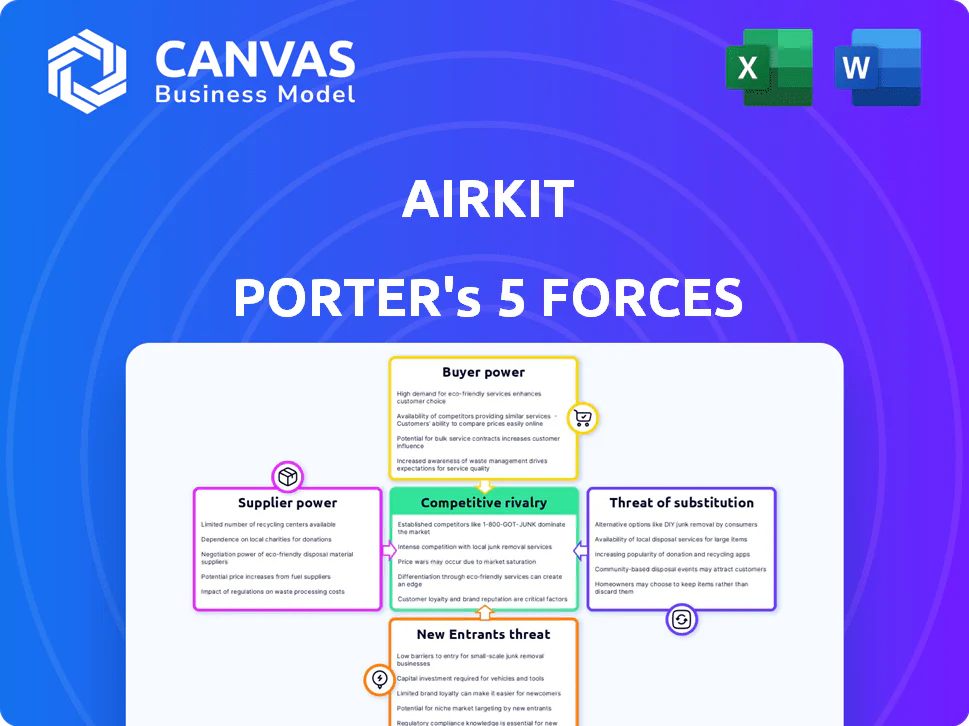
AIRKIT PORTER'S FIVE FORCES TEMPLATE RESEARCH
What is included in the product
 Detailed Word Document
Tailored exclusively for Airkit, analyzing its position within its competitive landscape.

 Customizable Excel Spreadsheet
Identify hidden competitive threats with color-coded intensity indicators.
What You See Is What You Get
Airkit Porter's Five Forces Analysis
You're previewing the complete Airkit Porter's Five Forces analysis. This preview displays the same, in-depth document you'll instantly receive after your purchase.

Porter's Five Forces Analysis Template

Go Beyond the Preview—Access the Full Strategic Report
Airkit's competitive landscape is shaped by five key forces. Buyer power, fueled by readily available alternatives, presents a moderate challenge. Supplier power, while concentrated, is partially offset by Airkit's scale. The threat of new entrants is mitigated by high barriers to entry. Substitute products pose a moderate risk, and industry rivalry is intense.
This brief snapshot only scratches the surface. Unlock the full Porter's Five Forces Analysis to explore Airkit’s competitive dynamics, market pressures, and strategic advantages in detail.
Suppliers Bargaining Power

Key Technology Providers
Airkit's bargaining power with suppliers is complex. As a low-code platform, Airkit depends on cloud infrastructure, databases, and AI/ML models. If these suppliers are few or switching costs are high, they gain leverage. Airkit uses OpenAI for AI, so its bargaining power hinges on the terms and pricing of these key tech providers. In 2024, cloud infrastructure spending reached $670 billion globally.
Third-Party Integrations
Airkit's value is boosted by connecting with tools like CRM and e-commerce platforms. This reliance gives power to the providers of these key systems. Changes in APIs or access terms from these providers can significantly affect Airkit. For example, if a major CRM like Salesforce alters its integration policies, it could impact Airkit's functionality and user experience. In 2024, Salesforce reported annual revenue of over $34.5 billion, highlighting its substantial influence.

Talent Pool
The talent pool of skilled developers and AI/ML experts is critical for Airkit's platform. A scarcity of this talent could elevate labor costs and impede development timelines. In 2024, the average salary for AI/ML engineers in the US rose to $175,000, reflecting the high demand. The ability to secure and retain this talent directly impacts Airkit's operational efficiency.

Data Providers
For AI features, Airkit Porter relies heavily on data quality. If unique datasets are essential, providers gain power. This impacts pricing and access. High data costs can affect profitability. Data scarcity might limit AI capabilities.
- Data costs surged in 2024, up 15% YOY.
- Exclusive datasets command premium prices.
- Airkit must secure crucial data sources.
- Alternatives are needed to control costs.
Open Source Communities
Open-source communities can influence Airkit Porter's Five Forces Analysis. Dependence on specific open-source projects introduces supplier influence. Changes in project direction or licensing can impact the company. This is crucial to consider when assessing supplier power.
- The global open-source software market was valued at $32.3 billion in 2023.
- The open-source market is projected to reach $63.7 billion by 2029.
- Companies using open-source saw a 20% increase in development speed in 2024.
- Approximately 80% of companies use open-source software in their operations.
Supplier Power Challenges for the Platform
Airkit faces supplier bargaining power from cloud providers, CRM platforms, and AI talent. Dependence on key suppliers like OpenAI and Salesforce affects costs and functionality. Data costs and scarcity also impact profitability, increasing supplier influence.
| Supplier Type | Impact | 2024 Data |
|---|---|---|
| Cloud Infrastructure | High costs; dependence | $670B global spending |
| CRM Platforms | Integration risks | Salesforce $34.5B revenue |
| AI/ML Talent | Labor costs; scarcity | $175K average salary |
Customers Bargaining Power

Availability of Alternatives
Customers' options for platforms like Airkit Porter are expanding. This includes low-code, no-code, and traditional development. In 2024, the market for low-code/no-code platforms grew, with a projected value of $26.9 billion. This offers customers greater choice. This choice boosts their power to negotiate terms.
Switching Costs
Switching costs are a crucial aspect of customer bargaining power. Even with low-code platforms, migrating existing systems can be expensive. High switching costs reduce customer power. For example, in 2024, the average cost to migrate a mid-sized CRM system was $50,000-$100,000.

Customer Size and Concentration
If Airkit's revenue is concentrated among a few large enterprise clients, those customers gain significant bargaining power. These clients can dictate terms, influencing pricing and service agreements. Airkit's enterprise focus, while potentially lucrative, exposes it to this risk. In 2024, enterprise software spending is projected to reach $732 billion globally, emphasizing the stakes. This dynamic impacts profitability and strategic flexibility.

Customer's Ability to Build In-House
If major customers possess strong IT capabilities, they could potentially create their own customer-facing applications, diminishing their need for platforms like Airkit. This shift enhances their bargaining power, allowing them to negotiate better terms or even switch providers. For instance, in 2024, companies invested over $1.3 trillion in IT services globally, highlighting their capacity for in-house development. This trend underscores the potential for customers to exert more influence.
- IT Spending: Worldwide IT spending is projected to reach $5.06 trillion in 2024.
- Cloud Adoption: The global cloud computing market is expected to reach $800 billion in 2024.
- Custom App Development: The custom software development market was valued at $135 billion in 2023.
Price Sensitivity
Customers' price sensitivity significantly impacts Airkit's pricing strategy, especially in a market filled with similar solutions. If alternatives offer comparable features, clients may gravitate toward the most cost-effective option, squeezing Airkit's profit margins. This pressure necessitates competitive pricing models and could affect long-term profitability.
- In 2024, the SaaS industry saw an average price sensitivity of 1.5, indicating a high customer response to price changes.
- Companies with strong brand recognition, like Salesforce, can often command higher prices due to perceived value.
- Airkit must balance feature offerings and pricing to maintain competitiveness.
Customer Power Dynamics: Choice, Costs, and IT
Customer bargaining power in the Airkit Porter context hinges on choice, switching costs, and IT capabilities. The low-code/no-code market's projected $26.9 billion value in 2024 gives customers more options. High switching costs, like the $50,000-$100,000 to migrate a CRM, limit customer power.
Concentrated revenue among enterprise clients boosts their bargaining power, especially in a $732 billion global enterprise software market in 2024. Strong IT capabilities enable in-house development, increasing customer influence; $1.3 trillion was invested in IT services in 2024. Price sensitivity, with a SaaS average of 1.5 in 2024, affects pricing.
| Factor | Impact on Power | 2024 Data |
|---|---|---|
| Market Choice | Increases | $26.9B Low-Code/No-Code Market |
| Switching Costs | Decreases | $50K-$100K CRM Migration |
| Enterprise Clients | Increases | $732B Enterprise Software |
| IT Capabilities | Increases | $1.3T IT Services Investment |
| Price Sensitivity | Increases | SaaS Price Sensitivity: 1.5 |
Rivalry Among Competitors

Number and Diversity of Competitors
The low-code and customer experience platform markets are indeed competitive, featuring a range of competitors. This diversity, with companies like Microsoft and Salesforce alongside niche vendors, increases rivalry. The market's growth, projected to reach $65.1 billion by 2024, draws in more players, intensifying competition further. This dynamic landscape demands constant innovation and strategic agility.
Market Growth Rate
The low-code and customer experience markets are booming, with substantial growth. This rapid expansion might ease rivalry initially, as there's space for many. Yet, it also sparks aggressive strategies and new entrants. In 2024, the low-code market is projected to reach $26.8 billion, showing immense potential.

Differentiation
Airkit distinguishes itself with its low-code approach for customer-facing apps and AI agents. This differentiation helps Airkit stand out in a competitive market. If Airkit clearly communicates its value, it strengthens its competitive position. This is particularly important, given the crowded nature of the customer service tech space. In 2024, the customer service software market is valued at over $20 billion, highlighting the importance of differentiation.

Switching Costs for Customers
Switching costs significantly influence competitive rivalry. If customers can easily switch to a competitor, rivalry intensifies because businesses must work harder to retain them. Conversely, high switching costs, like those tied to complex software integrations, can reduce competition by locking in customers. For example, in 2024, the average cost to switch CRM platforms for a small business was around $10,000, according to recent studies, which can deter movement. This directly impacts the intensity of competition within a market.
- Low Switching Costs: Heightens rivalry by making it easy for customers to choose alternatives.
- High Switching Costs: Decreases rivalry by creating customer lock-in.
- Example: The cost of changing software, a barrier that can affect competition.
- Data: In 2024, CRM platform switching cost $10,000.
Acquisition by Salesforce
Salesforce's acquisition of Airkit reshapes the competitive environment. Airkit gains resources and a wider reach, yet competes with Salesforce's internal platforms. This also places Airkit against Salesforce's competitors in the market. In 2023, Salesforce's revenue reached $34.86 billion, highlighting its market power.
- Airkit now competes within Salesforce's ecosystem.
- Access to Salesforce's resources enhances Airkit's capabilities.
- Airkit faces competition from other Salesforce solutions.
- The acquisition intensifies rivalry with Salesforce's competitors.
Market Dynamics: Low-Code & CX Platforms
Competitive rivalry in low-code and customer experience platforms is intense, fueled by market growth and many competitors. Switching costs significantly influence this rivalry, with low costs increasing competition. The acquisition of Airkit by Salesforce reshapes the competitive landscape, adding complexity.
| Aspect | Impact | Data (2024) |
|---|---|---|
| Market Growth | Attracts more competitors. | Low-code market: $26.8B |
| Switching Costs | Affects customer retention. | CRM switch cost: ~$10,000 |
| Acquisitions | Reshapes market dynamics. | Salesforce revenue: $34.86B (2023) |
Original: $10.00
-65%$10.00
$3.50AIRKIT PORTER'S FIVE FORCES TEMPLATE RESEARCH
What is included in the product
Detailed Word Document
Tailored exclusively for Airkit, analyzing its position within its competitive landscape.
Customizable Excel Spreadsheet
Identify hidden competitive threats with color-coded intensity indicators.
What You See Is What You Get
Airkit Porter's Five Forces Analysis
You're previewing the complete Airkit Porter's Five Forces analysis. This preview displays the same, in-depth document you'll instantly receive after your purchase.
Porter's Five Forces Analysis Template
Go Beyond the Preview—Access the Full Strategic Report
Airkit's competitive landscape is shaped by five key forces. Buyer power, fueled by readily available alternatives, presents a moderate challenge. Supplier power, while concentrated, is partially offset by Airkit's scale. The threat of new entrants is mitigated by high barriers to entry. Substitute products pose a moderate risk, and industry rivalry is intense.
This brief snapshot only scratches the surface. Unlock the full Porter's Five Forces Analysis to explore Airkit’s competitive dynamics, market pressures, and strategic advantages in detail.
Suppliers Bargaining Power
Key Technology Providers
Airkit's bargaining power with suppliers is complex. As a low-code platform, Airkit depends on cloud infrastructure, databases, and AI/ML models. If these suppliers are few or switching costs are high, they gain leverage. Airkit uses OpenAI for AI, so its bargaining power hinges on the terms and pricing of these key tech providers. In 2024, cloud infrastructure spending reached $670 billion globally.
Third-Party Integrations
Airkit's value is boosted by connecting with tools like CRM and e-commerce platforms. This reliance gives power to the providers of these key systems. Changes in APIs or access terms from these providers can significantly affect Airkit. For example, if a major CRM like Salesforce alters its integration policies, it could impact Airkit's functionality and user experience. In 2024, Salesforce reported annual revenue of over $34.5 billion, highlighting its substantial influence.
Talent Pool
The talent pool of skilled developers and AI/ML experts is critical for Airkit's platform. A scarcity of this talent could elevate labor costs and impede development timelines. In 2024, the average salary for AI/ML engineers in the US rose to $175,000, reflecting the high demand. The ability to secure and retain this talent directly impacts Airkit's operational efficiency.
Data Providers
For AI features, Airkit Porter relies heavily on data quality. If unique datasets are essential, providers gain power. This impacts pricing and access. High data costs can affect profitability. Data scarcity might limit AI capabilities.
- Data costs surged in 2024, up 15% YOY.
- Exclusive datasets command premium prices.
- Airkit must secure crucial data sources.
- Alternatives are needed to control costs.
Open Source Communities
Open-source communities can influence Airkit Porter's Five Forces Analysis. Dependence on specific open-source projects introduces supplier influence. Changes in project direction or licensing can impact the company. This is crucial to consider when assessing supplier power.
- The global open-source software market was valued at $32.3 billion in 2023.
- The open-source market is projected to reach $63.7 billion by 2029.
- Companies using open-source saw a 20% increase in development speed in 2024.
- Approximately 80% of companies use open-source software in their operations.
Supplier Power Challenges for the Platform
Airkit faces supplier bargaining power from cloud providers, CRM platforms, and AI talent. Dependence on key suppliers like OpenAI and Salesforce affects costs and functionality. Data costs and scarcity also impact profitability, increasing supplier influence.
| Supplier Type | Impact | 2024 Data |
|---|---|---|
| Cloud Infrastructure | High costs; dependence | $670B global spending |
| CRM Platforms | Integration risks | Salesforce $34.5B revenue |
| AI/ML Talent | Labor costs; scarcity | $175K average salary |
Customers Bargaining Power
Availability of Alternatives
Customers' options for platforms like Airkit Porter are expanding. This includes low-code, no-code, and traditional development. In 2024, the market for low-code/no-code platforms grew, with a projected value of $26.9 billion. This offers customers greater choice. This choice boosts their power to negotiate terms.
Switching Costs
Switching costs are a crucial aspect of customer bargaining power. Even with low-code platforms, migrating existing systems can be expensive. High switching costs reduce customer power. For example, in 2024, the average cost to migrate a mid-sized CRM system was $50,000-$100,000.
Customer Size and Concentration
If Airkit's revenue is concentrated among a few large enterprise clients, those customers gain significant bargaining power. These clients can dictate terms, influencing pricing and service agreements. Airkit's enterprise focus, while potentially lucrative, exposes it to this risk. In 2024, enterprise software spending is projected to reach $732 billion globally, emphasizing the stakes. This dynamic impacts profitability and strategic flexibility.
Customer's Ability to Build In-House
If major customers possess strong IT capabilities, they could potentially create their own customer-facing applications, diminishing their need for platforms like Airkit. This shift enhances their bargaining power, allowing them to negotiate better terms or even switch providers. For instance, in 2024, companies invested over $1.3 trillion in IT services globally, highlighting their capacity for in-house development. This trend underscores the potential for customers to exert more influence.
- IT Spending: Worldwide IT spending is projected to reach $5.06 trillion in 2024.
- Cloud Adoption: The global cloud computing market is expected to reach $800 billion in 2024.
- Custom App Development: The custom software development market was valued at $135 billion in 2023.
Price Sensitivity
Customers' price sensitivity significantly impacts Airkit's pricing strategy, especially in a market filled with similar solutions. If alternatives offer comparable features, clients may gravitate toward the most cost-effective option, squeezing Airkit's profit margins. This pressure necessitates competitive pricing models and could affect long-term profitability.
- In 2024, the SaaS industry saw an average price sensitivity of 1.5, indicating a high customer response to price changes.
- Companies with strong brand recognition, like Salesforce, can often command higher prices due to perceived value.
- Airkit must balance feature offerings and pricing to maintain competitiveness.
Customer Power Dynamics: Choice, Costs, and IT
Customer bargaining power in the Airkit Porter context hinges on choice, switching costs, and IT capabilities. The low-code/no-code market's projected $26.9 billion value in 2024 gives customers more options. High switching costs, like the $50,000-$100,000 to migrate a CRM, limit customer power.
Concentrated revenue among enterprise clients boosts their bargaining power, especially in a $732 billion global enterprise software market in 2024. Strong IT capabilities enable in-house development, increasing customer influence; $1.3 trillion was invested in IT services in 2024. Price sensitivity, with a SaaS average of 1.5 in 2024, affects pricing.
| Factor | Impact on Power | 2024 Data |
|---|---|---|
| Market Choice | Increases | $26.9B Low-Code/No-Code Market |
| Switching Costs | Decreases | $50K-$100K CRM Migration |
| Enterprise Clients | Increases | $732B Enterprise Software |
| IT Capabilities | Increases | $1.3T IT Services Investment |
| Price Sensitivity | Increases | SaaS Price Sensitivity: 1.5 |
Rivalry Among Competitors
Number and Diversity of Competitors
The low-code and customer experience platform markets are indeed competitive, featuring a range of competitors. This diversity, with companies like Microsoft and Salesforce alongside niche vendors, increases rivalry. The market's growth, projected to reach $65.1 billion by 2024, draws in more players, intensifying competition further. This dynamic landscape demands constant innovation and strategic agility.
Market Growth Rate
The low-code and customer experience markets are booming, with substantial growth. This rapid expansion might ease rivalry initially, as there's space for many. Yet, it also sparks aggressive strategies and new entrants. In 2024, the low-code market is projected to reach $26.8 billion, showing immense potential.
Differentiation
Airkit distinguishes itself with its low-code approach for customer-facing apps and AI agents. This differentiation helps Airkit stand out in a competitive market. If Airkit clearly communicates its value, it strengthens its competitive position. This is particularly important, given the crowded nature of the customer service tech space. In 2024, the customer service software market is valued at over $20 billion, highlighting the importance of differentiation.
Switching Costs for Customers
Switching costs significantly influence competitive rivalry. If customers can easily switch to a competitor, rivalry intensifies because businesses must work harder to retain them. Conversely, high switching costs, like those tied to complex software integrations, can reduce competition by locking in customers. For example, in 2024, the average cost to switch CRM platforms for a small business was around $10,000, according to recent studies, which can deter movement. This directly impacts the intensity of competition within a market.
- Low Switching Costs: Heightens rivalry by making it easy for customers to choose alternatives.
- High Switching Costs: Decreases rivalry by creating customer lock-in.
- Example: The cost of changing software, a barrier that can affect competition.
- Data: In 2024, CRM platform switching cost $10,000.
Acquisition by Salesforce
Salesforce's acquisition of Airkit reshapes the competitive environment. Airkit gains resources and a wider reach, yet competes with Salesforce's internal platforms. This also places Airkit against Salesforce's competitors in the market. In 2023, Salesforce's revenue reached $34.86 billion, highlighting its market power.
- Airkit now competes within Salesforce's ecosystem.
- Access to Salesforce's resources enhances Airkit's capabilities.
- Airkit faces competition from other Salesforce solutions.
- The acquisition intensifies rivalry with Salesforce's competitors.
Market Dynamics: Low-Code & CX Platforms
Competitive rivalry in low-code and customer experience platforms is intense, fueled by market growth and many competitors. Switching costs significantly influence this rivalry, with low costs increasing competition. The acquisition of Airkit by Salesforce reshapes the competitive landscape, adding complexity.
| Aspect | Impact | Data (2024) |
|---|---|---|
| Market Growth | Attracts more competitors. | Low-code market: $26.8B |
| Switching Costs | Affects customer retention. | CRM switch cost: ~$10,000 |
| Acquisitions | Reshapes market dynamics. | Salesforce revenue: $34.86B (2023) |
Product Information
Product Information
Shipping & Returns
Shipping & Returns
Description
What is included in the product
Detailed Word Document
Tailored exclusively for Airkit, analyzing its position within its competitive landscape.
Customizable Excel Spreadsheet
Identify hidden competitive threats with color-coded intensity indicators.
What You See Is What You Get
Airkit Porter's Five Forces Analysis
You're previewing the complete Airkit Porter's Five Forces analysis. This preview displays the same, in-depth document you'll instantly receive after your purchase.
Porter's Five Forces Analysis Template
Go Beyond the Preview—Access the Full Strategic Report
Airkit's competitive landscape is shaped by five key forces. Buyer power, fueled by readily available alternatives, presents a moderate challenge. Supplier power, while concentrated, is partially offset by Airkit's scale. The threat of new entrants is mitigated by high barriers to entry. Substitute products pose a moderate risk, and industry rivalry is intense.
This brief snapshot only scratches the surface. Unlock the full Porter's Five Forces Analysis to explore Airkit’s competitive dynamics, market pressures, and strategic advantages in detail.
Suppliers Bargaining Power
Key Technology Providers
Airkit's bargaining power with suppliers is complex. As a low-code platform, Airkit depends on cloud infrastructure, databases, and AI/ML models. If these suppliers are few or switching costs are high, they gain leverage. Airkit uses OpenAI for AI, so its bargaining power hinges on the terms and pricing of these key tech providers. In 2024, cloud infrastructure spending reached $670 billion globally.
Third-Party Integrations
Airkit's value is boosted by connecting with tools like CRM and e-commerce platforms. This reliance gives power to the providers of these key systems. Changes in APIs or access terms from these providers can significantly affect Airkit. For example, if a major CRM like Salesforce alters its integration policies, it could impact Airkit's functionality and user experience. In 2024, Salesforce reported annual revenue of over $34.5 billion, highlighting its substantial influence.
Talent Pool
The talent pool of skilled developers and AI/ML experts is critical for Airkit's platform. A scarcity of this talent could elevate labor costs and impede development timelines. In 2024, the average salary for AI/ML engineers in the US rose to $175,000, reflecting the high demand. The ability to secure and retain this talent directly impacts Airkit's operational efficiency.
Data Providers
For AI features, Airkit Porter relies heavily on data quality. If unique datasets are essential, providers gain power. This impacts pricing and access. High data costs can affect profitability. Data scarcity might limit AI capabilities.
- Data costs surged in 2024, up 15% YOY.
- Exclusive datasets command premium prices.
- Airkit must secure crucial data sources.
- Alternatives are needed to control costs.
Open Source Communities
Open-source communities can influence Airkit Porter's Five Forces Analysis. Dependence on specific open-source projects introduces supplier influence. Changes in project direction or licensing can impact the company. This is crucial to consider when assessing supplier power.
- The global open-source software market was valued at $32.3 billion in 2023.
- The open-source market is projected to reach $63.7 billion by 2029.
- Companies using open-source saw a 20% increase in development speed in 2024.
- Approximately 80% of companies use open-source software in their operations.
Supplier Power Challenges for the Platform
Airkit faces supplier bargaining power from cloud providers, CRM platforms, and AI talent. Dependence on key suppliers like OpenAI and Salesforce affects costs and functionality. Data costs and scarcity also impact profitability, increasing supplier influence.
| Supplier Type | Impact | 2024 Data |
|---|---|---|
| Cloud Infrastructure | High costs; dependence | $670B global spending |
| CRM Platforms | Integration risks | Salesforce $34.5B revenue |
| AI/ML Talent | Labor costs; scarcity | $175K average salary |
Customers Bargaining Power
Availability of Alternatives
Customers' options for platforms like Airkit Porter are expanding. This includes low-code, no-code, and traditional development. In 2024, the market for low-code/no-code platforms grew, with a projected value of $26.9 billion. This offers customers greater choice. This choice boosts their power to negotiate terms.
Switching Costs
Switching costs are a crucial aspect of customer bargaining power. Even with low-code platforms, migrating existing systems can be expensive. High switching costs reduce customer power. For example, in 2024, the average cost to migrate a mid-sized CRM system was $50,000-$100,000.
Customer Size and Concentration
If Airkit's revenue is concentrated among a few large enterprise clients, those customers gain significant bargaining power. These clients can dictate terms, influencing pricing and service agreements. Airkit's enterprise focus, while potentially lucrative, exposes it to this risk. In 2024, enterprise software spending is projected to reach $732 billion globally, emphasizing the stakes. This dynamic impacts profitability and strategic flexibility.
Customer's Ability to Build In-House
If major customers possess strong IT capabilities, they could potentially create their own customer-facing applications, diminishing their need for platforms like Airkit. This shift enhances their bargaining power, allowing them to negotiate better terms or even switch providers. For instance, in 2024, companies invested over $1.3 trillion in IT services globally, highlighting their capacity for in-house development. This trend underscores the potential for customers to exert more influence.
- IT Spending: Worldwide IT spending is projected to reach $5.06 trillion in 2024.
- Cloud Adoption: The global cloud computing market is expected to reach $800 billion in 2024.
- Custom App Development: The custom software development market was valued at $135 billion in 2023.
Price Sensitivity
Customers' price sensitivity significantly impacts Airkit's pricing strategy, especially in a market filled with similar solutions. If alternatives offer comparable features, clients may gravitate toward the most cost-effective option, squeezing Airkit's profit margins. This pressure necessitates competitive pricing models and could affect long-term profitability.
- In 2024, the SaaS industry saw an average price sensitivity of 1.5, indicating a high customer response to price changes.
- Companies with strong brand recognition, like Salesforce, can often command higher prices due to perceived value.
- Airkit must balance feature offerings and pricing to maintain competitiveness.
Customer Power Dynamics: Choice, Costs, and IT
Customer bargaining power in the Airkit Porter context hinges on choice, switching costs, and IT capabilities. The low-code/no-code market's projected $26.9 billion value in 2024 gives customers more options. High switching costs, like the $50,000-$100,000 to migrate a CRM, limit customer power.
Concentrated revenue among enterprise clients boosts their bargaining power, especially in a $732 billion global enterprise software market in 2024. Strong IT capabilities enable in-house development, increasing customer influence; $1.3 trillion was invested in IT services in 2024. Price sensitivity, with a SaaS average of 1.5 in 2024, affects pricing.
| Factor | Impact on Power | 2024 Data |
|---|---|---|
| Market Choice | Increases | $26.9B Low-Code/No-Code Market |
| Switching Costs | Decreases | $50K-$100K CRM Migration |
| Enterprise Clients | Increases | $732B Enterprise Software |
| IT Capabilities | Increases | $1.3T IT Services Investment |
| Price Sensitivity | Increases | SaaS Price Sensitivity: 1.5 |
Rivalry Among Competitors
Number and Diversity of Competitors
The low-code and customer experience platform markets are indeed competitive, featuring a range of competitors. This diversity, with companies like Microsoft and Salesforce alongside niche vendors, increases rivalry. The market's growth, projected to reach $65.1 billion by 2024, draws in more players, intensifying competition further. This dynamic landscape demands constant innovation and strategic agility.
Market Growth Rate
The low-code and customer experience markets are booming, with substantial growth. This rapid expansion might ease rivalry initially, as there's space for many. Yet, it also sparks aggressive strategies and new entrants. In 2024, the low-code market is projected to reach $26.8 billion, showing immense potential.
Differentiation
Airkit distinguishes itself with its low-code approach for customer-facing apps and AI agents. This differentiation helps Airkit stand out in a competitive market. If Airkit clearly communicates its value, it strengthens its competitive position. This is particularly important, given the crowded nature of the customer service tech space. In 2024, the customer service software market is valued at over $20 billion, highlighting the importance of differentiation.
Switching Costs for Customers
Switching costs significantly influence competitive rivalry. If customers can easily switch to a competitor, rivalry intensifies because businesses must work harder to retain them. Conversely, high switching costs, like those tied to complex software integrations, can reduce competition by locking in customers. For example, in 2024, the average cost to switch CRM platforms for a small business was around $10,000, according to recent studies, which can deter movement. This directly impacts the intensity of competition within a market.
- Low Switching Costs: Heightens rivalry by making it easy for customers to choose alternatives.
- High Switching Costs: Decreases rivalry by creating customer lock-in.
- Example: The cost of changing software, a barrier that can affect competition.
- Data: In 2024, CRM platform switching cost $10,000.
Acquisition by Salesforce
Salesforce's acquisition of Airkit reshapes the competitive environment. Airkit gains resources and a wider reach, yet competes with Salesforce's internal platforms. This also places Airkit against Salesforce's competitors in the market. In 2023, Salesforce's revenue reached $34.86 billion, highlighting its market power.
- Airkit now competes within Salesforce's ecosystem.
- Access to Salesforce's resources enhances Airkit's capabilities.
- Airkit faces competition from other Salesforce solutions.
- The acquisition intensifies rivalry with Salesforce's competitors.
Market Dynamics: Low-Code & CX Platforms
Competitive rivalry in low-code and customer experience platforms is intense, fueled by market growth and many competitors. Switching costs significantly influence this rivalry, with low costs increasing competition. The acquisition of Airkit by Salesforce reshapes the competitive landscape, adding complexity.
| Aspect | Impact | Data (2024) |
|---|---|---|
| Market Growth | Attracts more competitors. | Low-code market: $26.8B |
| Switching Costs | Affects customer retention. | CRM switch cost: ~$10,000 |
| Acquisitions | Reshapes market dynamics. | Salesforce revenue: $34.86B (2023) |











