ALCION PORTER'S FIVE FORCES TEMPLATE RESEARCH
What is included in the product
 Detailed Word Document
Tailored exclusively for Alcion, analyzing its position within its competitive landscape.

 Customizable Excel Spreadsheet
Uncover hidden threats: Visualize competitive forces with dynamic scoring, revealing opportunities.
What You See Is What You Get
Alcion Porter's Five Forces Analysis
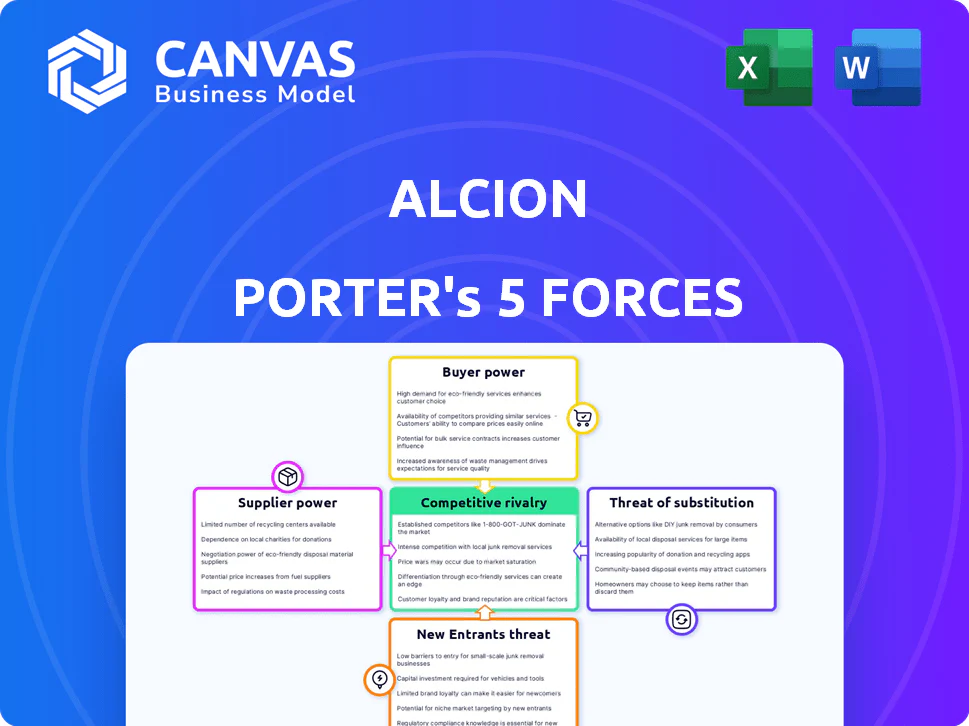
This preview showcases Alcion's Porter's Five Forces analysis, providing insights into the industry's competitive landscape. The document breaks down threats of new entrants, bargaining power of suppliers and buyers, rivalry, and substitutes. You'll receive this same detailed and professionally crafted analysis immediately after purchase. It's the complete, ready-to-use document, ensuring no hidden surprises.

Porter's Five Forces Analysis Template

A Must-Have Tool for Decision-Makers
Alcion's competitive landscape, as seen through Porter's Five Forces, reveals complex dynamics. Buyer power, supplier influence, and the threat of new entrants are critical. Consider the impact of substitute products and industry rivalry. Understanding these forces is crucial for strategic planning and investment analysis. This brief snapshot only scratches the surface. Unlock the full Porter's Five Forces Analysis to explore Alcion’s competitive dynamics, market pressures, and strategic advantages in detail.
Suppliers Bargaining Power

Dependency on Cloud Infrastructure Providers
Alcion's reliance on cloud infrastructure providers, such as Amazon Web Services (AWS), presents a supplier bargaining power challenge. These providers control significant market share; for example, AWS held around 32% of the cloud infrastructure market in Q4 2024. This concentration gives these suppliers leverage in pricing and service terms. Alcion must negotiate effectively to manage costs and ensure service quality.
Availability of AI Development Resources
Alcion's AI development hinges on skilled AI engineers and tech. A scarcity of these resources can hike costs, empowering suppliers. The AI talent pool is competitive; in 2024, demand for AI specialists surged. Average salaries for AI engineers rose by 15% in the U.S. due to talent shortages.

Reliance on Specific Software or Hardware Vendors
Alcion's reliance on specific software or hardware vendors can impact supplier bargaining power. If Alcion uses unique or essential components, vendors gain leverage. For example, in 2024, the software industry saw a 10% increase in proprietary software usage. This can lead to higher prices or less favorable contract terms for Alcion.

Data Sources for AI Training
Alcion's AI success hinges on data quality. External data sources, if used, could wield bargaining power. This is particularly true for unique or scarce data. The cost and availability of such data directly impact Alcion's operational costs and model performance.
- Data procurement costs can significantly affect profitability.
- Exclusive data sources limit competition.
- Data quality directly influences AI accuracy.
- Negotiating favorable data agreements is crucial.
Open Source Community Contributions
Alcion leverages the open-source Corso project, which presents unique supplier dynamics. The open-source community's influence on Corso's development pace and features acts as a form of supplier power. This can affect Alcion's ability to control its product roadmap effectively. Alcion must manage this influence to maintain its competitive edge.
- Corso's GitHub repository has over 3,000 stars, indicating a significant community.
- Community contributions can lead to feature enhancements or delays.
- Alcion's strategic decisions are tied to community-driven developments.
Alcion's Supplier Power: Cloud, Talent, and Data Costs
Alcion faces supplier bargaining power challenges from cloud providers, AI talent, and data sources. These suppliers, like AWS, control significant market share, around 32% in Q4 2024, affecting pricing. The scarcity of AI engineers and unique data also increases costs. Managing these supplier relationships is vital for Alcion's profitability.
| Supplier Type | Impact | Example |
|---|---|---|
| Cloud Infrastructure | Pricing, service terms | AWS (32% market share, Q4 2024) |
| AI Talent | Rising salaries | AI engineer salaries up 15% (2024, US) |
| Data Providers | Cost, availability | Procurement costs affect profitability |
Customers Bargaining Power

Availability of Alternatives
Customers can choose from diverse data protection methods, boosting their leverage. The market offers traditional backups, competing SaaS providers, and cloud-based solutions. For example, the global data backup and recovery market was valued at $11.4 billion in 2024. This competition gives customers significant bargaining power.
Switching Costs
Switching costs impact customer power; if they're low, customers have more influence. While Alcion simplifies data protection, migration still takes effort. Consider that in 2024, average IT project switching costs were around $10,000-$50,000. Lower switching costs increase customer bargaining power.

Customer Concentration
If Alcion's revenue relies heavily on a few key customers, these entities gain substantial leverage. These customers can dictate terms, potentially lowering prices or demanding more favorable service conditions. For instance, if 70% of Alcion's revenue comes from three clients, their bargaining power is high. This concentration increases the risk of revenue loss if any of these major clients switch to competitors.

Importance of Data Protection
Customer bargaining power increases with the need for data protection, a crucial aspect for all organizations. The rising risks from ransomware and malware necessitate robust solutions. This demand gives customers significant leverage in negotiating favorable terms. Companies face pressure to offer strong data security.
- Global ransomware damage costs are predicted to reach $265 billion by 2031.
- In 2024, the average ransomware payment increased to $2 million.
- Data breaches exposed 1.9 billion records in the first half of 2023.
- Cybersecurity spending is projected to exceed $270 billion in 2024.
Access to Information and Reviews
Customers in the data protection market wield considerable bargaining power due to readily available information and reviews. They can effortlessly compare solutions, read user feedback, and assess pricing across various providers online. This high degree of transparency allows them to negotiate terms and demand competitive pricing. For example, Gartner's 2024 report showed that 70% of customers research multiple vendors before choosing a data protection solution.
- Online reviews and comparisons empower customers.
- Transparency enables informed decision-making.
- Negotiation leverage increases with market knowledge.
- Approximately 70% of customers research multiple vendors.
Customer Power in Data Protection
Customers possess strong bargaining power in the data protection market. They can choose from a variety of solutions, increasing leverage. Low switching costs and transparent information further enhance their influence.
| Factor | Impact | Data (2024) |
|---|---|---|
| Competition | High | Data backup market: $11.4B |
| Switching Costs | Moderate | Avg. IT project: $10K-$50K |
| Information | High | 70% research multiple vendors |
Rivalry Among Competitors

Number and Diversity of Competitors
The data protection and backup market is highly competitive, featuring many companies. This includes giants like Dell Technologies and Veeam, along with numerous smaller firms and startups. In 2024, the market saw over 100 significant vendors. This diverse landscape fuels intense rivalry, as companies compete for market share.
Market Growth Rate
The data protection market's growth rate is robust. Data privacy software and AI in cybersecurity are key drivers. In 2024, the global data protection market was valued at $148.2 billion. Rapid growth can ease rivalry initially, but attracts new players. This dynamic impacts competition significantly.

Product Differentiation
Alcion's AI-powered approach and focus on security and ease of use are key differentiators. This strategy aims to set Alcion apart from competitors in the cybersecurity market. The success of this differentiation depends on how customers value these unique features. In 2024, the cybersecurity market was valued at over $200 billion, with AI integration growing rapidly.

Exit Barriers
High exit barriers intensify competitive rivalry. When leaving a market is tough, firms may persist in competing, even with low profits. For example, in 2024, the airline industry faced high exit costs due to aircraft ownership and lease agreements, fueling rivalry. This is a significant force in industries with substantial sunk costs.
- Sunk costs in manufacturing, such as specialized equipment, can be hard to recover.
- Union agreements and severance packages can increase the cost of exiting.
- Government regulations and restrictions also create barriers to exit.
- Inter-business relationships, long-term contracts increase exit costs.
Acquisition Activity
Acquisition activity in the data protection market is a key factor in competitive rivalry. Larger companies are often acquiring smaller, more innovative firms. This activity can reshape the competitive landscape.
- In 2024, several data protection companies were acquired, signaling industry consolidation.
- These acquisitions can lead to increased market concentration.
- Rivalry might intensify or diminish depending on integration strategies.
Data Protection Market: A Competitive Battlefield
Competitive rivalry in the data protection market is fierce, with numerous players vying for market share. The market's substantial growth, reaching $148.2 billion in 2024, attracts new entrants. High exit barriers, like sunk costs, intensify competition as firms persist.
| Factor | Impact | Example (2024) |
|---|---|---|
| Market Growth | Attracts new entrants | Data protection market at $148.2B |
| Exit Barriers | Intensifies competition | High sunk costs |
| Acquisitions | Reshapes landscape | Consolidation in market |
Original: $10.00
-65%$10.00
$3.50ALCION PORTER'S FIVE FORCES TEMPLATE RESEARCH
What is included in the product
Detailed Word Document
Tailored exclusively for Alcion, analyzing its position within its competitive landscape.
Customizable Excel Spreadsheet
Uncover hidden threats: Visualize competitive forces with dynamic scoring, revealing opportunities.
What You See Is What You Get
Alcion Porter's Five Forces Analysis
This preview showcases Alcion's Porter's Five Forces analysis, providing insights into the industry's competitive landscape. The document breaks down threats of new entrants, bargaining power of suppliers and buyers, rivalry, and substitutes. You'll receive this same detailed and professionally crafted analysis immediately after purchase. It's the complete, ready-to-use document, ensuring no hidden surprises.
Porter's Five Forces Analysis Template
A Must-Have Tool for Decision-Makers
Alcion's competitive landscape, as seen through Porter's Five Forces, reveals complex dynamics. Buyer power, supplier influence, and the threat of new entrants are critical. Consider the impact of substitute products and industry rivalry. Understanding these forces is crucial for strategic planning and investment analysis. This brief snapshot only scratches the surface. Unlock the full Porter's Five Forces Analysis to explore Alcion’s competitive dynamics, market pressures, and strategic advantages in detail.
Suppliers Bargaining Power
Dependency on Cloud Infrastructure Providers
Alcion's reliance on cloud infrastructure providers, such as Amazon Web Services (AWS), presents a supplier bargaining power challenge. These providers control significant market share; for example, AWS held around 32% of the cloud infrastructure market in Q4 2024. This concentration gives these suppliers leverage in pricing and service terms. Alcion must negotiate effectively to manage costs and ensure service quality.
Availability of AI Development Resources
Alcion's AI development hinges on skilled AI engineers and tech. A scarcity of these resources can hike costs, empowering suppliers. The AI talent pool is competitive; in 2024, demand for AI specialists surged. Average salaries for AI engineers rose by 15% in the U.S. due to talent shortages.
Reliance on Specific Software or Hardware Vendors
Alcion's reliance on specific software or hardware vendors can impact supplier bargaining power. If Alcion uses unique or essential components, vendors gain leverage. For example, in 2024, the software industry saw a 10% increase in proprietary software usage. This can lead to higher prices or less favorable contract terms for Alcion.
Data Sources for AI Training
Alcion's AI success hinges on data quality. External data sources, if used, could wield bargaining power. This is particularly true for unique or scarce data. The cost and availability of such data directly impact Alcion's operational costs and model performance.
- Data procurement costs can significantly affect profitability.
- Exclusive data sources limit competition.
- Data quality directly influences AI accuracy.
- Negotiating favorable data agreements is crucial.
Open Source Community Contributions
Alcion leverages the open-source Corso project, which presents unique supplier dynamics. The open-source community's influence on Corso's development pace and features acts as a form of supplier power. This can affect Alcion's ability to control its product roadmap effectively. Alcion must manage this influence to maintain its competitive edge.
- Corso's GitHub repository has over 3,000 stars, indicating a significant community.
- Community contributions can lead to feature enhancements or delays.
- Alcion's strategic decisions are tied to community-driven developments.
Alcion's Supplier Power: Cloud, Talent, and Data Costs
Alcion faces supplier bargaining power challenges from cloud providers, AI talent, and data sources. These suppliers, like AWS, control significant market share, around 32% in Q4 2024, affecting pricing. The scarcity of AI engineers and unique data also increases costs. Managing these supplier relationships is vital for Alcion's profitability.
| Supplier Type | Impact | Example |
|---|---|---|
| Cloud Infrastructure | Pricing, service terms | AWS (32% market share, Q4 2024) |
| AI Talent | Rising salaries | AI engineer salaries up 15% (2024, US) |
| Data Providers | Cost, availability | Procurement costs affect profitability |
Customers Bargaining Power
Availability of Alternatives
Customers can choose from diverse data protection methods, boosting their leverage. The market offers traditional backups, competing SaaS providers, and cloud-based solutions. For example, the global data backup and recovery market was valued at $11.4 billion in 2024. This competition gives customers significant bargaining power.
Switching Costs
Switching costs impact customer power; if they're low, customers have more influence. While Alcion simplifies data protection, migration still takes effort. Consider that in 2024, average IT project switching costs were around $10,000-$50,000. Lower switching costs increase customer bargaining power.
Customer Concentration
If Alcion's revenue relies heavily on a few key customers, these entities gain substantial leverage. These customers can dictate terms, potentially lowering prices or demanding more favorable service conditions. For instance, if 70% of Alcion's revenue comes from three clients, their bargaining power is high. This concentration increases the risk of revenue loss if any of these major clients switch to competitors.
Importance of Data Protection
Customer bargaining power increases with the need for data protection, a crucial aspect for all organizations. The rising risks from ransomware and malware necessitate robust solutions. This demand gives customers significant leverage in negotiating favorable terms. Companies face pressure to offer strong data security.
- Global ransomware damage costs are predicted to reach $265 billion by 2031.
- In 2024, the average ransomware payment increased to $2 million.
- Data breaches exposed 1.9 billion records in the first half of 2023.
- Cybersecurity spending is projected to exceed $270 billion in 2024.
Access to Information and Reviews
Customers in the data protection market wield considerable bargaining power due to readily available information and reviews. They can effortlessly compare solutions, read user feedback, and assess pricing across various providers online. This high degree of transparency allows them to negotiate terms and demand competitive pricing. For example, Gartner's 2024 report showed that 70% of customers research multiple vendors before choosing a data protection solution.
- Online reviews and comparisons empower customers.
- Transparency enables informed decision-making.
- Negotiation leverage increases with market knowledge.
- Approximately 70% of customers research multiple vendors.
Customer Power in Data Protection
Customers possess strong bargaining power in the data protection market. They can choose from a variety of solutions, increasing leverage. Low switching costs and transparent information further enhance their influence.
| Factor | Impact | Data (2024) |
|---|---|---|
| Competition | High | Data backup market: $11.4B |
| Switching Costs | Moderate | Avg. IT project: $10K-$50K |
| Information | High | 70% research multiple vendors |
Rivalry Among Competitors
Number and Diversity of Competitors
The data protection and backup market is highly competitive, featuring many companies. This includes giants like Dell Technologies and Veeam, along with numerous smaller firms and startups. In 2024, the market saw over 100 significant vendors. This diverse landscape fuels intense rivalry, as companies compete for market share.
Market Growth Rate
The data protection market's growth rate is robust. Data privacy software and AI in cybersecurity are key drivers. In 2024, the global data protection market was valued at $148.2 billion. Rapid growth can ease rivalry initially, but attracts new players. This dynamic impacts competition significantly.
Product Differentiation
Alcion's AI-powered approach and focus on security and ease of use are key differentiators. This strategy aims to set Alcion apart from competitors in the cybersecurity market. The success of this differentiation depends on how customers value these unique features. In 2024, the cybersecurity market was valued at over $200 billion, with AI integration growing rapidly.
Exit Barriers
High exit barriers intensify competitive rivalry. When leaving a market is tough, firms may persist in competing, even with low profits. For example, in 2024, the airline industry faced high exit costs due to aircraft ownership and lease agreements, fueling rivalry. This is a significant force in industries with substantial sunk costs.
- Sunk costs in manufacturing, such as specialized equipment, can be hard to recover.
- Union agreements and severance packages can increase the cost of exiting.
- Government regulations and restrictions also create barriers to exit.
- Inter-business relationships, long-term contracts increase exit costs.
Acquisition Activity
Acquisition activity in the data protection market is a key factor in competitive rivalry. Larger companies are often acquiring smaller, more innovative firms. This activity can reshape the competitive landscape.
- In 2024, several data protection companies were acquired, signaling industry consolidation.
- These acquisitions can lead to increased market concentration.
- Rivalry might intensify or diminish depending on integration strategies.
Data Protection Market: A Competitive Battlefield
Competitive rivalry in the data protection market is fierce, with numerous players vying for market share. The market's substantial growth, reaching $148.2 billion in 2024, attracts new entrants. High exit barriers, like sunk costs, intensify competition as firms persist.
| Factor | Impact | Example (2024) |
|---|---|---|
| Market Growth | Attracts new entrants | Data protection market at $148.2B |
| Exit Barriers | Intensifies competition | High sunk costs |
| Acquisitions | Reshapes landscape | Consolidation in market |
Product Information
Product Information
Shipping & Returns
Shipping & Returns
Description
What is included in the product
Detailed Word Document
Tailored exclusively for Alcion, analyzing its position within its competitive landscape.
Customizable Excel Spreadsheet
Uncover hidden threats: Visualize competitive forces with dynamic scoring, revealing opportunities.
What You See Is What You Get
Alcion Porter's Five Forces Analysis
This preview showcases Alcion's Porter's Five Forces analysis, providing insights into the industry's competitive landscape. The document breaks down threats of new entrants, bargaining power of suppliers and buyers, rivalry, and substitutes. You'll receive this same detailed and professionally crafted analysis immediately after purchase. It's the complete, ready-to-use document, ensuring no hidden surprises.
Porter's Five Forces Analysis Template
A Must-Have Tool for Decision-Makers
Alcion's competitive landscape, as seen through Porter's Five Forces, reveals complex dynamics. Buyer power, supplier influence, and the threat of new entrants are critical. Consider the impact of substitute products and industry rivalry. Understanding these forces is crucial for strategic planning and investment analysis. This brief snapshot only scratches the surface. Unlock the full Porter's Five Forces Analysis to explore Alcion’s competitive dynamics, market pressures, and strategic advantages in detail.
Suppliers Bargaining Power
Dependency on Cloud Infrastructure Providers
Alcion's reliance on cloud infrastructure providers, such as Amazon Web Services (AWS), presents a supplier bargaining power challenge. These providers control significant market share; for example, AWS held around 32% of the cloud infrastructure market in Q4 2024. This concentration gives these suppliers leverage in pricing and service terms. Alcion must negotiate effectively to manage costs and ensure service quality.
Availability of AI Development Resources
Alcion's AI development hinges on skilled AI engineers and tech. A scarcity of these resources can hike costs, empowering suppliers. The AI talent pool is competitive; in 2024, demand for AI specialists surged. Average salaries for AI engineers rose by 15% in the U.S. due to talent shortages.
Reliance on Specific Software or Hardware Vendors
Alcion's reliance on specific software or hardware vendors can impact supplier bargaining power. If Alcion uses unique or essential components, vendors gain leverage. For example, in 2024, the software industry saw a 10% increase in proprietary software usage. This can lead to higher prices or less favorable contract terms for Alcion.
Data Sources for AI Training
Alcion's AI success hinges on data quality. External data sources, if used, could wield bargaining power. This is particularly true for unique or scarce data. The cost and availability of such data directly impact Alcion's operational costs and model performance.
- Data procurement costs can significantly affect profitability.
- Exclusive data sources limit competition.
- Data quality directly influences AI accuracy.
- Negotiating favorable data agreements is crucial.
Open Source Community Contributions
Alcion leverages the open-source Corso project, which presents unique supplier dynamics. The open-source community's influence on Corso's development pace and features acts as a form of supplier power. This can affect Alcion's ability to control its product roadmap effectively. Alcion must manage this influence to maintain its competitive edge.
- Corso's GitHub repository has over 3,000 stars, indicating a significant community.
- Community contributions can lead to feature enhancements or delays.
- Alcion's strategic decisions are tied to community-driven developments.
Alcion's Supplier Power: Cloud, Talent, and Data Costs
Alcion faces supplier bargaining power challenges from cloud providers, AI talent, and data sources. These suppliers, like AWS, control significant market share, around 32% in Q4 2024, affecting pricing. The scarcity of AI engineers and unique data also increases costs. Managing these supplier relationships is vital for Alcion's profitability.
| Supplier Type | Impact | Example |
|---|---|---|
| Cloud Infrastructure | Pricing, service terms | AWS (32% market share, Q4 2024) |
| AI Talent | Rising salaries | AI engineer salaries up 15% (2024, US) |
| Data Providers | Cost, availability | Procurement costs affect profitability |
Customers Bargaining Power
Availability of Alternatives
Customers can choose from diverse data protection methods, boosting their leverage. The market offers traditional backups, competing SaaS providers, and cloud-based solutions. For example, the global data backup and recovery market was valued at $11.4 billion in 2024. This competition gives customers significant bargaining power.
Switching Costs
Switching costs impact customer power; if they're low, customers have more influence. While Alcion simplifies data protection, migration still takes effort. Consider that in 2024, average IT project switching costs were around $10,000-$50,000. Lower switching costs increase customer bargaining power.
Customer Concentration
If Alcion's revenue relies heavily on a few key customers, these entities gain substantial leverage. These customers can dictate terms, potentially lowering prices or demanding more favorable service conditions. For instance, if 70% of Alcion's revenue comes from three clients, their bargaining power is high. This concentration increases the risk of revenue loss if any of these major clients switch to competitors.
Importance of Data Protection
Customer bargaining power increases with the need for data protection, a crucial aspect for all organizations. The rising risks from ransomware and malware necessitate robust solutions. This demand gives customers significant leverage in negotiating favorable terms. Companies face pressure to offer strong data security.
- Global ransomware damage costs are predicted to reach $265 billion by 2031.
- In 2024, the average ransomware payment increased to $2 million.
- Data breaches exposed 1.9 billion records in the first half of 2023.
- Cybersecurity spending is projected to exceed $270 billion in 2024.
Access to Information and Reviews
Customers in the data protection market wield considerable bargaining power due to readily available information and reviews. They can effortlessly compare solutions, read user feedback, and assess pricing across various providers online. This high degree of transparency allows them to negotiate terms and demand competitive pricing. For example, Gartner's 2024 report showed that 70% of customers research multiple vendors before choosing a data protection solution.
- Online reviews and comparisons empower customers.
- Transparency enables informed decision-making.
- Negotiation leverage increases with market knowledge.
- Approximately 70% of customers research multiple vendors.
Customer Power in Data Protection
Customers possess strong bargaining power in the data protection market. They can choose from a variety of solutions, increasing leverage. Low switching costs and transparent information further enhance their influence.
| Factor | Impact | Data (2024) |
|---|---|---|
| Competition | High | Data backup market: $11.4B |
| Switching Costs | Moderate | Avg. IT project: $10K-$50K |
| Information | High | 70% research multiple vendors |
Rivalry Among Competitors
Number and Diversity of Competitors
The data protection and backup market is highly competitive, featuring many companies. This includes giants like Dell Technologies and Veeam, along with numerous smaller firms and startups. In 2024, the market saw over 100 significant vendors. This diverse landscape fuels intense rivalry, as companies compete for market share.
Market Growth Rate
The data protection market's growth rate is robust. Data privacy software and AI in cybersecurity are key drivers. In 2024, the global data protection market was valued at $148.2 billion. Rapid growth can ease rivalry initially, but attracts new players. This dynamic impacts competition significantly.
Product Differentiation
Alcion's AI-powered approach and focus on security and ease of use are key differentiators. This strategy aims to set Alcion apart from competitors in the cybersecurity market. The success of this differentiation depends on how customers value these unique features. In 2024, the cybersecurity market was valued at over $200 billion, with AI integration growing rapidly.
Exit Barriers
High exit barriers intensify competitive rivalry. When leaving a market is tough, firms may persist in competing, even with low profits. For example, in 2024, the airline industry faced high exit costs due to aircraft ownership and lease agreements, fueling rivalry. This is a significant force in industries with substantial sunk costs.
- Sunk costs in manufacturing, such as specialized equipment, can be hard to recover.
- Union agreements and severance packages can increase the cost of exiting.
- Government regulations and restrictions also create barriers to exit.
- Inter-business relationships, long-term contracts increase exit costs.
Acquisition Activity
Acquisition activity in the data protection market is a key factor in competitive rivalry. Larger companies are often acquiring smaller, more innovative firms. This activity can reshape the competitive landscape.
- In 2024, several data protection companies were acquired, signaling industry consolidation.
- These acquisitions can lead to increased market concentration.
- Rivalry might intensify or diminish depending on integration strategies.
Data Protection Market: A Competitive Battlefield
Competitive rivalry in the data protection market is fierce, with numerous players vying for market share. The market's substantial growth, reaching $148.2 billion in 2024, attracts new entrants. High exit barriers, like sunk costs, intensify competition as firms persist.
| Factor | Impact | Example (2024) |
|---|---|---|
| Market Growth | Attracts new entrants | Data protection market at $148.2B |
| Exit Barriers | Intensifies competition | High sunk costs |
| Acquisitions | Reshapes landscape | Consolidation in market |











