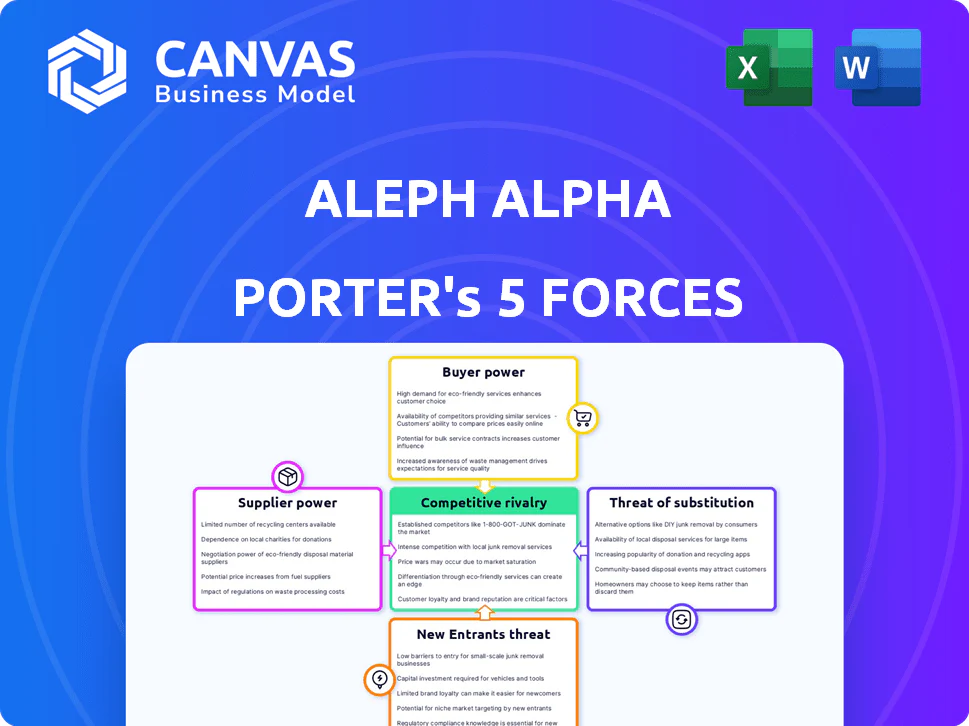
ALEPH ALPHA PORTER'S FIVE FORCES TEMPLATE RESEARCH

Elevate Your Analysis with the Complete Porter's Five Forces Analysis
Aleph Alpha sits at the intersection of advanced AI research and commercial deployment, facing intense rivalry from well-funded global models, supplier constraints on specialized compute, and evolving regulatory risks that could reshape market access.
This brief snapshot only scratches the surface. Unlock the full Porter's Five Forces Analysis to explore Aleph Alpha's competitive dynamics, market pressures, and strategic advantages in detail.
Suppliers Bargaining Power

Concentration of High-End Compute Hardware
Aleph Alpha's reliance on a narrow set of vendors for GPUs and AI accelerators keeps supplier power high: NVIDIA held ~80% of data‑center GPU market share in 2025, setting prices and lead times that Aleph Alpha must accept.
Collaboration with AMD (server GPU deals signed in 2025) diversifies the stack but hasn't significantly lowered costs as NVIDIA's dominance kept spot cluster prices ~15-25% above pre‑2024 levels.
Concentration means Aleph Alpha can't reliably negotiate discounts during demand surges; supply shocks in 2025 pushed delivery lead times to 16-24 weeks, raising training costs for PhariaAI.
Strategic Cloud Infrastructure Partnerships
Aleph Alpha's PhariaAI-as-a-Service ties it to sovereign clouds like Schwarz Group's STACKIT, creating a secure EU distribution route but increasing supplier dependency; STACKIT had €1.6bn revenue in 2024, signaling sizable negotiating power.
By embedding its AI OS into European data centers, Aleph Alpha secures EU data residency and certifications (e.g., GDPR, EU Cloud Act mitigations) but now follows providers' technical roadmaps and pricing tiers, risking margin pressure.
Sovereign-cloud leverage is acute for government deals: ~62% of EU public-sector AI procurements in 2025 required local data residency, so these partners control market access and can influence contract terms and SLAs.

Scarcity of Specialized AI Engineering Talent
The supply of elite AI researchers and engineers who can build sovereign, explainable models is very limited, giving them strong bargaining power; Aleph Alpha reported R&D personnel costs of €42m in FY2025, up 38% year-on-year, reflecting higher pay and hiring.
By early 2026 Aleph Alpha competes with OpenAI, Google, and European rivals like Mistral AI, where senior hires command total compensation packages often exceeding €400k-€600k, pressuring hiring costs.
High compensation expectations and frequent poaching force Aleph Alpha to spend heavily on retention-FY2025 stock-based compensation and bonuses rose to €12m-squeezing operating margin and slowing project timelines.

Dependency on High-Quality Curated Datasets
As EU AI Act enforcement tightens in 2026, suppliers of compliant European-language and sector-specific datasets gain leverage; Aleph Alpha depends on these curated sources to claim data sovereignty and auditability, raising supplier bargaining power.
Specialized repositories now charge premiums-industry reports show compliant dataset licensing fees up ~25-40% in 2025-26-and can impose restrictive terms that raise Aleph Alpha's training costs and slow deployments.
Loss of access or onerous terms would force Aleph Alpha to pay higher royalties or invest in costly in-house curation-estimated one-off build costs of €10-25m for proprietary European corpora-eroding margins and competitive positioning.
- EU AI Act enforcement ↑ supplier leverage
- Licensing fees up 25-40% (2025-26)
- In-house curation €10-25m one-off
- Dependency risks: cost, speed, legal exposure
Energy and Data Center Resource Costs
Aleph Alpha faces rising European energy costs-wholesale EU power prices averaged ~€120/MWh in 2024 versus €60-80/MWh pre-2022-raising compute bills materially for training and inference.
Limited green data-center capacity and premium renewable contracts (often +20-40% vs. grid mix) squeeze margins as public-sector mandates require certified renewables.
Localized, sovereign deployments prevent offshoring to cheaper markets, boosting bargaining power of local utilities and colocation providers and increasing fixed-cost leverage.
- EU wholesale power ~€120/MWh (2024)
- Renewable premium +20-40%
- Sovereign deployments reduce supplier alternatives
- Higher fixed-costs raise margin pressure
Aleph Alpha squeezed by NVIDIA GPU dominance, rising costs, and EU localization rules
Aleph Alpha faces high supplier power: NVIDIA ~80% DC GPU share (2025), spot cluster prices +15-25% vs pre‑2024, GPU lead times 16-24 weeks; FY2025 R&D €42m, stock comp €12m; EU public deals ~62% local‑residency requirement (2025); dataset licensing +25-40% (2025-26); EU power ~€120/MWh (2024).
| Metric | Value |
|---|---|
| NVIDIA DC GPU share (2025) | ~80% |
| Spot cluster price vs pre‑2024 | +15-25% |
| GPU lead times (2025) | 16-24 weeks |
| R&D costs (FY2025) | €42m |
| Stock comp & bonuses (FY2025) | €12m |
| EU public‑sector local residency (2025) | ~62% |
| Dataset licensing increase (2025-26) | +25-40% |
| EU wholesale power (2024) | ~€120/MWh |
What is included in the product
 Detailed Word Document
Tailored exclusively for Aleph Alpha, this Porter's Five Forces overview pinpoints competitive intensity, supplier/buyer leverage, threat of substitutes, and entry barriers, highlighting disruptive AI entrants and strategic levers to protect market share.

 Customizable Excel Spreadsheet
Instantly visualize Aleph Alpha's competitive landscape with a concise Porter's Five Forces one-sheet-customizable pressures, radar chart output, and copy-ready layout to speed boardroom decisions and integrate into existing decks or dashboards.
Customers Bargaining Power

Concentration of Public Sector and Regulated Buyers
Aleph Alpha's pivot to government and regulated sectors concentrates buyers-few large contracts, like the German Federal Employment Agency deals reportedly worth up to €30-50m, give clients outsized leverage.
These institutional customers demand bespoke features, strict SLAs (99.9% uptime common) and deep discounts, squeezing margins versus consumer sales.
Multi-year procurements and compliance needs (GDPR, BSI) raise switching costs and increase buyer bargaining power.
High Requirements for Transparency and Sovereignty
Buyers in 2026 demand AI ethics and data-privacy proofs and use them to push prices and contracts; 62% of EU enterprise buyers cite sovereignty as a purchase driver, so Aleph Alpha faces strong bargaining pressure.
Because Aleph Alpha sells sovereignty and explainability, customers require audits and on‑premise setups that can raise deployment costs by 15-25% versus cloud-only offerings.
If Aleph Alpha misses EU regulatory bars (e.g., AI Act compliance deadlines) buyers can switch to open-source models or rivals like Mistral and Hugging Face; 28% of buyers say they'd pivot within 12 months.

Low Switching Costs for Operating System Models
PhariaAI's OS for generative AI lets enterprises plug in third-party models, cutting switching costs; by FY2025 Aleph Alpha reported platform integrations up 42% versus FY2024, enabling engine swaps without changing the interface.
By 2026 buyers can avoid vendor lock‑in and pit providers on price and latency; surveys show 58% of EU enterprises plan multi‑model strategies, weakening Aleph Alpha's long‑term capture.

Availability of Open-Source Alternatives
The rise of open-weight models like Meta's Llama series and Mistral gives buyers high-performance, self-hostable alternatives; by 2026 roughly 30-40% of tech-savvy enterprises report using these models as negotiation baselines versus Aleph Alpha.
If Aleph Alpha can't demonstrate clear ROI-measured in TCO savings or 20-40% faster task throughput-clients use the open-source price floor to push for discounts or switch.
- 30-40% of enterprises using open-weight models (2026)
- Open-source reduces licensed spend pressure by ~20-50%
- ROI threshold: ~20-40% performance/TCO advantage needed
Budget Sensitivity Amid Economic Realism
Post-2025 AI hype, 2026's AI realism forces buyers to demand measurable productivity gains; procurement teams now prioritize ROI and proof-of-value before scaling pilots.
Aleph Alpha missed its 2025 revenue targets, signaling buyers are pushing back on pricing and deferring rollouts until use-case economics are clear; public-sector tenders report 18% tougher vendor evaluation scores in 2025.
- Buyers more price-sensitive; enterprise procurement RFPs rose 22% in 2025
- Aleph Alpha 2025 shortfall implies stronger buyer leverage on contracts
- Proof-of-value trials lengthened by 30% across EU govts in 2025
Public buyers squeeze AI vendors: €30-50m tenders, rising RFPs, multi‑model price pressure
Concentrated public-sector buyers (€30-50m tenders) wield strong leverage, demanding SLAs, audits, and discounts; 2025 data: Aleph Alpha missed revenue targets and procurement RFPs rose 22%, while 58% of EU firms plan multi‑model strategies and 30-40% use open-weight models, pressuring prices and margins.
| Metric | 2025/2026 |
|---|---|
| Major tender size | €30-50m |
| RFP increase | 22% (2025) |
| Multi-model adoption | 58% (2026) |
| Open-weight users | 30-40% (2026) |
Full Version Awaits
Aleph Alpha Porter's Five Forces Analysis
This preview shows the exact Aleph Alpha Porter's Five Forces analysis you'll receive immediately after purchase-fully formatted, professionally written, and ready for use with no placeholders or mockups.
You're looking at the actual document; once you complete your purchase, you'll get instant access to this identical file for download and immediate application.
No surprises-this is the complete, final analysis file, prepared for decision-making and distribution as shown.

Original: $10.00
-65%$10.00
$3.50ALEPH ALPHA PORTER'S FIVE FORCES TEMPLATE RESEARCH
Elevate Your Analysis with the Complete Porter's Five Forces Analysis
Aleph Alpha sits at the intersection of advanced AI research and commercial deployment, facing intense rivalry from well-funded global models, supplier constraints on specialized compute, and evolving regulatory risks that could reshape market access.
This brief snapshot only scratches the surface. Unlock the full Porter's Five Forces Analysis to explore Aleph Alpha's competitive dynamics, market pressures, and strategic advantages in detail.
Suppliers Bargaining Power
Concentration of High-End Compute Hardware
Aleph Alpha's reliance on a narrow set of vendors for GPUs and AI accelerators keeps supplier power high: NVIDIA held ~80% of data‑center GPU market share in 2025, setting prices and lead times that Aleph Alpha must accept.
Collaboration with AMD (server GPU deals signed in 2025) diversifies the stack but hasn't significantly lowered costs as NVIDIA's dominance kept spot cluster prices ~15-25% above pre‑2024 levels.
Concentration means Aleph Alpha can't reliably negotiate discounts during demand surges; supply shocks in 2025 pushed delivery lead times to 16-24 weeks, raising training costs for PhariaAI.
Strategic Cloud Infrastructure Partnerships
Aleph Alpha's PhariaAI-as-a-Service ties it to sovereign clouds like Schwarz Group's STACKIT, creating a secure EU distribution route but increasing supplier dependency; STACKIT had €1.6bn revenue in 2024, signaling sizable negotiating power.
By embedding its AI OS into European data centers, Aleph Alpha secures EU data residency and certifications (e.g., GDPR, EU Cloud Act mitigations) but now follows providers' technical roadmaps and pricing tiers, risking margin pressure.
Sovereign-cloud leverage is acute for government deals: ~62% of EU public-sector AI procurements in 2025 required local data residency, so these partners control market access and can influence contract terms and SLAs.
Scarcity of Specialized AI Engineering Talent
The supply of elite AI researchers and engineers who can build sovereign, explainable models is very limited, giving them strong bargaining power; Aleph Alpha reported R&D personnel costs of €42m in FY2025, up 38% year-on-year, reflecting higher pay and hiring.
By early 2026 Aleph Alpha competes with OpenAI, Google, and European rivals like Mistral AI, where senior hires command total compensation packages often exceeding €400k-€600k, pressuring hiring costs.
High compensation expectations and frequent poaching force Aleph Alpha to spend heavily on retention-FY2025 stock-based compensation and bonuses rose to €12m-squeezing operating margin and slowing project timelines.
Dependency on High-Quality Curated Datasets
As EU AI Act enforcement tightens in 2026, suppliers of compliant European-language and sector-specific datasets gain leverage; Aleph Alpha depends on these curated sources to claim data sovereignty and auditability, raising supplier bargaining power.
Specialized repositories now charge premiums-industry reports show compliant dataset licensing fees up ~25-40% in 2025-26-and can impose restrictive terms that raise Aleph Alpha's training costs and slow deployments.
Loss of access or onerous terms would force Aleph Alpha to pay higher royalties or invest in costly in-house curation-estimated one-off build costs of €10-25m for proprietary European corpora-eroding margins and competitive positioning.
- EU AI Act enforcement ↑ supplier leverage
- Licensing fees up 25-40% (2025-26)
- In-house curation €10-25m one-off
- Dependency risks: cost, speed, legal exposure
Energy and Data Center Resource Costs
Aleph Alpha faces rising European energy costs-wholesale EU power prices averaged ~€120/MWh in 2024 versus €60-80/MWh pre-2022-raising compute bills materially for training and inference.
Limited green data-center capacity and premium renewable contracts (often +20-40% vs. grid mix) squeeze margins as public-sector mandates require certified renewables.
Localized, sovereign deployments prevent offshoring to cheaper markets, boosting bargaining power of local utilities and colocation providers and increasing fixed-cost leverage.
- EU wholesale power ~€120/MWh (2024)
- Renewable premium +20-40%
- Sovereign deployments reduce supplier alternatives
- Higher fixed-costs raise margin pressure
Aleph Alpha squeezed by NVIDIA GPU dominance, rising costs, and EU localization rules
Aleph Alpha faces high supplier power: NVIDIA ~80% DC GPU share (2025), spot cluster prices +15-25% vs pre‑2024, GPU lead times 16-24 weeks; FY2025 R&D €42m, stock comp €12m; EU public deals ~62% local‑residency requirement (2025); dataset licensing +25-40% (2025-26); EU power ~€120/MWh (2024).
| Metric | Value |
|---|---|
| NVIDIA DC GPU share (2025) | ~80% |
| Spot cluster price vs pre‑2024 | +15-25% |
| GPU lead times (2025) | 16-24 weeks |
| R&D costs (FY2025) | €42m |
| Stock comp & bonuses (FY2025) | €12m |
| EU public‑sector local residency (2025) | ~62% |
| Dataset licensing increase (2025-26) | +25-40% |
| EU wholesale power (2024) | ~€120/MWh |
What is included in the product
Detailed Word Document
Tailored exclusively for Aleph Alpha, this Porter's Five Forces overview pinpoints competitive intensity, supplier/buyer leverage, threat of substitutes, and entry barriers, highlighting disruptive AI entrants and strategic levers to protect market share.
Customizable Excel Spreadsheet
Instantly visualize Aleph Alpha's competitive landscape with a concise Porter's Five Forces one-sheet-customizable pressures, radar chart output, and copy-ready layout to speed boardroom decisions and integrate into existing decks or dashboards.
Customers Bargaining Power
Concentration of Public Sector and Regulated Buyers
Aleph Alpha's pivot to government and regulated sectors concentrates buyers-few large contracts, like the German Federal Employment Agency deals reportedly worth up to €30-50m, give clients outsized leverage.
These institutional customers demand bespoke features, strict SLAs (99.9% uptime common) and deep discounts, squeezing margins versus consumer sales.
Multi-year procurements and compliance needs (GDPR, BSI) raise switching costs and increase buyer bargaining power.
High Requirements for Transparency and Sovereignty
Buyers in 2026 demand AI ethics and data-privacy proofs and use them to push prices and contracts; 62% of EU enterprise buyers cite sovereignty as a purchase driver, so Aleph Alpha faces strong bargaining pressure.
Because Aleph Alpha sells sovereignty and explainability, customers require audits and on‑premise setups that can raise deployment costs by 15-25% versus cloud-only offerings.
If Aleph Alpha misses EU regulatory bars (e.g., AI Act compliance deadlines) buyers can switch to open-source models or rivals like Mistral and Hugging Face; 28% of buyers say they'd pivot within 12 months.
Low Switching Costs for Operating System Models
PhariaAI's OS for generative AI lets enterprises plug in third-party models, cutting switching costs; by FY2025 Aleph Alpha reported platform integrations up 42% versus FY2024, enabling engine swaps without changing the interface.
By 2026 buyers can avoid vendor lock‑in and pit providers on price and latency; surveys show 58% of EU enterprises plan multi‑model strategies, weakening Aleph Alpha's long‑term capture.
Availability of Open-Source Alternatives
The rise of open-weight models like Meta's Llama series and Mistral gives buyers high-performance, self-hostable alternatives; by 2026 roughly 30-40% of tech-savvy enterprises report using these models as negotiation baselines versus Aleph Alpha.
If Aleph Alpha can't demonstrate clear ROI-measured in TCO savings or 20-40% faster task throughput-clients use the open-source price floor to push for discounts or switch.
- 30-40% of enterprises using open-weight models (2026)
- Open-source reduces licensed spend pressure by ~20-50%
- ROI threshold: ~20-40% performance/TCO advantage needed
Budget Sensitivity Amid Economic Realism
Post-2025 AI hype, 2026's AI realism forces buyers to demand measurable productivity gains; procurement teams now prioritize ROI and proof-of-value before scaling pilots.
Aleph Alpha missed its 2025 revenue targets, signaling buyers are pushing back on pricing and deferring rollouts until use-case economics are clear; public-sector tenders report 18% tougher vendor evaluation scores in 2025.
- Buyers more price-sensitive; enterprise procurement RFPs rose 22% in 2025
- Aleph Alpha 2025 shortfall implies stronger buyer leverage on contracts
- Proof-of-value trials lengthened by 30% across EU govts in 2025
Public buyers squeeze AI vendors: €30-50m tenders, rising RFPs, multi‑model price pressure
Concentrated public-sector buyers (€30-50m tenders) wield strong leverage, demanding SLAs, audits, and discounts; 2025 data: Aleph Alpha missed revenue targets and procurement RFPs rose 22%, while 58% of EU firms plan multi‑model strategies and 30-40% use open-weight models, pressuring prices and margins.
| Metric | 2025/2026 |
|---|---|
| Major tender size | €30-50m |
| RFP increase | 22% (2025) |
| Multi-model adoption | 58% (2026) |
| Open-weight users | 30-40% (2026) |
Full Version Awaits
Aleph Alpha Porter's Five Forces Analysis
This preview shows the exact Aleph Alpha Porter's Five Forces analysis you'll receive immediately after purchase-fully formatted, professionally written, and ready for use with no placeholders or mockups.
You're looking at the actual document; once you complete your purchase, you'll get instant access to this identical file for download and immediate application.
No surprises-this is the complete, final analysis file, prepared for decision-making and distribution as shown.
Product Information
Product Information
Shipping & Returns
Shipping & Returns
Description
Elevate Your Analysis with the Complete Porter's Five Forces Analysis
Aleph Alpha sits at the intersection of advanced AI research and commercial deployment, facing intense rivalry from well-funded global models, supplier constraints on specialized compute, and evolving regulatory risks that could reshape market access.
This brief snapshot only scratches the surface. Unlock the full Porter's Five Forces Analysis to explore Aleph Alpha's competitive dynamics, market pressures, and strategic advantages in detail.
Suppliers Bargaining Power
Concentration of High-End Compute Hardware
Aleph Alpha's reliance on a narrow set of vendors for GPUs and AI accelerators keeps supplier power high: NVIDIA held ~80% of data‑center GPU market share in 2025, setting prices and lead times that Aleph Alpha must accept.
Collaboration with AMD (server GPU deals signed in 2025) diversifies the stack but hasn't significantly lowered costs as NVIDIA's dominance kept spot cluster prices ~15-25% above pre‑2024 levels.
Concentration means Aleph Alpha can't reliably negotiate discounts during demand surges; supply shocks in 2025 pushed delivery lead times to 16-24 weeks, raising training costs for PhariaAI.
Strategic Cloud Infrastructure Partnerships
Aleph Alpha's PhariaAI-as-a-Service ties it to sovereign clouds like Schwarz Group's STACKIT, creating a secure EU distribution route but increasing supplier dependency; STACKIT had €1.6bn revenue in 2024, signaling sizable negotiating power.
By embedding its AI OS into European data centers, Aleph Alpha secures EU data residency and certifications (e.g., GDPR, EU Cloud Act mitigations) but now follows providers' technical roadmaps and pricing tiers, risking margin pressure.
Sovereign-cloud leverage is acute for government deals: ~62% of EU public-sector AI procurements in 2025 required local data residency, so these partners control market access and can influence contract terms and SLAs.
Scarcity of Specialized AI Engineering Talent
The supply of elite AI researchers and engineers who can build sovereign, explainable models is very limited, giving them strong bargaining power; Aleph Alpha reported R&D personnel costs of €42m in FY2025, up 38% year-on-year, reflecting higher pay and hiring.
By early 2026 Aleph Alpha competes with OpenAI, Google, and European rivals like Mistral AI, where senior hires command total compensation packages often exceeding €400k-€600k, pressuring hiring costs.
High compensation expectations and frequent poaching force Aleph Alpha to spend heavily on retention-FY2025 stock-based compensation and bonuses rose to €12m-squeezing operating margin and slowing project timelines.
Dependency on High-Quality Curated Datasets
As EU AI Act enforcement tightens in 2026, suppliers of compliant European-language and sector-specific datasets gain leverage; Aleph Alpha depends on these curated sources to claim data sovereignty and auditability, raising supplier bargaining power.
Specialized repositories now charge premiums-industry reports show compliant dataset licensing fees up ~25-40% in 2025-26-and can impose restrictive terms that raise Aleph Alpha's training costs and slow deployments.
Loss of access or onerous terms would force Aleph Alpha to pay higher royalties or invest in costly in-house curation-estimated one-off build costs of €10-25m for proprietary European corpora-eroding margins and competitive positioning.
- EU AI Act enforcement ↑ supplier leverage
- Licensing fees up 25-40% (2025-26)
- In-house curation €10-25m one-off
- Dependency risks: cost, speed, legal exposure
Energy and Data Center Resource Costs
Aleph Alpha faces rising European energy costs-wholesale EU power prices averaged ~€120/MWh in 2024 versus €60-80/MWh pre-2022-raising compute bills materially for training and inference.
Limited green data-center capacity and premium renewable contracts (often +20-40% vs. grid mix) squeeze margins as public-sector mandates require certified renewables.
Localized, sovereign deployments prevent offshoring to cheaper markets, boosting bargaining power of local utilities and colocation providers and increasing fixed-cost leverage.
- EU wholesale power ~€120/MWh (2024)
- Renewable premium +20-40%
- Sovereign deployments reduce supplier alternatives
- Higher fixed-costs raise margin pressure
Aleph Alpha squeezed by NVIDIA GPU dominance, rising costs, and EU localization rules
Aleph Alpha faces high supplier power: NVIDIA ~80% DC GPU share (2025), spot cluster prices +15-25% vs pre‑2024, GPU lead times 16-24 weeks; FY2025 R&D €42m, stock comp €12m; EU public deals ~62% local‑residency requirement (2025); dataset licensing +25-40% (2025-26); EU power ~€120/MWh (2024).
| Metric | Value |
|---|---|
| NVIDIA DC GPU share (2025) | ~80% |
| Spot cluster price vs pre‑2024 | +15-25% |
| GPU lead times (2025) | 16-24 weeks |
| R&D costs (FY2025) | €42m |
| Stock comp & bonuses (FY2025) | €12m |
| EU public‑sector local residency (2025) | ~62% |
| Dataset licensing increase (2025-26) | +25-40% |
| EU wholesale power (2024) | ~€120/MWh |
What is included in the product
Detailed Word Document
Tailored exclusively for Aleph Alpha, this Porter's Five Forces overview pinpoints competitive intensity, supplier/buyer leverage, threat of substitutes, and entry barriers, highlighting disruptive AI entrants and strategic levers to protect market share.
Customizable Excel Spreadsheet
Instantly visualize Aleph Alpha's competitive landscape with a concise Porter's Five Forces one-sheet-customizable pressures, radar chart output, and copy-ready layout to speed boardroom decisions and integrate into existing decks or dashboards.
Customers Bargaining Power
Concentration of Public Sector and Regulated Buyers
Aleph Alpha's pivot to government and regulated sectors concentrates buyers-few large contracts, like the German Federal Employment Agency deals reportedly worth up to €30-50m, give clients outsized leverage.
These institutional customers demand bespoke features, strict SLAs (99.9% uptime common) and deep discounts, squeezing margins versus consumer sales.
Multi-year procurements and compliance needs (GDPR, BSI) raise switching costs and increase buyer bargaining power.
High Requirements for Transparency and Sovereignty
Buyers in 2026 demand AI ethics and data-privacy proofs and use them to push prices and contracts; 62% of EU enterprise buyers cite sovereignty as a purchase driver, so Aleph Alpha faces strong bargaining pressure.
Because Aleph Alpha sells sovereignty and explainability, customers require audits and on‑premise setups that can raise deployment costs by 15-25% versus cloud-only offerings.
If Aleph Alpha misses EU regulatory bars (e.g., AI Act compliance deadlines) buyers can switch to open-source models or rivals like Mistral and Hugging Face; 28% of buyers say they'd pivot within 12 months.
Low Switching Costs for Operating System Models
PhariaAI's OS for generative AI lets enterprises plug in third-party models, cutting switching costs; by FY2025 Aleph Alpha reported platform integrations up 42% versus FY2024, enabling engine swaps without changing the interface.
By 2026 buyers can avoid vendor lock‑in and pit providers on price and latency; surveys show 58% of EU enterprises plan multi‑model strategies, weakening Aleph Alpha's long‑term capture.
Availability of Open-Source Alternatives
The rise of open-weight models like Meta's Llama series and Mistral gives buyers high-performance, self-hostable alternatives; by 2026 roughly 30-40% of tech-savvy enterprises report using these models as negotiation baselines versus Aleph Alpha.
If Aleph Alpha can't demonstrate clear ROI-measured in TCO savings or 20-40% faster task throughput-clients use the open-source price floor to push for discounts or switch.
- 30-40% of enterprises using open-weight models (2026)
- Open-source reduces licensed spend pressure by ~20-50%
- ROI threshold: ~20-40% performance/TCO advantage needed
Budget Sensitivity Amid Economic Realism
Post-2025 AI hype, 2026's AI realism forces buyers to demand measurable productivity gains; procurement teams now prioritize ROI and proof-of-value before scaling pilots.
Aleph Alpha missed its 2025 revenue targets, signaling buyers are pushing back on pricing and deferring rollouts until use-case economics are clear; public-sector tenders report 18% tougher vendor evaluation scores in 2025.
- Buyers more price-sensitive; enterprise procurement RFPs rose 22% in 2025
- Aleph Alpha 2025 shortfall implies stronger buyer leverage on contracts
- Proof-of-value trials lengthened by 30% across EU govts in 2025
Public buyers squeeze AI vendors: €30-50m tenders, rising RFPs, multi‑model price pressure
Concentrated public-sector buyers (€30-50m tenders) wield strong leverage, demanding SLAs, audits, and discounts; 2025 data: Aleph Alpha missed revenue targets and procurement RFPs rose 22%, while 58% of EU firms plan multi‑model strategies and 30-40% use open-weight models, pressuring prices and margins.
| Metric | 2025/2026 |
|---|---|
| Major tender size | €30-50m |
| RFP increase | 22% (2025) |
| Multi-model adoption | 58% (2026) |
| Open-weight users | 30-40% (2026) |
Full Version Awaits
Aleph Alpha Porter's Five Forces Analysis
This preview shows the exact Aleph Alpha Porter's Five Forces analysis you'll receive immediately after purchase-fully formatted, professionally written, and ready for use with no placeholders or mockups.
You're looking at the actual document; once you complete your purchase, you'll get instant access to this identical file for download and immediate application.
No surprises-this is the complete, final analysis file, prepared for decision-making and distribution as shown.











