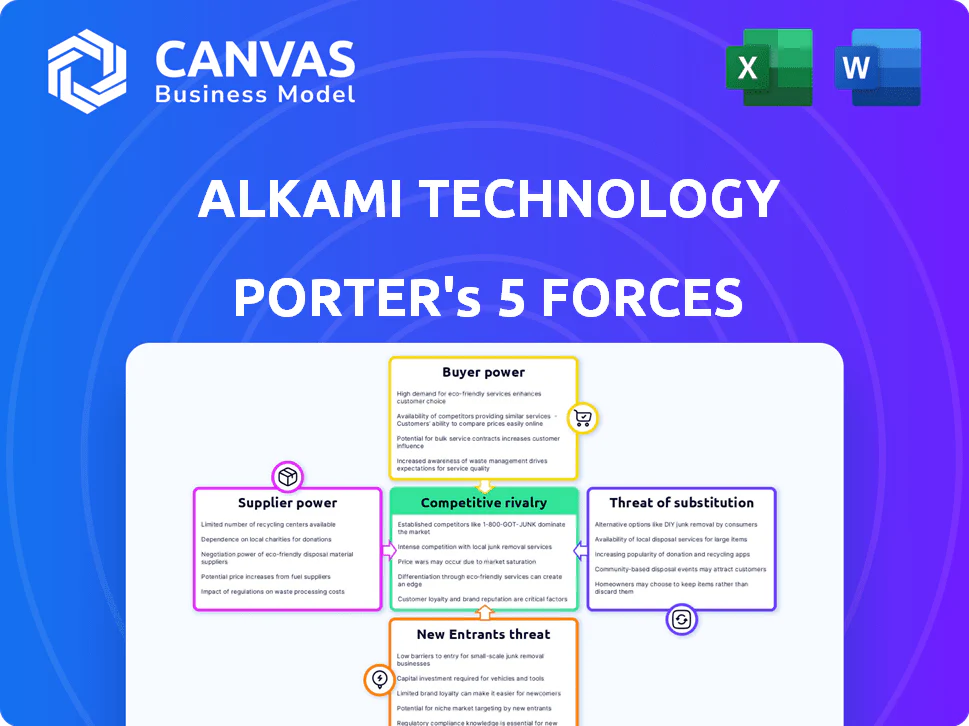
ALKAMI TECHNOLOGY PORTER'S FIVE FORCES TEMPLATE RESEARCH
What is included in the product
 Detailed Word Document
Examines the competitive forces impacting Alkami, offering insights into its market position.

 Customizable Excel Spreadsheet
Customize the force weighting to match Alkami's unique circumstances for better strategic planning.
What You See Is What You Get
Alkami Technology Porter's Five Forces Analysis
This preview reveals the complete Alkami Technology Porter's Five Forces analysis you'll receive after purchase.
It provides a detailed examination of the competitive landscape.
The analysis assesses industry rivalry, buyer power, supplier power, threat of substitutes, and threat of new entrants.
Download the ready-to-use analysis file immediately after your purchase.
This is the exact document, professionally formatted, and ready to use.

Porter's Five Forces Analysis Template

From Overview to Strategy Blueprint
Alkami Technology faces moderate competitive rivalry, with established fintech players and emerging disruptors vying for market share. Buyer power is relatively low due to the specialized nature of its services and customer lock-in. Supplier power is also moderate, with a mix of established and emerging technology providers. The threat of new entrants is moderate, balanced by high barriers to entry. Finally, the threat of substitutes is present, with alternative digital banking solutions constantly evolving.
Our full Porter's Five Forces report goes deeper—offering a data-driven framework to understand Alkami Technology's real business risks and market opportunities.
Suppliers Bargaining Power

Limited Number of Key Technology Suppliers
Alkami Technology depends on specialized tech and cloud providers. The digital banking sector has few core tech and cloud infrastructure suppliers, increasing their leverage. For example, in 2024, cloud infrastructure costs for similar firms rose by 10-15% due to supplier pricing power. This can pressure Alkami's margins.
Dependence on Specialized Software Development Talent
Alkami Technology's digital banking platform hinges on intricate software, demanding specialized developers. The limited availability of these experts grants them significant bargaining power. This can inflate development expenses and potentially extend project completion times. For instance, in 2024, the average software developer salary in the US was around $110,000, reflecting this dynamic.

Potential High Switching Costs for Infrastructure Providers
Alkami Technology faces high switching costs for core infrastructure, such as cloud services. Migrating and integrating with a new provider demands significant time and money. This increases the bargaining power of current suppliers. In 2024, cloud computing spending reached over $670 billion globally, indicating substantial supplier influence.

Concentration of Key Technology Vendors in Digital Banking Solutions
Alkami Technology relies on various tech vendors for its platform. A concentration of these vendors in specialized areas grants them more negotiating power. This can affect pricing and terms for Alkami. In 2024, digital banking tech spending reached $24.3 billion.
- Specialized vendor power impacts Alkami's costs.
- Digital banking tech spending is a growing market.
- Vendor concentration can lead to higher prices.
- Alkami must manage vendor relationships.
Opportunity for Suppliers to Collaborate on Innovation
Suppliers driving tech innovation can wield significant influence, offering Alkami essential competitive advantages. Collaboration with these suppliers is key, but it could also strengthen their bargaining position. This is especially true in specialized areas like cloud services, where a few providers dominate. For example, in 2024, cloud computing spending reached $678.8 billion globally, with major players like AWS, Microsoft Azure, and Google Cloud holding substantial sway.
- Alkami's reliance on specific tech suppliers increases their leverage.
- Innovative suppliers can dictate terms based on unique offerings.
- Collaboration's success hinges on managing supplier power.
- The cloud services market's concentration affects negotiation.
Alkami's Supplier Challenges: Costs & Power Dynamics
Alkami Technology faces supplier bargaining power in tech and cloud services. Limited suppliers and specialized developers increase costs. High switching costs and vendor concentration further strengthen suppliers' leverage.
| Supplier Type | Impact on Alkami | 2024 Data Point |
|---|---|---|
| Cloud Providers | Pricing Power | Cloud spending: $678.8B globally |
| Software Developers | Development Costs | Avg. US salary: $110,000 |
| Tech Vendors | Negotiating Power | Digital banking tech spend: $24.3B |
Customers Bargaining Power

Financial Institutions Seek Comprehensive Solutions
Alkami's customers, financial institutions (FIs), increasingly demand comprehensive digital banking solutions. FIs with large user bases or those needing extensive customization often have greater bargaining power. In 2024, the digital banking market is estimated at $4.7 billion, showing FIs' growing influence. This drives Alkami to offer competitive pricing and features.
Switching Costs for Financial Institutions
Financial institutions (FIs) weigh the costs of switching digital banking platforms against potential benefits. The digital banking market was valued at $9.3 billion in 2023, with a projected CAGR of 13.5% from 2024 to 2030. Enhanced features and efficiency improvements can incentivize FIs to switch. This ability to switch gives FIs some bargaining power over providers.

Customer Negotiation Power Based on Institution Size
The size of a financial institution significantly affects its bargaining power. Larger institutions, like Bank of America with over $3 trillion in assets in 2024, wield greater leverage. They can negotiate more favorable terms and pricing. Smaller institutions, with fewer resources and users, have less negotiation power.

Demand for Advanced Features and Customization
Financial institutions (FIs) are pushing for advanced features and customization. They need sophisticated API integrations and real-time options to compete effectively. For example, in 2024, the demand for personalized banking experiences rose by 30% among FIs. Alkami and others must adapt to these demands; FIs use these needs to negotiate better deals.
- Demand for real-time customization increased by 30% in 2024.
- API integration capabilities are crucial for competitive advantage.
- FIs leverage their feature demands in negotiations.
- Alkami and similar providers must meet these needs.
Client Base Expansion and Retention
Alkami's strong client base, primarily in the credit union sector, shows good customer relationships. Their high retention rate, exceeding 90% in recent years, demonstrates customer satisfaction. However, to sustain growth, Alkami must keep attracting new financial institutions and deepen its services. This ongoing need to win and keep customers gives them considerable bargaining power.
- Retention rate above 90% signals customer satisfaction.
- Expansion into new financial institutions is crucial for growth.
- Customer influence stems from the need for continued client acquisition.
Digital Banking Dynamics: Power, Market & Demand
Financial institutions (FIs) have significant bargaining power over Alkami due to their size and demands. The digital banking market was $4.7 billion in 2024. FIs, especially larger ones like Bank of America, can negotiate favorable terms. Alkami must meet demands for features and customization to retain and attract clients.
| Factor | Impact | Data (2024) |
|---|---|---|
| Market Size | High bargaining power | $4.7B digital banking market |
| Customer Size | Influences negotiation | BofA: $3T+ assets |
| Feature Demand | Drives provider adaptation | 30% increase in demand |
Rivalry Among Competitors

Intense Competition in the Digital Banking Market
The digital banking solutions market is fiercely competitive, drawing in established core processing vendors and agile fintech companies. Alkami competes with firms providing cloud-based platforms and digital banking services. In 2024, the market saw over $10 billion in investments in fintech, highlighting the intense rivalry. This competition drives innovation and pricing pressures, impacting Alkami's market position.
Presence of Larger, Established Competitors
Alkami faces intense competition from giants like Fiserv, Jack Henry & Associates, and FIS Global. These established firms boast substantial resources, including $18.5 billion in revenue for Fiserv in 2023, dwarfing Alkami's scale. Their existing client relationships and broader product offerings create significant competitive hurdles for Alkami. This competitive landscape demands Alkami to continually innovate and differentiate its solutions to maintain market share.

Competition from Point Solution Vendors and Internal Solutions
Alkami faces competition from point solution vendors and internal solutions, increasing rivalry. This includes specialized vendors and financial institutions building in-house digital banking solutions. In 2024, the digital banking market is highly competitive, with many specialized providers. The competition drives innovation but also pressures pricing and market share. The competitive landscape is diverse and dynamic.

Focus on Innovation and Product Expansion
Alkami and its competitors, like Jack Henry & Associates and FIS, face intense rivalry driven by the need to innovate. Financial institutions require cutting-edge digital banking solutions, compelling companies to expand their product offerings. This dynamic is reflected in the digital banking market's growth, projected to reach $16.5 billion by 2024. The rapid technological advancements mean companies must constantly update their platforms.
- Market growth fuels competition.
- Product suite expansion is key.
- Technological change accelerates rivalry.
- Constant updates are essential.
Market Share and Client Acquisition Efforts
Companies in the digital banking solutions market aggressively pursue market share. Alkami Technology actively competes for new clients, particularly in the credit union and bank sectors. In 2024, Alkami reported a notable increase in its client base, reflecting its competitive efforts. The success in the credit union space underscores the intensity of competition for customer acquisition.
- Alkami's client base expanded significantly in 2024, showing competitive success.
- The digital banking market is characterized by strong rivalry for customer acquisition.
- Alkami's focus includes both credit unions and banks, increasing competition.
- Competitors include established and emerging digital banking providers.
Digital Banking Battle: Fierce Competition
Competitive rivalry in digital banking is high, with firms like Fiserv and Jack Henry. The market saw over $10B in fintech investments in 2024. Alkami competes fiercely for market share.
| Aspect | Details |
|---|---|
| Key Competitors | Fiserv, Jack Henry & Associates, FIS |
| 2023 Revenue (Fiserv) | $18.5 billion |
| 2024 Fintech Investments | Over $10 billion |
Original: $10.00
-65%$10.00
$3.50ALKAMI TECHNOLOGY PORTER'S FIVE FORCES TEMPLATE RESEARCH
What is included in the product
Detailed Word Document
Examines the competitive forces impacting Alkami, offering insights into its market position.
Customizable Excel Spreadsheet
Customize the force weighting to match Alkami's unique circumstances for better strategic planning.
What You See Is What You Get
Alkami Technology Porter's Five Forces Analysis
This preview reveals the complete Alkami Technology Porter's Five Forces analysis you'll receive after purchase.
It provides a detailed examination of the competitive landscape.
The analysis assesses industry rivalry, buyer power, supplier power, threat of substitutes, and threat of new entrants.
Download the ready-to-use analysis file immediately after your purchase.
This is the exact document, professionally formatted, and ready to use.
Porter's Five Forces Analysis Template
From Overview to Strategy Blueprint
Alkami Technology faces moderate competitive rivalry, with established fintech players and emerging disruptors vying for market share. Buyer power is relatively low due to the specialized nature of its services and customer lock-in. Supplier power is also moderate, with a mix of established and emerging technology providers. The threat of new entrants is moderate, balanced by high barriers to entry. Finally, the threat of substitutes is present, with alternative digital banking solutions constantly evolving.
Our full Porter's Five Forces report goes deeper—offering a data-driven framework to understand Alkami Technology's real business risks and market opportunities.
Suppliers Bargaining Power
Limited Number of Key Technology Suppliers
Alkami Technology depends on specialized tech and cloud providers. The digital banking sector has few core tech and cloud infrastructure suppliers, increasing their leverage. For example, in 2024, cloud infrastructure costs for similar firms rose by 10-15% due to supplier pricing power. This can pressure Alkami's margins.
Dependence on Specialized Software Development Talent
Alkami Technology's digital banking platform hinges on intricate software, demanding specialized developers. The limited availability of these experts grants them significant bargaining power. This can inflate development expenses and potentially extend project completion times. For instance, in 2024, the average software developer salary in the US was around $110,000, reflecting this dynamic.
Potential High Switching Costs for Infrastructure Providers
Alkami Technology faces high switching costs for core infrastructure, such as cloud services. Migrating and integrating with a new provider demands significant time and money. This increases the bargaining power of current suppliers. In 2024, cloud computing spending reached over $670 billion globally, indicating substantial supplier influence.
Concentration of Key Technology Vendors in Digital Banking Solutions
Alkami Technology relies on various tech vendors for its platform. A concentration of these vendors in specialized areas grants them more negotiating power. This can affect pricing and terms for Alkami. In 2024, digital banking tech spending reached $24.3 billion.
- Specialized vendor power impacts Alkami's costs.
- Digital banking tech spending is a growing market.
- Vendor concentration can lead to higher prices.
- Alkami must manage vendor relationships.
Opportunity for Suppliers to Collaborate on Innovation
Suppliers driving tech innovation can wield significant influence, offering Alkami essential competitive advantages. Collaboration with these suppliers is key, but it could also strengthen their bargaining position. This is especially true in specialized areas like cloud services, where a few providers dominate. For example, in 2024, cloud computing spending reached $678.8 billion globally, with major players like AWS, Microsoft Azure, and Google Cloud holding substantial sway.
- Alkami's reliance on specific tech suppliers increases their leverage.
- Innovative suppliers can dictate terms based on unique offerings.
- Collaboration's success hinges on managing supplier power.
- The cloud services market's concentration affects negotiation.
Alkami's Supplier Challenges: Costs & Power Dynamics
Alkami Technology faces supplier bargaining power in tech and cloud services. Limited suppliers and specialized developers increase costs. High switching costs and vendor concentration further strengthen suppliers' leverage.
| Supplier Type | Impact on Alkami | 2024 Data Point |
|---|---|---|
| Cloud Providers | Pricing Power | Cloud spending: $678.8B globally |
| Software Developers | Development Costs | Avg. US salary: $110,000 |
| Tech Vendors | Negotiating Power | Digital banking tech spend: $24.3B |
Customers Bargaining Power
Financial Institutions Seek Comprehensive Solutions
Alkami's customers, financial institutions (FIs), increasingly demand comprehensive digital banking solutions. FIs with large user bases or those needing extensive customization often have greater bargaining power. In 2024, the digital banking market is estimated at $4.7 billion, showing FIs' growing influence. This drives Alkami to offer competitive pricing and features.
Switching Costs for Financial Institutions
Financial institutions (FIs) weigh the costs of switching digital banking platforms against potential benefits. The digital banking market was valued at $9.3 billion in 2023, with a projected CAGR of 13.5% from 2024 to 2030. Enhanced features and efficiency improvements can incentivize FIs to switch. This ability to switch gives FIs some bargaining power over providers.
Customer Negotiation Power Based on Institution Size
The size of a financial institution significantly affects its bargaining power. Larger institutions, like Bank of America with over $3 trillion in assets in 2024, wield greater leverage. They can negotiate more favorable terms and pricing. Smaller institutions, with fewer resources and users, have less negotiation power.
Demand for Advanced Features and Customization
Financial institutions (FIs) are pushing for advanced features and customization. They need sophisticated API integrations and real-time options to compete effectively. For example, in 2024, the demand for personalized banking experiences rose by 30% among FIs. Alkami and others must adapt to these demands; FIs use these needs to negotiate better deals.
- Demand for real-time customization increased by 30% in 2024.
- API integration capabilities are crucial for competitive advantage.
- FIs leverage their feature demands in negotiations.
- Alkami and similar providers must meet these needs.
Client Base Expansion and Retention
Alkami's strong client base, primarily in the credit union sector, shows good customer relationships. Their high retention rate, exceeding 90% in recent years, demonstrates customer satisfaction. However, to sustain growth, Alkami must keep attracting new financial institutions and deepen its services. This ongoing need to win and keep customers gives them considerable bargaining power.
- Retention rate above 90% signals customer satisfaction.
- Expansion into new financial institutions is crucial for growth.
- Customer influence stems from the need for continued client acquisition.
Digital Banking Dynamics: Power, Market & Demand
Financial institutions (FIs) have significant bargaining power over Alkami due to their size and demands. The digital banking market was $4.7 billion in 2024. FIs, especially larger ones like Bank of America, can negotiate favorable terms. Alkami must meet demands for features and customization to retain and attract clients.
| Factor | Impact | Data (2024) |
|---|---|---|
| Market Size | High bargaining power | $4.7B digital banking market |
| Customer Size | Influences negotiation | BofA: $3T+ assets |
| Feature Demand | Drives provider adaptation | 30% increase in demand |
Rivalry Among Competitors
Intense Competition in the Digital Banking Market
The digital banking solutions market is fiercely competitive, drawing in established core processing vendors and agile fintech companies. Alkami competes with firms providing cloud-based platforms and digital banking services. In 2024, the market saw over $10 billion in investments in fintech, highlighting the intense rivalry. This competition drives innovation and pricing pressures, impacting Alkami's market position.
Presence of Larger, Established Competitors
Alkami faces intense competition from giants like Fiserv, Jack Henry & Associates, and FIS Global. These established firms boast substantial resources, including $18.5 billion in revenue for Fiserv in 2023, dwarfing Alkami's scale. Their existing client relationships and broader product offerings create significant competitive hurdles for Alkami. This competitive landscape demands Alkami to continually innovate and differentiate its solutions to maintain market share.
Competition from Point Solution Vendors and Internal Solutions
Alkami faces competition from point solution vendors and internal solutions, increasing rivalry. This includes specialized vendors and financial institutions building in-house digital banking solutions. In 2024, the digital banking market is highly competitive, with many specialized providers. The competition drives innovation but also pressures pricing and market share. The competitive landscape is diverse and dynamic.
Focus on Innovation and Product Expansion
Alkami and its competitors, like Jack Henry & Associates and FIS, face intense rivalry driven by the need to innovate. Financial institutions require cutting-edge digital banking solutions, compelling companies to expand their product offerings. This dynamic is reflected in the digital banking market's growth, projected to reach $16.5 billion by 2024. The rapid technological advancements mean companies must constantly update their platforms.
- Market growth fuels competition.
- Product suite expansion is key.
- Technological change accelerates rivalry.
- Constant updates are essential.
Market Share and Client Acquisition Efforts
Companies in the digital banking solutions market aggressively pursue market share. Alkami Technology actively competes for new clients, particularly in the credit union and bank sectors. In 2024, Alkami reported a notable increase in its client base, reflecting its competitive efforts. The success in the credit union space underscores the intensity of competition for customer acquisition.
- Alkami's client base expanded significantly in 2024, showing competitive success.
- The digital banking market is characterized by strong rivalry for customer acquisition.
- Alkami's focus includes both credit unions and banks, increasing competition.
- Competitors include established and emerging digital banking providers.
Digital Banking Battle: Fierce Competition
Competitive rivalry in digital banking is high, with firms like Fiserv and Jack Henry. The market saw over $10B in fintech investments in 2024. Alkami competes fiercely for market share.
| Aspect | Details |
|---|---|
| Key Competitors | Fiserv, Jack Henry & Associates, FIS |
| 2023 Revenue (Fiserv) | $18.5 billion |
| 2024 Fintech Investments | Over $10 billion |
Product Information
Product Information
Shipping & Returns
Shipping & Returns
Description
What is included in the product
Detailed Word Document
Examines the competitive forces impacting Alkami, offering insights into its market position.
Customizable Excel Spreadsheet
Customize the force weighting to match Alkami's unique circumstances for better strategic planning.
What You See Is What You Get
Alkami Technology Porter's Five Forces Analysis
This preview reveals the complete Alkami Technology Porter's Five Forces analysis you'll receive after purchase.
It provides a detailed examination of the competitive landscape.
The analysis assesses industry rivalry, buyer power, supplier power, threat of substitutes, and threat of new entrants.
Download the ready-to-use analysis file immediately after your purchase.
This is the exact document, professionally formatted, and ready to use.
Porter's Five Forces Analysis Template
From Overview to Strategy Blueprint
Alkami Technology faces moderate competitive rivalry, with established fintech players and emerging disruptors vying for market share. Buyer power is relatively low due to the specialized nature of its services and customer lock-in. Supplier power is also moderate, with a mix of established and emerging technology providers. The threat of new entrants is moderate, balanced by high barriers to entry. Finally, the threat of substitutes is present, with alternative digital banking solutions constantly evolving.
Our full Porter's Five Forces report goes deeper—offering a data-driven framework to understand Alkami Technology's real business risks and market opportunities.
Suppliers Bargaining Power
Limited Number of Key Technology Suppliers
Alkami Technology depends on specialized tech and cloud providers. The digital banking sector has few core tech and cloud infrastructure suppliers, increasing their leverage. For example, in 2024, cloud infrastructure costs for similar firms rose by 10-15% due to supplier pricing power. This can pressure Alkami's margins.
Dependence on Specialized Software Development Talent
Alkami Technology's digital banking platform hinges on intricate software, demanding specialized developers. The limited availability of these experts grants them significant bargaining power. This can inflate development expenses and potentially extend project completion times. For instance, in 2024, the average software developer salary in the US was around $110,000, reflecting this dynamic.
Potential High Switching Costs for Infrastructure Providers
Alkami Technology faces high switching costs for core infrastructure, such as cloud services. Migrating and integrating with a new provider demands significant time and money. This increases the bargaining power of current suppliers. In 2024, cloud computing spending reached over $670 billion globally, indicating substantial supplier influence.
Concentration of Key Technology Vendors in Digital Banking Solutions
Alkami Technology relies on various tech vendors for its platform. A concentration of these vendors in specialized areas grants them more negotiating power. This can affect pricing and terms for Alkami. In 2024, digital banking tech spending reached $24.3 billion.
- Specialized vendor power impacts Alkami's costs.
- Digital banking tech spending is a growing market.
- Vendor concentration can lead to higher prices.
- Alkami must manage vendor relationships.
Opportunity for Suppliers to Collaborate on Innovation
Suppliers driving tech innovation can wield significant influence, offering Alkami essential competitive advantages. Collaboration with these suppliers is key, but it could also strengthen their bargaining position. This is especially true in specialized areas like cloud services, where a few providers dominate. For example, in 2024, cloud computing spending reached $678.8 billion globally, with major players like AWS, Microsoft Azure, and Google Cloud holding substantial sway.
- Alkami's reliance on specific tech suppliers increases their leverage.
- Innovative suppliers can dictate terms based on unique offerings.
- Collaboration's success hinges on managing supplier power.
- The cloud services market's concentration affects negotiation.
Alkami's Supplier Challenges: Costs & Power Dynamics
Alkami Technology faces supplier bargaining power in tech and cloud services. Limited suppliers and specialized developers increase costs. High switching costs and vendor concentration further strengthen suppliers' leverage.
| Supplier Type | Impact on Alkami | 2024 Data Point |
|---|---|---|
| Cloud Providers | Pricing Power | Cloud spending: $678.8B globally |
| Software Developers | Development Costs | Avg. US salary: $110,000 |
| Tech Vendors | Negotiating Power | Digital banking tech spend: $24.3B |
Customers Bargaining Power
Financial Institutions Seek Comprehensive Solutions
Alkami's customers, financial institutions (FIs), increasingly demand comprehensive digital banking solutions. FIs with large user bases or those needing extensive customization often have greater bargaining power. In 2024, the digital banking market is estimated at $4.7 billion, showing FIs' growing influence. This drives Alkami to offer competitive pricing and features.
Switching Costs for Financial Institutions
Financial institutions (FIs) weigh the costs of switching digital banking platforms against potential benefits. The digital banking market was valued at $9.3 billion in 2023, with a projected CAGR of 13.5% from 2024 to 2030. Enhanced features and efficiency improvements can incentivize FIs to switch. This ability to switch gives FIs some bargaining power over providers.
Customer Negotiation Power Based on Institution Size
The size of a financial institution significantly affects its bargaining power. Larger institutions, like Bank of America with over $3 trillion in assets in 2024, wield greater leverage. They can negotiate more favorable terms and pricing. Smaller institutions, with fewer resources and users, have less negotiation power.
Demand for Advanced Features and Customization
Financial institutions (FIs) are pushing for advanced features and customization. They need sophisticated API integrations and real-time options to compete effectively. For example, in 2024, the demand for personalized banking experiences rose by 30% among FIs. Alkami and others must adapt to these demands; FIs use these needs to negotiate better deals.
- Demand for real-time customization increased by 30% in 2024.
- API integration capabilities are crucial for competitive advantage.
- FIs leverage their feature demands in negotiations.
- Alkami and similar providers must meet these needs.
Client Base Expansion and Retention
Alkami's strong client base, primarily in the credit union sector, shows good customer relationships. Their high retention rate, exceeding 90% in recent years, demonstrates customer satisfaction. However, to sustain growth, Alkami must keep attracting new financial institutions and deepen its services. This ongoing need to win and keep customers gives them considerable bargaining power.
- Retention rate above 90% signals customer satisfaction.
- Expansion into new financial institutions is crucial for growth.
- Customer influence stems from the need for continued client acquisition.
Digital Banking Dynamics: Power, Market & Demand
Financial institutions (FIs) have significant bargaining power over Alkami due to their size and demands. The digital banking market was $4.7 billion in 2024. FIs, especially larger ones like Bank of America, can negotiate favorable terms. Alkami must meet demands for features and customization to retain and attract clients.
| Factor | Impact | Data (2024) |
|---|---|---|
| Market Size | High bargaining power | $4.7B digital banking market |
| Customer Size | Influences negotiation | BofA: $3T+ assets |
| Feature Demand | Drives provider adaptation | 30% increase in demand |
Rivalry Among Competitors
Intense Competition in the Digital Banking Market
The digital banking solutions market is fiercely competitive, drawing in established core processing vendors and agile fintech companies. Alkami competes with firms providing cloud-based platforms and digital banking services. In 2024, the market saw over $10 billion in investments in fintech, highlighting the intense rivalry. This competition drives innovation and pricing pressures, impacting Alkami's market position.
Presence of Larger, Established Competitors
Alkami faces intense competition from giants like Fiserv, Jack Henry & Associates, and FIS Global. These established firms boast substantial resources, including $18.5 billion in revenue for Fiserv in 2023, dwarfing Alkami's scale. Their existing client relationships and broader product offerings create significant competitive hurdles for Alkami. This competitive landscape demands Alkami to continually innovate and differentiate its solutions to maintain market share.
Competition from Point Solution Vendors and Internal Solutions
Alkami faces competition from point solution vendors and internal solutions, increasing rivalry. This includes specialized vendors and financial institutions building in-house digital banking solutions. In 2024, the digital banking market is highly competitive, with many specialized providers. The competition drives innovation but also pressures pricing and market share. The competitive landscape is diverse and dynamic.
Focus on Innovation and Product Expansion
Alkami and its competitors, like Jack Henry & Associates and FIS, face intense rivalry driven by the need to innovate. Financial institutions require cutting-edge digital banking solutions, compelling companies to expand their product offerings. This dynamic is reflected in the digital banking market's growth, projected to reach $16.5 billion by 2024. The rapid technological advancements mean companies must constantly update their platforms.
- Market growth fuels competition.
- Product suite expansion is key.
- Technological change accelerates rivalry.
- Constant updates are essential.
Market Share and Client Acquisition Efforts
Companies in the digital banking solutions market aggressively pursue market share. Alkami Technology actively competes for new clients, particularly in the credit union and bank sectors. In 2024, Alkami reported a notable increase in its client base, reflecting its competitive efforts. The success in the credit union space underscores the intensity of competition for customer acquisition.
- Alkami's client base expanded significantly in 2024, showing competitive success.
- The digital banking market is characterized by strong rivalry for customer acquisition.
- Alkami's focus includes both credit unions and banks, increasing competition.
- Competitors include established and emerging digital banking providers.
Digital Banking Battle: Fierce Competition
Competitive rivalry in digital banking is high, with firms like Fiserv and Jack Henry. The market saw over $10B in fintech investments in 2024. Alkami competes fiercely for market share.
| Aspect | Details |
|---|---|
| Key Competitors | Fiserv, Jack Henry & Associates, FIS |
| 2023 Revenue (Fiserv) | $18.5 billion |
| 2024 Fintech Investments | Over $10 billion |











