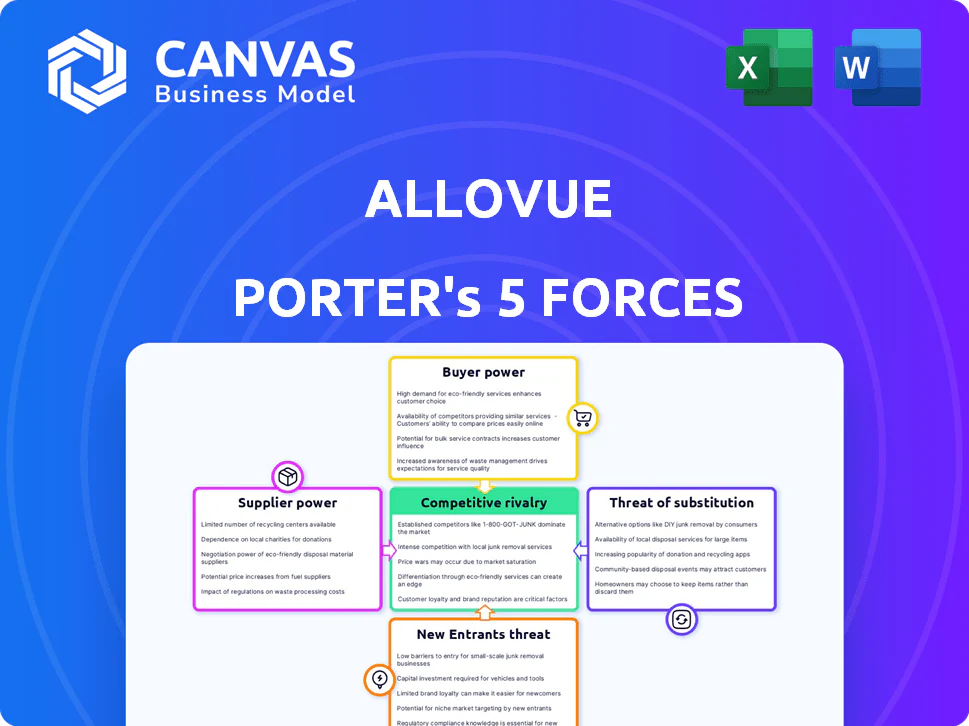
ALLOVUE PORTER'S FIVE FORCES TEMPLATE RESEARCH
What is included in the product
 Detailed Word Document
Analyzes Allovue's competitive environment, assessing forces impacting its market position.

 Customizable Excel Spreadsheet
Instantly understand strategic pressure with a powerful spider/radar chart.
Preview Before You Purchase
Allovue Porter's Five Forces Analysis
This preview offers a comprehensive look at the Allovue Porter's Five Forces Analysis. The document details the competitive landscape, assessing key forces like rivalry and supplier power. You're seeing the complete, professionally formatted analysis file. It is ready for your immediate review and use upon purchase.

Porter's Five Forces Analysis Template

A Must-Have Tool for Decision-Makers
Allovue's competitive landscape is shaped by forces like supplier bargaining power and the threat of new entrants. Understanding these dynamics is crucial for assessing its market position. Competition from substitute products and the influence of buyers also play a role. Analyzing these forces informs strategic planning and investment decisions. This brief snapshot only scratches the surface. Unlock the full Porter's Five Forces Analysis to explore Allovue’s competitive dynamics, market pressures, and strategic advantages in detail.
Suppliers Bargaining Power

Limited direct supplier power for core software
Allovue's bargaining power with suppliers is limited because its core software is internally developed. The company's reliance on internal technology reduces its vulnerability to individual suppliers. Allovue can switch suppliers if needed, since it is not heavily dependent on specific components. In 2024, software companies saw an average of 10-15% in cost of revenue from cloud services.
Potential power of infrastructure providers
Allovue's reliance on infrastructure suppliers, like cloud hosting providers, introduces supplier power. If Allovue depends on one provider, this power increases. However, Allovue can reduce this power by switching providers, or using multi-cloud strategies. In 2024, the cloud computing market grew to $670 billion globally, showing the scale of this sector.

Influence of data providers
Allovue depends on school districts for financial data, making them key suppliers. Districts can control data access, affecting Allovue's operations. This control influences Allovue's ability to offer services. In 2024, many districts manage budgets exceeding $100 million, highlighting their financial significance. They can affect Allovue's success.

Limited power of general IT suppliers
For generic IT needs, Allovue's supplier power is weak. They can easily switch between vendors for standard hardware and services. This competitive landscape keeps prices down and service quality high. In 2024, the IT services market was valued at over $1.4 trillion globally, offering numerous alternatives.
- Market size: The global IT services market was over $1.4 trillion in 2024.
- Competitive landscape: Allovue has many IT supplier options.
- Impact: Low supplier bargaining power.
Impact of specialized data or analytics tool providers
If Allovue depends on unique data analytics tools, the providers of these tools might gain bargaining power. This power is lessened if there are other similar tools available. For instance, the market for educational data analytics is growing, with an estimated value of $2.8 billion in 2024. This means there's competition.
- Market growth: The educational data analytics market is expanding.
- Competition: The presence of multiple tool providers limits supplier power.
- Dependency: High reliance on a single provider boosts their leverage.
- Alternatives: Availability of substitutes reduces supplier control.
Supplier Power Dynamics: A Breakdown
Allovue's supplier bargaining power varies based on the supplier. Internal software development reduces vulnerability to suppliers. Reliance on cloud providers and school districts increases supplier power. The IT services market was over $1.4 trillion in 2024.
| Supplier Type | Bargaining Power | Impact on Allovue |
|---|---|---|
| Internal Software | Low | Reduced dependency |
| Cloud Providers | Medium | Potential for switching |
| School Districts | High | Data access control |
| IT Services | Low | Many alternatives |
Customers Bargaining Power

High bargaining power of school districts
School districts, Allovue's direct customers, wield considerable bargaining power. They're large, with intricate procurement processes. Their software adoption decisions critically impact Allovue. In 2024, the K-12 software market hit $10.8 billion, highlighting district influence.
Influence of funding availability
School districts' financial stability, shaped by government funding and local taxes, significantly affects their ability to purchase software like Allovue. In 2024, U.S. public schools received approximately $776 billion in funding. Districts with robust funding can negotiate better terms. Conversely, those facing budget constraints may have limited bargaining power, impacting Allovue's sales.

Importance of successful implementation and support
Successful implementation and support are crucial for Allovue. School districts, reliant on financial software, need thorough training. Customer satisfaction and retention depend on service quality. In 2024, the EdTech market reached $150 billion, highlighting the importance of effective support.

Potential for collaboration and shared requirements
School districts' shared needs foster collaboration on financial software. This can create a more informed customer base. As of 2024, the K-12 education technology market reached $21.6 billion. Shared requirements strengthen their bargaining power. This collective approach influences vendor pricing and features.
- Shared financial management challenges promote collaboration.
- This leads to a more informed customer base with greater influence.
- Collective bargaining impacts vendor pricing and product development.
- 2024 K-12 ed tech market: $21.6 billion.
Sticky nature of financial systems
The bargaining power of customers in the financial systems market is affected by the "stickiness" of these systems. Switching financial systems is complicated for school districts, representing a significant undertaking. This complexity often reduces the chance of a district changing providers quickly, even if they are not completely satisfied. For example, in 2024, the average contract length for educational software was 3-5 years, showing a commitment to existing systems.
- Switching costs can be substantial, involving data migration, staff training, and system integration.
- Long-term contracts and established relationships can further cement customer loyalty.
- The specific requirements of each district's financial operations can make it difficult to find suitable alternatives.
- Vendors often offer bundled services, increasing the switching costs.
School Districts' Impact on EdTech Success
School districts heavily influence Allovue due to their size and procurement processes. Their financial stability, influenced by funding, affects purchasing power; in 2024, $776 billion funded U.S. public schools. Effective implementation and support are critical; the EdTech market hit $150 billion in 2024, emphasizing service importance. Collective needs strengthen bargaining, with the K-12 market at $21.6 billion in 2024.
| Aspect | Impact | 2024 Data |
|---|---|---|
| District Size | Influences negotiation | Large procurement processes |
| Funding | Affects purchasing ability | $776B U.S. public school funding |
| Support | Determines satisfaction | EdTech market: $150B |
Rivalry Among Competitors

Presence of multiple competitors in the K-12 software market
The K-12 software market, encompassing financial management solutions, is highly competitive. Allovue faces rivals offering similar services. Competitors include companies like Frontline Education and PowerSchool. In 2024, the K-12 software market was valued at over $10 billion, indicating significant competition.
Competition from larger education technology companies
Allovue faces stiff competition from larger edtech firms offering broader product ranges, including financial tools. PowerSchool's acquisition of Allovue highlights this, with PowerSchool's 2024 revenue reaching $700 million. These competitors can bundle services, potentially undercutting Allovue.

Differentiation through specialization
Allovue carves out its niche by concentrating solely on K-12 financial management. This specialization allows for tailored tools, like its data-driven platforms, that provide a competitive edge. The K-12 education technology market was valued at $21.5 billion in 2024. Allovue's focus lets them understand their specific market needs better than general financial software.

Impact of mergers and acquisitions
The merger of Allovue with PowerSchool exemplifies industry consolidation, potentially intensifying competitive rivalry. This union provides the combined entity with greater financial and operational resources, allowing for expanded market reach and enhanced service offerings. Such strategic moves can reshape market dynamics, influencing pricing strategies and product innovation. PowerSchool's revenue in 2024 was approximately $700 million, highlighting the financial scale of the acquiring entity.
- Market consolidation often reduces the number of competitors.
- Combined resources can lead to more aggressive market strategies.
- Increased financial strength may drive innovation and product development.
- Competitive rivalry intensifies as fewer, larger players compete.
Evolving market with technological advancements
The education technology market is fiercely competitive, driven by rapid technological advancements. Companies must quickly integrate innovations like AI and data analytics to stay ahead. Those who adapt swiftly to these changes can secure a stronger market position.
- The global EdTech market was valued at $106.4 billion in 2023.
- AI in education is projected to reach $4.8 billion by 2029.
- Companies investing in AI saw a 20% increase in user engagement.
K-12 Software Market: $10B+ and Growing!
Competitive rivalry in the K-12 software market is intense, with Allovue facing strong competitors like PowerSchool and Frontline Education. The K-12 software market was valued at over $10 billion in 2024. Consolidation, like PowerSchool's acquisition of Allovue, reshapes market dynamics, increasing competition.
| Aspect | Details | Data (2024) |
|---|---|---|
| Market Value | K-12 Software Market | $10B+ |
| Key Competitors | PowerSchool, Frontline Education | PowerSchool Revenue: $700M |
| EdTech Market | Overall Market Value | $21.5B (K-12) |
Original: $10.00
-65%$10.00
$3.50ALLOVUE PORTER'S FIVE FORCES TEMPLATE RESEARCH
What is included in the product
Detailed Word Document
Analyzes Allovue's competitive environment, assessing forces impacting its market position.
Customizable Excel Spreadsheet
Instantly understand strategic pressure with a powerful spider/radar chart.
Preview Before You Purchase
Allovue Porter's Five Forces Analysis
This preview offers a comprehensive look at the Allovue Porter's Five Forces Analysis. The document details the competitive landscape, assessing key forces like rivalry and supplier power. You're seeing the complete, professionally formatted analysis file. It is ready for your immediate review and use upon purchase.
Porter's Five Forces Analysis Template
A Must-Have Tool for Decision-Makers
Allovue's competitive landscape is shaped by forces like supplier bargaining power and the threat of new entrants. Understanding these dynamics is crucial for assessing its market position. Competition from substitute products and the influence of buyers also play a role. Analyzing these forces informs strategic planning and investment decisions. This brief snapshot only scratches the surface. Unlock the full Porter's Five Forces Analysis to explore Allovue’s competitive dynamics, market pressures, and strategic advantages in detail.
Suppliers Bargaining Power
Limited direct supplier power for core software
Allovue's bargaining power with suppliers is limited because its core software is internally developed. The company's reliance on internal technology reduces its vulnerability to individual suppliers. Allovue can switch suppliers if needed, since it is not heavily dependent on specific components. In 2024, software companies saw an average of 10-15% in cost of revenue from cloud services.
Potential power of infrastructure providers
Allovue's reliance on infrastructure suppliers, like cloud hosting providers, introduces supplier power. If Allovue depends on one provider, this power increases. However, Allovue can reduce this power by switching providers, or using multi-cloud strategies. In 2024, the cloud computing market grew to $670 billion globally, showing the scale of this sector.
Influence of data providers
Allovue depends on school districts for financial data, making them key suppliers. Districts can control data access, affecting Allovue's operations. This control influences Allovue's ability to offer services. In 2024, many districts manage budgets exceeding $100 million, highlighting their financial significance. They can affect Allovue's success.
Limited power of general IT suppliers
For generic IT needs, Allovue's supplier power is weak. They can easily switch between vendors for standard hardware and services. This competitive landscape keeps prices down and service quality high. In 2024, the IT services market was valued at over $1.4 trillion globally, offering numerous alternatives.
- Market size: The global IT services market was over $1.4 trillion in 2024.
- Competitive landscape: Allovue has many IT supplier options.
- Impact: Low supplier bargaining power.
Impact of specialized data or analytics tool providers
If Allovue depends on unique data analytics tools, the providers of these tools might gain bargaining power. This power is lessened if there are other similar tools available. For instance, the market for educational data analytics is growing, with an estimated value of $2.8 billion in 2024. This means there's competition.
- Market growth: The educational data analytics market is expanding.
- Competition: The presence of multiple tool providers limits supplier power.
- Dependency: High reliance on a single provider boosts their leverage.
- Alternatives: Availability of substitutes reduces supplier control.
Supplier Power Dynamics: A Breakdown
Allovue's supplier bargaining power varies based on the supplier. Internal software development reduces vulnerability to suppliers. Reliance on cloud providers and school districts increases supplier power. The IT services market was over $1.4 trillion in 2024.
| Supplier Type | Bargaining Power | Impact on Allovue |
|---|---|---|
| Internal Software | Low | Reduced dependency |
| Cloud Providers | Medium | Potential for switching |
| School Districts | High | Data access control |
| IT Services | Low | Many alternatives |
Customers Bargaining Power
High bargaining power of school districts
School districts, Allovue's direct customers, wield considerable bargaining power. They're large, with intricate procurement processes. Their software adoption decisions critically impact Allovue. In 2024, the K-12 software market hit $10.8 billion, highlighting district influence.
Influence of funding availability
School districts' financial stability, shaped by government funding and local taxes, significantly affects their ability to purchase software like Allovue. In 2024, U.S. public schools received approximately $776 billion in funding. Districts with robust funding can negotiate better terms. Conversely, those facing budget constraints may have limited bargaining power, impacting Allovue's sales.
Importance of successful implementation and support
Successful implementation and support are crucial for Allovue. School districts, reliant on financial software, need thorough training. Customer satisfaction and retention depend on service quality. In 2024, the EdTech market reached $150 billion, highlighting the importance of effective support.
Potential for collaboration and shared requirements
School districts' shared needs foster collaboration on financial software. This can create a more informed customer base. As of 2024, the K-12 education technology market reached $21.6 billion. Shared requirements strengthen their bargaining power. This collective approach influences vendor pricing and features.
- Shared financial management challenges promote collaboration.
- This leads to a more informed customer base with greater influence.
- Collective bargaining impacts vendor pricing and product development.
- 2024 K-12 ed tech market: $21.6 billion.
Sticky nature of financial systems
The bargaining power of customers in the financial systems market is affected by the "stickiness" of these systems. Switching financial systems is complicated for school districts, representing a significant undertaking. This complexity often reduces the chance of a district changing providers quickly, even if they are not completely satisfied. For example, in 2024, the average contract length for educational software was 3-5 years, showing a commitment to existing systems.
- Switching costs can be substantial, involving data migration, staff training, and system integration.
- Long-term contracts and established relationships can further cement customer loyalty.
- The specific requirements of each district's financial operations can make it difficult to find suitable alternatives.
- Vendors often offer bundled services, increasing the switching costs.
School Districts' Impact on EdTech Success
School districts heavily influence Allovue due to their size and procurement processes. Their financial stability, influenced by funding, affects purchasing power; in 2024, $776 billion funded U.S. public schools. Effective implementation and support are critical; the EdTech market hit $150 billion in 2024, emphasizing service importance. Collective needs strengthen bargaining, with the K-12 market at $21.6 billion in 2024.
| Aspect | Impact | 2024 Data |
|---|---|---|
| District Size | Influences negotiation | Large procurement processes |
| Funding | Affects purchasing ability | $776B U.S. public school funding |
| Support | Determines satisfaction | EdTech market: $150B |
Rivalry Among Competitors
Presence of multiple competitors in the K-12 software market
The K-12 software market, encompassing financial management solutions, is highly competitive. Allovue faces rivals offering similar services. Competitors include companies like Frontline Education and PowerSchool. In 2024, the K-12 software market was valued at over $10 billion, indicating significant competition.
Competition from larger education technology companies
Allovue faces stiff competition from larger edtech firms offering broader product ranges, including financial tools. PowerSchool's acquisition of Allovue highlights this, with PowerSchool's 2024 revenue reaching $700 million. These competitors can bundle services, potentially undercutting Allovue.
Differentiation through specialization
Allovue carves out its niche by concentrating solely on K-12 financial management. This specialization allows for tailored tools, like its data-driven platforms, that provide a competitive edge. The K-12 education technology market was valued at $21.5 billion in 2024. Allovue's focus lets them understand their specific market needs better than general financial software.
Impact of mergers and acquisitions
The merger of Allovue with PowerSchool exemplifies industry consolidation, potentially intensifying competitive rivalry. This union provides the combined entity with greater financial and operational resources, allowing for expanded market reach and enhanced service offerings. Such strategic moves can reshape market dynamics, influencing pricing strategies and product innovation. PowerSchool's revenue in 2024 was approximately $700 million, highlighting the financial scale of the acquiring entity.
- Market consolidation often reduces the number of competitors.
- Combined resources can lead to more aggressive market strategies.
- Increased financial strength may drive innovation and product development.
- Competitive rivalry intensifies as fewer, larger players compete.
Evolving market with technological advancements
The education technology market is fiercely competitive, driven by rapid technological advancements. Companies must quickly integrate innovations like AI and data analytics to stay ahead. Those who adapt swiftly to these changes can secure a stronger market position.
- The global EdTech market was valued at $106.4 billion in 2023.
- AI in education is projected to reach $4.8 billion by 2029.
- Companies investing in AI saw a 20% increase in user engagement.
K-12 Software Market: $10B+ and Growing!
Competitive rivalry in the K-12 software market is intense, with Allovue facing strong competitors like PowerSchool and Frontline Education. The K-12 software market was valued at over $10 billion in 2024. Consolidation, like PowerSchool's acquisition of Allovue, reshapes market dynamics, increasing competition.
| Aspect | Details | Data (2024) |
|---|---|---|
| Market Value | K-12 Software Market | $10B+ |
| Key Competitors | PowerSchool, Frontline Education | PowerSchool Revenue: $700M |
| EdTech Market | Overall Market Value | $21.5B (K-12) |
Product Information
Product Information
Shipping & Returns
Shipping & Returns
Description
What is included in the product
Detailed Word Document
Analyzes Allovue's competitive environment, assessing forces impacting its market position.
Customizable Excel Spreadsheet
Instantly understand strategic pressure with a powerful spider/radar chart.
Preview Before You Purchase
Allovue Porter's Five Forces Analysis
This preview offers a comprehensive look at the Allovue Porter's Five Forces Analysis. The document details the competitive landscape, assessing key forces like rivalry and supplier power. You're seeing the complete, professionally formatted analysis file. It is ready for your immediate review and use upon purchase.
Porter's Five Forces Analysis Template
A Must-Have Tool for Decision-Makers
Allovue's competitive landscape is shaped by forces like supplier bargaining power and the threat of new entrants. Understanding these dynamics is crucial for assessing its market position. Competition from substitute products and the influence of buyers also play a role. Analyzing these forces informs strategic planning and investment decisions. This brief snapshot only scratches the surface. Unlock the full Porter's Five Forces Analysis to explore Allovue’s competitive dynamics, market pressures, and strategic advantages in detail.
Suppliers Bargaining Power
Limited direct supplier power for core software
Allovue's bargaining power with suppliers is limited because its core software is internally developed. The company's reliance on internal technology reduces its vulnerability to individual suppliers. Allovue can switch suppliers if needed, since it is not heavily dependent on specific components. In 2024, software companies saw an average of 10-15% in cost of revenue from cloud services.
Potential power of infrastructure providers
Allovue's reliance on infrastructure suppliers, like cloud hosting providers, introduces supplier power. If Allovue depends on one provider, this power increases. However, Allovue can reduce this power by switching providers, or using multi-cloud strategies. In 2024, the cloud computing market grew to $670 billion globally, showing the scale of this sector.
Influence of data providers
Allovue depends on school districts for financial data, making them key suppliers. Districts can control data access, affecting Allovue's operations. This control influences Allovue's ability to offer services. In 2024, many districts manage budgets exceeding $100 million, highlighting their financial significance. They can affect Allovue's success.
Limited power of general IT suppliers
For generic IT needs, Allovue's supplier power is weak. They can easily switch between vendors for standard hardware and services. This competitive landscape keeps prices down and service quality high. In 2024, the IT services market was valued at over $1.4 trillion globally, offering numerous alternatives.
- Market size: The global IT services market was over $1.4 trillion in 2024.
- Competitive landscape: Allovue has many IT supplier options.
- Impact: Low supplier bargaining power.
Impact of specialized data or analytics tool providers
If Allovue depends on unique data analytics tools, the providers of these tools might gain bargaining power. This power is lessened if there are other similar tools available. For instance, the market for educational data analytics is growing, with an estimated value of $2.8 billion in 2024. This means there's competition.
- Market growth: The educational data analytics market is expanding.
- Competition: The presence of multiple tool providers limits supplier power.
- Dependency: High reliance on a single provider boosts their leverage.
- Alternatives: Availability of substitutes reduces supplier control.
Supplier Power Dynamics: A Breakdown
Allovue's supplier bargaining power varies based on the supplier. Internal software development reduces vulnerability to suppliers. Reliance on cloud providers and school districts increases supplier power. The IT services market was over $1.4 trillion in 2024.
| Supplier Type | Bargaining Power | Impact on Allovue |
|---|---|---|
| Internal Software | Low | Reduced dependency |
| Cloud Providers | Medium | Potential for switching |
| School Districts | High | Data access control |
| IT Services | Low | Many alternatives |
Customers Bargaining Power
High bargaining power of school districts
School districts, Allovue's direct customers, wield considerable bargaining power. They're large, with intricate procurement processes. Their software adoption decisions critically impact Allovue. In 2024, the K-12 software market hit $10.8 billion, highlighting district influence.
Influence of funding availability
School districts' financial stability, shaped by government funding and local taxes, significantly affects their ability to purchase software like Allovue. In 2024, U.S. public schools received approximately $776 billion in funding. Districts with robust funding can negotiate better terms. Conversely, those facing budget constraints may have limited bargaining power, impacting Allovue's sales.
Importance of successful implementation and support
Successful implementation and support are crucial for Allovue. School districts, reliant on financial software, need thorough training. Customer satisfaction and retention depend on service quality. In 2024, the EdTech market reached $150 billion, highlighting the importance of effective support.
Potential for collaboration and shared requirements
School districts' shared needs foster collaboration on financial software. This can create a more informed customer base. As of 2024, the K-12 education technology market reached $21.6 billion. Shared requirements strengthen their bargaining power. This collective approach influences vendor pricing and features.
- Shared financial management challenges promote collaboration.
- This leads to a more informed customer base with greater influence.
- Collective bargaining impacts vendor pricing and product development.
- 2024 K-12 ed tech market: $21.6 billion.
Sticky nature of financial systems
The bargaining power of customers in the financial systems market is affected by the "stickiness" of these systems. Switching financial systems is complicated for school districts, representing a significant undertaking. This complexity often reduces the chance of a district changing providers quickly, even if they are not completely satisfied. For example, in 2024, the average contract length for educational software was 3-5 years, showing a commitment to existing systems.
- Switching costs can be substantial, involving data migration, staff training, and system integration.
- Long-term contracts and established relationships can further cement customer loyalty.
- The specific requirements of each district's financial operations can make it difficult to find suitable alternatives.
- Vendors often offer bundled services, increasing the switching costs.
School Districts' Impact on EdTech Success
School districts heavily influence Allovue due to their size and procurement processes. Their financial stability, influenced by funding, affects purchasing power; in 2024, $776 billion funded U.S. public schools. Effective implementation and support are critical; the EdTech market hit $150 billion in 2024, emphasizing service importance. Collective needs strengthen bargaining, with the K-12 market at $21.6 billion in 2024.
| Aspect | Impact | 2024 Data |
|---|---|---|
| District Size | Influences negotiation | Large procurement processes |
| Funding | Affects purchasing ability | $776B U.S. public school funding |
| Support | Determines satisfaction | EdTech market: $150B |
Rivalry Among Competitors
Presence of multiple competitors in the K-12 software market
The K-12 software market, encompassing financial management solutions, is highly competitive. Allovue faces rivals offering similar services. Competitors include companies like Frontline Education and PowerSchool. In 2024, the K-12 software market was valued at over $10 billion, indicating significant competition.
Competition from larger education technology companies
Allovue faces stiff competition from larger edtech firms offering broader product ranges, including financial tools. PowerSchool's acquisition of Allovue highlights this, with PowerSchool's 2024 revenue reaching $700 million. These competitors can bundle services, potentially undercutting Allovue.
Differentiation through specialization
Allovue carves out its niche by concentrating solely on K-12 financial management. This specialization allows for tailored tools, like its data-driven platforms, that provide a competitive edge. The K-12 education technology market was valued at $21.5 billion in 2024. Allovue's focus lets them understand their specific market needs better than general financial software.
Impact of mergers and acquisitions
The merger of Allovue with PowerSchool exemplifies industry consolidation, potentially intensifying competitive rivalry. This union provides the combined entity with greater financial and operational resources, allowing for expanded market reach and enhanced service offerings. Such strategic moves can reshape market dynamics, influencing pricing strategies and product innovation. PowerSchool's revenue in 2024 was approximately $700 million, highlighting the financial scale of the acquiring entity.
- Market consolidation often reduces the number of competitors.
- Combined resources can lead to more aggressive market strategies.
- Increased financial strength may drive innovation and product development.
- Competitive rivalry intensifies as fewer, larger players compete.
Evolving market with technological advancements
The education technology market is fiercely competitive, driven by rapid technological advancements. Companies must quickly integrate innovations like AI and data analytics to stay ahead. Those who adapt swiftly to these changes can secure a stronger market position.
- The global EdTech market was valued at $106.4 billion in 2023.
- AI in education is projected to reach $4.8 billion by 2029.
- Companies investing in AI saw a 20% increase in user engagement.
K-12 Software Market: $10B+ and Growing!
Competitive rivalry in the K-12 software market is intense, with Allovue facing strong competitors like PowerSchool and Frontline Education. The K-12 software market was valued at over $10 billion in 2024. Consolidation, like PowerSchool's acquisition of Allovue, reshapes market dynamics, increasing competition.
| Aspect | Details | Data (2024) |
|---|---|---|
| Market Value | K-12 Software Market | $10B+ |
| Key Competitors | PowerSchool, Frontline Education | PowerSchool Revenue: $700M |
| EdTech Market | Overall Market Value | $21.5B (K-12) |











