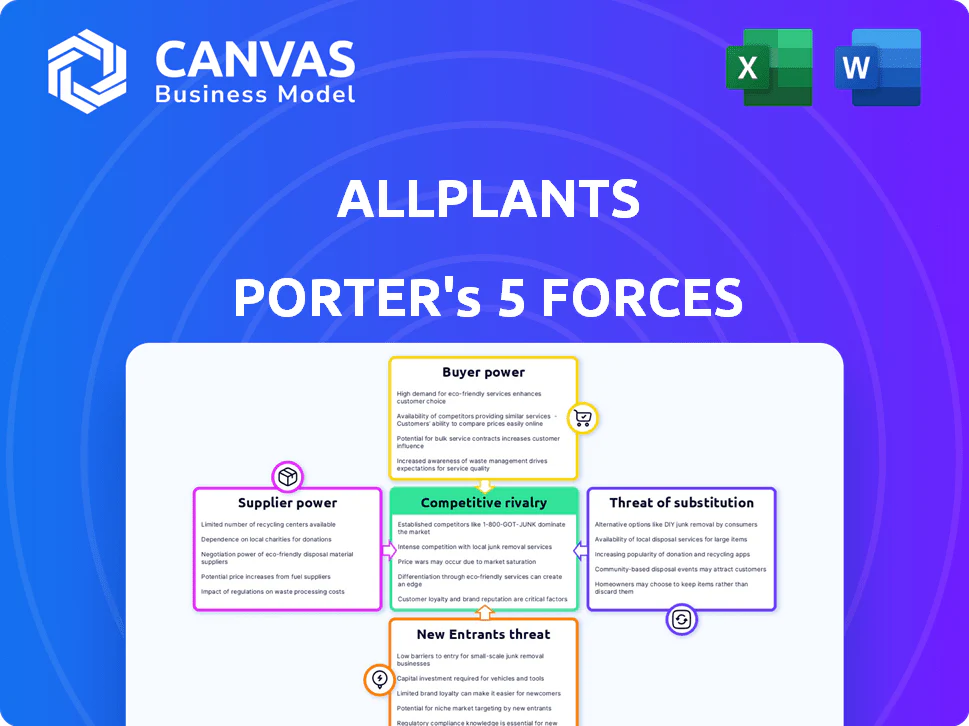
ALLPLANTS PORTER'S FIVE FORCES TEMPLATE RESEARCH
What is included in the product
 Detailed Word Document
Identifies disruptive forces, emerging threats, and substitutes that challenge market share.

 Customizable Excel Spreadsheet
Spot strategic weaknesses quickly with a visual, actionable force level score.
Same Document Delivered
AllPlants Porter's Five Forces Analysis
This is the complete AllPlants Porter's Five Forces analysis document. The preview displays the identical, professionally written analysis you will receive. It covers all forces: threat of new entrants, bargaining power of suppliers/buyers, threat of substitutes, and competitive rivalry. You'll download and use it immediately after purchase.

Porter's Five Forces Analysis Template

Go Beyond the Preview—Access the Full Strategic Report
AllPlants faces moderate rivalry, with strong competition from established plant-based food brands. Buyer power is significant, driven by consumer choice and price sensitivity. Threat of new entrants is moderate, due to established brand presence. Substitute products (meat alternatives) pose a considerable threat. Supplier power is low, due to diversified ingredient sourcing.
Ready to move beyond the basics? Get a full strategic breakdown of AllPlants’s market position, competitive intensity, and external threats—all in one powerful analysis.
Suppliers Bargaining Power

Reliance on Fresh Produce
Allplants depends on fresh produce for its meals. Prices fluctuate due to seasons and markets. In 2024, vegetable prices saw a 5-10% variance. Strong supplier relations are key to navigating these changes. This strategy helps maintain consistent quality and cost control.
Specialized Ingredients
Allplants might face supplier power if it relies on specialized plant-based ingredients. Limited availability gives suppliers more leverage. For instance, in 2024, the global plant-based food market was valued at approximately $36.3 billion.

Packaging Suppliers
Allplants' focus on sustainable packaging grants suppliers some leverage. Eco-friendly or innovative packaging providers, especially if scarce, can exert pressure. In 2024, the sustainable packaging market is valued at $350 billion, showing supplier importance. Limited alternatives for unique materials amplify this power.

Labor Costs
For Allplants, labor costs significantly impact their operations, given their in-house kitchen and chef teams. The ability to attract and retain skilled chefs and kitchen staff directly affects their operational expenses. In 2024, the average hourly wage for chefs in the UK was around £13.50, influencing Allplants' cost structure. High labor costs can reduce profit margins.
- Labor costs are a key factor, impacting profitability.
- Average chef wages in the UK in 2024 were approximately £13.50 per hour.
- Skilled labor availability is crucial for Allplants.
Negotiation and Sourcing Strategy
Allplants' negotiation and sourcing strategy is key to managing supplier power. They can negotiate favorable terms, like lower prices or flexible payment schedules, by having strong negotiation tactics. Diversifying their supplier base reduces dependency on any single supplier, giving them more leverage. Their ethical sourcing focus might also affect supplier choices and costs.
- Negotiation: Strong negotiation skills are crucial.
- Contracts: Long-term contracts stabilize supply.
- Diversity: Multiple suppliers reduce risk.
- Ethical Sourcing: Impacts supplier choice.
Navigating Supplier Dynamics in Plant-Based Foods
Allplants faces supplier power from fresh produce and specialized ingredients. The plant-based food market was around $36.3B in 2024. Sustainable packaging also gives suppliers leverage, with the market valued at $350B in 2024. Effective sourcing and negotiation are crucial to manage these supplier dynamics.
| Supplier Factor | Impact | 2024 Data |
|---|---|---|
| Fresh Produce | Price Volatility | Vegetable price variance: 5-10% |
| Specialized Ingredients | Limited Availability | Plant-based food market: $36.3B |
| Sustainable Packaging | Supplier Leverage | Sustainable packaging market: $350B |
Customers Bargaining Power

Availability of Alternatives
Customers wield significant power due to the abundance of alternatives. They can opt for home cooking, which in 2024 saw a 12% increase in plant-based recipe searches. Other meal delivery services and supermarket ready-meals offer easy switches. This variety pressures Allplants to maintain competitive pricing.
Price Sensitivity
Allplants faces price sensitivity from customers prioritizing convenience and health, though cheaper alternatives exist. Economic conditions influence this sensitivity, potentially impacting purchase decisions. In 2024, the plant-based food market grew, but value-focused options gained traction. Allplants must balance premium pricing with customer affordability.

Subscription Model
Allplants' subscription model cultivates customer loyalty, potentially lessening customer bargaining power; customers stay engaged unless they actively cancel. In 2024, subscription services saw a 15% churn rate on average, highlighting the importance of easy cancellation processes. Streamlined cancellation procedures are vital, as 60% of subscribers cite ease of cancellation as a key factor.

Customer Feedback and Reviews
Customer feedback and online reviews greatly impact Allplants. Positive reviews attract new customers, while negative ones can deter them. To mitigate this, Allplants must excel in product quality and customer service.
- 79% of consumers trust online reviews as much as personal recommendations.
- Businesses with a high online reputation see up to a 19% increase in revenue.
- Negative reviews can decrease sales by up to 70%.
Dietary Needs and Preferences
Customers' dietary needs and preferences significantly influence their bargaining power in the plant-based food market. If Allplants offers unique products catering to specific needs, like allergy-friendly or highly specialized diets, customer power may be lower. However, the proliferation of plant-based alternatives, with the market size of the global plant-based food market reaching $36.3 billion in 2023, gives consumers more choices. This increase in options allows customers to switch brands easily if they are not satisfied with Allplants. The rise of consumer awareness and demand has empowered customers to seek out and choose from many plant-based options.
- The global plant-based food market was valued at $36.3 billion in 2023.
- The market is expected to grow, increasing customer choices.
- Specialized offerings may reduce customer bargaining power.
Plant-Based Food: Market Dynamics & Customer Power
Customers' bargaining power is high due to numerous alternatives. The 2023 global plant-based food market hit $36.3B. Allplants' subscription model aims to retain customers, but the average churn rate was 15% in 2024.
| Aspect | Impact | Data |
|---|---|---|
| Alternatives | High bargaining power | Home cooking searches up 12% in 2024 |
| Subscription | Mitigates power | 15% churn rate in 2024 |
| Market Size | More Choices | $36.3B in 2023 |
Rivalry Among Competitors

Numerous Competitors
The plant-based food market is bustling, especially in ready-meals and delivery. This surge in competitors intensifies the battle for market share. In 2024, the global plant-based food market was valued at approximately $36.3 billion. AllPlants faces pressure from both specialized and traditional food companies.
Differentiation
Allplants distinguishes itself through taste, quality, and sustainability. This strategy is essential in the crowded plant-based food market. Competitors like Beyond Meat and Impossible Foods also focus on differentiating their products. Maintaining this edge is vital for market share; in 2024, the global plant-based market was valued at $36.6 billion.

Pricing Strategies
Allplants faces intense price competition. Competitors may start price wars or offer deals, squeezing Allplants' margins. In 2024, the plant-based food market saw aggressive promotional activity. This could force Allplants to cut prices, impacting profits, which is a challenge for any company.

Innovation and Product Development
Competitive rivalry in the plant-based food sector, including Allplants, is significantly influenced by innovation in product development. To maintain a competitive edge, Allplants must consistently introduce new and attractive plant-based meal options. The market saw a 17% increase in new plant-based product launches in 2024. This focus on innovation is crucial for Allplants to differentiate itself and meet evolving consumer demands.
- New product launches in the plant-based sector increased by 17% in 2024.
- Allplants must continuously innovate to stay ahead of competitors.
- Consumer demand for plant-based options is constantly evolving.
- Differentiation through innovation is key for market success.
Market Growth Potential
The plant-based market's expansion offers chances for various companies, even with tough competition. This growth draws newcomers, intensifying rivalry. In 2024, the global plant-based food market was valued at $36.3 billion. This sector is projected to reach $77.8 billion by 2029, according to a report.
- Market growth provides opportunities.
- Competition also attracts new entrants.
- The plant-based market was worth $36.3 billion in 2024.
- It's expected to reach $77.8 billion by 2029.
Plant-Based Food Fight: $77.8B by 2029!
Intense rivalry marks the plant-based food sector. Allplants competes in a market valued at $36.3 billion in 2024, projected to hit $77.8 billion by 2029. Constant innovation and differentiation are critical for survival. Aggressive pricing and new product launches, up 17% in 2024, fuel the competition.
| Factor | Impact on Allplants | 2024 Data |
|---|---|---|
| Market Value | Opportunity & Challenge | $36.3B |
| Projected Market | Long-term Growth | $77.8B by 2029 |
| New Product Launches | Intensified Competition | +17% |
Original: $10.00
-65%$10.00
$3.50ALLPLANTS PORTER'S FIVE FORCES TEMPLATE RESEARCH
What is included in the product
Detailed Word Document
Identifies disruptive forces, emerging threats, and substitutes that challenge market share.
Customizable Excel Spreadsheet
Spot strategic weaknesses quickly with a visual, actionable force level score.
Same Document Delivered
AllPlants Porter's Five Forces Analysis
This is the complete AllPlants Porter's Five Forces analysis document. The preview displays the identical, professionally written analysis you will receive. It covers all forces: threat of new entrants, bargaining power of suppliers/buyers, threat of substitutes, and competitive rivalry. You'll download and use it immediately after purchase.
Porter's Five Forces Analysis Template
Go Beyond the Preview—Access the Full Strategic Report
AllPlants faces moderate rivalry, with strong competition from established plant-based food brands. Buyer power is significant, driven by consumer choice and price sensitivity. Threat of new entrants is moderate, due to established brand presence. Substitute products (meat alternatives) pose a considerable threat. Supplier power is low, due to diversified ingredient sourcing.
Ready to move beyond the basics? Get a full strategic breakdown of AllPlants’s market position, competitive intensity, and external threats—all in one powerful analysis.
Suppliers Bargaining Power
Reliance on Fresh Produce
Allplants depends on fresh produce for its meals. Prices fluctuate due to seasons and markets. In 2024, vegetable prices saw a 5-10% variance. Strong supplier relations are key to navigating these changes. This strategy helps maintain consistent quality and cost control.
Specialized Ingredients
Allplants might face supplier power if it relies on specialized plant-based ingredients. Limited availability gives suppliers more leverage. For instance, in 2024, the global plant-based food market was valued at approximately $36.3 billion.
Packaging Suppliers
Allplants' focus on sustainable packaging grants suppliers some leverage. Eco-friendly or innovative packaging providers, especially if scarce, can exert pressure. In 2024, the sustainable packaging market is valued at $350 billion, showing supplier importance. Limited alternatives for unique materials amplify this power.
Labor Costs
For Allplants, labor costs significantly impact their operations, given their in-house kitchen and chef teams. The ability to attract and retain skilled chefs and kitchen staff directly affects their operational expenses. In 2024, the average hourly wage for chefs in the UK was around £13.50, influencing Allplants' cost structure. High labor costs can reduce profit margins.
- Labor costs are a key factor, impacting profitability.
- Average chef wages in the UK in 2024 were approximately £13.50 per hour.
- Skilled labor availability is crucial for Allplants.
Negotiation and Sourcing Strategy
Allplants' negotiation and sourcing strategy is key to managing supplier power. They can negotiate favorable terms, like lower prices or flexible payment schedules, by having strong negotiation tactics. Diversifying their supplier base reduces dependency on any single supplier, giving them more leverage. Their ethical sourcing focus might also affect supplier choices and costs.
- Negotiation: Strong negotiation skills are crucial.
- Contracts: Long-term contracts stabilize supply.
- Diversity: Multiple suppliers reduce risk.
- Ethical Sourcing: Impacts supplier choice.
Navigating Supplier Dynamics in Plant-Based Foods
Allplants faces supplier power from fresh produce and specialized ingredients. The plant-based food market was around $36.3B in 2024. Sustainable packaging also gives suppliers leverage, with the market valued at $350B in 2024. Effective sourcing and negotiation are crucial to manage these supplier dynamics.
| Supplier Factor | Impact | 2024 Data |
|---|---|---|
| Fresh Produce | Price Volatility | Vegetable price variance: 5-10% |
| Specialized Ingredients | Limited Availability | Plant-based food market: $36.3B |
| Sustainable Packaging | Supplier Leverage | Sustainable packaging market: $350B |
Customers Bargaining Power
Availability of Alternatives
Customers wield significant power due to the abundance of alternatives. They can opt for home cooking, which in 2024 saw a 12% increase in plant-based recipe searches. Other meal delivery services and supermarket ready-meals offer easy switches. This variety pressures Allplants to maintain competitive pricing.
Price Sensitivity
Allplants faces price sensitivity from customers prioritizing convenience and health, though cheaper alternatives exist. Economic conditions influence this sensitivity, potentially impacting purchase decisions. In 2024, the plant-based food market grew, but value-focused options gained traction. Allplants must balance premium pricing with customer affordability.
Subscription Model
Allplants' subscription model cultivates customer loyalty, potentially lessening customer bargaining power; customers stay engaged unless they actively cancel. In 2024, subscription services saw a 15% churn rate on average, highlighting the importance of easy cancellation processes. Streamlined cancellation procedures are vital, as 60% of subscribers cite ease of cancellation as a key factor.
Customer Feedback and Reviews
Customer feedback and online reviews greatly impact Allplants. Positive reviews attract new customers, while negative ones can deter them. To mitigate this, Allplants must excel in product quality and customer service.
- 79% of consumers trust online reviews as much as personal recommendations.
- Businesses with a high online reputation see up to a 19% increase in revenue.
- Negative reviews can decrease sales by up to 70%.
Dietary Needs and Preferences
Customers' dietary needs and preferences significantly influence their bargaining power in the plant-based food market. If Allplants offers unique products catering to specific needs, like allergy-friendly or highly specialized diets, customer power may be lower. However, the proliferation of plant-based alternatives, with the market size of the global plant-based food market reaching $36.3 billion in 2023, gives consumers more choices. This increase in options allows customers to switch brands easily if they are not satisfied with Allplants. The rise of consumer awareness and demand has empowered customers to seek out and choose from many plant-based options.
- The global plant-based food market was valued at $36.3 billion in 2023.
- The market is expected to grow, increasing customer choices.
- Specialized offerings may reduce customer bargaining power.
Plant-Based Food: Market Dynamics & Customer Power
Customers' bargaining power is high due to numerous alternatives. The 2023 global plant-based food market hit $36.3B. Allplants' subscription model aims to retain customers, but the average churn rate was 15% in 2024.
| Aspect | Impact | Data |
|---|---|---|
| Alternatives | High bargaining power | Home cooking searches up 12% in 2024 |
| Subscription | Mitigates power | 15% churn rate in 2024 |
| Market Size | More Choices | $36.3B in 2023 |
Rivalry Among Competitors
Numerous Competitors
The plant-based food market is bustling, especially in ready-meals and delivery. This surge in competitors intensifies the battle for market share. In 2024, the global plant-based food market was valued at approximately $36.3 billion. AllPlants faces pressure from both specialized and traditional food companies.
Differentiation
Allplants distinguishes itself through taste, quality, and sustainability. This strategy is essential in the crowded plant-based food market. Competitors like Beyond Meat and Impossible Foods also focus on differentiating their products. Maintaining this edge is vital for market share; in 2024, the global plant-based market was valued at $36.6 billion.
Pricing Strategies
Allplants faces intense price competition. Competitors may start price wars or offer deals, squeezing Allplants' margins. In 2024, the plant-based food market saw aggressive promotional activity. This could force Allplants to cut prices, impacting profits, which is a challenge for any company.
Innovation and Product Development
Competitive rivalry in the plant-based food sector, including Allplants, is significantly influenced by innovation in product development. To maintain a competitive edge, Allplants must consistently introduce new and attractive plant-based meal options. The market saw a 17% increase in new plant-based product launches in 2024. This focus on innovation is crucial for Allplants to differentiate itself and meet evolving consumer demands.
- New product launches in the plant-based sector increased by 17% in 2024.
- Allplants must continuously innovate to stay ahead of competitors.
- Consumer demand for plant-based options is constantly evolving.
- Differentiation through innovation is key for market success.
Market Growth Potential
The plant-based market's expansion offers chances for various companies, even with tough competition. This growth draws newcomers, intensifying rivalry. In 2024, the global plant-based food market was valued at $36.3 billion. This sector is projected to reach $77.8 billion by 2029, according to a report.
- Market growth provides opportunities.
- Competition also attracts new entrants.
- The plant-based market was worth $36.3 billion in 2024.
- It's expected to reach $77.8 billion by 2029.
Plant-Based Food Fight: $77.8B by 2029!
Intense rivalry marks the plant-based food sector. Allplants competes in a market valued at $36.3 billion in 2024, projected to hit $77.8 billion by 2029. Constant innovation and differentiation are critical for survival. Aggressive pricing and new product launches, up 17% in 2024, fuel the competition.
| Factor | Impact on Allplants | 2024 Data |
|---|---|---|
| Market Value | Opportunity & Challenge | $36.3B |
| Projected Market | Long-term Growth | $77.8B by 2029 |
| New Product Launches | Intensified Competition | +17% |
Product Information
Product Information
Shipping & Returns
Shipping & Returns
Description
What is included in the product
Detailed Word Document
Identifies disruptive forces, emerging threats, and substitutes that challenge market share.
Customizable Excel Spreadsheet
Spot strategic weaknesses quickly with a visual, actionable force level score.
Same Document Delivered
AllPlants Porter's Five Forces Analysis
This is the complete AllPlants Porter's Five Forces analysis document. The preview displays the identical, professionally written analysis you will receive. It covers all forces: threat of new entrants, bargaining power of suppliers/buyers, threat of substitutes, and competitive rivalry. You'll download and use it immediately after purchase.
Porter's Five Forces Analysis Template
Go Beyond the Preview—Access the Full Strategic Report
AllPlants faces moderate rivalry, with strong competition from established plant-based food brands. Buyer power is significant, driven by consumer choice and price sensitivity. Threat of new entrants is moderate, due to established brand presence. Substitute products (meat alternatives) pose a considerable threat. Supplier power is low, due to diversified ingredient sourcing.
Ready to move beyond the basics? Get a full strategic breakdown of AllPlants’s market position, competitive intensity, and external threats—all in one powerful analysis.
Suppliers Bargaining Power
Reliance on Fresh Produce
Allplants depends on fresh produce for its meals. Prices fluctuate due to seasons and markets. In 2024, vegetable prices saw a 5-10% variance. Strong supplier relations are key to navigating these changes. This strategy helps maintain consistent quality and cost control.
Specialized Ingredients
Allplants might face supplier power if it relies on specialized plant-based ingredients. Limited availability gives suppliers more leverage. For instance, in 2024, the global plant-based food market was valued at approximately $36.3 billion.
Packaging Suppliers
Allplants' focus on sustainable packaging grants suppliers some leverage. Eco-friendly or innovative packaging providers, especially if scarce, can exert pressure. In 2024, the sustainable packaging market is valued at $350 billion, showing supplier importance. Limited alternatives for unique materials amplify this power.
Labor Costs
For Allplants, labor costs significantly impact their operations, given their in-house kitchen and chef teams. The ability to attract and retain skilled chefs and kitchen staff directly affects their operational expenses. In 2024, the average hourly wage for chefs in the UK was around £13.50, influencing Allplants' cost structure. High labor costs can reduce profit margins.
- Labor costs are a key factor, impacting profitability.
- Average chef wages in the UK in 2024 were approximately £13.50 per hour.
- Skilled labor availability is crucial for Allplants.
Negotiation and Sourcing Strategy
Allplants' negotiation and sourcing strategy is key to managing supplier power. They can negotiate favorable terms, like lower prices or flexible payment schedules, by having strong negotiation tactics. Diversifying their supplier base reduces dependency on any single supplier, giving them more leverage. Their ethical sourcing focus might also affect supplier choices and costs.
- Negotiation: Strong negotiation skills are crucial.
- Contracts: Long-term contracts stabilize supply.
- Diversity: Multiple suppliers reduce risk.
- Ethical Sourcing: Impacts supplier choice.
Navigating Supplier Dynamics in Plant-Based Foods
Allplants faces supplier power from fresh produce and specialized ingredients. The plant-based food market was around $36.3B in 2024. Sustainable packaging also gives suppliers leverage, with the market valued at $350B in 2024. Effective sourcing and negotiation are crucial to manage these supplier dynamics.
| Supplier Factor | Impact | 2024 Data |
|---|---|---|
| Fresh Produce | Price Volatility | Vegetable price variance: 5-10% |
| Specialized Ingredients | Limited Availability | Plant-based food market: $36.3B |
| Sustainable Packaging | Supplier Leverage | Sustainable packaging market: $350B |
Customers Bargaining Power
Availability of Alternatives
Customers wield significant power due to the abundance of alternatives. They can opt for home cooking, which in 2024 saw a 12% increase in plant-based recipe searches. Other meal delivery services and supermarket ready-meals offer easy switches. This variety pressures Allplants to maintain competitive pricing.
Price Sensitivity
Allplants faces price sensitivity from customers prioritizing convenience and health, though cheaper alternatives exist. Economic conditions influence this sensitivity, potentially impacting purchase decisions. In 2024, the plant-based food market grew, but value-focused options gained traction. Allplants must balance premium pricing with customer affordability.
Subscription Model
Allplants' subscription model cultivates customer loyalty, potentially lessening customer bargaining power; customers stay engaged unless they actively cancel. In 2024, subscription services saw a 15% churn rate on average, highlighting the importance of easy cancellation processes. Streamlined cancellation procedures are vital, as 60% of subscribers cite ease of cancellation as a key factor.
Customer Feedback and Reviews
Customer feedback and online reviews greatly impact Allplants. Positive reviews attract new customers, while negative ones can deter them. To mitigate this, Allplants must excel in product quality and customer service.
- 79% of consumers trust online reviews as much as personal recommendations.
- Businesses with a high online reputation see up to a 19% increase in revenue.
- Negative reviews can decrease sales by up to 70%.
Dietary Needs and Preferences
Customers' dietary needs and preferences significantly influence their bargaining power in the plant-based food market. If Allplants offers unique products catering to specific needs, like allergy-friendly or highly specialized diets, customer power may be lower. However, the proliferation of plant-based alternatives, with the market size of the global plant-based food market reaching $36.3 billion in 2023, gives consumers more choices. This increase in options allows customers to switch brands easily if they are not satisfied with Allplants. The rise of consumer awareness and demand has empowered customers to seek out and choose from many plant-based options.
- The global plant-based food market was valued at $36.3 billion in 2023.
- The market is expected to grow, increasing customer choices.
- Specialized offerings may reduce customer bargaining power.
Plant-Based Food: Market Dynamics & Customer Power
Customers' bargaining power is high due to numerous alternatives. The 2023 global plant-based food market hit $36.3B. Allplants' subscription model aims to retain customers, but the average churn rate was 15% in 2024.
| Aspect | Impact | Data |
|---|---|---|
| Alternatives | High bargaining power | Home cooking searches up 12% in 2024 |
| Subscription | Mitigates power | 15% churn rate in 2024 |
| Market Size | More Choices | $36.3B in 2023 |
Rivalry Among Competitors
Numerous Competitors
The plant-based food market is bustling, especially in ready-meals and delivery. This surge in competitors intensifies the battle for market share. In 2024, the global plant-based food market was valued at approximately $36.3 billion. AllPlants faces pressure from both specialized and traditional food companies.
Differentiation
Allplants distinguishes itself through taste, quality, and sustainability. This strategy is essential in the crowded plant-based food market. Competitors like Beyond Meat and Impossible Foods also focus on differentiating their products. Maintaining this edge is vital for market share; in 2024, the global plant-based market was valued at $36.6 billion.
Pricing Strategies
Allplants faces intense price competition. Competitors may start price wars or offer deals, squeezing Allplants' margins. In 2024, the plant-based food market saw aggressive promotional activity. This could force Allplants to cut prices, impacting profits, which is a challenge for any company.
Innovation and Product Development
Competitive rivalry in the plant-based food sector, including Allplants, is significantly influenced by innovation in product development. To maintain a competitive edge, Allplants must consistently introduce new and attractive plant-based meal options. The market saw a 17% increase in new plant-based product launches in 2024. This focus on innovation is crucial for Allplants to differentiate itself and meet evolving consumer demands.
- New product launches in the plant-based sector increased by 17% in 2024.
- Allplants must continuously innovate to stay ahead of competitors.
- Consumer demand for plant-based options is constantly evolving.
- Differentiation through innovation is key for market success.
Market Growth Potential
The plant-based market's expansion offers chances for various companies, even with tough competition. This growth draws newcomers, intensifying rivalry. In 2024, the global plant-based food market was valued at $36.3 billion. This sector is projected to reach $77.8 billion by 2029, according to a report.
- Market growth provides opportunities.
- Competition also attracts new entrants.
- The plant-based market was worth $36.3 billion in 2024.
- It's expected to reach $77.8 billion by 2029.
Plant-Based Food Fight: $77.8B by 2029!
Intense rivalry marks the plant-based food sector. Allplants competes in a market valued at $36.3 billion in 2024, projected to hit $77.8 billion by 2029. Constant innovation and differentiation are critical for survival. Aggressive pricing and new product launches, up 17% in 2024, fuel the competition.
| Factor | Impact on Allplants | 2024 Data |
|---|---|---|
| Market Value | Opportunity & Challenge | $36.3B |
| Projected Market | Long-term Growth | $77.8B by 2029 |
| New Product Launches | Intensified Competition | +17% |











