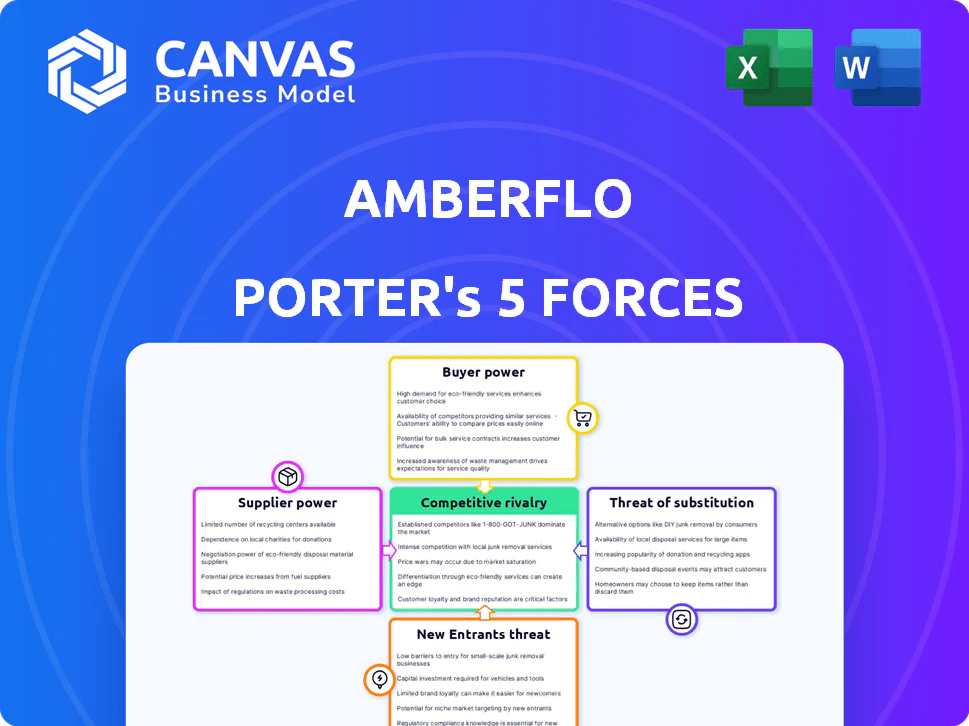
AMBERFLO PORTER'S FIVE FORCES TEMPLATE RESEARCH
What is included in the product
 Detailed Word Document
Analyzes competition, buyer power, and barriers to entry, tailored for Amberflo.

 Customizable Excel Spreadsheet
Calculate force strength instantly with automated calculations for informed strategies.
Full Version Awaits
Amberflo Porter's Five Forces Analysis
This preview is the complete Amberflo Porter's Five Forces analysis you'll receive. It includes detailed insights into competitive forces. After purchase, this formatted document is instantly available. You'll gain a strategic understanding ready for your use. No changes, no extra steps.

Porter's Five Forces Analysis Template

Elevate Your Analysis with the Complete Porter's Five Forces Analysis
Analyzing Amberflo through Porter's Five Forces reveals key competitive dynamics. Supplier power, buyer power, and threat of substitutes influence Amberflo's profitability. The threat of new entrants and competitive rivalry shape the market. Understand Amberflo's strategic positioning with this framework.
This brief snapshot only scratches the surface. Unlock the full Porter's Five Forces Analysis to explore Amberflo’s competitive dynamics, market pressures, and strategic advantages in detail.
Suppliers Bargaining Power

Dependence on Cloud Infrastructure Providers
Amberflo's platform, integrating with cloud providers like AWS and Google Cloud, faces their substantial bargaining power. In 2024, AWS controlled around 32% of the cloud infrastructure market, and Google Cloud held roughly 11%. This dependency can influence Amberflo's operational costs and service capabilities. For example, a price increase from AWS could directly impact Amberflo's profitability.
Availability of Data Sources
Amberflo's ability to gather real-time usage data directly impacts its operations. The ease of integrating with diverse data sources, crucial for its functionality, affects supplier power. If data integration is complex, the suppliers of that data gain more influence. As of late 2024, the market for real-time data solutions is estimated at $15 billion, highlighting the importance of accessible data for companies like Amberflo.

Talent Pool for Specialized Skills
The demand for cloud metering, billing, and data processing engineers impacts Amberflo's supplier power. Specialized skills increase recruitment and retention costs. In 2024, the average salary for these roles rose. This trend gives skilled talent some leverage.

Third-Party Software and Tools
Amberflo's reliance on third-party software and tools introduces supplier bargaining power. Vendors of critical components, like databases or development environments, can impact Amberflo through licensing fees and availability. For example, software costs increased by approximately 7% in 2024 across the tech industry. This can directly influence Amberflo's operational expenses and profitability.
- Software licensing costs can fluctuate, affecting operational budgets.
- Availability of key tools is essential for ongoing operations.
- Vendor consolidation could reduce options and increase costs.
- Negotiating favorable terms is vital to mitigate risks.
Funding and Investment Sources
For Amberflo, investors act like suppliers, providing essential capital. Their influence stems from funding availability and terms, shaping Amberflo's strategic choices. Securing investment affects Amberflo's bargaining power and operational flexibility. As of late 2024, venture capital funding saw a dip, affecting startups' fundraising.
- Funding availability directly impacts Amberflo's growth trajectory.
- Investment terms dictate Amberflo's strategic flexibility.
- Investor relations are crucial for maintaining favorable terms.
- Market conditions, like interest rates, affect funding costs.
Cloud Dependency: A Balancing Act
Amberflo's dependence on cloud providers like AWS and Google Cloud gives these suppliers considerable bargaining power. AWS controlled about 32% of the cloud infrastructure market in 2024, influencing Amberflo's costs. The rising demand for cloud metering engineers and third-party software further enhances supplier influence.
| Factor | Impact on Amberflo | 2024 Data |
|---|---|---|
| Cloud Providers | Influences costs, service capabilities | AWS: ~32% market share; Google Cloud: ~11% |
| Data Integration | Affects operational efficiency | Real-time data market: $15B |
| Engineering Skills | Increases recruitment costs | Salaries rose in 2024 |
Customers Bargaining Power

Availability of Alternatives
Customers in the cloud metering and billing space wield significant bargaining power due to the availability of alternatives. In 2024, the market saw a rise in competitors, including established players and startups. This competitive landscape, with options like in-house solutions, drove down prices. A recent study showed that 60% of companies consider multiple vendors before choosing.
Switching Costs
Switching costs significantly affect customer power within the billing software market. If customers face low switching costs, like ease of data migration, they have more leverage. For example, a 2024 survey showed 60% of businesses would switch if they found a 10% cost saving. This gives customers greater bargaining power to negotiate prices and terms.

Customer Concentration
If Amberflo's revenue heavily relies on a few key customers, those customers gain significant bargaining power. For example, if 70% of Amberflo's revenue comes from just three clients, those clients can demand better prices or services. In 2024, a similar scenario could force companies to lower prices by 5-10% to retain crucial customers.

Customer Understanding of Usage-Based Pricing
As businesses gain experience with usage-based pricing, they become more informed when dealing with providers such as Amberflo. They're now better at assessing and negotiating, pushing for clear pricing structures and adaptable terms. This shift is driven by the need to control costs and optimize resource use. For example, a 2024 survey showed that 65% of SaaS buyers prefer usage-based pricing for its perceived fairness.
- Negotiation Skills: Businesses now have the expertise to negotiate favorable terms.
- Cost Control: Usage-based pricing helps manage and reduce expenses effectively.
- Transparency: Demand for clear, easily understood pricing models is growing.
- Flexibility: Companies seek adaptable pricing that aligns with their changing needs.
Potential for In-House Development
Customers with substantial technical capabilities might opt to create their own metering and billing solutions internally, which reduces their reliance on Amberflo. This strategic move empowers them to negotiate more favorable terms and pricing. The capability to self-develop shifts the balance of power, giving these customers a distinct advantage. According to a 2024 survey, 15% of large enterprises are actively exploring in-house solutions for cloud cost management.
- Reduced Dependence: Customers lessen their dependence on Amberflo's services.
- Negotiating Leverage: They gain a stronger bargaining position in pricing discussions.
- Cost Control: Potential for long-term cost savings through in-house development.
- Customization: Ability to tailor metering and billing systems to specific needs.
Customer Power Soars in Cloud Metering: Key Stats
Customers in the cloud metering and billing space have strong bargaining power due to many choices. The rise of competitors in 2024 increased this power, pushing prices down. Studies show that 60% of companies consider multiple vendors before deciding.
Switching costs also play a role; if they're low, customers have more leverage. A 2024 survey found 60% would switch for a 10% cost saving, boosting their negotiation power. Concentrated revenue sources for Amberflo can shift the balance too.
Businesses are becoming more informed with usage-based pricing, demanding clear terms. They're now better at assessing and negotiating, pushing for clear pricing structures and adaptable terms. A 2024 survey showed that 65% of SaaS buyers prefer usage-based pricing.
| Factor | Impact | Data |
|---|---|---|
| Competition | Increased customer choice | 60% consider multiple vendors |
| Switching Costs | Higher bargaining power | 60% switch for 10% saving |
| Customer Knowledge | Better negotiation skills | 65% prefer usage-based pricing |
Rivalry Among Competitors

Number and Diversity of Competitors
The cloud metering and usage-based pricing market features various competitors, intensifying rivalry. In 2024, the market saw increased competition, with new entrants like CloudZero and established firms such as AWS and Azure. This diversity drives companies to innovate to maintain market share.
Market Growth Rate
The cloud billing market is rapidly expanding. This growth, with a projected value of $18.2 billion in 2024, can lessen rivalry as it accommodates more competitors. However, this also draws in new entrants, intensifying competition. The market is expected to reach $40.7 billion by 2029, signaling continued growth and potential for increased rivalry.

Differentiation of Offerings
The degree to which Amberflo's platform differs from its rivals impacts competition. Unique features, user-friendliness, or specialized solutions can set Amberflo apart. In 2024, companies focused on differentiating through AI integration saw a 20% increase in customer acquisition. Offering unique value is essential.

Pricing Strategies
Competitive pricing significantly shapes rivalry. Price wars can erupt as businesses fight for market share, often leading to reduced profitability for all involved. Aggressive pricing strategies, such as offering discounts or bundling products, are common tactics. For instance, in 2024, the airline industry saw fluctuating prices due to intense competition.
- Price wars can significantly reduce the profitability of companies.
- Aggressive pricing includes discounts and bundling products.
- Airline industry saw fluctuating prices due to intense competition in 2024.
Barriers to Exit
High exit barriers intensify competitive rivalry. Companies stuck in a market fight harder, impacting pricing and profits. This is especially true in capital-intensive industries. The airline industry saw this in 2024, with several airlines struggling but unable to exit easily. For example, the average cost to exit the airline industry is estimated to be $500 million.
- High exit costs can force companies to fight harder.
- This increases price wars and reduces profitability.
- Industries with high capital investments face this problem more.
- Airlines and other heavy-asset businesses often struggle with exit.
Cloud Metering: Fierce Competition Ahead!
Intense competition in cloud metering and usage-based pricing is driven by numerous rivals and market dynamics. The market's projected growth to $40.7 billion by 2029 fuels competition, attracting new entrants. Companies differentiate via AI; in 2024, those integrating AI saw a 20% rise in customer acquisition.
| Factor | Impact | 2024 Data |
|---|---|---|
| Market Growth | Attracts competitors | $18.2B market value |
| Differentiation | Key for market share | 20% increase in customer acquisition for AI integration |
| Exit Barriers | Intensify rivalry | Airline exit cost: $500M |
AMBERFLO PORTER'S FIVE FORCES TEMPLATE RESEARCH
What is included in the product
Detailed Word Document
Analyzes competition, buyer power, and barriers to entry, tailored for Amberflo.
Customizable Excel Spreadsheet
Calculate force strength instantly with automated calculations for informed strategies.
Full Version Awaits
Amberflo Porter's Five Forces Analysis
This preview is the complete Amberflo Porter's Five Forces analysis you'll receive. It includes detailed insights into competitive forces. After purchase, this formatted document is instantly available. You'll gain a strategic understanding ready for your use. No changes, no extra steps.
Porter's Five Forces Analysis Template
Elevate Your Analysis with the Complete Porter's Five Forces Analysis
Analyzing Amberflo through Porter's Five Forces reveals key competitive dynamics. Supplier power, buyer power, and threat of substitutes influence Amberflo's profitability. The threat of new entrants and competitive rivalry shape the market. Understand Amberflo's strategic positioning with this framework.
This brief snapshot only scratches the surface. Unlock the full Porter's Five Forces Analysis to explore Amberflo’s competitive dynamics, market pressures, and strategic advantages in detail.
Suppliers Bargaining Power
Dependence on Cloud Infrastructure Providers
Amberflo's platform, integrating with cloud providers like AWS and Google Cloud, faces their substantial bargaining power. In 2024, AWS controlled around 32% of the cloud infrastructure market, and Google Cloud held roughly 11%. This dependency can influence Amberflo's operational costs and service capabilities. For example, a price increase from AWS could directly impact Amberflo's profitability.
Availability of Data Sources
Amberflo's ability to gather real-time usage data directly impacts its operations. The ease of integrating with diverse data sources, crucial for its functionality, affects supplier power. If data integration is complex, the suppliers of that data gain more influence. As of late 2024, the market for real-time data solutions is estimated at $15 billion, highlighting the importance of accessible data for companies like Amberflo.
Talent Pool for Specialized Skills
The demand for cloud metering, billing, and data processing engineers impacts Amberflo's supplier power. Specialized skills increase recruitment and retention costs. In 2024, the average salary for these roles rose. This trend gives skilled talent some leverage.
Third-Party Software and Tools
Amberflo's reliance on third-party software and tools introduces supplier bargaining power. Vendors of critical components, like databases or development environments, can impact Amberflo through licensing fees and availability. For example, software costs increased by approximately 7% in 2024 across the tech industry. This can directly influence Amberflo's operational expenses and profitability.
- Software licensing costs can fluctuate, affecting operational budgets.
- Availability of key tools is essential for ongoing operations.
- Vendor consolidation could reduce options and increase costs.
- Negotiating favorable terms is vital to mitigate risks.
Funding and Investment Sources
For Amberflo, investors act like suppliers, providing essential capital. Their influence stems from funding availability and terms, shaping Amberflo's strategic choices. Securing investment affects Amberflo's bargaining power and operational flexibility. As of late 2024, venture capital funding saw a dip, affecting startups' fundraising.
- Funding availability directly impacts Amberflo's growth trajectory.
- Investment terms dictate Amberflo's strategic flexibility.
- Investor relations are crucial for maintaining favorable terms.
- Market conditions, like interest rates, affect funding costs.
Cloud Dependency: A Balancing Act
Amberflo's dependence on cloud providers like AWS and Google Cloud gives these suppliers considerable bargaining power. AWS controlled about 32% of the cloud infrastructure market in 2024, influencing Amberflo's costs. The rising demand for cloud metering engineers and third-party software further enhances supplier influence.
| Factor | Impact on Amberflo | 2024 Data |
|---|---|---|
| Cloud Providers | Influences costs, service capabilities | AWS: ~32% market share; Google Cloud: ~11% |
| Data Integration | Affects operational efficiency | Real-time data market: $15B |
| Engineering Skills | Increases recruitment costs | Salaries rose in 2024 |
Customers Bargaining Power
Availability of Alternatives
Customers in the cloud metering and billing space wield significant bargaining power due to the availability of alternatives. In 2024, the market saw a rise in competitors, including established players and startups. This competitive landscape, with options like in-house solutions, drove down prices. A recent study showed that 60% of companies consider multiple vendors before choosing.
Switching Costs
Switching costs significantly affect customer power within the billing software market. If customers face low switching costs, like ease of data migration, they have more leverage. For example, a 2024 survey showed 60% of businesses would switch if they found a 10% cost saving. This gives customers greater bargaining power to negotiate prices and terms.
Customer Concentration
If Amberflo's revenue heavily relies on a few key customers, those customers gain significant bargaining power. For example, if 70% of Amberflo's revenue comes from just three clients, those clients can demand better prices or services. In 2024, a similar scenario could force companies to lower prices by 5-10% to retain crucial customers.
Customer Understanding of Usage-Based Pricing
As businesses gain experience with usage-based pricing, they become more informed when dealing with providers such as Amberflo. They're now better at assessing and negotiating, pushing for clear pricing structures and adaptable terms. This shift is driven by the need to control costs and optimize resource use. For example, a 2024 survey showed that 65% of SaaS buyers prefer usage-based pricing for its perceived fairness.
- Negotiation Skills: Businesses now have the expertise to negotiate favorable terms.
- Cost Control: Usage-based pricing helps manage and reduce expenses effectively.
- Transparency: Demand for clear, easily understood pricing models is growing.
- Flexibility: Companies seek adaptable pricing that aligns with their changing needs.
Potential for In-House Development
Customers with substantial technical capabilities might opt to create their own metering and billing solutions internally, which reduces their reliance on Amberflo. This strategic move empowers them to negotiate more favorable terms and pricing. The capability to self-develop shifts the balance of power, giving these customers a distinct advantage. According to a 2024 survey, 15% of large enterprises are actively exploring in-house solutions for cloud cost management.
- Reduced Dependence: Customers lessen their dependence on Amberflo's services.
- Negotiating Leverage: They gain a stronger bargaining position in pricing discussions.
- Cost Control: Potential for long-term cost savings through in-house development.
- Customization: Ability to tailor metering and billing systems to specific needs.
Customer Power Soars in Cloud Metering: Key Stats
Customers in the cloud metering and billing space have strong bargaining power due to many choices. The rise of competitors in 2024 increased this power, pushing prices down. Studies show that 60% of companies consider multiple vendors before deciding.
Switching costs also play a role; if they're low, customers have more leverage. A 2024 survey found 60% would switch for a 10% cost saving, boosting their negotiation power. Concentrated revenue sources for Amberflo can shift the balance too.
Businesses are becoming more informed with usage-based pricing, demanding clear terms. They're now better at assessing and negotiating, pushing for clear pricing structures and adaptable terms. A 2024 survey showed that 65% of SaaS buyers prefer usage-based pricing.
| Factor | Impact | Data |
|---|---|---|
| Competition | Increased customer choice | 60% consider multiple vendors |
| Switching Costs | Higher bargaining power | 60% switch for 10% saving |
| Customer Knowledge | Better negotiation skills | 65% prefer usage-based pricing |
Rivalry Among Competitors
Number and Diversity of Competitors
The cloud metering and usage-based pricing market features various competitors, intensifying rivalry. In 2024, the market saw increased competition, with new entrants like CloudZero and established firms such as AWS and Azure. This diversity drives companies to innovate to maintain market share.
Market Growth Rate
The cloud billing market is rapidly expanding. This growth, with a projected value of $18.2 billion in 2024, can lessen rivalry as it accommodates more competitors. However, this also draws in new entrants, intensifying competition. The market is expected to reach $40.7 billion by 2029, signaling continued growth and potential for increased rivalry.
Differentiation of Offerings
The degree to which Amberflo's platform differs from its rivals impacts competition. Unique features, user-friendliness, or specialized solutions can set Amberflo apart. In 2024, companies focused on differentiating through AI integration saw a 20% increase in customer acquisition. Offering unique value is essential.
Pricing Strategies
Competitive pricing significantly shapes rivalry. Price wars can erupt as businesses fight for market share, often leading to reduced profitability for all involved. Aggressive pricing strategies, such as offering discounts or bundling products, are common tactics. For instance, in 2024, the airline industry saw fluctuating prices due to intense competition.
- Price wars can significantly reduce the profitability of companies.
- Aggressive pricing includes discounts and bundling products.
- Airline industry saw fluctuating prices due to intense competition in 2024.
Barriers to Exit
High exit barriers intensify competitive rivalry. Companies stuck in a market fight harder, impacting pricing and profits. This is especially true in capital-intensive industries. The airline industry saw this in 2024, with several airlines struggling but unable to exit easily. For example, the average cost to exit the airline industry is estimated to be $500 million.
- High exit costs can force companies to fight harder.
- This increases price wars and reduces profitability.
- Industries with high capital investments face this problem more.
- Airlines and other heavy-asset businesses often struggle with exit.
Cloud Metering: Fierce Competition Ahead!
Intense competition in cloud metering and usage-based pricing is driven by numerous rivals and market dynamics. The market's projected growth to $40.7 billion by 2029 fuels competition, attracting new entrants. Companies differentiate via AI; in 2024, those integrating AI saw a 20% rise in customer acquisition.
| Factor | Impact | 2024 Data |
|---|---|---|
| Market Growth | Attracts competitors | $18.2B market value |
| Differentiation | Key for market share | 20% increase in customer acquisition for AI integration |
| Exit Barriers | Intensify rivalry | Airline exit cost: $500M |
Product Information
Product Information
Shipping & Returns
Shipping & Returns
Description
What is included in the product
Detailed Word Document
Analyzes competition, buyer power, and barriers to entry, tailored for Amberflo.
Customizable Excel Spreadsheet
Calculate force strength instantly with automated calculations for informed strategies.
Full Version Awaits
Amberflo Porter's Five Forces Analysis
This preview is the complete Amberflo Porter's Five Forces analysis you'll receive. It includes detailed insights into competitive forces. After purchase, this formatted document is instantly available. You'll gain a strategic understanding ready for your use. No changes, no extra steps.
Porter's Five Forces Analysis Template
Elevate Your Analysis with the Complete Porter's Five Forces Analysis
Analyzing Amberflo through Porter's Five Forces reveals key competitive dynamics. Supplier power, buyer power, and threat of substitutes influence Amberflo's profitability. The threat of new entrants and competitive rivalry shape the market. Understand Amberflo's strategic positioning with this framework.
This brief snapshot only scratches the surface. Unlock the full Porter's Five Forces Analysis to explore Amberflo’s competitive dynamics, market pressures, and strategic advantages in detail.
Suppliers Bargaining Power
Dependence on Cloud Infrastructure Providers
Amberflo's platform, integrating with cloud providers like AWS and Google Cloud, faces their substantial bargaining power. In 2024, AWS controlled around 32% of the cloud infrastructure market, and Google Cloud held roughly 11%. This dependency can influence Amberflo's operational costs and service capabilities. For example, a price increase from AWS could directly impact Amberflo's profitability.
Availability of Data Sources
Amberflo's ability to gather real-time usage data directly impacts its operations. The ease of integrating with diverse data sources, crucial for its functionality, affects supplier power. If data integration is complex, the suppliers of that data gain more influence. As of late 2024, the market for real-time data solutions is estimated at $15 billion, highlighting the importance of accessible data for companies like Amberflo.
Talent Pool for Specialized Skills
The demand for cloud metering, billing, and data processing engineers impacts Amberflo's supplier power. Specialized skills increase recruitment and retention costs. In 2024, the average salary for these roles rose. This trend gives skilled talent some leverage.
Third-Party Software and Tools
Amberflo's reliance on third-party software and tools introduces supplier bargaining power. Vendors of critical components, like databases or development environments, can impact Amberflo through licensing fees and availability. For example, software costs increased by approximately 7% in 2024 across the tech industry. This can directly influence Amberflo's operational expenses and profitability.
- Software licensing costs can fluctuate, affecting operational budgets.
- Availability of key tools is essential for ongoing operations.
- Vendor consolidation could reduce options and increase costs.
- Negotiating favorable terms is vital to mitigate risks.
Funding and Investment Sources
For Amberflo, investors act like suppliers, providing essential capital. Their influence stems from funding availability and terms, shaping Amberflo's strategic choices. Securing investment affects Amberflo's bargaining power and operational flexibility. As of late 2024, venture capital funding saw a dip, affecting startups' fundraising.
- Funding availability directly impacts Amberflo's growth trajectory.
- Investment terms dictate Amberflo's strategic flexibility.
- Investor relations are crucial for maintaining favorable terms.
- Market conditions, like interest rates, affect funding costs.
Cloud Dependency: A Balancing Act
Amberflo's dependence on cloud providers like AWS and Google Cloud gives these suppliers considerable bargaining power. AWS controlled about 32% of the cloud infrastructure market in 2024, influencing Amberflo's costs. The rising demand for cloud metering engineers and third-party software further enhances supplier influence.
| Factor | Impact on Amberflo | 2024 Data |
|---|---|---|
| Cloud Providers | Influences costs, service capabilities | AWS: ~32% market share; Google Cloud: ~11% |
| Data Integration | Affects operational efficiency | Real-time data market: $15B |
| Engineering Skills | Increases recruitment costs | Salaries rose in 2024 |
Customers Bargaining Power
Availability of Alternatives
Customers in the cloud metering and billing space wield significant bargaining power due to the availability of alternatives. In 2024, the market saw a rise in competitors, including established players and startups. This competitive landscape, with options like in-house solutions, drove down prices. A recent study showed that 60% of companies consider multiple vendors before choosing.
Switching Costs
Switching costs significantly affect customer power within the billing software market. If customers face low switching costs, like ease of data migration, they have more leverage. For example, a 2024 survey showed 60% of businesses would switch if they found a 10% cost saving. This gives customers greater bargaining power to negotiate prices and terms.
Customer Concentration
If Amberflo's revenue heavily relies on a few key customers, those customers gain significant bargaining power. For example, if 70% of Amberflo's revenue comes from just three clients, those clients can demand better prices or services. In 2024, a similar scenario could force companies to lower prices by 5-10% to retain crucial customers.
Customer Understanding of Usage-Based Pricing
As businesses gain experience with usage-based pricing, they become more informed when dealing with providers such as Amberflo. They're now better at assessing and negotiating, pushing for clear pricing structures and adaptable terms. This shift is driven by the need to control costs and optimize resource use. For example, a 2024 survey showed that 65% of SaaS buyers prefer usage-based pricing for its perceived fairness.
- Negotiation Skills: Businesses now have the expertise to negotiate favorable terms.
- Cost Control: Usage-based pricing helps manage and reduce expenses effectively.
- Transparency: Demand for clear, easily understood pricing models is growing.
- Flexibility: Companies seek adaptable pricing that aligns with their changing needs.
Potential for In-House Development
Customers with substantial technical capabilities might opt to create their own metering and billing solutions internally, which reduces their reliance on Amberflo. This strategic move empowers them to negotiate more favorable terms and pricing. The capability to self-develop shifts the balance of power, giving these customers a distinct advantage. According to a 2024 survey, 15% of large enterprises are actively exploring in-house solutions for cloud cost management.
- Reduced Dependence: Customers lessen their dependence on Amberflo's services.
- Negotiating Leverage: They gain a stronger bargaining position in pricing discussions.
- Cost Control: Potential for long-term cost savings through in-house development.
- Customization: Ability to tailor metering and billing systems to specific needs.
Customer Power Soars in Cloud Metering: Key Stats
Customers in the cloud metering and billing space have strong bargaining power due to many choices. The rise of competitors in 2024 increased this power, pushing prices down. Studies show that 60% of companies consider multiple vendors before deciding.
Switching costs also play a role; if they're low, customers have more leverage. A 2024 survey found 60% would switch for a 10% cost saving, boosting their negotiation power. Concentrated revenue sources for Amberflo can shift the balance too.
Businesses are becoming more informed with usage-based pricing, demanding clear terms. They're now better at assessing and negotiating, pushing for clear pricing structures and adaptable terms. A 2024 survey showed that 65% of SaaS buyers prefer usage-based pricing.
| Factor | Impact | Data |
|---|---|---|
| Competition | Increased customer choice | 60% consider multiple vendors |
| Switching Costs | Higher bargaining power | 60% switch for 10% saving |
| Customer Knowledge | Better negotiation skills | 65% prefer usage-based pricing |
Rivalry Among Competitors
Number and Diversity of Competitors
The cloud metering and usage-based pricing market features various competitors, intensifying rivalry. In 2024, the market saw increased competition, with new entrants like CloudZero and established firms such as AWS and Azure. This diversity drives companies to innovate to maintain market share.
Market Growth Rate
The cloud billing market is rapidly expanding. This growth, with a projected value of $18.2 billion in 2024, can lessen rivalry as it accommodates more competitors. However, this also draws in new entrants, intensifying competition. The market is expected to reach $40.7 billion by 2029, signaling continued growth and potential for increased rivalry.
Differentiation of Offerings
The degree to which Amberflo's platform differs from its rivals impacts competition. Unique features, user-friendliness, or specialized solutions can set Amberflo apart. In 2024, companies focused on differentiating through AI integration saw a 20% increase in customer acquisition. Offering unique value is essential.
Pricing Strategies
Competitive pricing significantly shapes rivalry. Price wars can erupt as businesses fight for market share, often leading to reduced profitability for all involved. Aggressive pricing strategies, such as offering discounts or bundling products, are common tactics. For instance, in 2024, the airline industry saw fluctuating prices due to intense competition.
- Price wars can significantly reduce the profitability of companies.
- Aggressive pricing includes discounts and bundling products.
- Airline industry saw fluctuating prices due to intense competition in 2024.
Barriers to Exit
High exit barriers intensify competitive rivalry. Companies stuck in a market fight harder, impacting pricing and profits. This is especially true in capital-intensive industries. The airline industry saw this in 2024, with several airlines struggling but unable to exit easily. For example, the average cost to exit the airline industry is estimated to be $500 million.
- High exit costs can force companies to fight harder.
- This increases price wars and reduces profitability.
- Industries with high capital investments face this problem more.
- Airlines and other heavy-asset businesses often struggle with exit.
Cloud Metering: Fierce Competition Ahead!
Intense competition in cloud metering and usage-based pricing is driven by numerous rivals and market dynamics. The market's projected growth to $40.7 billion by 2029 fuels competition, attracting new entrants. Companies differentiate via AI; in 2024, those integrating AI saw a 20% rise in customer acquisition.
| Factor | Impact | 2024 Data |
|---|---|---|
| Market Growth | Attracts competitors | $18.2B market value |
| Differentiation | Key for market share | 20% increase in customer acquisition for AI integration |
| Exit Barriers | Intensify rivalry | Airline exit cost: $500M |











