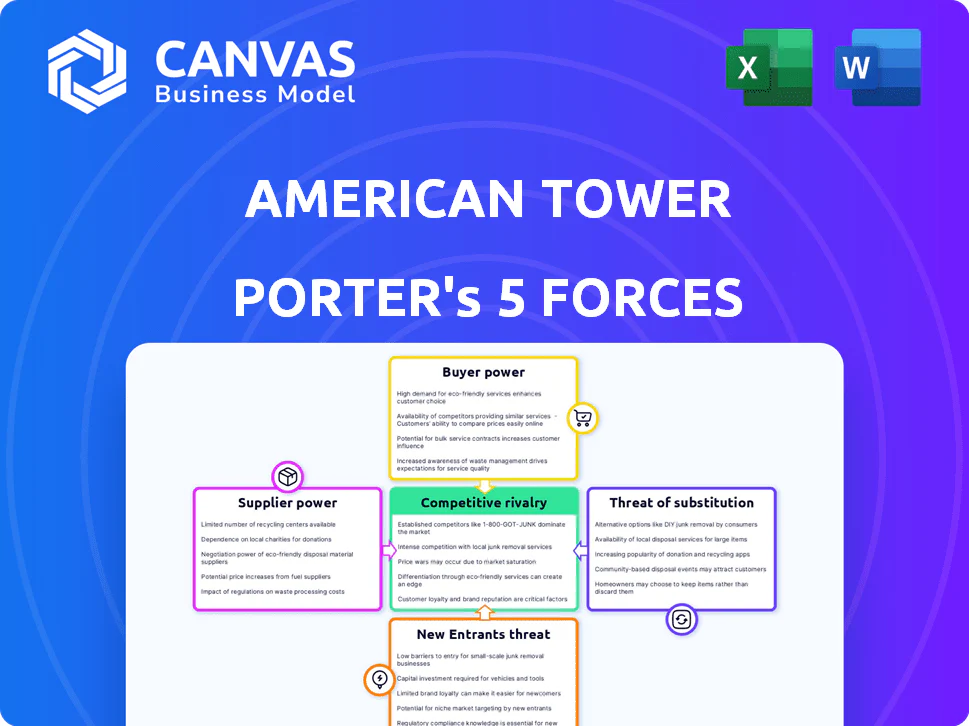
AMERICAN TOWER PORTER'S FIVE FORCES TEMPLATE RESEARCH

Don't Miss the Bigger Picture
American Tower benefits from scale, long-term leases, and high switching costs, but faces regulatory hurdles, rising interest rates, and evolving wireless tech that could shift demand; this snapshot highlights core pressures and strategic levers. Unlock the full Porter's Five Forces Analysis to see force-by-force ratings, visuals, and actionable implications for investment or strategy.
Suppliers Bargaining Power

Landowner Leverage and Ground Lease Terms
Most American Tower sites sit on leased land from thousands of private and public owners, creating a fragmented supplier base; individual owners have little bargaining power, but ground leases totaled about $1.7 billion in 2025, a material operating cost.
American Tower cuts exposure by securing long-term lease extensions and buying land-it closed $650 million in land purchases and extensions in 2025-to lock costs and preserve site permanence.
Specialized Construction and Maintenance Labor
Building and maintaining towers at height needs certified climbers and OSHA-compliant crews; US Bureau of Labor Statistics shows tower technician wages rose ~8% to a median $78,400 in 2025, raising labor cost per site by $7-12k.
With 5G standalone rollouts and early 6G prep, demand for MIMO-skilled techs surged; Gartner estimates 2025 site densification raised specialist contractor utilization to ~92%, giving them moderate pricing power.

Energy and Utility Costs for Edge Computing
With CoreSite integration, American Tower consumed an estimated 1.2 TWh in 2025 across towers and edge sites, raising utility suppliers' bargaining power as they set rates for power-hungry racks; utility costs now account for roughly 6-8% of consolidated operating expenses. Managing contracts with grid and renewable providers directly affects margins, so energy procurement equals steel upkeep in importance.

Capital Market Access and Interest Rate Sensitivity
As a REIT, American Tower depends on debt markets for capital; at FY2025 net debt was about $23.9 billion, so lenders and bondholders shape its M&A and dividend choices.
In 2026's higher-rate backdrop, keeping investment-grade ratings (S&P BBB, Moody's Baa2 in 2025) is vital to control interest expense and preserve access to cheap capital.
- Net debt FY2025: $23.9B
- Interest coverage need tied to ratings (S&P BBB)
- Higher rates raise funding cost, constrain dividends
Technology and Hardware Vendors
Shift to Open RAN and software-defined networking reduces traditional vendors' dominance but broadens supplier base; American Tower still needs Nokia and Ericsson and must partner with chipmakers and cloud providers for edge, keeping supplier leverage via IP and critical site components.
In 2025 American Tower spent ~$1.2B on network-related capex and faces supplier concentration: Nokia and Ericsson held ~30% combined global RAN market share in 2024, while top chipmakers maintain >60% share, preserving supplier bargaining power.
- Open RAN lowers single-vendor lock-in
- Equipment makers (Nokia, Ericsson) remain essential
- Chipmakers and cloud providers control critical IP
- 2025 capex ~$1.2B concentrates supplier leverage
Moderate supplier leverage: $1.7B leases, $650M land, labor & chip concentration pressure
Suppliers exert moderate power: fragmented landowners limit price pressure, yet $1.7B ground-lease expense and $650M 2025 land/extension buys matter; labor pressures (median tower-tech pay $78,400, +8% in 2025) and 92% contractor utilization lift costs; utilities (1.2 TWh, 6-8% OPEX) and supplier concentration in RAN/chips (Nokia+Ericsson ~30%, chipmakers >60%) keep leverage.
| Metric | 2025 |
|---|---|
| Ground-lease expense | $1.7B |
| Land purchases/extensions | $650M |
| Net debt | $23.9B |
| Tower-tech median pay | $78,400 (+8%) |
| Energy use | 1.2 TWh (6-8% OPEX) |
| RAN market (Nokia+Ericsson) | ~30% |
| Capex (network) | $1.2B |
What is included in the product
 Detailed Word Document
Tailored exclusively for American Tower, this Porter's Five Forces overview uncovers competitive drivers, supplier and buyer power, entry barriers, substitutes, and disruptive threats shaping its pricing, margins, and strategic defenses.

 Customizable Excel Spreadsheet
Clear, one-sheet Porter's Five Forces for American Tower-instantly visualize competitive pressures and regulatory risks to speed strategic decisions and deck-ready summaries.
Customers Bargaining Power

Concentration of Major Wireless Carriers
Major wireless carriers T‑Mobile, AT&T, and Verizon account for roughly 60-70% of American Tower's 2025 tenancy revenue, giving these buyers strong bargaining power to secure Master Lease Agreements across thousands of sites and demand volume discounts.
Long-term Non-cancelable Lease Structures
American Tower's 2025 portfolio benefits from long-term, largely non-cancelable leases-over 90% of tower leases in key markets carry 5- to 15-year terms with annual escalators (company-reported 2025 global same-store rent growth ~3.5%), creating a sticky revenue base that shields against sudden demand drops and inflation.

Network Sharing and Infrastructure Joint Ventures
Network-sharing deals-common in India and parts of Europe and rising in rural US-cut unique tenants per American Tower site; global shared-site agreements grew ~12% in 2025, lowering average tenants/site and squeezing yield (ATC reported 2025 global tower tenancy at ~1.6 tenants/site).

The Essential Nature of Tower Real Estate
American Tower's towers are essential infrastructure: major US carriers rely on 2025 footprint coverage-over 214,000 global towers, 43,000+ in the US-to meet service and FCC obligations, so carriers can't easily replace sites without service gaps.
Prime vertical real estate is scarce due to zoning and RF needs; vacancies for optimal sites run below 5% in key metros, creating a bottleneck advantage for American Tower and supporting pricing power.
Bullets:
- US towers: 43,000+ (2025)
- Global total: ~214,000 (2025)
- Key-metro optimal-site vacancy <5%
- Bottleneck raises switching cost, preserves lease rates
Emergence of Private Networks and Enterprise Clients
The rise of private 5G networks for factories, mines, and logistics hubs creates a new cohort of smaller, diverse customers that dilute reliance on national carriers, lowering American Tower's concentration risk-U.S. tower tenancy from top 3 carriers fell to 58% in 2025 from ~65% in 2020, aiding diversification.
This shift reduces single-buyer leverage versus American Tower because private networks buy targeted site leases or edge infrastructure, aligning with American Tower's 2026 goal to grow enterprise revenue to roughly 8-10% of consolidated revenue (2025 enterprise ~6.5%).
Still, individual private buyers have limited bargaining power; collectively they strengthen American Tower's negotiating stance and pricing resilience versus the major telcos.
- Top-3 carrier tenancy 58% (2025)
- Enterprise revenue ~6.5% (2025), target 8-10% (2026)
- Private 5G adoption in manufacturing/logistics + rising site leases
Carriers Keep Leverage: Top‑3 Tenancy 58%, Carrier Revenue 60-70%, Enterprise Growth
Large carriers still hold bulk leverage-top‑3 tenancy fell to 58% in 2025, but they drive ~60-70% of tenancy revenue, while long-term non‑cancelable leases (90% ≥5 years, ~3.5% same‑store rent growth) and scarce prime sites (vacancy <5%) limit buyer power; growing enterprise revenue (6.5% in 2025, 2026 target 8-10%) diversifies demand.
| Metric | 2025 |
|---|---|
| Top‑3 carrier tenancy | 58% |
| Carrier revenue share | 60-70% |
| US towers | 43,000+ |
| Global towers | ~214,000 |
| Tenants/site | ~1.6 |
| Enterprise rev. | 6.5% |
What You See Is What You Get
American Tower Porter's Five Forces Analysis
This preview shows the exact American Tower Porter's Five Forces analysis you'll receive immediately after purchase-no placeholders or mockups-fully formatted, ready to download and use the moment you buy.

Original: $10.00
-65%$10.00
$3.50AMERICAN TOWER PORTER'S FIVE FORCES TEMPLATE RESEARCH
Don't Miss the Bigger Picture
American Tower benefits from scale, long-term leases, and high switching costs, but faces regulatory hurdles, rising interest rates, and evolving wireless tech that could shift demand; this snapshot highlights core pressures and strategic levers. Unlock the full Porter's Five Forces Analysis to see force-by-force ratings, visuals, and actionable implications for investment or strategy.
Suppliers Bargaining Power
Landowner Leverage and Ground Lease Terms
Most American Tower sites sit on leased land from thousands of private and public owners, creating a fragmented supplier base; individual owners have little bargaining power, but ground leases totaled about $1.7 billion in 2025, a material operating cost.
American Tower cuts exposure by securing long-term lease extensions and buying land-it closed $650 million in land purchases and extensions in 2025-to lock costs and preserve site permanence.
Specialized Construction and Maintenance Labor
Building and maintaining towers at height needs certified climbers and OSHA-compliant crews; US Bureau of Labor Statistics shows tower technician wages rose ~8% to a median $78,400 in 2025, raising labor cost per site by $7-12k.
With 5G standalone rollouts and early 6G prep, demand for MIMO-skilled techs surged; Gartner estimates 2025 site densification raised specialist contractor utilization to ~92%, giving them moderate pricing power.
Energy and Utility Costs for Edge Computing
With CoreSite integration, American Tower consumed an estimated 1.2 TWh in 2025 across towers and edge sites, raising utility suppliers' bargaining power as they set rates for power-hungry racks; utility costs now account for roughly 6-8% of consolidated operating expenses. Managing contracts with grid and renewable providers directly affects margins, so energy procurement equals steel upkeep in importance.
Capital Market Access and Interest Rate Sensitivity
As a REIT, American Tower depends on debt markets for capital; at FY2025 net debt was about $23.9 billion, so lenders and bondholders shape its M&A and dividend choices.
In 2026's higher-rate backdrop, keeping investment-grade ratings (S&P BBB, Moody's Baa2 in 2025) is vital to control interest expense and preserve access to cheap capital.
- Net debt FY2025: $23.9B
- Interest coverage need tied to ratings (S&P BBB)
- Higher rates raise funding cost, constrain dividends
Technology and Hardware Vendors
Shift to Open RAN and software-defined networking reduces traditional vendors' dominance but broadens supplier base; American Tower still needs Nokia and Ericsson and must partner with chipmakers and cloud providers for edge, keeping supplier leverage via IP and critical site components.
In 2025 American Tower spent ~$1.2B on network-related capex and faces supplier concentration: Nokia and Ericsson held ~30% combined global RAN market share in 2024, while top chipmakers maintain >60% share, preserving supplier bargaining power.
- Open RAN lowers single-vendor lock-in
- Equipment makers (Nokia, Ericsson) remain essential
- Chipmakers and cloud providers control critical IP
- 2025 capex ~$1.2B concentrates supplier leverage
Moderate supplier leverage: $1.7B leases, $650M land, labor & chip concentration pressure
Suppliers exert moderate power: fragmented landowners limit price pressure, yet $1.7B ground-lease expense and $650M 2025 land/extension buys matter; labor pressures (median tower-tech pay $78,400, +8% in 2025) and 92% contractor utilization lift costs; utilities (1.2 TWh, 6-8% OPEX) and supplier concentration in RAN/chips (Nokia+Ericsson ~30%, chipmakers >60%) keep leverage.
| Metric | 2025 |
|---|---|
| Ground-lease expense | $1.7B |
| Land purchases/extensions | $650M |
| Net debt | $23.9B |
| Tower-tech median pay | $78,400 (+8%) |
| Energy use | 1.2 TWh (6-8% OPEX) |
| RAN market (Nokia+Ericsson) | ~30% |
| Capex (network) | $1.2B |
What is included in the product
Detailed Word Document
Tailored exclusively for American Tower, this Porter's Five Forces overview uncovers competitive drivers, supplier and buyer power, entry barriers, substitutes, and disruptive threats shaping its pricing, margins, and strategic defenses.
Customizable Excel Spreadsheet
Clear, one-sheet Porter's Five Forces for American Tower-instantly visualize competitive pressures and regulatory risks to speed strategic decisions and deck-ready summaries.
Customers Bargaining Power
Concentration of Major Wireless Carriers
Major wireless carriers T‑Mobile, AT&T, and Verizon account for roughly 60-70% of American Tower's 2025 tenancy revenue, giving these buyers strong bargaining power to secure Master Lease Agreements across thousands of sites and demand volume discounts.
Long-term Non-cancelable Lease Structures
American Tower's 2025 portfolio benefits from long-term, largely non-cancelable leases-over 90% of tower leases in key markets carry 5- to 15-year terms with annual escalators (company-reported 2025 global same-store rent growth ~3.5%), creating a sticky revenue base that shields against sudden demand drops and inflation.
Network Sharing and Infrastructure Joint Ventures
Network-sharing deals-common in India and parts of Europe and rising in rural US-cut unique tenants per American Tower site; global shared-site agreements grew ~12% in 2025, lowering average tenants/site and squeezing yield (ATC reported 2025 global tower tenancy at ~1.6 tenants/site).
The Essential Nature of Tower Real Estate
American Tower's towers are essential infrastructure: major US carriers rely on 2025 footprint coverage-over 214,000 global towers, 43,000+ in the US-to meet service and FCC obligations, so carriers can't easily replace sites without service gaps.
Prime vertical real estate is scarce due to zoning and RF needs; vacancies for optimal sites run below 5% in key metros, creating a bottleneck advantage for American Tower and supporting pricing power.
Bullets:
- US towers: 43,000+ (2025)
- Global total: ~214,000 (2025)
- Key-metro optimal-site vacancy <5%
- Bottleneck raises switching cost, preserves lease rates
Emergence of Private Networks and Enterprise Clients
The rise of private 5G networks for factories, mines, and logistics hubs creates a new cohort of smaller, diverse customers that dilute reliance on national carriers, lowering American Tower's concentration risk-U.S. tower tenancy from top 3 carriers fell to 58% in 2025 from ~65% in 2020, aiding diversification.
This shift reduces single-buyer leverage versus American Tower because private networks buy targeted site leases or edge infrastructure, aligning with American Tower's 2026 goal to grow enterprise revenue to roughly 8-10% of consolidated revenue (2025 enterprise ~6.5%).
Still, individual private buyers have limited bargaining power; collectively they strengthen American Tower's negotiating stance and pricing resilience versus the major telcos.
- Top-3 carrier tenancy 58% (2025)
- Enterprise revenue ~6.5% (2025), target 8-10% (2026)
- Private 5G adoption in manufacturing/logistics + rising site leases
Carriers Keep Leverage: Top‑3 Tenancy 58%, Carrier Revenue 60-70%, Enterprise Growth
Large carriers still hold bulk leverage-top‑3 tenancy fell to 58% in 2025, but they drive ~60-70% of tenancy revenue, while long-term non‑cancelable leases (90% ≥5 years, ~3.5% same‑store rent growth) and scarce prime sites (vacancy <5%) limit buyer power; growing enterprise revenue (6.5% in 2025, 2026 target 8-10%) diversifies demand.
| Metric | 2025 |
|---|---|
| Top‑3 carrier tenancy | 58% |
| Carrier revenue share | 60-70% |
| US towers | 43,000+ |
| Global towers | ~214,000 |
| Tenants/site | ~1.6 |
| Enterprise rev. | 6.5% |
What You See Is What You Get
American Tower Porter's Five Forces Analysis
This preview shows the exact American Tower Porter's Five Forces analysis you'll receive immediately after purchase-no placeholders or mockups-fully formatted, ready to download and use the moment you buy.
Product Information
Product Information
Shipping & Returns
Shipping & Returns
Description
Don't Miss the Bigger Picture
American Tower benefits from scale, long-term leases, and high switching costs, but faces regulatory hurdles, rising interest rates, and evolving wireless tech that could shift demand; this snapshot highlights core pressures and strategic levers. Unlock the full Porter's Five Forces Analysis to see force-by-force ratings, visuals, and actionable implications for investment or strategy.
Suppliers Bargaining Power
Landowner Leverage and Ground Lease Terms
Most American Tower sites sit on leased land from thousands of private and public owners, creating a fragmented supplier base; individual owners have little bargaining power, but ground leases totaled about $1.7 billion in 2025, a material operating cost.
American Tower cuts exposure by securing long-term lease extensions and buying land-it closed $650 million in land purchases and extensions in 2025-to lock costs and preserve site permanence.
Specialized Construction and Maintenance Labor
Building and maintaining towers at height needs certified climbers and OSHA-compliant crews; US Bureau of Labor Statistics shows tower technician wages rose ~8% to a median $78,400 in 2025, raising labor cost per site by $7-12k.
With 5G standalone rollouts and early 6G prep, demand for MIMO-skilled techs surged; Gartner estimates 2025 site densification raised specialist contractor utilization to ~92%, giving them moderate pricing power.
Energy and Utility Costs for Edge Computing
With CoreSite integration, American Tower consumed an estimated 1.2 TWh in 2025 across towers and edge sites, raising utility suppliers' bargaining power as they set rates for power-hungry racks; utility costs now account for roughly 6-8% of consolidated operating expenses. Managing contracts with grid and renewable providers directly affects margins, so energy procurement equals steel upkeep in importance.
Capital Market Access and Interest Rate Sensitivity
As a REIT, American Tower depends on debt markets for capital; at FY2025 net debt was about $23.9 billion, so lenders and bondholders shape its M&A and dividend choices.
In 2026's higher-rate backdrop, keeping investment-grade ratings (S&P BBB, Moody's Baa2 in 2025) is vital to control interest expense and preserve access to cheap capital.
- Net debt FY2025: $23.9B
- Interest coverage need tied to ratings (S&P BBB)
- Higher rates raise funding cost, constrain dividends
Technology and Hardware Vendors
Shift to Open RAN and software-defined networking reduces traditional vendors' dominance but broadens supplier base; American Tower still needs Nokia and Ericsson and must partner with chipmakers and cloud providers for edge, keeping supplier leverage via IP and critical site components.
In 2025 American Tower spent ~$1.2B on network-related capex and faces supplier concentration: Nokia and Ericsson held ~30% combined global RAN market share in 2024, while top chipmakers maintain >60% share, preserving supplier bargaining power.
- Open RAN lowers single-vendor lock-in
- Equipment makers (Nokia, Ericsson) remain essential
- Chipmakers and cloud providers control critical IP
- 2025 capex ~$1.2B concentrates supplier leverage
Moderate supplier leverage: $1.7B leases, $650M land, labor & chip concentration pressure
Suppliers exert moderate power: fragmented landowners limit price pressure, yet $1.7B ground-lease expense and $650M 2025 land/extension buys matter; labor pressures (median tower-tech pay $78,400, +8% in 2025) and 92% contractor utilization lift costs; utilities (1.2 TWh, 6-8% OPEX) and supplier concentration in RAN/chips (Nokia+Ericsson ~30%, chipmakers >60%) keep leverage.
| Metric | 2025 |
|---|---|
| Ground-lease expense | $1.7B |
| Land purchases/extensions | $650M |
| Net debt | $23.9B |
| Tower-tech median pay | $78,400 (+8%) |
| Energy use | 1.2 TWh (6-8% OPEX) |
| RAN market (Nokia+Ericsson) | ~30% |
| Capex (network) | $1.2B |
What is included in the product
Detailed Word Document
Tailored exclusively for American Tower, this Porter's Five Forces overview uncovers competitive drivers, supplier and buyer power, entry barriers, substitutes, and disruptive threats shaping its pricing, margins, and strategic defenses.
Customizable Excel Spreadsheet
Clear, one-sheet Porter's Five Forces for American Tower-instantly visualize competitive pressures and regulatory risks to speed strategic decisions and deck-ready summaries.
Customers Bargaining Power
Concentration of Major Wireless Carriers
Major wireless carriers T‑Mobile, AT&T, and Verizon account for roughly 60-70% of American Tower's 2025 tenancy revenue, giving these buyers strong bargaining power to secure Master Lease Agreements across thousands of sites and demand volume discounts.
Long-term Non-cancelable Lease Structures
American Tower's 2025 portfolio benefits from long-term, largely non-cancelable leases-over 90% of tower leases in key markets carry 5- to 15-year terms with annual escalators (company-reported 2025 global same-store rent growth ~3.5%), creating a sticky revenue base that shields against sudden demand drops and inflation.
Network Sharing and Infrastructure Joint Ventures
Network-sharing deals-common in India and parts of Europe and rising in rural US-cut unique tenants per American Tower site; global shared-site agreements grew ~12% in 2025, lowering average tenants/site and squeezing yield (ATC reported 2025 global tower tenancy at ~1.6 tenants/site).
The Essential Nature of Tower Real Estate
American Tower's towers are essential infrastructure: major US carriers rely on 2025 footprint coverage-over 214,000 global towers, 43,000+ in the US-to meet service and FCC obligations, so carriers can't easily replace sites without service gaps.
Prime vertical real estate is scarce due to zoning and RF needs; vacancies for optimal sites run below 5% in key metros, creating a bottleneck advantage for American Tower and supporting pricing power.
Bullets:
- US towers: 43,000+ (2025)
- Global total: ~214,000 (2025)
- Key-metro optimal-site vacancy <5%
- Bottleneck raises switching cost, preserves lease rates
Emergence of Private Networks and Enterprise Clients
The rise of private 5G networks for factories, mines, and logistics hubs creates a new cohort of smaller, diverse customers that dilute reliance on national carriers, lowering American Tower's concentration risk-U.S. tower tenancy from top 3 carriers fell to 58% in 2025 from ~65% in 2020, aiding diversification.
This shift reduces single-buyer leverage versus American Tower because private networks buy targeted site leases or edge infrastructure, aligning with American Tower's 2026 goal to grow enterprise revenue to roughly 8-10% of consolidated revenue (2025 enterprise ~6.5%).
Still, individual private buyers have limited bargaining power; collectively they strengthen American Tower's negotiating stance and pricing resilience versus the major telcos.
- Top-3 carrier tenancy 58% (2025)
- Enterprise revenue ~6.5% (2025), target 8-10% (2026)
- Private 5G adoption in manufacturing/logistics + rising site leases
Carriers Keep Leverage: Top‑3 Tenancy 58%, Carrier Revenue 60-70%, Enterprise Growth
Large carriers still hold bulk leverage-top‑3 tenancy fell to 58% in 2025, but they drive ~60-70% of tenancy revenue, while long-term non‑cancelable leases (90% ≥5 years, ~3.5% same‑store rent growth) and scarce prime sites (vacancy <5%) limit buyer power; growing enterprise revenue (6.5% in 2025, 2026 target 8-10%) diversifies demand.
| Metric | 2025 |
|---|---|
| Top‑3 carrier tenancy | 58% |
| Carrier revenue share | 60-70% |
| US towers | 43,000+ |
| Global towers | ~214,000 |
| Tenants/site | ~1.6 |
| Enterprise rev. | 6.5% |
What You See Is What You Get
American Tower Porter's Five Forces Analysis
This preview shows the exact American Tower Porter's Five Forces analysis you'll receive immediately after purchase-no placeholders or mockups-fully formatted, ready to download and use the moment you buy.











