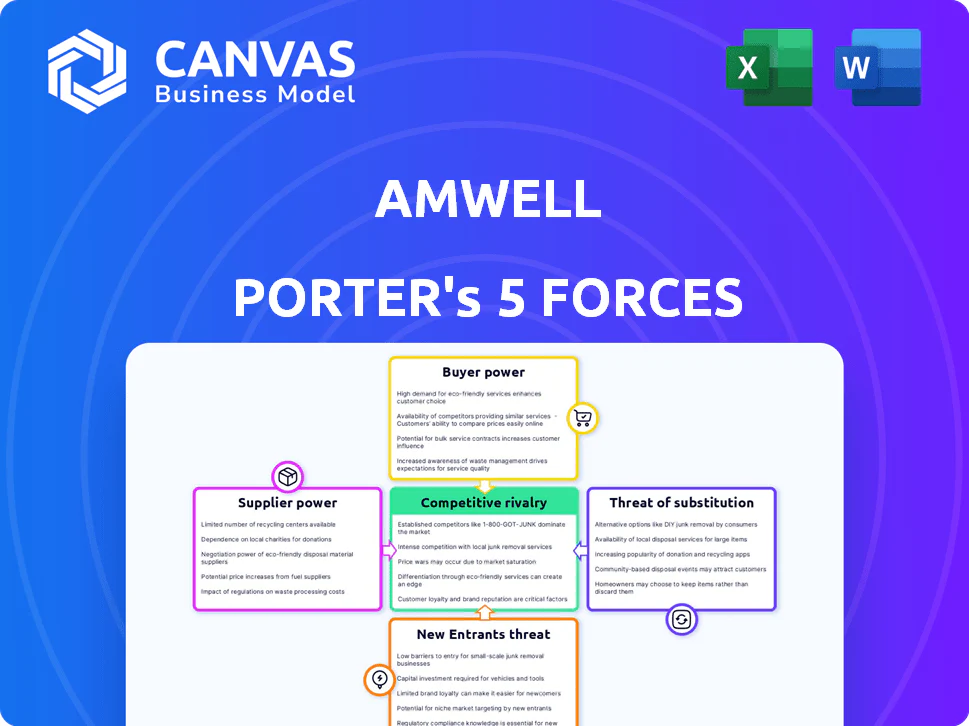
AMWELL PORTER'S FIVE FORCES TEMPLATE RESEARCH

Don't Miss the Bigger Picture
Amwell faces strong buyer power and rising substitute threats as telehealth adoption matures, while supplier and partner dynamics create both leverage and dependency for platform scale.
Regulatory shifts and capital-intensive tech investment raise barriers for newcomers but also pressure margins-nuanced force ratings reveal where Amwell can defend or expand.
This brief snapshot only scratches the surface. Unlock the full Porter's Five Forces Analysis to explore Amwell's competitive dynamics, market pressures, and strategic advantages in detail.
Suppliers Bargaining Power

Physician and Clinician Labor Supply
The supply of physicians and clinicians is Amwell's lifeblood, and in FY2025 providers held strong leverage: US physician burnout rose to ~51% and the AAMC projects a shortfall of up to 56,000-121,900 physicians by 2034, driving higher pay and demands for superior telehealth tools.
In FY2025 Amwell reported provider-related platform investments and partnerships to retain clinicians, since failure to improve experience risks migration to competitors or return to brick-and-mortar, which could raise Amwell's provider acquisition costs and reduce network capacity.
Cloud Infrastructure and Hosting Providers
Amwell depends on Amazon Web Services and Google Cloud for Converge uptime and security; in 2025 Amwell reported platform hosting costs of $112M, so AWS/GCP wield high supplier power because switching entails multi‑petabyte migration, weeks of downtime risk, and revalidation of HIPAA controls. A 10% price hike would cut 2025 operating margin by ~1.6 percentage points, leaving Amwell a price‑taker.

EHR and Software Integration Partners
Amwell's usefulness to large health systems depends on seamless integration with EHRs like Epic (over 34% U.S. market share) and Oracle Health; these vendors gatekeep clinical workflows and set technical roadmaps. Their control over APIs, certification timelines, and integration fees (often $100k-$1M+ per large deployment) limits Amwell's bargaining power. Federal rules (e.g., 21st Century Cures Act) improve data access, but Epic and Oracle still dictate prioritization and support, keeping suppliers advantaged.

Medical Device and IoT Manufacturers
As Amwell shifts into chronic care, it relies on remote monitoring hardware-blood pressure cuffs, glucose monitors-sourced from vendors with moderate bargaining power; market data shows global RPM device shipments grew ~18% YoY in 2024 to ~42 million units, raising supplier leverage.
When specific devices become clinical gold standards, Amwell's switching ability falls and procurement risk rises; a single-vendor disruption could delay care and hit revenue tied to device-enabled programs ($312M estimated service revenue 2025).
Ensuring redundancy and inventory buffer is now a core ops risk; industry lead times stretched to 20-28 weeks in 2024 for smart RPM modules, so supplier concentration materially raises operational vulnerability.
- RPM device shipments ~42M (2024), +18% YoY
- Lead times 20-28 weeks for smart modules
- Device-enabled service revenue exposure ~$312M (2025 est.)
- Gold-standard devices reduce Amwell's switching power
Cybersecurity and Compliance Software Vendors
With healthcare breaches costing a record $11.45M average per incident in 2025, cybersecurity and compliance software vendors hold elevated leverage over Amwell because uptime and data integrity are non-negotiable.
The need for specialized encryption, HIPAA/CCPA tooling, and managed detection gives these suppliers bargaining power; switching costs and integration risk are high.
Scarce talent and market rates-average senior cybersecurity engineers at $220k total comp in 2025-raise prices for managed services and consulting.
- 2025 avg breach cost $11.45M
- Senior cyber engineer comp $220k
- High switching costs and integration risk
- Compliance tooling essential, non-negotiable
Supplier pressures, clinician shortages and rising infra & breach costs threaten Amwell margins
Suppliers hold high leverage over Amwell in FY2025: provider shortages (51% physician burnout; AAMC shortfall 56k-121.9k by 2034) raise clinician costs; AWS/GCP hosting costs $112M in 2025 (10% hike ≈ -1.6 pp operating margin); RPM device shipments ~42M (2024) with device‑enabled revenue exposure ~$312M (2025); avg breach cost $11.45M (2025).
| Metric | Value (FY2025/2024) |
|---|---|
| AWS/GCP hosting costs | $112M (2025) |
| Physician burnout | ~51% (2025) |
| AAMC projected shortfall | 56,000-121,900 by 2034 |
| RPM shipments | ~42M (2024) |
| Device-enabled revenue exposure | $312M (2025 est.) |
| Avg breach cost | $11.45M (2025) |
What is included in the product
 Detailed Word Document
Tailored for Amwell, this Porter's Five Forces overview uncovers competitive pressures, customer and supplier bargaining power, threats from substitutes and new entrants, and highlights disruptive trends impacting its telehealth market position.

 Customizable Excel Spreadsheet
Amwell Porter's Five Forces distilled into a one-sheet-rapidly spot competitive pain points and prioritize strategic moves for telehealth growth.
Customers Bargaining Power

Health System and Hospital Enterprise Buyers
Large health systems are Amwell's primary enterprise customers and they wield enormous power-top 100 US health systems account for roughly 40% of hospital beds, enabling them to demand deep volume discounts and bespoke integrations.
Consolidation is rising: 2025 saw hospital M&A transactions totaling about $18 billion, further concentrating buying power and raising switching risk.
If Amwell cannot demonstrate ROI-Amwell reported enterprise revenue of $165 million in FY2025-these well-funded buyers can build internal telehealth platforms or shift to competitors and hybrid models.
Health Insurance Payers and Managed Care
Insurance payers and CMS dictate reimbursements, controlling Amwell's 2025 revenue mix-about 62% of virtual care payments tied to payer contracts and Medicare/Medicaid rules that year.
By 2026 payers push value-based care, demanding outcome metrics; Amwell must deliver clinical data showing reduced readmissions and cost-per-patient declines to secure contracts.
Meeting these criteria required Amwell to invest $48 million in 2025 R&D and analytics enhancements, cutting near-term margins to preserve long-term payer access.

Large Employer Benefit Managers
Fortune 500 employers increasingly vet telehealth ROI; in 2025 ~68% of large employers offer telehealth and demand bundled solutions, raising expectations for Company Amwell to include behavioral health and pharmacy; low switching costs and heavy courting by competitors drive price pressure-Amwell reported enterprise revenue pressures with 2025 enterprise bookings growth slowing to mid-single digits, so expanding services is key to retention.

Individual Patient Choice and Retail Expectations
Direct-to-consumer patients have max bargaining power: switching costs ≈ $0, so poor UX or >2-3 minute waits drive churn-Amwell reported 2025 telehealth visits growth slowed to 14% while MAU fell 6% in FY2025, forcing higher spend to retain users.
Retail expectations push Amwell to spend: FY2025 sales & marketing rose to $88.4M (up 22% YoY) and product R&D to $46.1M to cut friction and lower abandonment.
Impact: low switching costs + instant-gratification culture mean marginal UX drops or marketing lapses quickly reduce active users and ARPU.
- Zero switching costs → high churn risk
- 2-3 min wait tolerance
- FY2025 S&M $88.4M, R&D $46.1M
- MAU down 6% in FY2025
Government and Regulatory Agencies
The US government acts like a monopsonist via Medicare/Medicaid reimbursement; in 2025 Medicare expanded telehealth coverage, affecting Amwell's addressable revenue-Amwell reported $162.3M revenue in FY2025, making policy shifts material. Federal changes to cross-state licensing or e-prescribing can rapidly cut or boost demand for virtual visits.
- Medicare/Medicaid set prices, constraining Amwell margins
- FY2025 revenue $162.3M; policy shifts materially impact demand
- Cross-state licensing/e-prescribe rule changes can change utilization overnight
Buyers Rule: FY25 Revenue $162M, MAUs -6%, Enterprise Bookings Mid-Singles
Buyers wield high power: top health systems and payers concentrate purchasing, Medicaid/Medicare set prices, employers demand bundled ROI, and consumers face zero switching costs-FY2025 revenue $162.3M, enterprise revenue $165M, S&M $88.4M, R&D $46M, MAU -6%, enterprise bookings growth mid-single digits.
| Metric | FY2025 |
|---|---|
| Revenue | $162.3M |
| Enterprise rev | $165M |
| S&M | $88.4M |
| R&D | $46M |
| MAU change | -6% |
| Bookings growth | Mid-single digits |
Same Document Delivered
Amwell Porter's Five Forces Analysis
This preview shows the exact Amwell Porter's Five Forces analysis you'll receive immediately after purchase-no placeholders or mockups; the document is fully formatted and ready for download and use the moment you buy.

AMWELL PORTER'S FIVE FORCES TEMPLATE RESEARCH
Don't Miss the Bigger Picture
Amwell faces strong buyer power and rising substitute threats as telehealth adoption matures, while supplier and partner dynamics create both leverage and dependency for platform scale.
Regulatory shifts and capital-intensive tech investment raise barriers for newcomers but also pressure margins-nuanced force ratings reveal where Amwell can defend or expand.
This brief snapshot only scratches the surface. Unlock the full Porter's Five Forces Analysis to explore Amwell's competitive dynamics, market pressures, and strategic advantages in detail.
Suppliers Bargaining Power
Physician and Clinician Labor Supply
The supply of physicians and clinicians is Amwell's lifeblood, and in FY2025 providers held strong leverage: US physician burnout rose to ~51% and the AAMC projects a shortfall of up to 56,000-121,900 physicians by 2034, driving higher pay and demands for superior telehealth tools.
In FY2025 Amwell reported provider-related platform investments and partnerships to retain clinicians, since failure to improve experience risks migration to competitors or return to brick-and-mortar, which could raise Amwell's provider acquisition costs and reduce network capacity.
Cloud Infrastructure and Hosting Providers
Amwell depends on Amazon Web Services and Google Cloud for Converge uptime and security; in 2025 Amwell reported platform hosting costs of $112M, so AWS/GCP wield high supplier power because switching entails multi‑petabyte migration, weeks of downtime risk, and revalidation of HIPAA controls. A 10% price hike would cut 2025 operating margin by ~1.6 percentage points, leaving Amwell a price‑taker.
EHR and Software Integration Partners
Amwell's usefulness to large health systems depends on seamless integration with EHRs like Epic (over 34% U.S. market share) and Oracle Health; these vendors gatekeep clinical workflows and set technical roadmaps. Their control over APIs, certification timelines, and integration fees (often $100k-$1M+ per large deployment) limits Amwell's bargaining power. Federal rules (e.g., 21st Century Cures Act) improve data access, but Epic and Oracle still dictate prioritization and support, keeping suppliers advantaged.
Medical Device and IoT Manufacturers
As Amwell shifts into chronic care, it relies on remote monitoring hardware-blood pressure cuffs, glucose monitors-sourced from vendors with moderate bargaining power; market data shows global RPM device shipments grew ~18% YoY in 2024 to ~42 million units, raising supplier leverage.
When specific devices become clinical gold standards, Amwell's switching ability falls and procurement risk rises; a single-vendor disruption could delay care and hit revenue tied to device-enabled programs ($312M estimated service revenue 2025).
Ensuring redundancy and inventory buffer is now a core ops risk; industry lead times stretched to 20-28 weeks in 2024 for smart RPM modules, so supplier concentration materially raises operational vulnerability.
- RPM device shipments ~42M (2024), +18% YoY
- Lead times 20-28 weeks for smart modules
- Device-enabled service revenue exposure ~$312M (2025 est.)
- Gold-standard devices reduce Amwell's switching power
Cybersecurity and Compliance Software Vendors
With healthcare breaches costing a record $11.45M average per incident in 2025, cybersecurity and compliance software vendors hold elevated leverage over Amwell because uptime and data integrity are non-negotiable.
The need for specialized encryption, HIPAA/CCPA tooling, and managed detection gives these suppliers bargaining power; switching costs and integration risk are high.
Scarce talent and market rates-average senior cybersecurity engineers at $220k total comp in 2025-raise prices for managed services and consulting.
- 2025 avg breach cost $11.45M
- Senior cyber engineer comp $220k
- High switching costs and integration risk
- Compliance tooling essential, non-negotiable
Supplier pressures, clinician shortages and rising infra & breach costs threaten Amwell margins
Suppliers hold high leverage over Amwell in FY2025: provider shortages (51% physician burnout; AAMC shortfall 56k-121.9k by 2034) raise clinician costs; AWS/GCP hosting costs $112M in 2025 (10% hike ≈ -1.6 pp operating margin); RPM device shipments ~42M (2024) with device‑enabled revenue exposure ~$312M (2025); avg breach cost $11.45M (2025).
| Metric | Value (FY2025/2024) |
|---|---|
| AWS/GCP hosting costs | $112M (2025) |
| Physician burnout | ~51% (2025) |
| AAMC projected shortfall | 56,000-121,900 by 2034 |
| RPM shipments | ~42M (2024) |
| Device-enabled revenue exposure | $312M (2025 est.) |
| Avg breach cost | $11.45M (2025) |
What is included in the product
Detailed Word Document
Tailored for Amwell, this Porter's Five Forces overview uncovers competitive pressures, customer and supplier bargaining power, threats from substitutes and new entrants, and highlights disruptive trends impacting its telehealth market position.
Customizable Excel Spreadsheet
Amwell Porter's Five Forces distilled into a one-sheet-rapidly spot competitive pain points and prioritize strategic moves for telehealth growth.
Customers Bargaining Power
Health System and Hospital Enterprise Buyers
Large health systems are Amwell's primary enterprise customers and they wield enormous power-top 100 US health systems account for roughly 40% of hospital beds, enabling them to demand deep volume discounts and bespoke integrations.
Consolidation is rising: 2025 saw hospital M&A transactions totaling about $18 billion, further concentrating buying power and raising switching risk.
If Amwell cannot demonstrate ROI-Amwell reported enterprise revenue of $165 million in FY2025-these well-funded buyers can build internal telehealth platforms or shift to competitors and hybrid models.
Health Insurance Payers and Managed Care
Insurance payers and CMS dictate reimbursements, controlling Amwell's 2025 revenue mix-about 62% of virtual care payments tied to payer contracts and Medicare/Medicaid rules that year.
By 2026 payers push value-based care, demanding outcome metrics; Amwell must deliver clinical data showing reduced readmissions and cost-per-patient declines to secure contracts.
Meeting these criteria required Amwell to invest $48 million in 2025 R&D and analytics enhancements, cutting near-term margins to preserve long-term payer access.
Large Employer Benefit Managers
Fortune 500 employers increasingly vet telehealth ROI; in 2025 ~68% of large employers offer telehealth and demand bundled solutions, raising expectations for Company Amwell to include behavioral health and pharmacy; low switching costs and heavy courting by competitors drive price pressure-Amwell reported enterprise revenue pressures with 2025 enterprise bookings growth slowing to mid-single digits, so expanding services is key to retention.
Individual Patient Choice and Retail Expectations
Direct-to-consumer patients have max bargaining power: switching costs ≈ $0, so poor UX or >2-3 minute waits drive churn-Amwell reported 2025 telehealth visits growth slowed to 14% while MAU fell 6% in FY2025, forcing higher spend to retain users.
Retail expectations push Amwell to spend: FY2025 sales & marketing rose to $88.4M (up 22% YoY) and product R&D to $46.1M to cut friction and lower abandonment.
Impact: low switching costs + instant-gratification culture mean marginal UX drops or marketing lapses quickly reduce active users and ARPU.
- Zero switching costs → high churn risk
- 2-3 min wait tolerance
- FY2025 S&M $88.4M, R&D $46.1M
- MAU down 6% in FY2025
Government and Regulatory Agencies
The US government acts like a monopsonist via Medicare/Medicaid reimbursement; in 2025 Medicare expanded telehealth coverage, affecting Amwell's addressable revenue-Amwell reported $162.3M revenue in FY2025, making policy shifts material. Federal changes to cross-state licensing or e-prescribing can rapidly cut or boost demand for virtual visits.
- Medicare/Medicaid set prices, constraining Amwell margins
- FY2025 revenue $162.3M; policy shifts materially impact demand
- Cross-state licensing/e-prescribe rule changes can change utilization overnight
Buyers Rule: FY25 Revenue $162M, MAUs -6%, Enterprise Bookings Mid-Singles
Buyers wield high power: top health systems and payers concentrate purchasing, Medicaid/Medicare set prices, employers demand bundled ROI, and consumers face zero switching costs-FY2025 revenue $162.3M, enterprise revenue $165M, S&M $88.4M, R&D $46M, MAU -6%, enterprise bookings growth mid-single digits.
| Metric | FY2025 |
|---|---|
| Revenue | $162.3M |
| Enterprise rev | $165M |
| S&M | $88.4M |
| R&D | $46M |
| MAU change | -6% |
| Bookings growth | Mid-single digits |
Same Document Delivered
Amwell Porter's Five Forces Analysis
This preview shows the exact Amwell Porter's Five Forces analysis you'll receive immediately after purchase-no placeholders or mockups; the document is fully formatted and ready for download and use the moment you buy.
Product Information
Product Information
Shipping & Returns
Shipping & Returns
Description
Don't Miss the Bigger Picture
Amwell faces strong buyer power and rising substitute threats as telehealth adoption matures, while supplier and partner dynamics create both leverage and dependency for platform scale.
Regulatory shifts and capital-intensive tech investment raise barriers for newcomers but also pressure margins-nuanced force ratings reveal where Amwell can defend or expand.
This brief snapshot only scratches the surface. Unlock the full Porter's Five Forces Analysis to explore Amwell's competitive dynamics, market pressures, and strategic advantages in detail.
Suppliers Bargaining Power
Physician and Clinician Labor Supply
The supply of physicians and clinicians is Amwell's lifeblood, and in FY2025 providers held strong leverage: US physician burnout rose to ~51% and the AAMC projects a shortfall of up to 56,000-121,900 physicians by 2034, driving higher pay and demands for superior telehealth tools.
In FY2025 Amwell reported provider-related platform investments and partnerships to retain clinicians, since failure to improve experience risks migration to competitors or return to brick-and-mortar, which could raise Amwell's provider acquisition costs and reduce network capacity.
Cloud Infrastructure and Hosting Providers
Amwell depends on Amazon Web Services and Google Cloud for Converge uptime and security; in 2025 Amwell reported platform hosting costs of $112M, so AWS/GCP wield high supplier power because switching entails multi‑petabyte migration, weeks of downtime risk, and revalidation of HIPAA controls. A 10% price hike would cut 2025 operating margin by ~1.6 percentage points, leaving Amwell a price‑taker.
EHR and Software Integration Partners
Amwell's usefulness to large health systems depends on seamless integration with EHRs like Epic (over 34% U.S. market share) and Oracle Health; these vendors gatekeep clinical workflows and set technical roadmaps. Their control over APIs, certification timelines, and integration fees (often $100k-$1M+ per large deployment) limits Amwell's bargaining power. Federal rules (e.g., 21st Century Cures Act) improve data access, but Epic and Oracle still dictate prioritization and support, keeping suppliers advantaged.
Medical Device and IoT Manufacturers
As Amwell shifts into chronic care, it relies on remote monitoring hardware-blood pressure cuffs, glucose monitors-sourced from vendors with moderate bargaining power; market data shows global RPM device shipments grew ~18% YoY in 2024 to ~42 million units, raising supplier leverage.
When specific devices become clinical gold standards, Amwell's switching ability falls and procurement risk rises; a single-vendor disruption could delay care and hit revenue tied to device-enabled programs ($312M estimated service revenue 2025).
Ensuring redundancy and inventory buffer is now a core ops risk; industry lead times stretched to 20-28 weeks in 2024 for smart RPM modules, so supplier concentration materially raises operational vulnerability.
- RPM device shipments ~42M (2024), +18% YoY
- Lead times 20-28 weeks for smart modules
- Device-enabled service revenue exposure ~$312M (2025 est.)
- Gold-standard devices reduce Amwell's switching power
Cybersecurity and Compliance Software Vendors
With healthcare breaches costing a record $11.45M average per incident in 2025, cybersecurity and compliance software vendors hold elevated leverage over Amwell because uptime and data integrity are non-negotiable.
The need for specialized encryption, HIPAA/CCPA tooling, and managed detection gives these suppliers bargaining power; switching costs and integration risk are high.
Scarce talent and market rates-average senior cybersecurity engineers at $220k total comp in 2025-raise prices for managed services and consulting.
- 2025 avg breach cost $11.45M
- Senior cyber engineer comp $220k
- High switching costs and integration risk
- Compliance tooling essential, non-negotiable
Supplier pressures, clinician shortages and rising infra & breach costs threaten Amwell margins
Suppliers hold high leverage over Amwell in FY2025: provider shortages (51% physician burnout; AAMC shortfall 56k-121.9k by 2034) raise clinician costs; AWS/GCP hosting costs $112M in 2025 (10% hike ≈ -1.6 pp operating margin); RPM device shipments ~42M (2024) with device‑enabled revenue exposure ~$312M (2025); avg breach cost $11.45M (2025).
| Metric | Value (FY2025/2024) |
|---|---|
| AWS/GCP hosting costs | $112M (2025) |
| Physician burnout | ~51% (2025) |
| AAMC projected shortfall | 56,000-121,900 by 2034 |
| RPM shipments | ~42M (2024) |
| Device-enabled revenue exposure | $312M (2025 est.) |
| Avg breach cost | $11.45M (2025) |
What is included in the product
Detailed Word Document
Tailored for Amwell, this Porter's Five Forces overview uncovers competitive pressures, customer and supplier bargaining power, threats from substitutes and new entrants, and highlights disruptive trends impacting its telehealth market position.
Customizable Excel Spreadsheet
Amwell Porter's Five Forces distilled into a one-sheet-rapidly spot competitive pain points and prioritize strategic moves for telehealth growth.
Customers Bargaining Power
Health System and Hospital Enterprise Buyers
Large health systems are Amwell's primary enterprise customers and they wield enormous power-top 100 US health systems account for roughly 40% of hospital beds, enabling them to demand deep volume discounts and bespoke integrations.
Consolidation is rising: 2025 saw hospital M&A transactions totaling about $18 billion, further concentrating buying power and raising switching risk.
If Amwell cannot demonstrate ROI-Amwell reported enterprise revenue of $165 million in FY2025-these well-funded buyers can build internal telehealth platforms or shift to competitors and hybrid models.
Health Insurance Payers and Managed Care
Insurance payers and CMS dictate reimbursements, controlling Amwell's 2025 revenue mix-about 62% of virtual care payments tied to payer contracts and Medicare/Medicaid rules that year.
By 2026 payers push value-based care, demanding outcome metrics; Amwell must deliver clinical data showing reduced readmissions and cost-per-patient declines to secure contracts.
Meeting these criteria required Amwell to invest $48 million in 2025 R&D and analytics enhancements, cutting near-term margins to preserve long-term payer access.
Large Employer Benefit Managers
Fortune 500 employers increasingly vet telehealth ROI; in 2025 ~68% of large employers offer telehealth and demand bundled solutions, raising expectations for Company Amwell to include behavioral health and pharmacy; low switching costs and heavy courting by competitors drive price pressure-Amwell reported enterprise revenue pressures with 2025 enterprise bookings growth slowing to mid-single digits, so expanding services is key to retention.
Individual Patient Choice and Retail Expectations
Direct-to-consumer patients have max bargaining power: switching costs ≈ $0, so poor UX or >2-3 minute waits drive churn-Amwell reported 2025 telehealth visits growth slowed to 14% while MAU fell 6% in FY2025, forcing higher spend to retain users.
Retail expectations push Amwell to spend: FY2025 sales & marketing rose to $88.4M (up 22% YoY) and product R&D to $46.1M to cut friction and lower abandonment.
Impact: low switching costs + instant-gratification culture mean marginal UX drops or marketing lapses quickly reduce active users and ARPU.
- Zero switching costs → high churn risk
- 2-3 min wait tolerance
- FY2025 S&M $88.4M, R&D $46.1M
- MAU down 6% in FY2025
Government and Regulatory Agencies
The US government acts like a monopsonist via Medicare/Medicaid reimbursement; in 2025 Medicare expanded telehealth coverage, affecting Amwell's addressable revenue-Amwell reported $162.3M revenue in FY2025, making policy shifts material. Federal changes to cross-state licensing or e-prescribing can rapidly cut or boost demand for virtual visits.
- Medicare/Medicaid set prices, constraining Amwell margins
- FY2025 revenue $162.3M; policy shifts materially impact demand
- Cross-state licensing/e-prescribe rule changes can change utilization overnight
Buyers Rule: FY25 Revenue $162M, MAUs -6%, Enterprise Bookings Mid-Singles
Buyers wield high power: top health systems and payers concentrate purchasing, Medicaid/Medicare set prices, employers demand bundled ROI, and consumers face zero switching costs-FY2025 revenue $162.3M, enterprise revenue $165M, S&M $88.4M, R&D $46M, MAU -6%, enterprise bookings growth mid-single digits.
| Metric | FY2025 |
|---|---|
| Revenue | $162.3M |
| Enterprise rev | $165M |
| S&M | $88.4M |
| R&D | $46M |
| MAU change | -6% |
| Bookings growth | Mid-single digits |
Same Document Delivered
Amwell Porter's Five Forces Analysis
This preview shows the exact Amwell Porter's Five Forces analysis you'll receive immediately after purchase-no placeholders or mockups; the document is fully formatted and ready for download and use the moment you buy.











