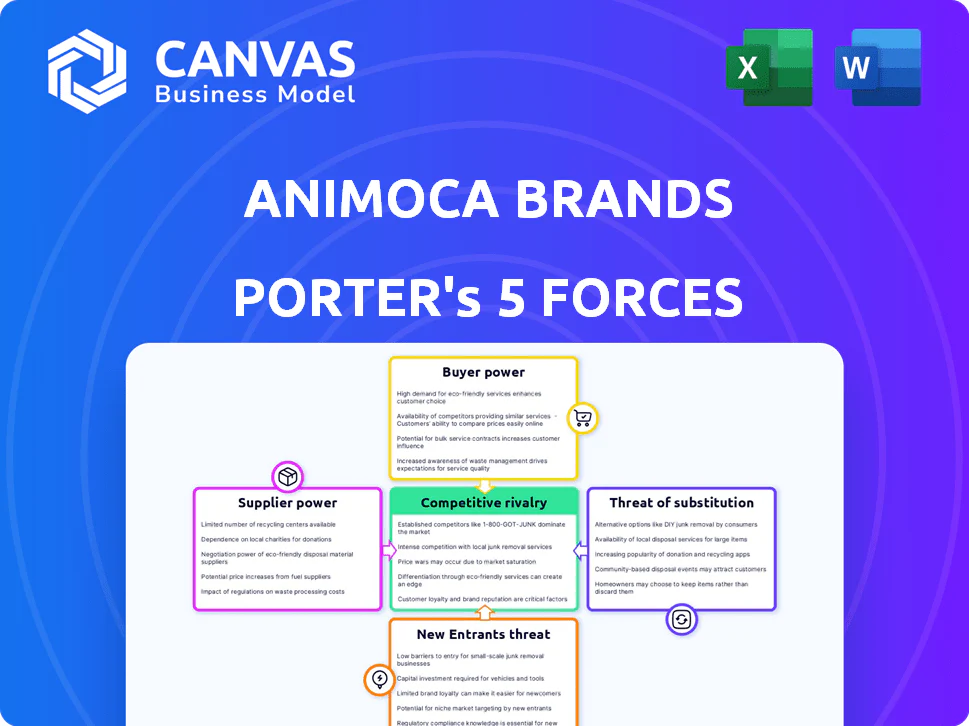
ANIMOCA BRANDS PORTER'S FIVE FORCES TEMPLATE RESEARCH
What is included in the product
 Detailed Word Document
Analyzes Animoca Brands' competitive landscape by evaluating its position with detailed industry data.

 Customizable Excel Spreadsheet
Customize force levels to address complex web3/metaverse market shifts.
Preview the Actual Deliverable
Animoca Brands Porter's Five Forces Analysis
This preview provides a comprehensive Porter's Five Forces analysis of Animoca Brands, evaluating industry rivalry, the bargaining power of suppliers and buyers, and the threat of new entrants and substitutes. The strategic insights presented here are based on thorough research. This is the complete, ready-to-use analysis file. What you're previewing is what you get—professionally formatted and ready for your needs.

Porter's Five Forces Analysis Template

A Must-Have Tool for Decision-Makers
Animoca Brands operates in a dynamic market, facing pressures from various forces. The threat of new entrants is moderate, with blockchain gaming's lower barriers to entry. Buyer power is significant, due to a wide range of gaming options. Supplier power is also notable, influenced by game developers and IP holders. The risk of substitutes is high, because of alternative entertainment. Finally, the rivalry among existing competitors is intense in the gaming space.
This brief snapshot only scratches the surface. Unlock the full Porter's Five Forces Analysis to explore Animoca Brands’s competitive dynamics, market pressures, and strategic advantages in detail.
Suppliers Bargaining Power

Key Technology Providers
Animoca Brands depends heavily on key technology providers. These include blockchain platforms like Ethereum and Solana. These suppliers wield significant bargaining power. This is especially true due to transaction fees. In 2024, Ethereum's average gas fees fluctuated between $10 and $50, impacting operational costs.
Content and IP Holders
Animoca Brands heavily relies on content and IP holders, making these suppliers powerful. The company collaborates with entities like Formula 1 and MotoGP. In 2024, Animoca Brands had partnerships with over 400 IP holders. This dependence gives IP holders significant leverage.

Talented Developers and Creators
Animoca Brands faces considerable bargaining power from talented developers and creators. The Web3 sector thrives on skilled individuals. High demand for expertise, like smart contract development, strengthens their negotiation position. The average salary for blockchain developers in 2024 is around $150,000 annually. This influences project costs.

Data and Analytics Providers
Animoca Brands relies on data and analytics providers for market insights. The bargaining power of these suppliers can be significant. High-quality, timely data is vital for strategic decisions. Access to the right data influences Animoca's ability to compete effectively. In 2024, the market for blockchain analytics grew, with firms like Chainalysis reporting increased demand.
- Dependence on specific data providers can increase costs.
- Data quality directly impacts investment decisions.
- Exclusive data access provides a competitive edge.
- Market volatility influences data demand and pricing.
Marketing and Distribution Channels
Animoca Brands depends on platforms and distribution channels to reach its audience, making these entities significant suppliers. These platforms, such as app stores and social media networks, control access to vast user bases. Their ability to influence marketing and promotion gives them leverage over Animoca Brands. Therefore, the fees and terms these suppliers impose affect Animoca Brands' profitability.
- Apple's App Store and Google Play Store are key distribution channels.
- Social media marketing, in 2024, cost between $0.20-$3.00 per click.
- Platform fees can range from 15% to 30% of sales.
Animoca Brands: Supplier Power Dynamics
Animoca Brands faces supplier power from multiple sources, including blockchain platforms and IP holders. Dependence on key tech providers, like Ethereum, exposes the company to fluctuating transaction costs. In 2024, Ethereum gas fees varied, affecting operational expenses. The company's reliance on content creators and distribution channels further amplifies supplier power.
| Supplier Type | Impact on Animoca Brands | 2024 Data Points |
|---|---|---|
| Blockchain Platforms | Transaction fees, platform costs | Ethereum gas fees: $10-$50 avg. |
| IP Holders | Licensing fees, content costs | Animoca had 400+ IP partnerships |
| Developers | Salary expenses, project costs | Blockchain dev salary: $150k avg. |
Customers Bargaining Power

Individual Users and Gamers
Individual users and gamers influence Animoca Brands through platform and game choices. Their spending directly affects Animoca's revenue, a key factor in financial results. In 2024, the gaming market generated over $184 billion globally. Brand loyalty can soften customer power, yet consumer preferences drive market trends. For instance, in 2023, mobile gaming accounted for 51% of the total market.
NFT Collectors and Traders
The bargaining power of NFT collectors and traders significantly shapes Animoca Brands' landscape. Demand from these groups directly influences NFT value and liquidity. Their activity on platforms like OpenSea, which saw over $2.7 billion in trading volume in January 2024, gives them considerable influence. This collective power impacts Animoca Brands' projects and overall ecosystem performance.

Institutional Investors and Partners
Institutional investors and partners hold considerable bargaining power, crucial for Animoca Brands' operations. These entities bring substantial capital and strategic opportunities, influencing deal terms. Animoca Brands actively seeks investments, making it susceptible to investor demands. In 2024, Animoca Brands raised $75 million in a funding round, showing investor influence.

Web3 Projects and Businesses
Animoca Brands' Digital Asset Advisory division works with other Web3 projects, making these projects its customers. The success of these clients directly affects Animoca Brands' revenue, granting these businesses some bargaining power. In 2024, Animoca Brands' revenue was $140 million, and advisory services contributed significantly. This influence varies with client size and project success.
- Animoca Brands' revenue in 2024 was $140 million.
- Advisory services significantly contribute to Animoca Brands' revenue.
- Client success impacts Animoca Brands' revenue, thus giving them influence.
- Bargaining power varies based on the client's size and project success.
Platform Users and Ecosystem Participants
Animoca Brands' platform users, including those on The Sandbox and Mocaverse, wield considerable bargaining power. Their active participation and content creation are crucial for the network effect, directly impacting platform value. User adoption and retention are vital, influencing the success of Animoca's ecosystem. In 2024, The Sandbox had over 4.5 million registered users. A strong user base translates to higher platform valuation.
- User-generated content drives platform engagement.
- High user retention is crucial for long-term success.
- Competition from other platforms impacts user choices.
- User feedback influences platform development.
Customer Power Dynamics at Play
Animoca Brands faces customer bargaining power from various groups, impacting its revenue streams. Individual gamers influence revenue through game choices, with the gaming market hitting $184B+ in 2024. NFT collectors affect NFT values, while institutional investors shape deal terms and investment strategies.
| Customer Segment | Influence | 2024 Data |
|---|---|---|
| Gamers | Platform & Game Choice | $184B+ Gaming Market |
| NFT Collectors | NFT Value & Liquidity | OpenSea: $2.7B+ Jan '24 |
| Institutional Investors | Deal Terms & Investment | $75M Raised in 2024 |
Rivalry Among Competitors

Numerous Web3 and Blockchain Companies
The Web3 and blockchain gaming space is intensely competitive. Animoca Brands faces many rivals in this market. The competition includes established gaming firms, startups, and tech giants. In 2024, the blockchain gaming market was valued at $10.5 billion. This rivalry pushes for innovation.
Established Gaming Companies Entering Web3
Established gaming giants are now entering Web3. This intensifies competition for Animoca Brands. For example, in 2024, major firms invested billions in Web3 initiatives. This influx of capital and established brands creates a more challenging market for Animoca Brands. The competition is fierce, with each company vying for market share.

NFT Marketplaces and Platforms
Competition in the NFT market is fierce, with platforms vying for users and market share. OpenSea, despite facing challenges, remains a leader, handling a trading volume of $176 million in Q4 2023. Animoca Brands, with its investments, competes against other major players like Magic Eden and Blur. The NFT market's volatility and evolving trends intensify this rivalry.

Diversified Portfolio and Investments
Animoca Brands combats competitive rivalry by diversifying its portfolio. Their strategy includes investing in and collaborating with numerous Web3 projects. This approach allows them to spread risk and capitalize on various market opportunities. In 2024, the company's portfolio included over 400 investments.
- Diverse Investments: Animoca Brands' portfolio spans gaming, metaverse, and infrastructure projects.
- Strategic Partnerships: Collaborations enhance market reach and innovation capabilities.
- Risk Mitigation: Diversification reduces the impact of any single project's failure.
- Market Leadership: A broad portfolio strengthens their position within the Web3 space.
Focus on Ecosystem Building and Interoperability
Animoca Brands' strategy involves building an open metaverse ecosystem. This focus on interoperability could be a significant competitive advantage. It creates a more connected and valuable network for users and developers. This approach may attract more users and developers to their platforms. The ultimate goal is to foster a robust ecosystem.
- Animoca Brands invested in over 400 Web3 companies by 2024.
- Their portfolio includes companies like Dapper Labs and Yield Guild Games.
- Animoca Brands raised $358.88 million in funding rounds in 2024.
- Their vision includes user-owned digital assets across multiple platforms.
Animoca Brands Navigates $10.5B Web3 Gaming Arena
Animoca Brands faces intense competition in the Web3 and blockchain gaming space, with the market valued at $10.5 billion in 2024. Established gaming firms and tech giants intensify this rivalry, investing billions in Web3. Animoca Brands diversifies its portfolio, which included over 400 investments in 2024, and builds an open metaverse ecosystem to combat competition.
| Aspect | Details | 2024 Data |
|---|---|---|
| Market Value | Blockchain Gaming | $10.5 billion |
| Investments | Animoca Brands' portfolio | Over 400 companies |
| Funding | Animoca Brands' raise | $358.88 million |
ANIMOCA BRANDS PORTER'S FIVE FORCES TEMPLATE RESEARCH
What is included in the product
Detailed Word Document
Analyzes Animoca Brands' competitive landscape by evaluating its position with detailed industry data.
Customizable Excel Spreadsheet
Customize force levels to address complex web3/metaverse market shifts.
Preview the Actual Deliverable
Animoca Brands Porter's Five Forces Analysis
This preview provides a comprehensive Porter's Five Forces analysis of Animoca Brands, evaluating industry rivalry, the bargaining power of suppliers and buyers, and the threat of new entrants and substitutes. The strategic insights presented here are based on thorough research. This is the complete, ready-to-use analysis file. What you're previewing is what you get—professionally formatted and ready for your needs.
Porter's Five Forces Analysis Template
A Must-Have Tool for Decision-Makers
Animoca Brands operates in a dynamic market, facing pressures from various forces. The threat of new entrants is moderate, with blockchain gaming's lower barriers to entry. Buyer power is significant, due to a wide range of gaming options. Supplier power is also notable, influenced by game developers and IP holders. The risk of substitutes is high, because of alternative entertainment. Finally, the rivalry among existing competitors is intense in the gaming space.
This brief snapshot only scratches the surface. Unlock the full Porter's Five Forces Analysis to explore Animoca Brands’s competitive dynamics, market pressures, and strategic advantages in detail.
Suppliers Bargaining Power
Key Technology Providers
Animoca Brands depends heavily on key technology providers. These include blockchain platforms like Ethereum and Solana. These suppliers wield significant bargaining power. This is especially true due to transaction fees. In 2024, Ethereum's average gas fees fluctuated between $10 and $50, impacting operational costs.
Content and IP Holders
Animoca Brands heavily relies on content and IP holders, making these suppliers powerful. The company collaborates with entities like Formula 1 and MotoGP. In 2024, Animoca Brands had partnerships with over 400 IP holders. This dependence gives IP holders significant leverage.
Talented Developers and Creators
Animoca Brands faces considerable bargaining power from talented developers and creators. The Web3 sector thrives on skilled individuals. High demand for expertise, like smart contract development, strengthens their negotiation position. The average salary for blockchain developers in 2024 is around $150,000 annually. This influences project costs.
Data and Analytics Providers
Animoca Brands relies on data and analytics providers for market insights. The bargaining power of these suppliers can be significant. High-quality, timely data is vital for strategic decisions. Access to the right data influences Animoca's ability to compete effectively. In 2024, the market for blockchain analytics grew, with firms like Chainalysis reporting increased demand.
- Dependence on specific data providers can increase costs.
- Data quality directly impacts investment decisions.
- Exclusive data access provides a competitive edge.
- Market volatility influences data demand and pricing.
Marketing and Distribution Channels
Animoca Brands depends on platforms and distribution channels to reach its audience, making these entities significant suppliers. These platforms, such as app stores and social media networks, control access to vast user bases. Their ability to influence marketing and promotion gives them leverage over Animoca Brands. Therefore, the fees and terms these suppliers impose affect Animoca Brands' profitability.
- Apple's App Store and Google Play Store are key distribution channels.
- Social media marketing, in 2024, cost between $0.20-$3.00 per click.
- Platform fees can range from 15% to 30% of sales.
Animoca Brands: Supplier Power Dynamics
Animoca Brands faces supplier power from multiple sources, including blockchain platforms and IP holders. Dependence on key tech providers, like Ethereum, exposes the company to fluctuating transaction costs. In 2024, Ethereum gas fees varied, affecting operational expenses. The company's reliance on content creators and distribution channels further amplifies supplier power.
| Supplier Type | Impact on Animoca Brands | 2024 Data Points |
|---|---|---|
| Blockchain Platforms | Transaction fees, platform costs | Ethereum gas fees: $10-$50 avg. |
| IP Holders | Licensing fees, content costs | Animoca had 400+ IP partnerships |
| Developers | Salary expenses, project costs | Blockchain dev salary: $150k avg. |
Customers Bargaining Power
Individual Users and Gamers
Individual users and gamers influence Animoca Brands through platform and game choices. Their spending directly affects Animoca's revenue, a key factor in financial results. In 2024, the gaming market generated over $184 billion globally. Brand loyalty can soften customer power, yet consumer preferences drive market trends. For instance, in 2023, mobile gaming accounted for 51% of the total market.
NFT Collectors and Traders
The bargaining power of NFT collectors and traders significantly shapes Animoca Brands' landscape. Demand from these groups directly influences NFT value and liquidity. Their activity on platforms like OpenSea, which saw over $2.7 billion in trading volume in January 2024, gives them considerable influence. This collective power impacts Animoca Brands' projects and overall ecosystem performance.
Institutional Investors and Partners
Institutional investors and partners hold considerable bargaining power, crucial for Animoca Brands' operations. These entities bring substantial capital and strategic opportunities, influencing deal terms. Animoca Brands actively seeks investments, making it susceptible to investor demands. In 2024, Animoca Brands raised $75 million in a funding round, showing investor influence.
Web3 Projects and Businesses
Animoca Brands' Digital Asset Advisory division works with other Web3 projects, making these projects its customers. The success of these clients directly affects Animoca Brands' revenue, granting these businesses some bargaining power. In 2024, Animoca Brands' revenue was $140 million, and advisory services contributed significantly. This influence varies with client size and project success.
- Animoca Brands' revenue in 2024 was $140 million.
- Advisory services significantly contribute to Animoca Brands' revenue.
- Client success impacts Animoca Brands' revenue, thus giving them influence.
- Bargaining power varies based on the client's size and project success.
Platform Users and Ecosystem Participants
Animoca Brands' platform users, including those on The Sandbox and Mocaverse, wield considerable bargaining power. Their active participation and content creation are crucial for the network effect, directly impacting platform value. User adoption and retention are vital, influencing the success of Animoca's ecosystem. In 2024, The Sandbox had over 4.5 million registered users. A strong user base translates to higher platform valuation.
- User-generated content drives platform engagement.
- High user retention is crucial for long-term success.
- Competition from other platforms impacts user choices.
- User feedback influences platform development.
Customer Power Dynamics at Play
Animoca Brands faces customer bargaining power from various groups, impacting its revenue streams. Individual gamers influence revenue through game choices, with the gaming market hitting $184B+ in 2024. NFT collectors affect NFT values, while institutional investors shape deal terms and investment strategies.
| Customer Segment | Influence | 2024 Data |
|---|---|---|
| Gamers | Platform & Game Choice | $184B+ Gaming Market |
| NFT Collectors | NFT Value & Liquidity | OpenSea: $2.7B+ Jan '24 |
| Institutional Investors | Deal Terms & Investment | $75M Raised in 2024 |
Rivalry Among Competitors
Numerous Web3 and Blockchain Companies
The Web3 and blockchain gaming space is intensely competitive. Animoca Brands faces many rivals in this market. The competition includes established gaming firms, startups, and tech giants. In 2024, the blockchain gaming market was valued at $10.5 billion. This rivalry pushes for innovation.
Established Gaming Companies Entering Web3
Established gaming giants are now entering Web3. This intensifies competition for Animoca Brands. For example, in 2024, major firms invested billions in Web3 initiatives. This influx of capital and established brands creates a more challenging market for Animoca Brands. The competition is fierce, with each company vying for market share.
NFT Marketplaces and Platforms
Competition in the NFT market is fierce, with platforms vying for users and market share. OpenSea, despite facing challenges, remains a leader, handling a trading volume of $176 million in Q4 2023. Animoca Brands, with its investments, competes against other major players like Magic Eden and Blur. The NFT market's volatility and evolving trends intensify this rivalry.
Diversified Portfolio and Investments
Animoca Brands combats competitive rivalry by diversifying its portfolio. Their strategy includes investing in and collaborating with numerous Web3 projects. This approach allows them to spread risk and capitalize on various market opportunities. In 2024, the company's portfolio included over 400 investments.
- Diverse Investments: Animoca Brands' portfolio spans gaming, metaverse, and infrastructure projects.
- Strategic Partnerships: Collaborations enhance market reach and innovation capabilities.
- Risk Mitigation: Diversification reduces the impact of any single project's failure.
- Market Leadership: A broad portfolio strengthens their position within the Web3 space.
Focus on Ecosystem Building and Interoperability
Animoca Brands' strategy involves building an open metaverse ecosystem. This focus on interoperability could be a significant competitive advantage. It creates a more connected and valuable network for users and developers. This approach may attract more users and developers to their platforms. The ultimate goal is to foster a robust ecosystem.
- Animoca Brands invested in over 400 Web3 companies by 2024.
- Their portfolio includes companies like Dapper Labs and Yield Guild Games.
- Animoca Brands raised $358.88 million in funding rounds in 2024.
- Their vision includes user-owned digital assets across multiple platforms.
Animoca Brands Navigates $10.5B Web3 Gaming Arena
Animoca Brands faces intense competition in the Web3 and blockchain gaming space, with the market valued at $10.5 billion in 2024. Established gaming firms and tech giants intensify this rivalry, investing billions in Web3. Animoca Brands diversifies its portfolio, which included over 400 investments in 2024, and builds an open metaverse ecosystem to combat competition.
| Aspect | Details | 2024 Data |
|---|---|---|
| Market Value | Blockchain Gaming | $10.5 billion |
| Investments | Animoca Brands' portfolio | Over 400 companies |
| Funding | Animoca Brands' raise | $358.88 million |
Product Information
Product Information
Shipping & Returns
Shipping & Returns
Description
What is included in the product
Detailed Word Document
Analyzes Animoca Brands' competitive landscape by evaluating its position with detailed industry data.
Customizable Excel Spreadsheet
Customize force levels to address complex web3/metaverse market shifts.
Preview the Actual Deliverable
Animoca Brands Porter's Five Forces Analysis
This preview provides a comprehensive Porter's Five Forces analysis of Animoca Brands, evaluating industry rivalry, the bargaining power of suppliers and buyers, and the threat of new entrants and substitutes. The strategic insights presented here are based on thorough research. This is the complete, ready-to-use analysis file. What you're previewing is what you get—professionally formatted and ready for your needs.
Porter's Five Forces Analysis Template
A Must-Have Tool for Decision-Makers
Animoca Brands operates in a dynamic market, facing pressures from various forces. The threat of new entrants is moderate, with blockchain gaming's lower barriers to entry. Buyer power is significant, due to a wide range of gaming options. Supplier power is also notable, influenced by game developers and IP holders. The risk of substitutes is high, because of alternative entertainment. Finally, the rivalry among existing competitors is intense in the gaming space.
This brief snapshot only scratches the surface. Unlock the full Porter's Five Forces Analysis to explore Animoca Brands’s competitive dynamics, market pressures, and strategic advantages in detail.
Suppliers Bargaining Power
Key Technology Providers
Animoca Brands depends heavily on key technology providers. These include blockchain platforms like Ethereum and Solana. These suppliers wield significant bargaining power. This is especially true due to transaction fees. In 2024, Ethereum's average gas fees fluctuated between $10 and $50, impacting operational costs.
Content and IP Holders
Animoca Brands heavily relies on content and IP holders, making these suppliers powerful. The company collaborates with entities like Formula 1 and MotoGP. In 2024, Animoca Brands had partnerships with over 400 IP holders. This dependence gives IP holders significant leverage.
Talented Developers and Creators
Animoca Brands faces considerable bargaining power from talented developers and creators. The Web3 sector thrives on skilled individuals. High demand for expertise, like smart contract development, strengthens their negotiation position. The average salary for blockchain developers in 2024 is around $150,000 annually. This influences project costs.
Data and Analytics Providers
Animoca Brands relies on data and analytics providers for market insights. The bargaining power of these suppliers can be significant. High-quality, timely data is vital for strategic decisions. Access to the right data influences Animoca's ability to compete effectively. In 2024, the market for blockchain analytics grew, with firms like Chainalysis reporting increased demand.
- Dependence on specific data providers can increase costs.
- Data quality directly impacts investment decisions.
- Exclusive data access provides a competitive edge.
- Market volatility influences data demand and pricing.
Marketing and Distribution Channels
Animoca Brands depends on platforms and distribution channels to reach its audience, making these entities significant suppliers. These platforms, such as app stores and social media networks, control access to vast user bases. Their ability to influence marketing and promotion gives them leverage over Animoca Brands. Therefore, the fees and terms these suppliers impose affect Animoca Brands' profitability.
- Apple's App Store and Google Play Store are key distribution channels.
- Social media marketing, in 2024, cost between $0.20-$3.00 per click.
- Platform fees can range from 15% to 30% of sales.
Animoca Brands: Supplier Power Dynamics
Animoca Brands faces supplier power from multiple sources, including blockchain platforms and IP holders. Dependence on key tech providers, like Ethereum, exposes the company to fluctuating transaction costs. In 2024, Ethereum gas fees varied, affecting operational expenses. The company's reliance on content creators and distribution channels further amplifies supplier power.
| Supplier Type | Impact on Animoca Brands | 2024 Data Points |
|---|---|---|
| Blockchain Platforms | Transaction fees, platform costs | Ethereum gas fees: $10-$50 avg. |
| IP Holders | Licensing fees, content costs | Animoca had 400+ IP partnerships |
| Developers | Salary expenses, project costs | Blockchain dev salary: $150k avg. |
Customers Bargaining Power
Individual Users and Gamers
Individual users and gamers influence Animoca Brands through platform and game choices. Their spending directly affects Animoca's revenue, a key factor in financial results. In 2024, the gaming market generated over $184 billion globally. Brand loyalty can soften customer power, yet consumer preferences drive market trends. For instance, in 2023, mobile gaming accounted for 51% of the total market.
NFT Collectors and Traders
The bargaining power of NFT collectors and traders significantly shapes Animoca Brands' landscape. Demand from these groups directly influences NFT value and liquidity. Their activity on platforms like OpenSea, which saw over $2.7 billion in trading volume in January 2024, gives them considerable influence. This collective power impacts Animoca Brands' projects and overall ecosystem performance.
Institutional Investors and Partners
Institutional investors and partners hold considerable bargaining power, crucial for Animoca Brands' operations. These entities bring substantial capital and strategic opportunities, influencing deal terms. Animoca Brands actively seeks investments, making it susceptible to investor demands. In 2024, Animoca Brands raised $75 million in a funding round, showing investor influence.
Web3 Projects and Businesses
Animoca Brands' Digital Asset Advisory division works with other Web3 projects, making these projects its customers. The success of these clients directly affects Animoca Brands' revenue, granting these businesses some bargaining power. In 2024, Animoca Brands' revenue was $140 million, and advisory services contributed significantly. This influence varies with client size and project success.
- Animoca Brands' revenue in 2024 was $140 million.
- Advisory services significantly contribute to Animoca Brands' revenue.
- Client success impacts Animoca Brands' revenue, thus giving them influence.
- Bargaining power varies based on the client's size and project success.
Platform Users and Ecosystem Participants
Animoca Brands' platform users, including those on The Sandbox and Mocaverse, wield considerable bargaining power. Their active participation and content creation are crucial for the network effect, directly impacting platform value. User adoption and retention are vital, influencing the success of Animoca's ecosystem. In 2024, The Sandbox had over 4.5 million registered users. A strong user base translates to higher platform valuation.
- User-generated content drives platform engagement.
- High user retention is crucial for long-term success.
- Competition from other platforms impacts user choices.
- User feedback influences platform development.
Customer Power Dynamics at Play
Animoca Brands faces customer bargaining power from various groups, impacting its revenue streams. Individual gamers influence revenue through game choices, with the gaming market hitting $184B+ in 2024. NFT collectors affect NFT values, while institutional investors shape deal terms and investment strategies.
| Customer Segment | Influence | 2024 Data |
|---|---|---|
| Gamers | Platform & Game Choice | $184B+ Gaming Market |
| NFT Collectors | NFT Value & Liquidity | OpenSea: $2.7B+ Jan '24 |
| Institutional Investors | Deal Terms & Investment | $75M Raised in 2024 |
Rivalry Among Competitors
Numerous Web3 and Blockchain Companies
The Web3 and blockchain gaming space is intensely competitive. Animoca Brands faces many rivals in this market. The competition includes established gaming firms, startups, and tech giants. In 2024, the blockchain gaming market was valued at $10.5 billion. This rivalry pushes for innovation.
Established Gaming Companies Entering Web3
Established gaming giants are now entering Web3. This intensifies competition for Animoca Brands. For example, in 2024, major firms invested billions in Web3 initiatives. This influx of capital and established brands creates a more challenging market for Animoca Brands. The competition is fierce, with each company vying for market share.
NFT Marketplaces and Platforms
Competition in the NFT market is fierce, with platforms vying for users and market share. OpenSea, despite facing challenges, remains a leader, handling a trading volume of $176 million in Q4 2023. Animoca Brands, with its investments, competes against other major players like Magic Eden and Blur. The NFT market's volatility and evolving trends intensify this rivalry.
Diversified Portfolio and Investments
Animoca Brands combats competitive rivalry by diversifying its portfolio. Their strategy includes investing in and collaborating with numerous Web3 projects. This approach allows them to spread risk and capitalize on various market opportunities. In 2024, the company's portfolio included over 400 investments.
- Diverse Investments: Animoca Brands' portfolio spans gaming, metaverse, and infrastructure projects.
- Strategic Partnerships: Collaborations enhance market reach and innovation capabilities.
- Risk Mitigation: Diversification reduces the impact of any single project's failure.
- Market Leadership: A broad portfolio strengthens their position within the Web3 space.
Focus on Ecosystem Building and Interoperability
Animoca Brands' strategy involves building an open metaverse ecosystem. This focus on interoperability could be a significant competitive advantage. It creates a more connected and valuable network for users and developers. This approach may attract more users and developers to their platforms. The ultimate goal is to foster a robust ecosystem.
- Animoca Brands invested in over 400 Web3 companies by 2024.
- Their portfolio includes companies like Dapper Labs and Yield Guild Games.
- Animoca Brands raised $358.88 million in funding rounds in 2024.
- Their vision includes user-owned digital assets across multiple platforms.
Animoca Brands Navigates $10.5B Web3 Gaming Arena
Animoca Brands faces intense competition in the Web3 and blockchain gaming space, with the market valued at $10.5 billion in 2024. Established gaming firms and tech giants intensify this rivalry, investing billions in Web3. Animoca Brands diversifies its portfolio, which included over 400 investments in 2024, and builds an open metaverse ecosystem to combat competition.
| Aspect | Details | 2024 Data |
|---|---|---|
| Market Value | Blockchain Gaming | $10.5 billion |
| Investments | Animoca Brands' portfolio | Over 400 companies |
| Funding | Animoca Brands' raise | $358.88 million |











