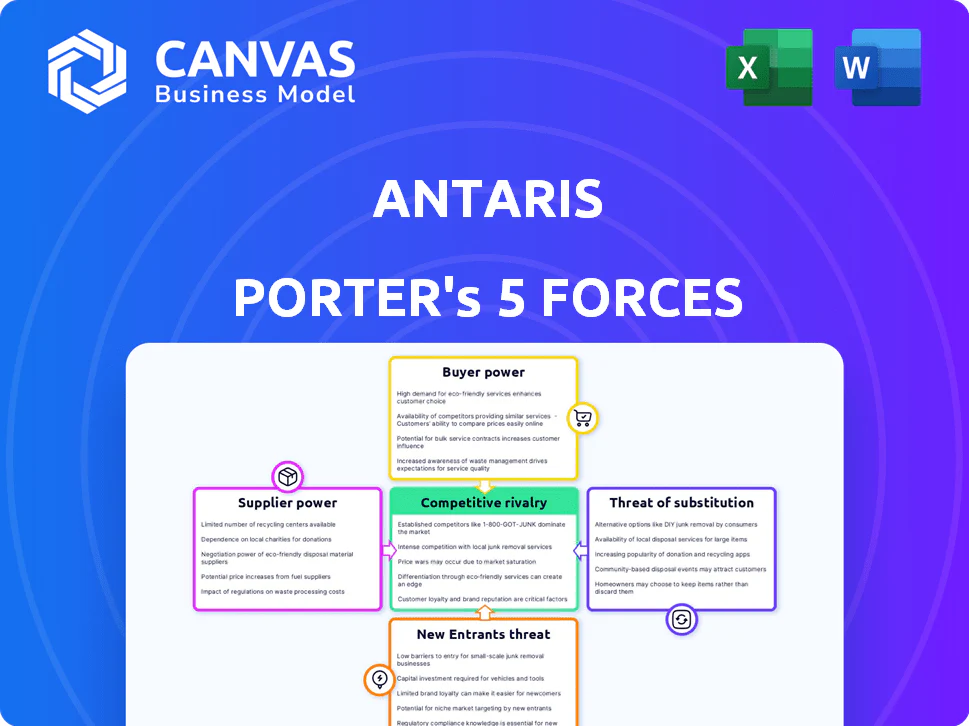
ANTARIS PORTER'S FIVE FORCES TEMPLATE RESEARCH
What is included in the product
 Detailed Word Document
Evaluates control held by suppliers and buyers, and their influence on pricing and profitability.

 Customizable Excel Spreadsheet
Instantly spot critical threats and opportunities with a dynamic, interconnected analysis.
Preview Before You Purchase
Antaris Porter's Five Forces Analysis
This preview provides the complete Porter's Five Forces analysis for Antaris. The document you see here is the final, ready-to-download file.

Porter's Five Forces Analysis Template

Elevate Your Analysis with the Complete Porter's Five Forces Analysis
Antaris faces a dynamic competitive landscape shaped by Porter's Five Forces. Buyer power, reflecting customer influence, impacts pricing and service demands. Supplier power assesses the bargaining leverage of providers. Threat of new entrants considers ease of market access. Substitute products evaluate alternative offerings. Rivalry among existing competitors analyzes the intensity of competition.
This preview is just the beginning. Dive into a complete, consultant-grade breakdown of Antaris’s industry competitiveness—ready for immediate use.
Suppliers Bargaining Power

Availability of specialized components and technology
Antaris depends on suppliers for unique satellite components and technology, increasing their bargaining power. The fewer suppliers offering these, the stronger their position. For example, in 2024, companies like SpaceX and Blue Origin have significant leverage due to their proprietary tech. Limited supply can drive up costs and impact Antaris's profitability. This is especially true for cutting-edge tech.
Concentration of suppliers
If Antaris relies on a few suppliers, those suppliers gain leverage. For example, in 2024, the semiconductor industry saw major suppliers like TSMC and Intel controlling a significant market share, giving them pricing power. This concentration can impact Antaris's profitability. It’s about the balance of power.

Switching costs for Antaris
Switching costs significantly affect supplier power. If Antaris faces high costs to change suppliers, those suppliers gain leverage. For example, if Antaris's specialized components have only a few providers, switching becomes expensive. In 2024, firms spent an average of $500,000 on new supplier onboarding.

Supplier's ability to forward integrate
If Antaris's suppliers could move forward and compete directly, their power would surge. This forward integration threat, like a satellite platform supplier launching its own services, raises supplier leverage. Companies like SpaceX, which designs and operates its own rockets, demonstrate this capability. In 2024, vertical integration strategies have become increasingly common, with companies seeking greater control over their supply chains.
- SpaceX's estimated 2024 revenue: $9 billion.
- Forward integration risk increases supplier negotiation leverage.
- Antaris's reliance on external suppliers strengthens their power.
- Vertical integration trends are reshaping the space industry.
Importance of Antaris to the supplier
The significance of Antaris as a customer is crucial for suppliers. If Antaris makes up a large part of a supplier's sales, the supplier's ability to negotiate prices or terms may be limited. This dependence can weaken the supplier's bargaining power within the market. For instance, if Antaris accounts for over 40% of a supplier's revenue, that supplier is more vulnerable. This scenario often results in less favorable terms for the supplier.
- Supplier dependence can limit negotiation power.
- High revenue share with Antaris increases vulnerability.
- Suppliers may face less favorable terms.
- Antaris's influence grows with supplier dependence.
Tech Supplier Dynamics: Impact on Profitability
Suppliers of unique tech strengthen their position. Limited options increase costs, impacting Antaris's profits. Forward integration by suppliers, like SpaceX's rocket operations, also boosts their leverage.
| Factor | Impact on Antaris | 2024 Data Point |
|---|---|---|
| Supplier Concentration | Higher costs, reduced margins | TSMC and Intel control ~60% of semiconductor market |
| Switching Costs | Lock-in to current suppliers | Avg. onboarding cost for new suppliers: $500,000 |
| Supplier Dependence | Vulnerability to supplier terms | If Antaris is >40% of supplier's revenue, supplier's power decreases |
Customers Bargaining Power

Concentration of customers
If Antaris has a few major clients, like commercial operators or government bodies, these customers wield considerable bargaining power. Their substantial orders are crucial to Antaris's revenue. For example, in 2024, government contracts accounted for 35% of Antaris's total sales, indicating a dependency that boosts customer influence.
Switching costs for customers
Switching costs significantly influence customer bargaining power in the satellite industry. If it's easy for customers to switch providers, their power grows. For instance, in 2024, the average churn rate in the satellite internet market was around 5%, indicating moderate switching costs. Lower switching costs, like those offered by some platforms with easy contract terms, amplify customer leverage. This allows them to negotiate better prices or demand improved services. Conversely, high switching costs, such as long-term contracts with penalties, diminish customer power.

Customer's potential for backward integration
Customers, able to create their own satellite systems, gain leverage against Antaris. This backward integration possibility, like a large government space agency, diminishes Antaris's control. For example, in 2024, SpaceX's Starlink demonstrated in-house satellite capabilities, impacting the broader market dynamics. This shift can pressure Antaris to offer better terms.

Customer price sensitivity
Customer price sensitivity significantly shapes their bargaining power regarding Antaris's platform and services. High platform costs often lead customers to aggressively negotiate prices. For instance, in 2024, companies with over $1 billion in revenue allocated an average of 12% of their IT budget to software and cloud services, indicating a substantial spend where price pressure is likely.
- Price sensitivity increases with higher platform costs.
- Customers seek alternatives if prices are deemed excessive.
- The availability of substitute solutions weakens Antaris's pricing power.
- Market competition further intensifies price negotiations.
Availability of alternative solutions
The availability of alternative solutions significantly influences customer bargaining power. If numerous platforms or methods exist for satellite design, simulation, and operation, customers can easily switch providers. This ability to choose increases their leverage in negotiations, potentially driving down prices or demanding better service. In 2024, the satellite industry saw over 500 companies involved in various aspects of space technology, highlighting the competitive landscape. This competition gives customers several options, strengthening their position.
- Increased competition among providers.
- Ability to negotiate better terms.
- Reduced dependence on a single vendor.
- Greater influence on product features.
Antaris's Customer Power: A Deep Dive
Customer bargaining power significantly impacts Antaris. Major clients, like governments, hold considerable influence, especially if they represent a large portion of Antaris's revenue. Switching costs influence customer power; lower costs increase leverage, while high costs diminish it. Alternatives, such as in-house satellite capabilities, further empower customers.
| Factor | Impact | 2024 Data |
|---|---|---|
| Client Concentration | High concentration = High power | Govt. contracts: 35% of sales |
| Switching Costs | Low costs = High power | Avg. churn rate: ~5% |
| Alternative Solutions | Availability = High power | Over 500 space tech companies |
Rivalry Among Competitors

Number and intensity of competitors
The space technology and satellite platform market is bustling with competition. It includes established aerospace giants and agile New Space startups. The intensity of rivalry is high, with companies vying for market share. In 2024, the global space economy is valued over $469 billion, reflecting a competitive landscape. This rivalry impacts Antaris directly as they compete for contracts and resources.
Industry growth rate
The satellite industry's growth rate significantly impacts competitive rivalry. Rapid expansion, like the projected 10% annual growth in the global space economy, eases competition, offering ample opportunities for various companies. Slow growth, however, intensifies rivalry, forcing companies to compete aggressively for a limited market share. For instance, a downturn could spark price wars or increased mergers and acquisitions as businesses fight for survival.

Product differentiation
The level of product differentiation significantly impacts competitive rivalry for Antaris. A unique offering can lessen direct competition. For instance, in 2024, the satellite industry saw increased consolidation, with companies like SpaceX leading the market. Antaris seeks differentiation by streamlining satellite lifecycles using a unified platform. This strategy aims to set it apart in a market where innovation is key.

Exit barriers
High exit barriers, like specialized assets or long-term contracts, keep struggling firms in the game, boosting rivalry. This intensifies competition as companies fight for market share, even with losses. For instance, in 2024, the airline industry faced high exit barriers, with significant investments in aircraft and airport slots. This led to intense price wars and route competition, even when demand fluctuated.
- High exit barriers often mean companies stay, increasing competition.
- Industries with specialized assets face higher exit costs.
- Long-term contracts can also act as exit barriers.
- The airline sector is a good example of this.
Diversity of competitors
The intensity of competitive rivalry increases when competitors have diverse strategies, origins, and goals. For example, in the space industry, traditional aerospace companies compete with newer, software-focused firms. This diversity can make market dynamics unpredictable, potentially leading to aggressive pricing or rapid innovation cycles. In 2024, the space sector saw over $50 billion in investment, indicating a highly competitive environment.
- Different strategic approaches can lead to varied competitive tactics.
- Companies from different backgrounds may have different cost structures and priorities.
- Varied goals, such as market share versus profitability, influence competitive behavior.
- Increased diversity often results in heightened rivalry and market volatility.
Space Sector Rivalry: Growth & Barriers
Competitive rivalry in the space sector is intense, fueled by diverse competitors like SpaceX and traditional firms. Rapid market growth, such as the projected 10% annual expansion, can ease this rivalry by creating more opportunities. Conversely, slow growth intensifies competition, potentially leading to price wars or mergers. High exit barriers, such as specialized assets, can further boost rivalry.
| Factor | Impact | Example (2024) |
|---|---|---|
| Market Growth | High growth eases rivalry | Space economy projected 10% growth |
| Product Differentiation | Unique offerings reduce competition | Antaris's platform streamlining lifecycles |
| Exit Barriers | High barriers increase rivalry | Airline industry's high asset investments |
Original: $10.00
-65%$10.00
$3.50ANTARIS PORTER'S FIVE FORCES TEMPLATE RESEARCH
What is included in the product
Detailed Word Document
Evaluates control held by suppliers and buyers, and their influence on pricing and profitability.
Customizable Excel Spreadsheet
Instantly spot critical threats and opportunities with a dynamic, interconnected analysis.
Preview Before You Purchase
Antaris Porter's Five Forces Analysis
This preview provides the complete Porter's Five Forces analysis for Antaris. The document you see here is the final, ready-to-download file.
Porter's Five Forces Analysis Template
Elevate Your Analysis with the Complete Porter's Five Forces Analysis
Antaris faces a dynamic competitive landscape shaped by Porter's Five Forces. Buyer power, reflecting customer influence, impacts pricing and service demands. Supplier power assesses the bargaining leverage of providers. Threat of new entrants considers ease of market access. Substitute products evaluate alternative offerings. Rivalry among existing competitors analyzes the intensity of competition.
This preview is just the beginning. Dive into a complete, consultant-grade breakdown of Antaris’s industry competitiveness—ready for immediate use.
Suppliers Bargaining Power
Availability of specialized components and technology
Antaris depends on suppliers for unique satellite components and technology, increasing their bargaining power. The fewer suppliers offering these, the stronger their position. For example, in 2024, companies like SpaceX and Blue Origin have significant leverage due to their proprietary tech. Limited supply can drive up costs and impact Antaris's profitability. This is especially true for cutting-edge tech.
Concentration of suppliers
If Antaris relies on a few suppliers, those suppliers gain leverage. For example, in 2024, the semiconductor industry saw major suppliers like TSMC and Intel controlling a significant market share, giving them pricing power. This concentration can impact Antaris's profitability. It’s about the balance of power.
Switching costs for Antaris
Switching costs significantly affect supplier power. If Antaris faces high costs to change suppliers, those suppliers gain leverage. For example, if Antaris's specialized components have only a few providers, switching becomes expensive. In 2024, firms spent an average of $500,000 on new supplier onboarding.
Supplier's ability to forward integrate
If Antaris's suppliers could move forward and compete directly, their power would surge. This forward integration threat, like a satellite platform supplier launching its own services, raises supplier leverage. Companies like SpaceX, which designs and operates its own rockets, demonstrate this capability. In 2024, vertical integration strategies have become increasingly common, with companies seeking greater control over their supply chains.
- SpaceX's estimated 2024 revenue: $9 billion.
- Forward integration risk increases supplier negotiation leverage.
- Antaris's reliance on external suppliers strengthens their power.
- Vertical integration trends are reshaping the space industry.
Importance of Antaris to the supplier
The significance of Antaris as a customer is crucial for suppliers. If Antaris makes up a large part of a supplier's sales, the supplier's ability to negotiate prices or terms may be limited. This dependence can weaken the supplier's bargaining power within the market. For instance, if Antaris accounts for over 40% of a supplier's revenue, that supplier is more vulnerable. This scenario often results in less favorable terms for the supplier.
- Supplier dependence can limit negotiation power.
- High revenue share with Antaris increases vulnerability.
- Suppliers may face less favorable terms.
- Antaris's influence grows with supplier dependence.
Tech Supplier Dynamics: Impact on Profitability
Suppliers of unique tech strengthen their position. Limited options increase costs, impacting Antaris's profits. Forward integration by suppliers, like SpaceX's rocket operations, also boosts their leverage.
| Factor | Impact on Antaris | 2024 Data Point |
|---|---|---|
| Supplier Concentration | Higher costs, reduced margins | TSMC and Intel control ~60% of semiconductor market |
| Switching Costs | Lock-in to current suppliers | Avg. onboarding cost for new suppliers: $500,000 |
| Supplier Dependence | Vulnerability to supplier terms | If Antaris is >40% of supplier's revenue, supplier's power decreases |
Customers Bargaining Power
Concentration of customers
If Antaris has a few major clients, like commercial operators or government bodies, these customers wield considerable bargaining power. Their substantial orders are crucial to Antaris's revenue. For example, in 2024, government contracts accounted for 35% of Antaris's total sales, indicating a dependency that boosts customer influence.
Switching costs for customers
Switching costs significantly influence customer bargaining power in the satellite industry. If it's easy for customers to switch providers, their power grows. For instance, in 2024, the average churn rate in the satellite internet market was around 5%, indicating moderate switching costs. Lower switching costs, like those offered by some platforms with easy contract terms, amplify customer leverage. This allows them to negotiate better prices or demand improved services. Conversely, high switching costs, such as long-term contracts with penalties, diminish customer power.
Customer's potential for backward integration
Customers, able to create their own satellite systems, gain leverage against Antaris. This backward integration possibility, like a large government space agency, diminishes Antaris's control. For example, in 2024, SpaceX's Starlink demonstrated in-house satellite capabilities, impacting the broader market dynamics. This shift can pressure Antaris to offer better terms.
Customer price sensitivity
Customer price sensitivity significantly shapes their bargaining power regarding Antaris's platform and services. High platform costs often lead customers to aggressively negotiate prices. For instance, in 2024, companies with over $1 billion in revenue allocated an average of 12% of their IT budget to software and cloud services, indicating a substantial spend where price pressure is likely.
- Price sensitivity increases with higher platform costs.
- Customers seek alternatives if prices are deemed excessive.
- The availability of substitute solutions weakens Antaris's pricing power.
- Market competition further intensifies price negotiations.
Availability of alternative solutions
The availability of alternative solutions significantly influences customer bargaining power. If numerous platforms or methods exist for satellite design, simulation, and operation, customers can easily switch providers. This ability to choose increases their leverage in negotiations, potentially driving down prices or demanding better service. In 2024, the satellite industry saw over 500 companies involved in various aspects of space technology, highlighting the competitive landscape. This competition gives customers several options, strengthening their position.
- Increased competition among providers.
- Ability to negotiate better terms.
- Reduced dependence on a single vendor.
- Greater influence on product features.
Antaris's Customer Power: A Deep Dive
Customer bargaining power significantly impacts Antaris. Major clients, like governments, hold considerable influence, especially if they represent a large portion of Antaris's revenue. Switching costs influence customer power; lower costs increase leverage, while high costs diminish it. Alternatives, such as in-house satellite capabilities, further empower customers.
| Factor | Impact | 2024 Data |
|---|---|---|
| Client Concentration | High concentration = High power | Govt. contracts: 35% of sales |
| Switching Costs | Low costs = High power | Avg. churn rate: ~5% |
| Alternative Solutions | Availability = High power | Over 500 space tech companies |
Rivalry Among Competitors
Number and intensity of competitors
The space technology and satellite platform market is bustling with competition. It includes established aerospace giants and agile New Space startups. The intensity of rivalry is high, with companies vying for market share. In 2024, the global space economy is valued over $469 billion, reflecting a competitive landscape. This rivalry impacts Antaris directly as they compete for contracts and resources.
Industry growth rate
The satellite industry's growth rate significantly impacts competitive rivalry. Rapid expansion, like the projected 10% annual growth in the global space economy, eases competition, offering ample opportunities for various companies. Slow growth, however, intensifies rivalry, forcing companies to compete aggressively for a limited market share. For instance, a downturn could spark price wars or increased mergers and acquisitions as businesses fight for survival.
Product differentiation
The level of product differentiation significantly impacts competitive rivalry for Antaris. A unique offering can lessen direct competition. For instance, in 2024, the satellite industry saw increased consolidation, with companies like SpaceX leading the market. Antaris seeks differentiation by streamlining satellite lifecycles using a unified platform. This strategy aims to set it apart in a market where innovation is key.
Exit barriers
High exit barriers, like specialized assets or long-term contracts, keep struggling firms in the game, boosting rivalry. This intensifies competition as companies fight for market share, even with losses. For instance, in 2024, the airline industry faced high exit barriers, with significant investments in aircraft and airport slots. This led to intense price wars and route competition, even when demand fluctuated.
- High exit barriers often mean companies stay, increasing competition.
- Industries with specialized assets face higher exit costs.
- Long-term contracts can also act as exit barriers.
- The airline sector is a good example of this.
Diversity of competitors
The intensity of competitive rivalry increases when competitors have diverse strategies, origins, and goals. For example, in the space industry, traditional aerospace companies compete with newer, software-focused firms. This diversity can make market dynamics unpredictable, potentially leading to aggressive pricing or rapid innovation cycles. In 2024, the space sector saw over $50 billion in investment, indicating a highly competitive environment.
- Different strategic approaches can lead to varied competitive tactics.
- Companies from different backgrounds may have different cost structures and priorities.
- Varied goals, such as market share versus profitability, influence competitive behavior.
- Increased diversity often results in heightened rivalry and market volatility.
Space Sector Rivalry: Growth & Barriers
Competitive rivalry in the space sector is intense, fueled by diverse competitors like SpaceX and traditional firms. Rapid market growth, such as the projected 10% annual expansion, can ease this rivalry by creating more opportunities. Conversely, slow growth intensifies competition, potentially leading to price wars or mergers. High exit barriers, such as specialized assets, can further boost rivalry.
| Factor | Impact | Example (2024) |
|---|---|---|
| Market Growth | High growth eases rivalry | Space economy projected 10% growth |
| Product Differentiation | Unique offerings reduce competition | Antaris's platform streamlining lifecycles |
| Exit Barriers | High barriers increase rivalry | Airline industry's high asset investments |
Product Information
Product Information
Shipping & Returns
Shipping & Returns
Description
What is included in the product
Detailed Word Document
Evaluates control held by suppliers and buyers, and their influence on pricing and profitability.
Customizable Excel Spreadsheet
Instantly spot critical threats and opportunities with a dynamic, interconnected analysis.
Preview Before You Purchase
Antaris Porter's Five Forces Analysis
This preview provides the complete Porter's Five Forces analysis for Antaris. The document you see here is the final, ready-to-download file.
Porter's Five Forces Analysis Template
Elevate Your Analysis with the Complete Porter's Five Forces Analysis
Antaris faces a dynamic competitive landscape shaped by Porter's Five Forces. Buyer power, reflecting customer influence, impacts pricing and service demands. Supplier power assesses the bargaining leverage of providers. Threat of new entrants considers ease of market access. Substitute products evaluate alternative offerings. Rivalry among existing competitors analyzes the intensity of competition.
This preview is just the beginning. Dive into a complete, consultant-grade breakdown of Antaris’s industry competitiveness—ready for immediate use.
Suppliers Bargaining Power
Availability of specialized components and technology
Antaris depends on suppliers for unique satellite components and technology, increasing their bargaining power. The fewer suppliers offering these, the stronger their position. For example, in 2024, companies like SpaceX and Blue Origin have significant leverage due to their proprietary tech. Limited supply can drive up costs and impact Antaris's profitability. This is especially true for cutting-edge tech.
Concentration of suppliers
If Antaris relies on a few suppliers, those suppliers gain leverage. For example, in 2024, the semiconductor industry saw major suppliers like TSMC and Intel controlling a significant market share, giving them pricing power. This concentration can impact Antaris's profitability. It’s about the balance of power.
Switching costs for Antaris
Switching costs significantly affect supplier power. If Antaris faces high costs to change suppliers, those suppliers gain leverage. For example, if Antaris's specialized components have only a few providers, switching becomes expensive. In 2024, firms spent an average of $500,000 on new supplier onboarding.
Supplier's ability to forward integrate
If Antaris's suppliers could move forward and compete directly, their power would surge. This forward integration threat, like a satellite platform supplier launching its own services, raises supplier leverage. Companies like SpaceX, which designs and operates its own rockets, demonstrate this capability. In 2024, vertical integration strategies have become increasingly common, with companies seeking greater control over their supply chains.
- SpaceX's estimated 2024 revenue: $9 billion.
- Forward integration risk increases supplier negotiation leverage.
- Antaris's reliance on external suppliers strengthens their power.
- Vertical integration trends are reshaping the space industry.
Importance of Antaris to the supplier
The significance of Antaris as a customer is crucial for suppliers. If Antaris makes up a large part of a supplier's sales, the supplier's ability to negotiate prices or terms may be limited. This dependence can weaken the supplier's bargaining power within the market. For instance, if Antaris accounts for over 40% of a supplier's revenue, that supplier is more vulnerable. This scenario often results in less favorable terms for the supplier.
- Supplier dependence can limit negotiation power.
- High revenue share with Antaris increases vulnerability.
- Suppliers may face less favorable terms.
- Antaris's influence grows with supplier dependence.
Tech Supplier Dynamics: Impact on Profitability
Suppliers of unique tech strengthen their position. Limited options increase costs, impacting Antaris's profits. Forward integration by suppliers, like SpaceX's rocket operations, also boosts their leverage.
| Factor | Impact on Antaris | 2024 Data Point |
|---|---|---|
| Supplier Concentration | Higher costs, reduced margins | TSMC and Intel control ~60% of semiconductor market |
| Switching Costs | Lock-in to current suppliers | Avg. onboarding cost for new suppliers: $500,000 |
| Supplier Dependence | Vulnerability to supplier terms | If Antaris is >40% of supplier's revenue, supplier's power decreases |
Customers Bargaining Power
Concentration of customers
If Antaris has a few major clients, like commercial operators or government bodies, these customers wield considerable bargaining power. Their substantial orders are crucial to Antaris's revenue. For example, in 2024, government contracts accounted for 35% of Antaris's total sales, indicating a dependency that boosts customer influence.
Switching costs for customers
Switching costs significantly influence customer bargaining power in the satellite industry. If it's easy for customers to switch providers, their power grows. For instance, in 2024, the average churn rate in the satellite internet market was around 5%, indicating moderate switching costs. Lower switching costs, like those offered by some platforms with easy contract terms, amplify customer leverage. This allows them to negotiate better prices or demand improved services. Conversely, high switching costs, such as long-term contracts with penalties, diminish customer power.
Customer's potential for backward integration
Customers, able to create their own satellite systems, gain leverage against Antaris. This backward integration possibility, like a large government space agency, diminishes Antaris's control. For example, in 2024, SpaceX's Starlink demonstrated in-house satellite capabilities, impacting the broader market dynamics. This shift can pressure Antaris to offer better terms.
Customer price sensitivity
Customer price sensitivity significantly shapes their bargaining power regarding Antaris's platform and services. High platform costs often lead customers to aggressively negotiate prices. For instance, in 2024, companies with over $1 billion in revenue allocated an average of 12% of their IT budget to software and cloud services, indicating a substantial spend where price pressure is likely.
- Price sensitivity increases with higher platform costs.
- Customers seek alternatives if prices are deemed excessive.
- The availability of substitute solutions weakens Antaris's pricing power.
- Market competition further intensifies price negotiations.
Availability of alternative solutions
The availability of alternative solutions significantly influences customer bargaining power. If numerous platforms or methods exist for satellite design, simulation, and operation, customers can easily switch providers. This ability to choose increases their leverage in negotiations, potentially driving down prices or demanding better service. In 2024, the satellite industry saw over 500 companies involved in various aspects of space technology, highlighting the competitive landscape. This competition gives customers several options, strengthening their position.
- Increased competition among providers.
- Ability to negotiate better terms.
- Reduced dependence on a single vendor.
- Greater influence on product features.
Antaris's Customer Power: A Deep Dive
Customer bargaining power significantly impacts Antaris. Major clients, like governments, hold considerable influence, especially if they represent a large portion of Antaris's revenue. Switching costs influence customer power; lower costs increase leverage, while high costs diminish it. Alternatives, such as in-house satellite capabilities, further empower customers.
| Factor | Impact | 2024 Data |
|---|---|---|
| Client Concentration | High concentration = High power | Govt. contracts: 35% of sales |
| Switching Costs | Low costs = High power | Avg. churn rate: ~5% |
| Alternative Solutions | Availability = High power | Over 500 space tech companies |
Rivalry Among Competitors
Number and intensity of competitors
The space technology and satellite platform market is bustling with competition. It includes established aerospace giants and agile New Space startups. The intensity of rivalry is high, with companies vying for market share. In 2024, the global space economy is valued over $469 billion, reflecting a competitive landscape. This rivalry impacts Antaris directly as they compete for contracts and resources.
Industry growth rate
The satellite industry's growth rate significantly impacts competitive rivalry. Rapid expansion, like the projected 10% annual growth in the global space economy, eases competition, offering ample opportunities for various companies. Slow growth, however, intensifies rivalry, forcing companies to compete aggressively for a limited market share. For instance, a downturn could spark price wars or increased mergers and acquisitions as businesses fight for survival.
Product differentiation
The level of product differentiation significantly impacts competitive rivalry for Antaris. A unique offering can lessen direct competition. For instance, in 2024, the satellite industry saw increased consolidation, with companies like SpaceX leading the market. Antaris seeks differentiation by streamlining satellite lifecycles using a unified platform. This strategy aims to set it apart in a market where innovation is key.
Exit barriers
High exit barriers, like specialized assets or long-term contracts, keep struggling firms in the game, boosting rivalry. This intensifies competition as companies fight for market share, even with losses. For instance, in 2024, the airline industry faced high exit barriers, with significant investments in aircraft and airport slots. This led to intense price wars and route competition, even when demand fluctuated.
- High exit barriers often mean companies stay, increasing competition.
- Industries with specialized assets face higher exit costs.
- Long-term contracts can also act as exit barriers.
- The airline sector is a good example of this.
Diversity of competitors
The intensity of competitive rivalry increases when competitors have diverse strategies, origins, and goals. For example, in the space industry, traditional aerospace companies compete with newer, software-focused firms. This diversity can make market dynamics unpredictable, potentially leading to aggressive pricing or rapid innovation cycles. In 2024, the space sector saw over $50 billion in investment, indicating a highly competitive environment.
- Different strategic approaches can lead to varied competitive tactics.
- Companies from different backgrounds may have different cost structures and priorities.
- Varied goals, such as market share versus profitability, influence competitive behavior.
- Increased diversity often results in heightened rivalry and market volatility.
Space Sector Rivalry: Growth & Barriers
Competitive rivalry in the space sector is intense, fueled by diverse competitors like SpaceX and traditional firms. Rapid market growth, such as the projected 10% annual expansion, can ease this rivalry by creating more opportunities. Conversely, slow growth intensifies competition, potentially leading to price wars or mergers. High exit barriers, such as specialized assets, can further boost rivalry.
| Factor | Impact | Example (2024) |
|---|---|---|
| Market Growth | High growth eases rivalry | Space economy projected 10% growth |
| Product Differentiation | Unique offerings reduce competition | Antaris's platform streamlining lifecycles |
| Exit Barriers | High barriers increase rivalry | Airline industry's high asset investments |











