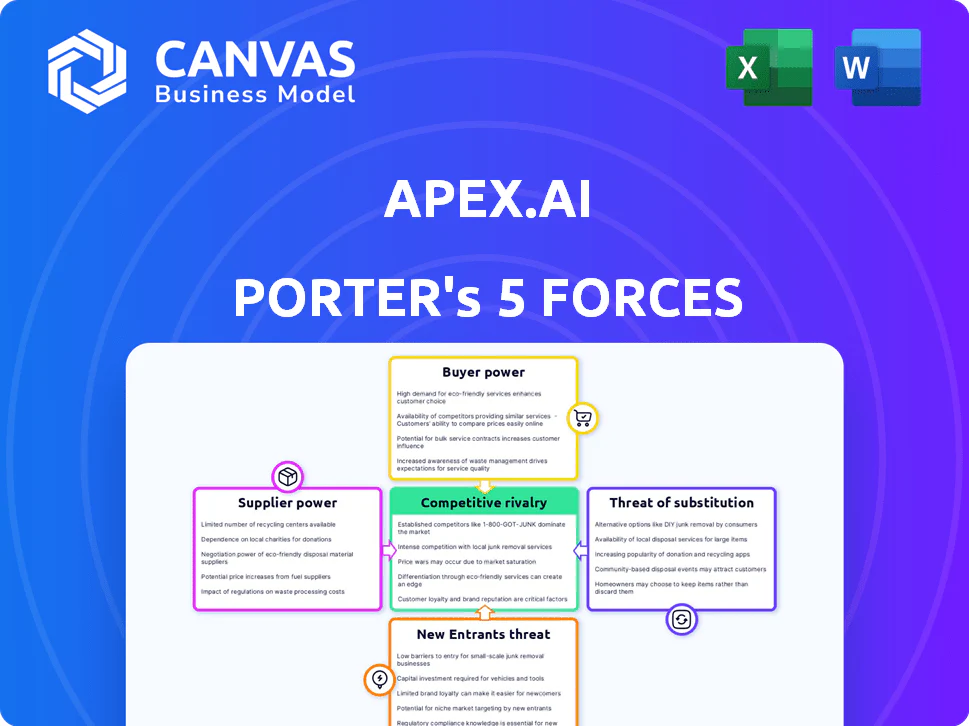
APEX.AI PORTER'S FIVE FORCES TEMPLATE RESEARCH
What is included in the product
 Detailed Word Document
Tailored exclusively for Apex.AI, analyzing its position within its competitive landscape.

 Customizable Excel Spreadsheet
Instantly visualize competitive forces with intuitive, color-coded scores.
Preview Before You Purchase
Apex.AI Porter's Five Forces Analysis
The Apex.AI Porter's Five Forces Analysis preview demonstrates the complete document. This analysis assesses industry rivalry, supplier power, buyer power, threat of substitutes, and threat of new entrants. The evaluation provides insights into Apex.AI's competitive landscape and strategic positioning. You're receiving the exact, fully formatted document, ready to download and use immediately after purchase.

Porter's Five Forces Analysis Template

A Must-Have Tool for Decision-Makers
Apex.AI operates within a dynamic market, facing pressures from various forces. Supplier power, driven by specialized tech, presents a moderate challenge. The threat of new entrants is mitigated by high barriers to entry and specialized knowledge. Buyer power, however, is considerable due to the diverse customer base. Substitute products, particularly open-source solutions, pose a notable threat. The level of rivalry is intense, with competitors vying for market share.
This brief snapshot only scratches the surface. Unlock the full Porter's Five Forces Analysis to explore Apex.AI’s competitive dynamics, market pressures, and strategic advantages in detail.
Suppliers Bargaining Power

Key Technology Providers
Apex.AI depends on key tech suppliers for sensors (camera, radar), high-performance computing, and potentially operating systems. A limited number of specialized providers for critical components can increase their bargaining power. In 2024, the automotive sensor market, a key area for Apex.AI, was valued at over $30 billion globally. These suppliers can therefore influence prices and terms.
Talent Pool
Apex.AI's success hinges on skilled talent. The shortage of experts in autonomous systems gives employees leverage. This can drive up labor costs. In 2024, the median salary for AI engineers reached $160,000.

Data Providers
Apex.AI relies on data providers for critical datasets. These suppliers, offering driving, sensor, and simulation data, exert bargaining power. Their influence grows if their data is unique and crucial for safety certifications. In 2024, the autonomous vehicle data market was valued at $2.1 billion, highlighting this power.

Cloud Computing Services
Apex.AI probably relies on cloud computing services for its operations. Major providers like Amazon Web Services, Microsoft Azure, and Google Cloud Platform possess substantial bargaining power. They can influence Apex.AI through pricing and service level agreements (SLAs). According to Gartner, the worldwide end-user spending on public cloud services is forecast to reach nearly $679 billion in 2024.
- Cloud providers control infrastructure and pricing.
- SLAs impact service quality and reliability for Apex.AI.
- Market concentration gives providers leverage.
- Spending on cloud services is rapidly increasing.
Open-Source Software Dependencies
Apex.AI's reliance on open-source software, like ROS, introduces supplier power. The quality and updates of these open-source components directly affect Apex.AI. The availability of commercial support or alternative solutions also impacts Apex.AI's operations and costs. This dependency necessitates careful management to mitigate risks.
- ROS has a global community of developers, but commercial support costs can vary.
- The open-source software market was valued at $27.57 billion in 2023.
- Companies like Apex.AI must assess the long-term viability of their open-source dependencies.
- The market is expected to grow to $58.93 billion by 2028.
Supplier Power Dynamics: A Look at Apex.AI
Apex.AI faces supplier power from tech providers. Limited suppliers for sensors and computing can dictate terms. In 2024, the global automotive sensor market hit $30B. Cloud providers like AWS also wield significant influence.
| Supplier Type | Impact on Apex.AI | 2024 Market Data |
|---|---|---|
| Sensor Providers | Influence prices and terms | $30B Automotive Sensor Market |
| Cloud Providers | Control infrastructure & pricing | $679B Cloud Services Spending |
| Data Suppliers | Exert bargaining power | $2.1B Autonomous Vehicle Data |
Customers Bargaining Power

Automotive OEMs and Tier 1 Suppliers
Apex.AI's main clients are likely automotive OEMs and Tier 1 suppliers. These big firms can set terms, particularly with large Apex.AI software deployments. In 2024, the global automotive industry's revenue reached $3.3 trillion, showing the customers' financial sway. OEMs and Tier 1s have strong bargaining power.
Customer Concentration
If Apex.AI relies heavily on a few key customers, these entities wield considerable bargaining power. Imagine if a few major clients account for, say, over 60% of Apex.AI's revenue. The loss of even one could severely impact the company's financial health. This dependence can force Apex.AI to accept lower prices or less favorable terms.

Switching Costs
Switching costs for Apex.AI's customers involve integrating their software, but the advantage is safety-certified solutions. This is crucial in the autonomous systems market. In 2024, the global autonomous vehicle market was valued at $128.6 billion. Apex.AI's focus on safety could make it more attractive than in-house options.

Customer Sophistication and In-House Capabilities
Automotive companies, like those partnering with Apex.AI, possess in-house software expertise, potentially reducing their reliance on external suppliers. This technical capacity strengthens their bargaining position. This capability allows them to negotiate more favorable terms, or even develop solutions independently. In 2024, in-house software development spending by major automakers reached an estimated $15 billion.
- In-house development reduces dependency on external suppliers.
- Automakers can negotiate better terms with suppliers.
- The ability to develop software independently is a key factor.
- In 2024, the in-house software spending was $15 billion.
Price Sensitivity
Price sensitivity is crucial for Apex.AI's customers. The expense of autonomous vehicle tech significantly impacts purchasing decisions. Apex.AI's pricing, safety certifications, and value proposition affect customer negotiation power. Companies assess costs carefully before adopting new technologies.
- Autonomous driving software market is projected to reach $36.7 billion by 2028.
- Safety certifications can add up to 20% to project costs.
- Companies often negotiate discounts of 5-10% on large software deals.
- Apex.AI's competitors offer similar products at competitive prices.
Automakers' Power: $3.3T Revenue & $15B Software Spend
Apex.AI's customers, mainly automotive giants, hold significant bargaining power due to their size and financial influence. The automotive industry's 2024 revenue of $3.3 trillion underscores this. Their in-house software capabilities, with $15 billion spent in 2024, further strengthen their position, allowing them to negotiate favorable terms.
| Factor | Impact | Data Point (2024) |
|---|---|---|
| Customer Size/Concentration | High | Automotive industry revenue: $3.3T |
| Switching Costs | Moderate | Autonomous vehicle market: $128.6B |
| In-house Capabilities | High | Automakers' in-house software spending: $15B |
Rivalry Among Competitors

Number and Diversity of Competitors
The autonomous vehicle and robotics software market, where Apex.AI operates, is highly competitive. It includes tech giants, auto suppliers, and startups. A crowded field, with many rivals, increases competition. For example, in 2024, over 200 companies were active in the autonomous driving software sector, according to industry reports.
Market Growth Rate
The autonomous vehicle and robotics software markets are expanding significantly. This growth, while offering opportunities, intensifies competition. In 2024, the global autonomous vehicle market was valued at approximately $88.8 billion. Rapid expansion draws in new competitors. This increased competition affects market dynamics.

Product Differentiation
Apex.AI's focus on safety-certified software is a key differentiator. The intensity of rivalry depends on how well their SDK and runtime environment stand out. If their offerings are significantly safer, more reliable, and easier to use, rivalry is less intense. In 2024, the autonomous vehicle software market was valued at approximately $1.5 billion.

Switching Costs for Customers
Switching costs in the autonomous software market, while not always prohibitive, do affect competition. Migrating to a new platform like Apex.AI's Porter requires time and potentially significant investment in retraining and system integration. This can create a barrier, making customers less likely to switch even if competitors offer slightly better terms. The costs of switching can range from 5% to 15% of the initial investment.
- Integration complexity influences switching costs.
- Training and personnel costs are also factors.
- Apex.AI's proprietary tech may increase switching costs.
- Switching costs can create customer loyalty.
Strategic Partnerships and Collaborations
Strategic partnerships significantly shape competitive dynamics. When rivals collaborate, it intensifies pressure on Apex.AI. Apex.AI's partnerships, like the one with LG Electronics, are crucial in this environment. Such alliances can boost market reach and technological capabilities. This requires Apex.AI to continually innovate and strengthen its collaborations.
- Partnerships can broaden market access.
- Collaborations enhance technological capabilities.
- Apex.AI must focus on innovation and alliances.
- Rival collaborations increase competitive intensity.
Autonomous Vehicle Software: A Competitive Landscape
Competitive rivalry in autonomous vehicle software is fierce, with over 200 companies competing in 2024. Market expansion, valued at $88.8 billion in 2024, attracts more rivals. Apex.AI's differentiation through safety-certified software and strategic partnerships is crucial. Switching costs, ranging from 5% to 15% of initial investment, also impact competition.
| Factor | Impact on Rivalry | Data (2024) |
|---|---|---|
| Market Growth | Attracts more competitors | Global market: $88.8B |
| Differentiation | Reduces intensity if strong | Software market: $1.5B |
| Switching Costs | Can create customer loyalty | Costs: 5%-15% of investment |
Original: $10.00
-65%$10.00
$3.50APEX.AI PORTER'S FIVE FORCES TEMPLATE RESEARCH
What is included in the product
Detailed Word Document
Tailored exclusively for Apex.AI, analyzing its position within its competitive landscape.
Customizable Excel Spreadsheet
Instantly visualize competitive forces with intuitive, color-coded scores.
Preview Before You Purchase
Apex.AI Porter's Five Forces Analysis
The Apex.AI Porter's Five Forces Analysis preview demonstrates the complete document. This analysis assesses industry rivalry, supplier power, buyer power, threat of substitutes, and threat of new entrants. The evaluation provides insights into Apex.AI's competitive landscape and strategic positioning. You're receiving the exact, fully formatted document, ready to download and use immediately after purchase.
Porter's Five Forces Analysis Template
A Must-Have Tool for Decision-Makers
Apex.AI operates within a dynamic market, facing pressures from various forces. Supplier power, driven by specialized tech, presents a moderate challenge. The threat of new entrants is mitigated by high barriers to entry and specialized knowledge. Buyer power, however, is considerable due to the diverse customer base. Substitute products, particularly open-source solutions, pose a notable threat. The level of rivalry is intense, with competitors vying for market share.
This brief snapshot only scratches the surface. Unlock the full Porter's Five Forces Analysis to explore Apex.AI’s competitive dynamics, market pressures, and strategic advantages in detail.
Suppliers Bargaining Power
Key Technology Providers
Apex.AI depends on key tech suppliers for sensors (camera, radar), high-performance computing, and potentially operating systems. A limited number of specialized providers for critical components can increase their bargaining power. In 2024, the automotive sensor market, a key area for Apex.AI, was valued at over $30 billion globally. These suppliers can therefore influence prices and terms.
Talent Pool
Apex.AI's success hinges on skilled talent. The shortage of experts in autonomous systems gives employees leverage. This can drive up labor costs. In 2024, the median salary for AI engineers reached $160,000.
Data Providers
Apex.AI relies on data providers for critical datasets. These suppliers, offering driving, sensor, and simulation data, exert bargaining power. Their influence grows if their data is unique and crucial for safety certifications. In 2024, the autonomous vehicle data market was valued at $2.1 billion, highlighting this power.
Cloud Computing Services
Apex.AI probably relies on cloud computing services for its operations. Major providers like Amazon Web Services, Microsoft Azure, and Google Cloud Platform possess substantial bargaining power. They can influence Apex.AI through pricing and service level agreements (SLAs). According to Gartner, the worldwide end-user spending on public cloud services is forecast to reach nearly $679 billion in 2024.
- Cloud providers control infrastructure and pricing.
- SLAs impact service quality and reliability for Apex.AI.
- Market concentration gives providers leverage.
- Spending on cloud services is rapidly increasing.
Open-Source Software Dependencies
Apex.AI's reliance on open-source software, like ROS, introduces supplier power. The quality and updates of these open-source components directly affect Apex.AI. The availability of commercial support or alternative solutions also impacts Apex.AI's operations and costs. This dependency necessitates careful management to mitigate risks.
- ROS has a global community of developers, but commercial support costs can vary.
- The open-source software market was valued at $27.57 billion in 2023.
- Companies like Apex.AI must assess the long-term viability of their open-source dependencies.
- The market is expected to grow to $58.93 billion by 2028.
Supplier Power Dynamics: A Look at Apex.AI
Apex.AI faces supplier power from tech providers. Limited suppliers for sensors and computing can dictate terms. In 2024, the global automotive sensor market hit $30B. Cloud providers like AWS also wield significant influence.
| Supplier Type | Impact on Apex.AI | 2024 Market Data |
|---|---|---|
| Sensor Providers | Influence prices and terms | $30B Automotive Sensor Market |
| Cloud Providers | Control infrastructure & pricing | $679B Cloud Services Spending |
| Data Suppliers | Exert bargaining power | $2.1B Autonomous Vehicle Data |
Customers Bargaining Power
Automotive OEMs and Tier 1 Suppliers
Apex.AI's main clients are likely automotive OEMs and Tier 1 suppliers. These big firms can set terms, particularly with large Apex.AI software deployments. In 2024, the global automotive industry's revenue reached $3.3 trillion, showing the customers' financial sway. OEMs and Tier 1s have strong bargaining power.
Customer Concentration
If Apex.AI relies heavily on a few key customers, these entities wield considerable bargaining power. Imagine if a few major clients account for, say, over 60% of Apex.AI's revenue. The loss of even one could severely impact the company's financial health. This dependence can force Apex.AI to accept lower prices or less favorable terms.
Switching Costs
Switching costs for Apex.AI's customers involve integrating their software, but the advantage is safety-certified solutions. This is crucial in the autonomous systems market. In 2024, the global autonomous vehicle market was valued at $128.6 billion. Apex.AI's focus on safety could make it more attractive than in-house options.
Customer Sophistication and In-House Capabilities
Automotive companies, like those partnering with Apex.AI, possess in-house software expertise, potentially reducing their reliance on external suppliers. This technical capacity strengthens their bargaining position. This capability allows them to negotiate more favorable terms, or even develop solutions independently. In 2024, in-house software development spending by major automakers reached an estimated $15 billion.
- In-house development reduces dependency on external suppliers.
- Automakers can negotiate better terms with suppliers.
- The ability to develop software independently is a key factor.
- In 2024, the in-house software spending was $15 billion.
Price Sensitivity
Price sensitivity is crucial for Apex.AI's customers. The expense of autonomous vehicle tech significantly impacts purchasing decisions. Apex.AI's pricing, safety certifications, and value proposition affect customer negotiation power. Companies assess costs carefully before adopting new technologies.
- Autonomous driving software market is projected to reach $36.7 billion by 2028.
- Safety certifications can add up to 20% to project costs.
- Companies often negotiate discounts of 5-10% on large software deals.
- Apex.AI's competitors offer similar products at competitive prices.
Automakers' Power: $3.3T Revenue & $15B Software Spend
Apex.AI's customers, mainly automotive giants, hold significant bargaining power due to their size and financial influence. The automotive industry's 2024 revenue of $3.3 trillion underscores this. Their in-house software capabilities, with $15 billion spent in 2024, further strengthen their position, allowing them to negotiate favorable terms.
| Factor | Impact | Data Point (2024) |
|---|---|---|
| Customer Size/Concentration | High | Automotive industry revenue: $3.3T |
| Switching Costs | Moderate | Autonomous vehicle market: $128.6B |
| In-house Capabilities | High | Automakers' in-house software spending: $15B |
Rivalry Among Competitors
Number and Diversity of Competitors
The autonomous vehicle and robotics software market, where Apex.AI operates, is highly competitive. It includes tech giants, auto suppliers, and startups. A crowded field, with many rivals, increases competition. For example, in 2024, over 200 companies were active in the autonomous driving software sector, according to industry reports.
Market Growth Rate
The autonomous vehicle and robotics software markets are expanding significantly. This growth, while offering opportunities, intensifies competition. In 2024, the global autonomous vehicle market was valued at approximately $88.8 billion. Rapid expansion draws in new competitors. This increased competition affects market dynamics.
Product Differentiation
Apex.AI's focus on safety-certified software is a key differentiator. The intensity of rivalry depends on how well their SDK and runtime environment stand out. If their offerings are significantly safer, more reliable, and easier to use, rivalry is less intense. In 2024, the autonomous vehicle software market was valued at approximately $1.5 billion.
Switching Costs for Customers
Switching costs in the autonomous software market, while not always prohibitive, do affect competition. Migrating to a new platform like Apex.AI's Porter requires time and potentially significant investment in retraining and system integration. This can create a barrier, making customers less likely to switch even if competitors offer slightly better terms. The costs of switching can range from 5% to 15% of the initial investment.
- Integration complexity influences switching costs.
- Training and personnel costs are also factors.
- Apex.AI's proprietary tech may increase switching costs.
- Switching costs can create customer loyalty.
Strategic Partnerships and Collaborations
Strategic partnerships significantly shape competitive dynamics. When rivals collaborate, it intensifies pressure on Apex.AI. Apex.AI's partnerships, like the one with LG Electronics, are crucial in this environment. Such alliances can boost market reach and technological capabilities. This requires Apex.AI to continually innovate and strengthen its collaborations.
- Partnerships can broaden market access.
- Collaborations enhance technological capabilities.
- Apex.AI must focus on innovation and alliances.
- Rival collaborations increase competitive intensity.
Autonomous Vehicle Software: A Competitive Landscape
Competitive rivalry in autonomous vehicle software is fierce, with over 200 companies competing in 2024. Market expansion, valued at $88.8 billion in 2024, attracts more rivals. Apex.AI's differentiation through safety-certified software and strategic partnerships is crucial. Switching costs, ranging from 5% to 15% of initial investment, also impact competition.
| Factor | Impact on Rivalry | Data (2024) |
|---|---|---|
| Market Growth | Attracts more competitors | Global market: $88.8B |
| Differentiation | Reduces intensity if strong | Software market: $1.5B |
| Switching Costs | Can create customer loyalty | Costs: 5%-15% of investment |
Product Information
Product Information
Shipping & Returns
Shipping & Returns
Description
What is included in the product
Detailed Word Document
Tailored exclusively for Apex.AI, analyzing its position within its competitive landscape.
Customizable Excel Spreadsheet
Instantly visualize competitive forces with intuitive, color-coded scores.
Preview Before You Purchase
Apex.AI Porter's Five Forces Analysis
The Apex.AI Porter's Five Forces Analysis preview demonstrates the complete document. This analysis assesses industry rivalry, supplier power, buyer power, threat of substitutes, and threat of new entrants. The evaluation provides insights into Apex.AI's competitive landscape and strategic positioning. You're receiving the exact, fully formatted document, ready to download and use immediately after purchase.
Porter's Five Forces Analysis Template
A Must-Have Tool for Decision-Makers
Apex.AI operates within a dynamic market, facing pressures from various forces. Supplier power, driven by specialized tech, presents a moderate challenge. The threat of new entrants is mitigated by high barriers to entry and specialized knowledge. Buyer power, however, is considerable due to the diverse customer base. Substitute products, particularly open-source solutions, pose a notable threat. The level of rivalry is intense, with competitors vying for market share.
This brief snapshot only scratches the surface. Unlock the full Porter's Five Forces Analysis to explore Apex.AI’s competitive dynamics, market pressures, and strategic advantages in detail.
Suppliers Bargaining Power
Key Technology Providers
Apex.AI depends on key tech suppliers for sensors (camera, radar), high-performance computing, and potentially operating systems. A limited number of specialized providers for critical components can increase their bargaining power. In 2024, the automotive sensor market, a key area for Apex.AI, was valued at over $30 billion globally. These suppliers can therefore influence prices and terms.
Talent Pool
Apex.AI's success hinges on skilled talent. The shortage of experts in autonomous systems gives employees leverage. This can drive up labor costs. In 2024, the median salary for AI engineers reached $160,000.
Data Providers
Apex.AI relies on data providers for critical datasets. These suppliers, offering driving, sensor, and simulation data, exert bargaining power. Their influence grows if their data is unique and crucial for safety certifications. In 2024, the autonomous vehicle data market was valued at $2.1 billion, highlighting this power.
Cloud Computing Services
Apex.AI probably relies on cloud computing services for its operations. Major providers like Amazon Web Services, Microsoft Azure, and Google Cloud Platform possess substantial bargaining power. They can influence Apex.AI through pricing and service level agreements (SLAs). According to Gartner, the worldwide end-user spending on public cloud services is forecast to reach nearly $679 billion in 2024.
- Cloud providers control infrastructure and pricing.
- SLAs impact service quality and reliability for Apex.AI.
- Market concentration gives providers leverage.
- Spending on cloud services is rapidly increasing.
Open-Source Software Dependencies
Apex.AI's reliance on open-source software, like ROS, introduces supplier power. The quality and updates of these open-source components directly affect Apex.AI. The availability of commercial support or alternative solutions also impacts Apex.AI's operations and costs. This dependency necessitates careful management to mitigate risks.
- ROS has a global community of developers, but commercial support costs can vary.
- The open-source software market was valued at $27.57 billion in 2023.
- Companies like Apex.AI must assess the long-term viability of their open-source dependencies.
- The market is expected to grow to $58.93 billion by 2028.
Supplier Power Dynamics: A Look at Apex.AI
Apex.AI faces supplier power from tech providers. Limited suppliers for sensors and computing can dictate terms. In 2024, the global automotive sensor market hit $30B. Cloud providers like AWS also wield significant influence.
| Supplier Type | Impact on Apex.AI | 2024 Market Data |
|---|---|---|
| Sensor Providers | Influence prices and terms | $30B Automotive Sensor Market |
| Cloud Providers | Control infrastructure & pricing | $679B Cloud Services Spending |
| Data Suppliers | Exert bargaining power | $2.1B Autonomous Vehicle Data |
Customers Bargaining Power
Automotive OEMs and Tier 1 Suppliers
Apex.AI's main clients are likely automotive OEMs and Tier 1 suppliers. These big firms can set terms, particularly with large Apex.AI software deployments. In 2024, the global automotive industry's revenue reached $3.3 trillion, showing the customers' financial sway. OEMs and Tier 1s have strong bargaining power.
Customer Concentration
If Apex.AI relies heavily on a few key customers, these entities wield considerable bargaining power. Imagine if a few major clients account for, say, over 60% of Apex.AI's revenue. The loss of even one could severely impact the company's financial health. This dependence can force Apex.AI to accept lower prices or less favorable terms.
Switching Costs
Switching costs for Apex.AI's customers involve integrating their software, but the advantage is safety-certified solutions. This is crucial in the autonomous systems market. In 2024, the global autonomous vehicle market was valued at $128.6 billion. Apex.AI's focus on safety could make it more attractive than in-house options.
Customer Sophistication and In-House Capabilities
Automotive companies, like those partnering with Apex.AI, possess in-house software expertise, potentially reducing their reliance on external suppliers. This technical capacity strengthens their bargaining position. This capability allows them to negotiate more favorable terms, or even develop solutions independently. In 2024, in-house software development spending by major automakers reached an estimated $15 billion.
- In-house development reduces dependency on external suppliers.
- Automakers can negotiate better terms with suppliers.
- The ability to develop software independently is a key factor.
- In 2024, the in-house software spending was $15 billion.
Price Sensitivity
Price sensitivity is crucial for Apex.AI's customers. The expense of autonomous vehicle tech significantly impacts purchasing decisions. Apex.AI's pricing, safety certifications, and value proposition affect customer negotiation power. Companies assess costs carefully before adopting new technologies.
- Autonomous driving software market is projected to reach $36.7 billion by 2028.
- Safety certifications can add up to 20% to project costs.
- Companies often negotiate discounts of 5-10% on large software deals.
- Apex.AI's competitors offer similar products at competitive prices.
Automakers' Power: $3.3T Revenue & $15B Software Spend
Apex.AI's customers, mainly automotive giants, hold significant bargaining power due to their size and financial influence. The automotive industry's 2024 revenue of $3.3 trillion underscores this. Their in-house software capabilities, with $15 billion spent in 2024, further strengthen their position, allowing them to negotiate favorable terms.
| Factor | Impact | Data Point (2024) |
|---|---|---|
| Customer Size/Concentration | High | Automotive industry revenue: $3.3T |
| Switching Costs | Moderate | Autonomous vehicle market: $128.6B |
| In-house Capabilities | High | Automakers' in-house software spending: $15B |
Rivalry Among Competitors
Number and Diversity of Competitors
The autonomous vehicle and robotics software market, where Apex.AI operates, is highly competitive. It includes tech giants, auto suppliers, and startups. A crowded field, with many rivals, increases competition. For example, in 2024, over 200 companies were active in the autonomous driving software sector, according to industry reports.
Market Growth Rate
The autonomous vehicle and robotics software markets are expanding significantly. This growth, while offering opportunities, intensifies competition. In 2024, the global autonomous vehicle market was valued at approximately $88.8 billion. Rapid expansion draws in new competitors. This increased competition affects market dynamics.
Product Differentiation
Apex.AI's focus on safety-certified software is a key differentiator. The intensity of rivalry depends on how well their SDK and runtime environment stand out. If their offerings are significantly safer, more reliable, and easier to use, rivalry is less intense. In 2024, the autonomous vehicle software market was valued at approximately $1.5 billion.
Switching Costs for Customers
Switching costs in the autonomous software market, while not always prohibitive, do affect competition. Migrating to a new platform like Apex.AI's Porter requires time and potentially significant investment in retraining and system integration. This can create a barrier, making customers less likely to switch even if competitors offer slightly better terms. The costs of switching can range from 5% to 15% of the initial investment.
- Integration complexity influences switching costs.
- Training and personnel costs are also factors.
- Apex.AI's proprietary tech may increase switching costs.
- Switching costs can create customer loyalty.
Strategic Partnerships and Collaborations
Strategic partnerships significantly shape competitive dynamics. When rivals collaborate, it intensifies pressure on Apex.AI. Apex.AI's partnerships, like the one with LG Electronics, are crucial in this environment. Such alliances can boost market reach and technological capabilities. This requires Apex.AI to continually innovate and strengthen its collaborations.
- Partnerships can broaden market access.
- Collaborations enhance technological capabilities.
- Apex.AI must focus on innovation and alliances.
- Rival collaborations increase competitive intensity.
Autonomous Vehicle Software: A Competitive Landscape
Competitive rivalry in autonomous vehicle software is fierce, with over 200 companies competing in 2024. Market expansion, valued at $88.8 billion in 2024, attracts more rivals. Apex.AI's differentiation through safety-certified software and strategic partnerships is crucial. Switching costs, ranging from 5% to 15% of initial investment, also impact competition.
| Factor | Impact on Rivalry | Data (2024) |
|---|---|---|
| Market Growth | Attracts more competitors | Global market: $88.8B |
| Differentiation | Reduces intensity if strong | Software market: $1.5B |
| Switching Costs | Can create customer loyalty | Costs: 5%-15% of investment |











