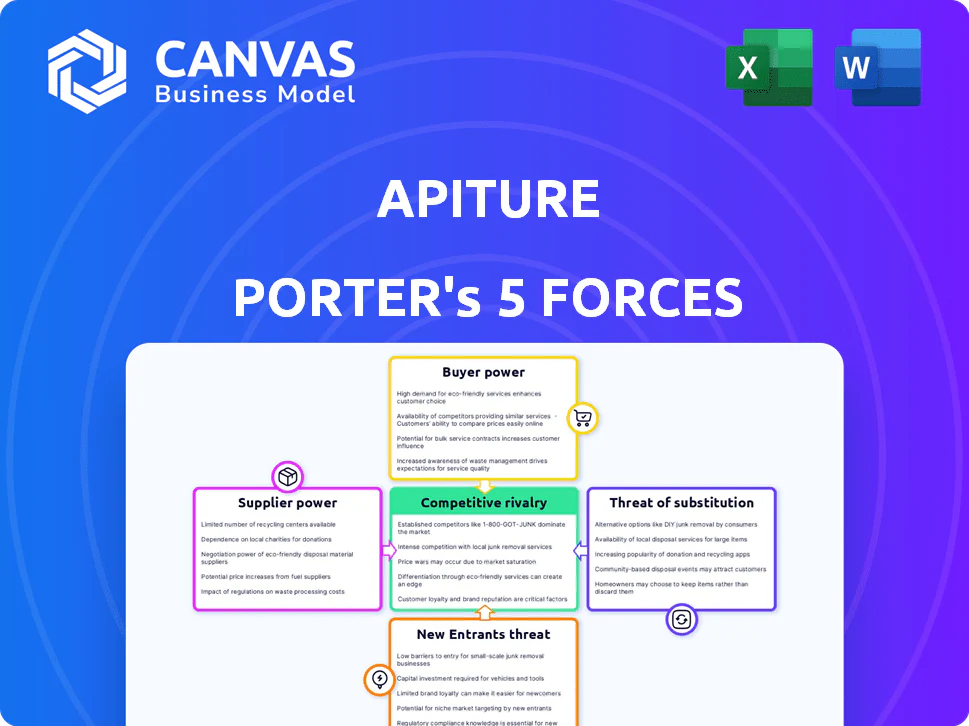
APITURE PORTER'S FIVE FORCES TEMPLATE RESEARCH
What is included in the product
 Detailed Word Document
Tailored exclusively for Apiture, analyzing its position within its competitive landscape.

 Customizable Excel Spreadsheet
Gain actionable insights with Porter's Five Forces, visualized with a shareable spider chart.
Preview the Actual Deliverable
Apiture Porter's Five Forces Analysis
This preview showcases the complete Porter's Five Forces analysis of Apiture. You are seeing the exact, ready-to-use document that will be immediately available for download after your purchase. The analysis is fully formatted and professionally written. No additional work is required, and the content is identical.

Porter's Five Forces Analysis Template

From Overview to Strategy Blueprint
Apiture's competitive landscape is shaped by crucial forces. Supplier power, buyer power, and the threat of new entrants are significant. The intensity of rivalry and the threat of substitutes also play key roles. These forces influence Apiture's profitability and strategic positioning.
Ready to move beyond the basics? Get a full strategic breakdown of Apiture’s market position, competitive intensity, and external threats—all in one powerful analysis.
Suppliers Bargaining Power

Technology Providers
Apiture's digital banking platform depends on tech suppliers, including core banking and cloud services. This concentration can give these suppliers significant bargaining power. However, Apiture's API-first approach and cloud transition offer flexibility. In 2024, cloud infrastructure spending reached $670 billion globally, highlighting supplier influence. This shift enables integration with various fintech partners, mitigating supplier power.
Data and Information Providers
Data providers hold significant power, especially in digital banking. Apiture relies on them for vital data intelligence and personalized services. The strength of these suppliers hinges on data access and regulatory frameworks like Open Banking. In 2024, the global market for financial data services was valued at approximately $30 billion, showing their market influence.

Fintech Partners
Apiture's reliance on numerous fintech partners for services like peer-to-peer payments affects supplier bargaining power. With many providers, no single partner can heavily influence pricing or terms. This structure, as of late 2024, helps Apiture maintain a strong negotiating position. For example, the digital payments market, valued at $7.6 trillion in 2023, offers many potential partners. This diversity reduces the risk of dependence on a single supplier.

Labor Market
The labor market significantly influences Apiture's supplier power. A scarcity of skilled software developers, cybersecurity experts, and fintech professionals can increase employee bargaining power. This results in higher salary demands and potentially less favorable terms. Competition for talent remains fierce, with the tech industry seeing a 4.8% increase in average salaries in 2024.
- Demand for tech talent remains high.
- Wage inflation is a concern.
- Employee bargaining power is rising.
- The market is competitive.
Financial Institutions' Internal Systems
Apiture's integration with financial institutions' core banking systems is a key factor in assessing supplier bargaining power. These systems are often complex and proprietary. According to a 2024 report, the average cost to replace a core banking system can range from $10 million to $50 million, highlighting the stakes involved.
This complexity can lead to vendor lock-in, where financial institutions become heavily reliant on a single supplier. Such lock-in may limit their options and increase costs. In 2024, about 30% of financial institutions reported experiencing vendor lock-in issues.
Financial institutions may leverage this to negotiate favorable terms during implementation and integration, such as pricing and service level agreements. The power dynamic depends on the specific institution and the vendor's market position.
- High integration costs.
- Vendor lock-in issues.
- Negotiating favorable terms.
Tech Suppliers' Grip on Digital Banking
Suppliers of digital banking tech, including cloud and data providers, wield substantial influence over Apiture. This power is amplified by the high costs of switching core banking systems, which can range from $10 million to $50 million, as of 2024.
The labor market dynamics, especially the demand for skilled tech professionals, further impact supplier bargaining power. Wage inflation, with an average tech salary increase of 4.8% in 2024, and talent scarcity increase supplier leverage.
However, Apiture's API-first approach and partnerships with numerous fintech providers, in a digital payments market valued at $7.6 trillion in 2023, help mitigate supplier dominance.
| Supplier Type | Impact on Apiture | 2024 Data |
|---|---|---|
| Cloud Services | High integration costs, potential vendor lock-in | $670B global cloud infrastructure spending |
| Data Providers | Essential for data intelligence and services | $30B financial data services market |
| Fintech Partners | Mitigates supplier power through diversity | $7.6T digital payments market (2023) |
Customers Bargaining Power

Community Banks and Credit Unions
Apiture's main clients, community banks and credit unions, have considerable bargaining power. They can choose from many digital banking platforms, making it easy to switch providers. In 2024, these institutions face pressure to offer strong digital services to compete, as over 60% of Americans use digital banking monthly, according to recent surveys. This need elevates their influence in negotiations.
End Users (Bank and Credit Union Customers)
End users, like bank customers, don't directly buy from Apiture, but their needs shape its offerings. Their demand for easy-to-use digital banking services affects financial institutions, thus impacting Apiture. Banks and credit unions are investing heavily, with digital banking tech spending projected to reach $37.5 billion in 2024. This pushes Apiture to offer competitive, innovative solutions.

Switching Costs
Switching costs significantly influence customer bargaining power in the digital banking landscape. The complexity and expense of migrating to a new platform can lock in customers, reducing their ability to negotiate better terms. High switching costs, such as those associated with data migration and employee retraining, diminish customer leverage. Conversely, lower switching costs, perhaps due to cloud-based solutions, empower customers, allowing them to easily move to competitors offering better deals. In 2024, the average cost for a financial institution to switch core banking systems ranged from $5 million to $10 million, highlighting the financial impact of these decisions.

Concentration of Customers
Apiture's customer concentration influences its bargaining power. Serving many financial institutions helps, but losing a major client could significantly impact revenue. For example, in 2024, a single top-tier bank accounted for up to 12% of a fintech company's total revenue, highlighting the vulnerability.
Larger customers may negotiate better pricing or demand more services. This dynamic can pressure Apiture's profitability, especially if they depend on fewer key accounts. Consider that the top 5 clients often generate over 40% of a software firm's income.
This scenario increases the bargaining power of big customers. Smaller clients may have less leverage, but the loss of even one substantial customer could create financial instability. This emphasizes the need for Apiture to diversify its client base.
- Customer concentration can significantly impact a company's financial stability.
- Large clients often possess greater negotiation power.
- Diversification of the customer base is crucial for mitigating risks.
- Revenue from top clients can represent a substantial portion of overall income.
Customer Expectations and Digital Adoption
The growing demand for top-notch digital banking experiences from both retail and business clients puts pressure on Apiture's customers. This shift boosts the bargaining power of financial institutions, expecting advanced services. Increased expectations mean Apiture's clients must meet higher standards. This impacts their ability to negotiate terms and pricing.
- Over 60% of customers prefer digital banking.
- Digital banking users increased by 15% in 2024.
- Banks invest heavily in digital, with spending up by 10% in 2024.
- Customer satisfaction with digital banking is at 80%.
Digital Banking's Bargaining Battleground: $37.5B at Stake!
Apiture's clients, community banks and credit unions, wield substantial bargaining power due to the availability of many digital banking platforms. The need for these institutions to offer strong digital services to stay competitive further elevates their influence in negotiations. Digital banking tech spending is projected to reach $37.5 billion in 2024, increasing pressure.
| Factor | Impact | 2024 Data |
|---|---|---|
| Customer Base | Concentration Risk | Top 5 clients generate over 40% of revenue |
| Switching Costs | Influence on Negotiation | Average switching cost: $5M-$10M |
| Digital Demand | Increased Pressure | Digital banking users increased by 15% |
Rivalry Among Competitors

Other Digital Banking Platform Providers
Apiture faces intense competition from digital banking solution providers. Key rivals include Alkami Technology, Finacle, Lumin Digital, and Q2. In 2024, the digital banking market is valued at billions, with Alkami's revenue exceeding $250 million. These firms constantly innovate, making the market dynamic.
In-house Development by Financial Institutions
Some major financial institutions opt for in-house digital banking solutions, intensifying competition for providers such as Apiture. This rivalry is most pronounced with institutions possessing substantial resources and technological expertise. For example, in 2024, JPMorgan Chase spent over $14 billion on technology, which includes in-house development. This internal approach can reduce reliance on external vendors, affecting market share dynamics.

Fintech Companies Offering Specific Solutions
Fintechs specializing in digital banking, like Stripe and Adyen, pose a competitive threat to Apiture. These firms provide specific services such as payment processing and data analytics. In 2024, the global fintech market was valued at over $150 billion, signaling substantial competition. The rise of these specialized firms could erode Apiture's market share in targeted areas.

Large Technology Companies
Large technology companies pose a significant competitive threat to financial services, intensifying rivalry. These tech giants are expanding into financial services, providing digital products that compete with traditional banking. Their vast resources, user bases, and technological capabilities give them a considerable edge. For instance, in 2024, tech companies like Apple and Google have significantly increased their financial services offerings, impacting market dynamics.
- Apple Pay processed $6.1 trillion in transactions globally in 2024.
- Google Pay had over 150 million active users in 2024.
- Amazon has been expanding its financial services, including lending and payment solutions.
- These companies' combined market capitalization exceeds the GDP of many nations, providing them with immense financial flexibility.
Pace of Technological Change
The digital banking landscape is rapidly evolving, intensifying competitive rivalry. Apiture faces pressure to innovate and adapt to customer demands. According to a 2024 report, the FinTech market is expected to reach $305 billion. Competitors constantly introduce new features, and customer expectations are ever-changing.
- FinTech market projected to reach $305 billion in 2024.
- Constant innovation is key for staying competitive.
- Customer expectations are a driving force in the market.
- Apiture must continuously update its offerings.
FinTech Rivals: A $305 Billion Battleground
Apiture's competition is fierce, with rivals like Alkami and Finacle pushing innovation. In 2024, Alkami's revenue topped $250 million, reflecting the market's intensity. Tech giants and fintechs, such as Apple and Stripe, further challenge Apiture's market position. Constant adaptation is key in this dynamic landscape.
| Aspect | Details |
|---|---|
| Market Size | FinTech market projected to reach $305 billion in 2024 |
| Key Players | Alkami, Finacle, Apple, Google, Stripe, Adyen |
| Tech Spending | JPMorgan Chase spent over $14B on tech in 2024 |
Original: $10.00
-65%$10.00
$3.50APITURE PORTER'S FIVE FORCES TEMPLATE RESEARCH
What is included in the product
Detailed Word Document
Tailored exclusively for Apiture, analyzing its position within its competitive landscape.
Customizable Excel Spreadsheet
Gain actionable insights with Porter's Five Forces, visualized with a shareable spider chart.
Preview the Actual Deliverable
Apiture Porter's Five Forces Analysis
This preview showcases the complete Porter's Five Forces analysis of Apiture. You are seeing the exact, ready-to-use document that will be immediately available for download after your purchase. The analysis is fully formatted and professionally written. No additional work is required, and the content is identical.
Porter's Five Forces Analysis Template
From Overview to Strategy Blueprint
Apiture's competitive landscape is shaped by crucial forces. Supplier power, buyer power, and the threat of new entrants are significant. The intensity of rivalry and the threat of substitutes also play key roles. These forces influence Apiture's profitability and strategic positioning.
Ready to move beyond the basics? Get a full strategic breakdown of Apiture’s market position, competitive intensity, and external threats—all in one powerful analysis.
Suppliers Bargaining Power
Technology Providers
Apiture's digital banking platform depends on tech suppliers, including core banking and cloud services. This concentration can give these suppliers significant bargaining power. However, Apiture's API-first approach and cloud transition offer flexibility. In 2024, cloud infrastructure spending reached $670 billion globally, highlighting supplier influence. This shift enables integration with various fintech partners, mitigating supplier power.
Data and Information Providers
Data providers hold significant power, especially in digital banking. Apiture relies on them for vital data intelligence and personalized services. The strength of these suppliers hinges on data access and regulatory frameworks like Open Banking. In 2024, the global market for financial data services was valued at approximately $30 billion, showing their market influence.
Fintech Partners
Apiture's reliance on numerous fintech partners for services like peer-to-peer payments affects supplier bargaining power. With many providers, no single partner can heavily influence pricing or terms. This structure, as of late 2024, helps Apiture maintain a strong negotiating position. For example, the digital payments market, valued at $7.6 trillion in 2023, offers many potential partners. This diversity reduces the risk of dependence on a single supplier.
Labor Market
The labor market significantly influences Apiture's supplier power. A scarcity of skilled software developers, cybersecurity experts, and fintech professionals can increase employee bargaining power. This results in higher salary demands and potentially less favorable terms. Competition for talent remains fierce, with the tech industry seeing a 4.8% increase in average salaries in 2024.
- Demand for tech talent remains high.
- Wage inflation is a concern.
- Employee bargaining power is rising.
- The market is competitive.
Financial Institutions' Internal Systems
Apiture's integration with financial institutions' core banking systems is a key factor in assessing supplier bargaining power. These systems are often complex and proprietary. According to a 2024 report, the average cost to replace a core banking system can range from $10 million to $50 million, highlighting the stakes involved.
This complexity can lead to vendor lock-in, where financial institutions become heavily reliant on a single supplier. Such lock-in may limit their options and increase costs. In 2024, about 30% of financial institutions reported experiencing vendor lock-in issues.
Financial institutions may leverage this to negotiate favorable terms during implementation and integration, such as pricing and service level agreements. The power dynamic depends on the specific institution and the vendor's market position.
- High integration costs.
- Vendor lock-in issues.
- Negotiating favorable terms.
Tech Suppliers' Grip on Digital Banking
Suppliers of digital banking tech, including cloud and data providers, wield substantial influence over Apiture. This power is amplified by the high costs of switching core banking systems, which can range from $10 million to $50 million, as of 2024.
The labor market dynamics, especially the demand for skilled tech professionals, further impact supplier bargaining power. Wage inflation, with an average tech salary increase of 4.8% in 2024, and talent scarcity increase supplier leverage.
However, Apiture's API-first approach and partnerships with numerous fintech providers, in a digital payments market valued at $7.6 trillion in 2023, help mitigate supplier dominance.
| Supplier Type | Impact on Apiture | 2024 Data |
|---|---|---|
| Cloud Services | High integration costs, potential vendor lock-in | $670B global cloud infrastructure spending |
| Data Providers | Essential for data intelligence and services | $30B financial data services market |
| Fintech Partners | Mitigates supplier power through diversity | $7.6T digital payments market (2023) |
Customers Bargaining Power
Community Banks and Credit Unions
Apiture's main clients, community banks and credit unions, have considerable bargaining power. They can choose from many digital banking platforms, making it easy to switch providers. In 2024, these institutions face pressure to offer strong digital services to compete, as over 60% of Americans use digital banking monthly, according to recent surveys. This need elevates their influence in negotiations.
End Users (Bank and Credit Union Customers)
End users, like bank customers, don't directly buy from Apiture, but their needs shape its offerings. Their demand for easy-to-use digital banking services affects financial institutions, thus impacting Apiture. Banks and credit unions are investing heavily, with digital banking tech spending projected to reach $37.5 billion in 2024. This pushes Apiture to offer competitive, innovative solutions.
Switching Costs
Switching costs significantly influence customer bargaining power in the digital banking landscape. The complexity and expense of migrating to a new platform can lock in customers, reducing their ability to negotiate better terms. High switching costs, such as those associated with data migration and employee retraining, diminish customer leverage. Conversely, lower switching costs, perhaps due to cloud-based solutions, empower customers, allowing them to easily move to competitors offering better deals. In 2024, the average cost for a financial institution to switch core banking systems ranged from $5 million to $10 million, highlighting the financial impact of these decisions.
Concentration of Customers
Apiture's customer concentration influences its bargaining power. Serving many financial institutions helps, but losing a major client could significantly impact revenue. For example, in 2024, a single top-tier bank accounted for up to 12% of a fintech company's total revenue, highlighting the vulnerability.
Larger customers may negotiate better pricing or demand more services. This dynamic can pressure Apiture's profitability, especially if they depend on fewer key accounts. Consider that the top 5 clients often generate over 40% of a software firm's income.
This scenario increases the bargaining power of big customers. Smaller clients may have less leverage, but the loss of even one substantial customer could create financial instability. This emphasizes the need for Apiture to diversify its client base.
- Customer concentration can significantly impact a company's financial stability.
- Large clients often possess greater negotiation power.
- Diversification of the customer base is crucial for mitigating risks.
- Revenue from top clients can represent a substantial portion of overall income.
Customer Expectations and Digital Adoption
The growing demand for top-notch digital banking experiences from both retail and business clients puts pressure on Apiture's customers. This shift boosts the bargaining power of financial institutions, expecting advanced services. Increased expectations mean Apiture's clients must meet higher standards. This impacts their ability to negotiate terms and pricing.
- Over 60% of customers prefer digital banking.
- Digital banking users increased by 15% in 2024.
- Banks invest heavily in digital, with spending up by 10% in 2024.
- Customer satisfaction with digital banking is at 80%.
Digital Banking's Bargaining Battleground: $37.5B at Stake!
Apiture's clients, community banks and credit unions, wield substantial bargaining power due to the availability of many digital banking platforms. The need for these institutions to offer strong digital services to stay competitive further elevates their influence in negotiations. Digital banking tech spending is projected to reach $37.5 billion in 2024, increasing pressure.
| Factor | Impact | 2024 Data |
|---|---|---|
| Customer Base | Concentration Risk | Top 5 clients generate over 40% of revenue |
| Switching Costs | Influence on Negotiation | Average switching cost: $5M-$10M |
| Digital Demand | Increased Pressure | Digital banking users increased by 15% |
Rivalry Among Competitors
Other Digital Banking Platform Providers
Apiture faces intense competition from digital banking solution providers. Key rivals include Alkami Technology, Finacle, Lumin Digital, and Q2. In 2024, the digital banking market is valued at billions, with Alkami's revenue exceeding $250 million. These firms constantly innovate, making the market dynamic.
In-house Development by Financial Institutions
Some major financial institutions opt for in-house digital banking solutions, intensifying competition for providers such as Apiture. This rivalry is most pronounced with institutions possessing substantial resources and technological expertise. For example, in 2024, JPMorgan Chase spent over $14 billion on technology, which includes in-house development. This internal approach can reduce reliance on external vendors, affecting market share dynamics.
Fintech Companies Offering Specific Solutions
Fintechs specializing in digital banking, like Stripe and Adyen, pose a competitive threat to Apiture. These firms provide specific services such as payment processing and data analytics. In 2024, the global fintech market was valued at over $150 billion, signaling substantial competition. The rise of these specialized firms could erode Apiture's market share in targeted areas.
Large Technology Companies
Large technology companies pose a significant competitive threat to financial services, intensifying rivalry. These tech giants are expanding into financial services, providing digital products that compete with traditional banking. Their vast resources, user bases, and technological capabilities give them a considerable edge. For instance, in 2024, tech companies like Apple and Google have significantly increased their financial services offerings, impacting market dynamics.
- Apple Pay processed $6.1 trillion in transactions globally in 2024.
- Google Pay had over 150 million active users in 2024.
- Amazon has been expanding its financial services, including lending and payment solutions.
- These companies' combined market capitalization exceeds the GDP of many nations, providing them with immense financial flexibility.
Pace of Technological Change
The digital banking landscape is rapidly evolving, intensifying competitive rivalry. Apiture faces pressure to innovate and adapt to customer demands. According to a 2024 report, the FinTech market is expected to reach $305 billion. Competitors constantly introduce new features, and customer expectations are ever-changing.
- FinTech market projected to reach $305 billion in 2024.
- Constant innovation is key for staying competitive.
- Customer expectations are a driving force in the market.
- Apiture must continuously update its offerings.
FinTech Rivals: A $305 Billion Battleground
Apiture's competition is fierce, with rivals like Alkami and Finacle pushing innovation. In 2024, Alkami's revenue topped $250 million, reflecting the market's intensity. Tech giants and fintechs, such as Apple and Stripe, further challenge Apiture's market position. Constant adaptation is key in this dynamic landscape.
| Aspect | Details |
|---|---|
| Market Size | FinTech market projected to reach $305 billion in 2024 |
| Key Players | Alkami, Finacle, Apple, Google, Stripe, Adyen |
| Tech Spending | JPMorgan Chase spent over $14B on tech in 2024 |
Product Information
Product Information
Shipping & Returns
Shipping & Returns
Description
What is included in the product
Detailed Word Document
Tailored exclusively for Apiture, analyzing its position within its competitive landscape.
Customizable Excel Spreadsheet
Gain actionable insights with Porter's Five Forces, visualized with a shareable spider chart.
Preview the Actual Deliverable
Apiture Porter's Five Forces Analysis
This preview showcases the complete Porter's Five Forces analysis of Apiture. You are seeing the exact, ready-to-use document that will be immediately available for download after your purchase. The analysis is fully formatted and professionally written. No additional work is required, and the content is identical.
Porter's Five Forces Analysis Template
From Overview to Strategy Blueprint
Apiture's competitive landscape is shaped by crucial forces. Supplier power, buyer power, and the threat of new entrants are significant. The intensity of rivalry and the threat of substitutes also play key roles. These forces influence Apiture's profitability and strategic positioning.
Ready to move beyond the basics? Get a full strategic breakdown of Apiture’s market position, competitive intensity, and external threats—all in one powerful analysis.
Suppliers Bargaining Power
Technology Providers
Apiture's digital banking platform depends on tech suppliers, including core banking and cloud services. This concentration can give these suppliers significant bargaining power. However, Apiture's API-first approach and cloud transition offer flexibility. In 2024, cloud infrastructure spending reached $670 billion globally, highlighting supplier influence. This shift enables integration with various fintech partners, mitigating supplier power.
Data and Information Providers
Data providers hold significant power, especially in digital banking. Apiture relies on them for vital data intelligence and personalized services. The strength of these suppliers hinges on data access and regulatory frameworks like Open Banking. In 2024, the global market for financial data services was valued at approximately $30 billion, showing their market influence.
Fintech Partners
Apiture's reliance on numerous fintech partners for services like peer-to-peer payments affects supplier bargaining power. With many providers, no single partner can heavily influence pricing or terms. This structure, as of late 2024, helps Apiture maintain a strong negotiating position. For example, the digital payments market, valued at $7.6 trillion in 2023, offers many potential partners. This diversity reduces the risk of dependence on a single supplier.
Labor Market
The labor market significantly influences Apiture's supplier power. A scarcity of skilled software developers, cybersecurity experts, and fintech professionals can increase employee bargaining power. This results in higher salary demands and potentially less favorable terms. Competition for talent remains fierce, with the tech industry seeing a 4.8% increase in average salaries in 2024.
- Demand for tech talent remains high.
- Wage inflation is a concern.
- Employee bargaining power is rising.
- The market is competitive.
Financial Institutions' Internal Systems
Apiture's integration with financial institutions' core banking systems is a key factor in assessing supplier bargaining power. These systems are often complex and proprietary. According to a 2024 report, the average cost to replace a core banking system can range from $10 million to $50 million, highlighting the stakes involved.
This complexity can lead to vendor lock-in, where financial institutions become heavily reliant on a single supplier. Such lock-in may limit their options and increase costs. In 2024, about 30% of financial institutions reported experiencing vendor lock-in issues.
Financial institutions may leverage this to negotiate favorable terms during implementation and integration, such as pricing and service level agreements. The power dynamic depends on the specific institution and the vendor's market position.
- High integration costs.
- Vendor lock-in issues.
- Negotiating favorable terms.
Tech Suppliers' Grip on Digital Banking
Suppliers of digital banking tech, including cloud and data providers, wield substantial influence over Apiture. This power is amplified by the high costs of switching core banking systems, which can range from $10 million to $50 million, as of 2024.
The labor market dynamics, especially the demand for skilled tech professionals, further impact supplier bargaining power. Wage inflation, with an average tech salary increase of 4.8% in 2024, and talent scarcity increase supplier leverage.
However, Apiture's API-first approach and partnerships with numerous fintech providers, in a digital payments market valued at $7.6 trillion in 2023, help mitigate supplier dominance.
| Supplier Type | Impact on Apiture | 2024 Data |
|---|---|---|
| Cloud Services | High integration costs, potential vendor lock-in | $670B global cloud infrastructure spending |
| Data Providers | Essential for data intelligence and services | $30B financial data services market |
| Fintech Partners | Mitigates supplier power through diversity | $7.6T digital payments market (2023) |
Customers Bargaining Power
Community Banks and Credit Unions
Apiture's main clients, community banks and credit unions, have considerable bargaining power. They can choose from many digital banking platforms, making it easy to switch providers. In 2024, these institutions face pressure to offer strong digital services to compete, as over 60% of Americans use digital banking monthly, according to recent surveys. This need elevates their influence in negotiations.
End Users (Bank and Credit Union Customers)
End users, like bank customers, don't directly buy from Apiture, but their needs shape its offerings. Their demand for easy-to-use digital banking services affects financial institutions, thus impacting Apiture. Banks and credit unions are investing heavily, with digital banking tech spending projected to reach $37.5 billion in 2024. This pushes Apiture to offer competitive, innovative solutions.
Switching Costs
Switching costs significantly influence customer bargaining power in the digital banking landscape. The complexity and expense of migrating to a new platform can lock in customers, reducing their ability to negotiate better terms. High switching costs, such as those associated with data migration and employee retraining, diminish customer leverage. Conversely, lower switching costs, perhaps due to cloud-based solutions, empower customers, allowing them to easily move to competitors offering better deals. In 2024, the average cost for a financial institution to switch core banking systems ranged from $5 million to $10 million, highlighting the financial impact of these decisions.
Concentration of Customers
Apiture's customer concentration influences its bargaining power. Serving many financial institutions helps, but losing a major client could significantly impact revenue. For example, in 2024, a single top-tier bank accounted for up to 12% of a fintech company's total revenue, highlighting the vulnerability.
Larger customers may negotiate better pricing or demand more services. This dynamic can pressure Apiture's profitability, especially if they depend on fewer key accounts. Consider that the top 5 clients often generate over 40% of a software firm's income.
This scenario increases the bargaining power of big customers. Smaller clients may have less leverage, but the loss of even one substantial customer could create financial instability. This emphasizes the need for Apiture to diversify its client base.
- Customer concentration can significantly impact a company's financial stability.
- Large clients often possess greater negotiation power.
- Diversification of the customer base is crucial for mitigating risks.
- Revenue from top clients can represent a substantial portion of overall income.
Customer Expectations and Digital Adoption
The growing demand for top-notch digital banking experiences from both retail and business clients puts pressure on Apiture's customers. This shift boosts the bargaining power of financial institutions, expecting advanced services. Increased expectations mean Apiture's clients must meet higher standards. This impacts their ability to negotiate terms and pricing.
- Over 60% of customers prefer digital banking.
- Digital banking users increased by 15% in 2024.
- Banks invest heavily in digital, with spending up by 10% in 2024.
- Customer satisfaction with digital banking is at 80%.
Digital Banking's Bargaining Battleground: $37.5B at Stake!
Apiture's clients, community banks and credit unions, wield substantial bargaining power due to the availability of many digital banking platforms. The need for these institutions to offer strong digital services to stay competitive further elevates their influence in negotiations. Digital banking tech spending is projected to reach $37.5 billion in 2024, increasing pressure.
| Factor | Impact | 2024 Data |
|---|---|---|
| Customer Base | Concentration Risk | Top 5 clients generate over 40% of revenue |
| Switching Costs | Influence on Negotiation | Average switching cost: $5M-$10M |
| Digital Demand | Increased Pressure | Digital banking users increased by 15% |
Rivalry Among Competitors
Other Digital Banking Platform Providers
Apiture faces intense competition from digital banking solution providers. Key rivals include Alkami Technology, Finacle, Lumin Digital, and Q2. In 2024, the digital banking market is valued at billions, with Alkami's revenue exceeding $250 million. These firms constantly innovate, making the market dynamic.
In-house Development by Financial Institutions
Some major financial institutions opt for in-house digital banking solutions, intensifying competition for providers such as Apiture. This rivalry is most pronounced with institutions possessing substantial resources and technological expertise. For example, in 2024, JPMorgan Chase spent over $14 billion on technology, which includes in-house development. This internal approach can reduce reliance on external vendors, affecting market share dynamics.
Fintech Companies Offering Specific Solutions
Fintechs specializing in digital banking, like Stripe and Adyen, pose a competitive threat to Apiture. These firms provide specific services such as payment processing and data analytics. In 2024, the global fintech market was valued at over $150 billion, signaling substantial competition. The rise of these specialized firms could erode Apiture's market share in targeted areas.
Large Technology Companies
Large technology companies pose a significant competitive threat to financial services, intensifying rivalry. These tech giants are expanding into financial services, providing digital products that compete with traditional banking. Their vast resources, user bases, and technological capabilities give them a considerable edge. For instance, in 2024, tech companies like Apple and Google have significantly increased their financial services offerings, impacting market dynamics.
- Apple Pay processed $6.1 trillion in transactions globally in 2024.
- Google Pay had over 150 million active users in 2024.
- Amazon has been expanding its financial services, including lending and payment solutions.
- These companies' combined market capitalization exceeds the GDP of many nations, providing them with immense financial flexibility.
Pace of Technological Change
The digital banking landscape is rapidly evolving, intensifying competitive rivalry. Apiture faces pressure to innovate and adapt to customer demands. According to a 2024 report, the FinTech market is expected to reach $305 billion. Competitors constantly introduce new features, and customer expectations are ever-changing.
- FinTech market projected to reach $305 billion in 2024.
- Constant innovation is key for staying competitive.
- Customer expectations are a driving force in the market.
- Apiture must continuously update its offerings.
FinTech Rivals: A $305 Billion Battleground
Apiture's competition is fierce, with rivals like Alkami and Finacle pushing innovation. In 2024, Alkami's revenue topped $250 million, reflecting the market's intensity. Tech giants and fintechs, such as Apple and Stripe, further challenge Apiture's market position. Constant adaptation is key in this dynamic landscape.
| Aspect | Details |
|---|---|
| Market Size | FinTech market projected to reach $305 billion in 2024 |
| Key Players | Alkami, Finacle, Apple, Google, Stripe, Adyen |
| Tech Spending | JPMorgan Chase spent over $14B on tech in 2024 |











