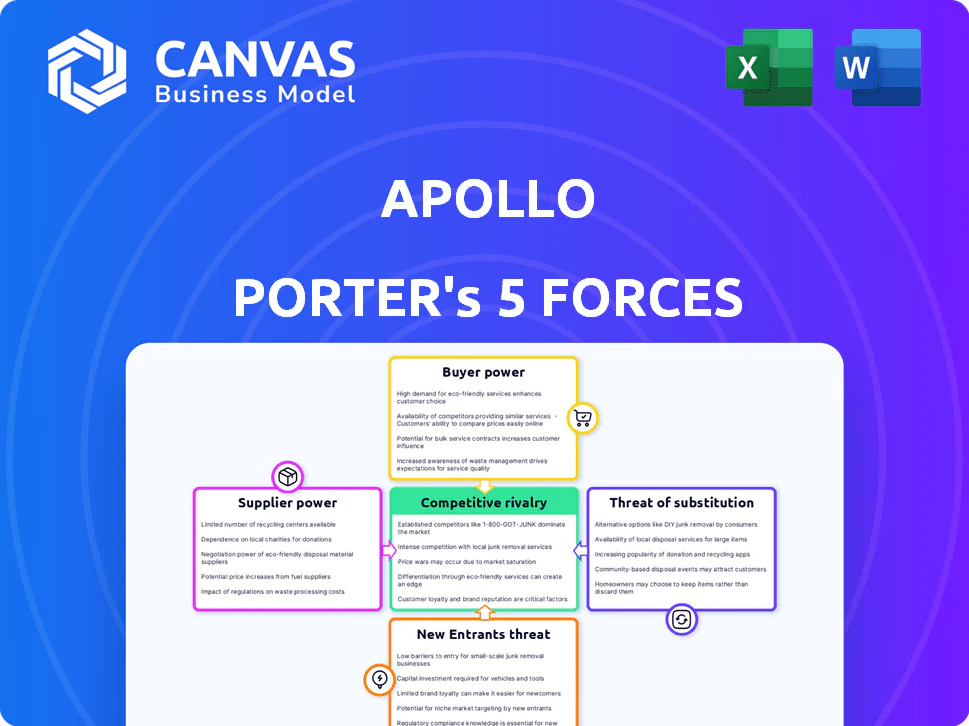
APOLLO PORTER'S FIVE FORCES TEMPLATE RESEARCH

Go Beyond the Preview-Access the Full Strategic Report
Apollo faces strong competitive rivalry, moderate supplier leverage, and evolving buyer power as private capital dynamics shift; threats from new entrants and substitutes hinge on regulatory shifts and tech-enabled alternatives. This brief snapshot only scratches the surface. Unlock the full Porter's Five Forces Analysis to explore Apollo's competitive dynamics, market pressures, and strategic advantages in detail.
Suppliers Bargaining Power

Concentrated Institutional Capital Base
Large limited partners-sovereign wealth funds and mega pension plans-wield high bargaining power over Apollo in fundraising, committing concentrated capital (top 20 LPs often provide >50% of a fund).
They push for fee cuts and side‑letters; in 2025 some SWFs secured fee discounts of 100-200 bps and bespoke governance terms.
By 2026 these anchors are narrowing managers to a few top-tier firms, raising Apollo's cost of capital and forcing tougher deal terms.
The War for Specialized Investment Talent
The supply of elite credit and distressed-debt pros is tight; Apollo Global Management reported $1.6B of compensation expense in FY2025, reflecting war-for-talent costs as top dealmakers demand larger carried interest splits (often 20-30%) and $1-5M+ in base pay for senior hires.

Proprietary Insurance Float via Athene
Apollo's supplier power is strengthened by Athene providing proprietary insurance float-Athene held $195 billion of invested assets and generated $7.4 billion of net investment income in FY2025, supplying stable, long-term capital that cuts Apollo's need for external fundraising.

Technological and Data Infrastructure Providers
As Apollo shifts to AI underwriting and real-time risk, dependency on specialized vendors of alternative data and HPC (high-performance computing) rises, giving suppliers moderate pricing power driven by integration complexity and client-specific models.
In 2025 Apollo spends an estimated $220-$300m on external tech and data; surveys show 62% of asset managers cite high switching costs for core data platforms, raising vulnerability to vendor price hikes.
- AI/data vendors supply proprietary signals; lock-in risk
- HPC/cloud spend ~$220-$300m for 2025
- 62% of peers report high switching costs
- Price hikes can raise underwriting costs and lower margins
Investment Banking Syndication and Deal Flow
Apollo Global Management leads in direct origination but still depends on global investment banks for exit liquidity and niche deal referrals; in 2025 banks underwrote roughly $1.2T in global equity issuance and advised on $3.8T of M&A, preserving gatekeeper power.
Banks remain preferred partners due to Apollo's scale-$570B AUM in 2025-yet they keep leverage via IPO pipelines, syndication control, and specialist sector desks that influence pricing and timing.
- Investment banks underwrote ~$1.2T equity (2025)
- Advised on ~$3.8T M&A (2025)
- Apollo AUM $570B (2025)
- Banks control IPO pipelines, syndication, exit timing
Fund LPs force fee cuts as talent, tech and bank-deal flow reshape exits
Suppliers exert mixed power: top LPs (top 20 often >50% fund) push fee cuts (2025 discounts 100-200bps), talent costs rose-Apollo FY2025 comp $1.6B-and Athene provided $195B assets/ $7.4B net income, lowering external fundraising; 2025 tech/data spend ~$220-$300M; banks underwrote ~$1.2T equity and advised ~$3.8T M&A, keeping exit leverage.
| Item | 2025 Value |
|---|---|
| Apollo comp expense | $1.6B |
| Athene invested assets | $195B |
| Athene net investment income | $7.4B |
| Tech/data spend | $220-$300M |
| Equity underwritten (banks) | $1.2T |
| M&A advised (banks) | $3.8T |
What is included in the product
 Detailed Word Document
Tailored for Apollo, this Porter's Five Forces analysis uncovers competitive drivers, supplier/buyer power, entry barriers, substitutes, and emerging disruptors-with data-backed insight to inform strategy and investor materials.

 Customizable Excel Spreadsheet
Instantly diagnose competitive pain points with a one-sheet Porter's Five Forces snapshot-customizable pressure sliders and a radar chart make strategy decisions fast and board-ready.
Customers Bargaining Power

Institutional Fee Sensitivity and Transparency
Institutional clients like endowments and foundations are highly fee-sensitive in 2026, with 72% negotiating 'most favored nation' clauses per a 2025 ICI survey; they demand greater transparency on asset valuations and stress-test fees against returns.
Their collective scale-Apollo Global Management manages $568 billion in AUM (2025)-gives them leverage to cap management fees, pressuring Apollo to hold fees steady.
Meanwhile, Apollo's compliance and reporting costs rose ~14% in 2025, shrinking fee-margin upside and tightening pricing power.
Growth of the Fragmented Retail Wealth Channel
Apollo Global Management is pushing into fragmented retail wealth channels-via platforms like iCapital and aftermarket products-targeting ~1.2 million HNW accounts and raising retail AUM to $85 billion in FY2025, where individual customers hold far less bargaining power than institutions, letting Apollo preserve 800-1200 bps higher margins on retail-focused funds.

Corporate Borrowers in Private Credit
Corporate borrowers in private credit now choose among Apollo Global Management, Blackstone, and Ares, cutting Apollo's pricing power; 2025 data show non-bank market share rose to ~40% of US leveraged loans, and top-tier borrowers secured covenant-lite deals at average spreads ~120bps below middle-market levels, pressuring Apollo's credit returns.

Demand for Bespoke Separately Managed Accounts
Large institutional clients shifted $120bn into Separately Managed Accounts (SMAs) in 2025, preferring custom mandates over commingled funds, reducing Apollo's pricing power.
SMAs let clients set ESG screens, tax rules, and bespoke reporting, forcing Apollo to deliver outsourced portfolio services rather than one-size-fits-all management.
As clients demand tailored transparency and control, Apollo faces margin pressure and higher servicing costs to retain mandates.
- 2025 SMA inflows: $120bn
- Clients set ESG, tax, reporting
- Apollo shifts to service-provider role
- Higher servicing costs, lower pricing power
The Threat of Capital Redemption
In 2025, high rates and volatility give investors strong exit power; Apollo Global Management faces rapid capital redemption if returns lag peers-BlackRock and KKR raised net inflows while Apollo saw net outflows in specific credit funds in 2024-25, intensifying investor bargaining leverage.
- 2025 trend: investors favor managers with 8%+ net IRR
- Apollo's lag vs. peers can trigger redemptions within 12-18 months
- Wide manager pool: thousands of alternative funds available
Apollo under institutional pressure: MFNs, SMA costs and squeezed loan margins
Institutional clients wield strong fee and disclosure leverage-72% demand MFN clauses (2025); Apollo's $568B AUM and $85B retail AUM split shift pricing power to institutions; $120B SMA inflows (2025) raise servicing costs; non-bank lenders hold ~40% US leveraged loan share, compressing credit spreads and Apollo's margins.
| Metric | 2025 |
|---|---|
| AUM | $568B |
| Retail AUM | $85B |
| SMA inflows | $120B |
| Non-bank loan share | ~40% |
| MFN demand | 72% |
Preview Before You Purchase
Apollo Porter's Five Forces Analysis
This preview shows the exact Apollo Porter's Five Forces Analysis you'll receive upon purchase-no placeholders, no condensed samples; the full, professionally formatted document is ready for instant download and use.

APOLLO PORTER'S FIVE FORCES TEMPLATE RESEARCH
Go Beyond the Preview-Access the Full Strategic Report
Apollo faces strong competitive rivalry, moderate supplier leverage, and evolving buyer power as private capital dynamics shift; threats from new entrants and substitutes hinge on regulatory shifts and tech-enabled alternatives. This brief snapshot only scratches the surface. Unlock the full Porter's Five Forces Analysis to explore Apollo's competitive dynamics, market pressures, and strategic advantages in detail.
Suppliers Bargaining Power
Concentrated Institutional Capital Base
Large limited partners-sovereign wealth funds and mega pension plans-wield high bargaining power over Apollo in fundraising, committing concentrated capital (top 20 LPs often provide >50% of a fund).
They push for fee cuts and side‑letters; in 2025 some SWFs secured fee discounts of 100-200 bps and bespoke governance terms.
By 2026 these anchors are narrowing managers to a few top-tier firms, raising Apollo's cost of capital and forcing tougher deal terms.
The War for Specialized Investment Talent
The supply of elite credit and distressed-debt pros is tight; Apollo Global Management reported $1.6B of compensation expense in FY2025, reflecting war-for-talent costs as top dealmakers demand larger carried interest splits (often 20-30%) and $1-5M+ in base pay for senior hires.
Proprietary Insurance Float via Athene
Apollo's supplier power is strengthened by Athene providing proprietary insurance float-Athene held $195 billion of invested assets and generated $7.4 billion of net investment income in FY2025, supplying stable, long-term capital that cuts Apollo's need for external fundraising.
Technological and Data Infrastructure Providers
As Apollo shifts to AI underwriting and real-time risk, dependency on specialized vendors of alternative data and HPC (high-performance computing) rises, giving suppliers moderate pricing power driven by integration complexity and client-specific models.
In 2025 Apollo spends an estimated $220-$300m on external tech and data; surveys show 62% of asset managers cite high switching costs for core data platforms, raising vulnerability to vendor price hikes.
- AI/data vendors supply proprietary signals; lock-in risk
- HPC/cloud spend ~$220-$300m for 2025
- 62% of peers report high switching costs
- Price hikes can raise underwriting costs and lower margins
Investment Banking Syndication and Deal Flow
Apollo Global Management leads in direct origination but still depends on global investment banks for exit liquidity and niche deal referrals; in 2025 banks underwrote roughly $1.2T in global equity issuance and advised on $3.8T of M&A, preserving gatekeeper power.
Banks remain preferred partners due to Apollo's scale-$570B AUM in 2025-yet they keep leverage via IPO pipelines, syndication control, and specialist sector desks that influence pricing and timing.
- Investment banks underwrote ~$1.2T equity (2025)
- Advised on ~$3.8T M&A (2025)
- Apollo AUM $570B (2025)
- Banks control IPO pipelines, syndication, exit timing
Fund LPs force fee cuts as talent, tech and bank-deal flow reshape exits
Suppliers exert mixed power: top LPs (top 20 often >50% fund) push fee cuts (2025 discounts 100-200bps), talent costs rose-Apollo FY2025 comp $1.6B-and Athene provided $195B assets/ $7.4B net income, lowering external fundraising; 2025 tech/data spend ~$220-$300M; banks underwrote ~$1.2T equity and advised ~$3.8T M&A, keeping exit leverage.
| Item | 2025 Value |
|---|---|
| Apollo comp expense | $1.6B |
| Athene invested assets | $195B |
| Athene net investment income | $7.4B |
| Tech/data spend | $220-$300M |
| Equity underwritten (banks) | $1.2T |
| M&A advised (banks) | $3.8T |
What is included in the product
Detailed Word Document
Tailored for Apollo, this Porter's Five Forces analysis uncovers competitive drivers, supplier/buyer power, entry barriers, substitutes, and emerging disruptors-with data-backed insight to inform strategy and investor materials.
Customizable Excel Spreadsheet
Instantly diagnose competitive pain points with a one-sheet Porter's Five Forces snapshot-customizable pressure sliders and a radar chart make strategy decisions fast and board-ready.
Customers Bargaining Power
Institutional Fee Sensitivity and Transparency
Institutional clients like endowments and foundations are highly fee-sensitive in 2026, with 72% negotiating 'most favored nation' clauses per a 2025 ICI survey; they demand greater transparency on asset valuations and stress-test fees against returns.
Their collective scale-Apollo Global Management manages $568 billion in AUM (2025)-gives them leverage to cap management fees, pressuring Apollo to hold fees steady.
Meanwhile, Apollo's compliance and reporting costs rose ~14% in 2025, shrinking fee-margin upside and tightening pricing power.
Growth of the Fragmented Retail Wealth Channel
Apollo Global Management is pushing into fragmented retail wealth channels-via platforms like iCapital and aftermarket products-targeting ~1.2 million HNW accounts and raising retail AUM to $85 billion in FY2025, where individual customers hold far less bargaining power than institutions, letting Apollo preserve 800-1200 bps higher margins on retail-focused funds.
Corporate Borrowers in Private Credit
Corporate borrowers in private credit now choose among Apollo Global Management, Blackstone, and Ares, cutting Apollo's pricing power; 2025 data show non-bank market share rose to ~40% of US leveraged loans, and top-tier borrowers secured covenant-lite deals at average spreads ~120bps below middle-market levels, pressuring Apollo's credit returns.
Demand for Bespoke Separately Managed Accounts
Large institutional clients shifted $120bn into Separately Managed Accounts (SMAs) in 2025, preferring custom mandates over commingled funds, reducing Apollo's pricing power.
SMAs let clients set ESG screens, tax rules, and bespoke reporting, forcing Apollo to deliver outsourced portfolio services rather than one-size-fits-all management.
As clients demand tailored transparency and control, Apollo faces margin pressure and higher servicing costs to retain mandates.
- 2025 SMA inflows: $120bn
- Clients set ESG, tax, reporting
- Apollo shifts to service-provider role
- Higher servicing costs, lower pricing power
The Threat of Capital Redemption
In 2025, high rates and volatility give investors strong exit power; Apollo Global Management faces rapid capital redemption if returns lag peers-BlackRock and KKR raised net inflows while Apollo saw net outflows in specific credit funds in 2024-25, intensifying investor bargaining leverage.
- 2025 trend: investors favor managers with 8%+ net IRR
- Apollo's lag vs. peers can trigger redemptions within 12-18 months
- Wide manager pool: thousands of alternative funds available
Apollo under institutional pressure: MFNs, SMA costs and squeezed loan margins
Institutional clients wield strong fee and disclosure leverage-72% demand MFN clauses (2025); Apollo's $568B AUM and $85B retail AUM split shift pricing power to institutions; $120B SMA inflows (2025) raise servicing costs; non-bank lenders hold ~40% US leveraged loan share, compressing credit spreads and Apollo's margins.
| Metric | 2025 |
|---|---|
| AUM | $568B |
| Retail AUM | $85B |
| SMA inflows | $120B |
| Non-bank loan share | ~40% |
| MFN demand | 72% |
Preview Before You Purchase
Apollo Porter's Five Forces Analysis
This preview shows the exact Apollo Porter's Five Forces Analysis you'll receive upon purchase-no placeholders, no condensed samples; the full, professionally formatted document is ready for instant download and use.
Product Information
Product Information
Shipping & Returns
Shipping & Returns
Description
Go Beyond the Preview-Access the Full Strategic Report
Apollo faces strong competitive rivalry, moderate supplier leverage, and evolving buyer power as private capital dynamics shift; threats from new entrants and substitutes hinge on regulatory shifts and tech-enabled alternatives. This brief snapshot only scratches the surface. Unlock the full Porter's Five Forces Analysis to explore Apollo's competitive dynamics, market pressures, and strategic advantages in detail.
Suppliers Bargaining Power
Concentrated Institutional Capital Base
Large limited partners-sovereign wealth funds and mega pension plans-wield high bargaining power over Apollo in fundraising, committing concentrated capital (top 20 LPs often provide >50% of a fund).
They push for fee cuts and side‑letters; in 2025 some SWFs secured fee discounts of 100-200 bps and bespoke governance terms.
By 2026 these anchors are narrowing managers to a few top-tier firms, raising Apollo's cost of capital and forcing tougher deal terms.
The War for Specialized Investment Talent
The supply of elite credit and distressed-debt pros is tight; Apollo Global Management reported $1.6B of compensation expense in FY2025, reflecting war-for-talent costs as top dealmakers demand larger carried interest splits (often 20-30%) and $1-5M+ in base pay for senior hires.
Proprietary Insurance Float via Athene
Apollo's supplier power is strengthened by Athene providing proprietary insurance float-Athene held $195 billion of invested assets and generated $7.4 billion of net investment income in FY2025, supplying stable, long-term capital that cuts Apollo's need for external fundraising.
Technological and Data Infrastructure Providers
As Apollo shifts to AI underwriting and real-time risk, dependency on specialized vendors of alternative data and HPC (high-performance computing) rises, giving suppliers moderate pricing power driven by integration complexity and client-specific models.
In 2025 Apollo spends an estimated $220-$300m on external tech and data; surveys show 62% of asset managers cite high switching costs for core data platforms, raising vulnerability to vendor price hikes.
- AI/data vendors supply proprietary signals; lock-in risk
- HPC/cloud spend ~$220-$300m for 2025
- 62% of peers report high switching costs
- Price hikes can raise underwriting costs and lower margins
Investment Banking Syndication and Deal Flow
Apollo Global Management leads in direct origination but still depends on global investment banks for exit liquidity and niche deal referrals; in 2025 banks underwrote roughly $1.2T in global equity issuance and advised on $3.8T of M&A, preserving gatekeeper power.
Banks remain preferred partners due to Apollo's scale-$570B AUM in 2025-yet they keep leverage via IPO pipelines, syndication control, and specialist sector desks that influence pricing and timing.
- Investment banks underwrote ~$1.2T equity (2025)
- Advised on ~$3.8T M&A (2025)
- Apollo AUM $570B (2025)
- Banks control IPO pipelines, syndication, exit timing
Fund LPs force fee cuts as talent, tech and bank-deal flow reshape exits
Suppliers exert mixed power: top LPs (top 20 often >50% fund) push fee cuts (2025 discounts 100-200bps), talent costs rose-Apollo FY2025 comp $1.6B-and Athene provided $195B assets/ $7.4B net income, lowering external fundraising; 2025 tech/data spend ~$220-$300M; banks underwrote ~$1.2T equity and advised ~$3.8T M&A, keeping exit leverage.
| Item | 2025 Value |
|---|---|
| Apollo comp expense | $1.6B |
| Athene invested assets | $195B |
| Athene net investment income | $7.4B |
| Tech/data spend | $220-$300M |
| Equity underwritten (banks) | $1.2T |
| M&A advised (banks) | $3.8T |
What is included in the product
Detailed Word Document
Tailored for Apollo, this Porter's Five Forces analysis uncovers competitive drivers, supplier/buyer power, entry barriers, substitutes, and emerging disruptors-with data-backed insight to inform strategy and investor materials.
Customizable Excel Spreadsheet
Instantly diagnose competitive pain points with a one-sheet Porter's Five Forces snapshot-customizable pressure sliders and a radar chart make strategy decisions fast and board-ready.
Customers Bargaining Power
Institutional Fee Sensitivity and Transparency
Institutional clients like endowments and foundations are highly fee-sensitive in 2026, with 72% negotiating 'most favored nation' clauses per a 2025 ICI survey; they demand greater transparency on asset valuations and stress-test fees against returns.
Their collective scale-Apollo Global Management manages $568 billion in AUM (2025)-gives them leverage to cap management fees, pressuring Apollo to hold fees steady.
Meanwhile, Apollo's compliance and reporting costs rose ~14% in 2025, shrinking fee-margin upside and tightening pricing power.
Growth of the Fragmented Retail Wealth Channel
Apollo Global Management is pushing into fragmented retail wealth channels-via platforms like iCapital and aftermarket products-targeting ~1.2 million HNW accounts and raising retail AUM to $85 billion in FY2025, where individual customers hold far less bargaining power than institutions, letting Apollo preserve 800-1200 bps higher margins on retail-focused funds.
Corporate Borrowers in Private Credit
Corporate borrowers in private credit now choose among Apollo Global Management, Blackstone, and Ares, cutting Apollo's pricing power; 2025 data show non-bank market share rose to ~40% of US leveraged loans, and top-tier borrowers secured covenant-lite deals at average spreads ~120bps below middle-market levels, pressuring Apollo's credit returns.
Demand for Bespoke Separately Managed Accounts
Large institutional clients shifted $120bn into Separately Managed Accounts (SMAs) in 2025, preferring custom mandates over commingled funds, reducing Apollo's pricing power.
SMAs let clients set ESG screens, tax rules, and bespoke reporting, forcing Apollo to deliver outsourced portfolio services rather than one-size-fits-all management.
As clients demand tailored transparency and control, Apollo faces margin pressure and higher servicing costs to retain mandates.
- 2025 SMA inflows: $120bn
- Clients set ESG, tax, reporting
- Apollo shifts to service-provider role
- Higher servicing costs, lower pricing power
The Threat of Capital Redemption
In 2025, high rates and volatility give investors strong exit power; Apollo Global Management faces rapid capital redemption if returns lag peers-BlackRock and KKR raised net inflows while Apollo saw net outflows in specific credit funds in 2024-25, intensifying investor bargaining leverage.
- 2025 trend: investors favor managers with 8%+ net IRR
- Apollo's lag vs. peers can trigger redemptions within 12-18 months
- Wide manager pool: thousands of alternative funds available
Apollo under institutional pressure: MFNs, SMA costs and squeezed loan margins
Institutional clients wield strong fee and disclosure leverage-72% demand MFN clauses (2025); Apollo's $568B AUM and $85B retail AUM split shift pricing power to institutions; $120B SMA inflows (2025) raise servicing costs; non-bank lenders hold ~40% US leveraged loan share, compressing credit spreads and Apollo's margins.
| Metric | 2025 |
|---|---|
| AUM | $568B |
| Retail AUM | $85B |
| SMA inflows | $120B |
| Non-bank loan share | ~40% |
| MFN demand | 72% |
Preview Before You Purchase
Apollo Porter's Five Forces Analysis
This preview shows the exact Apollo Porter's Five Forces Analysis you'll receive upon purchase-no placeholders, no condensed samples; the full, professionally formatted document is ready for instant download and use.











