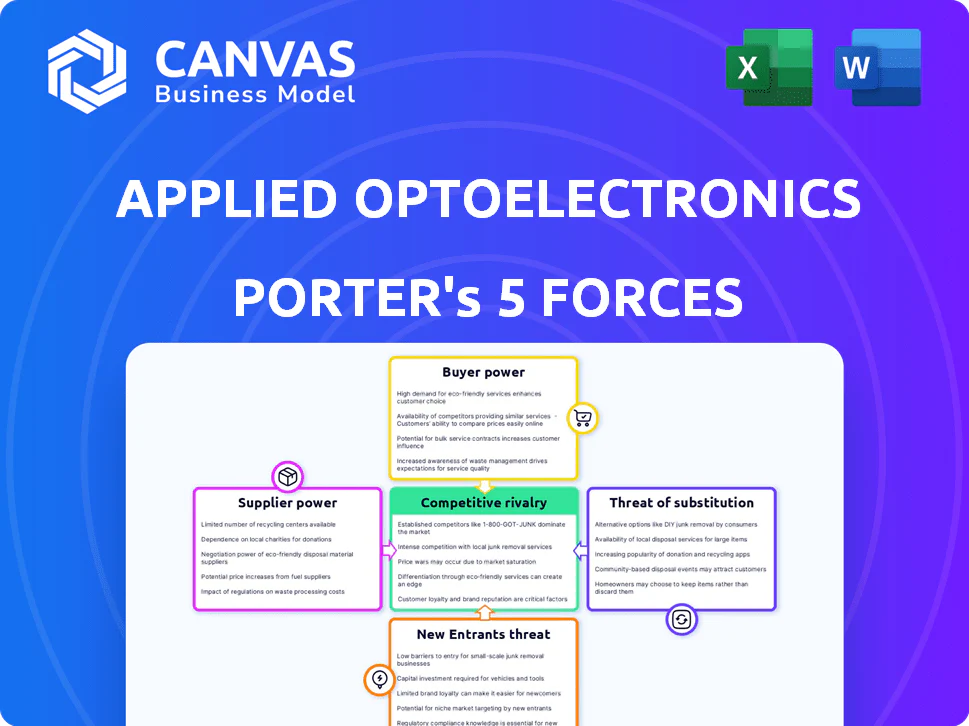
APPLIED OPTOELECTRONICS PORTER'S FIVE FORCES TEMPLATE RESEARCH
What is included in the product
 Detailed Word Document
Detailed analysis of each competitive force, supported by industry data and strategic commentary.

 Customizable Excel Spreadsheet
Quickly identify threats with a dynamic chart—perfect for board presentations.
Preview Before You Purchase
Applied Optoelectronics Porter's Five Forces Analysis
This preview details the comprehensive Porter's Five Forces analysis for Applied Optoelectronics. The analysis covers factors like competitive rivalry, and supplier power, among others. This is the same document that you will instantly receive after purchase. It provides a clear, in-depth evaluation. The document is formatted professionally for your use.

Porter's Five Forces Analysis Template

Elevate Your Analysis with the Complete Porter's Five Forces Analysis
Applied Optoelectronics operates in a competitive landscape influenced by supplier power, particularly for specialized components. Buyer power is moderate, with some concentration among key customers. The threat of new entrants is relatively low, due to high capital requirements and technical expertise needed. Substitutes, while present, offer different functionalities. Competitive rivalry is intense, fueled by rapid technological advancements.
Our full Porter's Five Forces report goes deeper—offering a data-driven framework to understand Applied Optoelectronics's real business risks and market opportunities.
Suppliers Bargaining Power

Limited Number of Specialized Suppliers
Applied Optoelectronics (AAOI) sources from a few specialized suppliers. In 2024, the optical networking market saw a consolidation, increasing supplier power. These suppliers offer unique semiconductors and components. This situation allows suppliers to influence prices and terms significantly.
Suppliers' Technological Expertise
Applied Optoelectronics (AAOI) faces suppliers with substantial technological expertise, particularly in optical networking. These suppliers invest heavily in R&D, enhancing their ability to control the value chain. For example, AAOI's cost of revenue was $28.2 million in Q3 2023, showing dependence on supplier pricing. The precision needed in manufacturing also concentrates the supplier base, increasing their influence.

Capital Investment for Precision Manufacturing
The bargaining power of suppliers in precision manufacturing is intensified by high capital investments. The optical networking components manufacturing demands significant capital for equipment. For example, photolithography systems can cost over $5 million. This financial barrier limits new entrants, concentrating the supplier pool and increasing supplier power.

Raw Materials Dependency
Applied Optoelectronics (AAOI) relies heavily on raw materials, including semiconductor wafers and optical fiber, for its products. The cost and availability of these materials can significantly impact AAOI's profitability. Dependence on a few suppliers for these critical components amplifies the suppliers' bargaining power. This can lead to increased costs and potential supply chain disruptions for AAOI.
- In 2024, the price of silicon wafers, a key raw material, increased by approximately 10-15% due to high demand.
- AAOI's gross margin was at 18% in Q3 2024, reflecting the impact of raw material costs.
- The company's reliance on specific suppliers for rare earth elements poses a risk.
Supply Chain Disruptions
Supply chain disruptions can greatly affect Applied Optoelectronics, impacting production timelines and expenses. The company's dependence on manufacturing centers, particularly in regions like China, heightens its vulnerability. This reliance boosts the bargaining power of suppliers within those areas. In 2024, supply chain issues, including component shortages, increased logistics costs, and geopolitical tensions, continue to strain businesses.
- China's dominance in manufacturing poses risks.
- Increased costs due to logistics and components.
- Geopolitical factors affect supplier power.
- Supply chain resilience is critical.
Supplier Dynamics Impacting AAOI's Margins
Applied Optoelectronics (AAOI) depends on specialized suppliers, especially in optical networking. These suppliers, offering unique components and semiconductors, wield considerable influence over pricing and terms. AAOI’s gross margin, at 18% in Q3 2024, reflects the impact of supplier costs.
| Factor | Impact | 2024 Data |
|---|---|---|
| Raw Materials | Cost Increases | Silicon wafer prices up 10-15% |
| Supply Chain | Disruptions & Costs | Logistics costs increased |
| Geopolitical | Supplier Influence | China's manufacturing dominance |
Customers Bargaining Power

Concentrated Customer Base
Applied Optoelectronics (AAOI) faces concentrated customer power. A few major clients, especially in data centers, drive most sales. In Q4 2023, the top 5 customers accounted for a substantial portion of revenue. This concentration allows these key customers to strongly influence pricing and agreements, potentially squeezing profit margins.
Large Customer Negotiation Power
Applied Optoelectronics (AOI) faces strong customer bargaining power due to its reliance on major clients like Amazon. These large customers, purchasing in high volumes, wield considerable influence. For instance, in 2024, Amazon's agreements with AOI, including warrant arrangements, led to significant volume discounts. This dynamic pressures AOI's profitability.

Price Sensitivity
Customers in the optical networking market, especially in the data center segment, are price-sensitive. The average selling prices (ASPs) of optical transceivers have decreased over time, influenced by competitive pressures. This price sensitivity enables customers to negotiate lower prices. For instance, AOI's gross margin in 2024 was 28% due to price declines.

Customer Switching Costs
Customer switching costs play a role in Applied Optoelectronics' (AAOI) bargaining power dynamics. While switching suppliers might involve some costs, major customers often possess the resources to switch for better deals or technology. The customer's switching cost can influence negotiations, but it may not be a significant barrier for the largest clients. For AAOI, this means they must continuously offer competitive value to retain key accounts. This is especially crucial in a market where technological advancements are rapid and alternatives are available.
- AAOI's revenue in 2024 was approximately $250 million, showing their market standing.
- The cost of switching suppliers can range from 5% to 15% of the contract value, impacting customer decisions.
- Key customers, representing over 20% of AAOI's revenue, have significant influence on pricing.
- AAOI's gross margin in 2024 was around 20%, which affects its pricing flexibility.
Demand for Optical Solutions
The bargaining power of customers in the optical solutions market, particularly for Applied Optoelectronics, is complex. Strong demand for high-speed optical solutions, especially in areas like high-speed transceivers, should ideally benefit suppliers. However, the customer base is often concentrated, with a few major players accounting for a large portion of orders, as of 2024.
These key customers wield considerable influence due to the volume of their purchases. For example, in 2024, major data center operators and telecommunications companies significantly impacted pricing and product specifications. This concentration allows customers to negotiate favorable terms.
The dynamic between demand and customer concentration determines the actual power balance. Applied Optoelectronics, like other suppliers, must navigate this balance to maintain profitability. The company's ability to innovate and differentiate products also affects customer power.
- High demand for optical solutions, especially in data centers and telecom.
- Concentrated customer base, giving major clients significant leverage.
- In 2024, large data center operators influenced pricing.
- Applied Optoelectronics must balance demand and customer influence.
AAOI: Customer Power Impacts Revenue
Applied Optoelectronics (AAOI) faces strong customer bargaining power. Key clients, like major data centers, drive sales, influencing pricing. In 2024, AAOI's top customers accounted for over 60% of revenue, impacting margins.
| Aspect | Details | Impact |
|---|---|---|
| Customer Concentration | Top 5 customers contribute significantly to revenue | Increased price sensitivity, margin pressure |
| Switching Costs | Can range from 5% to 15% of contract value | Impacts negotiation leverage |
| Market Dynamics | High demand, but concentrated customer base | Requires strategic balancing by AAOI |
Rivalry Among Competitors

Intense Competitive Landscape
The optical communications market is highly competitive, with Applied Optoelectronics facing significant rivalry. Major competitors include established giants and agile smaller firms, increasing pressure. In 2024, the market saw aggressive pricing strategies and rapid innovation cycles. This competitive dynamic impacts profitability and market share, with constant shifts among players.
Rapid Technological Advancements
The fiber optic sector sees rapid tech advancements, pushing constant innovation. Firms must invest heavily in R&D for products like 800G and 1.6T transceivers. Applied Optoelectronics (AAOI) spent $18.4 million on R&D in Q3 2023. Failing to innovate means losing market share, a critical risk. AAOI's Q3 2023 revenue was $48.6 million.

Global Competition
Applied Optoelectronics faces intense global competition. The company competes with manufacturers from Asia, including China, Taiwan, and Japan. These regions hold significant market share in optical components. In 2024, the global optical components market was valued at approximately $10 billion.

Pricing Pressures
Pricing pressure is a major concern in the optical communication market, where competition is fierce. Optical transceivers, for instance, have seen average price declines, impacting profitability. Companies must aggressively cut costs to maintain margins and remain competitive. In 2024, Applied Optoelectronics faced gross margin compression due to these pricing dynamics.
- Price declines are common for optical transceivers.
- Gross margin compression is a direct result.
- Cost reduction is a key strategic focus.
- Applied Optoelectronics felt the impact in 2024.
Product Differentiation and Innovation
Competition at Applied Optoelectronics (AAOI) goes beyond price, focusing on product features, quality, and service. To stay ahead, AAOI must innovate and distinguish its products to maintain customer interest. In 2024, AAOI's R&D spending was approximately $10 million, reflecting its commitment to innovation. This drive for differentiation is crucial in a market where several companies compete.
- AAOI's competitors include established tech firms like Broadcom and smaller, specialized companies.
- Product breadth involves offering a wide range of optical components and modules.
- Continuous innovation is vital for staying ahead in the fast-changing tech landscape.
- Differentiation also comes from providing excellent customer service and support.
AAOI: Navigating the $10B Optical Components Market
Applied Optoelectronics faces intense competition from established and emerging firms. The market is marked by aggressive pricing and rapid innovation cycles. In 2024, the optical components market was worth around $10 billion.
| Aspect | Details | Impact on AAOI |
|---|---|---|
| R&D Spending (Q3 2023) | $18.4 million | Supports innovation; essential for market share. |
| Q3 2023 Revenue | $48.6 million | Indicates market position; affected by competition. |
| 2024 Market Value | $10 billion | Reflects overall market size and competitive scope. |
APPLIED OPTOELECTRONICS PORTER'S FIVE FORCES TEMPLATE RESEARCH
What is included in the product
Detailed Word Document
Detailed analysis of each competitive force, supported by industry data and strategic commentary.
Customizable Excel Spreadsheet
Quickly identify threats with a dynamic chart—perfect for board presentations.
Preview Before You Purchase
Applied Optoelectronics Porter's Five Forces Analysis
This preview details the comprehensive Porter's Five Forces analysis for Applied Optoelectronics. The analysis covers factors like competitive rivalry, and supplier power, among others. This is the same document that you will instantly receive after purchase. It provides a clear, in-depth evaluation. The document is formatted professionally for your use.
Porter's Five Forces Analysis Template
Elevate Your Analysis with the Complete Porter's Five Forces Analysis
Applied Optoelectronics operates in a competitive landscape influenced by supplier power, particularly for specialized components. Buyer power is moderate, with some concentration among key customers. The threat of new entrants is relatively low, due to high capital requirements and technical expertise needed. Substitutes, while present, offer different functionalities. Competitive rivalry is intense, fueled by rapid technological advancements.
Our full Porter's Five Forces report goes deeper—offering a data-driven framework to understand Applied Optoelectronics's real business risks and market opportunities.
Suppliers Bargaining Power
Limited Number of Specialized Suppliers
Applied Optoelectronics (AAOI) sources from a few specialized suppliers. In 2024, the optical networking market saw a consolidation, increasing supplier power. These suppliers offer unique semiconductors and components. This situation allows suppliers to influence prices and terms significantly.
Suppliers' Technological Expertise
Applied Optoelectronics (AAOI) faces suppliers with substantial technological expertise, particularly in optical networking. These suppliers invest heavily in R&D, enhancing their ability to control the value chain. For example, AAOI's cost of revenue was $28.2 million in Q3 2023, showing dependence on supplier pricing. The precision needed in manufacturing also concentrates the supplier base, increasing their influence.
Capital Investment for Precision Manufacturing
The bargaining power of suppliers in precision manufacturing is intensified by high capital investments. The optical networking components manufacturing demands significant capital for equipment. For example, photolithography systems can cost over $5 million. This financial barrier limits new entrants, concentrating the supplier pool and increasing supplier power.
Raw Materials Dependency
Applied Optoelectronics (AAOI) relies heavily on raw materials, including semiconductor wafers and optical fiber, for its products. The cost and availability of these materials can significantly impact AAOI's profitability. Dependence on a few suppliers for these critical components amplifies the suppliers' bargaining power. This can lead to increased costs and potential supply chain disruptions for AAOI.
- In 2024, the price of silicon wafers, a key raw material, increased by approximately 10-15% due to high demand.
- AAOI's gross margin was at 18% in Q3 2024, reflecting the impact of raw material costs.
- The company's reliance on specific suppliers for rare earth elements poses a risk.
Supply Chain Disruptions
Supply chain disruptions can greatly affect Applied Optoelectronics, impacting production timelines and expenses. The company's dependence on manufacturing centers, particularly in regions like China, heightens its vulnerability. This reliance boosts the bargaining power of suppliers within those areas. In 2024, supply chain issues, including component shortages, increased logistics costs, and geopolitical tensions, continue to strain businesses.
- China's dominance in manufacturing poses risks.
- Increased costs due to logistics and components.
- Geopolitical factors affect supplier power.
- Supply chain resilience is critical.
Supplier Dynamics Impacting AAOI's Margins
Applied Optoelectronics (AAOI) depends on specialized suppliers, especially in optical networking. These suppliers, offering unique components and semiconductors, wield considerable influence over pricing and terms. AAOI’s gross margin, at 18% in Q3 2024, reflects the impact of supplier costs.
| Factor | Impact | 2024 Data |
|---|---|---|
| Raw Materials | Cost Increases | Silicon wafer prices up 10-15% |
| Supply Chain | Disruptions & Costs | Logistics costs increased |
| Geopolitical | Supplier Influence | China's manufacturing dominance |
Customers Bargaining Power
Concentrated Customer Base
Applied Optoelectronics (AAOI) faces concentrated customer power. A few major clients, especially in data centers, drive most sales. In Q4 2023, the top 5 customers accounted for a substantial portion of revenue. This concentration allows these key customers to strongly influence pricing and agreements, potentially squeezing profit margins.
Large Customer Negotiation Power
Applied Optoelectronics (AOI) faces strong customer bargaining power due to its reliance on major clients like Amazon. These large customers, purchasing in high volumes, wield considerable influence. For instance, in 2024, Amazon's agreements with AOI, including warrant arrangements, led to significant volume discounts. This dynamic pressures AOI's profitability.
Price Sensitivity
Customers in the optical networking market, especially in the data center segment, are price-sensitive. The average selling prices (ASPs) of optical transceivers have decreased over time, influenced by competitive pressures. This price sensitivity enables customers to negotiate lower prices. For instance, AOI's gross margin in 2024 was 28% due to price declines.
Customer Switching Costs
Customer switching costs play a role in Applied Optoelectronics' (AAOI) bargaining power dynamics. While switching suppliers might involve some costs, major customers often possess the resources to switch for better deals or technology. The customer's switching cost can influence negotiations, but it may not be a significant barrier for the largest clients. For AAOI, this means they must continuously offer competitive value to retain key accounts. This is especially crucial in a market where technological advancements are rapid and alternatives are available.
- AAOI's revenue in 2024 was approximately $250 million, showing their market standing.
- The cost of switching suppliers can range from 5% to 15% of the contract value, impacting customer decisions.
- Key customers, representing over 20% of AAOI's revenue, have significant influence on pricing.
- AAOI's gross margin in 2024 was around 20%, which affects its pricing flexibility.
Demand for Optical Solutions
The bargaining power of customers in the optical solutions market, particularly for Applied Optoelectronics, is complex. Strong demand for high-speed optical solutions, especially in areas like high-speed transceivers, should ideally benefit suppliers. However, the customer base is often concentrated, with a few major players accounting for a large portion of orders, as of 2024.
These key customers wield considerable influence due to the volume of their purchases. For example, in 2024, major data center operators and telecommunications companies significantly impacted pricing and product specifications. This concentration allows customers to negotiate favorable terms.
The dynamic between demand and customer concentration determines the actual power balance. Applied Optoelectronics, like other suppliers, must navigate this balance to maintain profitability. The company's ability to innovate and differentiate products also affects customer power.
- High demand for optical solutions, especially in data centers and telecom.
- Concentrated customer base, giving major clients significant leverage.
- In 2024, large data center operators influenced pricing.
- Applied Optoelectronics must balance demand and customer influence.
AAOI: Customer Power Impacts Revenue
Applied Optoelectronics (AAOI) faces strong customer bargaining power. Key clients, like major data centers, drive sales, influencing pricing. In 2024, AAOI's top customers accounted for over 60% of revenue, impacting margins.
| Aspect | Details | Impact |
|---|---|---|
| Customer Concentration | Top 5 customers contribute significantly to revenue | Increased price sensitivity, margin pressure |
| Switching Costs | Can range from 5% to 15% of contract value | Impacts negotiation leverage |
| Market Dynamics | High demand, but concentrated customer base | Requires strategic balancing by AAOI |
Rivalry Among Competitors
Intense Competitive Landscape
The optical communications market is highly competitive, with Applied Optoelectronics facing significant rivalry. Major competitors include established giants and agile smaller firms, increasing pressure. In 2024, the market saw aggressive pricing strategies and rapid innovation cycles. This competitive dynamic impacts profitability and market share, with constant shifts among players.
Rapid Technological Advancements
The fiber optic sector sees rapid tech advancements, pushing constant innovation. Firms must invest heavily in R&D for products like 800G and 1.6T transceivers. Applied Optoelectronics (AAOI) spent $18.4 million on R&D in Q3 2023. Failing to innovate means losing market share, a critical risk. AAOI's Q3 2023 revenue was $48.6 million.
Global Competition
Applied Optoelectronics faces intense global competition. The company competes with manufacturers from Asia, including China, Taiwan, and Japan. These regions hold significant market share in optical components. In 2024, the global optical components market was valued at approximately $10 billion.
Pricing Pressures
Pricing pressure is a major concern in the optical communication market, where competition is fierce. Optical transceivers, for instance, have seen average price declines, impacting profitability. Companies must aggressively cut costs to maintain margins and remain competitive. In 2024, Applied Optoelectronics faced gross margin compression due to these pricing dynamics.
- Price declines are common for optical transceivers.
- Gross margin compression is a direct result.
- Cost reduction is a key strategic focus.
- Applied Optoelectronics felt the impact in 2024.
Product Differentiation and Innovation
Competition at Applied Optoelectronics (AAOI) goes beyond price, focusing on product features, quality, and service. To stay ahead, AAOI must innovate and distinguish its products to maintain customer interest. In 2024, AAOI's R&D spending was approximately $10 million, reflecting its commitment to innovation. This drive for differentiation is crucial in a market where several companies compete.
- AAOI's competitors include established tech firms like Broadcom and smaller, specialized companies.
- Product breadth involves offering a wide range of optical components and modules.
- Continuous innovation is vital for staying ahead in the fast-changing tech landscape.
- Differentiation also comes from providing excellent customer service and support.
AAOI: Navigating the $10B Optical Components Market
Applied Optoelectronics faces intense competition from established and emerging firms. The market is marked by aggressive pricing and rapid innovation cycles. In 2024, the optical components market was worth around $10 billion.
| Aspect | Details | Impact on AAOI |
|---|---|---|
| R&D Spending (Q3 2023) | $18.4 million | Supports innovation; essential for market share. |
| Q3 2023 Revenue | $48.6 million | Indicates market position; affected by competition. |
| 2024 Market Value | $10 billion | Reflects overall market size and competitive scope. |
Product Information
Product Information
Shipping & Returns
Shipping & Returns
Description
What is included in the product
Detailed Word Document
Detailed analysis of each competitive force, supported by industry data and strategic commentary.
Customizable Excel Spreadsheet
Quickly identify threats with a dynamic chart—perfect for board presentations.
Preview Before You Purchase
Applied Optoelectronics Porter's Five Forces Analysis
This preview details the comprehensive Porter's Five Forces analysis for Applied Optoelectronics. The analysis covers factors like competitive rivalry, and supplier power, among others. This is the same document that you will instantly receive after purchase. It provides a clear, in-depth evaluation. The document is formatted professionally for your use.
Porter's Five Forces Analysis Template
Elevate Your Analysis with the Complete Porter's Five Forces Analysis
Applied Optoelectronics operates in a competitive landscape influenced by supplier power, particularly for specialized components. Buyer power is moderate, with some concentration among key customers. The threat of new entrants is relatively low, due to high capital requirements and technical expertise needed. Substitutes, while present, offer different functionalities. Competitive rivalry is intense, fueled by rapid technological advancements.
Our full Porter's Five Forces report goes deeper—offering a data-driven framework to understand Applied Optoelectronics's real business risks and market opportunities.
Suppliers Bargaining Power
Limited Number of Specialized Suppliers
Applied Optoelectronics (AAOI) sources from a few specialized suppliers. In 2024, the optical networking market saw a consolidation, increasing supplier power. These suppliers offer unique semiconductors and components. This situation allows suppliers to influence prices and terms significantly.
Suppliers' Technological Expertise
Applied Optoelectronics (AAOI) faces suppliers with substantial technological expertise, particularly in optical networking. These suppliers invest heavily in R&D, enhancing their ability to control the value chain. For example, AAOI's cost of revenue was $28.2 million in Q3 2023, showing dependence on supplier pricing. The precision needed in manufacturing also concentrates the supplier base, increasing their influence.
Capital Investment for Precision Manufacturing
The bargaining power of suppliers in precision manufacturing is intensified by high capital investments. The optical networking components manufacturing demands significant capital for equipment. For example, photolithography systems can cost over $5 million. This financial barrier limits new entrants, concentrating the supplier pool and increasing supplier power.
Raw Materials Dependency
Applied Optoelectronics (AAOI) relies heavily on raw materials, including semiconductor wafers and optical fiber, for its products. The cost and availability of these materials can significantly impact AAOI's profitability. Dependence on a few suppliers for these critical components amplifies the suppliers' bargaining power. This can lead to increased costs and potential supply chain disruptions for AAOI.
- In 2024, the price of silicon wafers, a key raw material, increased by approximately 10-15% due to high demand.
- AAOI's gross margin was at 18% in Q3 2024, reflecting the impact of raw material costs.
- The company's reliance on specific suppliers for rare earth elements poses a risk.
Supply Chain Disruptions
Supply chain disruptions can greatly affect Applied Optoelectronics, impacting production timelines and expenses. The company's dependence on manufacturing centers, particularly in regions like China, heightens its vulnerability. This reliance boosts the bargaining power of suppliers within those areas. In 2024, supply chain issues, including component shortages, increased logistics costs, and geopolitical tensions, continue to strain businesses.
- China's dominance in manufacturing poses risks.
- Increased costs due to logistics and components.
- Geopolitical factors affect supplier power.
- Supply chain resilience is critical.
Supplier Dynamics Impacting AAOI's Margins
Applied Optoelectronics (AAOI) depends on specialized suppliers, especially in optical networking. These suppliers, offering unique components and semiconductors, wield considerable influence over pricing and terms. AAOI’s gross margin, at 18% in Q3 2024, reflects the impact of supplier costs.
| Factor | Impact | 2024 Data |
|---|---|---|
| Raw Materials | Cost Increases | Silicon wafer prices up 10-15% |
| Supply Chain | Disruptions & Costs | Logistics costs increased |
| Geopolitical | Supplier Influence | China's manufacturing dominance |
Customers Bargaining Power
Concentrated Customer Base
Applied Optoelectronics (AAOI) faces concentrated customer power. A few major clients, especially in data centers, drive most sales. In Q4 2023, the top 5 customers accounted for a substantial portion of revenue. This concentration allows these key customers to strongly influence pricing and agreements, potentially squeezing profit margins.
Large Customer Negotiation Power
Applied Optoelectronics (AOI) faces strong customer bargaining power due to its reliance on major clients like Amazon. These large customers, purchasing in high volumes, wield considerable influence. For instance, in 2024, Amazon's agreements with AOI, including warrant arrangements, led to significant volume discounts. This dynamic pressures AOI's profitability.
Price Sensitivity
Customers in the optical networking market, especially in the data center segment, are price-sensitive. The average selling prices (ASPs) of optical transceivers have decreased over time, influenced by competitive pressures. This price sensitivity enables customers to negotiate lower prices. For instance, AOI's gross margin in 2024 was 28% due to price declines.
Customer Switching Costs
Customer switching costs play a role in Applied Optoelectronics' (AAOI) bargaining power dynamics. While switching suppliers might involve some costs, major customers often possess the resources to switch for better deals or technology. The customer's switching cost can influence negotiations, but it may not be a significant barrier for the largest clients. For AAOI, this means they must continuously offer competitive value to retain key accounts. This is especially crucial in a market where technological advancements are rapid and alternatives are available.
- AAOI's revenue in 2024 was approximately $250 million, showing their market standing.
- The cost of switching suppliers can range from 5% to 15% of the contract value, impacting customer decisions.
- Key customers, representing over 20% of AAOI's revenue, have significant influence on pricing.
- AAOI's gross margin in 2024 was around 20%, which affects its pricing flexibility.
Demand for Optical Solutions
The bargaining power of customers in the optical solutions market, particularly for Applied Optoelectronics, is complex. Strong demand for high-speed optical solutions, especially in areas like high-speed transceivers, should ideally benefit suppliers. However, the customer base is often concentrated, with a few major players accounting for a large portion of orders, as of 2024.
These key customers wield considerable influence due to the volume of their purchases. For example, in 2024, major data center operators and telecommunications companies significantly impacted pricing and product specifications. This concentration allows customers to negotiate favorable terms.
The dynamic between demand and customer concentration determines the actual power balance. Applied Optoelectronics, like other suppliers, must navigate this balance to maintain profitability. The company's ability to innovate and differentiate products also affects customer power.
- High demand for optical solutions, especially in data centers and telecom.
- Concentrated customer base, giving major clients significant leverage.
- In 2024, large data center operators influenced pricing.
- Applied Optoelectronics must balance demand and customer influence.
AAOI: Customer Power Impacts Revenue
Applied Optoelectronics (AAOI) faces strong customer bargaining power. Key clients, like major data centers, drive sales, influencing pricing. In 2024, AAOI's top customers accounted for over 60% of revenue, impacting margins.
| Aspect | Details | Impact |
|---|---|---|
| Customer Concentration | Top 5 customers contribute significantly to revenue | Increased price sensitivity, margin pressure |
| Switching Costs | Can range from 5% to 15% of contract value | Impacts negotiation leverage |
| Market Dynamics | High demand, but concentrated customer base | Requires strategic balancing by AAOI |
Rivalry Among Competitors
Intense Competitive Landscape
The optical communications market is highly competitive, with Applied Optoelectronics facing significant rivalry. Major competitors include established giants and agile smaller firms, increasing pressure. In 2024, the market saw aggressive pricing strategies and rapid innovation cycles. This competitive dynamic impacts profitability and market share, with constant shifts among players.
Rapid Technological Advancements
The fiber optic sector sees rapid tech advancements, pushing constant innovation. Firms must invest heavily in R&D for products like 800G and 1.6T transceivers. Applied Optoelectronics (AAOI) spent $18.4 million on R&D in Q3 2023. Failing to innovate means losing market share, a critical risk. AAOI's Q3 2023 revenue was $48.6 million.
Global Competition
Applied Optoelectronics faces intense global competition. The company competes with manufacturers from Asia, including China, Taiwan, and Japan. These regions hold significant market share in optical components. In 2024, the global optical components market was valued at approximately $10 billion.
Pricing Pressures
Pricing pressure is a major concern in the optical communication market, where competition is fierce. Optical transceivers, for instance, have seen average price declines, impacting profitability. Companies must aggressively cut costs to maintain margins and remain competitive. In 2024, Applied Optoelectronics faced gross margin compression due to these pricing dynamics.
- Price declines are common for optical transceivers.
- Gross margin compression is a direct result.
- Cost reduction is a key strategic focus.
- Applied Optoelectronics felt the impact in 2024.
Product Differentiation and Innovation
Competition at Applied Optoelectronics (AAOI) goes beyond price, focusing on product features, quality, and service. To stay ahead, AAOI must innovate and distinguish its products to maintain customer interest. In 2024, AAOI's R&D spending was approximately $10 million, reflecting its commitment to innovation. This drive for differentiation is crucial in a market where several companies compete.
- AAOI's competitors include established tech firms like Broadcom and smaller, specialized companies.
- Product breadth involves offering a wide range of optical components and modules.
- Continuous innovation is vital for staying ahead in the fast-changing tech landscape.
- Differentiation also comes from providing excellent customer service and support.
AAOI: Navigating the $10B Optical Components Market
Applied Optoelectronics faces intense competition from established and emerging firms. The market is marked by aggressive pricing and rapid innovation cycles. In 2024, the optical components market was worth around $10 billion.
| Aspect | Details | Impact on AAOI |
|---|---|---|
| R&D Spending (Q3 2023) | $18.4 million | Supports innovation; essential for market share. |
| Q3 2023 Revenue | $48.6 million | Indicates market position; affected by competition. |
| 2024 Market Value | $10 billion | Reflects overall market size and competitive scope. |











