APPRENTICE.IO PORTER'S FIVE FORCES TEMPLATE RESEARCH
What is included in the product
 Detailed Word Document
Apprentice.io's competitive landscape is analyzed, identifying its position & market entry challenges.

 Customizable Excel Spreadsheet
Quickly identify and rate industry forces with an interactive scoring system.
What You See Is What You Get
Apprentice.io Porter's Five Forces Analysis
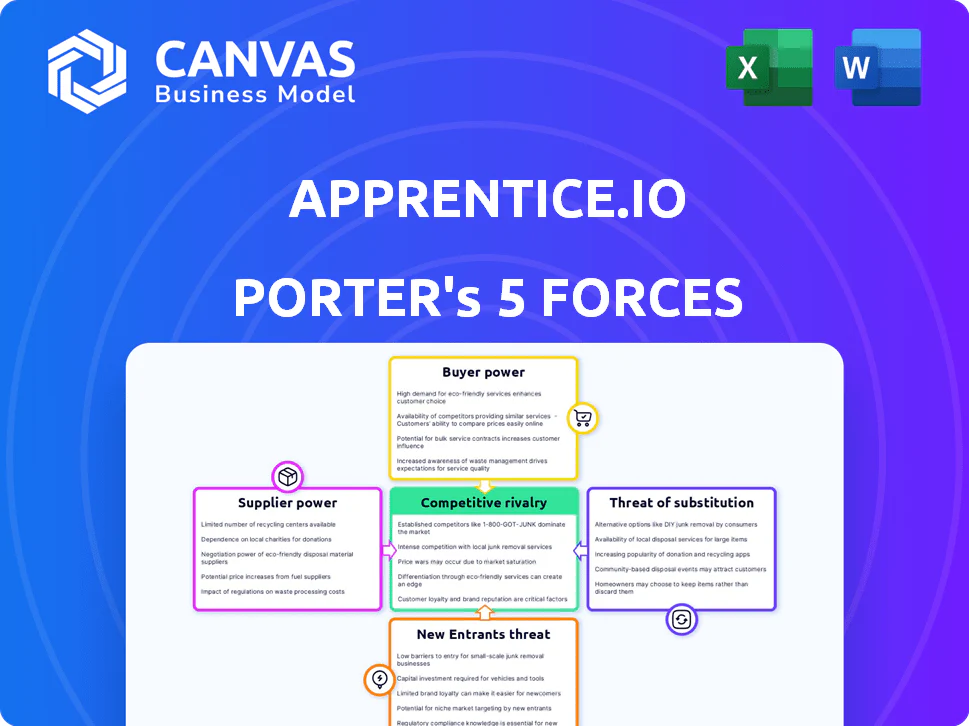
This preview shows the exact Porter's Five Forces analysis you'll receive immediately after purchase, providing a comprehensive assessment. It analyzes the competitive landscape affecting Apprentice.io. The document includes factors such as competitive rivalry, supplier power, and buyer power. You'll also see threats of new entrants and substitutes.

Porter's Five Forces Analysis Template

Elevate Your Analysis with the Complete Porter's Five Forces Analysis
Apprentice.io faces moderate rivalry, with key players vying for market share. Supplier power appears manageable, but buyer power is a factor to consider. The threat of new entrants and substitutes is present, influencing its strategy. These forces shape Apprentice.io's competitive landscape.
Unlock key insights into Apprentice.io’s industry forces—from buyer power to substitute threats—and use this knowledge to inform strategy or investment decisions.
Suppliers Bargaining Power

Concentrated Supplier Market
In the life sciences MES market, a concentrated supplier base for specialized tech components can boost supplier power. This is especially true for unique integrations. The global MES market was valued at $12.3 billion in 2023. Cloud solutions and modular MES designs help balance this power dynamic.
Importance of Specific Technologies
Suppliers of advanced tech like AI or AR, crucial for MES platforms, gain bargaining power. Their unique tech creates differentiation, increasing their leverage. For instance, in 2024, the AI market grew significantly, with investments in MES-integrated AI solutions. This tech provides a competitive edge.

Integration Complexity and Switching Costs
Integrating a Manufacturing Execution System (MES) within pharmaceutical manufacturing is complex. Switching MES vendors is costly, boosting supplier power. The MES market grew to $13.4 billion in 2024. Switching costs include data migration and retraining, strengthening supplier control.

Availability of Alternatives
The bargaining power of suppliers is often low in pharmaceuticals due to many raw material and chemical suppliers. However, for specialized MES components or services, options may be fewer. This could increase supplier power. For example, the global pharmaceutical excipients market was valued at $7.6 billion in 2024.
- Many suppliers keep supplier power low.
- Specialized components can increase supplier power.
- Excipients market valued $7.6B in 2024.
- Limited suppliers can raise costs.
Supplier Forward Integration
Supplier forward integration involves suppliers entering the customer's market. While rare for software, manufacturers of specialized equipment might offer basic software. These software solutions often lack the breadth of a complete MES system like Apprentice.io. For instance, Rockwell Automation, a major supplier, generated $9.1 billion in revenue in 2024, including software and services. This is a strategic move to capture more value.
- Limited Scope: Suppliers' software often focuses on specific equipment or processes.
- Market Entry: Suppliers aim to control downstream value chains.
- Competitive Pressure: This intensifies rivalry in the software market.
- Financial Impact: Forward integration can significantly alter the market's revenue distribution.
MES Market Dynamics: Supplier Power in Focus
Supplier power in the MES market varies. A wide supplier base keeps power low. Specialized components can increase supplier bargaining power. The pharmaceutical excipients market was valued at $7.6 billion in 2024.
| Aspect | Impact | Example |
|---|---|---|
| Supplier Concentration | Affects bargaining power | Specialized tech components |
| Switching Costs | Boosts supplier influence | Data migration, retraining |
| Market Size | Indicates potential impact | MES market at $13.4B in 2024 |
Customers Bargaining Power

High Cost of MES Implementation
Implementing a Manufacturing Execution System (MES) is costly for pharmaceutical and biotech firms. The investment includes software, integration, and training, potentially reaching millions of dollars. This substantial upfront cost gives customers considerable bargaining power during initial contract negotiations. For example, MES implementation costs can range from $500,000 to over $5 million, depending on the complexity and scale of the operation.
Regulatory Compliance Requirements
Customers in the pharmaceutical sector wield substantial power due to strict regulatory demands. MES providers, like Apprentice.io, must meet complex standards such as GMP and GAMP. The need for compliance gives customers leverage in negotiations. In 2024, the global MES market reached $11.4 billion, highlighting the value of these systems.

Availability of MES Options
The life sciences MES market offers diverse choices, boosting customer bargaining power. Vendors provide various features and deployment models. The market size was valued at USD 1.56 billion in 2023. Customers can negotiate based on their needs.

Customer Size and Concentration
Large pharmaceutical and biotech companies, especially top players, wield significant purchasing power. Their substantial scale and potential for extensive deployments across multiple sites boost their negotiation leverage. This makes their business highly valuable to MES providers. For example, in 2024, the top 10 pharmaceutical companies generated over $800 billion in revenue, showcasing their financial clout.
- Revenue concentration among these firms gives them an upper hand.
- Large-scale deployments translate into significant contracts.
- The high value of their business enhances their bargaining power.
Potential for In-House Solutions or Partial Adoption
Some customers may opt for in-house solutions or partial adoption of MES. This strategy can address specific needs but often leads to inefficiencies. Research from 2024 showed that companies using hybrid systems experience, on average, a 15% reduction in overall operational efficiency.
- Limited scope solutions can be less effective than comprehensive MES.
- Hybrid systems often create data silos, hindering real-time insights.
- In-house development requires significant resources and ongoing maintenance.
- Partial adoption may not fully realize the benefits of MES.
Pharma's Customer Power: Cost, Choice & Control
Customers’ bargaining power in the pharmaceutical sector is strong due to high implementation costs and regulatory demands. The MES market, valued at $11.4B in 2024, offers choices, enhancing customer leverage. Large firms, like the top 10 generating over $800B in revenue, have significant negotiation power.
| Factor | Impact | Example |
|---|---|---|
| High Implementation Costs | Increases customer leverage | MES costs $500K-$5M+ |
| Regulatory Compliance | Demands compliance, giving customers leverage | GMP, GAMP standards |
| Market Choices | Diverse options boost bargaining power | 2023 market valued at $1.56B |
Rivalry Among Competitors

Presence of Multiple MES Vendors
The MES landscape in life sciences is highly competitive. Several vendors vie for market share, offering diverse solutions. Established firms and innovative cloud-native platform specialists are present. This rivalry drives innovation and price adjustments. The global MES market was valued at $10.3 billion in 2024.
Differentiation through Technology and Features
MES providers stand out via tech and features. They integrate AI, machine learning, and AR. Apprentice.io highlights its AI and cloud-native platform. The global MES market was valued at $12.8 billion in 2024.

Importance of Compliance and Validation
Competitive rivalry in the pharmaceutical software sector hinges on compliance. Vendors must adhere to strict regulations, like those from the FDA. The ability to validate software is crucial, influencing market share. In 2024, the global pharmaceutical market reached approximately $1.5 trillion, highlighting the stakes. Strong validation processes ensure trust and longevity.

Strategic Partnerships and Integrations
MES vendors boost competitiveness through strategic alliances. They integrate with ERP, LIMS, and EAM systems for comprehensive solutions. Seamless integration is a major competitive edge, impacting customer adoption. In 2024, integrated solutions saw a 20% increase in market share.
- Strategic partnerships enhance market reach.
- Integration capabilities drive customer choice.
- Comprehensive solutions increase competitiveness.
- Market share for integrated systems is growing.
Market Growth and Specialization
The MES market in life sciences is expanding, fueled by Pharma 4.0 and digital transformation. This growth can increase rivalry as firms compete for market share. Specialization opportunities arise in areas such as biotech and advanced therapies. The global MES market is projected to reach $19.6 billion by 2024.
- Market growth is significantly influencing competitive dynamics.
- Specialization allows for niche market focus.
- The MES market size is substantial and growing.
- Pharma 4.0 and digital transformation are key drivers.
MES Market: $12.8B with AI & Integration Driving Growth
Competitive rivalry in the MES market is intense, with vendors innovating rapidly. Key differentiators include AI, integration, and compliance with regulations like those from the FDA. The global MES market was valued at $12.8 billion in 2024, reflecting significant competition.
| Feature | Impact | 2024 Data |
|---|---|---|
| AI Integration | Enhances efficiency | Market Share Increase: 15% |
| System Integration | Drives customer choice | Market Share Increase: 20% |
| Regulatory Compliance | Ensures trust | Pharmaceutical Market: $1.5T |
APPRENTICE.IO PORTER'S FIVE FORCES TEMPLATE RESEARCH
What is included in the product
Detailed Word Document
Apprentice.io's competitive landscape is analyzed, identifying its position & market entry challenges.
Customizable Excel Spreadsheet
Quickly identify and rate industry forces with an interactive scoring system.
What You See Is What You Get
Apprentice.io Porter's Five Forces Analysis
This preview shows the exact Porter's Five Forces analysis you'll receive immediately after purchase, providing a comprehensive assessment. It analyzes the competitive landscape affecting Apprentice.io. The document includes factors such as competitive rivalry, supplier power, and buyer power. You'll also see threats of new entrants and substitutes.
Porter's Five Forces Analysis Template
Elevate Your Analysis with the Complete Porter's Five Forces Analysis
Apprentice.io faces moderate rivalry, with key players vying for market share. Supplier power appears manageable, but buyer power is a factor to consider. The threat of new entrants and substitutes is present, influencing its strategy. These forces shape Apprentice.io's competitive landscape.
Unlock key insights into Apprentice.io’s industry forces—from buyer power to substitute threats—and use this knowledge to inform strategy or investment decisions.
Suppliers Bargaining Power
Concentrated Supplier Market
In the life sciences MES market, a concentrated supplier base for specialized tech components can boost supplier power. This is especially true for unique integrations. The global MES market was valued at $12.3 billion in 2023. Cloud solutions and modular MES designs help balance this power dynamic.
Importance of Specific Technologies
Suppliers of advanced tech like AI or AR, crucial for MES platforms, gain bargaining power. Their unique tech creates differentiation, increasing their leverage. For instance, in 2024, the AI market grew significantly, with investments in MES-integrated AI solutions. This tech provides a competitive edge.
Integration Complexity and Switching Costs
Integrating a Manufacturing Execution System (MES) within pharmaceutical manufacturing is complex. Switching MES vendors is costly, boosting supplier power. The MES market grew to $13.4 billion in 2024. Switching costs include data migration and retraining, strengthening supplier control.
Availability of Alternatives
The bargaining power of suppliers is often low in pharmaceuticals due to many raw material and chemical suppliers. However, for specialized MES components or services, options may be fewer. This could increase supplier power. For example, the global pharmaceutical excipients market was valued at $7.6 billion in 2024.
- Many suppliers keep supplier power low.
- Specialized components can increase supplier power.
- Excipients market valued $7.6B in 2024.
- Limited suppliers can raise costs.
Supplier Forward Integration
Supplier forward integration involves suppliers entering the customer's market. While rare for software, manufacturers of specialized equipment might offer basic software. These software solutions often lack the breadth of a complete MES system like Apprentice.io. For instance, Rockwell Automation, a major supplier, generated $9.1 billion in revenue in 2024, including software and services. This is a strategic move to capture more value.
- Limited Scope: Suppliers' software often focuses on specific equipment or processes.
- Market Entry: Suppliers aim to control downstream value chains.
- Competitive Pressure: This intensifies rivalry in the software market.
- Financial Impact: Forward integration can significantly alter the market's revenue distribution.
MES Market Dynamics: Supplier Power in Focus
Supplier power in the MES market varies. A wide supplier base keeps power low. Specialized components can increase supplier bargaining power. The pharmaceutical excipients market was valued at $7.6 billion in 2024.
| Aspect | Impact | Example |
|---|---|---|
| Supplier Concentration | Affects bargaining power | Specialized tech components |
| Switching Costs | Boosts supplier influence | Data migration, retraining |
| Market Size | Indicates potential impact | MES market at $13.4B in 2024 |
Customers Bargaining Power
High Cost of MES Implementation
Implementing a Manufacturing Execution System (MES) is costly for pharmaceutical and biotech firms. The investment includes software, integration, and training, potentially reaching millions of dollars. This substantial upfront cost gives customers considerable bargaining power during initial contract negotiations. For example, MES implementation costs can range from $500,000 to over $5 million, depending on the complexity and scale of the operation.
Regulatory Compliance Requirements
Customers in the pharmaceutical sector wield substantial power due to strict regulatory demands. MES providers, like Apprentice.io, must meet complex standards such as GMP and GAMP. The need for compliance gives customers leverage in negotiations. In 2024, the global MES market reached $11.4 billion, highlighting the value of these systems.
Availability of MES Options
The life sciences MES market offers diverse choices, boosting customer bargaining power. Vendors provide various features and deployment models. The market size was valued at USD 1.56 billion in 2023. Customers can negotiate based on their needs.
Customer Size and Concentration
Large pharmaceutical and biotech companies, especially top players, wield significant purchasing power. Their substantial scale and potential for extensive deployments across multiple sites boost their negotiation leverage. This makes their business highly valuable to MES providers. For example, in 2024, the top 10 pharmaceutical companies generated over $800 billion in revenue, showcasing their financial clout.
- Revenue concentration among these firms gives them an upper hand.
- Large-scale deployments translate into significant contracts.
- The high value of their business enhances their bargaining power.
Potential for In-House Solutions or Partial Adoption
Some customers may opt for in-house solutions or partial adoption of MES. This strategy can address specific needs but often leads to inefficiencies. Research from 2024 showed that companies using hybrid systems experience, on average, a 15% reduction in overall operational efficiency.
- Limited scope solutions can be less effective than comprehensive MES.
- Hybrid systems often create data silos, hindering real-time insights.
- In-house development requires significant resources and ongoing maintenance.
- Partial adoption may not fully realize the benefits of MES.
Pharma's Customer Power: Cost, Choice & Control
Customers’ bargaining power in the pharmaceutical sector is strong due to high implementation costs and regulatory demands. The MES market, valued at $11.4B in 2024, offers choices, enhancing customer leverage. Large firms, like the top 10 generating over $800B in revenue, have significant negotiation power.
| Factor | Impact | Example |
|---|---|---|
| High Implementation Costs | Increases customer leverage | MES costs $500K-$5M+ |
| Regulatory Compliance | Demands compliance, giving customers leverage | GMP, GAMP standards |
| Market Choices | Diverse options boost bargaining power | 2023 market valued at $1.56B |
Rivalry Among Competitors
Presence of Multiple MES Vendors
The MES landscape in life sciences is highly competitive. Several vendors vie for market share, offering diverse solutions. Established firms and innovative cloud-native platform specialists are present. This rivalry drives innovation and price adjustments. The global MES market was valued at $10.3 billion in 2024.
Differentiation through Technology and Features
MES providers stand out via tech and features. They integrate AI, machine learning, and AR. Apprentice.io highlights its AI and cloud-native platform. The global MES market was valued at $12.8 billion in 2024.
Importance of Compliance and Validation
Competitive rivalry in the pharmaceutical software sector hinges on compliance. Vendors must adhere to strict regulations, like those from the FDA. The ability to validate software is crucial, influencing market share. In 2024, the global pharmaceutical market reached approximately $1.5 trillion, highlighting the stakes. Strong validation processes ensure trust and longevity.
Strategic Partnerships and Integrations
MES vendors boost competitiveness through strategic alliances. They integrate with ERP, LIMS, and EAM systems for comprehensive solutions. Seamless integration is a major competitive edge, impacting customer adoption. In 2024, integrated solutions saw a 20% increase in market share.
- Strategic partnerships enhance market reach.
- Integration capabilities drive customer choice.
- Comprehensive solutions increase competitiveness.
- Market share for integrated systems is growing.
Market Growth and Specialization
The MES market in life sciences is expanding, fueled by Pharma 4.0 and digital transformation. This growth can increase rivalry as firms compete for market share. Specialization opportunities arise in areas such as biotech and advanced therapies. The global MES market is projected to reach $19.6 billion by 2024.
- Market growth is significantly influencing competitive dynamics.
- Specialization allows for niche market focus.
- The MES market size is substantial and growing.
- Pharma 4.0 and digital transformation are key drivers.
MES Market: $12.8B with AI & Integration Driving Growth
Competitive rivalry in the MES market is intense, with vendors innovating rapidly. Key differentiators include AI, integration, and compliance with regulations like those from the FDA. The global MES market was valued at $12.8 billion in 2024, reflecting significant competition.
| Feature | Impact | 2024 Data |
|---|---|---|
| AI Integration | Enhances efficiency | Market Share Increase: 15% |
| System Integration | Drives customer choice | Market Share Increase: 20% |
| Regulatory Compliance | Ensures trust | Pharmaceutical Market: $1.5T |
Product Information
Product Information
Shipping & Returns
Shipping & Returns
Description
What is included in the product
Detailed Word Document
Apprentice.io's competitive landscape is analyzed, identifying its position & market entry challenges.
Customizable Excel Spreadsheet
Quickly identify and rate industry forces with an interactive scoring system.
What You See Is What You Get
Apprentice.io Porter's Five Forces Analysis
This preview shows the exact Porter's Five Forces analysis you'll receive immediately after purchase, providing a comprehensive assessment. It analyzes the competitive landscape affecting Apprentice.io. The document includes factors such as competitive rivalry, supplier power, and buyer power. You'll also see threats of new entrants and substitutes.
Porter's Five Forces Analysis Template
Elevate Your Analysis with the Complete Porter's Five Forces Analysis
Apprentice.io faces moderate rivalry, with key players vying for market share. Supplier power appears manageable, but buyer power is a factor to consider. The threat of new entrants and substitutes is present, influencing its strategy. These forces shape Apprentice.io's competitive landscape.
Unlock key insights into Apprentice.io’s industry forces—from buyer power to substitute threats—and use this knowledge to inform strategy or investment decisions.
Suppliers Bargaining Power
Concentrated Supplier Market
In the life sciences MES market, a concentrated supplier base for specialized tech components can boost supplier power. This is especially true for unique integrations. The global MES market was valued at $12.3 billion in 2023. Cloud solutions and modular MES designs help balance this power dynamic.
Importance of Specific Technologies
Suppliers of advanced tech like AI or AR, crucial for MES platforms, gain bargaining power. Their unique tech creates differentiation, increasing their leverage. For instance, in 2024, the AI market grew significantly, with investments in MES-integrated AI solutions. This tech provides a competitive edge.
Integration Complexity and Switching Costs
Integrating a Manufacturing Execution System (MES) within pharmaceutical manufacturing is complex. Switching MES vendors is costly, boosting supplier power. The MES market grew to $13.4 billion in 2024. Switching costs include data migration and retraining, strengthening supplier control.
Availability of Alternatives
The bargaining power of suppliers is often low in pharmaceuticals due to many raw material and chemical suppliers. However, for specialized MES components or services, options may be fewer. This could increase supplier power. For example, the global pharmaceutical excipients market was valued at $7.6 billion in 2024.
- Many suppliers keep supplier power low.
- Specialized components can increase supplier power.
- Excipients market valued $7.6B in 2024.
- Limited suppliers can raise costs.
Supplier Forward Integration
Supplier forward integration involves suppliers entering the customer's market. While rare for software, manufacturers of specialized equipment might offer basic software. These software solutions often lack the breadth of a complete MES system like Apprentice.io. For instance, Rockwell Automation, a major supplier, generated $9.1 billion in revenue in 2024, including software and services. This is a strategic move to capture more value.
- Limited Scope: Suppliers' software often focuses on specific equipment or processes.
- Market Entry: Suppliers aim to control downstream value chains.
- Competitive Pressure: This intensifies rivalry in the software market.
- Financial Impact: Forward integration can significantly alter the market's revenue distribution.
MES Market Dynamics: Supplier Power in Focus
Supplier power in the MES market varies. A wide supplier base keeps power low. Specialized components can increase supplier bargaining power. The pharmaceutical excipients market was valued at $7.6 billion in 2024.
| Aspect | Impact | Example |
|---|---|---|
| Supplier Concentration | Affects bargaining power | Specialized tech components |
| Switching Costs | Boosts supplier influence | Data migration, retraining |
| Market Size | Indicates potential impact | MES market at $13.4B in 2024 |
Customers Bargaining Power
High Cost of MES Implementation
Implementing a Manufacturing Execution System (MES) is costly for pharmaceutical and biotech firms. The investment includes software, integration, and training, potentially reaching millions of dollars. This substantial upfront cost gives customers considerable bargaining power during initial contract negotiations. For example, MES implementation costs can range from $500,000 to over $5 million, depending on the complexity and scale of the operation.
Regulatory Compliance Requirements
Customers in the pharmaceutical sector wield substantial power due to strict regulatory demands. MES providers, like Apprentice.io, must meet complex standards such as GMP and GAMP. The need for compliance gives customers leverage in negotiations. In 2024, the global MES market reached $11.4 billion, highlighting the value of these systems.
Availability of MES Options
The life sciences MES market offers diverse choices, boosting customer bargaining power. Vendors provide various features and deployment models. The market size was valued at USD 1.56 billion in 2023. Customers can negotiate based on their needs.
Customer Size and Concentration
Large pharmaceutical and biotech companies, especially top players, wield significant purchasing power. Their substantial scale and potential for extensive deployments across multiple sites boost their negotiation leverage. This makes their business highly valuable to MES providers. For example, in 2024, the top 10 pharmaceutical companies generated over $800 billion in revenue, showcasing their financial clout.
- Revenue concentration among these firms gives them an upper hand.
- Large-scale deployments translate into significant contracts.
- The high value of their business enhances their bargaining power.
Potential for In-House Solutions or Partial Adoption
Some customers may opt for in-house solutions or partial adoption of MES. This strategy can address specific needs but often leads to inefficiencies. Research from 2024 showed that companies using hybrid systems experience, on average, a 15% reduction in overall operational efficiency.
- Limited scope solutions can be less effective than comprehensive MES.
- Hybrid systems often create data silos, hindering real-time insights.
- In-house development requires significant resources and ongoing maintenance.
- Partial adoption may not fully realize the benefits of MES.
Pharma's Customer Power: Cost, Choice & Control
Customers’ bargaining power in the pharmaceutical sector is strong due to high implementation costs and regulatory demands. The MES market, valued at $11.4B in 2024, offers choices, enhancing customer leverage. Large firms, like the top 10 generating over $800B in revenue, have significant negotiation power.
| Factor | Impact | Example |
|---|---|---|
| High Implementation Costs | Increases customer leverage | MES costs $500K-$5M+ |
| Regulatory Compliance | Demands compliance, giving customers leverage | GMP, GAMP standards |
| Market Choices | Diverse options boost bargaining power | 2023 market valued at $1.56B |
Rivalry Among Competitors
Presence of Multiple MES Vendors
The MES landscape in life sciences is highly competitive. Several vendors vie for market share, offering diverse solutions. Established firms and innovative cloud-native platform specialists are present. This rivalry drives innovation and price adjustments. The global MES market was valued at $10.3 billion in 2024.
Differentiation through Technology and Features
MES providers stand out via tech and features. They integrate AI, machine learning, and AR. Apprentice.io highlights its AI and cloud-native platform. The global MES market was valued at $12.8 billion in 2024.
Importance of Compliance and Validation
Competitive rivalry in the pharmaceutical software sector hinges on compliance. Vendors must adhere to strict regulations, like those from the FDA. The ability to validate software is crucial, influencing market share. In 2024, the global pharmaceutical market reached approximately $1.5 trillion, highlighting the stakes. Strong validation processes ensure trust and longevity.
Strategic Partnerships and Integrations
MES vendors boost competitiveness through strategic alliances. They integrate with ERP, LIMS, and EAM systems for comprehensive solutions. Seamless integration is a major competitive edge, impacting customer adoption. In 2024, integrated solutions saw a 20% increase in market share.
- Strategic partnerships enhance market reach.
- Integration capabilities drive customer choice.
- Comprehensive solutions increase competitiveness.
- Market share for integrated systems is growing.
Market Growth and Specialization
The MES market in life sciences is expanding, fueled by Pharma 4.0 and digital transformation. This growth can increase rivalry as firms compete for market share. Specialization opportunities arise in areas such as biotech and advanced therapies. The global MES market is projected to reach $19.6 billion by 2024.
- Market growth is significantly influencing competitive dynamics.
- Specialization allows for niche market focus.
- The MES market size is substantial and growing.
- Pharma 4.0 and digital transformation are key drivers.
MES Market: $12.8B with AI & Integration Driving Growth
Competitive rivalry in the MES market is intense, with vendors innovating rapidly. Key differentiators include AI, integration, and compliance with regulations like those from the FDA. The global MES market was valued at $12.8 billion in 2024, reflecting significant competition.
| Feature | Impact | 2024 Data |
|---|---|---|
| AI Integration | Enhances efficiency | Market Share Increase: 15% |
| System Integration | Drives customer choice | Market Share Increase: 20% |
| Regulatory Compliance | Ensures trust | Pharmaceutical Market: $1.5T |











