APTOSE BIOSCIENCES PORTER'S FIVE FORCES TEMPLATE RESEARCH
What is included in the product
 Detailed Word Document
Tailored exclusively for Aptose Biosciences, analyzing its position within its competitive landscape.

 Customizable Excel Spreadsheet
Swap in Aptose's data, labels, and notes to reflect precise competitive dynamics.
Preview the Actual Deliverable
Aptose Biosciences Porter's Five Forces Analysis
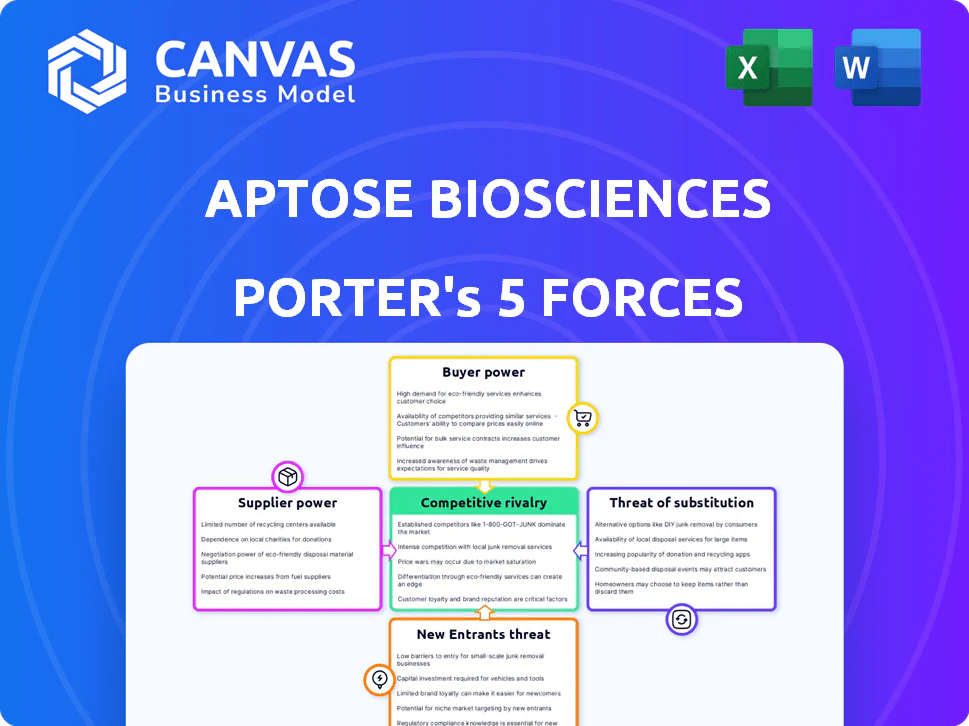
This preview unveils the complete Aptose Biosciences Porter's Five Forces analysis. It meticulously examines competitive rivalry, bargaining power of suppliers & buyers, threat of substitutes, and new entrants.
The document you're examining presents the full analysis you’ll receive. Expect in-depth insights, expertly crafted to inform your strategic decisions.
Immediately after purchase, this fully formatted document is ready for download. It features precise details and comprehensive evaluations.
See precisely what you get: the same professionally written analysis is delivered instantly after purchase.
No surprises—what you view is the document you'll download, a complete and ready-to-use Porter's Five Forces analysis.

Porter's Five Forces Analysis Template

Go Beyond the Preview—Access the Full Strategic Report
Aptose Biosciences operates in a competitive biotech landscape, marked by intense rivalry and high barriers. Bargaining power of suppliers, especially for specialized materials, can be significant. The threat of new entrants remains moderate due to regulatory hurdles and capital needs. Buyer power is relatively limited. Substitute products pose a moderate threat, given the focus on unmet medical needs.
This brief snapshot only scratches the surface. Unlock the full Porter's Five Forces Analysis to explore Aptose Biosciences’s competitive dynamics, market pressures, and strategic advantages in detail.
Suppliers Bargaining Power

Reliance on specialized suppliers
Aptose, a clinical-stage biotech firm, probably depends on specific suppliers for unique materials and services. This reliance, especially for items like specialized reagents, grants suppliers considerable bargaining power. This is because the availability of such specialized items is often limited. For example, in 2024, the cost of certain biotech reagents rose by approximately 7%.
Availability of alternative suppliers
The bargaining power of suppliers is also influenced by the availability of alternative sources. When there are few alternatives, suppliers have more power. In the pharmaceutical industry, the availability of raw materials impacts supplier power. For instance, in 2024, the limited supply of certain specialized chemicals for drug manufacturing increased supplier leverage, impacting costs for companies like Aptose Biosciences. A wider range of options can reduce supplier leverage.

Switching costs
Switching suppliers in biotech is costly. This involves requalifying materials, validating processes, and facing potential R&D delays. These high costs amplify supplier influence. In 2024, the average cost to switch suppliers in the pharmaceutical industry was estimated at $1.2 million, reflecting the complexity of such transitions.

Supplier concentration
Supplier concentration significantly impacts Aptose's operational costs and flexibility. If key inputs come from a few dominant suppliers, these entities can exert considerable influence. This concentration can lead to higher prices or less favorable contract terms for Aptose.
- High concentration increases supplier power.
- Aptose may struggle with cost control.
- Dependence on few suppliers creates risks.
Impact of supplier inputs on product quality and differentiation
The quality of supplier inputs critically affects Aptose's drug candidates' effectiveness and safety. Suppliers gain power when their inputs are vital for therapeutic performance, impacting product quality and differentiation. For example, in 2024, the pharmaceutical industry faced increased scrutiny regarding supply chain reliability. This highlights how supplier influence directly affects Aptose.
- Supplier inputs determine drug efficacy and safety.
- Key suppliers can exert significant influence.
- Supply chain reliability is crucial.
Biotech Supplier Dynamics: Aptose's 2024 Challenges
Aptose's suppliers, offering specialized biotech materials, wield considerable power. Limited alternatives and high switching costs bolster their influence. In 2024, supplier concentration significantly affected operational costs.
| Factor | Impact on Aptose | 2024 Data |
|---|---|---|
| Specialized Reagents | Higher Costs | 7% Cost Increase |
| Supplier Alternatives | Reduced Flexibility | Fewer Options = Higher Power |
| Switching Costs | Operational Challenges | $1.2M Average Cost |
Customers Bargaining Power

Nature of customers
Aptose's customers include healthcare providers and potential pharmaceutical partners. These buyers possess deep knowledge of treatment efficacy. In 2024, the global pharmaceutical market reached approximately $1.5 trillion, showcasing customer influence. Their sophistication allows them to negotiate favorable terms.
Availability of alternative treatments
The bargaining power of customers is significantly shaped by alternative treatments. With numerous therapies for hematologic malignancies and solid tumors, patients gain leverage. In 2024, the FDA approved 53 new drugs and biologics, increasing treatment options. This abundance allows patients to negotiate better prices.

Price sensitivity
Healthcare providers and payers, aiming to cut costs, are very price-conscious. The value and clinical advantages of Aptose's drugs compared to others affect how sensitive customers are to price. In 2024, the pharmaceutical industry faced increased scrutiny on drug pricing, with some drugs facing price negotiations. For example, in 2024, the average price increase for prescription drugs was about 3.2%.

Customer concentration
Customer concentration impacts Aptose Biosciences' bargaining power. If major healthcare networks or institutions constitute a significant portion of customers, they may wield more influence. In the cancer therapeutics market, the customer base is generally dispersed. This dispersion limits the bargaining power of individual customers, potentially benefiting Aptose. However, fluctuations in healthcare provider consolidation could shift this dynamic.
- In 2024, the global oncology market was valued at approximately $200 billion.
- The top 10 pharmaceutical companies control roughly 60% of the global oncology market.
- The trend towards larger healthcare networks continues, potentially increasing customer concentration.
- Aptose's success hinges on navigating relationships with diverse payers and providers.
Influence of patients and patient advocacy groups
Patients and advocacy groups significantly influence treatment choices and market access, indirectly affecting bargaining power. Their advocacy for accessible therapies impacts pricing and adoption rates. For instance, patient demand for innovative cancer treatments has driven changes in drug development and approval processes. This can lead to increased pressure on companies like Aptose Biosciences to offer competitive pricing and demonstrate clinical efficacy.
- Patient advocacy groups like the Leukemia & Lymphoma Society actively lobby for drug access.
- In 2024, patient demand for targeted therapies grew, influencing pharmaceutical strategies.
- The FDA's accelerated approval pathways are often influenced by patient advocacy.
- Pricing pressures are evident, with some cancer drugs costing over $100,000 annually.
Aptose's Customer Dynamics: Market & Approvals
Aptose's customers include healthcare providers and potential pharmaceutical partners, with substantial influence in the $1.5 trillion global pharmaceutical market in 2024. The availability of alternative treatments and the 53 new FDA-approved drugs and biologics in 2024 also empower customers. Price sensitivity is heightened by cost-cutting efforts, and customer concentration affects Aptose's bargaining power.
| Factor | Impact | Data (2024) |
|---|---|---|
| Customer Sophistication | High | Pharma market: $1.5T |
| Treatment Alternatives | High | 53 new FDA approvals |
| Price Sensitivity | Moderate | Drug price increase: 3.2% |
Rivalry Among Competitors

Number and intensity of competitors
The biotechnology market, especially in oncology, sees fierce competition. Many firms compete for market share, leading to pricing pressures. In 2024, oncology drug R&D spending reached billions. This rivalry drives innovation, with faster drug development timelines.
Market growth rate
The hematologic malignancies therapeutics market is expected to grow substantially. Despite growth, competition remains intense due to the number of companies. In 2024, the global hematology market was valued at approximately $25 billion, with an anticipated compound annual growth rate (CAGR) of about 6-8% through 2030.

Product differentiation
Aptose's success hinges on how its drug candidates stand out. They aim to beat drug resistance, which is a key differentiator. In 2024, the oncology market was worth billions, highlighting the stakes. Strong differentiation helps them gain market share and pricing power.

Exit barriers
High exit barriers in the biotech sector significantly impact competitive rivalry. Substantial R&D investments and specialized facilities keep underperforming firms in the game, escalating competition. These barriers make it harder for companies to leave, intensifying market battles. This dynamic pressures profitability and innovation. In 2024, the biotech industry saw average R&D spending reach $2.5 billion per company, underlining these high exit costs.
- The average cost to bring a new drug to market is approximately $2.6 billion.
- Specialized manufacturing facilities can cost upwards of $500 million to establish.
- Approximately 90% of clinical trials fail, resulting in significant sunk costs.
- Mergers and acquisitions have become a common exit strategy, with deal values in 2024 exceeding $300 billion.
Industry concentration
The biotech industry boasts numerous players, yet specific hematologic malignancy markets may be concentrated, dominated by companies with approved products and substantial resources. This concentration intensifies competitive rivalry, posing challenges for clinical-stage firms like Aptose Biosciences. For instance, in 2024, the global hematology market was valued at approximately $25 billion, with key players controlling significant market share. This environment demands robust strategies for survival.
- Market concentration can lead to price wars or aggressive marketing.
- Established companies have advantages in resources and distribution.
- Smaller firms need to differentiate through innovation or niche focus.
- The need for strategic partnerships can arise for smaller companies.
Biotech Battles: Billions at Stake in Oncology
Competitive rivalry in the biotech sector, especially in oncology, is intense, marked by numerous firms vying for market share. High R&D spending, averaging $2.5 billion per company in 2024, and specialized facilities create high exit barriers. The hematology market, valued at $25 billion in 2024, sees significant competition.
| Aspect | Details | 2024 Data |
|---|---|---|
| R&D Spending | Average per biotech company | $2.5 billion |
| Hematology Market Value | Global market size | $25 billion |
| Drug to Market Cost | Average cost | $2.6 billion |
APTOSE BIOSCIENCES PORTER'S FIVE FORCES TEMPLATE RESEARCH
What is included in the product
Detailed Word Document
Tailored exclusively for Aptose Biosciences, analyzing its position within its competitive landscape.
Customizable Excel Spreadsheet
Swap in Aptose's data, labels, and notes to reflect precise competitive dynamics.
Preview the Actual Deliverable
Aptose Biosciences Porter's Five Forces Analysis
This preview unveils the complete Aptose Biosciences Porter's Five Forces analysis. It meticulously examines competitive rivalry, bargaining power of suppliers & buyers, threat of substitutes, and new entrants.
The document you're examining presents the full analysis you’ll receive. Expect in-depth insights, expertly crafted to inform your strategic decisions.
Immediately after purchase, this fully formatted document is ready for download. It features precise details and comprehensive evaluations.
See precisely what you get: the same professionally written analysis is delivered instantly after purchase.
No surprises—what you view is the document you'll download, a complete and ready-to-use Porter's Five Forces analysis.
Porter's Five Forces Analysis Template
Go Beyond the Preview—Access the Full Strategic Report
Aptose Biosciences operates in a competitive biotech landscape, marked by intense rivalry and high barriers. Bargaining power of suppliers, especially for specialized materials, can be significant. The threat of new entrants remains moderate due to regulatory hurdles and capital needs. Buyer power is relatively limited. Substitute products pose a moderate threat, given the focus on unmet medical needs.
This brief snapshot only scratches the surface. Unlock the full Porter's Five Forces Analysis to explore Aptose Biosciences’s competitive dynamics, market pressures, and strategic advantages in detail.
Suppliers Bargaining Power
Reliance on specialized suppliers
Aptose, a clinical-stage biotech firm, probably depends on specific suppliers for unique materials and services. This reliance, especially for items like specialized reagents, grants suppliers considerable bargaining power. This is because the availability of such specialized items is often limited. For example, in 2024, the cost of certain biotech reagents rose by approximately 7%.
Availability of alternative suppliers
The bargaining power of suppliers is also influenced by the availability of alternative sources. When there are few alternatives, suppliers have more power. In the pharmaceutical industry, the availability of raw materials impacts supplier power. For instance, in 2024, the limited supply of certain specialized chemicals for drug manufacturing increased supplier leverage, impacting costs for companies like Aptose Biosciences. A wider range of options can reduce supplier leverage.
Switching costs
Switching suppliers in biotech is costly. This involves requalifying materials, validating processes, and facing potential R&D delays. These high costs amplify supplier influence. In 2024, the average cost to switch suppliers in the pharmaceutical industry was estimated at $1.2 million, reflecting the complexity of such transitions.
Supplier concentration
Supplier concentration significantly impacts Aptose's operational costs and flexibility. If key inputs come from a few dominant suppliers, these entities can exert considerable influence. This concentration can lead to higher prices or less favorable contract terms for Aptose.
- High concentration increases supplier power.
- Aptose may struggle with cost control.
- Dependence on few suppliers creates risks.
Impact of supplier inputs on product quality and differentiation
The quality of supplier inputs critically affects Aptose's drug candidates' effectiveness and safety. Suppliers gain power when their inputs are vital for therapeutic performance, impacting product quality and differentiation. For example, in 2024, the pharmaceutical industry faced increased scrutiny regarding supply chain reliability. This highlights how supplier influence directly affects Aptose.
- Supplier inputs determine drug efficacy and safety.
- Key suppliers can exert significant influence.
- Supply chain reliability is crucial.
Biotech Supplier Dynamics: Aptose's 2024 Challenges
Aptose's suppliers, offering specialized biotech materials, wield considerable power. Limited alternatives and high switching costs bolster their influence. In 2024, supplier concentration significantly affected operational costs.
| Factor | Impact on Aptose | 2024 Data |
|---|---|---|
| Specialized Reagents | Higher Costs | 7% Cost Increase |
| Supplier Alternatives | Reduced Flexibility | Fewer Options = Higher Power |
| Switching Costs | Operational Challenges | $1.2M Average Cost |
Customers Bargaining Power
Nature of customers
Aptose's customers include healthcare providers and potential pharmaceutical partners. These buyers possess deep knowledge of treatment efficacy. In 2024, the global pharmaceutical market reached approximately $1.5 trillion, showcasing customer influence. Their sophistication allows them to negotiate favorable terms.
Availability of alternative treatments
The bargaining power of customers is significantly shaped by alternative treatments. With numerous therapies for hematologic malignancies and solid tumors, patients gain leverage. In 2024, the FDA approved 53 new drugs and biologics, increasing treatment options. This abundance allows patients to negotiate better prices.
Price sensitivity
Healthcare providers and payers, aiming to cut costs, are very price-conscious. The value and clinical advantages of Aptose's drugs compared to others affect how sensitive customers are to price. In 2024, the pharmaceutical industry faced increased scrutiny on drug pricing, with some drugs facing price negotiations. For example, in 2024, the average price increase for prescription drugs was about 3.2%.
Customer concentration
Customer concentration impacts Aptose Biosciences' bargaining power. If major healthcare networks or institutions constitute a significant portion of customers, they may wield more influence. In the cancer therapeutics market, the customer base is generally dispersed. This dispersion limits the bargaining power of individual customers, potentially benefiting Aptose. However, fluctuations in healthcare provider consolidation could shift this dynamic.
- In 2024, the global oncology market was valued at approximately $200 billion.
- The top 10 pharmaceutical companies control roughly 60% of the global oncology market.
- The trend towards larger healthcare networks continues, potentially increasing customer concentration.
- Aptose's success hinges on navigating relationships with diverse payers and providers.
Influence of patients and patient advocacy groups
Patients and advocacy groups significantly influence treatment choices and market access, indirectly affecting bargaining power. Their advocacy for accessible therapies impacts pricing and adoption rates. For instance, patient demand for innovative cancer treatments has driven changes in drug development and approval processes. This can lead to increased pressure on companies like Aptose Biosciences to offer competitive pricing and demonstrate clinical efficacy.
- Patient advocacy groups like the Leukemia & Lymphoma Society actively lobby for drug access.
- In 2024, patient demand for targeted therapies grew, influencing pharmaceutical strategies.
- The FDA's accelerated approval pathways are often influenced by patient advocacy.
- Pricing pressures are evident, with some cancer drugs costing over $100,000 annually.
Aptose's Customer Dynamics: Market & Approvals
Aptose's customers include healthcare providers and potential pharmaceutical partners, with substantial influence in the $1.5 trillion global pharmaceutical market in 2024. The availability of alternative treatments and the 53 new FDA-approved drugs and biologics in 2024 also empower customers. Price sensitivity is heightened by cost-cutting efforts, and customer concentration affects Aptose's bargaining power.
| Factor | Impact | Data (2024) |
|---|---|---|
| Customer Sophistication | High | Pharma market: $1.5T |
| Treatment Alternatives | High | 53 new FDA approvals |
| Price Sensitivity | Moderate | Drug price increase: 3.2% |
Rivalry Among Competitors
Number and intensity of competitors
The biotechnology market, especially in oncology, sees fierce competition. Many firms compete for market share, leading to pricing pressures. In 2024, oncology drug R&D spending reached billions. This rivalry drives innovation, with faster drug development timelines.
Market growth rate
The hematologic malignancies therapeutics market is expected to grow substantially. Despite growth, competition remains intense due to the number of companies. In 2024, the global hematology market was valued at approximately $25 billion, with an anticipated compound annual growth rate (CAGR) of about 6-8% through 2030.
Product differentiation
Aptose's success hinges on how its drug candidates stand out. They aim to beat drug resistance, which is a key differentiator. In 2024, the oncology market was worth billions, highlighting the stakes. Strong differentiation helps them gain market share and pricing power.
Exit barriers
High exit barriers in the biotech sector significantly impact competitive rivalry. Substantial R&D investments and specialized facilities keep underperforming firms in the game, escalating competition. These barriers make it harder for companies to leave, intensifying market battles. This dynamic pressures profitability and innovation. In 2024, the biotech industry saw average R&D spending reach $2.5 billion per company, underlining these high exit costs.
- The average cost to bring a new drug to market is approximately $2.6 billion.
- Specialized manufacturing facilities can cost upwards of $500 million to establish.
- Approximately 90% of clinical trials fail, resulting in significant sunk costs.
- Mergers and acquisitions have become a common exit strategy, with deal values in 2024 exceeding $300 billion.
Industry concentration
The biotech industry boasts numerous players, yet specific hematologic malignancy markets may be concentrated, dominated by companies with approved products and substantial resources. This concentration intensifies competitive rivalry, posing challenges for clinical-stage firms like Aptose Biosciences. For instance, in 2024, the global hematology market was valued at approximately $25 billion, with key players controlling significant market share. This environment demands robust strategies for survival.
- Market concentration can lead to price wars or aggressive marketing.
- Established companies have advantages in resources and distribution.
- Smaller firms need to differentiate through innovation or niche focus.
- The need for strategic partnerships can arise for smaller companies.
Biotech Battles: Billions at Stake in Oncology
Competitive rivalry in the biotech sector, especially in oncology, is intense, marked by numerous firms vying for market share. High R&D spending, averaging $2.5 billion per company in 2024, and specialized facilities create high exit barriers. The hematology market, valued at $25 billion in 2024, sees significant competition.
| Aspect | Details | 2024 Data |
|---|---|---|
| R&D Spending | Average per biotech company | $2.5 billion |
| Hematology Market Value | Global market size | $25 billion |
| Drug to Market Cost | Average cost | $2.6 billion |
Product Information
Product Information
Shipping & Returns
Shipping & Returns
Description
What is included in the product
Detailed Word Document
Tailored exclusively for Aptose Biosciences, analyzing its position within its competitive landscape.
Customizable Excel Spreadsheet
Swap in Aptose's data, labels, and notes to reflect precise competitive dynamics.
Preview the Actual Deliverable
Aptose Biosciences Porter's Five Forces Analysis
This preview unveils the complete Aptose Biosciences Porter's Five Forces analysis. It meticulously examines competitive rivalry, bargaining power of suppliers & buyers, threat of substitutes, and new entrants.
The document you're examining presents the full analysis you’ll receive. Expect in-depth insights, expertly crafted to inform your strategic decisions.
Immediately after purchase, this fully formatted document is ready for download. It features precise details and comprehensive evaluations.
See precisely what you get: the same professionally written analysis is delivered instantly after purchase.
No surprises—what you view is the document you'll download, a complete and ready-to-use Porter's Five Forces analysis.
Porter's Five Forces Analysis Template
Go Beyond the Preview—Access the Full Strategic Report
Aptose Biosciences operates in a competitive biotech landscape, marked by intense rivalry and high barriers. Bargaining power of suppliers, especially for specialized materials, can be significant. The threat of new entrants remains moderate due to regulatory hurdles and capital needs. Buyer power is relatively limited. Substitute products pose a moderate threat, given the focus on unmet medical needs.
This brief snapshot only scratches the surface. Unlock the full Porter's Five Forces Analysis to explore Aptose Biosciences’s competitive dynamics, market pressures, and strategic advantages in detail.
Suppliers Bargaining Power
Reliance on specialized suppliers
Aptose, a clinical-stage biotech firm, probably depends on specific suppliers for unique materials and services. This reliance, especially for items like specialized reagents, grants suppliers considerable bargaining power. This is because the availability of such specialized items is often limited. For example, in 2024, the cost of certain biotech reagents rose by approximately 7%.
Availability of alternative suppliers
The bargaining power of suppliers is also influenced by the availability of alternative sources. When there are few alternatives, suppliers have more power. In the pharmaceutical industry, the availability of raw materials impacts supplier power. For instance, in 2024, the limited supply of certain specialized chemicals for drug manufacturing increased supplier leverage, impacting costs for companies like Aptose Biosciences. A wider range of options can reduce supplier leverage.
Switching costs
Switching suppliers in biotech is costly. This involves requalifying materials, validating processes, and facing potential R&D delays. These high costs amplify supplier influence. In 2024, the average cost to switch suppliers in the pharmaceutical industry was estimated at $1.2 million, reflecting the complexity of such transitions.
Supplier concentration
Supplier concentration significantly impacts Aptose's operational costs and flexibility. If key inputs come from a few dominant suppliers, these entities can exert considerable influence. This concentration can lead to higher prices or less favorable contract terms for Aptose.
- High concentration increases supplier power.
- Aptose may struggle with cost control.
- Dependence on few suppliers creates risks.
Impact of supplier inputs on product quality and differentiation
The quality of supplier inputs critically affects Aptose's drug candidates' effectiveness and safety. Suppliers gain power when their inputs are vital for therapeutic performance, impacting product quality and differentiation. For example, in 2024, the pharmaceutical industry faced increased scrutiny regarding supply chain reliability. This highlights how supplier influence directly affects Aptose.
- Supplier inputs determine drug efficacy and safety.
- Key suppliers can exert significant influence.
- Supply chain reliability is crucial.
Biotech Supplier Dynamics: Aptose's 2024 Challenges
Aptose's suppliers, offering specialized biotech materials, wield considerable power. Limited alternatives and high switching costs bolster their influence. In 2024, supplier concentration significantly affected operational costs.
| Factor | Impact on Aptose | 2024 Data |
|---|---|---|
| Specialized Reagents | Higher Costs | 7% Cost Increase |
| Supplier Alternatives | Reduced Flexibility | Fewer Options = Higher Power |
| Switching Costs | Operational Challenges | $1.2M Average Cost |
Customers Bargaining Power
Nature of customers
Aptose's customers include healthcare providers and potential pharmaceutical partners. These buyers possess deep knowledge of treatment efficacy. In 2024, the global pharmaceutical market reached approximately $1.5 trillion, showcasing customer influence. Their sophistication allows them to negotiate favorable terms.
Availability of alternative treatments
The bargaining power of customers is significantly shaped by alternative treatments. With numerous therapies for hematologic malignancies and solid tumors, patients gain leverage. In 2024, the FDA approved 53 new drugs and biologics, increasing treatment options. This abundance allows patients to negotiate better prices.
Price sensitivity
Healthcare providers and payers, aiming to cut costs, are very price-conscious. The value and clinical advantages of Aptose's drugs compared to others affect how sensitive customers are to price. In 2024, the pharmaceutical industry faced increased scrutiny on drug pricing, with some drugs facing price negotiations. For example, in 2024, the average price increase for prescription drugs was about 3.2%.
Customer concentration
Customer concentration impacts Aptose Biosciences' bargaining power. If major healthcare networks or institutions constitute a significant portion of customers, they may wield more influence. In the cancer therapeutics market, the customer base is generally dispersed. This dispersion limits the bargaining power of individual customers, potentially benefiting Aptose. However, fluctuations in healthcare provider consolidation could shift this dynamic.
- In 2024, the global oncology market was valued at approximately $200 billion.
- The top 10 pharmaceutical companies control roughly 60% of the global oncology market.
- The trend towards larger healthcare networks continues, potentially increasing customer concentration.
- Aptose's success hinges on navigating relationships with diverse payers and providers.
Influence of patients and patient advocacy groups
Patients and advocacy groups significantly influence treatment choices and market access, indirectly affecting bargaining power. Their advocacy for accessible therapies impacts pricing and adoption rates. For instance, patient demand for innovative cancer treatments has driven changes in drug development and approval processes. This can lead to increased pressure on companies like Aptose Biosciences to offer competitive pricing and demonstrate clinical efficacy.
- Patient advocacy groups like the Leukemia & Lymphoma Society actively lobby for drug access.
- In 2024, patient demand for targeted therapies grew, influencing pharmaceutical strategies.
- The FDA's accelerated approval pathways are often influenced by patient advocacy.
- Pricing pressures are evident, with some cancer drugs costing over $100,000 annually.
Aptose's Customer Dynamics: Market & Approvals
Aptose's customers include healthcare providers and potential pharmaceutical partners, with substantial influence in the $1.5 trillion global pharmaceutical market in 2024. The availability of alternative treatments and the 53 new FDA-approved drugs and biologics in 2024 also empower customers. Price sensitivity is heightened by cost-cutting efforts, and customer concentration affects Aptose's bargaining power.
| Factor | Impact | Data (2024) |
|---|---|---|
| Customer Sophistication | High | Pharma market: $1.5T |
| Treatment Alternatives | High | 53 new FDA approvals |
| Price Sensitivity | Moderate | Drug price increase: 3.2% |
Rivalry Among Competitors
Number and intensity of competitors
The biotechnology market, especially in oncology, sees fierce competition. Many firms compete for market share, leading to pricing pressures. In 2024, oncology drug R&D spending reached billions. This rivalry drives innovation, with faster drug development timelines.
Market growth rate
The hematologic malignancies therapeutics market is expected to grow substantially. Despite growth, competition remains intense due to the number of companies. In 2024, the global hematology market was valued at approximately $25 billion, with an anticipated compound annual growth rate (CAGR) of about 6-8% through 2030.
Product differentiation
Aptose's success hinges on how its drug candidates stand out. They aim to beat drug resistance, which is a key differentiator. In 2024, the oncology market was worth billions, highlighting the stakes. Strong differentiation helps them gain market share and pricing power.
Exit barriers
High exit barriers in the biotech sector significantly impact competitive rivalry. Substantial R&D investments and specialized facilities keep underperforming firms in the game, escalating competition. These barriers make it harder for companies to leave, intensifying market battles. This dynamic pressures profitability and innovation. In 2024, the biotech industry saw average R&D spending reach $2.5 billion per company, underlining these high exit costs.
- The average cost to bring a new drug to market is approximately $2.6 billion.
- Specialized manufacturing facilities can cost upwards of $500 million to establish.
- Approximately 90% of clinical trials fail, resulting in significant sunk costs.
- Mergers and acquisitions have become a common exit strategy, with deal values in 2024 exceeding $300 billion.
Industry concentration
The biotech industry boasts numerous players, yet specific hematologic malignancy markets may be concentrated, dominated by companies with approved products and substantial resources. This concentration intensifies competitive rivalry, posing challenges for clinical-stage firms like Aptose Biosciences. For instance, in 2024, the global hematology market was valued at approximately $25 billion, with key players controlling significant market share. This environment demands robust strategies for survival.
- Market concentration can lead to price wars or aggressive marketing.
- Established companies have advantages in resources and distribution.
- Smaller firms need to differentiate through innovation or niche focus.
- The need for strategic partnerships can arise for smaller companies.
Biotech Battles: Billions at Stake in Oncology
Competitive rivalry in the biotech sector, especially in oncology, is intense, marked by numerous firms vying for market share. High R&D spending, averaging $2.5 billion per company in 2024, and specialized facilities create high exit barriers. The hematology market, valued at $25 billion in 2024, sees significant competition.
| Aspect | Details | 2024 Data |
|---|---|---|
| R&D Spending | Average per biotech company | $2.5 billion |
| Hematology Market Value | Global market size | $25 billion |
| Drug to Market Cost | Average cost | $2.6 billion |











