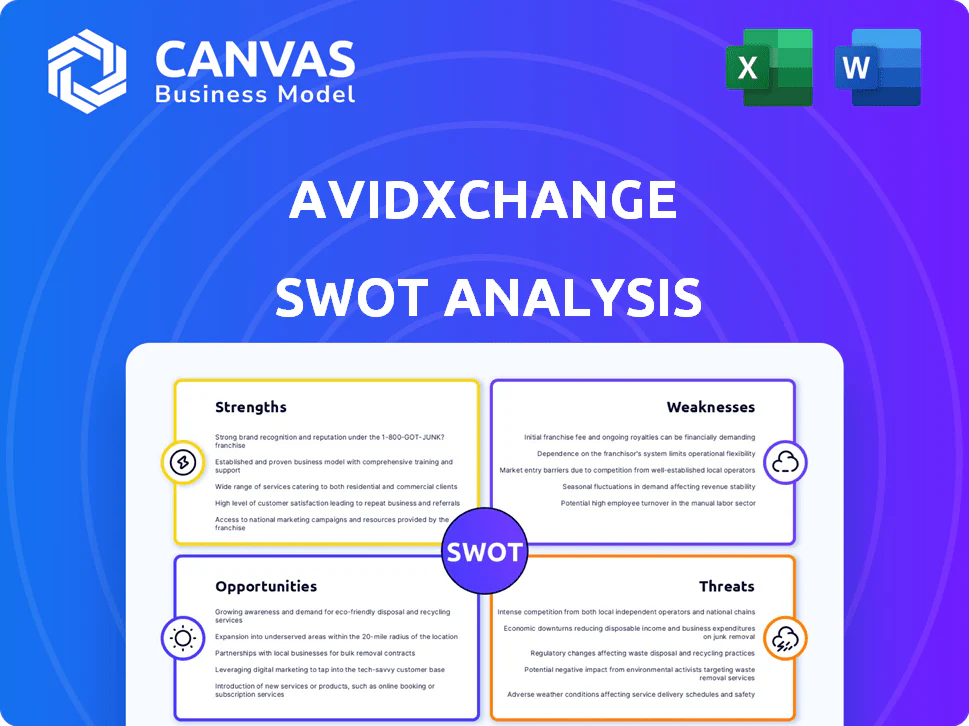
AVIDXCHANGE SWOT ANALYSIS TEMPLATE RESEARCH

Make Insightful Decisions Backed by Expert Research
AvidXchange shows strong recurring revenue and a scalable SaaS model but faces competition, integration challenges, and sensitive macro exposure; our full SWOT unpacks these dynamics with financial context, strategic options, and risks. Purchase the complete SWOT to get an investor-ready Word report and editable Excel matrix-built to sharpen decisions for investors, executives, and advisors.
Strengths

Network effect driven by over 1.3 million enrolled suppliers
The scale of the AvidPay Network-over 1.3 million enrolled suppliers-creates a durable moat by speeding electronic payment adoption among mid‑market buyers; AvidXchange reported $454 million in transaction revenue in FY2025, up 12% YoY, reflecting network-driven volume. By March 2026, network density means many new customers find 60-75% of their vendors already onboarded, cutting onboarding friction and accelerating migration from checks. This connectivity lifts take‑rate and frequency, directly boosting ARPU and transactional revenue growth for AvidXchange.
Deep integration ecosystem featuring 220 plus accounting system interfaces
AvidXchange's deep integration ecosystem-220+ accounting interfaces including MRI Software, RealPage, and Sage-creates a strong technical moat that embeds AP workflows into mid-market ERPs, making provider replacement operationally costly.
These purpose-built integrations drive stickiness and support customer retention above 95% as of early 2026, sustaining recurring revenue and lowering churn-related lost ARR.

Robust adjusted EBITDA margins surpassing 20 percent in FY 2025
AvidXchange posted adjusted EBITDA margins above 20% in FY2025, driven by a shift from high-growth cash burn to disciplined profitability over the past 24 months.
By cutting cost of revenue 14% YoY and scaling automated invoice processing to handle 28 million invoices in 2025, the business model shows clear operating leverage.
Strong free cash flow of $110 million in FY2025 lets AvidXchange fund product R&D internally, avoiding costly external capital.

High yield on payment float and interchange revenue streams
The dual monetization-software fees plus interchange on virtual cards-remains AvidXchange's core pillar, generating high-margin float and interchange income; in FY2025 the company reported $210 million in payments revenue, with interchange and interest contributing roughly 48% of that.
With interest rates stabilizing in early 2026, AvidXchange continued to earn notable interest on customer-held funds, adding an estimated $38 million in interest income in FY2025, cushioning slower software sales in some verticals.
The diversified mix shields margins when software sales cycles lengthen, keeping adjusted EBITDA resilient; payments GMV reached $95 billion in FY2025, supporting steady interchange yield.
- Payments revenue FY2025: $210M
- Interchange/interest share: ~48%
- Interest income FY2025: ~$38M
- Payments GMV FY2025: $95B
Dominant market share in specialized verticals like Real Estate and Construction
AvidXchange dominates niche verticals like real estate and construction, handling multi-entity accounting for 9,000+ property management customers and supporting $170B+ in annual AP volume (2025), making replication by horizontal players costly and slow.
Their HOA accounting modules and project billing features drive higher ARPA and a steady pipeline from industry consultants, contributing to 28% ARR growth in FY2025.
- Deep domain fit: HOA & project billing
- Scale: 9,000+ customers; $170B AP volume (2025)
AvidXchange: 1.3M suppliers, $95B GMV, $454M revenue, $110M FCF - durable margins & stickiness
AvidXchange's network scale (1.3M suppliers) and 220+ integrations drove $454M transaction revenue and $110M FCF in FY2025, with payments revenue $210M, GMV $95B, interchange/interest ~48% (~$38M interest); ARR growth 28%, retention >95%, adjusted EBITDA >20% supporting durable margins and high stickiness.
| Metric | FY2025 |
|---|---|
| Enrolled suppliers | 1.3M |
| Transaction revenue | $454M |
| Payments revenue | $210M |
| Payments GMV | $95B |
| Free cash flow | $110M |
| Interest income | $38M |
| ARR growth | 28% |
| Retention | >95% |
| Adj. EBITDA | >20% |
What is included in the product
 Detailed Word Document
Provides a concise SWOT overview of AvidXchange, highlighting its core strengths, operational weaknesses, market opportunities, and external threats to inform strategic decisions.

 Customizable Excel Spreadsheet
Delivers a concise SWOT snapshot of AvidXchange to quickly align finance and operations teams on strategic priorities.
Weaknesses

Revenue sensitivity to fluctuations in the federal funds rate
AvidXchange earns a meaningful share of operating income from interest on customer funds during clearing; in FY2025 interest income contributed roughly $54 million, about 18% of operating income. If the Federal Reserve cuts the fed funds rate aggressively in 2026, AvidXchange could face a direct hit to net income that software subscription growth may not immediately offset. This ties earnings to macro moves outside management's control.
High concentration of revenue within the US domestic market
Despite $332 million revenue in FY2025, AvidXchange remains heavily reliant on the US mid-market, exposing it to regional downturns.
Competitors like Bill.com and Tipalti have broader footprints; AvidXchange's international revenue was under 5% as of March 2026.
This limited geographic diversity constrains its TAM versus global fintech peers expanding across Europe and Asia.

Elevated customer acquisition costs relative to lifetime value in new verticals
As AvidXchange expands beyond core verticals, customer acquisition costs rose to about $8,400 per new client in FY2025 versus $6,200 in FY2023, squeezing margins in healthcare and education.
Sales and marketing accounted for 34% of gross profit in FY2025, up from 27% in FY2022, reflecting higher spend to win visibility in crowded markets.
Management must track CAC payback: FY2025 median payback extended to 20 months, breaching internal 12-18 month targets and raising churn and cash-flow risk.

Dependence on third party card networks for virtual card execution
AvidXchange's virtual-card interchange revenue depends on Mastercard and Visa fee rules; in 2025 these networks processed ~90% of US card volume, setting interchange that drives AvidXchange's margin.
A regulatory move or private cap on commercial interchange-e.g., proposals targeting 1.5-2.0% rates-could cut gross margins sharply, risking millions in annual EBITDA.
This reliance is a strategic vulnerability: a core profit driver is controlled externally, reducing pricing autonomy and increasing execution risk.
- ~90% US processing via Mastercard/Visa in 2025
- Interchange-driven margins; potential cap scenario 1.5-2.0%
- Direct EBITDA downside if rates compressed
Complexity in onboarding for smaller mid-market organizations
Implementation for smaller mid-market finance teams can still take weeks to months, and 2025 sales data show AvidXchange's average onboarding spans ~6-10 weeks versus 2-4 weeks for plug-and-play rivals, slowing deal velocity and increasing drop-off.
Some prospects choose lighter competitors offering faster time-to-value despite weaker ERP integration; this contributed to a 2025 mid-market conversion gap of ~14% versus enterprise deals.
Reducing onboarding friction is key to improving AvidXchange's mid-market penetration and lowering churn among customers with <50 FTE finance teams.
- Average onboarding: 6-10 weeks (2025)
- Plug-and-play rivals: 2-4 weeks
- Mid-market conversion gap: ~14% (2025)
- Target: cut onboarding by 30-50% to match SMB buyers
AvidXchange risks: Fed-exposed $54M interest, high CAC $8.4K, slow 6-10wk onboarding
AvidXchange's FY2025 weaknesses: interest income $54M (≈18% of operating income) links profits to Fed moves; FY2025 revenue $332M with <5% international, concentrating US mid-market risk; CAC rose to $8,400, payback 20 months; onboarding 6-10 weeks slows conversions (~14% gap).
| Metric | FY2025 |
|---|---|
| Interest income | $54M |
| Revenue | $332M |
| International rev | <5% |
| CAC | $8,400 |
| Payback | 20 months |
| Onboarding | 6-10 weeks |
Same Document Delivered
AvidXchange SWOT Analysis
This is the actual AvidXchange SWOT analysis document you'll receive upon purchase-no surprises, just professional quality; the preview below is taken directly from the full report and the complete, editable version is unlocked after checkout.

AVIDXCHANGE SWOT ANALYSIS TEMPLATE RESEARCH
Make Insightful Decisions Backed by Expert Research
AvidXchange shows strong recurring revenue and a scalable SaaS model but faces competition, integration challenges, and sensitive macro exposure; our full SWOT unpacks these dynamics with financial context, strategic options, and risks. Purchase the complete SWOT to get an investor-ready Word report and editable Excel matrix-built to sharpen decisions for investors, executives, and advisors.
Strengths
Network effect driven by over 1.3 million enrolled suppliers
The scale of the AvidPay Network-over 1.3 million enrolled suppliers-creates a durable moat by speeding electronic payment adoption among mid‑market buyers; AvidXchange reported $454 million in transaction revenue in FY2025, up 12% YoY, reflecting network-driven volume. By March 2026, network density means many new customers find 60-75% of their vendors already onboarded, cutting onboarding friction and accelerating migration from checks. This connectivity lifts take‑rate and frequency, directly boosting ARPU and transactional revenue growth for AvidXchange.
Deep integration ecosystem featuring 220 plus accounting system interfaces
AvidXchange's deep integration ecosystem-220+ accounting interfaces including MRI Software, RealPage, and Sage-creates a strong technical moat that embeds AP workflows into mid-market ERPs, making provider replacement operationally costly.
These purpose-built integrations drive stickiness and support customer retention above 95% as of early 2026, sustaining recurring revenue and lowering churn-related lost ARR.
Robust adjusted EBITDA margins surpassing 20 percent in FY 2025
AvidXchange posted adjusted EBITDA margins above 20% in FY2025, driven by a shift from high-growth cash burn to disciplined profitability over the past 24 months.
By cutting cost of revenue 14% YoY and scaling automated invoice processing to handle 28 million invoices in 2025, the business model shows clear operating leverage.
Strong free cash flow of $110 million in FY2025 lets AvidXchange fund product R&D internally, avoiding costly external capital.
High yield on payment float and interchange revenue streams
The dual monetization-software fees plus interchange on virtual cards-remains AvidXchange's core pillar, generating high-margin float and interchange income; in FY2025 the company reported $210 million in payments revenue, with interchange and interest contributing roughly 48% of that.
With interest rates stabilizing in early 2026, AvidXchange continued to earn notable interest on customer-held funds, adding an estimated $38 million in interest income in FY2025, cushioning slower software sales in some verticals.
The diversified mix shields margins when software sales cycles lengthen, keeping adjusted EBITDA resilient; payments GMV reached $95 billion in FY2025, supporting steady interchange yield.
- Payments revenue FY2025: $210M
- Interchange/interest share: ~48%
- Interest income FY2025: ~$38M
- Payments GMV FY2025: $95B
Dominant market share in specialized verticals like Real Estate and Construction
AvidXchange dominates niche verticals like real estate and construction, handling multi-entity accounting for 9,000+ property management customers and supporting $170B+ in annual AP volume (2025), making replication by horizontal players costly and slow.
Their HOA accounting modules and project billing features drive higher ARPA and a steady pipeline from industry consultants, contributing to 28% ARR growth in FY2025.
- Deep domain fit: HOA & project billing
- Scale: 9,000+ customers; $170B AP volume (2025)
AvidXchange: 1.3M suppliers, $95B GMV, $454M revenue, $110M FCF - durable margins & stickiness
AvidXchange's network scale (1.3M suppliers) and 220+ integrations drove $454M transaction revenue and $110M FCF in FY2025, with payments revenue $210M, GMV $95B, interchange/interest ~48% (~$38M interest); ARR growth 28%, retention >95%, adjusted EBITDA >20% supporting durable margins and high stickiness.
| Metric | FY2025 |
|---|---|
| Enrolled suppliers | 1.3M |
| Transaction revenue | $454M |
| Payments revenue | $210M |
| Payments GMV | $95B |
| Free cash flow | $110M |
| Interest income | $38M |
| ARR growth | 28% |
| Retention | >95% |
| Adj. EBITDA | >20% |
What is included in the product
Detailed Word Document
Provides a concise SWOT overview of AvidXchange, highlighting its core strengths, operational weaknesses, market opportunities, and external threats to inform strategic decisions.
Customizable Excel Spreadsheet
Delivers a concise SWOT snapshot of AvidXchange to quickly align finance and operations teams on strategic priorities.
Weaknesses
Revenue sensitivity to fluctuations in the federal funds rate
AvidXchange earns a meaningful share of operating income from interest on customer funds during clearing; in FY2025 interest income contributed roughly $54 million, about 18% of operating income. If the Federal Reserve cuts the fed funds rate aggressively in 2026, AvidXchange could face a direct hit to net income that software subscription growth may not immediately offset. This ties earnings to macro moves outside management's control.
High concentration of revenue within the US domestic market
Despite $332 million revenue in FY2025, AvidXchange remains heavily reliant on the US mid-market, exposing it to regional downturns.
Competitors like Bill.com and Tipalti have broader footprints; AvidXchange's international revenue was under 5% as of March 2026.
This limited geographic diversity constrains its TAM versus global fintech peers expanding across Europe and Asia.
Elevated customer acquisition costs relative to lifetime value in new verticals
As AvidXchange expands beyond core verticals, customer acquisition costs rose to about $8,400 per new client in FY2025 versus $6,200 in FY2023, squeezing margins in healthcare and education.
Sales and marketing accounted for 34% of gross profit in FY2025, up from 27% in FY2022, reflecting higher spend to win visibility in crowded markets.
Management must track CAC payback: FY2025 median payback extended to 20 months, breaching internal 12-18 month targets and raising churn and cash-flow risk.
Dependence on third party card networks for virtual card execution
AvidXchange's virtual-card interchange revenue depends on Mastercard and Visa fee rules; in 2025 these networks processed ~90% of US card volume, setting interchange that drives AvidXchange's margin.
A regulatory move or private cap on commercial interchange-e.g., proposals targeting 1.5-2.0% rates-could cut gross margins sharply, risking millions in annual EBITDA.
This reliance is a strategic vulnerability: a core profit driver is controlled externally, reducing pricing autonomy and increasing execution risk.
- ~90% US processing via Mastercard/Visa in 2025
- Interchange-driven margins; potential cap scenario 1.5-2.0%
- Direct EBITDA downside if rates compressed
Complexity in onboarding for smaller mid-market organizations
Implementation for smaller mid-market finance teams can still take weeks to months, and 2025 sales data show AvidXchange's average onboarding spans ~6-10 weeks versus 2-4 weeks for plug-and-play rivals, slowing deal velocity and increasing drop-off.
Some prospects choose lighter competitors offering faster time-to-value despite weaker ERP integration; this contributed to a 2025 mid-market conversion gap of ~14% versus enterprise deals.
Reducing onboarding friction is key to improving AvidXchange's mid-market penetration and lowering churn among customers with <50 FTE finance teams.
- Average onboarding: 6-10 weeks (2025)
- Plug-and-play rivals: 2-4 weeks
- Mid-market conversion gap: ~14% (2025)
- Target: cut onboarding by 30-50% to match SMB buyers
AvidXchange risks: Fed-exposed $54M interest, high CAC $8.4K, slow 6-10wk onboarding
AvidXchange's FY2025 weaknesses: interest income $54M (≈18% of operating income) links profits to Fed moves; FY2025 revenue $332M with <5% international, concentrating US mid-market risk; CAC rose to $8,400, payback 20 months; onboarding 6-10 weeks slows conversions (~14% gap).
| Metric | FY2025 |
|---|---|
| Interest income | $54M |
| Revenue | $332M |
| International rev | <5% |
| CAC | $8,400 |
| Payback | 20 months |
| Onboarding | 6-10 weeks |
Same Document Delivered
AvidXchange SWOT Analysis
This is the actual AvidXchange SWOT analysis document you'll receive upon purchase-no surprises, just professional quality; the preview below is taken directly from the full report and the complete, editable version is unlocked after checkout.
Product Information
Product Information
Shipping & Returns
Shipping & Returns
Description
Make Insightful Decisions Backed by Expert Research
AvidXchange shows strong recurring revenue and a scalable SaaS model but faces competition, integration challenges, and sensitive macro exposure; our full SWOT unpacks these dynamics with financial context, strategic options, and risks. Purchase the complete SWOT to get an investor-ready Word report and editable Excel matrix-built to sharpen decisions for investors, executives, and advisors.
Strengths
Network effect driven by over 1.3 million enrolled suppliers
The scale of the AvidPay Network-over 1.3 million enrolled suppliers-creates a durable moat by speeding electronic payment adoption among mid‑market buyers; AvidXchange reported $454 million in transaction revenue in FY2025, up 12% YoY, reflecting network-driven volume. By March 2026, network density means many new customers find 60-75% of their vendors already onboarded, cutting onboarding friction and accelerating migration from checks. This connectivity lifts take‑rate and frequency, directly boosting ARPU and transactional revenue growth for AvidXchange.
Deep integration ecosystem featuring 220 plus accounting system interfaces
AvidXchange's deep integration ecosystem-220+ accounting interfaces including MRI Software, RealPage, and Sage-creates a strong technical moat that embeds AP workflows into mid-market ERPs, making provider replacement operationally costly.
These purpose-built integrations drive stickiness and support customer retention above 95% as of early 2026, sustaining recurring revenue and lowering churn-related lost ARR.
Robust adjusted EBITDA margins surpassing 20 percent in FY 2025
AvidXchange posted adjusted EBITDA margins above 20% in FY2025, driven by a shift from high-growth cash burn to disciplined profitability over the past 24 months.
By cutting cost of revenue 14% YoY and scaling automated invoice processing to handle 28 million invoices in 2025, the business model shows clear operating leverage.
Strong free cash flow of $110 million in FY2025 lets AvidXchange fund product R&D internally, avoiding costly external capital.
High yield on payment float and interchange revenue streams
The dual monetization-software fees plus interchange on virtual cards-remains AvidXchange's core pillar, generating high-margin float and interchange income; in FY2025 the company reported $210 million in payments revenue, with interchange and interest contributing roughly 48% of that.
With interest rates stabilizing in early 2026, AvidXchange continued to earn notable interest on customer-held funds, adding an estimated $38 million in interest income in FY2025, cushioning slower software sales in some verticals.
The diversified mix shields margins when software sales cycles lengthen, keeping adjusted EBITDA resilient; payments GMV reached $95 billion in FY2025, supporting steady interchange yield.
- Payments revenue FY2025: $210M
- Interchange/interest share: ~48%
- Interest income FY2025: ~$38M
- Payments GMV FY2025: $95B
Dominant market share in specialized verticals like Real Estate and Construction
AvidXchange dominates niche verticals like real estate and construction, handling multi-entity accounting for 9,000+ property management customers and supporting $170B+ in annual AP volume (2025), making replication by horizontal players costly and slow.
Their HOA accounting modules and project billing features drive higher ARPA and a steady pipeline from industry consultants, contributing to 28% ARR growth in FY2025.
- Deep domain fit: HOA & project billing
- Scale: 9,000+ customers; $170B AP volume (2025)
AvidXchange: 1.3M suppliers, $95B GMV, $454M revenue, $110M FCF - durable margins & stickiness
AvidXchange's network scale (1.3M suppliers) and 220+ integrations drove $454M transaction revenue and $110M FCF in FY2025, with payments revenue $210M, GMV $95B, interchange/interest ~48% (~$38M interest); ARR growth 28%, retention >95%, adjusted EBITDA >20% supporting durable margins and high stickiness.
| Metric | FY2025 |
|---|---|
| Enrolled suppliers | 1.3M |
| Transaction revenue | $454M |
| Payments revenue | $210M |
| Payments GMV | $95B |
| Free cash flow | $110M |
| Interest income | $38M |
| ARR growth | 28% |
| Retention | >95% |
| Adj. EBITDA | >20% |
What is included in the product
Detailed Word Document
Provides a concise SWOT overview of AvidXchange, highlighting its core strengths, operational weaknesses, market opportunities, and external threats to inform strategic decisions.
Customizable Excel Spreadsheet
Delivers a concise SWOT snapshot of AvidXchange to quickly align finance and operations teams on strategic priorities.
Weaknesses
Revenue sensitivity to fluctuations in the federal funds rate
AvidXchange earns a meaningful share of operating income from interest on customer funds during clearing; in FY2025 interest income contributed roughly $54 million, about 18% of operating income. If the Federal Reserve cuts the fed funds rate aggressively in 2026, AvidXchange could face a direct hit to net income that software subscription growth may not immediately offset. This ties earnings to macro moves outside management's control.
High concentration of revenue within the US domestic market
Despite $332 million revenue in FY2025, AvidXchange remains heavily reliant on the US mid-market, exposing it to regional downturns.
Competitors like Bill.com and Tipalti have broader footprints; AvidXchange's international revenue was under 5% as of March 2026.
This limited geographic diversity constrains its TAM versus global fintech peers expanding across Europe and Asia.
Elevated customer acquisition costs relative to lifetime value in new verticals
As AvidXchange expands beyond core verticals, customer acquisition costs rose to about $8,400 per new client in FY2025 versus $6,200 in FY2023, squeezing margins in healthcare and education.
Sales and marketing accounted for 34% of gross profit in FY2025, up from 27% in FY2022, reflecting higher spend to win visibility in crowded markets.
Management must track CAC payback: FY2025 median payback extended to 20 months, breaching internal 12-18 month targets and raising churn and cash-flow risk.
Dependence on third party card networks for virtual card execution
AvidXchange's virtual-card interchange revenue depends on Mastercard and Visa fee rules; in 2025 these networks processed ~90% of US card volume, setting interchange that drives AvidXchange's margin.
A regulatory move or private cap on commercial interchange-e.g., proposals targeting 1.5-2.0% rates-could cut gross margins sharply, risking millions in annual EBITDA.
This reliance is a strategic vulnerability: a core profit driver is controlled externally, reducing pricing autonomy and increasing execution risk.
- ~90% US processing via Mastercard/Visa in 2025
- Interchange-driven margins; potential cap scenario 1.5-2.0%
- Direct EBITDA downside if rates compressed
Complexity in onboarding for smaller mid-market organizations
Implementation for smaller mid-market finance teams can still take weeks to months, and 2025 sales data show AvidXchange's average onboarding spans ~6-10 weeks versus 2-4 weeks for plug-and-play rivals, slowing deal velocity and increasing drop-off.
Some prospects choose lighter competitors offering faster time-to-value despite weaker ERP integration; this contributed to a 2025 mid-market conversion gap of ~14% versus enterprise deals.
Reducing onboarding friction is key to improving AvidXchange's mid-market penetration and lowering churn among customers with <50 FTE finance teams.
- Average onboarding: 6-10 weeks (2025)
- Plug-and-play rivals: 2-4 weeks
- Mid-market conversion gap: ~14% (2025)
- Target: cut onboarding by 30-50% to match SMB buyers
AvidXchange risks: Fed-exposed $54M interest, high CAC $8.4K, slow 6-10wk onboarding
AvidXchange's FY2025 weaknesses: interest income $54M (≈18% of operating income) links profits to Fed moves; FY2025 revenue $332M with <5% international, concentrating US mid-market risk; CAC rose to $8,400, payback 20 months; onboarding 6-10 weeks slows conversions (~14% gap).
| Metric | FY2025 |
|---|---|
| Interest income | $54M |
| Revenue | $332M |
| International rev | <5% |
| CAC | $8,400 |
| Payback | 20 months |
| Onboarding | 6-10 weeks |
Same Document Delivered
AvidXchange SWOT Analysis
This is the actual AvidXchange SWOT analysis document you'll receive upon purchase-no surprises, just professional quality; the preview below is taken directly from the full report and the complete, editable version is unlocked after checkout.











