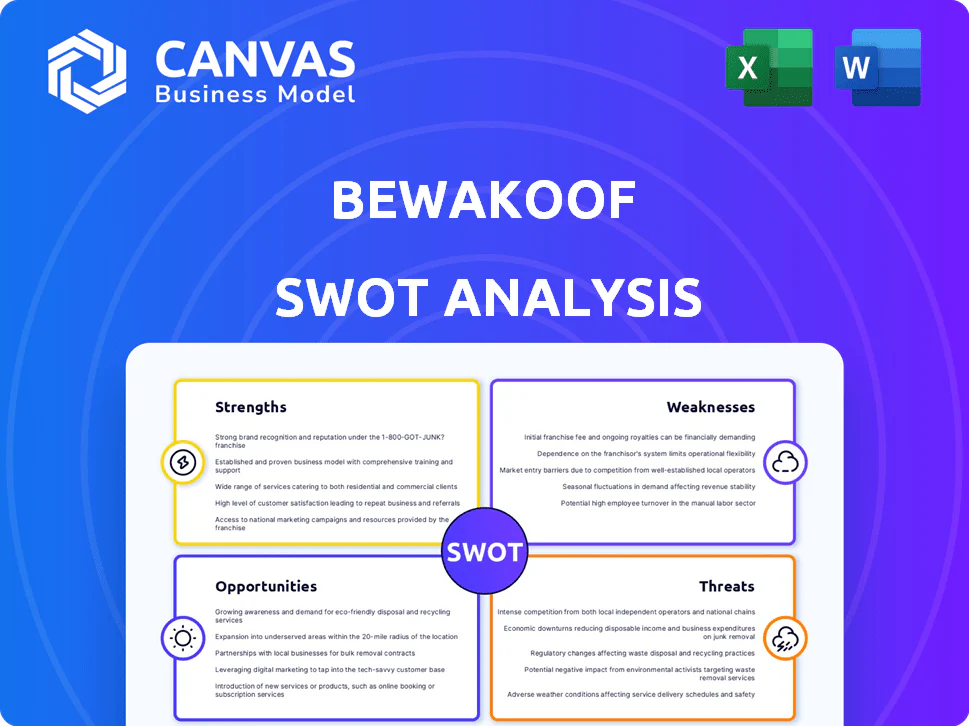
BEWAKOOF SWOT ANALYSIS TEMPLATE RESEARCH

Make Insightful Decisions Backed by Expert Research
Bewakoof's agile D2C model, strong youth brand, and digital-first marketing fuel rapid growth, but thin margins, rising competition, and supply-chain pressures pose real risks; our full SWOT unpacks these dynamics with revenue scenarios and strategic moves to defend market share. Purchase the complete SWOT analysis for a professionally formatted Word report and editable Excel tools-ready to support investment decisions, pitches, or competitive strategy.
Strengths

10 million plus active mobile app users
Bewakoof's mobile-first strategy yields 10+ million monthly active app users as of FY2025, concentrating Gen Z traffic and creating a direct, owned marketing channel that cuts paid-ad spend by an estimated 25% year-over-year; richer first-party data lifts targeting accuracy and reduces customer acquisition cost (CAC) to roughly ₹420 per user versus ₹560 on third-party channels.
Backing by TMRW House of Brands with 200 million dollars in capital support
As part of Aditya Birla Group's TMRW House of Brands with $200 million capital support, Bewakoof gains deep-pocketed backing and scaling expertise; TMRW's retail investments helped drive group FY2025 synergies, lowering procurement costs by ~8% and logistics OPEX by ~6% versus standalone peers.

Vertical integration with 30 day design to shelf cycles
Bewakoof's vertical integration lets it move from design to shelf in ~30 days, vs traditional retailers' 3-6 months, keeping inventory aligned with weekly social-media trends; in FY2025 Bewakoof reported ~₹520 crore revenue and cited 25% of SKU rollouts from rapid-response lines, underpinning speed-to-market as a clear competitive edge in fast fashion.

70 percent repeat customer rate across core demographics
70% repeat purchase rate shows Bewakoof's affordable-trendy offer resonates with core users; retention beats the ~30-40% online apparel average, implying stronger brand affinity and community effects.
This loyalty supports predictable revenue-Bewakoof reported FY2025 gross merchandise value of ₹1,050 crore and benefits from reduced acquisition cost and resilience against demand swings.
- 70% repeat rate vs 30-40% industry
- FY2025 GMV ₹1,050 crore
- Higher retention lowers CAC, stabilizes revenue
6 million plus social media followers across Instagram and Facebook
Bewakoof leverages 6.2 million+ followers on Instagram and Facebook (Mar 2026) to drive social commerce via integrated shopping, converting engagement into direct sales and reducing CAC (customer acquisition cost).
Real-time feedback on new designs crowdsources market research, with product pre-orders rising ~18% on posts that run shoppable tags.
High engagement sustains organic reach-social-driven traffic accounted for about 22% of Q4 2025 online sales-cutting ad spend.
- 6.2M+ followers (Mar 2026)
- Shoppable-post pre-order lift ~18%
- Social traffic ≈22% of Q4 2025 online sales
Bewakoof: 10M+ MAU, ₹1,050cr GMV, ₹520cr Rev, CAC ₹420, 70% Repeat
Bewakoof's mobile-first app: 10M+ MAU (FY2025), CAC ₹420 vs ₹560, GMV ₹1,050 crore, Revenue ₹520 crore, 70% repeat rate, 6.2M+ social followers (Mar 2026), social sales 22% (Q4 2025), procurement cost down 8%, logistics OPEX down 6%.
| Metric | Value (FY2025/Mar 2026) |
|---|---|
| MAU | 10M+ |
| GMV | ₹1,050 cr |
| Revenue | ₹520 cr |
| Repeat rate | 70% |
| CAC | ₹420 |
| Social followers | 6.2M+ |
What is included in the product
 Detailed Word Document
Provides a concise SWOT framework that highlights Bewakoof's core strengths, operational weaknesses, market opportunities, and external threats shaping its competitive apparel and D2C strategy.

 Customizable Excel Spreadsheet
Offers a compact SWOT snapshot of Bewakoof to quickly align strategy and highlight actionable strengths, weaknesses, opportunities, and threats for fast stakeholder decisions.
Weaknesses

85 percent revenue concentration in the graphic apparel segment
Bewakoof's revenue is 85% concentrated in graphic apparel (printed t-shirts/hoodies), creating material concentration risk; FY2025 net sales were INR 1,024 crore with ~INR 870 crore from this segment.
If consumer preference shifts to minimalist or 'quiet luxury', Bewakoof could see rapid sales erosion-graphic SKU mix still 78% of units in FY2025.
Diversification into footwear and ethnic wear remains limited-non-graphic categories contributed just 15% of FY2025 revenue and grew 6% YoY, below company average.
Marketing expenditures exceeding 20 percent of total revenue
Despite a 6.2 million Instagram+YouTube following, Bewakoof Technologies spent 22.5% of FY2025 revenue on marketing, diluting EBITDA margin to 3.1% and turning rising GMV of ₹1,230 crore into thin profits.

Limited 5 percent revenue contribution from offline retail channels
Bewakoof's offline retail contributes just 5% of FY2025 revenue (₹~45 crore of ₹900 crore total), leaving physical presence far below H&M's India store network and local chains; the missing touch-and-feel limits uptake among 35+ shoppers and low-digital-trust regions. Relying ~95% on digital sales raises exposure to platform algorithm shifts and a 22%+ YoY rise in digital ad costs recorded in 2024-25, squeezing margins and growth resilience.

Heavy dependence on third party logistics for last mile delivery
Bewakoof relies on external courier partners for last-mile delivery, causing inconsistent delivery times and a return rate of ~8.2% in FY2025, above industry peer average of ~5.5%.
Shipping delays or mishandling by partners harm brand trust and contributed to a 6% YoY drop in repeat buyers in 2025, despite the company lacking control over carriers.
The absence of an in-house logistics arm prevents offering guaranteed same-day or next-day delivery like larger rivals, limiting conversion on time-sensitive sales.
- 8.2% returns FY2025
- 6% YoY fall in repeat buyers 2025
- No owned last-mile fleet-no same/next-day delivery
90 percent of sales concentrated within the Indian domestic market
Bewakoof earns about 90% of revenue from India, leaving it vulnerable to local GDP swings and regulatory shifts; this concentration contrasts with peers like H&M and SHEIN that earn significant sales in USD/EUR, supporting higher margins and valuations.
Lack of international presence cost Bewakoof missed FX tailwinds and premium pricing; FY2025 Indian retail slowdown (GDP ~6.1%) could cut growth while global D2C comps trade at 2-4x higher EV/GMV multiples.
- ~90% revenue India exposure
- No meaningful USD/EUR sales mix
- Missed higher-margin international demand
- Valuation lag vs global D2C peers
Graphic-heavy apparel drives 85% revenue; high marketing and returns squeeze margins
High product concentration: FY2025 net sales ₹1,024 crore with ~₹870 crore (85%) from graphic apparel; SKU mix 78% graphics. Limited diversification: non-graphic revenue 15% (grew 6% YoY). High marketing spend 22.5% of revenue eroded EBITDA margin to 3.1%. Logistics gap: 8.2% returns, 6% drop in repeat buyers; ~90% revenue India.
| Metric | FY2025 |
|---|---|
| Net sales | ₹1,024 crore |
| Graphic apparel rev | ₹870 crore (85%) |
| EBITDA margin | 3.1% |
| Marketing spend | 22.5% rev |
| Returns | 8.2% |
| Repeat buyers change | -6% YoY |
| India revenue | ~90% |
What You See Is What You Get
Bewakoof SWOT Analysis
This is the actual SWOT analysis document you'll receive upon purchase-no surprises, just professional quality.

Original: $10.00
-65%$10.00
$3.50BEWAKOOF SWOT ANALYSIS TEMPLATE RESEARCH
Make Insightful Decisions Backed by Expert Research
Bewakoof's agile D2C model, strong youth brand, and digital-first marketing fuel rapid growth, but thin margins, rising competition, and supply-chain pressures pose real risks; our full SWOT unpacks these dynamics with revenue scenarios and strategic moves to defend market share. Purchase the complete SWOT analysis for a professionally formatted Word report and editable Excel tools-ready to support investment decisions, pitches, or competitive strategy.
Strengths
10 million plus active mobile app users
Bewakoof's mobile-first strategy yields 10+ million monthly active app users as of FY2025, concentrating Gen Z traffic and creating a direct, owned marketing channel that cuts paid-ad spend by an estimated 25% year-over-year; richer first-party data lifts targeting accuracy and reduces customer acquisition cost (CAC) to roughly ₹420 per user versus ₹560 on third-party channels.
Backing by TMRW House of Brands with 200 million dollars in capital support
As part of Aditya Birla Group's TMRW House of Brands with $200 million capital support, Bewakoof gains deep-pocketed backing and scaling expertise; TMRW's retail investments helped drive group FY2025 synergies, lowering procurement costs by ~8% and logistics OPEX by ~6% versus standalone peers.
Vertical integration with 30 day design to shelf cycles
Bewakoof's vertical integration lets it move from design to shelf in ~30 days, vs traditional retailers' 3-6 months, keeping inventory aligned with weekly social-media trends; in FY2025 Bewakoof reported ~₹520 crore revenue and cited 25% of SKU rollouts from rapid-response lines, underpinning speed-to-market as a clear competitive edge in fast fashion.
70 percent repeat customer rate across core demographics
70% repeat purchase rate shows Bewakoof's affordable-trendy offer resonates with core users; retention beats the ~30-40% online apparel average, implying stronger brand affinity and community effects.
This loyalty supports predictable revenue-Bewakoof reported FY2025 gross merchandise value of ₹1,050 crore and benefits from reduced acquisition cost and resilience against demand swings.
- 70% repeat rate vs 30-40% industry
- FY2025 GMV ₹1,050 crore
- Higher retention lowers CAC, stabilizes revenue
6 million plus social media followers across Instagram and Facebook
Bewakoof leverages 6.2 million+ followers on Instagram and Facebook (Mar 2026) to drive social commerce via integrated shopping, converting engagement into direct sales and reducing CAC (customer acquisition cost).
Real-time feedback on new designs crowdsources market research, with product pre-orders rising ~18% on posts that run shoppable tags.
High engagement sustains organic reach-social-driven traffic accounted for about 22% of Q4 2025 online sales-cutting ad spend.
- 6.2M+ followers (Mar 2026)
- Shoppable-post pre-order lift ~18%
- Social traffic ≈22% of Q4 2025 online sales
Bewakoof: 10M+ MAU, ₹1,050cr GMV, ₹520cr Rev, CAC ₹420, 70% Repeat
Bewakoof's mobile-first app: 10M+ MAU (FY2025), CAC ₹420 vs ₹560, GMV ₹1,050 crore, Revenue ₹520 crore, 70% repeat rate, 6.2M+ social followers (Mar 2026), social sales 22% (Q4 2025), procurement cost down 8%, logistics OPEX down 6%.
| Metric | Value (FY2025/Mar 2026) |
|---|---|
| MAU | 10M+ |
| GMV | ₹1,050 cr |
| Revenue | ₹520 cr |
| Repeat rate | 70% |
| CAC | ₹420 |
| Social followers | 6.2M+ |
What is included in the product
Detailed Word Document
Provides a concise SWOT framework that highlights Bewakoof's core strengths, operational weaknesses, market opportunities, and external threats shaping its competitive apparel and D2C strategy.
Customizable Excel Spreadsheet
Offers a compact SWOT snapshot of Bewakoof to quickly align strategy and highlight actionable strengths, weaknesses, opportunities, and threats for fast stakeholder decisions.
Weaknesses
85 percent revenue concentration in the graphic apparel segment
Bewakoof's revenue is 85% concentrated in graphic apparel (printed t-shirts/hoodies), creating material concentration risk; FY2025 net sales were INR 1,024 crore with ~INR 870 crore from this segment.
If consumer preference shifts to minimalist or 'quiet luxury', Bewakoof could see rapid sales erosion-graphic SKU mix still 78% of units in FY2025.
Diversification into footwear and ethnic wear remains limited-non-graphic categories contributed just 15% of FY2025 revenue and grew 6% YoY, below company average.
Marketing expenditures exceeding 20 percent of total revenue
Despite a 6.2 million Instagram+YouTube following, Bewakoof Technologies spent 22.5% of FY2025 revenue on marketing, diluting EBITDA margin to 3.1% and turning rising GMV of ₹1,230 crore into thin profits.
Limited 5 percent revenue contribution from offline retail channels
Bewakoof's offline retail contributes just 5% of FY2025 revenue (₹~45 crore of ₹900 crore total), leaving physical presence far below H&M's India store network and local chains; the missing touch-and-feel limits uptake among 35+ shoppers and low-digital-trust regions. Relying ~95% on digital sales raises exposure to platform algorithm shifts and a 22%+ YoY rise in digital ad costs recorded in 2024-25, squeezing margins and growth resilience.
Heavy dependence on third party logistics for last mile delivery
Bewakoof relies on external courier partners for last-mile delivery, causing inconsistent delivery times and a return rate of ~8.2% in FY2025, above industry peer average of ~5.5%.
Shipping delays or mishandling by partners harm brand trust and contributed to a 6% YoY drop in repeat buyers in 2025, despite the company lacking control over carriers.
The absence of an in-house logistics arm prevents offering guaranteed same-day or next-day delivery like larger rivals, limiting conversion on time-sensitive sales.
- 8.2% returns FY2025
- 6% YoY fall in repeat buyers 2025
- No owned last-mile fleet-no same/next-day delivery
90 percent of sales concentrated within the Indian domestic market
Bewakoof earns about 90% of revenue from India, leaving it vulnerable to local GDP swings and regulatory shifts; this concentration contrasts with peers like H&M and SHEIN that earn significant sales in USD/EUR, supporting higher margins and valuations.
Lack of international presence cost Bewakoof missed FX tailwinds and premium pricing; FY2025 Indian retail slowdown (GDP ~6.1%) could cut growth while global D2C comps trade at 2-4x higher EV/GMV multiples.
- ~90% revenue India exposure
- No meaningful USD/EUR sales mix
- Missed higher-margin international demand
- Valuation lag vs global D2C peers
Graphic-heavy apparel drives 85% revenue; high marketing and returns squeeze margins
High product concentration: FY2025 net sales ₹1,024 crore with ~₹870 crore (85%) from graphic apparel; SKU mix 78% graphics. Limited diversification: non-graphic revenue 15% (grew 6% YoY). High marketing spend 22.5% of revenue eroded EBITDA margin to 3.1%. Logistics gap: 8.2% returns, 6% drop in repeat buyers; ~90% revenue India.
| Metric | FY2025 |
|---|---|
| Net sales | ₹1,024 crore |
| Graphic apparel rev | ₹870 crore (85%) |
| EBITDA margin | 3.1% |
| Marketing spend | 22.5% rev |
| Returns | 8.2% |
| Repeat buyers change | -6% YoY |
| India revenue | ~90% |
What You See Is What You Get
Bewakoof SWOT Analysis
This is the actual SWOT analysis document you'll receive upon purchase-no surprises, just professional quality.
Product Information
Product Information
Shipping & Returns
Shipping & Returns
Description
Make Insightful Decisions Backed by Expert Research
Bewakoof's agile D2C model, strong youth brand, and digital-first marketing fuel rapid growth, but thin margins, rising competition, and supply-chain pressures pose real risks; our full SWOT unpacks these dynamics with revenue scenarios and strategic moves to defend market share. Purchase the complete SWOT analysis for a professionally formatted Word report and editable Excel tools-ready to support investment decisions, pitches, or competitive strategy.
Strengths
10 million plus active mobile app users
Bewakoof's mobile-first strategy yields 10+ million monthly active app users as of FY2025, concentrating Gen Z traffic and creating a direct, owned marketing channel that cuts paid-ad spend by an estimated 25% year-over-year; richer first-party data lifts targeting accuracy and reduces customer acquisition cost (CAC) to roughly ₹420 per user versus ₹560 on third-party channels.
Backing by TMRW House of Brands with 200 million dollars in capital support
As part of Aditya Birla Group's TMRW House of Brands with $200 million capital support, Bewakoof gains deep-pocketed backing and scaling expertise; TMRW's retail investments helped drive group FY2025 synergies, lowering procurement costs by ~8% and logistics OPEX by ~6% versus standalone peers.
Vertical integration with 30 day design to shelf cycles
Bewakoof's vertical integration lets it move from design to shelf in ~30 days, vs traditional retailers' 3-6 months, keeping inventory aligned with weekly social-media trends; in FY2025 Bewakoof reported ~₹520 crore revenue and cited 25% of SKU rollouts from rapid-response lines, underpinning speed-to-market as a clear competitive edge in fast fashion.
70 percent repeat customer rate across core demographics
70% repeat purchase rate shows Bewakoof's affordable-trendy offer resonates with core users; retention beats the ~30-40% online apparel average, implying stronger brand affinity and community effects.
This loyalty supports predictable revenue-Bewakoof reported FY2025 gross merchandise value of ₹1,050 crore and benefits from reduced acquisition cost and resilience against demand swings.
- 70% repeat rate vs 30-40% industry
- FY2025 GMV ₹1,050 crore
- Higher retention lowers CAC, stabilizes revenue
6 million plus social media followers across Instagram and Facebook
Bewakoof leverages 6.2 million+ followers on Instagram and Facebook (Mar 2026) to drive social commerce via integrated shopping, converting engagement into direct sales and reducing CAC (customer acquisition cost).
Real-time feedback on new designs crowdsources market research, with product pre-orders rising ~18% on posts that run shoppable tags.
High engagement sustains organic reach-social-driven traffic accounted for about 22% of Q4 2025 online sales-cutting ad spend.
- 6.2M+ followers (Mar 2026)
- Shoppable-post pre-order lift ~18%
- Social traffic ≈22% of Q4 2025 online sales
Bewakoof: 10M+ MAU, ₹1,050cr GMV, ₹520cr Rev, CAC ₹420, 70% Repeat
Bewakoof's mobile-first app: 10M+ MAU (FY2025), CAC ₹420 vs ₹560, GMV ₹1,050 crore, Revenue ₹520 crore, 70% repeat rate, 6.2M+ social followers (Mar 2026), social sales 22% (Q4 2025), procurement cost down 8%, logistics OPEX down 6%.
| Metric | Value (FY2025/Mar 2026) |
|---|---|
| MAU | 10M+ |
| GMV | ₹1,050 cr |
| Revenue | ₹520 cr |
| Repeat rate | 70% |
| CAC | ₹420 |
| Social followers | 6.2M+ |
What is included in the product
Detailed Word Document
Provides a concise SWOT framework that highlights Bewakoof's core strengths, operational weaknesses, market opportunities, and external threats shaping its competitive apparel and D2C strategy.
Customizable Excel Spreadsheet
Offers a compact SWOT snapshot of Bewakoof to quickly align strategy and highlight actionable strengths, weaknesses, opportunities, and threats for fast stakeholder decisions.
Weaknesses
85 percent revenue concentration in the graphic apparel segment
Bewakoof's revenue is 85% concentrated in graphic apparel (printed t-shirts/hoodies), creating material concentration risk; FY2025 net sales were INR 1,024 crore with ~INR 870 crore from this segment.
If consumer preference shifts to minimalist or 'quiet luxury', Bewakoof could see rapid sales erosion-graphic SKU mix still 78% of units in FY2025.
Diversification into footwear and ethnic wear remains limited-non-graphic categories contributed just 15% of FY2025 revenue and grew 6% YoY, below company average.
Marketing expenditures exceeding 20 percent of total revenue
Despite a 6.2 million Instagram+YouTube following, Bewakoof Technologies spent 22.5% of FY2025 revenue on marketing, diluting EBITDA margin to 3.1% and turning rising GMV of ₹1,230 crore into thin profits.
Limited 5 percent revenue contribution from offline retail channels
Bewakoof's offline retail contributes just 5% of FY2025 revenue (₹~45 crore of ₹900 crore total), leaving physical presence far below H&M's India store network and local chains; the missing touch-and-feel limits uptake among 35+ shoppers and low-digital-trust regions. Relying ~95% on digital sales raises exposure to platform algorithm shifts and a 22%+ YoY rise in digital ad costs recorded in 2024-25, squeezing margins and growth resilience.
Heavy dependence on third party logistics for last mile delivery
Bewakoof relies on external courier partners for last-mile delivery, causing inconsistent delivery times and a return rate of ~8.2% in FY2025, above industry peer average of ~5.5%.
Shipping delays or mishandling by partners harm brand trust and contributed to a 6% YoY drop in repeat buyers in 2025, despite the company lacking control over carriers.
The absence of an in-house logistics arm prevents offering guaranteed same-day or next-day delivery like larger rivals, limiting conversion on time-sensitive sales.
- 8.2% returns FY2025
- 6% YoY fall in repeat buyers 2025
- No owned last-mile fleet-no same/next-day delivery
90 percent of sales concentrated within the Indian domestic market
Bewakoof earns about 90% of revenue from India, leaving it vulnerable to local GDP swings and regulatory shifts; this concentration contrasts with peers like H&M and SHEIN that earn significant sales in USD/EUR, supporting higher margins and valuations.
Lack of international presence cost Bewakoof missed FX tailwinds and premium pricing; FY2025 Indian retail slowdown (GDP ~6.1%) could cut growth while global D2C comps trade at 2-4x higher EV/GMV multiples.
- ~90% revenue India exposure
- No meaningful USD/EUR sales mix
- Missed higher-margin international demand
- Valuation lag vs global D2C peers
Graphic-heavy apparel drives 85% revenue; high marketing and returns squeeze margins
High product concentration: FY2025 net sales ₹1,024 crore with ~₹870 crore (85%) from graphic apparel; SKU mix 78% graphics. Limited diversification: non-graphic revenue 15% (grew 6% YoY). High marketing spend 22.5% of revenue eroded EBITDA margin to 3.1%. Logistics gap: 8.2% returns, 6% drop in repeat buyers; ~90% revenue India.
| Metric | FY2025 |
|---|---|
| Net sales | ₹1,024 crore |
| Graphic apparel rev | ₹870 crore (85%) |
| EBITDA margin | 3.1% |
| Marketing spend | 22.5% rev |
| Returns | 8.2% |
| Repeat buyers change | -6% YoY |
| India revenue | ~90% |
What You See Is What You Get
Bewakoof SWOT Analysis
This is the actual SWOT analysis document you'll receive upon purchase-no surprises, just professional quality.











