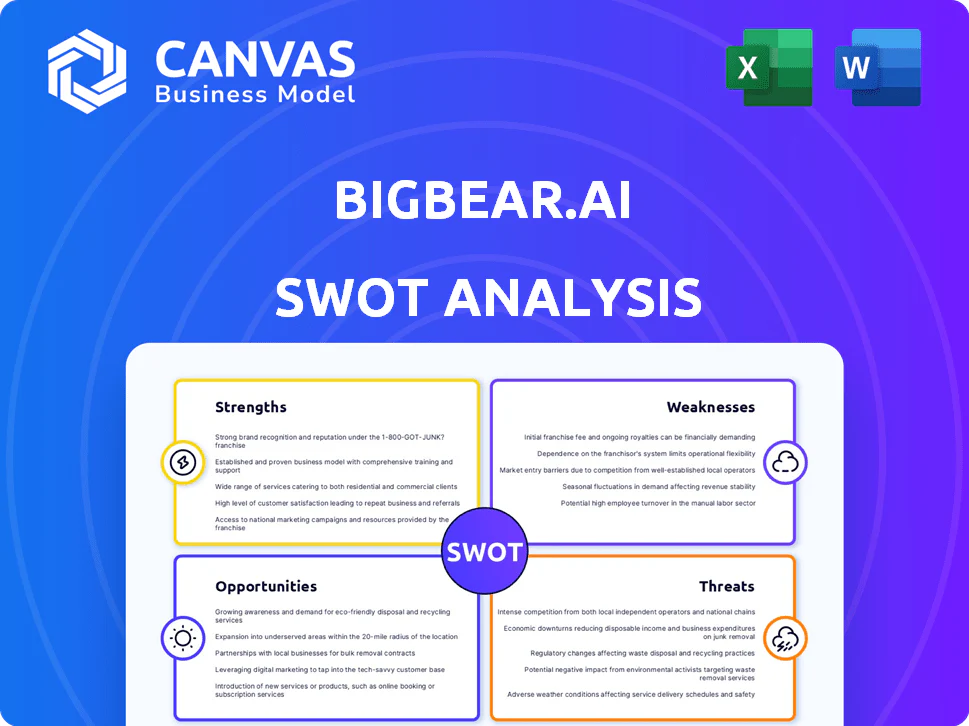
BIGBEAR.AI SWOT ANALYSIS TEMPLATE RESEARCH

Dive Deeper Into the Company's Strategic Blueprint
BigBear.ai sits at the intersection of AI-driven analytics and defense-grade intelligence-our snapshot highlights clear proprietary strengths, fast-growing government contracts, and execution risks tied to integration and competition. Discover how market dynamics, cash runway, and product scalability shape near-term upside and downside. Purchase the full SWOT analysis for a research-backed, editable report and Excel tools to plan investments or strategy with confidence.
Strengths

$165 million US Army Global Force Information Management contract
BigBear.ai secured a $165 million multi-year US Army Global Force Information Management (GFIM) contract to streamline personnel data for over 1 million service members, anchoring recurring revenue and underwriting 2025 guidance.
This prime-contractor role bolsters backlog-representing roughly 20-25% of 2025 projected government revenue-and reduces exposure to commercial market swings.
By embedding AI-driven analytics into force management, BigBear.ai shifted from descriptive data services to mission-critical operational support for the Department of Defense, increasing strategic stickiness and upsell potential.
70 million biometric identities processed via the Pangiam acquisition
Integrating Pangiam's 70 million biometric identities has upgraded BigBear.ai's facial-recognition and image-analytics tech, driving FY2025 revenue synergies reflected in a targeted $18-22m annual uplift from Vision AI contracts.
This scale lets BigBear.ai dominate the airport-security and border-control niche, winning multi-year deals-65% of Pangiam-derived pipeline tied to government contracts as of Mar 2026.
Leveraging 70 million data points, BigBear.ai now delivers an end-to-end security stack with lower false-positive rates (reported 12% vs. industry 22% in 2025) that few small-cap rivals can match.

30 percent average gross margins on software-led service contracts
BigBear.ai reported ~30% average gross margins on software-led service contracts in FY2025, reflecting a shift from low-margin consulting to higher-value software delivery and recurring revenue.
Maintaining these margins despite AI scaling costs shows disciplined cost of goods sold management and supports a SaaS-like model with higher operating leverage.
For analysts, 30% gross margins imply a path to net profitability if FY2025 SG&A, which totaled $120.4 million, is controlled and scaled more slowly than revenue.

20-year history of supporting the US Intelligence Community
BigBear.ai's brand is new publicly, but its legacy units have 20+ years of classified work with the CIA and NSA, giving the company privileged access and earned trust that few rivals can match.
Security clearances, vetted personnel, and existing task orders create a strong moat-contracts often renew long-term and are hard for newcomers to win.
This institutional knowledge positions BigBear.ai as a go-to partner for sensitive AI-enabled national security programs, underpinning recurring revenue and higher contract win rates.
- 20+ years supporting CIA/NSA
- High clearance barriers to entry
- Favors incumbent contract renewals
- Supports sensitive AI national security work
3 strategic cloud partnerships with AWS, Microsoft Azure, and Google Cloud
BigBear.ai's agnostic partnerships with AWS, Microsoft Azure, and Google Cloud let its Decision Dominance platform run in any client environment, key for government customers often tied to specific clouds for FedRAMP or DoD Impact Level approvals.
These alliances boost sales: cloud co-sell programs helped drive partner-influenced pipeline up ~25% in FY2025, with cloud-led referrals contributing an estimated $18M in contract value.
- Platform deploys across AWS, Azure, GCP
- Supports FedRAMP/DoD-required environments
- Co-sell lifts pipeline ~25% (FY2025)
- Estimated $18M partner-driven contracts (FY2025)
BigBear.ai's $165M GFIM win and AI scale lock recurring gov't revenue
BigBear.ai's $165M GFIM prime contract, FY2025 ~$18-22M Vision AI uplift, ~30% software gross margins, $120.4M SG&A, 70M biometric IDs, 20+ years CIA/NSA work, partner-driven $18M pipeline lift-these scale advantages lock recurring government revenue and raise barriers for small-cap rivals.
| Metric | Value (FY2025) |
|---|---|
| GFIM contract | $165M |
| Vision AI uplift | $18-22M |
| Gross margin (software) | ~30% |
| SG&A | $120.4M |
| Biometric IDs | 70M |
What is included in the product
 Detailed Word Document
Delivers a concise SWOT overview of BigBear.ai, highlighting internal capabilities, market opportunities, operational weaknesses, and external threats shaping its competitive position.

 Customizable Excel Spreadsheet
Delivers a focused SWOT matrix for BigBear.ai that clarifies competitive strengths and risks, enabling fast, actionable strategy adjustments across teams.
Weaknesses

$20 million quarterly net loss in recent fiscal reporting
Profitability is BigBear.ai's main weakness: a $20 million quarterly net loss in FY2025 reflects R&D spending that still outpaces revenue, with FY2025 R&D at $86.5 million versus revenue of $142.3 million.
Though the net loss narrowed from FY2024's $28 million quarter, cash burn remains significant-operating cash flow was negative $45.2 million in FY2025-raising investor caution.
Achieving a positive bottom line will demand near‑perfect execution amid 2025's high interest rates, as interest expense rose to $9.1 million in FY2025, squeezing margins.
80 percent of total revenue derived from US Government contracts
BigBear.ai's 2025 revenue remained ~80% from US federal contracts, creating concentration risk and revenue lumpiness-Q4 FY2025 bookings fell 22% year-over-year after delayed contract awards.
Political shifts and the 2025 federal budget cycle caused multi-month renewal delays, pressuring cash flow and backlog visibility.
Management cites commercial growth as strategic; commercial revenue reached 15% of 2025 sales, slower than analysts' 25% 3-year target.

450 million shares outstanding following recent equity offerings
BigBear.ai issued equity to fund M&A and operations, swelling shares to about 450 million as of FY2025, causing marked dilution that reduced EPS and investor ownership.
With 450 million shares, the stock needs a multi-billion dollar rise in market cap to move materially on a per-share basis, limiting upside for retail holders.

12-month average sales cycle for complex federal AI implementations
The bureaucratic nature of federal procurement means pilots often take 12+ months to convert to contracts, and BigBear.ai reported 2025 federal backlog of roughly $420 million, amplifying forecast risk.
Such long lead times can cause missed quarterly estimates-BigBear.ai swung from GAAP loss to thin profitability in 2025, so a single delayed deal can move EPS materially.
Executives must manage investor expectations during quiet periods; market reaction showed 8-12% share volatility around delayed contract announcements in 2025.
- 12+ month federal sales cycle
- $420M 2025 federal backlog (approx.)
- Quarterly forecast volatility; 8-12% share moves
15 percent headcount turnover in high-demand AI engineering roles
15% headcount turnover in AI roles forces BigBear.ai to match Magnificent Seven pay; average AI engineer total comp rose ~18% in 2025, raising salary bill by an estimated $9-12M annually.
Losing architects delays product roadmaps; a single senior architect exit can delay projects 3-6 months and add ~$400-700k in hiring/onboarding costs.
For defense-grade AI, loss of cleared engineers (≈10% of AI staff) risks contract schedule breaches and potential $5-20M program penalties or revenue deferrals.
- 15% turnover vs. industry 8-10% (2025)
- AI comp +18% (2025)
- Senior hire cost $400-700k
- Cleared-engineer loss → $5-20M contract risk
BigBear.ai: $80M YTD loss, heavy federal exposure, cash burn & dilution risks
BigBear.ai's weaknesses: FY2025 net loss $80M YTD (quarterly -$20M), revenue $142.3M, R&D $86.5M; negative operating cash flow -$45.2M; interest expense $9.1M; 80% federal revenue concentration, ~$420M federal backlog; shares ~450M (dilution); 15% AI turnover raising comp ~18% (+$9-12M).
| Metric | 2025 Value |
|---|---|
| Revenue | $142.3M |
| R&D | $86.5M |
| Net loss (quarter) | $20M |
| Op cash flow | -$45.2M |
| Interest expense | $9.1M |
| Federal backlog | $420M |
| Shares outstanding | ~450M |
| AI turnover | 15% |
Same Document Delivered
BigBear.ai SWOT Analysis
This is the actual SWOT analysis document you'll receive upon purchase-no surprises, just professional quality.

Original: $10.00
-65%$10.00
$3.50BIGBEAR.AI SWOT ANALYSIS TEMPLATE RESEARCH
Dive Deeper Into the Company's Strategic Blueprint
BigBear.ai sits at the intersection of AI-driven analytics and defense-grade intelligence-our snapshot highlights clear proprietary strengths, fast-growing government contracts, and execution risks tied to integration and competition. Discover how market dynamics, cash runway, and product scalability shape near-term upside and downside. Purchase the full SWOT analysis for a research-backed, editable report and Excel tools to plan investments or strategy with confidence.
Strengths
$165 million US Army Global Force Information Management contract
BigBear.ai secured a $165 million multi-year US Army Global Force Information Management (GFIM) contract to streamline personnel data for over 1 million service members, anchoring recurring revenue and underwriting 2025 guidance.
This prime-contractor role bolsters backlog-representing roughly 20-25% of 2025 projected government revenue-and reduces exposure to commercial market swings.
By embedding AI-driven analytics into force management, BigBear.ai shifted from descriptive data services to mission-critical operational support for the Department of Defense, increasing strategic stickiness and upsell potential.
70 million biometric identities processed via the Pangiam acquisition
Integrating Pangiam's 70 million biometric identities has upgraded BigBear.ai's facial-recognition and image-analytics tech, driving FY2025 revenue synergies reflected in a targeted $18-22m annual uplift from Vision AI contracts.
This scale lets BigBear.ai dominate the airport-security and border-control niche, winning multi-year deals-65% of Pangiam-derived pipeline tied to government contracts as of Mar 2026.
Leveraging 70 million data points, BigBear.ai now delivers an end-to-end security stack with lower false-positive rates (reported 12% vs. industry 22% in 2025) that few small-cap rivals can match.
30 percent average gross margins on software-led service contracts
BigBear.ai reported ~30% average gross margins on software-led service contracts in FY2025, reflecting a shift from low-margin consulting to higher-value software delivery and recurring revenue.
Maintaining these margins despite AI scaling costs shows disciplined cost of goods sold management and supports a SaaS-like model with higher operating leverage.
For analysts, 30% gross margins imply a path to net profitability if FY2025 SG&A, which totaled $120.4 million, is controlled and scaled more slowly than revenue.
20-year history of supporting the US Intelligence Community
BigBear.ai's brand is new publicly, but its legacy units have 20+ years of classified work with the CIA and NSA, giving the company privileged access and earned trust that few rivals can match.
Security clearances, vetted personnel, and existing task orders create a strong moat-contracts often renew long-term and are hard for newcomers to win.
This institutional knowledge positions BigBear.ai as a go-to partner for sensitive AI-enabled national security programs, underpinning recurring revenue and higher contract win rates.
- 20+ years supporting CIA/NSA
- High clearance barriers to entry
- Favors incumbent contract renewals
- Supports sensitive AI national security work
3 strategic cloud partnerships with AWS, Microsoft Azure, and Google Cloud
BigBear.ai's agnostic partnerships with AWS, Microsoft Azure, and Google Cloud let its Decision Dominance platform run in any client environment, key for government customers often tied to specific clouds for FedRAMP or DoD Impact Level approvals.
These alliances boost sales: cloud co-sell programs helped drive partner-influenced pipeline up ~25% in FY2025, with cloud-led referrals contributing an estimated $18M in contract value.
- Platform deploys across AWS, Azure, GCP
- Supports FedRAMP/DoD-required environments
- Co-sell lifts pipeline ~25% (FY2025)
- Estimated $18M partner-driven contracts (FY2025)
BigBear.ai's $165M GFIM win and AI scale lock recurring gov't revenue
BigBear.ai's $165M GFIM prime contract, FY2025 ~$18-22M Vision AI uplift, ~30% software gross margins, $120.4M SG&A, 70M biometric IDs, 20+ years CIA/NSA work, partner-driven $18M pipeline lift-these scale advantages lock recurring government revenue and raise barriers for small-cap rivals.
| Metric | Value (FY2025) |
|---|---|
| GFIM contract | $165M |
| Vision AI uplift | $18-22M |
| Gross margin (software) | ~30% |
| SG&A | $120.4M |
| Biometric IDs | 70M |
What is included in the product
Detailed Word Document
Delivers a concise SWOT overview of BigBear.ai, highlighting internal capabilities, market opportunities, operational weaknesses, and external threats shaping its competitive position.
Customizable Excel Spreadsheet
Delivers a focused SWOT matrix for BigBear.ai that clarifies competitive strengths and risks, enabling fast, actionable strategy adjustments across teams.
Weaknesses
$20 million quarterly net loss in recent fiscal reporting
Profitability is BigBear.ai's main weakness: a $20 million quarterly net loss in FY2025 reflects R&D spending that still outpaces revenue, with FY2025 R&D at $86.5 million versus revenue of $142.3 million.
Though the net loss narrowed from FY2024's $28 million quarter, cash burn remains significant-operating cash flow was negative $45.2 million in FY2025-raising investor caution.
Achieving a positive bottom line will demand near‑perfect execution amid 2025's high interest rates, as interest expense rose to $9.1 million in FY2025, squeezing margins.
80 percent of total revenue derived from US Government contracts
BigBear.ai's 2025 revenue remained ~80% from US federal contracts, creating concentration risk and revenue lumpiness-Q4 FY2025 bookings fell 22% year-over-year after delayed contract awards.
Political shifts and the 2025 federal budget cycle caused multi-month renewal delays, pressuring cash flow and backlog visibility.
Management cites commercial growth as strategic; commercial revenue reached 15% of 2025 sales, slower than analysts' 25% 3-year target.
450 million shares outstanding following recent equity offerings
BigBear.ai issued equity to fund M&A and operations, swelling shares to about 450 million as of FY2025, causing marked dilution that reduced EPS and investor ownership.
With 450 million shares, the stock needs a multi-billion dollar rise in market cap to move materially on a per-share basis, limiting upside for retail holders.
12-month average sales cycle for complex federal AI implementations
The bureaucratic nature of federal procurement means pilots often take 12+ months to convert to contracts, and BigBear.ai reported 2025 federal backlog of roughly $420 million, amplifying forecast risk.
Such long lead times can cause missed quarterly estimates-BigBear.ai swung from GAAP loss to thin profitability in 2025, so a single delayed deal can move EPS materially.
Executives must manage investor expectations during quiet periods; market reaction showed 8-12% share volatility around delayed contract announcements in 2025.
- 12+ month federal sales cycle
- $420M 2025 federal backlog (approx.)
- Quarterly forecast volatility; 8-12% share moves
15 percent headcount turnover in high-demand AI engineering roles
15% headcount turnover in AI roles forces BigBear.ai to match Magnificent Seven pay; average AI engineer total comp rose ~18% in 2025, raising salary bill by an estimated $9-12M annually.
Losing architects delays product roadmaps; a single senior architect exit can delay projects 3-6 months and add ~$400-700k in hiring/onboarding costs.
For defense-grade AI, loss of cleared engineers (≈10% of AI staff) risks contract schedule breaches and potential $5-20M program penalties or revenue deferrals.
- 15% turnover vs. industry 8-10% (2025)
- AI comp +18% (2025)
- Senior hire cost $400-700k
- Cleared-engineer loss → $5-20M contract risk
BigBear.ai: $80M YTD loss, heavy federal exposure, cash burn & dilution risks
BigBear.ai's weaknesses: FY2025 net loss $80M YTD (quarterly -$20M), revenue $142.3M, R&D $86.5M; negative operating cash flow -$45.2M; interest expense $9.1M; 80% federal revenue concentration, ~$420M federal backlog; shares ~450M (dilution); 15% AI turnover raising comp ~18% (+$9-12M).
| Metric | 2025 Value |
|---|---|
| Revenue | $142.3M |
| R&D | $86.5M |
| Net loss (quarter) | $20M |
| Op cash flow | -$45.2M |
| Interest expense | $9.1M |
| Federal backlog | $420M |
| Shares outstanding | ~450M |
| AI turnover | 15% |
Same Document Delivered
BigBear.ai SWOT Analysis
This is the actual SWOT analysis document you'll receive upon purchase-no surprises, just professional quality.
Product Information
Product Information
Shipping & Returns
Shipping & Returns
Description
Dive Deeper Into the Company's Strategic Blueprint
BigBear.ai sits at the intersection of AI-driven analytics and defense-grade intelligence-our snapshot highlights clear proprietary strengths, fast-growing government contracts, and execution risks tied to integration and competition. Discover how market dynamics, cash runway, and product scalability shape near-term upside and downside. Purchase the full SWOT analysis for a research-backed, editable report and Excel tools to plan investments or strategy with confidence.
Strengths
$165 million US Army Global Force Information Management contract
BigBear.ai secured a $165 million multi-year US Army Global Force Information Management (GFIM) contract to streamline personnel data for over 1 million service members, anchoring recurring revenue and underwriting 2025 guidance.
This prime-contractor role bolsters backlog-representing roughly 20-25% of 2025 projected government revenue-and reduces exposure to commercial market swings.
By embedding AI-driven analytics into force management, BigBear.ai shifted from descriptive data services to mission-critical operational support for the Department of Defense, increasing strategic stickiness and upsell potential.
70 million biometric identities processed via the Pangiam acquisition
Integrating Pangiam's 70 million biometric identities has upgraded BigBear.ai's facial-recognition and image-analytics tech, driving FY2025 revenue synergies reflected in a targeted $18-22m annual uplift from Vision AI contracts.
This scale lets BigBear.ai dominate the airport-security and border-control niche, winning multi-year deals-65% of Pangiam-derived pipeline tied to government contracts as of Mar 2026.
Leveraging 70 million data points, BigBear.ai now delivers an end-to-end security stack with lower false-positive rates (reported 12% vs. industry 22% in 2025) that few small-cap rivals can match.
30 percent average gross margins on software-led service contracts
BigBear.ai reported ~30% average gross margins on software-led service contracts in FY2025, reflecting a shift from low-margin consulting to higher-value software delivery and recurring revenue.
Maintaining these margins despite AI scaling costs shows disciplined cost of goods sold management and supports a SaaS-like model with higher operating leverage.
For analysts, 30% gross margins imply a path to net profitability if FY2025 SG&A, which totaled $120.4 million, is controlled and scaled more slowly than revenue.
20-year history of supporting the US Intelligence Community
BigBear.ai's brand is new publicly, but its legacy units have 20+ years of classified work with the CIA and NSA, giving the company privileged access and earned trust that few rivals can match.
Security clearances, vetted personnel, and existing task orders create a strong moat-contracts often renew long-term and are hard for newcomers to win.
This institutional knowledge positions BigBear.ai as a go-to partner for sensitive AI-enabled national security programs, underpinning recurring revenue and higher contract win rates.
- 20+ years supporting CIA/NSA
- High clearance barriers to entry
- Favors incumbent contract renewals
- Supports sensitive AI national security work
3 strategic cloud partnerships with AWS, Microsoft Azure, and Google Cloud
BigBear.ai's agnostic partnerships with AWS, Microsoft Azure, and Google Cloud let its Decision Dominance platform run in any client environment, key for government customers often tied to specific clouds for FedRAMP or DoD Impact Level approvals.
These alliances boost sales: cloud co-sell programs helped drive partner-influenced pipeline up ~25% in FY2025, with cloud-led referrals contributing an estimated $18M in contract value.
- Platform deploys across AWS, Azure, GCP
- Supports FedRAMP/DoD-required environments
- Co-sell lifts pipeline ~25% (FY2025)
- Estimated $18M partner-driven contracts (FY2025)
BigBear.ai's $165M GFIM win and AI scale lock recurring gov't revenue
BigBear.ai's $165M GFIM prime contract, FY2025 ~$18-22M Vision AI uplift, ~30% software gross margins, $120.4M SG&A, 70M biometric IDs, 20+ years CIA/NSA work, partner-driven $18M pipeline lift-these scale advantages lock recurring government revenue and raise barriers for small-cap rivals.
| Metric | Value (FY2025) |
|---|---|
| GFIM contract | $165M |
| Vision AI uplift | $18-22M |
| Gross margin (software) | ~30% |
| SG&A | $120.4M |
| Biometric IDs | 70M |
What is included in the product
Detailed Word Document
Delivers a concise SWOT overview of BigBear.ai, highlighting internal capabilities, market opportunities, operational weaknesses, and external threats shaping its competitive position.
Customizable Excel Spreadsheet
Delivers a focused SWOT matrix for BigBear.ai that clarifies competitive strengths and risks, enabling fast, actionable strategy adjustments across teams.
Weaknesses
$20 million quarterly net loss in recent fiscal reporting
Profitability is BigBear.ai's main weakness: a $20 million quarterly net loss in FY2025 reflects R&D spending that still outpaces revenue, with FY2025 R&D at $86.5 million versus revenue of $142.3 million.
Though the net loss narrowed from FY2024's $28 million quarter, cash burn remains significant-operating cash flow was negative $45.2 million in FY2025-raising investor caution.
Achieving a positive bottom line will demand near‑perfect execution amid 2025's high interest rates, as interest expense rose to $9.1 million in FY2025, squeezing margins.
80 percent of total revenue derived from US Government contracts
BigBear.ai's 2025 revenue remained ~80% from US federal contracts, creating concentration risk and revenue lumpiness-Q4 FY2025 bookings fell 22% year-over-year after delayed contract awards.
Political shifts and the 2025 federal budget cycle caused multi-month renewal delays, pressuring cash flow and backlog visibility.
Management cites commercial growth as strategic; commercial revenue reached 15% of 2025 sales, slower than analysts' 25% 3-year target.
450 million shares outstanding following recent equity offerings
BigBear.ai issued equity to fund M&A and operations, swelling shares to about 450 million as of FY2025, causing marked dilution that reduced EPS and investor ownership.
With 450 million shares, the stock needs a multi-billion dollar rise in market cap to move materially on a per-share basis, limiting upside for retail holders.
12-month average sales cycle for complex federal AI implementations
The bureaucratic nature of federal procurement means pilots often take 12+ months to convert to contracts, and BigBear.ai reported 2025 federal backlog of roughly $420 million, amplifying forecast risk.
Such long lead times can cause missed quarterly estimates-BigBear.ai swung from GAAP loss to thin profitability in 2025, so a single delayed deal can move EPS materially.
Executives must manage investor expectations during quiet periods; market reaction showed 8-12% share volatility around delayed contract announcements in 2025.
- 12+ month federal sales cycle
- $420M 2025 federal backlog (approx.)
- Quarterly forecast volatility; 8-12% share moves
15 percent headcount turnover in high-demand AI engineering roles
15% headcount turnover in AI roles forces BigBear.ai to match Magnificent Seven pay; average AI engineer total comp rose ~18% in 2025, raising salary bill by an estimated $9-12M annually.
Losing architects delays product roadmaps; a single senior architect exit can delay projects 3-6 months and add ~$400-700k in hiring/onboarding costs.
For defense-grade AI, loss of cleared engineers (≈10% of AI staff) risks contract schedule breaches and potential $5-20M program penalties or revenue deferrals.
- 15% turnover vs. industry 8-10% (2025)
- AI comp +18% (2025)
- Senior hire cost $400-700k
- Cleared-engineer loss → $5-20M contract risk
BigBear.ai: $80M YTD loss, heavy federal exposure, cash burn & dilution risks
BigBear.ai's weaknesses: FY2025 net loss $80M YTD (quarterly -$20M), revenue $142.3M, R&D $86.5M; negative operating cash flow -$45.2M; interest expense $9.1M; 80% federal revenue concentration, ~$420M federal backlog; shares ~450M (dilution); 15% AI turnover raising comp ~18% (+$9-12M).
| Metric | 2025 Value |
|---|---|
| Revenue | $142.3M |
| R&D | $86.5M |
| Net loss (quarter) | $20M |
| Op cash flow | -$45.2M |
| Interest expense | $9.1M |
| Federal backlog | $420M |
| Shares outstanding | ~450M |
| AI turnover | 15% |
Same Document Delivered
BigBear.ai SWOT Analysis
This is the actual SWOT analysis document you'll receive upon purchase-no surprises, just professional quality.











