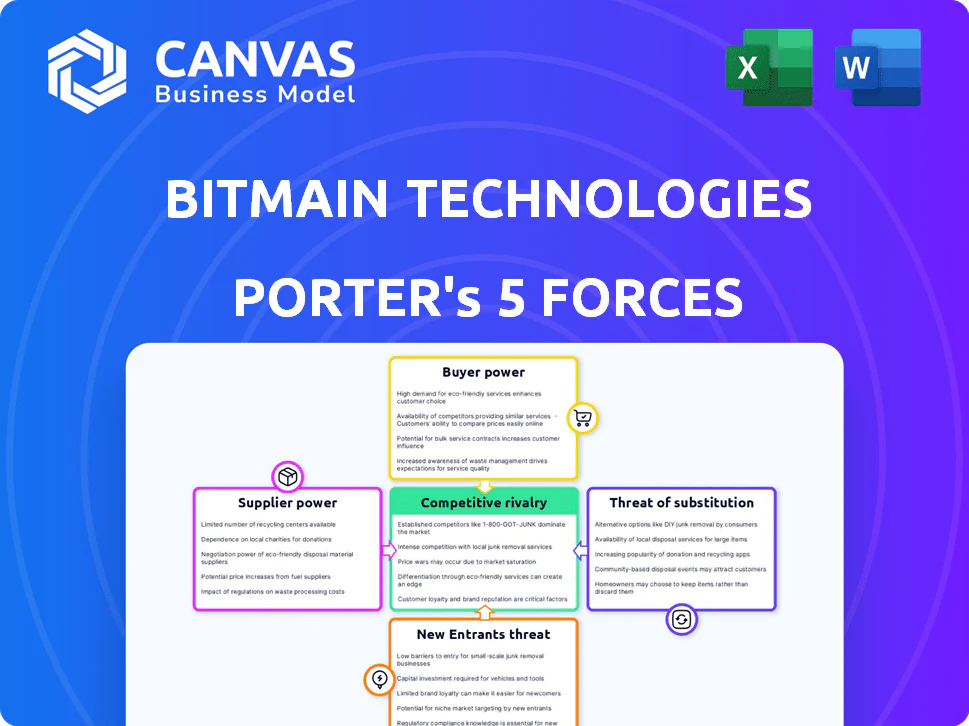
BITMAIN TECHNOLOGIES PORTER'S FIVE FORCES TEMPLATE RESEARCH
What is included in the product
 Detailed Word Document
Analyzes Bitmain's competitive position by examining key forces like rivalry, suppliers, and buyers.

 Customizable Excel Spreadsheet
Instantly identify competitive threats via color-coded force scores.
Preview the Actual Deliverable
Bitmain Technologies Porter's Five Forces Analysis
This preview showcases the complete Porter's Five Forces analysis of Bitmain Technologies. The document analyzes industry rivalry, threat of new entrants, bargaining power of suppliers, bargaining power of buyers, and threat of substitutes. You're viewing the full, final analysis.

Porter's Five Forces Analysis Template

Don't Miss the Bigger Picture
Bitmain Technologies faces intense competition, especially from specialized chip manufacturers, impacting its profitability. Buyer power is moderate, largely due to market price sensitivity and alternative mining hardware options. Suppliers, mainly semiconductor foundries, hold significant bargaining power, which directly affects production costs. The threat of new entrants is high, fueled by the growing cryptocurrency mining market. The availability of substitute products, such as cloud mining services, presents a moderate threat to Bitmain's market share.
The complete report reveals the real forces shaping Bitmain Technologies’s industry—from supplier influence to threat of new entrants. Gain actionable insights to drive smarter decision-making.
Suppliers Bargaining Power

Limited Number of Specialized ASIC Chip Manufacturers
The advanced ASIC chip market is dominated by a few key players like TSMC and Samsung, who control a significant portion of the global foundry capacity. In 2024, TSMC accounted for over 60% of the global foundry market share. This concentration gives suppliers substantial bargaining power. Bitmain, heavily reliant on these few manufacturers, faces higher costs and potential supply constraints. The limited options make Bitmain vulnerable to supplier price increases and demands.
High Switching Costs for Bitmain
Bitmain faces substantial supplier power due to high switching costs. Moving from a major semiconductor supplier is costly. Redesigning chips and retooling manufacturing processes are expensive. This reduces the likelihood of Bitmain switching suppliers frequently.

Proprietary Technology Held by Suppliers
Key suppliers in the semiconductor industry, such as TSMC, hold proprietary technology essential for high-performance ASIC chips. This gives them strong bargaining power. Bitmain relies on these suppliers' advancements. In 2024, TSMC's net revenue was approximately $69.3 billion, reflecting its significant market influence.

Potential for Supply Chain Constraints
The semiconductor industry's global nature exposes it to supply chain issues, significantly affecting ASIC chip availability and price. This vulnerability enhances supplier power, particularly when demand surpasses supply, enabling them to set terms. In 2024, the chip shortage continued to influence the market, with prices fluctuating and impacting manufacturers like Bitmain. Recent data indicates that the average lead time for chip deliveries has decreased, but the risk of disruptions remains.
- Supply chain disruptions can severely limit ASIC chip availability.
- Suppliers gain leverage when demand exceeds the available supply.
- Chip price volatility impacts manufacturers' profitability.
- Lead times for chip deliveries may fluctuate.
Suppliers' Ability to Forward Integrate
Suppliers' ability to forward integrate poses a moderate threat to Bitmain. The primary suppliers, like TSMC, could theoretically enter the ASIC mining hardware market directly. This potential, even if not acted upon, grants suppliers negotiation power. They could use this to influence pricing or supply terms.
- TSMC reported a revenue of $19.3 billion in Q4 2023.
- In 2024, the global semiconductor market is projected to reach $588.2 billion.
- Bitmain's market share in the ASIC mining hardware market was estimated around 70% in 2024.
Chip Giants Squeeze: Supplier Power Dynamics
Bitmain faces strong supplier power from key chip manufacturers like TSMC and Samsung. In 2024, TSMC held over 60% of the global foundry market share, giving them significant leverage. High switching costs and proprietary tech further strengthen suppliers' positions. Supply chain issues also enhance supplier power, affecting chip availability and prices.
| Aspect | Impact on Bitmain | 2024 Data/Fact |
|---|---|---|
| Market Concentration | Limits options, increases costs | TSMC: Over 60% foundry market share |
| Switching Costs | Reduces supplier switching | Redesigning chips is expensive |
| Technology Dependence | Vulnerability to supplier advancements | TSMC's 2024 net revenue: ~$69.3B |
| Supply Chain | Affects chip availability, prices | Global chip market projected: $588.2B |
Customers Bargaining Power

Concentration of Large Mining Farms as Customers
Bitmain's customer base includes large mining farms, which account for a substantial portion of its sales. These farms have significant bargaining power. In 2024, major mining pools and large-scale operations, like those in North America, have driven significant hardware purchases. They leverage their purchasing volume to negotiate favorable terms.
Customers' Price Sensitivity
Bitmain's customers, cryptocurrency miners, are notably price-sensitive. Their profitability hinges on electricity costs and crypto prices, driving them to seek the most affordable hardware. This price sensitivity bolsters their bargaining power. In 2024, Bitcoin's price volatility directly impacted miner profitability, heightening this pressure.

Availability of Alternative ASIC Manufacturers
Bitmain faces competition from ASIC manufacturers like MicroBT. In 2024, MicroBT's market share grew, offering alternatives. This competition forces Bitmain to offer competitive pricing and product features. Customers can switch, affecting Bitmain's profitability.

Customers' Ability to Delay Purchases
Customers, particularly mining companies, can significantly influence Bitmain's sales. When Bitcoin or other cryptocurrency prices dip, or mining profitability decreases, these companies often postpone purchasing new mining hardware. This delay in investment directly impacts Bitmain, reducing demand for their products and increasing customer leverage.
- Bitcoin's price volatility in 2024, with major swings, impacted hardware demand.
- Mining profitability fluctuations in 2024, affected by the block reward halving, influenced purchasing decisions.
- Bitmain's sales figures for Q3 2024 showed a direct correlation to market conditions.
Customers' Exploration of Alternative Mining Technologies
Customers possess bargaining power, especially concerning the exploration of alternative mining technologies. This power stems from their ability to switch to alternatives if they become more attractive. For example, the shift towards more energy-efficient mining methods is ongoing. This could influence customer choices. The market share of ASICs in Bitcoin mining was approximately 70% in 2024.
- ASIC dominance faces potential disruption from technologies like FPGA or GPU mining.
- The cost-effectiveness of mining is a key driver for customer decisions.
- Customer exploration of alternatives reduces reliance on any single technology.
- Technological advancements constantly reshape the mining landscape.
Customer Power and Market Dynamics in 2024
Bitmain's customers, mainly large mining farms, hold substantial bargaining power. They negotiate favorable terms due to their significant purchasing volume. In 2024, price sensitivity driven by electricity costs and crypto prices heightened this power. Competition from MicroBT and others, which had a growing market share in 2024, further increased customer leverage.
| Factor | Impact in 2024 | Data |
|---|---|---|
| Market Share | MicroBT market share growth | Increased competition |
| Price Volatility | Bitcoin price swings | Affected hardware demand |
| Profitability | Mining profitability fluctuations | Influenced purchasing |
Rivalry Among Competitors

Presence of Multiple ASIC Manufacturers
The ASIC miner market, once Bitmain's domain, now sees fierce rivalry. MicroBT and Canaan Creative compete aggressively. In 2024, Bitmain's revenue was about $3 billion. This competition impacts pricing and innovation.
Rapid Technological Advancements
Rapid technological advancements significantly intensify competitive rivalry for Bitmain. The rapid pace of innovation in ASIC chip design and manufacturing demands continuous investment and improvement. Bitmain faces constant pressure from competitors like MicroBT, who strive to produce more efficient miners. This dynamic leads to a cycle of product development, with the newest models offering higher hash rates and energy efficiency. For example, the latest Antminer S21 from Bitmain, released in late 2023, boasted significant improvements over previous models, underscoring the ongoing competitive battle.

Price Competition Among Manufacturers
The ASIC miner market experiences fierce price competition. Multiple manufacturers, like Bitmain, vie for market share. This leads to price wars, with firms focusing on price per terahash. For example, in 2024, miner prices varied widely, impacting profitability.

Competition in Mining Pool and Cloud Mining Services
Bitmain's competitive arena extends beyond hardware into mining pools and cloud mining services, increasing rivalry. This means they contend with firms offering similar services, intensifying competition. The cloud mining market, for instance, was valued at USD 1.3 billion in 2023. Several companies like NiceHash and Genesis Mining, also compete in this space, impacting Bitmain's market share.
- Cloud mining services are projected to reach USD 2.7 billion by 2029.
- NiceHash offers mining services.
- Genesis Mining is another cloud mining provider.
- Bitmain's AntPool is a major mining pool.
Geopolitical Factors and Trade Policies
Geopolitical factors and trade policies significantly shape the competitive dynamics for Bitmain. Trade disputes and sanctions, such as those impacting China's tech sector, directly affect Bitmain's operations. These policies influence where Bitmain can manufacture its mining equipment and access key markets. The ongoing US-China trade tensions, for example, have led to increased tariffs, impacting the cost and accessibility of components and finished products.
- China's semiconductor imports rose 10.1% in 2023 despite global chip shortages.
- US tariffs on Chinese goods, including tech components, remain a significant factor.
- Global chip sales reached $526.8 billion in 2023, a 8.2% decrease from 2022.
Mining Market Heats Up: $2.7B Cloud Mining Forecast!
Competitive rivalry in Bitmain's market is intense. MicroBT and Canaan Creative compete for market share. Price wars and rapid tech advancements are common. Cloud mining services are projected to hit $2.7B by 2029.
| Aspect | Details | Impact |
|---|---|---|
| Key Competitors | MicroBT, Canaan Creative | Price pressure, innovation cycles |
| Market Dynamics | Price wars, tech advancements | Profit margins, product lifecycles |
| Cloud Mining Market | Projected $2.7B by 2029 | Diversification, service competition |
Original: $10.00
-65%$10.00
$3.50BITMAIN TECHNOLOGIES PORTER'S FIVE FORCES TEMPLATE RESEARCH
What is included in the product
Detailed Word Document
Analyzes Bitmain's competitive position by examining key forces like rivalry, suppliers, and buyers.
Customizable Excel Spreadsheet
Instantly identify competitive threats via color-coded force scores.
Preview the Actual Deliverable
Bitmain Technologies Porter's Five Forces Analysis
This preview showcases the complete Porter's Five Forces analysis of Bitmain Technologies. The document analyzes industry rivalry, threat of new entrants, bargaining power of suppliers, bargaining power of buyers, and threat of substitutes. You're viewing the full, final analysis.
Porter's Five Forces Analysis Template
Don't Miss the Bigger Picture
Bitmain Technologies faces intense competition, especially from specialized chip manufacturers, impacting its profitability. Buyer power is moderate, largely due to market price sensitivity and alternative mining hardware options. Suppliers, mainly semiconductor foundries, hold significant bargaining power, which directly affects production costs. The threat of new entrants is high, fueled by the growing cryptocurrency mining market. The availability of substitute products, such as cloud mining services, presents a moderate threat to Bitmain's market share.
The complete report reveals the real forces shaping Bitmain Technologies’s industry—from supplier influence to threat of new entrants. Gain actionable insights to drive smarter decision-making.
Suppliers Bargaining Power
Limited Number of Specialized ASIC Chip Manufacturers
The advanced ASIC chip market is dominated by a few key players like TSMC and Samsung, who control a significant portion of the global foundry capacity. In 2024, TSMC accounted for over 60% of the global foundry market share. This concentration gives suppliers substantial bargaining power. Bitmain, heavily reliant on these few manufacturers, faces higher costs and potential supply constraints. The limited options make Bitmain vulnerable to supplier price increases and demands.
High Switching Costs for Bitmain
Bitmain faces substantial supplier power due to high switching costs. Moving from a major semiconductor supplier is costly. Redesigning chips and retooling manufacturing processes are expensive. This reduces the likelihood of Bitmain switching suppliers frequently.
Proprietary Technology Held by Suppliers
Key suppliers in the semiconductor industry, such as TSMC, hold proprietary technology essential for high-performance ASIC chips. This gives them strong bargaining power. Bitmain relies on these suppliers' advancements. In 2024, TSMC's net revenue was approximately $69.3 billion, reflecting its significant market influence.
Potential for Supply Chain Constraints
The semiconductor industry's global nature exposes it to supply chain issues, significantly affecting ASIC chip availability and price. This vulnerability enhances supplier power, particularly when demand surpasses supply, enabling them to set terms. In 2024, the chip shortage continued to influence the market, with prices fluctuating and impacting manufacturers like Bitmain. Recent data indicates that the average lead time for chip deliveries has decreased, but the risk of disruptions remains.
- Supply chain disruptions can severely limit ASIC chip availability.
- Suppliers gain leverage when demand exceeds the available supply.
- Chip price volatility impacts manufacturers' profitability.
- Lead times for chip deliveries may fluctuate.
Suppliers' Ability to Forward Integrate
Suppliers' ability to forward integrate poses a moderate threat to Bitmain. The primary suppliers, like TSMC, could theoretically enter the ASIC mining hardware market directly. This potential, even if not acted upon, grants suppliers negotiation power. They could use this to influence pricing or supply terms.
- TSMC reported a revenue of $19.3 billion in Q4 2023.
- In 2024, the global semiconductor market is projected to reach $588.2 billion.
- Bitmain's market share in the ASIC mining hardware market was estimated around 70% in 2024.
Chip Giants Squeeze: Supplier Power Dynamics
Bitmain faces strong supplier power from key chip manufacturers like TSMC and Samsung. In 2024, TSMC held over 60% of the global foundry market share, giving them significant leverage. High switching costs and proprietary tech further strengthen suppliers' positions. Supply chain issues also enhance supplier power, affecting chip availability and prices.
| Aspect | Impact on Bitmain | 2024 Data/Fact |
|---|---|---|
| Market Concentration | Limits options, increases costs | TSMC: Over 60% foundry market share |
| Switching Costs | Reduces supplier switching | Redesigning chips is expensive |
| Technology Dependence | Vulnerability to supplier advancements | TSMC's 2024 net revenue: ~$69.3B |
| Supply Chain | Affects chip availability, prices | Global chip market projected: $588.2B |
Customers Bargaining Power
Concentration of Large Mining Farms as Customers
Bitmain's customer base includes large mining farms, which account for a substantial portion of its sales. These farms have significant bargaining power. In 2024, major mining pools and large-scale operations, like those in North America, have driven significant hardware purchases. They leverage their purchasing volume to negotiate favorable terms.
Customers' Price Sensitivity
Bitmain's customers, cryptocurrency miners, are notably price-sensitive. Their profitability hinges on electricity costs and crypto prices, driving them to seek the most affordable hardware. This price sensitivity bolsters their bargaining power. In 2024, Bitcoin's price volatility directly impacted miner profitability, heightening this pressure.
Availability of Alternative ASIC Manufacturers
Bitmain faces competition from ASIC manufacturers like MicroBT. In 2024, MicroBT's market share grew, offering alternatives. This competition forces Bitmain to offer competitive pricing and product features. Customers can switch, affecting Bitmain's profitability.
Customers' Ability to Delay Purchases
Customers, particularly mining companies, can significantly influence Bitmain's sales. When Bitcoin or other cryptocurrency prices dip, or mining profitability decreases, these companies often postpone purchasing new mining hardware. This delay in investment directly impacts Bitmain, reducing demand for their products and increasing customer leverage.
- Bitcoin's price volatility in 2024, with major swings, impacted hardware demand.
- Mining profitability fluctuations in 2024, affected by the block reward halving, influenced purchasing decisions.
- Bitmain's sales figures for Q3 2024 showed a direct correlation to market conditions.
Customers' Exploration of Alternative Mining Technologies
Customers possess bargaining power, especially concerning the exploration of alternative mining technologies. This power stems from their ability to switch to alternatives if they become more attractive. For example, the shift towards more energy-efficient mining methods is ongoing. This could influence customer choices. The market share of ASICs in Bitcoin mining was approximately 70% in 2024.
- ASIC dominance faces potential disruption from technologies like FPGA or GPU mining.
- The cost-effectiveness of mining is a key driver for customer decisions.
- Customer exploration of alternatives reduces reliance on any single technology.
- Technological advancements constantly reshape the mining landscape.
Customer Power and Market Dynamics in 2024
Bitmain's customers, mainly large mining farms, hold substantial bargaining power. They negotiate favorable terms due to their significant purchasing volume. In 2024, price sensitivity driven by electricity costs and crypto prices heightened this power. Competition from MicroBT and others, which had a growing market share in 2024, further increased customer leverage.
| Factor | Impact in 2024 | Data |
|---|---|---|
| Market Share | MicroBT market share growth | Increased competition |
| Price Volatility | Bitcoin price swings | Affected hardware demand |
| Profitability | Mining profitability fluctuations | Influenced purchasing |
Rivalry Among Competitors
Presence of Multiple ASIC Manufacturers
The ASIC miner market, once Bitmain's domain, now sees fierce rivalry. MicroBT and Canaan Creative compete aggressively. In 2024, Bitmain's revenue was about $3 billion. This competition impacts pricing and innovation.
Rapid Technological Advancements
Rapid technological advancements significantly intensify competitive rivalry for Bitmain. The rapid pace of innovation in ASIC chip design and manufacturing demands continuous investment and improvement. Bitmain faces constant pressure from competitors like MicroBT, who strive to produce more efficient miners. This dynamic leads to a cycle of product development, with the newest models offering higher hash rates and energy efficiency. For example, the latest Antminer S21 from Bitmain, released in late 2023, boasted significant improvements over previous models, underscoring the ongoing competitive battle.
Price Competition Among Manufacturers
The ASIC miner market experiences fierce price competition. Multiple manufacturers, like Bitmain, vie for market share. This leads to price wars, with firms focusing on price per terahash. For example, in 2024, miner prices varied widely, impacting profitability.
Competition in Mining Pool and Cloud Mining Services
Bitmain's competitive arena extends beyond hardware into mining pools and cloud mining services, increasing rivalry. This means they contend with firms offering similar services, intensifying competition. The cloud mining market, for instance, was valued at USD 1.3 billion in 2023. Several companies like NiceHash and Genesis Mining, also compete in this space, impacting Bitmain's market share.
- Cloud mining services are projected to reach USD 2.7 billion by 2029.
- NiceHash offers mining services.
- Genesis Mining is another cloud mining provider.
- Bitmain's AntPool is a major mining pool.
Geopolitical Factors and Trade Policies
Geopolitical factors and trade policies significantly shape the competitive dynamics for Bitmain. Trade disputes and sanctions, such as those impacting China's tech sector, directly affect Bitmain's operations. These policies influence where Bitmain can manufacture its mining equipment and access key markets. The ongoing US-China trade tensions, for example, have led to increased tariffs, impacting the cost and accessibility of components and finished products.
- China's semiconductor imports rose 10.1% in 2023 despite global chip shortages.
- US tariffs on Chinese goods, including tech components, remain a significant factor.
- Global chip sales reached $526.8 billion in 2023, a 8.2% decrease from 2022.
Mining Market Heats Up: $2.7B Cloud Mining Forecast!
Competitive rivalry in Bitmain's market is intense. MicroBT and Canaan Creative compete for market share. Price wars and rapid tech advancements are common. Cloud mining services are projected to hit $2.7B by 2029.
| Aspect | Details | Impact |
|---|---|---|
| Key Competitors | MicroBT, Canaan Creative | Price pressure, innovation cycles |
| Market Dynamics | Price wars, tech advancements | Profit margins, product lifecycles |
| Cloud Mining Market | Projected $2.7B by 2029 | Diversification, service competition |
Product Information
Product Information
Shipping & Returns
Shipping & Returns
Description
What is included in the product
Detailed Word Document
Analyzes Bitmain's competitive position by examining key forces like rivalry, suppliers, and buyers.
Customizable Excel Spreadsheet
Instantly identify competitive threats via color-coded force scores.
Preview the Actual Deliverable
Bitmain Technologies Porter's Five Forces Analysis
This preview showcases the complete Porter's Five Forces analysis of Bitmain Technologies. The document analyzes industry rivalry, threat of new entrants, bargaining power of suppliers, bargaining power of buyers, and threat of substitutes. You're viewing the full, final analysis.
Porter's Five Forces Analysis Template
Don't Miss the Bigger Picture
Bitmain Technologies faces intense competition, especially from specialized chip manufacturers, impacting its profitability. Buyer power is moderate, largely due to market price sensitivity and alternative mining hardware options. Suppliers, mainly semiconductor foundries, hold significant bargaining power, which directly affects production costs. The threat of new entrants is high, fueled by the growing cryptocurrency mining market. The availability of substitute products, such as cloud mining services, presents a moderate threat to Bitmain's market share.
The complete report reveals the real forces shaping Bitmain Technologies’s industry—from supplier influence to threat of new entrants. Gain actionable insights to drive smarter decision-making.
Suppliers Bargaining Power
Limited Number of Specialized ASIC Chip Manufacturers
The advanced ASIC chip market is dominated by a few key players like TSMC and Samsung, who control a significant portion of the global foundry capacity. In 2024, TSMC accounted for over 60% of the global foundry market share. This concentration gives suppliers substantial bargaining power. Bitmain, heavily reliant on these few manufacturers, faces higher costs and potential supply constraints. The limited options make Bitmain vulnerable to supplier price increases and demands.
High Switching Costs for Bitmain
Bitmain faces substantial supplier power due to high switching costs. Moving from a major semiconductor supplier is costly. Redesigning chips and retooling manufacturing processes are expensive. This reduces the likelihood of Bitmain switching suppliers frequently.
Proprietary Technology Held by Suppliers
Key suppliers in the semiconductor industry, such as TSMC, hold proprietary technology essential for high-performance ASIC chips. This gives them strong bargaining power. Bitmain relies on these suppliers' advancements. In 2024, TSMC's net revenue was approximately $69.3 billion, reflecting its significant market influence.
Potential for Supply Chain Constraints
The semiconductor industry's global nature exposes it to supply chain issues, significantly affecting ASIC chip availability and price. This vulnerability enhances supplier power, particularly when demand surpasses supply, enabling them to set terms. In 2024, the chip shortage continued to influence the market, with prices fluctuating and impacting manufacturers like Bitmain. Recent data indicates that the average lead time for chip deliveries has decreased, but the risk of disruptions remains.
- Supply chain disruptions can severely limit ASIC chip availability.
- Suppliers gain leverage when demand exceeds the available supply.
- Chip price volatility impacts manufacturers' profitability.
- Lead times for chip deliveries may fluctuate.
Suppliers' Ability to Forward Integrate
Suppliers' ability to forward integrate poses a moderate threat to Bitmain. The primary suppliers, like TSMC, could theoretically enter the ASIC mining hardware market directly. This potential, even if not acted upon, grants suppliers negotiation power. They could use this to influence pricing or supply terms.
- TSMC reported a revenue of $19.3 billion in Q4 2023.
- In 2024, the global semiconductor market is projected to reach $588.2 billion.
- Bitmain's market share in the ASIC mining hardware market was estimated around 70% in 2024.
Chip Giants Squeeze: Supplier Power Dynamics
Bitmain faces strong supplier power from key chip manufacturers like TSMC and Samsung. In 2024, TSMC held over 60% of the global foundry market share, giving them significant leverage. High switching costs and proprietary tech further strengthen suppliers' positions. Supply chain issues also enhance supplier power, affecting chip availability and prices.
| Aspect | Impact on Bitmain | 2024 Data/Fact |
|---|---|---|
| Market Concentration | Limits options, increases costs | TSMC: Over 60% foundry market share |
| Switching Costs | Reduces supplier switching | Redesigning chips is expensive |
| Technology Dependence | Vulnerability to supplier advancements | TSMC's 2024 net revenue: ~$69.3B |
| Supply Chain | Affects chip availability, prices | Global chip market projected: $588.2B |
Customers Bargaining Power
Concentration of Large Mining Farms as Customers
Bitmain's customer base includes large mining farms, which account for a substantial portion of its sales. These farms have significant bargaining power. In 2024, major mining pools and large-scale operations, like those in North America, have driven significant hardware purchases. They leverage their purchasing volume to negotiate favorable terms.
Customers' Price Sensitivity
Bitmain's customers, cryptocurrency miners, are notably price-sensitive. Their profitability hinges on electricity costs and crypto prices, driving them to seek the most affordable hardware. This price sensitivity bolsters their bargaining power. In 2024, Bitcoin's price volatility directly impacted miner profitability, heightening this pressure.
Availability of Alternative ASIC Manufacturers
Bitmain faces competition from ASIC manufacturers like MicroBT. In 2024, MicroBT's market share grew, offering alternatives. This competition forces Bitmain to offer competitive pricing and product features. Customers can switch, affecting Bitmain's profitability.
Customers' Ability to Delay Purchases
Customers, particularly mining companies, can significantly influence Bitmain's sales. When Bitcoin or other cryptocurrency prices dip, or mining profitability decreases, these companies often postpone purchasing new mining hardware. This delay in investment directly impacts Bitmain, reducing demand for their products and increasing customer leverage.
- Bitcoin's price volatility in 2024, with major swings, impacted hardware demand.
- Mining profitability fluctuations in 2024, affected by the block reward halving, influenced purchasing decisions.
- Bitmain's sales figures for Q3 2024 showed a direct correlation to market conditions.
Customers' Exploration of Alternative Mining Technologies
Customers possess bargaining power, especially concerning the exploration of alternative mining technologies. This power stems from their ability to switch to alternatives if they become more attractive. For example, the shift towards more energy-efficient mining methods is ongoing. This could influence customer choices. The market share of ASICs in Bitcoin mining was approximately 70% in 2024.
- ASIC dominance faces potential disruption from technologies like FPGA or GPU mining.
- The cost-effectiveness of mining is a key driver for customer decisions.
- Customer exploration of alternatives reduces reliance on any single technology.
- Technological advancements constantly reshape the mining landscape.
Customer Power and Market Dynamics in 2024
Bitmain's customers, mainly large mining farms, hold substantial bargaining power. They negotiate favorable terms due to their significant purchasing volume. In 2024, price sensitivity driven by electricity costs and crypto prices heightened this power. Competition from MicroBT and others, which had a growing market share in 2024, further increased customer leverage.
| Factor | Impact in 2024 | Data |
|---|---|---|
| Market Share | MicroBT market share growth | Increased competition |
| Price Volatility | Bitcoin price swings | Affected hardware demand |
| Profitability | Mining profitability fluctuations | Influenced purchasing |
Rivalry Among Competitors
Presence of Multiple ASIC Manufacturers
The ASIC miner market, once Bitmain's domain, now sees fierce rivalry. MicroBT and Canaan Creative compete aggressively. In 2024, Bitmain's revenue was about $3 billion. This competition impacts pricing and innovation.
Rapid Technological Advancements
Rapid technological advancements significantly intensify competitive rivalry for Bitmain. The rapid pace of innovation in ASIC chip design and manufacturing demands continuous investment and improvement. Bitmain faces constant pressure from competitors like MicroBT, who strive to produce more efficient miners. This dynamic leads to a cycle of product development, with the newest models offering higher hash rates and energy efficiency. For example, the latest Antminer S21 from Bitmain, released in late 2023, boasted significant improvements over previous models, underscoring the ongoing competitive battle.
Price Competition Among Manufacturers
The ASIC miner market experiences fierce price competition. Multiple manufacturers, like Bitmain, vie for market share. This leads to price wars, with firms focusing on price per terahash. For example, in 2024, miner prices varied widely, impacting profitability.
Competition in Mining Pool and Cloud Mining Services
Bitmain's competitive arena extends beyond hardware into mining pools and cloud mining services, increasing rivalry. This means they contend with firms offering similar services, intensifying competition. The cloud mining market, for instance, was valued at USD 1.3 billion in 2023. Several companies like NiceHash and Genesis Mining, also compete in this space, impacting Bitmain's market share.
- Cloud mining services are projected to reach USD 2.7 billion by 2029.
- NiceHash offers mining services.
- Genesis Mining is another cloud mining provider.
- Bitmain's AntPool is a major mining pool.
Geopolitical Factors and Trade Policies
Geopolitical factors and trade policies significantly shape the competitive dynamics for Bitmain. Trade disputes and sanctions, such as those impacting China's tech sector, directly affect Bitmain's operations. These policies influence where Bitmain can manufacture its mining equipment and access key markets. The ongoing US-China trade tensions, for example, have led to increased tariffs, impacting the cost and accessibility of components and finished products.
- China's semiconductor imports rose 10.1% in 2023 despite global chip shortages.
- US tariffs on Chinese goods, including tech components, remain a significant factor.
- Global chip sales reached $526.8 billion in 2023, a 8.2% decrease from 2022.
Mining Market Heats Up: $2.7B Cloud Mining Forecast!
Competitive rivalry in Bitmain's market is intense. MicroBT and Canaan Creative compete for market share. Price wars and rapid tech advancements are common. Cloud mining services are projected to hit $2.7B by 2029.
| Aspect | Details | Impact |
|---|---|---|
| Key Competitors | MicroBT, Canaan Creative | Price pressure, innovation cycles |
| Market Dynamics | Price wars, tech advancements | Profit margins, product lifecycles |
| Cloud Mining Market | Projected $2.7B by 2029 | Diversification, service competition |











