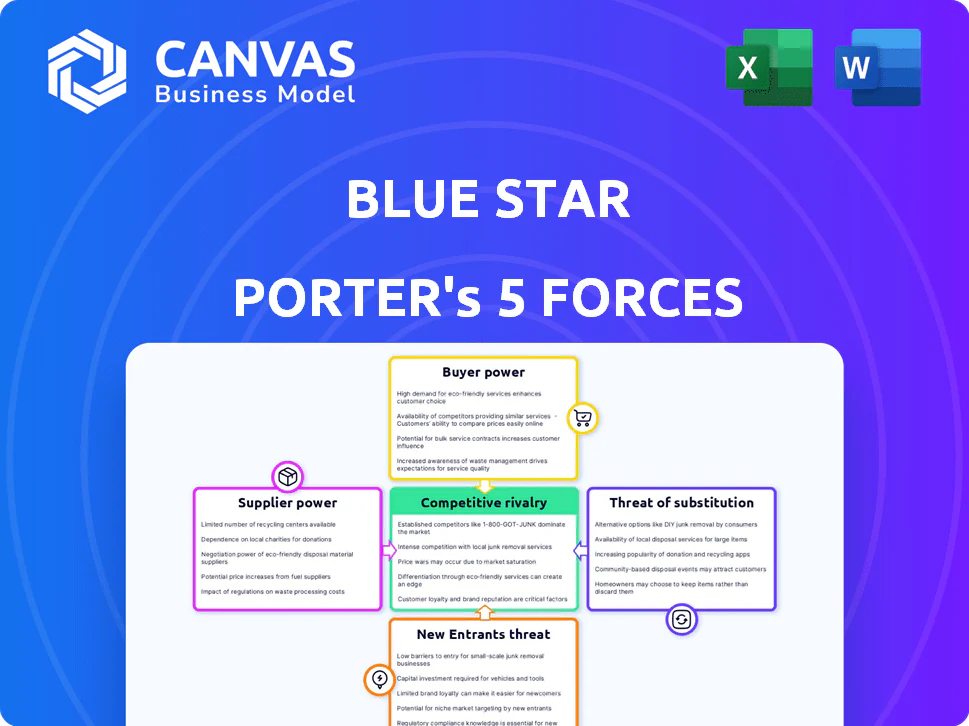
BLUE STAR PORTER'S FIVE FORCES TEMPLATE RESEARCH

Go Beyond the Preview-Access the Full Strategic Report
Blue Star's Five Forces snapshot highlights moderate supplier leverage, fragmented buyers, and manageable substitute threats-yet looming regulatory and tech shifts could intensify competition; this brief only scratches the surface. Unlock the full Porter's Five Forces Analysis to explore force-by-force ratings, visuals, and actionable strategies tailored to Blue Star.
Suppliers Bargaining Power

Critical Component Dependency
Blue Star depends on specialized compressors and semiconductors from a few global makers; in FY2025, 42% of HVAC component spend came from three suppliers, concentrating pricing power.
Backward integration cut purchases by 18% since 2022, but technical complexity keeps suppliers with leverage on lead times and premiums.
Supply shocks risk bottlenecks in peak summer: a 2024 semiconductor shortage raised lead times by 60%, threatening revenue during >Q2 demand spikes.
Raw Material Price Volatility
Raw material price volatility hits Blue Star: copper rose ~23% and aluminum ~15% in 2025 YTD, raising input costs for AC and refrigeration manufacturing that use large metal volumes.
Blue Star can't always pass costs to consumers, so suppliers' price swings squeeze gross margins-procurement must absorb or hedge to protect profits.
Procurement balances spot buys, 12-24 month contracts and copper hedges; in 2025 this mix aimed to limit COGS inflation to ~6-8% versus commodity moves.

Impact of Production Linked Incentive Schemes
The Indian PLI schemes boosted local component output-domestic sourcing rose ~18% from 2022-2025-marginally reducing supplier leverage for Blue Star; still, as of FY2025, ~65% of high-end HVAC compressors and controls are imported from a handful of global firms, keeping power concentrated at the top tier.

Specialized Electronics and IoT Integration
Specialized electronic-controller suppliers wield strong bargaining power as smart HVAC demand rises; global MCU (microcontroller) shortages tightened in 2024 lifted component ASPs ~18%, and top suppliers often favor big consumer-electronics clients over HVAC firms like Blue Star, forcing longer lead times and higher prices.
Suppliers' market concentration is high-top 5 component firms held ~55% MCU market share in 2024-so Blue Star faces limited alternative sourcing and must accept stricter contract terms and volume commitments.
- MCU ASPs up ~18% (2024)
- Top‑5 MCU share ~55% (2024)
- Lead times extended 12-20 weeks
- Price and volume clauses favor suppliers
Logistics and Freight Costs
Suppliers of logistics and shipping services strongly affect Blue Star's cost of goods sold; diesel price volatility and 2025 global container rates (average $2,300 per 40ft in H1 2025) raised freight expense by ~8% YoY for industry peers, pressuring margins.
Blue Star's centralized inventory and route optimization cut carrier spend; improving on-time deliveries to 94% in FY2025 would reduce supplier leverage.
- 2025 avg container rate $2,300/40ft
- Fuel volatility drove ~8% YoY freight cost rise
- 94% on-time delivery target lowers supplier power
Supplier Concentration Drives 6-8% COGS Inflation Amid MCU ASPs +18% and Longer Lead Times
Suppliers hold strong power: FY2025 three vendors supplied 42% of HVAC parts; 65% of high‑end compressors/imported controls; MCU ASPs +18% (2024); top‑5 MCU share 55%; lead times +12-20 weeks; container rate $2,300/40ft (H1‑2025); procurement mix limited COGS rise to ~6-8%.
| Metric | Value |
|---|---|
| Top‑3 supplier share | 42% |
| Imported high‑end parts | 65% |
| MCU ASPs (2024) | +18% |
| Top‑5 MCU share (2024) | 55% |
| Lead times | 12-20 wks |
| Container rate H1‑2025 | $2,300/40ft |
| COGS inflation FY2025 | 6-8% |
What is included in the product
 Detailed Word Document
Uncovers key drivers of competition, buyer and supplier power, and entry/substitute risks specific to Blue Star, highlighting disruptive threats and strategic levers to protect market share.

 Customizable Excel Spreadsheet
Concise, one-sheet Porter's Five Forces tailored to Blue Star-instantly identify competitive pressures and prioritize strategic moves for faster, data-driven decisions.
Customers Bargaining Power

High Price Sensitivity in Retail
Individual consumers in Blue Star's residential segment show high price sensitivity-2025 retail data: ~62% of buyers compare 3+ brands before purchase and average price elasticity suggests a 1% price cut raises unit demand ~0.9%; churn to competitors rises if perceived value lags, forcing Blue Star to run aggressive pricing and promotions to protect its FY2025 market share of ~18.5%.
Growing Importance of Energy Ratings
Modern buyers prioritize total cost of ownership, driving demand for Blue Star 5-star energy-rated units; in FY2025 Blue Star reported a 14% sales mix shift to high-efficiency models, reflecting customers valuing lower running costs.
Any efficiency lag risks rapid customer churn-industry data shows 72% of Indian HVAC buyers cite energy savings as top purchase criterion in 2025, pressuring Blue Star to upgrade tech.

B2B Volume Leverage
Large institutional clients-hospitals, hotels, data centers-buy HVAC in bulk; in FY2025 Blue Star reported 42% of commercial revenues from such projects, giving buyers leverage to demand bespoke systems, extended 5-10 year warranties, and discounts up to 18%, compressing project margins.

Expectations for After-Sales Service
Customers in the cooling sector rate after-sales service-maintenance and repairs-as a key loyalty driver; 68% of commercial buyers cite service quality as decisive, and firms with <24-hour response achieve 15-20% higher retention.
Buyers expect fast responses and affordable contracts; average service contract margins run 10-18% for vendors, so price and speed shape repeat purchases.
Poor service triggers negative reviews and rapid churn; studies show 22% brand switching within 12 months after one bad service episode.
- 68% cite service quality as decisive
- <24-hour response → +15-20% retention
- Service contract margins 10-18%
- 22% switch after one bad service
Availability of Consumer Financing
The rise of EMI and BNPL has lifted average ticket sizes; India's EMI/GST appliance financing grew ~18% YoY in 2025 to ₹42,300 crore, letting buyers choose higher-end Blue Star models.
Third-party fintechs set terms that sway final choice; 65% of appliance buyers in 2025 cited financing terms as decisive, so Blue Star must bundle attractive offers.
- ₹42,300 crore: 2025 appliance financing market
- 18% YoY growth in EMI/GST financing (2025)
- 65% buyers cite financing terms (2025 survey)
- Action: bundle competitive EMIs, co-branded fintech deals
Buyers Drive Deals: Service, Financing & Brand Comparison Shape FY25 Appliance Market
Buyers hold high price and service leverage: FY2025 retail data-62% compare 3+ brands; Blue Star market share ~18.5%; 14% sales mix to 5-star units; commercial projects = 42% revenues; service importance: 68% decisive, <24-hr response → +15-20% retention; appliance financing ₹42,300 crore (2025), 65% cite financing terms.
| Metric | FY2025 |
|---|---|
| Retail brand comparison | 62% |
| Blue Star market share | 18.5% |
| 5-star mix | 14% |
| Commercial revs | 42% |
| Service decisive | 68% |
| Appliance financing | ₹42,300 cr |
What You See Is What You Get
Blue Star Porter's Five Forces Analysis
This preview shows the exact Blue Star Porter's Five Forces analysis you'll receive-fully formatted, complete, and ready to download immediately after purchase with no placeholders or mockups.

BLUE STAR PORTER'S FIVE FORCES TEMPLATE RESEARCH
Go Beyond the Preview-Access the Full Strategic Report
Blue Star's Five Forces snapshot highlights moderate supplier leverage, fragmented buyers, and manageable substitute threats-yet looming regulatory and tech shifts could intensify competition; this brief only scratches the surface. Unlock the full Porter's Five Forces Analysis to explore force-by-force ratings, visuals, and actionable strategies tailored to Blue Star.
Suppliers Bargaining Power
Critical Component Dependency
Blue Star depends on specialized compressors and semiconductors from a few global makers; in FY2025, 42% of HVAC component spend came from three suppliers, concentrating pricing power.
Backward integration cut purchases by 18% since 2022, but technical complexity keeps suppliers with leverage on lead times and premiums.
Supply shocks risk bottlenecks in peak summer: a 2024 semiconductor shortage raised lead times by 60%, threatening revenue during >Q2 demand spikes.
Raw Material Price Volatility
Raw material price volatility hits Blue Star: copper rose ~23% and aluminum ~15% in 2025 YTD, raising input costs for AC and refrigeration manufacturing that use large metal volumes.
Blue Star can't always pass costs to consumers, so suppliers' price swings squeeze gross margins-procurement must absorb or hedge to protect profits.
Procurement balances spot buys, 12-24 month contracts and copper hedges; in 2025 this mix aimed to limit COGS inflation to ~6-8% versus commodity moves.
Impact of Production Linked Incentive Schemes
The Indian PLI schemes boosted local component output-domestic sourcing rose ~18% from 2022-2025-marginally reducing supplier leverage for Blue Star; still, as of FY2025, ~65% of high-end HVAC compressors and controls are imported from a handful of global firms, keeping power concentrated at the top tier.
Specialized Electronics and IoT Integration
Specialized electronic-controller suppliers wield strong bargaining power as smart HVAC demand rises; global MCU (microcontroller) shortages tightened in 2024 lifted component ASPs ~18%, and top suppliers often favor big consumer-electronics clients over HVAC firms like Blue Star, forcing longer lead times and higher prices.
Suppliers' market concentration is high-top 5 component firms held ~55% MCU market share in 2024-so Blue Star faces limited alternative sourcing and must accept stricter contract terms and volume commitments.
- MCU ASPs up ~18% (2024)
- Top‑5 MCU share ~55% (2024)
- Lead times extended 12-20 weeks
- Price and volume clauses favor suppliers
Logistics and Freight Costs
Suppliers of logistics and shipping services strongly affect Blue Star's cost of goods sold; diesel price volatility and 2025 global container rates (average $2,300 per 40ft in H1 2025) raised freight expense by ~8% YoY for industry peers, pressuring margins.
Blue Star's centralized inventory and route optimization cut carrier spend; improving on-time deliveries to 94% in FY2025 would reduce supplier leverage.
- 2025 avg container rate $2,300/40ft
- Fuel volatility drove ~8% YoY freight cost rise
- 94% on-time delivery target lowers supplier power
Supplier Concentration Drives 6-8% COGS Inflation Amid MCU ASPs +18% and Longer Lead Times
Suppliers hold strong power: FY2025 three vendors supplied 42% of HVAC parts; 65% of high‑end compressors/imported controls; MCU ASPs +18% (2024); top‑5 MCU share 55%; lead times +12-20 weeks; container rate $2,300/40ft (H1‑2025); procurement mix limited COGS rise to ~6-8%.
| Metric | Value |
|---|---|
| Top‑3 supplier share | 42% |
| Imported high‑end parts | 65% |
| MCU ASPs (2024) | +18% |
| Top‑5 MCU share (2024) | 55% |
| Lead times | 12-20 wks |
| Container rate H1‑2025 | $2,300/40ft |
| COGS inflation FY2025 | 6-8% |
What is included in the product
Detailed Word Document
Uncovers key drivers of competition, buyer and supplier power, and entry/substitute risks specific to Blue Star, highlighting disruptive threats and strategic levers to protect market share.
Customizable Excel Spreadsheet
Concise, one-sheet Porter's Five Forces tailored to Blue Star-instantly identify competitive pressures and prioritize strategic moves for faster, data-driven decisions.
Customers Bargaining Power
High Price Sensitivity in Retail
Individual consumers in Blue Star's residential segment show high price sensitivity-2025 retail data: ~62% of buyers compare 3+ brands before purchase and average price elasticity suggests a 1% price cut raises unit demand ~0.9%; churn to competitors rises if perceived value lags, forcing Blue Star to run aggressive pricing and promotions to protect its FY2025 market share of ~18.5%.
Growing Importance of Energy Ratings
Modern buyers prioritize total cost of ownership, driving demand for Blue Star 5-star energy-rated units; in FY2025 Blue Star reported a 14% sales mix shift to high-efficiency models, reflecting customers valuing lower running costs.
Any efficiency lag risks rapid customer churn-industry data shows 72% of Indian HVAC buyers cite energy savings as top purchase criterion in 2025, pressuring Blue Star to upgrade tech.
B2B Volume Leverage
Large institutional clients-hospitals, hotels, data centers-buy HVAC in bulk; in FY2025 Blue Star reported 42% of commercial revenues from such projects, giving buyers leverage to demand bespoke systems, extended 5-10 year warranties, and discounts up to 18%, compressing project margins.
Expectations for After-Sales Service
Customers in the cooling sector rate after-sales service-maintenance and repairs-as a key loyalty driver; 68% of commercial buyers cite service quality as decisive, and firms with <24-hour response achieve 15-20% higher retention.
Buyers expect fast responses and affordable contracts; average service contract margins run 10-18% for vendors, so price and speed shape repeat purchases.
Poor service triggers negative reviews and rapid churn; studies show 22% brand switching within 12 months after one bad service episode.
- 68% cite service quality as decisive
- <24-hour response → +15-20% retention
- Service contract margins 10-18%
- 22% switch after one bad service
Availability of Consumer Financing
The rise of EMI and BNPL has lifted average ticket sizes; India's EMI/GST appliance financing grew ~18% YoY in 2025 to ₹42,300 crore, letting buyers choose higher-end Blue Star models.
Third-party fintechs set terms that sway final choice; 65% of appliance buyers in 2025 cited financing terms as decisive, so Blue Star must bundle attractive offers.
- ₹42,300 crore: 2025 appliance financing market
- 18% YoY growth in EMI/GST financing (2025)
- 65% buyers cite financing terms (2025 survey)
- Action: bundle competitive EMIs, co-branded fintech deals
Buyers Drive Deals: Service, Financing & Brand Comparison Shape FY25 Appliance Market
Buyers hold high price and service leverage: FY2025 retail data-62% compare 3+ brands; Blue Star market share ~18.5%; 14% sales mix to 5-star units; commercial projects = 42% revenues; service importance: 68% decisive, <24-hr response → +15-20% retention; appliance financing ₹42,300 crore (2025), 65% cite financing terms.
| Metric | FY2025 |
|---|---|
| Retail brand comparison | 62% |
| Blue Star market share | 18.5% |
| 5-star mix | 14% |
| Commercial revs | 42% |
| Service decisive | 68% |
| Appliance financing | ₹42,300 cr |
What You See Is What You Get
Blue Star Porter's Five Forces Analysis
This preview shows the exact Blue Star Porter's Five Forces analysis you'll receive-fully formatted, complete, and ready to download immediately after purchase with no placeholders or mockups.
Product Information
Product Information
Shipping & Returns
Shipping & Returns
Description
Go Beyond the Preview-Access the Full Strategic Report
Blue Star's Five Forces snapshot highlights moderate supplier leverage, fragmented buyers, and manageable substitute threats-yet looming regulatory and tech shifts could intensify competition; this brief only scratches the surface. Unlock the full Porter's Five Forces Analysis to explore force-by-force ratings, visuals, and actionable strategies tailored to Blue Star.
Suppliers Bargaining Power
Critical Component Dependency
Blue Star depends on specialized compressors and semiconductors from a few global makers; in FY2025, 42% of HVAC component spend came from three suppliers, concentrating pricing power.
Backward integration cut purchases by 18% since 2022, but technical complexity keeps suppliers with leverage on lead times and premiums.
Supply shocks risk bottlenecks in peak summer: a 2024 semiconductor shortage raised lead times by 60%, threatening revenue during >Q2 demand spikes.
Raw Material Price Volatility
Raw material price volatility hits Blue Star: copper rose ~23% and aluminum ~15% in 2025 YTD, raising input costs for AC and refrigeration manufacturing that use large metal volumes.
Blue Star can't always pass costs to consumers, so suppliers' price swings squeeze gross margins-procurement must absorb or hedge to protect profits.
Procurement balances spot buys, 12-24 month contracts and copper hedges; in 2025 this mix aimed to limit COGS inflation to ~6-8% versus commodity moves.
Impact of Production Linked Incentive Schemes
The Indian PLI schemes boosted local component output-domestic sourcing rose ~18% from 2022-2025-marginally reducing supplier leverage for Blue Star; still, as of FY2025, ~65% of high-end HVAC compressors and controls are imported from a handful of global firms, keeping power concentrated at the top tier.
Specialized Electronics and IoT Integration
Specialized electronic-controller suppliers wield strong bargaining power as smart HVAC demand rises; global MCU (microcontroller) shortages tightened in 2024 lifted component ASPs ~18%, and top suppliers often favor big consumer-electronics clients over HVAC firms like Blue Star, forcing longer lead times and higher prices.
Suppliers' market concentration is high-top 5 component firms held ~55% MCU market share in 2024-so Blue Star faces limited alternative sourcing and must accept stricter contract terms and volume commitments.
- MCU ASPs up ~18% (2024)
- Top‑5 MCU share ~55% (2024)
- Lead times extended 12-20 weeks
- Price and volume clauses favor suppliers
Logistics and Freight Costs
Suppliers of logistics and shipping services strongly affect Blue Star's cost of goods sold; diesel price volatility and 2025 global container rates (average $2,300 per 40ft in H1 2025) raised freight expense by ~8% YoY for industry peers, pressuring margins.
Blue Star's centralized inventory and route optimization cut carrier spend; improving on-time deliveries to 94% in FY2025 would reduce supplier leverage.
- 2025 avg container rate $2,300/40ft
- Fuel volatility drove ~8% YoY freight cost rise
- 94% on-time delivery target lowers supplier power
Supplier Concentration Drives 6-8% COGS Inflation Amid MCU ASPs +18% and Longer Lead Times
Suppliers hold strong power: FY2025 three vendors supplied 42% of HVAC parts; 65% of high‑end compressors/imported controls; MCU ASPs +18% (2024); top‑5 MCU share 55%; lead times +12-20 weeks; container rate $2,300/40ft (H1‑2025); procurement mix limited COGS rise to ~6-8%.
| Metric | Value |
|---|---|
| Top‑3 supplier share | 42% |
| Imported high‑end parts | 65% |
| MCU ASPs (2024) | +18% |
| Top‑5 MCU share (2024) | 55% |
| Lead times | 12-20 wks |
| Container rate H1‑2025 | $2,300/40ft |
| COGS inflation FY2025 | 6-8% |
What is included in the product
Detailed Word Document
Uncovers key drivers of competition, buyer and supplier power, and entry/substitute risks specific to Blue Star, highlighting disruptive threats and strategic levers to protect market share.
Customizable Excel Spreadsheet
Concise, one-sheet Porter's Five Forces tailored to Blue Star-instantly identify competitive pressures and prioritize strategic moves for faster, data-driven decisions.
Customers Bargaining Power
High Price Sensitivity in Retail
Individual consumers in Blue Star's residential segment show high price sensitivity-2025 retail data: ~62% of buyers compare 3+ brands before purchase and average price elasticity suggests a 1% price cut raises unit demand ~0.9%; churn to competitors rises if perceived value lags, forcing Blue Star to run aggressive pricing and promotions to protect its FY2025 market share of ~18.5%.
Growing Importance of Energy Ratings
Modern buyers prioritize total cost of ownership, driving demand for Blue Star 5-star energy-rated units; in FY2025 Blue Star reported a 14% sales mix shift to high-efficiency models, reflecting customers valuing lower running costs.
Any efficiency lag risks rapid customer churn-industry data shows 72% of Indian HVAC buyers cite energy savings as top purchase criterion in 2025, pressuring Blue Star to upgrade tech.
B2B Volume Leverage
Large institutional clients-hospitals, hotels, data centers-buy HVAC in bulk; in FY2025 Blue Star reported 42% of commercial revenues from such projects, giving buyers leverage to demand bespoke systems, extended 5-10 year warranties, and discounts up to 18%, compressing project margins.
Expectations for After-Sales Service
Customers in the cooling sector rate after-sales service-maintenance and repairs-as a key loyalty driver; 68% of commercial buyers cite service quality as decisive, and firms with <24-hour response achieve 15-20% higher retention.
Buyers expect fast responses and affordable contracts; average service contract margins run 10-18% for vendors, so price and speed shape repeat purchases.
Poor service triggers negative reviews and rapid churn; studies show 22% brand switching within 12 months after one bad service episode.
- 68% cite service quality as decisive
- <24-hour response → +15-20% retention
- Service contract margins 10-18%
- 22% switch after one bad service
Availability of Consumer Financing
The rise of EMI and BNPL has lifted average ticket sizes; India's EMI/GST appliance financing grew ~18% YoY in 2025 to ₹42,300 crore, letting buyers choose higher-end Blue Star models.
Third-party fintechs set terms that sway final choice; 65% of appliance buyers in 2025 cited financing terms as decisive, so Blue Star must bundle attractive offers.
- ₹42,300 crore: 2025 appliance financing market
- 18% YoY growth in EMI/GST financing (2025)
- 65% buyers cite financing terms (2025 survey)
- Action: bundle competitive EMIs, co-branded fintech deals
Buyers Drive Deals: Service, Financing & Brand Comparison Shape FY25 Appliance Market
Buyers hold high price and service leverage: FY2025 retail data-62% compare 3+ brands; Blue Star market share ~18.5%; 14% sales mix to 5-star units; commercial projects = 42% revenues; service importance: 68% decisive, <24-hr response → +15-20% retention; appliance financing ₹42,300 crore (2025), 65% cite financing terms.
| Metric | FY2025 |
|---|---|
| Retail brand comparison | 62% |
| Blue Star market share | 18.5% |
| 5-star mix | 14% |
| Commercial revs | 42% |
| Service decisive | 68% |
| Appliance financing | ₹42,300 cr |
What You See Is What You Get
Blue Star Porter's Five Forces Analysis
This preview shows the exact Blue Star Porter's Five Forces analysis you'll receive-fully formatted, complete, and ready to download immediately after purchase with no placeholders or mockups.











