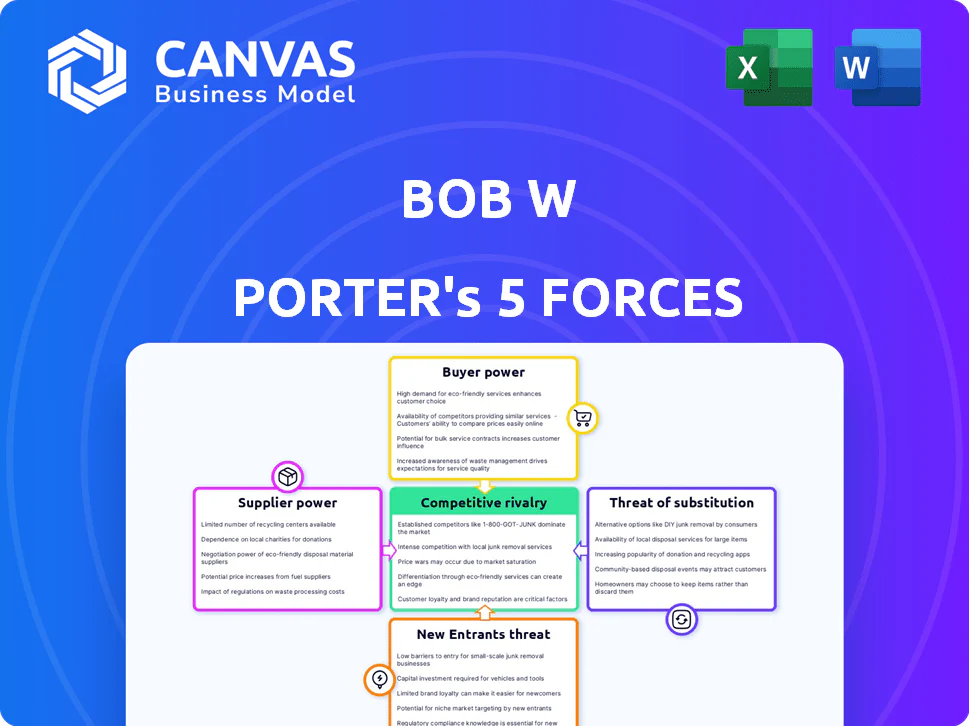
BOB W PORTER'S FIVE FORCES TEMPLATE RESEARCH
What is included in the product
 Detailed Word Document
Tailored exclusively for Bob W, analyzing its position within its competitive landscape.

 Customizable Excel Spreadsheet
Quickly identify and evaluate competitive forces, avoiding costly missteps.
Preview the Actual Deliverable
Bob W Porter's Five Forces Analysis
This preview showcases the comprehensive Bob W Porter's Five Forces Analysis. It’s the complete, fully analyzed document you'll receive instantly upon purchase. The same detailed insights and professional formatting seen here are what you'll download. No editing or waiting is needed—it's ready to use. You're getting the exact analysis you're viewing.

Porter's Five Forces Analysis Template

Elevate Your Analysis with the Complete Porter's Five Forces Analysis
Bob W's competitive landscape is shaped by five key forces. These include the intensity of rivalry among existing competitors and the bargaining power of both suppliers and buyers. Understanding the threat of new entrants and the availability of substitute products is also crucial. This brief snapshot only scratches the surface. Unlock the full Porter's Five Forces Analysis to explore Bob W’s competitive dynamics, market pressures, and strategic advantages in detail.
Suppliers Bargaining Power

Real Estate Owners
Bob W's business model significantly depends on its relationships with real estate owners, who supply the properties essential for its serviced apartments. The bargaining power of these suppliers can be substantial, especially in prime urban areas. In 2024, the average occupancy rate for serviced apartments in major European cities was around 75%, indicating a demand that gives landlords leverage. This dynamic impacts Bob W's operational costs and property acquisition strategies.
Technology Providers
Bob W, a tech-reliant company, is vulnerable to the bargaining power of its tech suppliers. This is because their guest experience hinges on providers of online check-in, keyless entry, and in-app services. Specialized or proprietary tech can give these suppliers significant leverage. For instance, in 2024, the average cost for hospitality tech solutions increased by 7%, affecting operational costs.

Cleaning and Maintenance Services
Bob W's brand relies heavily on cleanliness and upkeep. The bargaining power of cleaning services varies. In 2024, the cleaning services market was valued at approximately $70 billion. High-quality, reliable services are essential.

Local Experience Providers
Bob W's reliance on local experience providers, such as restaurants and gyms, introduces supplier bargaining power. The uniqueness and quality of these local services can make them essential to Bob W's offerings. Consider that in 2024, the average cost for partnering with a local gym for hotel guests was about $15 per guest per day. This means that the ability of the local providers to set their prices can directly affect Bob W's profitability and guest experience.
- Supplier Concentration: If a few providers dominate, they gain more leverage.
- Service Uniqueness: Unique offerings increase bargaining power.
- Switching Costs: High costs to switch suppliers enhance their power.
- Impact on Quality: Providers' quality directly impacts guest satisfaction.
Furniture and Design Suppliers
Bob W's focus on local design and sustainable sourcing gives furniture and design suppliers some leverage. Suppliers offering unique, eco-friendly options can command better terms. This is especially true if Bob W's brand values align closely with these suppliers’ offerings. The global sustainable furniture market was valued at $37.1 billion in 2023.
- Bob W's brand values influence supplier power.
- Sustainable suppliers can negotiate better terms.
- The sustainable furniture market is growing.
- Local design adds supplier uniqueness.
Supplier Dynamics: Key Influences on Operations
Suppliers significantly influence Bob W's operations. Real estate owners in prime areas and tech providers hold considerable bargaining power. Cleaning services and local experience providers also affect costs.
| Supplier Type | Bargaining Power | 2024 Data |
|---|---|---|
| Real Estate | High | 75% occupancy in Europe |
| Tech | Medium | 7% tech cost increase |
| Cleaning | Medium | $70B market size |
Customers Bargaining Power

Price Sensitivity
Customers in the hospitality sector, including short-term rentals, are highly price-sensitive. They actively compare prices across platforms like Airbnb and Booking.com. In 2024, average daily rates (ADR) for hotels fluctuated, highlighting customer price awareness. Bob W must offer competitive pricing while emphasizing its unique value proposition.
Availability of Alternatives
Customers of Bob W face numerous alternatives, including established hotels and short-term rentals. This abundance of choices significantly boosts their bargaining power. According to a 2024 report, the short-term rental market alone generated over $100 billion in revenue globally. If Bob W's prices or services are unsatisfactory, customers can easily shift to these alternatives.

Access to Information and Reviews
Customers today wield considerable power thanks to readily available information. Online platforms and review sites offer extensive details for comparing choices, like hotels or airlines. Reviews heavily influence decisions, giving customers significant influence through their collective feedback. For example, sites like TripAdvisor had over 460 million monthly users in 2024, showing the impact of customer opinions.

Demand for Value and Amenities
Modern travelers, like those targeted by Bob W, prioritize value and specific amenities. These customers, including young professionals and business travelers, drive demand for kitchens and workspaces. This influences Bob W's offerings and pricing to meet these expectations.
- In 2024, 68% of business travelers sought accommodations with workspaces.
- Kitchens are a top amenity; 45% of travelers prefer them.
- Value-driven travelers increased by 20% in 2024.
Loyalty and Repeat Business
Customer loyalty is key to reducing their power; happy customers mean repeat business and less price sensitivity. Bob W's tech-forward approach and local charm aim to build this bond. This strategy aims to retain customers and boost average spending per guest. Strong customer loyalty can lead to increased profitability.
- Bob W's focus on tech-enabled experience and local authenticity fosters customer loyalty.
- Loyalty programs can further reduce customer bargaining power.
- Repeat business leads to less price sensitivity.
- Customer retention boosts profitability.
Hospitality Customers: Price-Savvy & Choice-Rich
Customers in the hospitality sector, especially those considering Bob W, possess considerable bargaining power due to abundant choices and price sensitivity. They can easily compare options and switch based on price or value. In 2024, the short-term rental market was worth over $100 billion, highlighting the alternatives available.
| Factor | Impact on Bargaining Power | 2024 Data |
|---|---|---|
| Price Comparison | High | ADR fluctuations highlight customer price awareness. |
| Alternatives | High | Short-term rental market generated over $100B. |
| Information Availability | High | TripAdvisor had over 460M monthly users. |
Rivalry Among Competitors

Diverse Competitor Landscape
Bob W faces intense competition. The market includes hotels, aparthotels, and short-term rentals. This diverse group drives rivalry. Airbnb's Q3 2024 revenue reached $3.4 billion, highlighting the competition's scale and intensity.
Differentiation through Technology and Design
Bob W's strategy centers on tech-driven experiences and unique designs, blending hotel and short-term rental features. Competitive intensity hinges on how rivals match or surpass these tech and design aspects. In 2024, the global hospitality market was valued at over $5.5 trillion, highlighting intense competition. Companies like Airbnb, with a $95 billion market cap, pose a significant challenge.

Expansion of Competitors
Established hotel chains like Marriott and Hilton are aggressively expanding, with Marriott planning to add 100,000 rooms by 2025. Short-term rental platforms such as Airbnb continue to grow, with over 6.6 million listings globally as of late 2024. This expansion intensifies competition for Bob W in key urban markets. These factors directly impact occupancy rates and pricing strategies.

Pricing Strategies
Pricing strategies are crucial for Bob W in the competitive hospitality and short-term rental markets. To stay competitive, Bob W must use effective revenue management. This includes adjusting prices based on demand and competitor pricing. Data from 2024 shows average daily rates (ADR) fluctuate significantly.
- Dynamic Pricing: Implement real-time price adjustments.
- Competitive Analysis: Regularly monitor competitor rates.
- Promotional Offers: Use discounts strategically.
- Value-Added Services: Bundle services to justify pricing.
Brand Reputation and Customer Experience
In the hospitality sector, brand reputation and customer experience heavily influence competitive dynamics. Bob W's focus on high customer satisfaction helps them stand out. Maintaining this focus is essential for managing rivalry effectively. High scores translate into repeat business and positive word-of-mouth. This strategy is vital in a competitive landscape.
- Customer satisfaction scores directly affect revenue.
- Positive reviews boost brand perception.
- Superior service reduces customer churn.
- Bob W emphasizes experience to gain an edge.
Intense Competition in the Hospitality Sector
Competitive rivalry is high for Bob W due to many competitors. This includes hotels and short-term rentals, like Airbnb, which had $3.4B revenue in Q3 2024. Established chains like Marriott and Hilton are also expanding rapidly. Pricing strategies and customer experience are key to staying competitive.
| Metric | Data (2024) | Impact |
|---|---|---|
| Global Hospitality Market Value | >$5.5 Trillion | High rivalry |
| Airbnb Market Cap | $95 Billion | Significant competitor |
| Marriott Room Expansion (Planned) | 100,000 rooms by 2025 | Increased Competition |
Original: $10.00
-65%$10.00
$3.50BOB W PORTER'S FIVE FORCES TEMPLATE RESEARCH
What is included in the product
Detailed Word Document
Tailored exclusively for Bob W, analyzing its position within its competitive landscape.
Customizable Excel Spreadsheet
Quickly identify and evaluate competitive forces, avoiding costly missteps.
Preview the Actual Deliverable
Bob W Porter's Five Forces Analysis
This preview showcases the comprehensive Bob W Porter's Five Forces Analysis. It’s the complete, fully analyzed document you'll receive instantly upon purchase. The same detailed insights and professional formatting seen here are what you'll download. No editing or waiting is needed—it's ready to use. You're getting the exact analysis you're viewing.
Porter's Five Forces Analysis Template
Elevate Your Analysis with the Complete Porter's Five Forces Analysis
Bob W's competitive landscape is shaped by five key forces. These include the intensity of rivalry among existing competitors and the bargaining power of both suppliers and buyers. Understanding the threat of new entrants and the availability of substitute products is also crucial. This brief snapshot only scratches the surface. Unlock the full Porter's Five Forces Analysis to explore Bob W’s competitive dynamics, market pressures, and strategic advantages in detail.
Suppliers Bargaining Power
Real Estate Owners
Bob W's business model significantly depends on its relationships with real estate owners, who supply the properties essential for its serviced apartments. The bargaining power of these suppliers can be substantial, especially in prime urban areas. In 2024, the average occupancy rate for serviced apartments in major European cities was around 75%, indicating a demand that gives landlords leverage. This dynamic impacts Bob W's operational costs and property acquisition strategies.
Technology Providers
Bob W, a tech-reliant company, is vulnerable to the bargaining power of its tech suppliers. This is because their guest experience hinges on providers of online check-in, keyless entry, and in-app services. Specialized or proprietary tech can give these suppliers significant leverage. For instance, in 2024, the average cost for hospitality tech solutions increased by 7%, affecting operational costs.
Cleaning and Maintenance Services
Bob W's brand relies heavily on cleanliness and upkeep. The bargaining power of cleaning services varies. In 2024, the cleaning services market was valued at approximately $70 billion. High-quality, reliable services are essential.
Local Experience Providers
Bob W's reliance on local experience providers, such as restaurants and gyms, introduces supplier bargaining power. The uniqueness and quality of these local services can make them essential to Bob W's offerings. Consider that in 2024, the average cost for partnering with a local gym for hotel guests was about $15 per guest per day. This means that the ability of the local providers to set their prices can directly affect Bob W's profitability and guest experience.
- Supplier Concentration: If a few providers dominate, they gain more leverage.
- Service Uniqueness: Unique offerings increase bargaining power.
- Switching Costs: High costs to switch suppliers enhance their power.
- Impact on Quality: Providers' quality directly impacts guest satisfaction.
Furniture and Design Suppliers
Bob W's focus on local design and sustainable sourcing gives furniture and design suppliers some leverage. Suppliers offering unique, eco-friendly options can command better terms. This is especially true if Bob W's brand values align closely with these suppliers’ offerings. The global sustainable furniture market was valued at $37.1 billion in 2023.
- Bob W's brand values influence supplier power.
- Sustainable suppliers can negotiate better terms.
- The sustainable furniture market is growing.
- Local design adds supplier uniqueness.
Supplier Dynamics: Key Influences on Operations
Suppliers significantly influence Bob W's operations. Real estate owners in prime areas and tech providers hold considerable bargaining power. Cleaning services and local experience providers also affect costs.
| Supplier Type | Bargaining Power | 2024 Data |
|---|---|---|
| Real Estate | High | 75% occupancy in Europe |
| Tech | Medium | 7% tech cost increase |
| Cleaning | Medium | $70B market size |
Customers Bargaining Power
Price Sensitivity
Customers in the hospitality sector, including short-term rentals, are highly price-sensitive. They actively compare prices across platforms like Airbnb and Booking.com. In 2024, average daily rates (ADR) for hotels fluctuated, highlighting customer price awareness. Bob W must offer competitive pricing while emphasizing its unique value proposition.
Availability of Alternatives
Customers of Bob W face numerous alternatives, including established hotels and short-term rentals. This abundance of choices significantly boosts their bargaining power. According to a 2024 report, the short-term rental market alone generated over $100 billion in revenue globally. If Bob W's prices or services are unsatisfactory, customers can easily shift to these alternatives.
Access to Information and Reviews
Customers today wield considerable power thanks to readily available information. Online platforms and review sites offer extensive details for comparing choices, like hotels or airlines. Reviews heavily influence decisions, giving customers significant influence through their collective feedback. For example, sites like TripAdvisor had over 460 million monthly users in 2024, showing the impact of customer opinions.
Demand for Value and Amenities
Modern travelers, like those targeted by Bob W, prioritize value and specific amenities. These customers, including young professionals and business travelers, drive demand for kitchens and workspaces. This influences Bob W's offerings and pricing to meet these expectations.
- In 2024, 68% of business travelers sought accommodations with workspaces.
- Kitchens are a top amenity; 45% of travelers prefer them.
- Value-driven travelers increased by 20% in 2024.
Loyalty and Repeat Business
Customer loyalty is key to reducing their power; happy customers mean repeat business and less price sensitivity. Bob W's tech-forward approach and local charm aim to build this bond. This strategy aims to retain customers and boost average spending per guest. Strong customer loyalty can lead to increased profitability.
- Bob W's focus on tech-enabled experience and local authenticity fosters customer loyalty.
- Loyalty programs can further reduce customer bargaining power.
- Repeat business leads to less price sensitivity.
- Customer retention boosts profitability.
Hospitality Customers: Price-Savvy & Choice-Rich
Customers in the hospitality sector, especially those considering Bob W, possess considerable bargaining power due to abundant choices and price sensitivity. They can easily compare options and switch based on price or value. In 2024, the short-term rental market was worth over $100 billion, highlighting the alternatives available.
| Factor | Impact on Bargaining Power | 2024 Data |
|---|---|---|
| Price Comparison | High | ADR fluctuations highlight customer price awareness. |
| Alternatives | High | Short-term rental market generated over $100B. |
| Information Availability | High | TripAdvisor had over 460M monthly users. |
Rivalry Among Competitors
Diverse Competitor Landscape
Bob W faces intense competition. The market includes hotels, aparthotels, and short-term rentals. This diverse group drives rivalry. Airbnb's Q3 2024 revenue reached $3.4 billion, highlighting the competition's scale and intensity.
Differentiation through Technology and Design
Bob W's strategy centers on tech-driven experiences and unique designs, blending hotel and short-term rental features. Competitive intensity hinges on how rivals match or surpass these tech and design aspects. In 2024, the global hospitality market was valued at over $5.5 trillion, highlighting intense competition. Companies like Airbnb, with a $95 billion market cap, pose a significant challenge.
Expansion of Competitors
Established hotel chains like Marriott and Hilton are aggressively expanding, with Marriott planning to add 100,000 rooms by 2025. Short-term rental platforms such as Airbnb continue to grow, with over 6.6 million listings globally as of late 2024. This expansion intensifies competition for Bob W in key urban markets. These factors directly impact occupancy rates and pricing strategies.
Pricing Strategies
Pricing strategies are crucial for Bob W in the competitive hospitality and short-term rental markets. To stay competitive, Bob W must use effective revenue management. This includes adjusting prices based on demand and competitor pricing. Data from 2024 shows average daily rates (ADR) fluctuate significantly.
- Dynamic Pricing: Implement real-time price adjustments.
- Competitive Analysis: Regularly monitor competitor rates.
- Promotional Offers: Use discounts strategically.
- Value-Added Services: Bundle services to justify pricing.
Brand Reputation and Customer Experience
In the hospitality sector, brand reputation and customer experience heavily influence competitive dynamics. Bob W's focus on high customer satisfaction helps them stand out. Maintaining this focus is essential for managing rivalry effectively. High scores translate into repeat business and positive word-of-mouth. This strategy is vital in a competitive landscape.
- Customer satisfaction scores directly affect revenue.
- Positive reviews boost brand perception.
- Superior service reduces customer churn.
- Bob W emphasizes experience to gain an edge.
Intense Competition in the Hospitality Sector
Competitive rivalry is high for Bob W due to many competitors. This includes hotels and short-term rentals, like Airbnb, which had $3.4B revenue in Q3 2024. Established chains like Marriott and Hilton are also expanding rapidly. Pricing strategies and customer experience are key to staying competitive.
| Metric | Data (2024) | Impact |
|---|---|---|
| Global Hospitality Market Value | >$5.5 Trillion | High rivalry |
| Airbnb Market Cap | $95 Billion | Significant competitor |
| Marriott Room Expansion (Planned) | 100,000 rooms by 2025 | Increased Competition |
Product Information
Product Information
Shipping & Returns
Shipping & Returns
Description
What is included in the product
Detailed Word Document
Tailored exclusively for Bob W, analyzing its position within its competitive landscape.
Customizable Excel Spreadsheet
Quickly identify and evaluate competitive forces, avoiding costly missteps.
Preview the Actual Deliverable
Bob W Porter's Five Forces Analysis
This preview showcases the comprehensive Bob W Porter's Five Forces Analysis. It’s the complete, fully analyzed document you'll receive instantly upon purchase. The same detailed insights and professional formatting seen here are what you'll download. No editing or waiting is needed—it's ready to use. You're getting the exact analysis you're viewing.
Porter's Five Forces Analysis Template
Elevate Your Analysis with the Complete Porter's Five Forces Analysis
Bob W's competitive landscape is shaped by five key forces. These include the intensity of rivalry among existing competitors and the bargaining power of both suppliers and buyers. Understanding the threat of new entrants and the availability of substitute products is also crucial. This brief snapshot only scratches the surface. Unlock the full Porter's Five Forces Analysis to explore Bob W’s competitive dynamics, market pressures, and strategic advantages in detail.
Suppliers Bargaining Power
Real Estate Owners
Bob W's business model significantly depends on its relationships with real estate owners, who supply the properties essential for its serviced apartments. The bargaining power of these suppliers can be substantial, especially in prime urban areas. In 2024, the average occupancy rate for serviced apartments in major European cities was around 75%, indicating a demand that gives landlords leverage. This dynamic impacts Bob W's operational costs and property acquisition strategies.
Technology Providers
Bob W, a tech-reliant company, is vulnerable to the bargaining power of its tech suppliers. This is because their guest experience hinges on providers of online check-in, keyless entry, and in-app services. Specialized or proprietary tech can give these suppliers significant leverage. For instance, in 2024, the average cost for hospitality tech solutions increased by 7%, affecting operational costs.
Cleaning and Maintenance Services
Bob W's brand relies heavily on cleanliness and upkeep. The bargaining power of cleaning services varies. In 2024, the cleaning services market was valued at approximately $70 billion. High-quality, reliable services are essential.
Local Experience Providers
Bob W's reliance on local experience providers, such as restaurants and gyms, introduces supplier bargaining power. The uniqueness and quality of these local services can make them essential to Bob W's offerings. Consider that in 2024, the average cost for partnering with a local gym for hotel guests was about $15 per guest per day. This means that the ability of the local providers to set their prices can directly affect Bob W's profitability and guest experience.
- Supplier Concentration: If a few providers dominate, they gain more leverage.
- Service Uniqueness: Unique offerings increase bargaining power.
- Switching Costs: High costs to switch suppliers enhance their power.
- Impact on Quality: Providers' quality directly impacts guest satisfaction.
Furniture and Design Suppliers
Bob W's focus on local design and sustainable sourcing gives furniture and design suppliers some leverage. Suppliers offering unique, eco-friendly options can command better terms. This is especially true if Bob W's brand values align closely with these suppliers’ offerings. The global sustainable furniture market was valued at $37.1 billion in 2023.
- Bob W's brand values influence supplier power.
- Sustainable suppliers can negotiate better terms.
- The sustainable furniture market is growing.
- Local design adds supplier uniqueness.
Supplier Dynamics: Key Influences on Operations
Suppliers significantly influence Bob W's operations. Real estate owners in prime areas and tech providers hold considerable bargaining power. Cleaning services and local experience providers also affect costs.
| Supplier Type | Bargaining Power | 2024 Data |
|---|---|---|
| Real Estate | High | 75% occupancy in Europe |
| Tech | Medium | 7% tech cost increase |
| Cleaning | Medium | $70B market size |
Customers Bargaining Power
Price Sensitivity
Customers in the hospitality sector, including short-term rentals, are highly price-sensitive. They actively compare prices across platforms like Airbnb and Booking.com. In 2024, average daily rates (ADR) for hotels fluctuated, highlighting customer price awareness. Bob W must offer competitive pricing while emphasizing its unique value proposition.
Availability of Alternatives
Customers of Bob W face numerous alternatives, including established hotels and short-term rentals. This abundance of choices significantly boosts their bargaining power. According to a 2024 report, the short-term rental market alone generated over $100 billion in revenue globally. If Bob W's prices or services are unsatisfactory, customers can easily shift to these alternatives.
Access to Information and Reviews
Customers today wield considerable power thanks to readily available information. Online platforms and review sites offer extensive details for comparing choices, like hotels or airlines. Reviews heavily influence decisions, giving customers significant influence through their collective feedback. For example, sites like TripAdvisor had over 460 million monthly users in 2024, showing the impact of customer opinions.
Demand for Value and Amenities
Modern travelers, like those targeted by Bob W, prioritize value and specific amenities. These customers, including young professionals and business travelers, drive demand for kitchens and workspaces. This influences Bob W's offerings and pricing to meet these expectations.
- In 2024, 68% of business travelers sought accommodations with workspaces.
- Kitchens are a top amenity; 45% of travelers prefer them.
- Value-driven travelers increased by 20% in 2024.
Loyalty and Repeat Business
Customer loyalty is key to reducing their power; happy customers mean repeat business and less price sensitivity. Bob W's tech-forward approach and local charm aim to build this bond. This strategy aims to retain customers and boost average spending per guest. Strong customer loyalty can lead to increased profitability.
- Bob W's focus on tech-enabled experience and local authenticity fosters customer loyalty.
- Loyalty programs can further reduce customer bargaining power.
- Repeat business leads to less price sensitivity.
- Customer retention boosts profitability.
Hospitality Customers: Price-Savvy & Choice-Rich
Customers in the hospitality sector, especially those considering Bob W, possess considerable bargaining power due to abundant choices and price sensitivity. They can easily compare options and switch based on price or value. In 2024, the short-term rental market was worth over $100 billion, highlighting the alternatives available.
| Factor | Impact on Bargaining Power | 2024 Data |
|---|---|---|
| Price Comparison | High | ADR fluctuations highlight customer price awareness. |
| Alternatives | High | Short-term rental market generated over $100B. |
| Information Availability | High | TripAdvisor had over 460M monthly users. |
Rivalry Among Competitors
Diverse Competitor Landscape
Bob W faces intense competition. The market includes hotels, aparthotels, and short-term rentals. This diverse group drives rivalry. Airbnb's Q3 2024 revenue reached $3.4 billion, highlighting the competition's scale and intensity.
Differentiation through Technology and Design
Bob W's strategy centers on tech-driven experiences and unique designs, blending hotel and short-term rental features. Competitive intensity hinges on how rivals match or surpass these tech and design aspects. In 2024, the global hospitality market was valued at over $5.5 trillion, highlighting intense competition. Companies like Airbnb, with a $95 billion market cap, pose a significant challenge.
Expansion of Competitors
Established hotel chains like Marriott and Hilton are aggressively expanding, with Marriott planning to add 100,000 rooms by 2025. Short-term rental platforms such as Airbnb continue to grow, with over 6.6 million listings globally as of late 2024. This expansion intensifies competition for Bob W in key urban markets. These factors directly impact occupancy rates and pricing strategies.
Pricing Strategies
Pricing strategies are crucial for Bob W in the competitive hospitality and short-term rental markets. To stay competitive, Bob W must use effective revenue management. This includes adjusting prices based on demand and competitor pricing. Data from 2024 shows average daily rates (ADR) fluctuate significantly.
- Dynamic Pricing: Implement real-time price adjustments.
- Competitive Analysis: Regularly monitor competitor rates.
- Promotional Offers: Use discounts strategically.
- Value-Added Services: Bundle services to justify pricing.
Brand Reputation and Customer Experience
In the hospitality sector, brand reputation and customer experience heavily influence competitive dynamics. Bob W's focus on high customer satisfaction helps them stand out. Maintaining this focus is essential for managing rivalry effectively. High scores translate into repeat business and positive word-of-mouth. This strategy is vital in a competitive landscape.
- Customer satisfaction scores directly affect revenue.
- Positive reviews boost brand perception.
- Superior service reduces customer churn.
- Bob W emphasizes experience to gain an edge.
Intense Competition in the Hospitality Sector
Competitive rivalry is high for Bob W due to many competitors. This includes hotels and short-term rentals, like Airbnb, which had $3.4B revenue in Q3 2024. Established chains like Marriott and Hilton are also expanding rapidly. Pricing strategies and customer experience are key to staying competitive.
| Metric | Data (2024) | Impact |
|---|---|---|
| Global Hospitality Market Value | >$5.5 Trillion | High rivalry |
| Airbnb Market Cap | $95 Billion | Significant competitor |
| Marriott Room Expansion (Planned) | 100,000 rooms by 2025 | Increased Competition |











