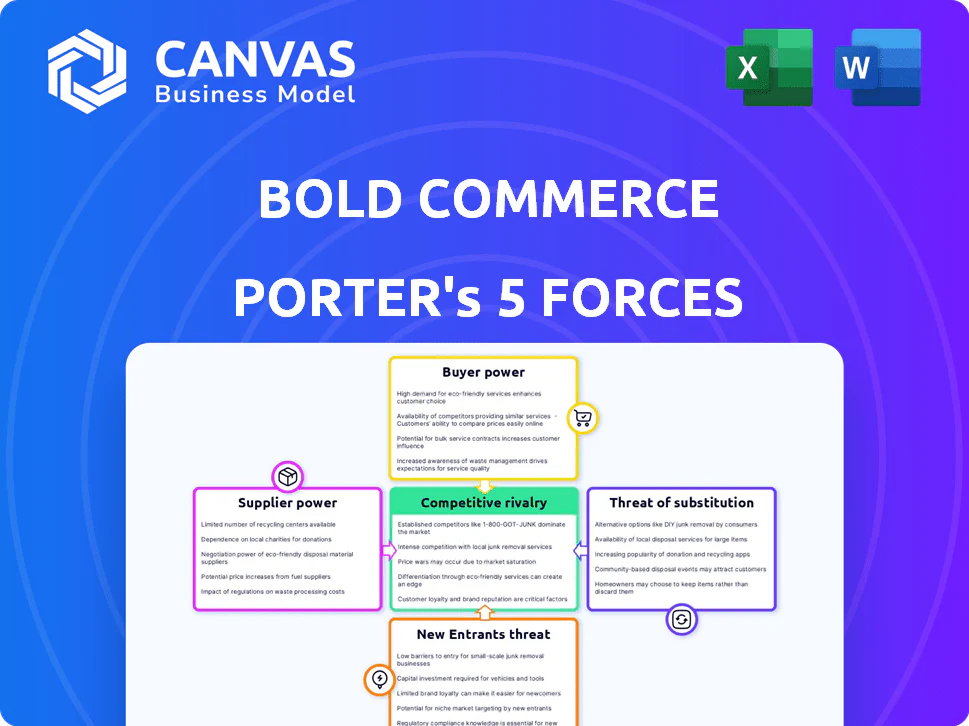
BOLD COMMERCE PORTER'S FIVE FORCES TEMPLATE RESEARCH
What is included in the product
 Detailed Word Document
Evaluates control held by suppliers/buyers, their influence on pricing/profitability.

 Customizable Excel Spreadsheet
Easily visualize the competitive landscape—empowering strategic decisions.
Same Document Delivered
Bold Commerce Porter's Five Forces Analysis
The preview shows the full Bold Commerce Porter's Five Forces analysis. This in-depth document, ready for download, covers industry rivals, suppliers, buyers, new entrants & substitutes.

Porter's Five Forces Analysis Template

Don't Miss the Bigger Picture
Bold Commerce faces diverse competitive pressures, from the bargaining power of its buyers to the threat of new entrants. Rivalry among existing competitors, particularly in the e-commerce space, is intense. Substitute products, like alternative e-commerce platforms, also pose a challenge. The power of suppliers, though potentially moderate, can affect costs. Understanding these forces is key.
This brief snapshot only scratches the surface. Unlock the full Porter's Five Forces Analysis to explore Bold Commerce’s competitive dynamics, market pressures, and strategic advantages in detail.
Suppliers Bargaining Power

Dependence on key technology providers
Bold Commerce's reliance on key technology providers, such as Shopify, BigCommerce, and WooCommerce, significantly impacts its bargaining power. These integrations are crucial for its operational capabilities, but this dependence can limit customization and flexibility. For example, in 2024, Shopify accounted for 28% of the e-commerce platform market share, influencing Bold's strategic options. The ecosystem's constraints can affect Bold's ability to innovate independently. This dependence could also affect pricing and negotiation.
Limited number of payment processing suppliers
The payment processing industry, featuring key players like PayPal and Stripe, is highly concentrated. This concentration provides significant bargaining power to these suppliers. For instance, in 2024, PayPal processed $1.5 trillion in total payment volume. This allows them to dictate terms to merchants. Their control can impact pricing and service conditions for businesses like Bold Commerce.

Suppliers with unique technology
Suppliers with unique technology, such as payment processors like Adyen and Checkout.com, hold considerable bargaining power. Their specialized integration capabilities are a key differentiator. In 2024, Adyen's revenue was around EUR 2.2 billion, reflecting its strong market position. This strength allows them to influence pricing and terms.

Potential for bundled services
Suppliers, like payment processors, can increase their bargaining power by offering bundled services. These packages might combine payment processing with fraud detection or other value-added features, enhancing their appeal. This bundling strategy can create a stronger dependency for companies like Bold Commerce on these suppliers. This is because switching becomes more complex and costly. The global payment processing market was valued at $53.6 billion in 2024, and is expected to reach $100 billion by 2030, showing the scale of supplier influence.
- Bundled services increase supplier influence.
- Switching costs rise due to service integration.
- The payment processing market is growing.
- Suppliers offer more than just basic services.
Influence on pricing strategies
Bold Commerce's reliance on specific tech suppliers gives these suppliers pricing power. This can affect the company's expenses and profit margins. For example, in 2024, software companies saw a 10-15% rise in supplier costs. This is due to increased demand and limited alternatives.
- Supplier concentration: Few suppliers for key tech.
- Impact on costs: Higher prices for essential components.
- Profitability squeeze: Reduced margins if costs rise.
- Negotiation challenges: Limited bargaining leverage.
Supplier Power: A Challenge for the Company
Bold Commerce faces supplier bargaining power challenges due to its reliance on key tech and payment processors. These suppliers, like Shopify and PayPal, control critical services, affecting operational costs. The limited number of suppliers and their bundled offerings, such as fraud detection, increase dependence and switching costs.
| Aspect | Impact | Data (2024) |
|---|---|---|
| Tech Dependence | Limits flexibility, influences costs | Shopify's 28% market share |
| Payment Processors | Dictate terms, affect pricing | PayPal processed $1.5T |
| Bundled Services | Increase dependency, switching costs | Payment market at $53.6B |
Customers Bargaining Power

Ease of switching to competitors
In the e-commerce platform market, customers have significant bargaining power because it's easy to switch providers. This is a key factor. For instance, Shopify, a major player, reported over 2.5 million merchants using their platform in 2024. The ease of migrating to competitors like BigCommerce or Wix.com enhances customer influence.
Trend towards direct-to-consumer (DTC) models
The rise of direct-to-consumer (DTC) models is significantly reshaping customer dynamics. This shift, allowing consumers to buy straight from brands, boosts their bargaining power. In 2024, DTC sales accounted for a substantial portion of e-commerce, roughly 17%. This gives customers more control over pricing and product choices. This trend is particularly strong in the apparel and beauty industries.

Price sensitivity
In e-commerce, customers are highly price-sensitive, always hunting for the best deals. This behavior pushes companies like Bold Commerce to offer competitive pricing to attract and retain customers. For instance, in 2024, online retail sales in the U.S. reached approximately $1.1 trillion, with discounts and promotions playing a significant role in driving those numbers. This price sensitivity is a key consideration in Bold Commerce's strategic decisions.

Availability of information
Customers today wield significant bargaining power due to readily available information. They can easily compare prices and product features online, fostering a transparent marketplace. This transparency enables informed decision-making and strong negotiation positions for customers. For instance, in 2024, e-commerce sales hit approximately $3 trillion in the U.S., highlighting the shift towards online shopping where price comparison is simple. This shift boosts customer power.
- Price Comparison: Online tools facilitate easy price comparisons across different vendors.
- Product Information: Customers access detailed product specifications and reviews.
- Negotiation Leverage: Informed customers can negotiate better deals.
- Market Transparency: The market becomes more transparent, helping customers.
Customer expectations for seamless checkout
Customers now expect effortless checkout experiences. Unsatisfactory checkout processes can lead to abandoned purchases or brand switches, amplifying customer power. In 2024, 70% of online shoppers reported abandoning carts due to complex checkout steps. This highlights the critical need for streamlined processes to retain customers and maintain competitiveness.
- 70% of online shoppers abandoned carts due to complex checkout steps in 2024.
- Brands with seamless checkout saw 20% higher conversion rates.
- Mobile checkout optimization is crucial, with 60% of e-commerce traffic originating from mobile devices.
- Personalized checkout experiences increased customer retention by 15%.
E-commerce: Customer Power & Price Wars
Customers have significant bargaining power in e-commerce, easily switching platforms. The rise of DTC models enhances customer control over pricing. Price sensitivity drives the need for competitive offerings.
| Aspect | Impact | Data (2024) |
|---|---|---|
| Switching Costs | Low | Shopify had over 2.5M merchants. |
| DTC Sales | Increased control | ~17% of e-commerce sales. |
| Price Sensitivity | High | US online retail sales ~$1.1T. |
Rivalry Among Competitors

Presence of major e-commerce platforms
Bold Commerce faces intense competition from major e-commerce platforms. Shopify, Magento, and WooCommerce provide integrated checkout solutions. Shopify alone had a 32% market share in 2024, highlighting the competitive pressure. This substantial market share of rivals poses a significant threat to Bold Commerce's growth.
Intensity of competition in the e-commerce software market
The e-commerce software market is fiercely competitive, with a valuation exceeding billions of dollars. In 2024, the global e-commerce market reached approximately $6.3 trillion. Numerous providers compete for market share. This includes established giants and emerging platforms, leading to intense rivalry. The dynamic landscape forces constant innovation and pricing pressure.

Competitors offering integrated solutions
Rivalry intensifies with competitors offering integrated e-commerce solutions, including checkout. Platforms like Shopify and BigCommerce bundle features, appealing to brands seeking simplicity. In 2024, Shopify's revenue hit $7.1 billion, highlighting the demand for such integrated systems. This contrasts with Bold Commerce's specialized approach, potentially affecting market share. Brands must weigh the benefits of specialized versus all-in-one platforms.

Aggressive growth strategies of competitors
Major competitors in the checkout solutions space are indeed displaying aggressive growth strategies. This is evident in their increasing gross merchandise volume (GMV). For instance, in 2024, Shopify's GMV reached over $230 billion, indicating a significant expansion. This rapid expansion intensifies the competitive rivalry, as companies vie for market share. The competition is fierce, pushing for innovation and attracting customers.
- Shopify's GMV in 2024 surpassed $230 billion.
- Aggressive growth tactics lead to higher competition.
- Checkout solutions market sees intense rivalry.
- Companies are focused on market share gains.
Diverse range of alternatives
Competitive rivalry in the e-commerce tools market is intense. Bold Commerce faces numerous competitors, including Shopify, BigCommerce, and WooCommerce. This creates a dynamic environment where companies constantly innovate to attract and retain customers. The availability of various options means customers can easily switch providers. This intensifies the need for Bold Commerce to differentiate its offerings.
- Shopify's market share in the U.S. e-commerce platform market was 32% in 2024.
- BigCommerce reported over $3.4 billion in merchant GMV in Q4 2023.
- WooCommerce powers over 4 million online stores globally.
E-commerce Rivals: Fierce Competition!
Bold Commerce competes in a highly competitive e-commerce market. Shopify’s 32% market share in 2024 shows the intensity of rivalry. Rivals like BigCommerce and WooCommerce also fight for market share, intensifying the pressure. This demands constant innovation to stay competitive.
| Competitor | 2024 Market Share/GMV | Key Strategy |
|---|---|---|
| Shopify | 32% (U.S. Platform Share) / $230B+ GMV | Integrated e-commerce solutions |
| BigCommerce | $3.4B+ GMV (Q4 2023) | All-in-one platform |
| WooCommerce | 4M+ Online Stores | Open-source flexibility |
Original: $10.00
-65%$10.00
$3.50BOLD COMMERCE PORTER'S FIVE FORCES TEMPLATE RESEARCH
What is included in the product
Detailed Word Document
Evaluates control held by suppliers/buyers, their influence on pricing/profitability.
Customizable Excel Spreadsheet
Easily visualize the competitive landscape—empowering strategic decisions.
Same Document Delivered
Bold Commerce Porter's Five Forces Analysis
The preview shows the full Bold Commerce Porter's Five Forces analysis. This in-depth document, ready for download, covers industry rivals, suppliers, buyers, new entrants & substitutes.
Porter's Five Forces Analysis Template
Don't Miss the Bigger Picture
Bold Commerce faces diverse competitive pressures, from the bargaining power of its buyers to the threat of new entrants. Rivalry among existing competitors, particularly in the e-commerce space, is intense. Substitute products, like alternative e-commerce platforms, also pose a challenge. The power of suppliers, though potentially moderate, can affect costs. Understanding these forces is key.
This brief snapshot only scratches the surface. Unlock the full Porter's Five Forces Analysis to explore Bold Commerce’s competitive dynamics, market pressures, and strategic advantages in detail.
Suppliers Bargaining Power
Dependence on key technology providers
Bold Commerce's reliance on key technology providers, such as Shopify, BigCommerce, and WooCommerce, significantly impacts its bargaining power. These integrations are crucial for its operational capabilities, but this dependence can limit customization and flexibility. For example, in 2024, Shopify accounted for 28% of the e-commerce platform market share, influencing Bold's strategic options. The ecosystem's constraints can affect Bold's ability to innovate independently. This dependence could also affect pricing and negotiation.
Limited number of payment processing suppliers
The payment processing industry, featuring key players like PayPal and Stripe, is highly concentrated. This concentration provides significant bargaining power to these suppliers. For instance, in 2024, PayPal processed $1.5 trillion in total payment volume. This allows them to dictate terms to merchants. Their control can impact pricing and service conditions for businesses like Bold Commerce.
Suppliers with unique technology
Suppliers with unique technology, such as payment processors like Adyen and Checkout.com, hold considerable bargaining power. Their specialized integration capabilities are a key differentiator. In 2024, Adyen's revenue was around EUR 2.2 billion, reflecting its strong market position. This strength allows them to influence pricing and terms.
Potential for bundled services
Suppliers, like payment processors, can increase their bargaining power by offering bundled services. These packages might combine payment processing with fraud detection or other value-added features, enhancing their appeal. This bundling strategy can create a stronger dependency for companies like Bold Commerce on these suppliers. This is because switching becomes more complex and costly. The global payment processing market was valued at $53.6 billion in 2024, and is expected to reach $100 billion by 2030, showing the scale of supplier influence.
- Bundled services increase supplier influence.
- Switching costs rise due to service integration.
- The payment processing market is growing.
- Suppliers offer more than just basic services.
Influence on pricing strategies
Bold Commerce's reliance on specific tech suppliers gives these suppliers pricing power. This can affect the company's expenses and profit margins. For example, in 2024, software companies saw a 10-15% rise in supplier costs. This is due to increased demand and limited alternatives.
- Supplier concentration: Few suppliers for key tech.
- Impact on costs: Higher prices for essential components.
- Profitability squeeze: Reduced margins if costs rise.
- Negotiation challenges: Limited bargaining leverage.
Supplier Power: A Challenge for the Company
Bold Commerce faces supplier bargaining power challenges due to its reliance on key tech and payment processors. These suppliers, like Shopify and PayPal, control critical services, affecting operational costs. The limited number of suppliers and their bundled offerings, such as fraud detection, increase dependence and switching costs.
| Aspect | Impact | Data (2024) |
|---|---|---|
| Tech Dependence | Limits flexibility, influences costs | Shopify's 28% market share |
| Payment Processors | Dictate terms, affect pricing | PayPal processed $1.5T |
| Bundled Services | Increase dependency, switching costs | Payment market at $53.6B |
Customers Bargaining Power
Ease of switching to competitors
In the e-commerce platform market, customers have significant bargaining power because it's easy to switch providers. This is a key factor. For instance, Shopify, a major player, reported over 2.5 million merchants using their platform in 2024. The ease of migrating to competitors like BigCommerce or Wix.com enhances customer influence.
Trend towards direct-to-consumer (DTC) models
The rise of direct-to-consumer (DTC) models is significantly reshaping customer dynamics. This shift, allowing consumers to buy straight from brands, boosts their bargaining power. In 2024, DTC sales accounted for a substantial portion of e-commerce, roughly 17%. This gives customers more control over pricing and product choices. This trend is particularly strong in the apparel and beauty industries.
Price sensitivity
In e-commerce, customers are highly price-sensitive, always hunting for the best deals. This behavior pushes companies like Bold Commerce to offer competitive pricing to attract and retain customers. For instance, in 2024, online retail sales in the U.S. reached approximately $1.1 trillion, with discounts and promotions playing a significant role in driving those numbers. This price sensitivity is a key consideration in Bold Commerce's strategic decisions.
Availability of information
Customers today wield significant bargaining power due to readily available information. They can easily compare prices and product features online, fostering a transparent marketplace. This transparency enables informed decision-making and strong negotiation positions for customers. For instance, in 2024, e-commerce sales hit approximately $3 trillion in the U.S., highlighting the shift towards online shopping where price comparison is simple. This shift boosts customer power.
- Price Comparison: Online tools facilitate easy price comparisons across different vendors.
- Product Information: Customers access detailed product specifications and reviews.
- Negotiation Leverage: Informed customers can negotiate better deals.
- Market Transparency: The market becomes more transparent, helping customers.
Customer expectations for seamless checkout
Customers now expect effortless checkout experiences. Unsatisfactory checkout processes can lead to abandoned purchases or brand switches, amplifying customer power. In 2024, 70% of online shoppers reported abandoning carts due to complex checkout steps. This highlights the critical need for streamlined processes to retain customers and maintain competitiveness.
- 70% of online shoppers abandoned carts due to complex checkout steps in 2024.
- Brands with seamless checkout saw 20% higher conversion rates.
- Mobile checkout optimization is crucial, with 60% of e-commerce traffic originating from mobile devices.
- Personalized checkout experiences increased customer retention by 15%.
E-commerce: Customer Power & Price Wars
Customers have significant bargaining power in e-commerce, easily switching platforms. The rise of DTC models enhances customer control over pricing. Price sensitivity drives the need for competitive offerings.
| Aspect | Impact | Data (2024) |
|---|---|---|
| Switching Costs | Low | Shopify had over 2.5M merchants. |
| DTC Sales | Increased control | ~17% of e-commerce sales. |
| Price Sensitivity | High | US online retail sales ~$1.1T. |
Rivalry Among Competitors
Presence of major e-commerce platforms
Bold Commerce faces intense competition from major e-commerce platforms. Shopify, Magento, and WooCommerce provide integrated checkout solutions. Shopify alone had a 32% market share in 2024, highlighting the competitive pressure. This substantial market share of rivals poses a significant threat to Bold Commerce's growth.
Intensity of competition in the e-commerce software market
The e-commerce software market is fiercely competitive, with a valuation exceeding billions of dollars. In 2024, the global e-commerce market reached approximately $6.3 trillion. Numerous providers compete for market share. This includes established giants and emerging platforms, leading to intense rivalry. The dynamic landscape forces constant innovation and pricing pressure.
Competitors offering integrated solutions
Rivalry intensifies with competitors offering integrated e-commerce solutions, including checkout. Platforms like Shopify and BigCommerce bundle features, appealing to brands seeking simplicity. In 2024, Shopify's revenue hit $7.1 billion, highlighting the demand for such integrated systems. This contrasts with Bold Commerce's specialized approach, potentially affecting market share. Brands must weigh the benefits of specialized versus all-in-one platforms.
Aggressive growth strategies of competitors
Major competitors in the checkout solutions space are indeed displaying aggressive growth strategies. This is evident in their increasing gross merchandise volume (GMV). For instance, in 2024, Shopify's GMV reached over $230 billion, indicating a significant expansion. This rapid expansion intensifies the competitive rivalry, as companies vie for market share. The competition is fierce, pushing for innovation and attracting customers.
- Shopify's GMV in 2024 surpassed $230 billion.
- Aggressive growth tactics lead to higher competition.
- Checkout solutions market sees intense rivalry.
- Companies are focused on market share gains.
Diverse range of alternatives
Competitive rivalry in the e-commerce tools market is intense. Bold Commerce faces numerous competitors, including Shopify, BigCommerce, and WooCommerce. This creates a dynamic environment where companies constantly innovate to attract and retain customers. The availability of various options means customers can easily switch providers. This intensifies the need for Bold Commerce to differentiate its offerings.
- Shopify's market share in the U.S. e-commerce platform market was 32% in 2024.
- BigCommerce reported over $3.4 billion in merchant GMV in Q4 2023.
- WooCommerce powers over 4 million online stores globally.
E-commerce Rivals: Fierce Competition!
Bold Commerce competes in a highly competitive e-commerce market. Shopify’s 32% market share in 2024 shows the intensity of rivalry. Rivals like BigCommerce and WooCommerce also fight for market share, intensifying the pressure. This demands constant innovation to stay competitive.
| Competitor | 2024 Market Share/GMV | Key Strategy |
|---|---|---|
| Shopify | 32% (U.S. Platform Share) / $230B+ GMV | Integrated e-commerce solutions |
| BigCommerce | $3.4B+ GMV (Q4 2023) | All-in-one platform |
| WooCommerce | 4M+ Online Stores | Open-source flexibility |
Product Information
Product Information
Shipping & Returns
Shipping & Returns
Description
What is included in the product
Detailed Word Document
Evaluates control held by suppliers/buyers, their influence on pricing/profitability.
Customizable Excel Spreadsheet
Easily visualize the competitive landscape—empowering strategic decisions.
Same Document Delivered
Bold Commerce Porter's Five Forces Analysis
The preview shows the full Bold Commerce Porter's Five Forces analysis. This in-depth document, ready for download, covers industry rivals, suppliers, buyers, new entrants & substitutes.
Porter's Five Forces Analysis Template
Don't Miss the Bigger Picture
Bold Commerce faces diverse competitive pressures, from the bargaining power of its buyers to the threat of new entrants. Rivalry among existing competitors, particularly in the e-commerce space, is intense. Substitute products, like alternative e-commerce platforms, also pose a challenge. The power of suppliers, though potentially moderate, can affect costs. Understanding these forces is key.
This brief snapshot only scratches the surface. Unlock the full Porter's Five Forces Analysis to explore Bold Commerce’s competitive dynamics, market pressures, and strategic advantages in detail.
Suppliers Bargaining Power
Dependence on key technology providers
Bold Commerce's reliance on key technology providers, such as Shopify, BigCommerce, and WooCommerce, significantly impacts its bargaining power. These integrations are crucial for its operational capabilities, but this dependence can limit customization and flexibility. For example, in 2024, Shopify accounted for 28% of the e-commerce platform market share, influencing Bold's strategic options. The ecosystem's constraints can affect Bold's ability to innovate independently. This dependence could also affect pricing and negotiation.
Limited number of payment processing suppliers
The payment processing industry, featuring key players like PayPal and Stripe, is highly concentrated. This concentration provides significant bargaining power to these suppliers. For instance, in 2024, PayPal processed $1.5 trillion in total payment volume. This allows them to dictate terms to merchants. Their control can impact pricing and service conditions for businesses like Bold Commerce.
Suppliers with unique technology
Suppliers with unique technology, such as payment processors like Adyen and Checkout.com, hold considerable bargaining power. Their specialized integration capabilities are a key differentiator. In 2024, Adyen's revenue was around EUR 2.2 billion, reflecting its strong market position. This strength allows them to influence pricing and terms.
Potential for bundled services
Suppliers, like payment processors, can increase their bargaining power by offering bundled services. These packages might combine payment processing with fraud detection or other value-added features, enhancing their appeal. This bundling strategy can create a stronger dependency for companies like Bold Commerce on these suppliers. This is because switching becomes more complex and costly. The global payment processing market was valued at $53.6 billion in 2024, and is expected to reach $100 billion by 2030, showing the scale of supplier influence.
- Bundled services increase supplier influence.
- Switching costs rise due to service integration.
- The payment processing market is growing.
- Suppliers offer more than just basic services.
Influence on pricing strategies
Bold Commerce's reliance on specific tech suppliers gives these suppliers pricing power. This can affect the company's expenses and profit margins. For example, in 2024, software companies saw a 10-15% rise in supplier costs. This is due to increased demand and limited alternatives.
- Supplier concentration: Few suppliers for key tech.
- Impact on costs: Higher prices for essential components.
- Profitability squeeze: Reduced margins if costs rise.
- Negotiation challenges: Limited bargaining leverage.
Supplier Power: A Challenge for the Company
Bold Commerce faces supplier bargaining power challenges due to its reliance on key tech and payment processors. These suppliers, like Shopify and PayPal, control critical services, affecting operational costs. The limited number of suppliers and their bundled offerings, such as fraud detection, increase dependence and switching costs.
| Aspect | Impact | Data (2024) |
|---|---|---|
| Tech Dependence | Limits flexibility, influences costs | Shopify's 28% market share |
| Payment Processors | Dictate terms, affect pricing | PayPal processed $1.5T |
| Bundled Services | Increase dependency, switching costs | Payment market at $53.6B |
Customers Bargaining Power
Ease of switching to competitors
In the e-commerce platform market, customers have significant bargaining power because it's easy to switch providers. This is a key factor. For instance, Shopify, a major player, reported over 2.5 million merchants using their platform in 2024. The ease of migrating to competitors like BigCommerce or Wix.com enhances customer influence.
Trend towards direct-to-consumer (DTC) models
The rise of direct-to-consumer (DTC) models is significantly reshaping customer dynamics. This shift, allowing consumers to buy straight from brands, boosts their bargaining power. In 2024, DTC sales accounted for a substantial portion of e-commerce, roughly 17%. This gives customers more control over pricing and product choices. This trend is particularly strong in the apparel and beauty industries.
Price sensitivity
In e-commerce, customers are highly price-sensitive, always hunting for the best deals. This behavior pushes companies like Bold Commerce to offer competitive pricing to attract and retain customers. For instance, in 2024, online retail sales in the U.S. reached approximately $1.1 trillion, with discounts and promotions playing a significant role in driving those numbers. This price sensitivity is a key consideration in Bold Commerce's strategic decisions.
Availability of information
Customers today wield significant bargaining power due to readily available information. They can easily compare prices and product features online, fostering a transparent marketplace. This transparency enables informed decision-making and strong negotiation positions for customers. For instance, in 2024, e-commerce sales hit approximately $3 trillion in the U.S., highlighting the shift towards online shopping where price comparison is simple. This shift boosts customer power.
- Price Comparison: Online tools facilitate easy price comparisons across different vendors.
- Product Information: Customers access detailed product specifications and reviews.
- Negotiation Leverage: Informed customers can negotiate better deals.
- Market Transparency: The market becomes more transparent, helping customers.
Customer expectations for seamless checkout
Customers now expect effortless checkout experiences. Unsatisfactory checkout processes can lead to abandoned purchases or brand switches, amplifying customer power. In 2024, 70% of online shoppers reported abandoning carts due to complex checkout steps. This highlights the critical need for streamlined processes to retain customers and maintain competitiveness.
- 70% of online shoppers abandoned carts due to complex checkout steps in 2024.
- Brands with seamless checkout saw 20% higher conversion rates.
- Mobile checkout optimization is crucial, with 60% of e-commerce traffic originating from mobile devices.
- Personalized checkout experiences increased customer retention by 15%.
E-commerce: Customer Power & Price Wars
Customers have significant bargaining power in e-commerce, easily switching platforms. The rise of DTC models enhances customer control over pricing. Price sensitivity drives the need for competitive offerings.
| Aspect | Impact | Data (2024) |
|---|---|---|
| Switching Costs | Low | Shopify had over 2.5M merchants. |
| DTC Sales | Increased control | ~17% of e-commerce sales. |
| Price Sensitivity | High | US online retail sales ~$1.1T. |
Rivalry Among Competitors
Presence of major e-commerce platforms
Bold Commerce faces intense competition from major e-commerce platforms. Shopify, Magento, and WooCommerce provide integrated checkout solutions. Shopify alone had a 32% market share in 2024, highlighting the competitive pressure. This substantial market share of rivals poses a significant threat to Bold Commerce's growth.
Intensity of competition in the e-commerce software market
The e-commerce software market is fiercely competitive, with a valuation exceeding billions of dollars. In 2024, the global e-commerce market reached approximately $6.3 trillion. Numerous providers compete for market share. This includes established giants and emerging platforms, leading to intense rivalry. The dynamic landscape forces constant innovation and pricing pressure.
Competitors offering integrated solutions
Rivalry intensifies with competitors offering integrated e-commerce solutions, including checkout. Platforms like Shopify and BigCommerce bundle features, appealing to brands seeking simplicity. In 2024, Shopify's revenue hit $7.1 billion, highlighting the demand for such integrated systems. This contrasts with Bold Commerce's specialized approach, potentially affecting market share. Brands must weigh the benefits of specialized versus all-in-one platforms.
Aggressive growth strategies of competitors
Major competitors in the checkout solutions space are indeed displaying aggressive growth strategies. This is evident in their increasing gross merchandise volume (GMV). For instance, in 2024, Shopify's GMV reached over $230 billion, indicating a significant expansion. This rapid expansion intensifies the competitive rivalry, as companies vie for market share. The competition is fierce, pushing for innovation and attracting customers.
- Shopify's GMV in 2024 surpassed $230 billion.
- Aggressive growth tactics lead to higher competition.
- Checkout solutions market sees intense rivalry.
- Companies are focused on market share gains.
Diverse range of alternatives
Competitive rivalry in the e-commerce tools market is intense. Bold Commerce faces numerous competitors, including Shopify, BigCommerce, and WooCommerce. This creates a dynamic environment where companies constantly innovate to attract and retain customers. The availability of various options means customers can easily switch providers. This intensifies the need for Bold Commerce to differentiate its offerings.
- Shopify's market share in the U.S. e-commerce platform market was 32% in 2024.
- BigCommerce reported over $3.4 billion in merchant GMV in Q4 2023.
- WooCommerce powers over 4 million online stores globally.
E-commerce Rivals: Fierce Competition!
Bold Commerce competes in a highly competitive e-commerce market. Shopify’s 32% market share in 2024 shows the intensity of rivalry. Rivals like BigCommerce and WooCommerce also fight for market share, intensifying the pressure. This demands constant innovation to stay competitive.
| Competitor | 2024 Market Share/GMV | Key Strategy |
|---|---|---|
| Shopify | 32% (U.S. Platform Share) / $230B+ GMV | Integrated e-commerce solutions |
| BigCommerce | $3.4B+ GMV (Q4 2023) | All-in-one platform |
| WooCommerce | 4M+ Online Stores | Open-source flexibility |











