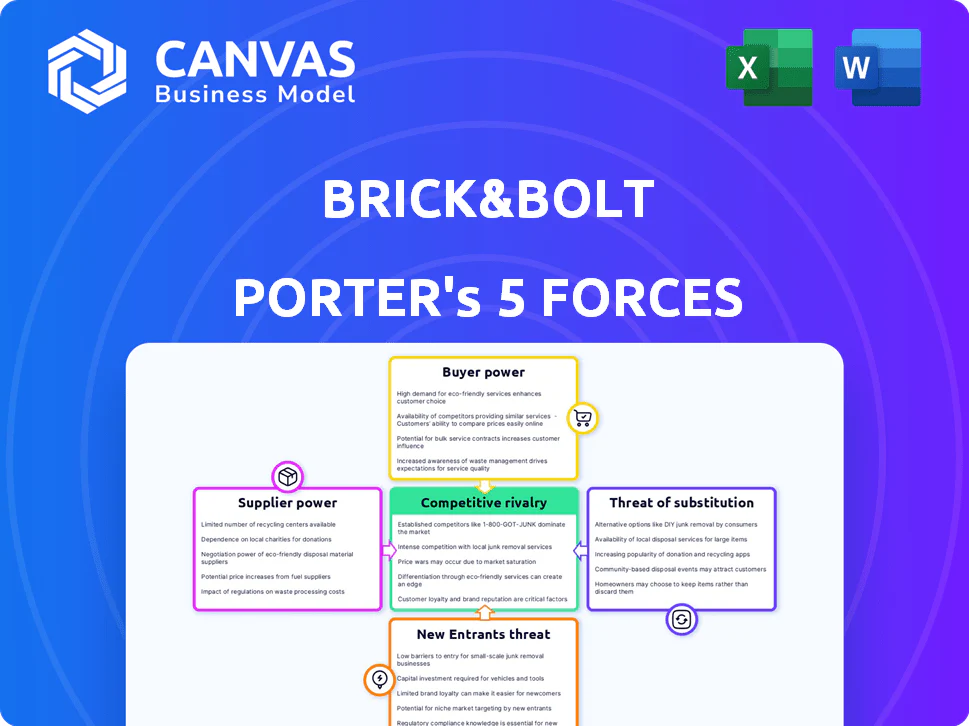
BRICK&BOLT PORTER'S FIVE FORCES TEMPLATE RESEARCH
What is included in the product
 Detailed Word Document
Analyzes Brick&Bolt's competitive position by examining industry forces, threats, and market dynamics.

 Customizable Excel Spreadsheet
Instantly visualize the strategic landscape with dynamic charts.
What You See Is What You Get
Brick&Bolt Porter's Five Forces Analysis
This preview showcases the comprehensive Porter's Five Forces analysis for Brick&Bolt, a deep dive into its competitive landscape. It examines the bargaining power of suppliers and buyers, threat of new entrants and substitutes, and industry rivalry. The document you're viewing is the exact analysis file you'll receive post-purchase.

Porter's Five Forces Analysis Template

Don't Miss the Bigger Picture
Brick&Bolt faces a complex landscape. The threat of new entrants and bargaining power of suppliers are key considerations. Buyer power and rivalry among existing competitors also shape the market. Substitutes present another layer of challenge for Brick&Bolt. Understand these forces for better strategic decisions.
Ready to move beyond the basics? Get a full strategic breakdown of Brick&Bolt’s market position, competitive intensity, and external threats—all in one powerful analysis.
Suppliers Bargaining Power

Availability of Substitute Materials
The construction industry boasts a wide array of substitute materials, curbing supplier power. Brick&Bolt can pivot to alternatives if suppliers hike prices. For instance, in 2024, the market saw diverse options, from advanced concrete to recycled materials. This flexibility helps manage costs and maintain project timelines. This is especially true in a market where, as of late 2024, prices of raw materials have fluctuated significantly.
Fragmented Supplier Base
Brick&Bolt benefits from a fragmented supplier base, particularly for standard materials. This structure limits the power of individual suppliers. For instance, in 2024, the construction materials market saw numerous small to medium-sized enterprises (SMEs). This provides Brick&Bolt with multiple sourcing options. This competition among suppliers keeps prices competitive.

Brick&Bolt's Volume of Business
Brick&Bolt, as an e-commerce marketplace, consolidates demand, potentially giving it leverage. For example, in 2024, the company facilitated over ₹2,000 crore in construction projects. This volume allows for better price negotiations with suppliers. The ability to switch suppliers also impacts this power.

Supplier Dependence on the Platform
Suppliers heavily reliant on Brick&Bolt's platform may face reduced bargaining power. Their dependence can lead to accepting less favorable terms to secure continued access to Brick&Bolt's customers. This dynamic is evident in the construction industry, where platform control influences supplier pricing. For instance, in 2024, companies using platforms for over 70% of sales showed reduced profit margins.
- Platform dependence lowers supplier bargaining power.
- Suppliers may accept less favorable terms.
- Construction industry examples reflect this trend.
- 2024 data shows margin impacts for high-reliance suppliers.
Switching Costs for Brick&Bolt
Switching costs for suppliers can impact Brick&Bolt's operations. Replacing individual suppliers is generally easy, yet changing major ones might cause disruptions. The platform model, however, could make switching less expensive than in traditional construction. Brick&Bolt has a network of over 1000 suppliers, which provides leverage. The construction industry saw a 5% increase in material costs in 2024.
- Supplier Diversity: Brick&Bolt's wide network reduces dependency.
- Platform Advantage: The platform model simplifies supplier transitions.
- Cost Impact: Construction material costs increased by 5% in 2024.
- Negotiating Power: Brick&Bolt's size helps in negotiations.
Supplier Dynamics: Balancing Power in Construction
Brick&Bolt's supplier power is lessened by material substitutes and a fragmented supplier base, fostering competition. The e-commerce platform consolidates demand, providing negotiation leverage. Reliance on the platform can weaken supplier bargaining power, especially affecting profit margins. In 2024, construction material costs rose, highlighting the importance of managing supplier relationships.
| Factor | Impact | 2024 Data |
|---|---|---|
| Substitute Availability | Reduces Supplier Power | Diverse materials available |
| Supplier Base | Fragmented, Competitive | Numerous SMEs in market |
| Platform Leverage | Enhances Bargaining | ₹2,000cr+ projects facilitated |
Customers Bargaining Power

Availability of Alternatives for Customers
Customers in the construction sector have numerous alternatives, like traditional contractors and online platforms, increasing their bargaining power. A 2024 report showed that 60% of construction projects consider multiple bids. This competition pushes companies like Brick&Bolt to offer competitive pricing and better service.
Price Sensitivity of Customers
Construction projects demand substantial investment, increasing customer price sensitivity. Brick&Bolt's platform could boost customer power via transparent pricing and comparisons. The construction industry's price volatility, like a 5-10% material cost fluctuation in 2024, highlights this sensitivity. This empowers customers to negotiate effectively.

Information Availability to Customers
Brick&Bolt's transparency model, offering pricing and project tracking, strengthens customer power. This access to information enables informed decisions and accountability. In 2024, 65% of construction clients sought transparent pricing. Contractor review platforms saw a 40% increase in user engagement.

Low Customer Switching Costs
Customers of Brick&Bolt often face low switching costs before committing to a project. This means they can easily compare quotes and services from various construction providers. This ease of switching enhances their bargaining power significantly.
- Industry data shows a high churn rate among construction clients.
- Competitors' offerings are often seen as similar.
- Clients can quickly gather multiple bids, increasing their leverage.
Nature of the Purchase
When customers purchase construction services, it's a big deal. This is because it involves significant investment and long-term implications. Customers often conduct extensive research, compare multiple providers, and negotiate prices. This thorough process gives them substantial power in the transaction, influencing pricing and service terms. In 2024, the construction industry saw a 5% increase in project cost overruns, highlighting the importance of customer negotiation.
- Negotiation is key due to high costs.
- Customers research extensively, comparing options.
- This power impacts pricing and service terms.
- In 2024, cost overruns emphasized customer influence.
Construction Clients: Strong Bargaining Power in 2024
Customers' bargaining power in the construction sector is strong due to numerous choices and price sensitivity. Transparent pricing and easy switching further empower clients. High project costs and extensive research amplify their influence on pricing and service terms. In 2024, cost overruns highlighted this.
| Factor | Impact | 2024 Data |
|---|---|---|
| Alternatives | Increased bargaining power | 60% projects consider multiple bids |
| Price Sensitivity | Higher customer influence | 5-10% material cost fluctuations |
| Transparency | Enhanced customer control | 65% sought transparent pricing |
Rivalry Among Competitors

Number and Diversity of Competitors
The construction services market sees intense rivalry. Numerous competitors, including traditional contractors and tech platforms, create a fragmented landscape. This diversity, according to a 2024 report, includes over 1.2 million construction businesses in the U.S. alone, intensifying competition.
Market Growth Rate
The Indian e-commerce market for building materials is projected to grow substantially. This growth, however, doesn't automatically ease rivalry. With e-commerce penetration still low, competition intensifies as companies compete for a larger share of the expanding market. The construction industry in India is expected to reach $738.5 billion by 2028.

Differentiation Among Competitors
Competitors in the construction space often distinguish themselves through pricing, service quality, and technology. Brick&Bolt sets itself apart with its commitment to transparency and tech-driven solutions. In 2024, the construction tech market was valued at over $10 billion, highlighting the importance of such differentiators. This focus helps attract clients. This approach can lead to a stronger market position.

Exit Barriers
High exit barriers in the construction sector intensify competition. This means firms struggle to leave, even when unprofitable, increasing rivalry. The construction industry's exit barriers are significant due to high capital investments and specialized equipment. This can lead to price wars and reduced profitability across the board. In 2024, the construction industry's profit margins were under pressure, with many firms facing challenges.
- Capital-intensive nature of construction projects.
- Specialized equipment and workforce.
- Long-term contracts and project commitments.
Brand Loyalty
In a competitive market, like the construction sector, brand loyalty is key. Brick&Bolt works to cultivate trust through its platform and reliable processes, which helps in a market with many choices. This can help Brick&Bolt stand out amidst strong competition. Building brand loyalty can lead to repeat business and a stronger market position.
- Customer retention is a key metric for brand loyalty, with companies aiming for rates above 70%.
- Companies with strong brand loyalty often see higher profit margins.
- Investments in customer service and experience are crucial for boosting loyalty.
- Loyal customers are more likely to recommend a brand, increasing market reach.
Construction's Competitive Landscape: Key Insights
Competitive rivalry in construction is fierce, with many players. This is intensified by high exit barriers, such as capital investments. In 2024, profit margins were under pressure. Brand loyalty helps companies like Brick&Bolt stand out.
| Factor | Impact | Data (2024) |
|---|---|---|
| Market Fragmentation | Increased Competition | Over 1.2M construction businesses in the U.S. |
| Exit Barriers | Intensified Rivalry | Profit margins under pressure |
| Brand Loyalty | Competitive Advantage | Customer retention rates above 70% |
BRICK&BOLT PORTER'S FIVE FORCES TEMPLATE RESEARCH
What is included in the product
Detailed Word Document
Analyzes Brick&Bolt's competitive position by examining industry forces, threats, and market dynamics.
Customizable Excel Spreadsheet
Instantly visualize the strategic landscape with dynamic charts.
What You See Is What You Get
Brick&Bolt Porter's Five Forces Analysis
This preview showcases the comprehensive Porter's Five Forces analysis for Brick&Bolt, a deep dive into its competitive landscape. It examines the bargaining power of suppliers and buyers, threat of new entrants and substitutes, and industry rivalry. The document you're viewing is the exact analysis file you'll receive post-purchase.
Porter's Five Forces Analysis Template
Don't Miss the Bigger Picture
Brick&Bolt faces a complex landscape. The threat of new entrants and bargaining power of suppliers are key considerations. Buyer power and rivalry among existing competitors also shape the market. Substitutes present another layer of challenge for Brick&Bolt. Understand these forces for better strategic decisions.
Ready to move beyond the basics? Get a full strategic breakdown of Brick&Bolt’s market position, competitive intensity, and external threats—all in one powerful analysis.
Suppliers Bargaining Power
Availability of Substitute Materials
The construction industry boasts a wide array of substitute materials, curbing supplier power. Brick&Bolt can pivot to alternatives if suppliers hike prices. For instance, in 2024, the market saw diverse options, from advanced concrete to recycled materials. This flexibility helps manage costs and maintain project timelines. This is especially true in a market where, as of late 2024, prices of raw materials have fluctuated significantly.
Fragmented Supplier Base
Brick&Bolt benefits from a fragmented supplier base, particularly for standard materials. This structure limits the power of individual suppliers. For instance, in 2024, the construction materials market saw numerous small to medium-sized enterprises (SMEs). This provides Brick&Bolt with multiple sourcing options. This competition among suppliers keeps prices competitive.
Brick&Bolt's Volume of Business
Brick&Bolt, as an e-commerce marketplace, consolidates demand, potentially giving it leverage. For example, in 2024, the company facilitated over ₹2,000 crore in construction projects. This volume allows for better price negotiations with suppliers. The ability to switch suppliers also impacts this power.
Supplier Dependence on the Platform
Suppliers heavily reliant on Brick&Bolt's platform may face reduced bargaining power. Their dependence can lead to accepting less favorable terms to secure continued access to Brick&Bolt's customers. This dynamic is evident in the construction industry, where platform control influences supplier pricing. For instance, in 2024, companies using platforms for over 70% of sales showed reduced profit margins.
- Platform dependence lowers supplier bargaining power.
- Suppliers may accept less favorable terms.
- Construction industry examples reflect this trend.
- 2024 data shows margin impacts for high-reliance suppliers.
Switching Costs for Brick&Bolt
Switching costs for suppliers can impact Brick&Bolt's operations. Replacing individual suppliers is generally easy, yet changing major ones might cause disruptions. The platform model, however, could make switching less expensive than in traditional construction. Brick&Bolt has a network of over 1000 suppliers, which provides leverage. The construction industry saw a 5% increase in material costs in 2024.
- Supplier Diversity: Brick&Bolt's wide network reduces dependency.
- Platform Advantage: The platform model simplifies supplier transitions.
- Cost Impact: Construction material costs increased by 5% in 2024.
- Negotiating Power: Brick&Bolt's size helps in negotiations.
Supplier Dynamics: Balancing Power in Construction
Brick&Bolt's supplier power is lessened by material substitutes and a fragmented supplier base, fostering competition. The e-commerce platform consolidates demand, providing negotiation leverage. Reliance on the platform can weaken supplier bargaining power, especially affecting profit margins. In 2024, construction material costs rose, highlighting the importance of managing supplier relationships.
| Factor | Impact | 2024 Data |
|---|---|---|
| Substitute Availability | Reduces Supplier Power | Diverse materials available |
| Supplier Base | Fragmented, Competitive | Numerous SMEs in market |
| Platform Leverage | Enhances Bargaining | ₹2,000cr+ projects facilitated |
Customers Bargaining Power
Availability of Alternatives for Customers
Customers in the construction sector have numerous alternatives, like traditional contractors and online platforms, increasing their bargaining power. A 2024 report showed that 60% of construction projects consider multiple bids. This competition pushes companies like Brick&Bolt to offer competitive pricing and better service.
Price Sensitivity of Customers
Construction projects demand substantial investment, increasing customer price sensitivity. Brick&Bolt's platform could boost customer power via transparent pricing and comparisons. The construction industry's price volatility, like a 5-10% material cost fluctuation in 2024, highlights this sensitivity. This empowers customers to negotiate effectively.
Information Availability to Customers
Brick&Bolt's transparency model, offering pricing and project tracking, strengthens customer power. This access to information enables informed decisions and accountability. In 2024, 65% of construction clients sought transparent pricing. Contractor review platforms saw a 40% increase in user engagement.
Low Customer Switching Costs
Customers of Brick&Bolt often face low switching costs before committing to a project. This means they can easily compare quotes and services from various construction providers. This ease of switching enhances their bargaining power significantly.
- Industry data shows a high churn rate among construction clients.
- Competitors' offerings are often seen as similar.
- Clients can quickly gather multiple bids, increasing their leverage.
Nature of the Purchase
When customers purchase construction services, it's a big deal. This is because it involves significant investment and long-term implications. Customers often conduct extensive research, compare multiple providers, and negotiate prices. This thorough process gives them substantial power in the transaction, influencing pricing and service terms. In 2024, the construction industry saw a 5% increase in project cost overruns, highlighting the importance of customer negotiation.
- Negotiation is key due to high costs.
- Customers research extensively, comparing options.
- This power impacts pricing and service terms.
- In 2024, cost overruns emphasized customer influence.
Construction Clients: Strong Bargaining Power in 2024
Customers' bargaining power in the construction sector is strong due to numerous choices and price sensitivity. Transparent pricing and easy switching further empower clients. High project costs and extensive research amplify their influence on pricing and service terms. In 2024, cost overruns highlighted this.
| Factor | Impact | 2024 Data |
|---|---|---|
| Alternatives | Increased bargaining power | 60% projects consider multiple bids |
| Price Sensitivity | Higher customer influence | 5-10% material cost fluctuations |
| Transparency | Enhanced customer control | 65% sought transparent pricing |
Rivalry Among Competitors
Number and Diversity of Competitors
The construction services market sees intense rivalry. Numerous competitors, including traditional contractors and tech platforms, create a fragmented landscape. This diversity, according to a 2024 report, includes over 1.2 million construction businesses in the U.S. alone, intensifying competition.
Market Growth Rate
The Indian e-commerce market for building materials is projected to grow substantially. This growth, however, doesn't automatically ease rivalry. With e-commerce penetration still low, competition intensifies as companies compete for a larger share of the expanding market. The construction industry in India is expected to reach $738.5 billion by 2028.
Differentiation Among Competitors
Competitors in the construction space often distinguish themselves through pricing, service quality, and technology. Brick&Bolt sets itself apart with its commitment to transparency and tech-driven solutions. In 2024, the construction tech market was valued at over $10 billion, highlighting the importance of such differentiators. This focus helps attract clients. This approach can lead to a stronger market position.
Exit Barriers
High exit barriers in the construction sector intensify competition. This means firms struggle to leave, even when unprofitable, increasing rivalry. The construction industry's exit barriers are significant due to high capital investments and specialized equipment. This can lead to price wars and reduced profitability across the board. In 2024, the construction industry's profit margins were under pressure, with many firms facing challenges.
- Capital-intensive nature of construction projects.
- Specialized equipment and workforce.
- Long-term contracts and project commitments.
Brand Loyalty
In a competitive market, like the construction sector, brand loyalty is key. Brick&Bolt works to cultivate trust through its platform and reliable processes, which helps in a market with many choices. This can help Brick&Bolt stand out amidst strong competition. Building brand loyalty can lead to repeat business and a stronger market position.
- Customer retention is a key metric for brand loyalty, with companies aiming for rates above 70%.
- Companies with strong brand loyalty often see higher profit margins.
- Investments in customer service and experience are crucial for boosting loyalty.
- Loyal customers are more likely to recommend a brand, increasing market reach.
Construction's Competitive Landscape: Key Insights
Competitive rivalry in construction is fierce, with many players. This is intensified by high exit barriers, such as capital investments. In 2024, profit margins were under pressure. Brand loyalty helps companies like Brick&Bolt stand out.
| Factor | Impact | Data (2024) |
|---|---|---|
| Market Fragmentation | Increased Competition | Over 1.2M construction businesses in the U.S. |
| Exit Barriers | Intensified Rivalry | Profit margins under pressure |
| Brand Loyalty | Competitive Advantage | Customer retention rates above 70% |
Product Information
Product Information
Shipping & Returns
Shipping & Returns
Description
What is included in the product
Detailed Word Document
Analyzes Brick&Bolt's competitive position by examining industry forces, threats, and market dynamics.
Customizable Excel Spreadsheet
Instantly visualize the strategic landscape with dynamic charts.
What You See Is What You Get
Brick&Bolt Porter's Five Forces Analysis
This preview showcases the comprehensive Porter's Five Forces analysis for Brick&Bolt, a deep dive into its competitive landscape. It examines the bargaining power of suppliers and buyers, threat of new entrants and substitutes, and industry rivalry. The document you're viewing is the exact analysis file you'll receive post-purchase.
Porter's Five Forces Analysis Template
Don't Miss the Bigger Picture
Brick&Bolt faces a complex landscape. The threat of new entrants and bargaining power of suppliers are key considerations. Buyer power and rivalry among existing competitors also shape the market. Substitutes present another layer of challenge for Brick&Bolt. Understand these forces for better strategic decisions.
Ready to move beyond the basics? Get a full strategic breakdown of Brick&Bolt’s market position, competitive intensity, and external threats—all in one powerful analysis.
Suppliers Bargaining Power
Availability of Substitute Materials
The construction industry boasts a wide array of substitute materials, curbing supplier power. Brick&Bolt can pivot to alternatives if suppliers hike prices. For instance, in 2024, the market saw diverse options, from advanced concrete to recycled materials. This flexibility helps manage costs and maintain project timelines. This is especially true in a market where, as of late 2024, prices of raw materials have fluctuated significantly.
Fragmented Supplier Base
Brick&Bolt benefits from a fragmented supplier base, particularly for standard materials. This structure limits the power of individual suppliers. For instance, in 2024, the construction materials market saw numerous small to medium-sized enterprises (SMEs). This provides Brick&Bolt with multiple sourcing options. This competition among suppliers keeps prices competitive.
Brick&Bolt's Volume of Business
Brick&Bolt, as an e-commerce marketplace, consolidates demand, potentially giving it leverage. For example, in 2024, the company facilitated over ₹2,000 crore in construction projects. This volume allows for better price negotiations with suppliers. The ability to switch suppliers also impacts this power.
Supplier Dependence on the Platform
Suppliers heavily reliant on Brick&Bolt's platform may face reduced bargaining power. Their dependence can lead to accepting less favorable terms to secure continued access to Brick&Bolt's customers. This dynamic is evident in the construction industry, where platform control influences supplier pricing. For instance, in 2024, companies using platforms for over 70% of sales showed reduced profit margins.
- Platform dependence lowers supplier bargaining power.
- Suppliers may accept less favorable terms.
- Construction industry examples reflect this trend.
- 2024 data shows margin impacts for high-reliance suppliers.
Switching Costs for Brick&Bolt
Switching costs for suppliers can impact Brick&Bolt's operations. Replacing individual suppliers is generally easy, yet changing major ones might cause disruptions. The platform model, however, could make switching less expensive than in traditional construction. Brick&Bolt has a network of over 1000 suppliers, which provides leverage. The construction industry saw a 5% increase in material costs in 2024.
- Supplier Diversity: Brick&Bolt's wide network reduces dependency.
- Platform Advantage: The platform model simplifies supplier transitions.
- Cost Impact: Construction material costs increased by 5% in 2024.
- Negotiating Power: Brick&Bolt's size helps in negotiations.
Supplier Dynamics: Balancing Power in Construction
Brick&Bolt's supplier power is lessened by material substitutes and a fragmented supplier base, fostering competition. The e-commerce platform consolidates demand, providing negotiation leverage. Reliance on the platform can weaken supplier bargaining power, especially affecting profit margins. In 2024, construction material costs rose, highlighting the importance of managing supplier relationships.
| Factor | Impact | 2024 Data |
|---|---|---|
| Substitute Availability | Reduces Supplier Power | Diverse materials available |
| Supplier Base | Fragmented, Competitive | Numerous SMEs in market |
| Platform Leverage | Enhances Bargaining | ₹2,000cr+ projects facilitated |
Customers Bargaining Power
Availability of Alternatives for Customers
Customers in the construction sector have numerous alternatives, like traditional contractors and online platforms, increasing their bargaining power. A 2024 report showed that 60% of construction projects consider multiple bids. This competition pushes companies like Brick&Bolt to offer competitive pricing and better service.
Price Sensitivity of Customers
Construction projects demand substantial investment, increasing customer price sensitivity. Brick&Bolt's platform could boost customer power via transparent pricing and comparisons. The construction industry's price volatility, like a 5-10% material cost fluctuation in 2024, highlights this sensitivity. This empowers customers to negotiate effectively.
Information Availability to Customers
Brick&Bolt's transparency model, offering pricing and project tracking, strengthens customer power. This access to information enables informed decisions and accountability. In 2024, 65% of construction clients sought transparent pricing. Contractor review platforms saw a 40% increase in user engagement.
Low Customer Switching Costs
Customers of Brick&Bolt often face low switching costs before committing to a project. This means they can easily compare quotes and services from various construction providers. This ease of switching enhances their bargaining power significantly.
- Industry data shows a high churn rate among construction clients.
- Competitors' offerings are often seen as similar.
- Clients can quickly gather multiple bids, increasing their leverage.
Nature of the Purchase
When customers purchase construction services, it's a big deal. This is because it involves significant investment and long-term implications. Customers often conduct extensive research, compare multiple providers, and negotiate prices. This thorough process gives them substantial power in the transaction, influencing pricing and service terms. In 2024, the construction industry saw a 5% increase in project cost overruns, highlighting the importance of customer negotiation.
- Negotiation is key due to high costs.
- Customers research extensively, comparing options.
- This power impacts pricing and service terms.
- In 2024, cost overruns emphasized customer influence.
Construction Clients: Strong Bargaining Power in 2024
Customers' bargaining power in the construction sector is strong due to numerous choices and price sensitivity. Transparent pricing and easy switching further empower clients. High project costs and extensive research amplify their influence on pricing and service terms. In 2024, cost overruns highlighted this.
| Factor | Impact | 2024 Data |
|---|---|---|
| Alternatives | Increased bargaining power | 60% projects consider multiple bids |
| Price Sensitivity | Higher customer influence | 5-10% material cost fluctuations |
| Transparency | Enhanced customer control | 65% sought transparent pricing |
Rivalry Among Competitors
Number and Diversity of Competitors
The construction services market sees intense rivalry. Numerous competitors, including traditional contractors and tech platforms, create a fragmented landscape. This diversity, according to a 2024 report, includes over 1.2 million construction businesses in the U.S. alone, intensifying competition.
Market Growth Rate
The Indian e-commerce market for building materials is projected to grow substantially. This growth, however, doesn't automatically ease rivalry. With e-commerce penetration still low, competition intensifies as companies compete for a larger share of the expanding market. The construction industry in India is expected to reach $738.5 billion by 2028.
Differentiation Among Competitors
Competitors in the construction space often distinguish themselves through pricing, service quality, and technology. Brick&Bolt sets itself apart with its commitment to transparency and tech-driven solutions. In 2024, the construction tech market was valued at over $10 billion, highlighting the importance of such differentiators. This focus helps attract clients. This approach can lead to a stronger market position.
Exit Barriers
High exit barriers in the construction sector intensify competition. This means firms struggle to leave, even when unprofitable, increasing rivalry. The construction industry's exit barriers are significant due to high capital investments and specialized equipment. This can lead to price wars and reduced profitability across the board. In 2024, the construction industry's profit margins were under pressure, with many firms facing challenges.
- Capital-intensive nature of construction projects.
- Specialized equipment and workforce.
- Long-term contracts and project commitments.
Brand Loyalty
In a competitive market, like the construction sector, brand loyalty is key. Brick&Bolt works to cultivate trust through its platform and reliable processes, which helps in a market with many choices. This can help Brick&Bolt stand out amidst strong competition. Building brand loyalty can lead to repeat business and a stronger market position.
- Customer retention is a key metric for brand loyalty, with companies aiming for rates above 70%.
- Companies with strong brand loyalty often see higher profit margins.
- Investments in customer service and experience are crucial for boosting loyalty.
- Loyal customers are more likely to recommend a brand, increasing market reach.
Construction's Competitive Landscape: Key Insights
Competitive rivalry in construction is fierce, with many players. This is intensified by high exit barriers, such as capital investments. In 2024, profit margins were under pressure. Brand loyalty helps companies like Brick&Bolt stand out.
| Factor | Impact | Data (2024) |
|---|---|---|
| Market Fragmentation | Increased Competition | Over 1.2M construction businesses in the U.S. |
| Exit Barriers | Intensified Rivalry | Profit margins under pressure |
| Brand Loyalty | Competitive Advantage | Customer retention rates above 70% |











