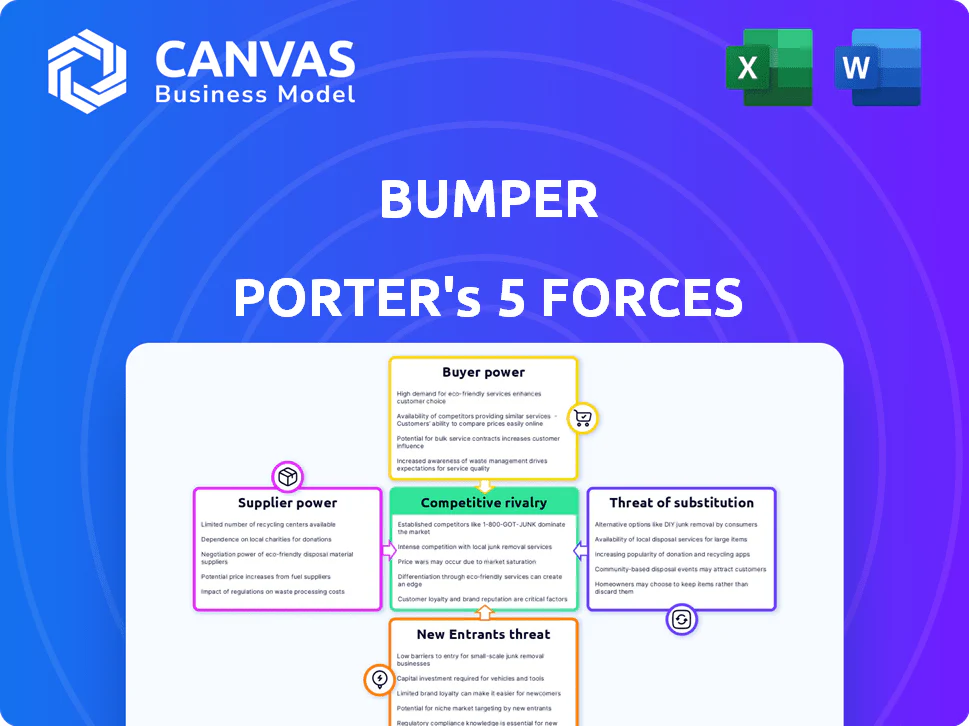
BUMPER PORTER'S FIVE FORCES TEMPLATE RESEARCH
What is included in the product
 Detailed Word Document
Tailored exclusively for Bumper, analyzing its position within its competitive landscape.

 Customizable Excel Spreadsheet
Get instant insights with color-coded, intuitive scoring.
What You See Is What You Get
Bumper Porter's Five Forces Analysis
This preview reveals the complete Porter's Five Forces analysis. The detailed assessment you see is identical to the purchased document. It is professionally crafted and immediately downloadable after your purchase is finalized. The document is fully formatted and ready for your application.

Porter's Five Forces Analysis Template

Go Beyond the Preview—Access the Full Strategic Report
Bumper operates in a dynamic market, influenced by five key forces. Buyer power impacts Bumper's pricing strategies and customer relationships. The threat of new entrants and substitute products constantly challenges Bumper's market share. Supplier bargaining power affects operational costs, and the competitive rivalry defines the industry's intensity. Understanding these forces is vital for strategic planning.
This brief snapshot only scratches the surface. Unlock the full Porter's Five Forces Analysis to explore Bumper’s competitive dynamics, market pressures, and strategic advantages in detail.
Suppliers Bargaining Power

Payment Gateway Providers
Bumper depends on payment gateway providers for transactions. The bargaining power of these suppliers is influenced by the number of providers and Bumper's switching costs. Partnerships with companies like Volt, using open banking for 'Pay Now', and integrations with Keyloop and Pinewood.AI, highlight this reliance. In 2024, the global payment gateway market was valued at approximately $40 billion, with significant consolidation among providers.
Technology and Software Providers
Bumper relies on technology and software for its platform, including credit assessment and data analytics. The bargaining power of these suppliers hinges on the uniqueness and importance of their services. Bumper's acquisition of AutoBI aims to integrate business intelligence, potentially lessening dependence on external suppliers. In 2024, the global business intelligence market was valued at approximately $30 billion, indicating the scale of this sector.

Financial Institutions and Lenders
As a payment platform, Bumper's 'Buy Now, Pay Later' (BNPL) services depend on financial institutions for loan capital. The terms and availability of funding significantly impact Bumper. In 2024, Bumper received £40 million in Series B funding, including debt, highlighting the influence of lenders. This financial dependency gives lenders substantial bargaining power over Bumper's operations.

Data and Credit Information Providers
Bumper relies on data and credit information providers to evaluate customer creditworthiness for financing options. These suppliers, including credit bureaus and data analytics firms, wield bargaining power due to the depth and precision of their data. This power impacts Bumper's ability to assess risk effectively and offer competitive financing terms. Partnerships with major credit bureaus are essential for accessing this critical information. In 2024, the credit bureau industry generated over $10 billion in revenue, highlighting the financial significance of these data providers.
- Credit data is essential for assessing risk.
- Data providers have significant market power.
- Partnerships with credit bureaus are crucial.
- The credit bureau industry is financially large.
Marketing and Sales Channel Partners
Bumper heavily depends on car dealerships to distribute its payment solutions. Dealerships, acting as suppliers of customers and distribution channels, hold considerable bargaining power. Their willingness to adopt and promote Bumper directly affects its success. The more dealerships on board, the greater Bumper’s reach and potential revenue. In 2024, the auto industry saw a shift, with digital payment adoption increasing by 15%.
- Dealerships control customer access.
- Promotion is crucial for Bumper's adoption.
- Adoption directly affects Bumper's revenue.
- Digital payments in auto are growing.
Key Suppliers Shaping Operations
Bumper's suppliers significantly influence its operations. Payment gateways, valued at $40B in 2024, and tech providers exert considerable power. Financial institutions and data providers also hold sway. Dealerships, vital for distribution, further impact Bumper's market position.
| Supplier Type | Bargaining Power Factor | 2024 Market Data |
|---|---|---|
| Payment Gateways | Switching Costs, Provider Numbers | $40B Global Market |
| Tech/Software | Uniqueness, Service Importance | $30B Business Intelligence |
| Financial Institutions | Funding Terms, Availability | £40M Series B Funding |
Customers Bargaining Power

Car Dealerships
Bumper's primary customers are car dealerships, who wield considerable bargaining power. Dealerships decide if they offer Bumper's platform to their customers. Their leverage stems from alternative payment solutions and the value Bumper provides. In 2024, dealerships saw an average profit margin of 4.8%, influencing their decisions.
End Consumers (Car Owners)
End consumers, car owners using Bumper, wield power through platform choice. Their engagement hinges on ease of use, influencing adoption rates. Attractive payment terms, like interest-free options, boost appeal. Awareness of alternatives shapes their decisions, impacting Bumper's success.

Large Dealership Groups
Large dealership groups wield significant bargaining power. They negotiate better terms due to their substantial order volumes, critical for Bumper's revenue. Securing deals with groups like Penske Automotive Group, which had $29.2 billion in revenue in 2023, is key. These groups' influence impacts pricing and service agreements.

Customers with Good Credit
Customers with excellent credit scores possess greater financial flexibility for car repairs. They can explore options like personal loans or credit cards with lower interest rates, diminishing their need for Bumper's BNPL services. This financial leverage boosts their bargaining position. For instance, in 2024, the average interest rate on a new credit card was around 22.75%, while personal loan rates varied. This gives them more negotiating power.
- Creditworthy customers can secure better financing terms.
- This reduces their reliance on Bumper's BNPL.
- They gain more negotiating strength.
- Lower interest rates provide cost savings.
Customers Facing Unexpected High Repair Costs
Customers dealing with unexpected high car repair costs often have limited bargaining power because of the immediate need for funds. Bumper's platform, which allows for cost spreading, addresses this vulnerability. This feature could decrease customer power in these situations, as they may be more willing to accept terms. In 2024, the average car repair cost was around $400 to $500.
- High repair costs limit customer options.
- Bumper's services reduce immediate financial strain.
- Cost spreading can lessen customer negotiation leverage.
- Customers might accept less favorable terms.
Who Holds the Cards in BNPL for Auto?
Car dealerships, key customers, significantly influence Bumper's terms. Their ability to choose alternative payment options gives them leverage. Large dealership groups, such as Penske Automotive Group (2023 revenue: $29.2B), negotiate favorable deals.
End consumers' power comes from platform choice and awareness of alternatives. Attractive payment terms, like interest-free options, boost appeal. Creditworthy customers can explore personal loans or credit cards (2024 avg. interest rate: ~22.75%), reducing BNPL dependence.
| Customer Type | Bargaining Power | Factors Influencing Power |
|---|---|---|
| Dealerships | High | Alternative payment solutions, profit margins (2024 avg: 4.8%) |
| End Consumers | Moderate | Platform choice, payment terms, awareness of alternatives |
| Creditworthy | High | Access to lower interest rates, alternative financing |
Rivalry Among Competitors

Other BNPL Providers
Bumper competes with other BNPL providers. Klarna is a major player in this space, offering financing for diverse purchases. The BNPL market is growing; in 2024, the global BNPL market was valued at approximately $185.2 billion. This intense rivalry can impact Bumper's market share and profitability.
Traditional Financial Institutions
Traditional financial institutions, such as banks and credit unions, are key competitors. These institutions provide personal loans and financing options that customers use for car repairs. This competition is particularly strong for customers with excellent credit scores. In 2024, the average interest rate on a personal loan was around 12.5%.

Credit Card Companies
Credit card companies pose a competitive threat to Bumper, especially with 0% APR offers. In 2024, credit card debt hit $1.1 trillion in the US, showing their widespread use. This allows consumers to finance expenses like car repairs, competing with Bumper's services. This alternative payment method impacts Bumper's market share and pricing strategies.

Dealerships Offering In-House Financing or Payment Plans
Dealerships offering in-house financing intensify competitive rivalry. This is because they directly compete with third-party platforms. In 2024, about 60% of car dealerships offered in-house financing. This allows them to control terms and potentially offer more flexible options. This strategy directly challenges platforms like Bumper.
- Direct competition increases.
- Dealers control financing terms.
- Impacts Bumper's market share.
- Reflects industry adaptation.
Specialized Auto Repair Financing Companies
Specialized auto repair financing companies, like Payment Assist, directly compete with Bumper. These firms focus solely on financing auto repairs, creating intense rivalry. In 2024, the auto repair financing market saw a 15% increase in competition. This intensifies the pressure on Bumper to offer competitive rates and services.
- Payment Assist's market share grew by 8% in 2024.
- Competition increased due to the rise of fintech in auto finance.
- Bumper must differentiate through unique value propositions.
- The specialized nature of competitors demands strategic focus.
Financing Face-Off: Rivals Challenge Market Share
Bumper faces intense competition from various financing options. Rivals include BNPL providers, traditional banks, and credit card companies. Dealerships offering in-house financing and specialized auto repair financing firms also add to the competition. This rivalry impacts Bumper's market share and pricing strategies.
| Competitor Type | 2024 Market Share/Data | Impact on Bumper |
|---|---|---|
| BNPL Providers | $185.2B global market | Direct competition |
| Credit Card Companies | $1.1T US debt | Alternative financing |
| Dealerships | 60% offer in-house | Control of terms |
Original: $10.00
-65%$10.00
$3.50BUMPER PORTER'S FIVE FORCES TEMPLATE RESEARCH
What is included in the product
Detailed Word Document
Tailored exclusively for Bumper, analyzing its position within its competitive landscape.
Customizable Excel Spreadsheet
Get instant insights with color-coded, intuitive scoring.
What You See Is What You Get
Bumper Porter's Five Forces Analysis
This preview reveals the complete Porter's Five Forces analysis. The detailed assessment you see is identical to the purchased document. It is professionally crafted and immediately downloadable after your purchase is finalized. The document is fully formatted and ready for your application.
Porter's Five Forces Analysis Template
Go Beyond the Preview—Access the Full Strategic Report
Bumper operates in a dynamic market, influenced by five key forces. Buyer power impacts Bumper's pricing strategies and customer relationships. The threat of new entrants and substitute products constantly challenges Bumper's market share. Supplier bargaining power affects operational costs, and the competitive rivalry defines the industry's intensity. Understanding these forces is vital for strategic planning.
This brief snapshot only scratches the surface. Unlock the full Porter's Five Forces Analysis to explore Bumper’s competitive dynamics, market pressures, and strategic advantages in detail.
Suppliers Bargaining Power
Payment Gateway Providers
Bumper depends on payment gateway providers for transactions. The bargaining power of these suppliers is influenced by the number of providers and Bumper's switching costs. Partnerships with companies like Volt, using open banking for 'Pay Now', and integrations with Keyloop and Pinewood.AI, highlight this reliance. In 2024, the global payment gateway market was valued at approximately $40 billion, with significant consolidation among providers.
Technology and Software Providers
Bumper relies on technology and software for its platform, including credit assessment and data analytics. The bargaining power of these suppliers hinges on the uniqueness and importance of their services. Bumper's acquisition of AutoBI aims to integrate business intelligence, potentially lessening dependence on external suppliers. In 2024, the global business intelligence market was valued at approximately $30 billion, indicating the scale of this sector.
Financial Institutions and Lenders
As a payment platform, Bumper's 'Buy Now, Pay Later' (BNPL) services depend on financial institutions for loan capital. The terms and availability of funding significantly impact Bumper. In 2024, Bumper received £40 million in Series B funding, including debt, highlighting the influence of lenders. This financial dependency gives lenders substantial bargaining power over Bumper's operations.
Data and Credit Information Providers
Bumper relies on data and credit information providers to evaluate customer creditworthiness for financing options. These suppliers, including credit bureaus and data analytics firms, wield bargaining power due to the depth and precision of their data. This power impacts Bumper's ability to assess risk effectively and offer competitive financing terms. Partnerships with major credit bureaus are essential for accessing this critical information. In 2024, the credit bureau industry generated over $10 billion in revenue, highlighting the financial significance of these data providers.
- Credit data is essential for assessing risk.
- Data providers have significant market power.
- Partnerships with credit bureaus are crucial.
- The credit bureau industry is financially large.
Marketing and Sales Channel Partners
Bumper heavily depends on car dealerships to distribute its payment solutions. Dealerships, acting as suppliers of customers and distribution channels, hold considerable bargaining power. Their willingness to adopt and promote Bumper directly affects its success. The more dealerships on board, the greater Bumper’s reach and potential revenue. In 2024, the auto industry saw a shift, with digital payment adoption increasing by 15%.
- Dealerships control customer access.
- Promotion is crucial for Bumper's adoption.
- Adoption directly affects Bumper's revenue.
- Digital payments in auto are growing.
Key Suppliers Shaping Operations
Bumper's suppliers significantly influence its operations. Payment gateways, valued at $40B in 2024, and tech providers exert considerable power. Financial institutions and data providers also hold sway. Dealerships, vital for distribution, further impact Bumper's market position.
| Supplier Type | Bargaining Power Factor | 2024 Market Data |
|---|---|---|
| Payment Gateways | Switching Costs, Provider Numbers | $40B Global Market |
| Tech/Software | Uniqueness, Service Importance | $30B Business Intelligence |
| Financial Institutions | Funding Terms, Availability | £40M Series B Funding |
Customers Bargaining Power
Car Dealerships
Bumper's primary customers are car dealerships, who wield considerable bargaining power. Dealerships decide if they offer Bumper's platform to their customers. Their leverage stems from alternative payment solutions and the value Bumper provides. In 2024, dealerships saw an average profit margin of 4.8%, influencing their decisions.
End Consumers (Car Owners)
End consumers, car owners using Bumper, wield power through platform choice. Their engagement hinges on ease of use, influencing adoption rates. Attractive payment terms, like interest-free options, boost appeal. Awareness of alternatives shapes their decisions, impacting Bumper's success.
Large Dealership Groups
Large dealership groups wield significant bargaining power. They negotiate better terms due to their substantial order volumes, critical for Bumper's revenue. Securing deals with groups like Penske Automotive Group, which had $29.2 billion in revenue in 2023, is key. These groups' influence impacts pricing and service agreements.
Customers with Good Credit
Customers with excellent credit scores possess greater financial flexibility for car repairs. They can explore options like personal loans or credit cards with lower interest rates, diminishing their need for Bumper's BNPL services. This financial leverage boosts their bargaining position. For instance, in 2024, the average interest rate on a new credit card was around 22.75%, while personal loan rates varied. This gives them more negotiating power.
- Creditworthy customers can secure better financing terms.
- This reduces their reliance on Bumper's BNPL.
- They gain more negotiating strength.
- Lower interest rates provide cost savings.
Customers Facing Unexpected High Repair Costs
Customers dealing with unexpected high car repair costs often have limited bargaining power because of the immediate need for funds. Bumper's platform, which allows for cost spreading, addresses this vulnerability. This feature could decrease customer power in these situations, as they may be more willing to accept terms. In 2024, the average car repair cost was around $400 to $500.
- High repair costs limit customer options.
- Bumper's services reduce immediate financial strain.
- Cost spreading can lessen customer negotiation leverage.
- Customers might accept less favorable terms.
Who Holds the Cards in BNPL for Auto?
Car dealerships, key customers, significantly influence Bumper's terms. Their ability to choose alternative payment options gives them leverage. Large dealership groups, such as Penske Automotive Group (2023 revenue: $29.2B), negotiate favorable deals.
End consumers' power comes from platform choice and awareness of alternatives. Attractive payment terms, like interest-free options, boost appeal. Creditworthy customers can explore personal loans or credit cards (2024 avg. interest rate: ~22.75%), reducing BNPL dependence.
| Customer Type | Bargaining Power | Factors Influencing Power |
|---|---|---|
| Dealerships | High | Alternative payment solutions, profit margins (2024 avg: 4.8%) |
| End Consumers | Moderate | Platform choice, payment terms, awareness of alternatives |
| Creditworthy | High | Access to lower interest rates, alternative financing |
Rivalry Among Competitors
Other BNPL Providers
Bumper competes with other BNPL providers. Klarna is a major player in this space, offering financing for diverse purchases. The BNPL market is growing; in 2024, the global BNPL market was valued at approximately $185.2 billion. This intense rivalry can impact Bumper's market share and profitability.
Traditional Financial Institutions
Traditional financial institutions, such as banks and credit unions, are key competitors. These institutions provide personal loans and financing options that customers use for car repairs. This competition is particularly strong for customers with excellent credit scores. In 2024, the average interest rate on a personal loan was around 12.5%.
Credit Card Companies
Credit card companies pose a competitive threat to Bumper, especially with 0% APR offers. In 2024, credit card debt hit $1.1 trillion in the US, showing their widespread use. This allows consumers to finance expenses like car repairs, competing with Bumper's services. This alternative payment method impacts Bumper's market share and pricing strategies.
Dealerships Offering In-House Financing or Payment Plans
Dealerships offering in-house financing intensify competitive rivalry. This is because they directly compete with third-party platforms. In 2024, about 60% of car dealerships offered in-house financing. This allows them to control terms and potentially offer more flexible options. This strategy directly challenges platforms like Bumper.
- Direct competition increases.
- Dealers control financing terms.
- Impacts Bumper's market share.
- Reflects industry adaptation.
Specialized Auto Repair Financing Companies
Specialized auto repair financing companies, like Payment Assist, directly compete with Bumper. These firms focus solely on financing auto repairs, creating intense rivalry. In 2024, the auto repair financing market saw a 15% increase in competition. This intensifies the pressure on Bumper to offer competitive rates and services.
- Payment Assist's market share grew by 8% in 2024.
- Competition increased due to the rise of fintech in auto finance.
- Bumper must differentiate through unique value propositions.
- The specialized nature of competitors demands strategic focus.
Financing Face-Off: Rivals Challenge Market Share
Bumper faces intense competition from various financing options. Rivals include BNPL providers, traditional banks, and credit card companies. Dealerships offering in-house financing and specialized auto repair financing firms also add to the competition. This rivalry impacts Bumper's market share and pricing strategies.
| Competitor Type | 2024 Market Share/Data | Impact on Bumper |
|---|---|---|
| BNPL Providers | $185.2B global market | Direct competition |
| Credit Card Companies | $1.1T US debt | Alternative financing |
| Dealerships | 60% offer in-house | Control of terms |
Product Information
Product Information
Shipping & Returns
Shipping & Returns
Description
What is included in the product
Detailed Word Document
Tailored exclusively for Bumper, analyzing its position within its competitive landscape.
Customizable Excel Spreadsheet
Get instant insights with color-coded, intuitive scoring.
What You See Is What You Get
Bumper Porter's Five Forces Analysis
This preview reveals the complete Porter's Five Forces analysis. The detailed assessment you see is identical to the purchased document. It is professionally crafted and immediately downloadable after your purchase is finalized. The document is fully formatted and ready for your application.
Porter's Five Forces Analysis Template
Go Beyond the Preview—Access the Full Strategic Report
Bumper operates in a dynamic market, influenced by five key forces. Buyer power impacts Bumper's pricing strategies and customer relationships. The threat of new entrants and substitute products constantly challenges Bumper's market share. Supplier bargaining power affects operational costs, and the competitive rivalry defines the industry's intensity. Understanding these forces is vital for strategic planning.
This brief snapshot only scratches the surface. Unlock the full Porter's Five Forces Analysis to explore Bumper’s competitive dynamics, market pressures, and strategic advantages in detail.
Suppliers Bargaining Power
Payment Gateway Providers
Bumper depends on payment gateway providers for transactions. The bargaining power of these suppliers is influenced by the number of providers and Bumper's switching costs. Partnerships with companies like Volt, using open banking for 'Pay Now', and integrations with Keyloop and Pinewood.AI, highlight this reliance. In 2024, the global payment gateway market was valued at approximately $40 billion, with significant consolidation among providers.
Technology and Software Providers
Bumper relies on technology and software for its platform, including credit assessment and data analytics. The bargaining power of these suppliers hinges on the uniqueness and importance of their services. Bumper's acquisition of AutoBI aims to integrate business intelligence, potentially lessening dependence on external suppliers. In 2024, the global business intelligence market was valued at approximately $30 billion, indicating the scale of this sector.
Financial Institutions and Lenders
As a payment platform, Bumper's 'Buy Now, Pay Later' (BNPL) services depend on financial institutions for loan capital. The terms and availability of funding significantly impact Bumper. In 2024, Bumper received £40 million in Series B funding, including debt, highlighting the influence of lenders. This financial dependency gives lenders substantial bargaining power over Bumper's operations.
Data and Credit Information Providers
Bumper relies on data and credit information providers to evaluate customer creditworthiness for financing options. These suppliers, including credit bureaus and data analytics firms, wield bargaining power due to the depth and precision of their data. This power impacts Bumper's ability to assess risk effectively and offer competitive financing terms. Partnerships with major credit bureaus are essential for accessing this critical information. In 2024, the credit bureau industry generated over $10 billion in revenue, highlighting the financial significance of these data providers.
- Credit data is essential for assessing risk.
- Data providers have significant market power.
- Partnerships with credit bureaus are crucial.
- The credit bureau industry is financially large.
Marketing and Sales Channel Partners
Bumper heavily depends on car dealerships to distribute its payment solutions. Dealerships, acting as suppliers of customers and distribution channels, hold considerable bargaining power. Their willingness to adopt and promote Bumper directly affects its success. The more dealerships on board, the greater Bumper’s reach and potential revenue. In 2024, the auto industry saw a shift, with digital payment adoption increasing by 15%.
- Dealerships control customer access.
- Promotion is crucial for Bumper's adoption.
- Adoption directly affects Bumper's revenue.
- Digital payments in auto are growing.
Key Suppliers Shaping Operations
Bumper's suppliers significantly influence its operations. Payment gateways, valued at $40B in 2024, and tech providers exert considerable power. Financial institutions and data providers also hold sway. Dealerships, vital for distribution, further impact Bumper's market position.
| Supplier Type | Bargaining Power Factor | 2024 Market Data |
|---|---|---|
| Payment Gateways | Switching Costs, Provider Numbers | $40B Global Market |
| Tech/Software | Uniqueness, Service Importance | $30B Business Intelligence |
| Financial Institutions | Funding Terms, Availability | £40M Series B Funding |
Customers Bargaining Power
Car Dealerships
Bumper's primary customers are car dealerships, who wield considerable bargaining power. Dealerships decide if they offer Bumper's platform to their customers. Their leverage stems from alternative payment solutions and the value Bumper provides. In 2024, dealerships saw an average profit margin of 4.8%, influencing their decisions.
End Consumers (Car Owners)
End consumers, car owners using Bumper, wield power through platform choice. Their engagement hinges on ease of use, influencing adoption rates. Attractive payment terms, like interest-free options, boost appeal. Awareness of alternatives shapes their decisions, impacting Bumper's success.
Large Dealership Groups
Large dealership groups wield significant bargaining power. They negotiate better terms due to their substantial order volumes, critical for Bumper's revenue. Securing deals with groups like Penske Automotive Group, which had $29.2 billion in revenue in 2023, is key. These groups' influence impacts pricing and service agreements.
Customers with Good Credit
Customers with excellent credit scores possess greater financial flexibility for car repairs. They can explore options like personal loans or credit cards with lower interest rates, diminishing their need for Bumper's BNPL services. This financial leverage boosts their bargaining position. For instance, in 2024, the average interest rate on a new credit card was around 22.75%, while personal loan rates varied. This gives them more negotiating power.
- Creditworthy customers can secure better financing terms.
- This reduces their reliance on Bumper's BNPL.
- They gain more negotiating strength.
- Lower interest rates provide cost savings.
Customers Facing Unexpected High Repair Costs
Customers dealing with unexpected high car repair costs often have limited bargaining power because of the immediate need for funds. Bumper's platform, which allows for cost spreading, addresses this vulnerability. This feature could decrease customer power in these situations, as they may be more willing to accept terms. In 2024, the average car repair cost was around $400 to $500.
- High repair costs limit customer options.
- Bumper's services reduce immediate financial strain.
- Cost spreading can lessen customer negotiation leverage.
- Customers might accept less favorable terms.
Who Holds the Cards in BNPL for Auto?
Car dealerships, key customers, significantly influence Bumper's terms. Their ability to choose alternative payment options gives them leverage. Large dealership groups, such as Penske Automotive Group (2023 revenue: $29.2B), negotiate favorable deals.
End consumers' power comes from platform choice and awareness of alternatives. Attractive payment terms, like interest-free options, boost appeal. Creditworthy customers can explore personal loans or credit cards (2024 avg. interest rate: ~22.75%), reducing BNPL dependence.
| Customer Type | Bargaining Power | Factors Influencing Power |
|---|---|---|
| Dealerships | High | Alternative payment solutions, profit margins (2024 avg: 4.8%) |
| End Consumers | Moderate | Platform choice, payment terms, awareness of alternatives |
| Creditworthy | High | Access to lower interest rates, alternative financing |
Rivalry Among Competitors
Other BNPL Providers
Bumper competes with other BNPL providers. Klarna is a major player in this space, offering financing for diverse purchases. The BNPL market is growing; in 2024, the global BNPL market was valued at approximately $185.2 billion. This intense rivalry can impact Bumper's market share and profitability.
Traditional Financial Institutions
Traditional financial institutions, such as banks and credit unions, are key competitors. These institutions provide personal loans and financing options that customers use for car repairs. This competition is particularly strong for customers with excellent credit scores. In 2024, the average interest rate on a personal loan was around 12.5%.
Credit Card Companies
Credit card companies pose a competitive threat to Bumper, especially with 0% APR offers. In 2024, credit card debt hit $1.1 trillion in the US, showing their widespread use. This allows consumers to finance expenses like car repairs, competing with Bumper's services. This alternative payment method impacts Bumper's market share and pricing strategies.
Dealerships Offering In-House Financing or Payment Plans
Dealerships offering in-house financing intensify competitive rivalry. This is because they directly compete with third-party platforms. In 2024, about 60% of car dealerships offered in-house financing. This allows them to control terms and potentially offer more flexible options. This strategy directly challenges platforms like Bumper.
- Direct competition increases.
- Dealers control financing terms.
- Impacts Bumper's market share.
- Reflects industry adaptation.
Specialized Auto Repair Financing Companies
Specialized auto repair financing companies, like Payment Assist, directly compete with Bumper. These firms focus solely on financing auto repairs, creating intense rivalry. In 2024, the auto repair financing market saw a 15% increase in competition. This intensifies the pressure on Bumper to offer competitive rates and services.
- Payment Assist's market share grew by 8% in 2024.
- Competition increased due to the rise of fintech in auto finance.
- Bumper must differentiate through unique value propositions.
- The specialized nature of competitors demands strategic focus.
Financing Face-Off: Rivals Challenge Market Share
Bumper faces intense competition from various financing options. Rivals include BNPL providers, traditional banks, and credit card companies. Dealerships offering in-house financing and specialized auto repair financing firms also add to the competition. This rivalry impacts Bumper's market share and pricing strategies.
| Competitor Type | 2024 Market Share/Data | Impact on Bumper |
|---|---|---|
| BNPL Providers | $185.2B global market | Direct competition |
| Credit Card Companies | $1.1T US debt | Alternative financing |
| Dealerships | 60% offer in-house | Control of terms |











