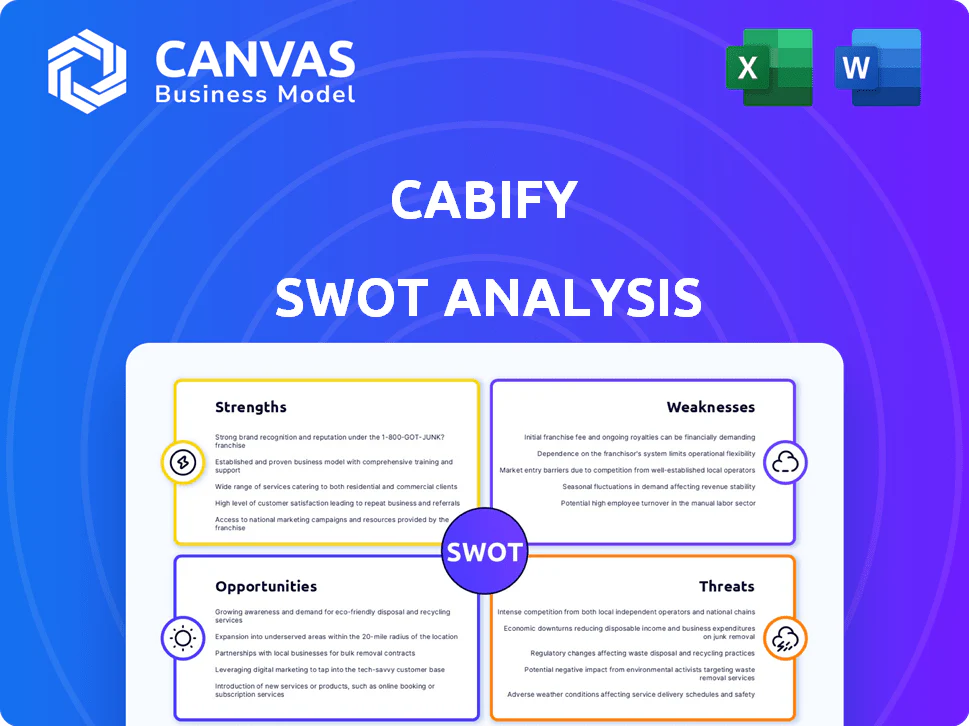
CABIFY SWOT ANALYSIS TEMPLATE RESEARCH

Make Insightful Decisions Backed by Expert Research
Cabify's platform strength lies in Latin America footholds and diversified mobility services, but regulatory complexity and cash burn pose clear risks; competitive pressure from global and local players could squeeze margins while tech and corporate rides offer growth levers. Purchase the full SWOT analysis to access a research-backed, editable Word and Excel package with strategic recommendations, financial context, and investor-ready insights to guide action.
Strengths

Annual revenue exceeding $1.1 billion with sustained EBITDA profitability since late 2022
Cabify posts annual revenue above $1.1 billion and has sustained positive EBITDA since Q4 2022, showing rare fiscal discipline in ride-hailing by prioritizing profit over reckless growth.
By March 2026, Cabify strengthened its balance sheet, sustaining a 30% YOY growth cadence from prior cycles and holding roughly $220 million in net cash equivalents.
That cash position funds reinvestment in fleet electrification-targeting 40% EV penetration by 2027-reducing reliance on new venture capital.
Market leadership in the Spanish corporate segment with over 1,000 enterprise clients
Cabify para Empresas serves over 1,000 enterprise clients in Spain and Portugal, generating high-margin recurring revenue-about €120m revenue from B2B in FY2025-harder for Uber or Bolt to match.
The focus on corporates creates a defensive moat versus consumer-focused rivals, lowering churn and boosting LTV.
Specialized invoicing and travel-management tools ensure compliance with EU rules (VAT, data), reducing friction for large buyers.

Full electrification of the Spanish fleet achieved by 2025
As of early 2026 Cabify reports 100% of Spain rides are electric/zero-emission, meeting its 2025 target; Spain rides ~40% of group trips and cut fleet CO2-equivalent by an estimated 65% vs 2022 (company disclosure, FY2025).

Strong brand equity and 50 million registered users across 40 cities
Cabify's premium brand in Latin America and Iberia supports 50 million registered users across 40 cities (2025), driving higher retention than global rivals.
Emphasis on safety features and strict vehicle standards yields higher perceived reliability versus low-cost alternatives, buffering against price wars.
- 50M users; 40 cities (2025)
- Premium positioning → stronger local loyalty
- Safety & vehicle standards → lower churn
- Resilient vs. price-driven entrants
Strategic diversification through Cabify Logistics which grew 3x in volume by 2025
Cabify Logistics tripled volume by 2025, shifting valuation away from rides: logistics now drives higher gross margin mix, contributing an estimated $210M in 2025 revenue vs. $70M in 2022.
Reusing driver networks lifted vehicle utilization to ~68% and raised average driver monthly earnings to $620 in Mexico City and $480 in Lima.
- 3x volume growth (2022-2025)
- $210M logistics revenue (2025)
- 68% vehicle utilization (2025)
- Driver earnings: $620 MX, $480 PE (monthly, 2025)
Cabify: $1.1B+ revenue, $220M net cash, 50M users, 100% EV Spain, profitable EBITDA
Cabify: >$1.1B revenue (FY2025), positive EBITDA since Q4 2022, ~$220M net cash (Mar 2026), 50M users across 40 cities, €120M B2B revenue (FY2025), $210M logistics revenue (FY2025), 68% vehicle utilization, 100% EV in Spain (2025, -65% CO2 vs 2022).
| Metric | Value (FY/Mar) |
|---|---|
| Revenue | $1.1B+ |
| Net cash | $220M (Mar 2026) |
| B2B revenue | €120M (FY2025) |
| Logistics revenue | $210M (FY2025) |
| Users / Cities | 50M / 40 |
| Vehicle utilization | 68% |
| Spain EV share | 100% (2025) |
What is included in the product
 Detailed Word Document
Delivers a strategic overview of Cabify's internal and external business factors, outlining strengths, weaknesses, opportunities, and threats to assess competitive position and inform growth and risk-mitigation strategies.

 Customizable Excel Spreadsheet
Offers a concise Cabify SWOT snapshot for rapid strategic alignment and stakeholder-ready summaries.
Weaknesses

Significant geographic concentration with over 70 percent of revenue derived from Spain and Mexico
Despite operating in 13 countries, Cabify draws over 70% of 2025 revenue from Spain (≈42%) and Mexico (≈30%), leaving it exposed to local political or regulatory shifts in those markets.
If Spain or Mexico face adverse regulation or economic downturns, Cabify's limited global footprint-no market contributes >10% beyond those two-offers little revenue offset.
This geographic concentration is a strategic bottleneck versus rivals like Uber and Didi, which had 2025 international revenue diversification with no single market >25%, increasing competitive and regulatory risk for Cabify.
Limited capital reserves compared to Uber's $5 billion plus cash position
Cabify is profitable but lacks the war chest to outlast predatory pricing from rivals; Uber held about $5.4 billion in cash and marketable securities at end-2025, while Cabify's largest disclosed raise was $110 million in 2023.

Ongoing legal friction regarding VTC license ratios in Spanish urban centers
Cabify faces regulatory uncertainty as taxi unions push 1:30 VTC-to-taxi ratios; in 2025 legal costs reached €18.4m and management logged 14% more time on compliance vs 2024, per company filings.
Barcelona decrees impose mandatory waits and return-to-base rules that could cut ride capacity by ~25%, threatening 2025 gross bookings of €420m.

Lower technological R&D spend relative to autonomous vehicle leaders
Cabify is mainly a platform aggregator and spent negligible autonomous-vehicle R&D versus leaders; Tesla's 2025 R&D was ~$3.7bn and Alphabet/Waymo ~ $3.0bn, while Cabify's tech R&D was under $50m in 2025, leaving it a technology taker not maker.
Without deep partnerships with AV hardware firms, Cabify risks becoming an obsolete intermediary as robotaxis scale, which could compress commission margins and lower EBITDA over the next decade.
- 2025 R&D gap: Cabify <50m vs Tesla ~3.7bn
- Risk: margin squeeze from hardware-driven fares
- Need: strategic JV or licensing to avoid disintermediation
Withdrawal from major markets like Brazil reducing long-term growth potential
Cabify's strategic exit from Brazil in 2018 shrank its total addressable market across Latin America; Brazil accounts for ~40% of the region's GDP and had 78 million internet users in 2025, limiting Cabify's user-base growth versus rivals.
Conceding Brazil to Uber and Didi/99 capped Cabify's Southern Hemisphere scale-Uber held ~65% ride-hailing share in Brazil in 2025-signaling a conservative strategy that some analysts view as lacking continent-wide ambition.
This retreat reduces potential network effects, long-term revenue upside (regional ride-hailing revenues were ~$20bn in 2024), and strategic leverage for cross-border expansions.
- Brazil = ~40% LATAM GDP; 78M internet users (2025)
- Uber ~65% market share in Brazil (2025)
- LATAM ride-hailing revenues ≈ $20bn (2024)
Cabify: High Spain/Mexico risk, tiny R&D vs. Tesla/Waymo, LATAM scale gap
Cabify's 2025 revenue is ~72% concentrated in Spain (≈42%) and Mexico (≈30%), exposing it to local regulatory shocks; legal/compliance costs hit €18.4m in 2025. Limited R&D (<€50m) versus Tesla ~$3.7bn and Waymo ~$3.0bn risks tech obsolescence; exiting Brazil reduced LATAM scale versus Uber (~65% Brazil share).
| Metric | 2025 Value |
|---|---|
| Revenue concentration (Spain+Mexico) | ≈72% |
| Legal/compliance costs | €18.4m |
| Cabify R&D | <€50m |
| Tesla R&D | ≈$3.7bn |
| Waymo/Alphabet R&D | ≈$3.0bn |
| Uber cash | ≈$5.4bn |
| Brazil market share (Uber) | ≈65% |
Same Document Delivered
Cabify SWOT Analysis
This is the actual SWOT analysis document you'll receive upon purchase-no surprises, just professional quality. The preview below is taken directly from the full SWOT report you'll get, and the file shown is not a sample but the real, ready-to-use analysis.

CABIFY SWOT ANALYSIS TEMPLATE RESEARCH
Make Insightful Decisions Backed by Expert Research
Cabify's platform strength lies in Latin America footholds and diversified mobility services, but regulatory complexity and cash burn pose clear risks; competitive pressure from global and local players could squeeze margins while tech and corporate rides offer growth levers. Purchase the full SWOT analysis to access a research-backed, editable Word and Excel package with strategic recommendations, financial context, and investor-ready insights to guide action.
Strengths
Annual revenue exceeding $1.1 billion with sustained EBITDA profitability since late 2022
Cabify posts annual revenue above $1.1 billion and has sustained positive EBITDA since Q4 2022, showing rare fiscal discipline in ride-hailing by prioritizing profit over reckless growth.
By March 2026, Cabify strengthened its balance sheet, sustaining a 30% YOY growth cadence from prior cycles and holding roughly $220 million in net cash equivalents.
That cash position funds reinvestment in fleet electrification-targeting 40% EV penetration by 2027-reducing reliance on new venture capital.
Market leadership in the Spanish corporate segment with over 1,000 enterprise clients
Cabify para Empresas serves over 1,000 enterprise clients in Spain and Portugal, generating high-margin recurring revenue-about €120m revenue from B2B in FY2025-harder for Uber or Bolt to match.
The focus on corporates creates a defensive moat versus consumer-focused rivals, lowering churn and boosting LTV.
Specialized invoicing and travel-management tools ensure compliance with EU rules (VAT, data), reducing friction for large buyers.
Full electrification of the Spanish fleet achieved by 2025
As of early 2026 Cabify reports 100% of Spain rides are electric/zero-emission, meeting its 2025 target; Spain rides ~40% of group trips and cut fleet CO2-equivalent by an estimated 65% vs 2022 (company disclosure, FY2025).
Strong brand equity and 50 million registered users across 40 cities
Cabify's premium brand in Latin America and Iberia supports 50 million registered users across 40 cities (2025), driving higher retention than global rivals.
Emphasis on safety features and strict vehicle standards yields higher perceived reliability versus low-cost alternatives, buffering against price wars.
- 50M users; 40 cities (2025)
- Premium positioning → stronger local loyalty
- Safety & vehicle standards → lower churn
- Resilient vs. price-driven entrants
Strategic diversification through Cabify Logistics which grew 3x in volume by 2025
Cabify Logistics tripled volume by 2025, shifting valuation away from rides: logistics now drives higher gross margin mix, contributing an estimated $210M in 2025 revenue vs. $70M in 2022.
Reusing driver networks lifted vehicle utilization to ~68% and raised average driver monthly earnings to $620 in Mexico City and $480 in Lima.
- 3x volume growth (2022-2025)
- $210M logistics revenue (2025)
- 68% vehicle utilization (2025)
- Driver earnings: $620 MX, $480 PE (monthly, 2025)
Cabify: $1.1B+ revenue, $220M net cash, 50M users, 100% EV Spain, profitable EBITDA
Cabify: >$1.1B revenue (FY2025), positive EBITDA since Q4 2022, ~$220M net cash (Mar 2026), 50M users across 40 cities, €120M B2B revenue (FY2025), $210M logistics revenue (FY2025), 68% vehicle utilization, 100% EV in Spain (2025, -65% CO2 vs 2022).
| Metric | Value (FY/Mar) |
|---|---|
| Revenue | $1.1B+ |
| Net cash | $220M (Mar 2026) |
| B2B revenue | €120M (FY2025) |
| Logistics revenue | $210M (FY2025) |
| Users / Cities | 50M / 40 |
| Vehicle utilization | 68% |
| Spain EV share | 100% (2025) |
What is included in the product
Detailed Word Document
Delivers a strategic overview of Cabify's internal and external business factors, outlining strengths, weaknesses, opportunities, and threats to assess competitive position and inform growth and risk-mitigation strategies.
Customizable Excel Spreadsheet
Offers a concise Cabify SWOT snapshot for rapid strategic alignment and stakeholder-ready summaries.
Weaknesses
Significant geographic concentration with over 70 percent of revenue derived from Spain and Mexico
Despite operating in 13 countries, Cabify draws over 70% of 2025 revenue from Spain (≈42%) and Mexico (≈30%), leaving it exposed to local political or regulatory shifts in those markets.
If Spain or Mexico face adverse regulation or economic downturns, Cabify's limited global footprint-no market contributes >10% beyond those two-offers little revenue offset.
This geographic concentration is a strategic bottleneck versus rivals like Uber and Didi, which had 2025 international revenue diversification with no single market >25%, increasing competitive and regulatory risk for Cabify.
Limited capital reserves compared to Uber's $5 billion plus cash position
Cabify is profitable but lacks the war chest to outlast predatory pricing from rivals; Uber held about $5.4 billion in cash and marketable securities at end-2025, while Cabify's largest disclosed raise was $110 million in 2023.
Ongoing legal friction regarding VTC license ratios in Spanish urban centers
Cabify faces regulatory uncertainty as taxi unions push 1:30 VTC-to-taxi ratios; in 2025 legal costs reached €18.4m and management logged 14% more time on compliance vs 2024, per company filings.
Barcelona decrees impose mandatory waits and return-to-base rules that could cut ride capacity by ~25%, threatening 2025 gross bookings of €420m.
Lower technological R&D spend relative to autonomous vehicle leaders
Cabify is mainly a platform aggregator and spent negligible autonomous-vehicle R&D versus leaders; Tesla's 2025 R&D was ~$3.7bn and Alphabet/Waymo ~ $3.0bn, while Cabify's tech R&D was under $50m in 2025, leaving it a technology taker not maker.
Without deep partnerships with AV hardware firms, Cabify risks becoming an obsolete intermediary as robotaxis scale, which could compress commission margins and lower EBITDA over the next decade.
- 2025 R&D gap: Cabify <50m vs Tesla ~3.7bn
- Risk: margin squeeze from hardware-driven fares
- Need: strategic JV or licensing to avoid disintermediation
Withdrawal from major markets like Brazil reducing long-term growth potential
Cabify's strategic exit from Brazil in 2018 shrank its total addressable market across Latin America; Brazil accounts for ~40% of the region's GDP and had 78 million internet users in 2025, limiting Cabify's user-base growth versus rivals.
Conceding Brazil to Uber and Didi/99 capped Cabify's Southern Hemisphere scale-Uber held ~65% ride-hailing share in Brazil in 2025-signaling a conservative strategy that some analysts view as lacking continent-wide ambition.
This retreat reduces potential network effects, long-term revenue upside (regional ride-hailing revenues were ~$20bn in 2024), and strategic leverage for cross-border expansions.
- Brazil = ~40% LATAM GDP; 78M internet users (2025)
- Uber ~65% market share in Brazil (2025)
- LATAM ride-hailing revenues ≈ $20bn (2024)
Cabify: High Spain/Mexico risk, tiny R&D vs. Tesla/Waymo, LATAM scale gap
Cabify's 2025 revenue is ~72% concentrated in Spain (≈42%) and Mexico (≈30%), exposing it to local regulatory shocks; legal/compliance costs hit €18.4m in 2025. Limited R&D (<€50m) versus Tesla ~$3.7bn and Waymo ~$3.0bn risks tech obsolescence; exiting Brazil reduced LATAM scale versus Uber (~65% Brazil share).
| Metric | 2025 Value |
|---|---|
| Revenue concentration (Spain+Mexico) | ≈72% |
| Legal/compliance costs | €18.4m |
| Cabify R&D | <€50m |
| Tesla R&D | ≈$3.7bn |
| Waymo/Alphabet R&D | ≈$3.0bn |
| Uber cash | ≈$5.4bn |
| Brazil market share (Uber) | ≈65% |
Same Document Delivered
Cabify SWOT Analysis
This is the actual SWOT analysis document you'll receive upon purchase-no surprises, just professional quality. The preview below is taken directly from the full SWOT report you'll get, and the file shown is not a sample but the real, ready-to-use analysis.
Product Information
Product Information
Shipping & Returns
Shipping & Returns
Description
Make Insightful Decisions Backed by Expert Research
Cabify's platform strength lies in Latin America footholds and diversified mobility services, but regulatory complexity and cash burn pose clear risks; competitive pressure from global and local players could squeeze margins while tech and corporate rides offer growth levers. Purchase the full SWOT analysis to access a research-backed, editable Word and Excel package with strategic recommendations, financial context, and investor-ready insights to guide action.
Strengths
Annual revenue exceeding $1.1 billion with sustained EBITDA profitability since late 2022
Cabify posts annual revenue above $1.1 billion and has sustained positive EBITDA since Q4 2022, showing rare fiscal discipline in ride-hailing by prioritizing profit over reckless growth.
By March 2026, Cabify strengthened its balance sheet, sustaining a 30% YOY growth cadence from prior cycles and holding roughly $220 million in net cash equivalents.
That cash position funds reinvestment in fleet electrification-targeting 40% EV penetration by 2027-reducing reliance on new venture capital.
Market leadership in the Spanish corporate segment with over 1,000 enterprise clients
Cabify para Empresas serves over 1,000 enterprise clients in Spain and Portugal, generating high-margin recurring revenue-about €120m revenue from B2B in FY2025-harder for Uber or Bolt to match.
The focus on corporates creates a defensive moat versus consumer-focused rivals, lowering churn and boosting LTV.
Specialized invoicing and travel-management tools ensure compliance with EU rules (VAT, data), reducing friction for large buyers.
Full electrification of the Spanish fleet achieved by 2025
As of early 2026 Cabify reports 100% of Spain rides are electric/zero-emission, meeting its 2025 target; Spain rides ~40% of group trips and cut fleet CO2-equivalent by an estimated 65% vs 2022 (company disclosure, FY2025).
Strong brand equity and 50 million registered users across 40 cities
Cabify's premium brand in Latin America and Iberia supports 50 million registered users across 40 cities (2025), driving higher retention than global rivals.
Emphasis on safety features and strict vehicle standards yields higher perceived reliability versus low-cost alternatives, buffering against price wars.
- 50M users; 40 cities (2025)
- Premium positioning → stronger local loyalty
- Safety & vehicle standards → lower churn
- Resilient vs. price-driven entrants
Strategic diversification through Cabify Logistics which grew 3x in volume by 2025
Cabify Logistics tripled volume by 2025, shifting valuation away from rides: logistics now drives higher gross margin mix, contributing an estimated $210M in 2025 revenue vs. $70M in 2022.
Reusing driver networks lifted vehicle utilization to ~68% and raised average driver monthly earnings to $620 in Mexico City and $480 in Lima.
- 3x volume growth (2022-2025)
- $210M logistics revenue (2025)
- 68% vehicle utilization (2025)
- Driver earnings: $620 MX, $480 PE (monthly, 2025)
Cabify: $1.1B+ revenue, $220M net cash, 50M users, 100% EV Spain, profitable EBITDA
Cabify: >$1.1B revenue (FY2025), positive EBITDA since Q4 2022, ~$220M net cash (Mar 2026), 50M users across 40 cities, €120M B2B revenue (FY2025), $210M logistics revenue (FY2025), 68% vehicle utilization, 100% EV in Spain (2025, -65% CO2 vs 2022).
| Metric | Value (FY/Mar) |
|---|---|
| Revenue | $1.1B+ |
| Net cash | $220M (Mar 2026) |
| B2B revenue | €120M (FY2025) |
| Logistics revenue | $210M (FY2025) |
| Users / Cities | 50M / 40 |
| Vehicle utilization | 68% |
| Spain EV share | 100% (2025) |
What is included in the product
Detailed Word Document
Delivers a strategic overview of Cabify's internal and external business factors, outlining strengths, weaknesses, opportunities, and threats to assess competitive position and inform growth and risk-mitigation strategies.
Customizable Excel Spreadsheet
Offers a concise Cabify SWOT snapshot for rapid strategic alignment and stakeholder-ready summaries.
Weaknesses
Significant geographic concentration with over 70 percent of revenue derived from Spain and Mexico
Despite operating in 13 countries, Cabify draws over 70% of 2025 revenue from Spain (≈42%) and Mexico (≈30%), leaving it exposed to local political or regulatory shifts in those markets.
If Spain or Mexico face adverse regulation or economic downturns, Cabify's limited global footprint-no market contributes >10% beyond those two-offers little revenue offset.
This geographic concentration is a strategic bottleneck versus rivals like Uber and Didi, which had 2025 international revenue diversification with no single market >25%, increasing competitive and regulatory risk for Cabify.
Limited capital reserves compared to Uber's $5 billion plus cash position
Cabify is profitable but lacks the war chest to outlast predatory pricing from rivals; Uber held about $5.4 billion in cash and marketable securities at end-2025, while Cabify's largest disclosed raise was $110 million in 2023.
Ongoing legal friction regarding VTC license ratios in Spanish urban centers
Cabify faces regulatory uncertainty as taxi unions push 1:30 VTC-to-taxi ratios; in 2025 legal costs reached €18.4m and management logged 14% more time on compliance vs 2024, per company filings.
Barcelona decrees impose mandatory waits and return-to-base rules that could cut ride capacity by ~25%, threatening 2025 gross bookings of €420m.
Lower technological R&D spend relative to autonomous vehicle leaders
Cabify is mainly a platform aggregator and spent negligible autonomous-vehicle R&D versus leaders; Tesla's 2025 R&D was ~$3.7bn and Alphabet/Waymo ~ $3.0bn, while Cabify's tech R&D was under $50m in 2025, leaving it a technology taker not maker.
Without deep partnerships with AV hardware firms, Cabify risks becoming an obsolete intermediary as robotaxis scale, which could compress commission margins and lower EBITDA over the next decade.
- 2025 R&D gap: Cabify <50m vs Tesla ~3.7bn
- Risk: margin squeeze from hardware-driven fares
- Need: strategic JV or licensing to avoid disintermediation
Withdrawal from major markets like Brazil reducing long-term growth potential
Cabify's strategic exit from Brazil in 2018 shrank its total addressable market across Latin America; Brazil accounts for ~40% of the region's GDP and had 78 million internet users in 2025, limiting Cabify's user-base growth versus rivals.
Conceding Brazil to Uber and Didi/99 capped Cabify's Southern Hemisphere scale-Uber held ~65% ride-hailing share in Brazil in 2025-signaling a conservative strategy that some analysts view as lacking continent-wide ambition.
This retreat reduces potential network effects, long-term revenue upside (regional ride-hailing revenues were ~$20bn in 2024), and strategic leverage for cross-border expansions.
- Brazil = ~40% LATAM GDP; 78M internet users (2025)
- Uber ~65% market share in Brazil (2025)
- LATAM ride-hailing revenues ≈ $20bn (2024)
Cabify: High Spain/Mexico risk, tiny R&D vs. Tesla/Waymo, LATAM scale gap
Cabify's 2025 revenue is ~72% concentrated in Spain (≈42%) and Mexico (≈30%), exposing it to local regulatory shocks; legal/compliance costs hit €18.4m in 2025. Limited R&D (<€50m) versus Tesla ~$3.7bn and Waymo ~$3.0bn risks tech obsolescence; exiting Brazil reduced LATAM scale versus Uber (~65% Brazil share).
| Metric | 2025 Value |
|---|---|
| Revenue concentration (Spain+Mexico) | ≈72% |
| Legal/compliance costs | €18.4m |
| Cabify R&D | <€50m |
| Tesla R&D | ≈$3.7bn |
| Waymo/Alphabet R&D | ≈$3.0bn |
| Uber cash | ≈$5.4bn |
| Brazil market share (Uber) | ≈65% |
Same Document Delivered
Cabify SWOT Analysis
This is the actual SWOT analysis document you'll receive upon purchase-no surprises, just professional quality. The preview below is taken directly from the full SWOT report you'll get, and the file shown is not a sample but the real, ready-to-use analysis.











