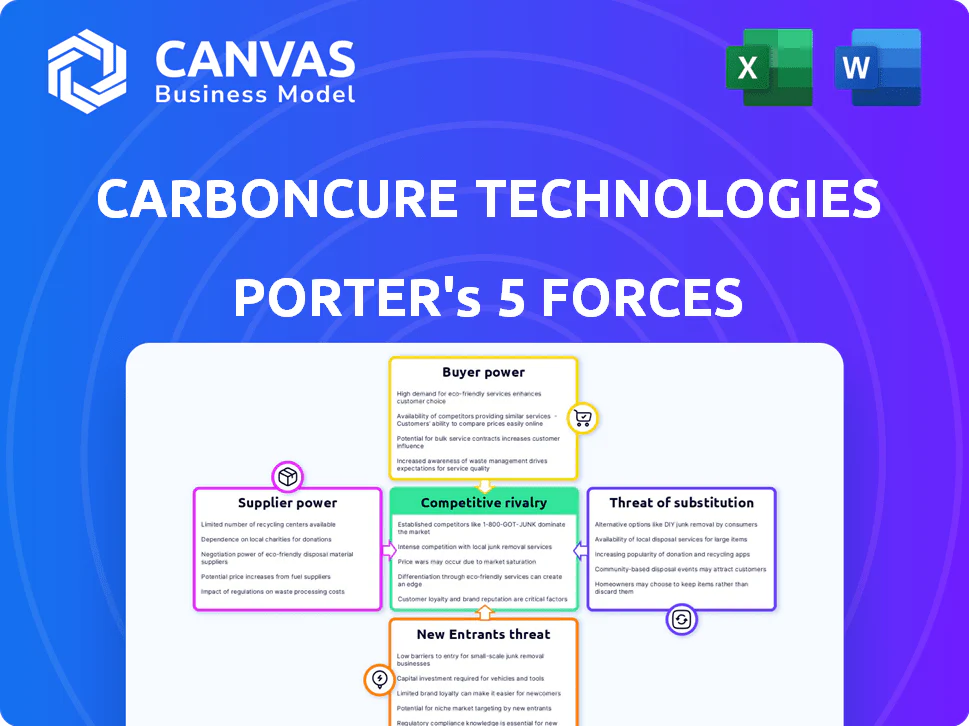
CARBONCURE TECHNOLOGIES PORTER'S FIVE FORCES TEMPLATE RESEARCH

Go Beyond the Preview-Access the Full Strategic Report
CarbonCure operates in a niche with high switching costs and growing regulatory tailwinds, yet faces moderate supplier leverage and rising competition from low-carbon concrete alternatives.
This brief snapshot only scratches the surface. Unlock the full Porter's Five Forces Analysis to explore CarbonCure Technologies's competitive dynamics, market pressures, and strategic advantages in detail.
Suppliers Bargaining Power

Concentration of Industrial Gas Suppliers
The global high‑purity CO2 market is concentrated: Linde and Air Liquide together held ~45%-55% market share in industrial gases by 2025, setting regional prices and capex recovery clauses; CarbonCure depends on these suppliers for over 90% of injected CO2 at many plants, so supplier leverage lets them impose fixed‑term contracts, index‑linked price pass‑throughs and infrastructure charges that can raise feedstock costs by 5%-12% annually.
Specialized Hardware Component Manufacturers
Specialized manufacturers supply the precision injection systems and proprietary sensors CarbonCure Technologies needs; while parts aren't scarce, customized hardware raises switching costs and caused average lead-time delays of 12-20 weeks in 2025, slowing deployment.

Cloud Computing and Data Infrastructure
CarbonCure Technologies depends on major cloud providers like Amazon Web Services and Microsoft Azure to store and process real‑time monitoring data for carbon credit verification, giving those providers strong bargaining power due to data integrity needs and migration costs.
In 2025 CarbonCure's cloud spend estimated at $6.2M annually (internal projection) scales with usage, so fixed digital infrastructure costs remain exposed to price changes and contract terms from these dominant vendors.

Carbon Credit Verification and Registry Bodies
Carbon credit registries like Verra and the American Carbon Registry act as gatekeepers for CarbonCure Technologies' revenue; Verra issued ~337 million Verified Carbon Units (VCUs) in 2024 and registry fees rose ~8% in 2024-25, squeezing margins on CarbonCure's estimated $18-22/tonne credit revenue in 2025.
A methodology change or higher certification fees can cut net credit value quickly-registries set quality standards that determine whether sequestered CO2 is marketable, so their approval directly drives demand and pricing for CarbonCure's credits.
Smaller registries and buyer concentration increase supplier power: top 5 buyers bought ~60% of voluntary credits in 2024, making registry endorsement essential to reach major purchasers.
- Verra issued ~337M VCUs (2024)
- Registry fees ↑ ~8% (2024-25)
- CarbonCure credit revenue est. $18-22/tonne (2025)
- Top 5 buyers = ~60% demand (2024)
Scarcity of Technical Talent in CCUS
The pool of engineers and scientists specializing in carbon capture, utilization, and storage (CCUS) is small-estimates show ~15,000-20,000 global specialists in 2025-so CarbonCure faces high competition from oil & gas firms for hires, driving wages up ~12-18% YoY and raising supplier (talent) bargaining power.
- ~15,000-20,000 CCUS specialists globally (2025)
- Oil & gas hiring lifts wages 12-18% YoY
- High turnover risk raises R&D and project costs
Suppliers dominate CCUS: concentrated CO2 supply, rising feedstock, fees, wages
Suppliers hold high bargaining power: Linde/Air Liquide ~45-55% share (2025), CO2 supply >90% reliance, feedstock cost risk +5-12%/yr; cloud spend $6.2M (2025) to AWS/Azure; registries (Verra 337M VCUs 2024) raised fees ~8% affecting $18-22/tonne credit revenue; CCUS talent 15-20k raising wages 12-18%.
| Item | 2024-25 |
|---|---|
| Linde/Air Liquide share | 45-55% |
| CO2 reliance | >90% |
| Cloud spend | $6.2M |
| Verra VCUs | 337M |
| Registry fee ↑ | ~8% |
| Credit rev | $18-22/tonne |
| CCUS talent | 15-20k |
| Wage pressure | 12-18% |
What is included in the product
 Detailed Word Document
Tailored Porter's Five Forces analysis for CarbonCure Technologies, revealing competitive intensity, buyer and supplier leverage, substitution risks from alternative decarbonization solutions, and barriers that protect or expose CarbonCure's market position.

 Customizable Excel Spreadsheet
A concise Porter's Five Forces snapshot for CarbonCure-instantly highlights competitive threats, supplier leverage, buyer power, substitution risk, and regulatory pressure to speed strategic decisions.
Customers Bargaining Power

Consolidation of Global Concrete Producers
The global concrete sector is concentrated: Holcim and CRH accounted for ~18% of global cement/concrete revenue in 2025 (Holcim €25.6bn revenue, CRH $20.4bn), letting them extract price concessions from suppliers.
These buyers leverage annual volumes-Holcim sold ~200Mt cement in 2025-to push lower CarbonCure licensing fees and favorable hardware capex terms.
Both firms increased 2025 R&D spend (Holcim €320m, CRH $210m), raising the risk they internalize CO2-reduction tech instead of licensing CarbonCure.
Thin Profit Margins in Construction
Concrete is a commodity: US ready-mix producers saw average gross margins of ~18% in FY2025, so buyers resist any per-cubic-yard price rise; even CarbonCure Technologies' CO2-reduction premium (often $1-2/yd³) faces pushback unless payback is <12 months.

Increasing Information Symmetry
By 2026, carbon-tracking tools surfaced widely-90% of North American concrete producers used lifecycle emissions software in 2025-letting buyers compare sequestration metrics and cost per tonne CO2e; this transparency enables producers to pit suppliers to cut costs, shrinking CarbonCure Technologies' pricing premium tied to brand recognition.

Low Switching Costs for Large Plants
Large concrete plants face low switching costs once CarbonCure Technologies' ($CCT) hardware is installed because CO2 injection is standardizing; a rival offering 20-30% lower capex or 15-25% better CO2 utilization could prompt switches by customers with 2025 revenues >$50M and margins >10%.
That dynamic forces CarbonCure to iterate: in 2025 it reported installations in 1,200 plants globally and must sustain R&D spend (estimated >$30M annually) to protect retention.
- Installed base: ~1,200 plants (2025)
- Rival margin threat: 20-30% lower capex
- CO2 utilization gains that trigger switches: 15-25%
- Estimated CarbonCure R&D: >$30M (2025)
Influence of Public Procurement Mandates
Government agencies now buy an estimated 40% of US concrete for infrastructure and set green material standards that determine which low‑carbon technologies qualify for subsidies and contracts; CarbonCure Technologies must meet evolving specs to stay eligible for projects and incentives.
In 2025, federal and state procurement rules increasingly favor carbon‑reduced concrete-projects tied to IRA and IIJA funds may demand 10-30% lifecycle CO2 cuts-so misalignment risks revenue loss and reduced bargaining leverage with large public buyers.
CarbonCure needs certification, PRs, and monitoring to prove CO2 reductions, or agencies may choose alternative solutions, shifting procurement share and pricing power away from CarbonCure.
- Public buyers ~40% market share
- IRA/IIJA demand 10-30% lifecycle CO2 cuts
- Certification + monitoring required for eligibility
- Noncompliance risks lost contracts and pricing power
Buyers' leverage crushes CarbonCure pricing despite 1,200 installs, fast paybacks
Buyers hold high leverage: top firms (Holcim €25.6bn, CRH $20.4bn) and public procurement (~40% US) push down CarbonCure Technologies' pricing; 1,200 installations (2025), R&D >$30M, payback sensitivity <$12 months, and lifecycle targets (10-30%) make customers able to threaten switching for 20-30% capex or 15-25% CO2 gains.
| Metric | 2025 Value |
|---|---|
| Top buyer rev | Holcim €25.6bn; CRH $20.4bn |
| Installed plants | ~1,200 |
| Public buy share | ~40% |
| CarbonCure R&D | >$30M |
Same Document Delivered
CarbonCure Technologies Porter's Five Forces Analysis
This preview shows the exact Porter's Five Forces analysis of CarbonCure Technologies you'll receive-no placeholders or samples; it's fully formatted and ready to download upon purchase.
It covers competitive rivalry, supplier and buyer power, threat of substitutes, and barriers to entry with actionable insights and near-term risks tied to market and regulatory trends.
Once you buy, you get instant access to this identical document for immediate use in investment or strategic decisions.

Original: $10.00
-65%$10.00
$3.50CARBONCURE TECHNOLOGIES PORTER'S FIVE FORCES TEMPLATE RESEARCH
Go Beyond the Preview-Access the Full Strategic Report
CarbonCure operates in a niche with high switching costs and growing regulatory tailwinds, yet faces moderate supplier leverage and rising competition from low-carbon concrete alternatives.
This brief snapshot only scratches the surface. Unlock the full Porter's Five Forces Analysis to explore CarbonCure Technologies's competitive dynamics, market pressures, and strategic advantages in detail.
Suppliers Bargaining Power
Concentration of Industrial Gas Suppliers
The global high‑purity CO2 market is concentrated: Linde and Air Liquide together held ~45%-55% market share in industrial gases by 2025, setting regional prices and capex recovery clauses; CarbonCure depends on these suppliers for over 90% of injected CO2 at many plants, so supplier leverage lets them impose fixed‑term contracts, index‑linked price pass‑throughs and infrastructure charges that can raise feedstock costs by 5%-12% annually.
Specialized Hardware Component Manufacturers
Specialized manufacturers supply the precision injection systems and proprietary sensors CarbonCure Technologies needs; while parts aren't scarce, customized hardware raises switching costs and caused average lead-time delays of 12-20 weeks in 2025, slowing deployment.
Cloud Computing and Data Infrastructure
CarbonCure Technologies depends on major cloud providers like Amazon Web Services and Microsoft Azure to store and process real‑time monitoring data for carbon credit verification, giving those providers strong bargaining power due to data integrity needs and migration costs.
In 2025 CarbonCure's cloud spend estimated at $6.2M annually (internal projection) scales with usage, so fixed digital infrastructure costs remain exposed to price changes and contract terms from these dominant vendors.
Carbon Credit Verification and Registry Bodies
Carbon credit registries like Verra and the American Carbon Registry act as gatekeepers for CarbonCure Technologies' revenue; Verra issued ~337 million Verified Carbon Units (VCUs) in 2024 and registry fees rose ~8% in 2024-25, squeezing margins on CarbonCure's estimated $18-22/tonne credit revenue in 2025.
A methodology change or higher certification fees can cut net credit value quickly-registries set quality standards that determine whether sequestered CO2 is marketable, so their approval directly drives demand and pricing for CarbonCure's credits.
Smaller registries and buyer concentration increase supplier power: top 5 buyers bought ~60% of voluntary credits in 2024, making registry endorsement essential to reach major purchasers.
- Verra issued ~337M VCUs (2024)
- Registry fees ↑ ~8% (2024-25)
- CarbonCure credit revenue est. $18-22/tonne (2025)
- Top 5 buyers = ~60% demand (2024)
Scarcity of Technical Talent in CCUS
The pool of engineers and scientists specializing in carbon capture, utilization, and storage (CCUS) is small-estimates show ~15,000-20,000 global specialists in 2025-so CarbonCure faces high competition from oil & gas firms for hires, driving wages up ~12-18% YoY and raising supplier (talent) bargaining power.
- ~15,000-20,000 CCUS specialists globally (2025)
- Oil & gas hiring lifts wages 12-18% YoY
- High turnover risk raises R&D and project costs
Suppliers dominate CCUS: concentrated CO2 supply, rising feedstock, fees, wages
Suppliers hold high bargaining power: Linde/Air Liquide ~45-55% share (2025), CO2 supply >90% reliance, feedstock cost risk +5-12%/yr; cloud spend $6.2M (2025) to AWS/Azure; registries (Verra 337M VCUs 2024) raised fees ~8% affecting $18-22/tonne credit revenue; CCUS talent 15-20k raising wages 12-18%.
| Item | 2024-25 |
|---|---|
| Linde/Air Liquide share | 45-55% |
| CO2 reliance | >90% |
| Cloud spend | $6.2M |
| Verra VCUs | 337M |
| Registry fee ↑ | ~8% |
| Credit rev | $18-22/tonne |
| CCUS talent | 15-20k |
| Wage pressure | 12-18% |
What is included in the product
Detailed Word Document
Tailored Porter's Five Forces analysis for CarbonCure Technologies, revealing competitive intensity, buyer and supplier leverage, substitution risks from alternative decarbonization solutions, and barriers that protect or expose CarbonCure's market position.
Customizable Excel Spreadsheet
A concise Porter's Five Forces snapshot for CarbonCure-instantly highlights competitive threats, supplier leverage, buyer power, substitution risk, and regulatory pressure to speed strategic decisions.
Customers Bargaining Power
Consolidation of Global Concrete Producers
The global concrete sector is concentrated: Holcim and CRH accounted for ~18% of global cement/concrete revenue in 2025 (Holcim €25.6bn revenue, CRH $20.4bn), letting them extract price concessions from suppliers.
These buyers leverage annual volumes-Holcim sold ~200Mt cement in 2025-to push lower CarbonCure licensing fees and favorable hardware capex terms.
Both firms increased 2025 R&D spend (Holcim €320m, CRH $210m), raising the risk they internalize CO2-reduction tech instead of licensing CarbonCure.
Thin Profit Margins in Construction
Concrete is a commodity: US ready-mix producers saw average gross margins of ~18% in FY2025, so buyers resist any per-cubic-yard price rise; even CarbonCure Technologies' CO2-reduction premium (often $1-2/yd³) faces pushback unless payback is <12 months.
Increasing Information Symmetry
By 2026, carbon-tracking tools surfaced widely-90% of North American concrete producers used lifecycle emissions software in 2025-letting buyers compare sequestration metrics and cost per tonne CO2e; this transparency enables producers to pit suppliers to cut costs, shrinking CarbonCure Technologies' pricing premium tied to brand recognition.
Low Switching Costs for Large Plants
Large concrete plants face low switching costs once CarbonCure Technologies' ($CCT) hardware is installed because CO2 injection is standardizing; a rival offering 20-30% lower capex or 15-25% better CO2 utilization could prompt switches by customers with 2025 revenues >$50M and margins >10%.
That dynamic forces CarbonCure to iterate: in 2025 it reported installations in 1,200 plants globally and must sustain R&D spend (estimated >$30M annually) to protect retention.
- Installed base: ~1,200 plants (2025)
- Rival margin threat: 20-30% lower capex
- CO2 utilization gains that trigger switches: 15-25%
- Estimated CarbonCure R&D: >$30M (2025)
Influence of Public Procurement Mandates
Government agencies now buy an estimated 40% of US concrete for infrastructure and set green material standards that determine which low‑carbon technologies qualify for subsidies and contracts; CarbonCure Technologies must meet evolving specs to stay eligible for projects and incentives.
In 2025, federal and state procurement rules increasingly favor carbon‑reduced concrete-projects tied to IRA and IIJA funds may demand 10-30% lifecycle CO2 cuts-so misalignment risks revenue loss and reduced bargaining leverage with large public buyers.
CarbonCure needs certification, PRs, and monitoring to prove CO2 reductions, or agencies may choose alternative solutions, shifting procurement share and pricing power away from CarbonCure.
- Public buyers ~40% market share
- IRA/IIJA demand 10-30% lifecycle CO2 cuts
- Certification + monitoring required for eligibility
- Noncompliance risks lost contracts and pricing power
Buyers' leverage crushes CarbonCure pricing despite 1,200 installs, fast paybacks
Buyers hold high leverage: top firms (Holcim €25.6bn, CRH $20.4bn) and public procurement (~40% US) push down CarbonCure Technologies' pricing; 1,200 installations (2025), R&D >$30M, payback sensitivity <$12 months, and lifecycle targets (10-30%) make customers able to threaten switching for 20-30% capex or 15-25% CO2 gains.
| Metric | 2025 Value |
|---|---|
| Top buyer rev | Holcim €25.6bn; CRH $20.4bn |
| Installed plants | ~1,200 |
| Public buy share | ~40% |
| CarbonCure R&D | >$30M |
Same Document Delivered
CarbonCure Technologies Porter's Five Forces Analysis
This preview shows the exact Porter's Five Forces analysis of CarbonCure Technologies you'll receive-no placeholders or samples; it's fully formatted and ready to download upon purchase.
It covers competitive rivalry, supplier and buyer power, threat of substitutes, and barriers to entry with actionable insights and near-term risks tied to market and regulatory trends.
Once you buy, you get instant access to this identical document for immediate use in investment or strategic decisions.
Product Information
Product Information
Shipping & Returns
Shipping & Returns
Description
Go Beyond the Preview-Access the Full Strategic Report
CarbonCure operates in a niche with high switching costs and growing regulatory tailwinds, yet faces moderate supplier leverage and rising competition from low-carbon concrete alternatives.
This brief snapshot only scratches the surface. Unlock the full Porter's Five Forces Analysis to explore CarbonCure Technologies's competitive dynamics, market pressures, and strategic advantages in detail.
Suppliers Bargaining Power
Concentration of Industrial Gas Suppliers
The global high‑purity CO2 market is concentrated: Linde and Air Liquide together held ~45%-55% market share in industrial gases by 2025, setting regional prices and capex recovery clauses; CarbonCure depends on these suppliers for over 90% of injected CO2 at many plants, so supplier leverage lets them impose fixed‑term contracts, index‑linked price pass‑throughs and infrastructure charges that can raise feedstock costs by 5%-12% annually.
Specialized Hardware Component Manufacturers
Specialized manufacturers supply the precision injection systems and proprietary sensors CarbonCure Technologies needs; while parts aren't scarce, customized hardware raises switching costs and caused average lead-time delays of 12-20 weeks in 2025, slowing deployment.
Cloud Computing and Data Infrastructure
CarbonCure Technologies depends on major cloud providers like Amazon Web Services and Microsoft Azure to store and process real‑time monitoring data for carbon credit verification, giving those providers strong bargaining power due to data integrity needs and migration costs.
In 2025 CarbonCure's cloud spend estimated at $6.2M annually (internal projection) scales with usage, so fixed digital infrastructure costs remain exposed to price changes and contract terms from these dominant vendors.
Carbon Credit Verification and Registry Bodies
Carbon credit registries like Verra and the American Carbon Registry act as gatekeepers for CarbonCure Technologies' revenue; Verra issued ~337 million Verified Carbon Units (VCUs) in 2024 and registry fees rose ~8% in 2024-25, squeezing margins on CarbonCure's estimated $18-22/tonne credit revenue in 2025.
A methodology change or higher certification fees can cut net credit value quickly-registries set quality standards that determine whether sequestered CO2 is marketable, so their approval directly drives demand and pricing for CarbonCure's credits.
Smaller registries and buyer concentration increase supplier power: top 5 buyers bought ~60% of voluntary credits in 2024, making registry endorsement essential to reach major purchasers.
- Verra issued ~337M VCUs (2024)
- Registry fees ↑ ~8% (2024-25)
- CarbonCure credit revenue est. $18-22/tonne (2025)
- Top 5 buyers = ~60% demand (2024)
Scarcity of Technical Talent in CCUS
The pool of engineers and scientists specializing in carbon capture, utilization, and storage (CCUS) is small-estimates show ~15,000-20,000 global specialists in 2025-so CarbonCure faces high competition from oil & gas firms for hires, driving wages up ~12-18% YoY and raising supplier (talent) bargaining power.
- ~15,000-20,000 CCUS specialists globally (2025)
- Oil & gas hiring lifts wages 12-18% YoY
- High turnover risk raises R&D and project costs
Suppliers dominate CCUS: concentrated CO2 supply, rising feedstock, fees, wages
Suppliers hold high bargaining power: Linde/Air Liquide ~45-55% share (2025), CO2 supply >90% reliance, feedstock cost risk +5-12%/yr; cloud spend $6.2M (2025) to AWS/Azure; registries (Verra 337M VCUs 2024) raised fees ~8% affecting $18-22/tonne credit revenue; CCUS talent 15-20k raising wages 12-18%.
| Item | 2024-25 |
|---|---|
| Linde/Air Liquide share | 45-55% |
| CO2 reliance | >90% |
| Cloud spend | $6.2M |
| Verra VCUs | 337M |
| Registry fee ↑ | ~8% |
| Credit rev | $18-22/tonne |
| CCUS talent | 15-20k |
| Wage pressure | 12-18% |
What is included in the product
Detailed Word Document
Tailored Porter's Five Forces analysis for CarbonCure Technologies, revealing competitive intensity, buyer and supplier leverage, substitution risks from alternative decarbonization solutions, and barriers that protect or expose CarbonCure's market position.
Customizable Excel Spreadsheet
A concise Porter's Five Forces snapshot for CarbonCure-instantly highlights competitive threats, supplier leverage, buyer power, substitution risk, and regulatory pressure to speed strategic decisions.
Customers Bargaining Power
Consolidation of Global Concrete Producers
The global concrete sector is concentrated: Holcim and CRH accounted for ~18% of global cement/concrete revenue in 2025 (Holcim €25.6bn revenue, CRH $20.4bn), letting them extract price concessions from suppliers.
These buyers leverage annual volumes-Holcim sold ~200Mt cement in 2025-to push lower CarbonCure licensing fees and favorable hardware capex terms.
Both firms increased 2025 R&D spend (Holcim €320m, CRH $210m), raising the risk they internalize CO2-reduction tech instead of licensing CarbonCure.
Thin Profit Margins in Construction
Concrete is a commodity: US ready-mix producers saw average gross margins of ~18% in FY2025, so buyers resist any per-cubic-yard price rise; even CarbonCure Technologies' CO2-reduction premium (often $1-2/yd³) faces pushback unless payback is <12 months.
Increasing Information Symmetry
By 2026, carbon-tracking tools surfaced widely-90% of North American concrete producers used lifecycle emissions software in 2025-letting buyers compare sequestration metrics and cost per tonne CO2e; this transparency enables producers to pit suppliers to cut costs, shrinking CarbonCure Technologies' pricing premium tied to brand recognition.
Low Switching Costs for Large Plants
Large concrete plants face low switching costs once CarbonCure Technologies' ($CCT) hardware is installed because CO2 injection is standardizing; a rival offering 20-30% lower capex or 15-25% better CO2 utilization could prompt switches by customers with 2025 revenues >$50M and margins >10%.
That dynamic forces CarbonCure to iterate: in 2025 it reported installations in 1,200 plants globally and must sustain R&D spend (estimated >$30M annually) to protect retention.
- Installed base: ~1,200 plants (2025)
- Rival margin threat: 20-30% lower capex
- CO2 utilization gains that trigger switches: 15-25%
- Estimated CarbonCure R&D: >$30M (2025)
Influence of Public Procurement Mandates
Government agencies now buy an estimated 40% of US concrete for infrastructure and set green material standards that determine which low‑carbon technologies qualify for subsidies and contracts; CarbonCure Technologies must meet evolving specs to stay eligible for projects and incentives.
In 2025, federal and state procurement rules increasingly favor carbon‑reduced concrete-projects tied to IRA and IIJA funds may demand 10-30% lifecycle CO2 cuts-so misalignment risks revenue loss and reduced bargaining leverage with large public buyers.
CarbonCure needs certification, PRs, and monitoring to prove CO2 reductions, or agencies may choose alternative solutions, shifting procurement share and pricing power away from CarbonCure.
- Public buyers ~40% market share
- IRA/IIJA demand 10-30% lifecycle CO2 cuts
- Certification + monitoring required for eligibility
- Noncompliance risks lost contracts and pricing power
Buyers' leverage crushes CarbonCure pricing despite 1,200 installs, fast paybacks
Buyers hold high leverage: top firms (Holcim €25.6bn, CRH $20.4bn) and public procurement (~40% US) push down CarbonCure Technologies' pricing; 1,200 installations (2025), R&D >$30M, payback sensitivity <$12 months, and lifecycle targets (10-30%) make customers able to threaten switching for 20-30% capex or 15-25% CO2 gains.
| Metric | 2025 Value |
|---|---|
| Top buyer rev | Holcim €25.6bn; CRH $20.4bn |
| Installed plants | ~1,200 |
| Public buy share | ~40% |
| CarbonCure R&D | >$30M |
Same Document Delivered
CarbonCure Technologies Porter's Five Forces Analysis
This preview shows the exact Porter's Five Forces analysis of CarbonCure Technologies you'll receive-no placeholders or samples; it's fully formatted and ready to download upon purchase.
It covers competitive rivalry, supplier and buyer power, threat of substitutes, and barriers to entry with actionable insights and near-term risks tied to market and regulatory trends.
Once you buy, you get instant access to this identical document for immediate use in investment or strategic decisions.











