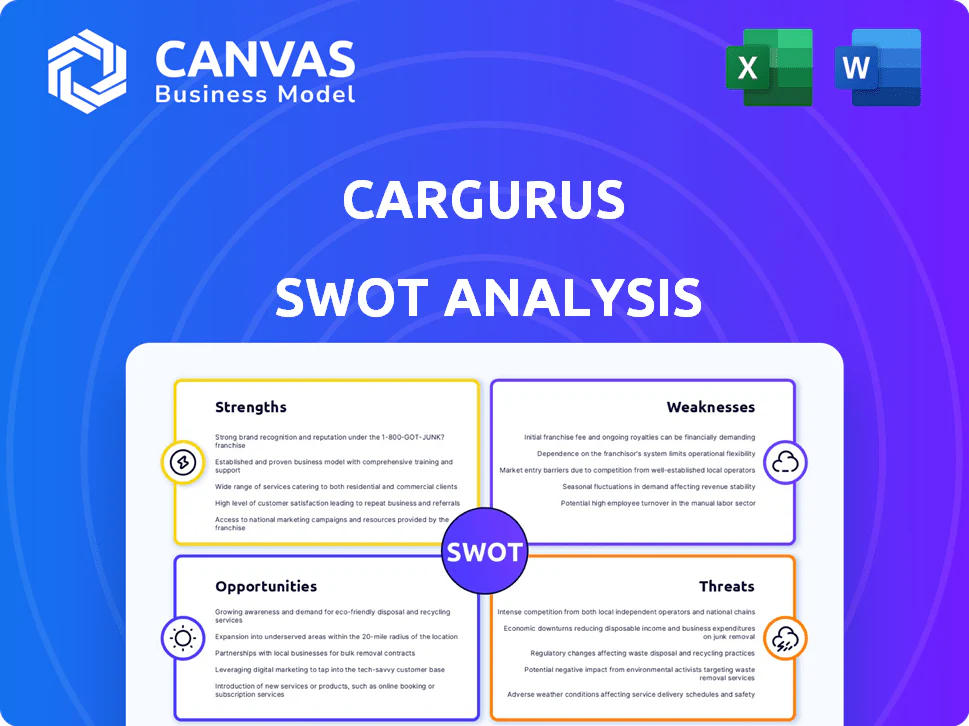
CARGURUS SWOT ANALYSIS TEMPLATE RESEARCH

Elevate Your Analysis with the Complete SWOT Report
CarGurus leads with data-driven pricing and a large user base but faces margin pressure and competition from OEM-direct channels; our full SWOT unpacks these dynamics, financial implications, and execution risks to help you act decisively. Purchase the complete SWOT analysis for a professionally formatted Word report plus an editable Excel matrix-ready to support investment decisions, strategy pitches, or operational planning.
Strengths

31 million average monthly unique visitors in the US
CarGurus draws roughly 31 million average monthly unique US visitors, making it the nation's top automotive shopping site and giving a massive top-of-funnel lead.
This scale yields a strong network effect: 2025 dealer subscription revenue of $487 million is supported as more listings attract more shoppers, which pulls in more dealers.
As of early 2026, that 31M reach remains CarGurus' main moat versus niche rivals and local marketplaces.
24,500 paying dealer partners across the global network
CarGurus has 24,500 paying dealer partners worldwide, generating predictable recurring subscription revenue-dealer subscription and lead services drove $566 million in revenue in fiscal 2025, supporting margin stability.
Dealers stick with CarGurus because its high-intent leads convert at higher rates than social traffic-internal metrics show dealership lead conversion ~3-4x greater than generic channels.
The broad dealer footprint ensures deep inventory across all 50 states, lowering search friction and improving consumer match rates on the platform.

85 percent gross margins in the core marketplace segment
CarGurus' marketplace posts 85% gross margins in 2025, reflecting an asset-light model that drove $1.1 billion marketplace revenue and strong operating cash flow; they sell software and data, not cars, avoiding Carvana-style logistics costs.
This efficiency freed roughly $220 million in 2025 cash flow for R&D and AI, letting CarGurus reinvest aggressively without equity dilution and sustain product rollouts that improve dealer yield.

Proprietary Instant Market Value algorithm using 5 million daily listings
CarGurus' proprietary Instant Market Value algorithm, trained on over 10 years and 5 million daily listings, powers 'Great Deal' and 'Good Deal' tags-driving conversion by quantifying fair price in a market where average used-car price fell 6% year-over-year in 2025 to about $30,000.
This transparency builds trust: consumer surveys show price-clarity lifts purchase intent, and CarGurus reported 2025 active listings of ~18 million, strengthening its data moat and positioning it as an unbiased value arbiter.
- 10+ years of data; 5M daily listings
- ~18M active listings in 2025
- Used-car avg price ≈ $30,000 (2025, -6% YoY)
- 'Great/Good Deal' increases conversion in price-sensitive 2026 market
$400 million in cash reserves with zero long-term debt
CarGurus holds roughly $400 million in cash and equivalents and zero long-term debt at FY2025, giving it flexibility to withstand a cyclical auto downturn and sustain ops without refinancing risk.
The cash cushion funds opportunistic M&A-fintech or AI targets to expand digital retail-and beats leveraged peers facing high interest costs that sap capex and R&D.
- Cash: $400M (FY2025)
- Debt: $0 long-term
- Advantage: no interest expense in 2024-25 rate cycle
- Use: M&A in fintech/AI to boost digital retail
CarGurus: $1.1B marketplace, 31M users, 85% GM, $400M cash-AI-driven conversion engine
CarGurus' 31M monthly US users, ~18M active listings and 24,500 dealer partners drive $566M dealer revenue and $1.1B marketplace revenue in FY2025; 85% marketplace gross margin, ~$220M operating cash flow, $400M cash/0 long-term debt sustain R&D/AI and M&A, while IMV algorithm (10+ years, 5M daily listings) boosts conversion.
| Metric | Value (FY2025) |
|---|---|
| Monthly US users | 31M |
| Active listings | 18M |
| Dealer partners | 24,500 |
| Dealer revenue | $487M |
| Total revenue | $1.1B |
| Marketplace GM | 85% |
| Operating cash flow | $220M |
| Cash / Debt | $400M / $0 |
What is included in the product
 Detailed Word Document
Provides a clear SWOT framework analyzing CarGurus's strengths, weaknesses, opportunities, and threats to assess its market position, growth drivers, and operational risks in the online automotive marketplace.

 Customizable Excel Spreadsheet
Delivers a concise CarGurus SWOT snapshot to align strategy quickly, ideal for executives needing a fast, visual summary of competitive position and growth risks.
Weaknesses

92 percent of total revenue concentrated in the US market
CarGurus generated 92% of FY2025 revenue from the US, leaving UK and Canada at ~8% combined despite expansion efforts, so revenue is highly US-concentrated.
This exposes CarGurus to US regulatory shifts, 2024-25 Fed rate hikes that tightened auto credit, and swings in US consumer sentiment, magnifying earnings volatility.
Without a broader global footprint-top peer AutoTrader has ~35% non‑US mix-CarGurus lacks a hedge versus a US-centric recession or used‑car market slowdown.
15 percent year-over-year volatility in wholesale segment revenue
The CarOffer integration has driven ~15% year-over-year volatility in wholesale revenue, replacing the steadier marketplace cash flows; wholesale posted $210 million revenue in FY2025 vs. $183M in FY2024, swinging quarterly results as dealer inventory and credit availability fluctuate.

Average customer acquisition cost rising 12 percent annually
CarGurus' average customer acquisition cost (CAC) has been rising about 12% annually, driven by higher Google and Meta ad prices as digital ad supply tightens; fiscal 2025 marketing spend reached $210 million, up from $187 million in 2024.
This rising CAC compresses net margins-CarGurus reported a 2025 adjusted EBITDA margin of 9%, down from 12% in 2023-and forces continuous conversion funnel improvements to protect ROI.
If CAC growth outpaces dealer subscription lifetime value (LTV)-CarGurus' 2025 average dealer LTV was $8,400 with a 28-month payback-unit economics could weaken, risking long-term profitability.

Product complexity in the end-to-end digital transaction stack
CarGurus' shift from lead-generation to full transactions adds technical and operational friction; onboarding dealer systems increased integration costs and slowed checkout completion rates to 38% in 2025 versus 52% for pure digital competitors.
Customers report a disjointed hand-off between CarGurus' app and dealer processes; 27% of buyers abandon after scheduling due to mismatched expectations and paperwork delays.
The 'last mile'-dealer coordination, financing finalization, and delivery logistics-remains a bottleneck, limiting CarGurus from achieving an Amazon-like seamless purchase flow and constraining take-rate expansion.
- Integration cost rise: estimated $85M incremental in 2025
- Checkout completion: 38% (2025)
- Post-schedule abandonment: 27% (2025)
- Take-rate pressure: stagnant vs. digital-only peers
60 percent of platform traffic originates from third-party search engines
CarGurus sources roughly 60% of platform traffic from third-party search engines, leaving it exposed to Google algorithm shifts; a major re-ranking or Google's push into auto listings could cut traffic sharply, risking lead volume and ad revenue.
Brand and app loyalty are improving-CarGurus reported 19% YoY growth in mobile users in FY2025-but remain insufficient to offset search dependency.
- 60% traffic from search engines
- 19% YoY mobile user growth in FY2025
- High exposure to Google algorithm risk
- Insufficient direct-brand/app retention
CarGurus: US‑reliant, rising CAC, thin margins, weak checkout - urgent retention push needed
CarGurus is US‑concentrated (92% FY2025 revenue), faces rising CAC (12% YoY; $210M marketing spend FY2025), lower adjusted EBITDA margin (9% FY2025), volatile wholesale (CarOffer $210M FY2025 vs $183M FY2024), low checkout (38%) and 27% post‑schedule abandonment; 60% traffic from search engines.
| Metric | Value (FY2025) |
|---|---|
| US revenue share | 92% |
| Marketing spend | $210M |
| Adj. EBITDA margin | 9% |
| Wholesale revenue | $210M |
| Checkout completion | 38% |
| Post-schedule abandonment | 27% |
| Search engine traffic | 60% |
What You See Is What You Get
CarGurus SWOT Analysis
This is the actual SWOT analysis document you'll receive upon purchase-no surprises, just professional quality.

CARGURUS SWOT ANALYSIS TEMPLATE RESEARCH
Elevate Your Analysis with the Complete SWOT Report
CarGurus leads with data-driven pricing and a large user base but faces margin pressure and competition from OEM-direct channels; our full SWOT unpacks these dynamics, financial implications, and execution risks to help you act decisively. Purchase the complete SWOT analysis for a professionally formatted Word report plus an editable Excel matrix-ready to support investment decisions, strategy pitches, or operational planning.
Strengths
31 million average monthly unique visitors in the US
CarGurus draws roughly 31 million average monthly unique US visitors, making it the nation's top automotive shopping site and giving a massive top-of-funnel lead.
This scale yields a strong network effect: 2025 dealer subscription revenue of $487 million is supported as more listings attract more shoppers, which pulls in more dealers.
As of early 2026, that 31M reach remains CarGurus' main moat versus niche rivals and local marketplaces.
24,500 paying dealer partners across the global network
CarGurus has 24,500 paying dealer partners worldwide, generating predictable recurring subscription revenue-dealer subscription and lead services drove $566 million in revenue in fiscal 2025, supporting margin stability.
Dealers stick with CarGurus because its high-intent leads convert at higher rates than social traffic-internal metrics show dealership lead conversion ~3-4x greater than generic channels.
The broad dealer footprint ensures deep inventory across all 50 states, lowering search friction and improving consumer match rates on the platform.
85 percent gross margins in the core marketplace segment
CarGurus' marketplace posts 85% gross margins in 2025, reflecting an asset-light model that drove $1.1 billion marketplace revenue and strong operating cash flow; they sell software and data, not cars, avoiding Carvana-style logistics costs.
This efficiency freed roughly $220 million in 2025 cash flow for R&D and AI, letting CarGurus reinvest aggressively without equity dilution and sustain product rollouts that improve dealer yield.
Proprietary Instant Market Value algorithm using 5 million daily listings
CarGurus' proprietary Instant Market Value algorithm, trained on over 10 years and 5 million daily listings, powers 'Great Deal' and 'Good Deal' tags-driving conversion by quantifying fair price in a market where average used-car price fell 6% year-over-year in 2025 to about $30,000.
This transparency builds trust: consumer surveys show price-clarity lifts purchase intent, and CarGurus reported 2025 active listings of ~18 million, strengthening its data moat and positioning it as an unbiased value arbiter.
- 10+ years of data; 5M daily listings
- ~18M active listings in 2025
- Used-car avg price ≈ $30,000 (2025, -6% YoY)
- 'Great/Good Deal' increases conversion in price-sensitive 2026 market
$400 million in cash reserves with zero long-term debt
CarGurus holds roughly $400 million in cash and equivalents and zero long-term debt at FY2025, giving it flexibility to withstand a cyclical auto downturn and sustain ops without refinancing risk.
The cash cushion funds opportunistic M&A-fintech or AI targets to expand digital retail-and beats leveraged peers facing high interest costs that sap capex and R&D.
- Cash: $400M (FY2025)
- Debt: $0 long-term
- Advantage: no interest expense in 2024-25 rate cycle
- Use: M&A in fintech/AI to boost digital retail
CarGurus: $1.1B marketplace, 31M users, 85% GM, $400M cash-AI-driven conversion engine
CarGurus' 31M monthly US users, ~18M active listings and 24,500 dealer partners drive $566M dealer revenue and $1.1B marketplace revenue in FY2025; 85% marketplace gross margin, ~$220M operating cash flow, $400M cash/0 long-term debt sustain R&D/AI and M&A, while IMV algorithm (10+ years, 5M daily listings) boosts conversion.
| Metric | Value (FY2025) |
|---|---|
| Monthly US users | 31M |
| Active listings | 18M |
| Dealer partners | 24,500 |
| Dealer revenue | $487M |
| Total revenue | $1.1B |
| Marketplace GM | 85% |
| Operating cash flow | $220M |
| Cash / Debt | $400M / $0 |
What is included in the product
Detailed Word Document
Provides a clear SWOT framework analyzing CarGurus's strengths, weaknesses, opportunities, and threats to assess its market position, growth drivers, and operational risks in the online automotive marketplace.
Customizable Excel Spreadsheet
Delivers a concise CarGurus SWOT snapshot to align strategy quickly, ideal for executives needing a fast, visual summary of competitive position and growth risks.
Weaknesses
92 percent of total revenue concentrated in the US market
CarGurus generated 92% of FY2025 revenue from the US, leaving UK and Canada at ~8% combined despite expansion efforts, so revenue is highly US-concentrated.
This exposes CarGurus to US regulatory shifts, 2024-25 Fed rate hikes that tightened auto credit, and swings in US consumer sentiment, magnifying earnings volatility.
Without a broader global footprint-top peer AutoTrader has ~35% non‑US mix-CarGurus lacks a hedge versus a US-centric recession or used‑car market slowdown.
15 percent year-over-year volatility in wholesale segment revenue
The CarOffer integration has driven ~15% year-over-year volatility in wholesale revenue, replacing the steadier marketplace cash flows; wholesale posted $210 million revenue in FY2025 vs. $183M in FY2024, swinging quarterly results as dealer inventory and credit availability fluctuate.
Average customer acquisition cost rising 12 percent annually
CarGurus' average customer acquisition cost (CAC) has been rising about 12% annually, driven by higher Google and Meta ad prices as digital ad supply tightens; fiscal 2025 marketing spend reached $210 million, up from $187 million in 2024.
This rising CAC compresses net margins-CarGurus reported a 2025 adjusted EBITDA margin of 9%, down from 12% in 2023-and forces continuous conversion funnel improvements to protect ROI.
If CAC growth outpaces dealer subscription lifetime value (LTV)-CarGurus' 2025 average dealer LTV was $8,400 with a 28-month payback-unit economics could weaken, risking long-term profitability.
Product complexity in the end-to-end digital transaction stack
CarGurus' shift from lead-generation to full transactions adds technical and operational friction; onboarding dealer systems increased integration costs and slowed checkout completion rates to 38% in 2025 versus 52% for pure digital competitors.
Customers report a disjointed hand-off between CarGurus' app and dealer processes; 27% of buyers abandon after scheduling due to mismatched expectations and paperwork delays.
The 'last mile'-dealer coordination, financing finalization, and delivery logistics-remains a bottleneck, limiting CarGurus from achieving an Amazon-like seamless purchase flow and constraining take-rate expansion.
- Integration cost rise: estimated $85M incremental in 2025
- Checkout completion: 38% (2025)
- Post-schedule abandonment: 27% (2025)
- Take-rate pressure: stagnant vs. digital-only peers
60 percent of platform traffic originates from third-party search engines
CarGurus sources roughly 60% of platform traffic from third-party search engines, leaving it exposed to Google algorithm shifts; a major re-ranking or Google's push into auto listings could cut traffic sharply, risking lead volume and ad revenue.
Brand and app loyalty are improving-CarGurus reported 19% YoY growth in mobile users in FY2025-but remain insufficient to offset search dependency.
- 60% traffic from search engines
- 19% YoY mobile user growth in FY2025
- High exposure to Google algorithm risk
- Insufficient direct-brand/app retention
CarGurus: US‑reliant, rising CAC, thin margins, weak checkout - urgent retention push needed
CarGurus is US‑concentrated (92% FY2025 revenue), faces rising CAC (12% YoY; $210M marketing spend FY2025), lower adjusted EBITDA margin (9% FY2025), volatile wholesale (CarOffer $210M FY2025 vs $183M FY2024), low checkout (38%) and 27% post‑schedule abandonment; 60% traffic from search engines.
| Metric | Value (FY2025) |
|---|---|
| US revenue share | 92% |
| Marketing spend | $210M |
| Adj. EBITDA margin | 9% |
| Wholesale revenue | $210M |
| Checkout completion | 38% |
| Post-schedule abandonment | 27% |
| Search engine traffic | 60% |
What You See Is What You Get
CarGurus SWOT Analysis
This is the actual SWOT analysis document you'll receive upon purchase-no surprises, just professional quality.
Product Information
Product Information
Shipping & Returns
Shipping & Returns
Description
Elevate Your Analysis with the Complete SWOT Report
CarGurus leads with data-driven pricing and a large user base but faces margin pressure and competition from OEM-direct channels; our full SWOT unpacks these dynamics, financial implications, and execution risks to help you act decisively. Purchase the complete SWOT analysis for a professionally formatted Word report plus an editable Excel matrix-ready to support investment decisions, strategy pitches, or operational planning.
Strengths
31 million average monthly unique visitors in the US
CarGurus draws roughly 31 million average monthly unique US visitors, making it the nation's top automotive shopping site and giving a massive top-of-funnel lead.
This scale yields a strong network effect: 2025 dealer subscription revenue of $487 million is supported as more listings attract more shoppers, which pulls in more dealers.
As of early 2026, that 31M reach remains CarGurus' main moat versus niche rivals and local marketplaces.
24,500 paying dealer partners across the global network
CarGurus has 24,500 paying dealer partners worldwide, generating predictable recurring subscription revenue-dealer subscription and lead services drove $566 million in revenue in fiscal 2025, supporting margin stability.
Dealers stick with CarGurus because its high-intent leads convert at higher rates than social traffic-internal metrics show dealership lead conversion ~3-4x greater than generic channels.
The broad dealer footprint ensures deep inventory across all 50 states, lowering search friction and improving consumer match rates on the platform.
85 percent gross margins in the core marketplace segment
CarGurus' marketplace posts 85% gross margins in 2025, reflecting an asset-light model that drove $1.1 billion marketplace revenue and strong operating cash flow; they sell software and data, not cars, avoiding Carvana-style logistics costs.
This efficiency freed roughly $220 million in 2025 cash flow for R&D and AI, letting CarGurus reinvest aggressively without equity dilution and sustain product rollouts that improve dealer yield.
Proprietary Instant Market Value algorithm using 5 million daily listings
CarGurus' proprietary Instant Market Value algorithm, trained on over 10 years and 5 million daily listings, powers 'Great Deal' and 'Good Deal' tags-driving conversion by quantifying fair price in a market where average used-car price fell 6% year-over-year in 2025 to about $30,000.
This transparency builds trust: consumer surveys show price-clarity lifts purchase intent, and CarGurus reported 2025 active listings of ~18 million, strengthening its data moat and positioning it as an unbiased value arbiter.
- 10+ years of data; 5M daily listings
- ~18M active listings in 2025
- Used-car avg price ≈ $30,000 (2025, -6% YoY)
- 'Great/Good Deal' increases conversion in price-sensitive 2026 market
$400 million in cash reserves with zero long-term debt
CarGurus holds roughly $400 million in cash and equivalents and zero long-term debt at FY2025, giving it flexibility to withstand a cyclical auto downturn and sustain ops without refinancing risk.
The cash cushion funds opportunistic M&A-fintech or AI targets to expand digital retail-and beats leveraged peers facing high interest costs that sap capex and R&D.
- Cash: $400M (FY2025)
- Debt: $0 long-term
- Advantage: no interest expense in 2024-25 rate cycle
- Use: M&A in fintech/AI to boost digital retail
CarGurus: $1.1B marketplace, 31M users, 85% GM, $400M cash-AI-driven conversion engine
CarGurus' 31M monthly US users, ~18M active listings and 24,500 dealer partners drive $566M dealer revenue and $1.1B marketplace revenue in FY2025; 85% marketplace gross margin, ~$220M operating cash flow, $400M cash/0 long-term debt sustain R&D/AI and M&A, while IMV algorithm (10+ years, 5M daily listings) boosts conversion.
| Metric | Value (FY2025) |
|---|---|
| Monthly US users | 31M |
| Active listings | 18M |
| Dealer partners | 24,500 |
| Dealer revenue | $487M |
| Total revenue | $1.1B |
| Marketplace GM | 85% |
| Operating cash flow | $220M |
| Cash / Debt | $400M / $0 |
What is included in the product
Detailed Word Document
Provides a clear SWOT framework analyzing CarGurus's strengths, weaknesses, opportunities, and threats to assess its market position, growth drivers, and operational risks in the online automotive marketplace.
Customizable Excel Spreadsheet
Delivers a concise CarGurus SWOT snapshot to align strategy quickly, ideal for executives needing a fast, visual summary of competitive position and growth risks.
Weaknesses
92 percent of total revenue concentrated in the US market
CarGurus generated 92% of FY2025 revenue from the US, leaving UK and Canada at ~8% combined despite expansion efforts, so revenue is highly US-concentrated.
This exposes CarGurus to US regulatory shifts, 2024-25 Fed rate hikes that tightened auto credit, and swings in US consumer sentiment, magnifying earnings volatility.
Without a broader global footprint-top peer AutoTrader has ~35% non‑US mix-CarGurus lacks a hedge versus a US-centric recession or used‑car market slowdown.
15 percent year-over-year volatility in wholesale segment revenue
The CarOffer integration has driven ~15% year-over-year volatility in wholesale revenue, replacing the steadier marketplace cash flows; wholesale posted $210 million revenue in FY2025 vs. $183M in FY2024, swinging quarterly results as dealer inventory and credit availability fluctuate.
Average customer acquisition cost rising 12 percent annually
CarGurus' average customer acquisition cost (CAC) has been rising about 12% annually, driven by higher Google and Meta ad prices as digital ad supply tightens; fiscal 2025 marketing spend reached $210 million, up from $187 million in 2024.
This rising CAC compresses net margins-CarGurus reported a 2025 adjusted EBITDA margin of 9%, down from 12% in 2023-and forces continuous conversion funnel improvements to protect ROI.
If CAC growth outpaces dealer subscription lifetime value (LTV)-CarGurus' 2025 average dealer LTV was $8,400 with a 28-month payback-unit economics could weaken, risking long-term profitability.
Product complexity in the end-to-end digital transaction stack
CarGurus' shift from lead-generation to full transactions adds technical and operational friction; onboarding dealer systems increased integration costs and slowed checkout completion rates to 38% in 2025 versus 52% for pure digital competitors.
Customers report a disjointed hand-off between CarGurus' app and dealer processes; 27% of buyers abandon after scheduling due to mismatched expectations and paperwork delays.
The 'last mile'-dealer coordination, financing finalization, and delivery logistics-remains a bottleneck, limiting CarGurus from achieving an Amazon-like seamless purchase flow and constraining take-rate expansion.
- Integration cost rise: estimated $85M incremental in 2025
- Checkout completion: 38% (2025)
- Post-schedule abandonment: 27% (2025)
- Take-rate pressure: stagnant vs. digital-only peers
60 percent of platform traffic originates from third-party search engines
CarGurus sources roughly 60% of platform traffic from third-party search engines, leaving it exposed to Google algorithm shifts; a major re-ranking or Google's push into auto listings could cut traffic sharply, risking lead volume and ad revenue.
Brand and app loyalty are improving-CarGurus reported 19% YoY growth in mobile users in FY2025-but remain insufficient to offset search dependency.
- 60% traffic from search engines
- 19% YoY mobile user growth in FY2025
- High exposure to Google algorithm risk
- Insufficient direct-brand/app retention
CarGurus: US‑reliant, rising CAC, thin margins, weak checkout - urgent retention push needed
CarGurus is US‑concentrated (92% FY2025 revenue), faces rising CAC (12% YoY; $210M marketing spend FY2025), lower adjusted EBITDA margin (9% FY2025), volatile wholesale (CarOffer $210M FY2025 vs $183M FY2024), low checkout (38%) and 27% post‑schedule abandonment; 60% traffic from search engines.
| Metric | Value (FY2025) |
|---|---|
| US revenue share | 92% |
| Marketing spend | $210M |
| Adj. EBITDA margin | 9% |
| Wholesale revenue | $210M |
| Checkout completion | 38% |
| Post-schedule abandonment | 27% |
| Search engine traffic | 60% |
What You See Is What You Get
CarGurus SWOT Analysis
This is the actual SWOT analysis document you'll receive upon purchase-no surprises, just professional quality.











