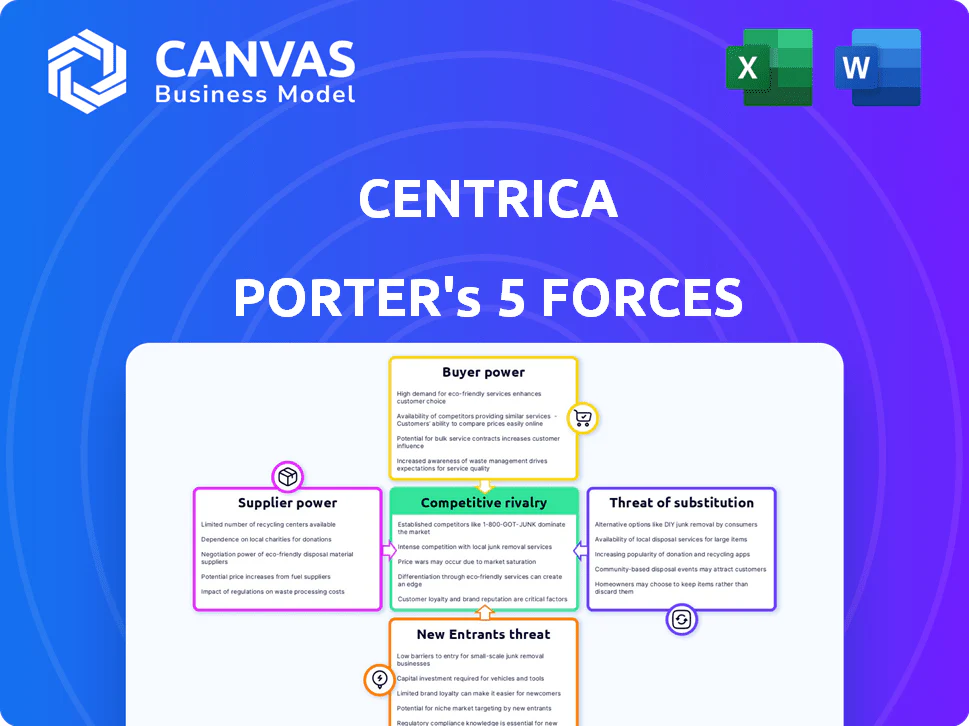
CENTRICA PORTER'S FIVE FORCES TEMPLATE RESEARCH
What is included in the product
 Detailed Word Document
Evaluates control held by suppliers and buyers, and their influence on pricing and profitability.

 Customizable Excel Spreadsheet
Instantly grasp competitive threats with a vivid visual breakdown of Centrica's market position.
Same Document Delivered
Centrica Porter's Five Forces Analysis
This is the Centrica Porter's Five Forces Analysis. The preview you see here is the identical document you'll receive after completing your purchase. It's a comprehensive analysis covering all five forces, providing actionable insights. No edits or revisions will be needed; the file is ready for instant download and use.

Porter's Five Forces Analysis Template

A Must-Have Tool for Decision-Makers
Centrica faces complex industry pressures, as revealed by Porter's Five Forces. Buyer power, due to energy consumer choice, impacts profitability. Supplier influence, particularly from energy producers, is a key factor. The threat of new entrants, like renewable energy startups, is significant. Substitute products, such as alternative energy sources, pose a challenge. Competitive rivalry within the energy market intensifies these dynamics.
This brief snapshot only scratches the surface. Unlock the full Porter's Five Forces Analysis to explore Centrica’s competitive dynamics, market pressures, and strategic advantages in detail.
Suppliers Bargaining Power

Limited number of key energy suppliers
Centrica faces supplier power due to its reliance on a few major energy providers. This concentration, especially for natural gas and electricity, gives suppliers leverage. In 2024, wholesale gas prices fluctuated, impacting Centrica's procurement costs. This can squeeze profit margins.
Dependence on infrastructure providers
Centrica's operations heavily rely on infrastructure providers. For example, in 2024, National Grid's transmission costs impacted energy delivery prices. This dependence gives infrastructure providers considerable bargaining power. Fluctuations in their charges directly affect Centrica's profitability and market competitiveness. The ability to negotiate is vital.

Potential for forward integration by suppliers
Some upstream energy producers are integrating downstream, directly selling energy to consumers. This forward integration can limit Centrica's resource access or raise costs. For example, in 2024, some oil and gas firms expanded retail energy offerings. This shift intensifies competition for Centrica. It also affects their pricing strategies.

Low availability of alternative immediate suppliers
Centrica faces challenges due to the low immediate availability of alternative suppliers, particularly for essential energy resources. This dependence can weaken Centrica's negotiating position. In 2024, natural gas spot prices in the UK fluctuated significantly, affecting Centrica's procurement costs. This volatility underscores the impact of supplier power. Centrica's ability to diversify supply is crucial for mitigating risks.
- 2024 saw significant price volatility in energy markets.
- Centrica's reliance on specific suppliers can increase costs.
- Diversification is key to managing supplier power.
- Market conditions influence supplier bargaining power.
Influence of commodity price volatility
Centrica's costs are significantly influenced by fluctuations in wholesale energy prices. Supplier bargaining power rises during periods of high volatility, allowing them to demand higher prices. For instance, in 2024, natural gas prices experienced considerable swings, impacting Centrica's procurement costs. This volatility directly affects Centrica's profitability and operational expenses.
- 2024: Natural gas prices saw substantial fluctuations, increasing supplier power.
- Volatility in wholesale markets directly affects Centrica's cost structure.
- Increased supplier bargaining power can lead to higher procurement costs.
Centrica's Supplier Dynamics: Risks & Mitigation
Centrica's supplier power is notably affected by energy market concentration. In 2024, wholesale price volatility, particularly in natural gas, impacted Centrica's procurement costs. Diversifying suppliers is crucial to mitigate these risks.
| Factor | Impact | 2024 Data |
|---|---|---|
| Supplier Concentration | Higher costs, reduced margins | UK gas prices fluctuated 30% |
| Infrastructure Dependence | Increased operational costs | National Grid's costs rose 5% |
| Market Volatility | Supplier leverage increases | Brent crude varied $20/barrel |
Customers Bargaining Power

High customer awareness and demand for renewable energy
Customer demand for renewable energy is on the rise, boosting their bargaining power. A 2024 study showed that 70% of consumers actively seek sustainable products. This trend forces Centrica to adapt. In 2023, Centrica's investment in green energy increased by 15%, responding to customer preferences. This shift impacts Centrica's strategy.
Availability of various energy providers and ease of switching
The UK energy market features numerous suppliers, both long-standing and new. Customers can readily compare deals and switch providers, boosting their bargaining power. In 2024, around 5.6 million UK households switched energy suppliers. This ease of switching pressures suppliers to offer competitive pricing and service.

Increasing focus on energy efficiency and conservation
Customers are prioritizing energy efficiency, reducing demand. This gives them more power in price talks. In 2024, residential energy consumption decreased by 1.5% due to efficiency upgrades. This shift empowers customers.

Customer sensitivity to price changes
Customers' sensitivity to energy prices is high because energy is a major expense for households and businesses. This sensitivity gives customers leverage to push Centrica and its competitors to offer competitive prices. For example, in 2024, UK household energy bills averaged around £1,500 annually, making any price fluctuation significant. This price pressure affects Centrica's profitability and market share.
- Household energy bills in the UK averaged approximately £1,500 in 2024.
- Price sensitivity significantly influences customer decisions in the energy market.
- Competitive pricing is crucial for retaining and attracting customers.
Growth of prosumers and localized energy generation
The growth of prosumers, like those with solar panels, and localized energy generation weakens customer reliance on major suppliers such as Centrica. This shift gives customers more control over their energy, increasing their bargaining power. The trend is supported by a rise in distributed energy resources. In 2024, the UK saw a 15% increase in household solar installations.
- Prosumers now have more energy choices.
- Local generation boosts customer independence.
- This trend reduces reliance on big energy firms.
- Empowered customers can negotiate better deals.
Customer Power: Reshaping the Energy Market
Customer bargaining power significantly impacts Centrica's market position. High price sensitivity, with UK household energy bills averaging £1,500 in 2024, gives customers leverage. The rise of prosumers and energy efficiency further empower consumers, reshaping the energy landscape.
| Factor | Impact | 2024 Data |
|---|---|---|
| Price Sensitivity | High customer leverage | Avg. UK household energy bill: £1,500 |
| Energy Efficiency | Reduced demand, higher power | Residential consumption down 1.5% |
| Prosumers | Increased energy choices | 15% rise in UK solar installs |
Rivalry Among Competitors

Presence of established major energy companies
Centrica faces fierce competition from established energy giants. These include EDF Energy, E.ON, and SSE, which have considerable market share. In 2024, the UK energy market saw these major players still dominating. Their financial strength allows for aggressive pricing and investment strategies.
Increased competition from new entrants and smaller suppliers
The UK energy market's competitive landscape has intensified, with new entrants and smaller suppliers gaining ground. These innovative firms have disrupted the market. In 2024, the market share of smaller suppliers grew by 5%, increasing pressure on established companies. This forces companies like Centrica to compete aggressively on price and service offerings to retain customers.

Homogenous nature of the core product (energy supply)
Energy supply, being largely homogenous, intensifies price-based competition. This drives down profit margins. In 2024, the UK energy market saw fluctuating wholesale prices, impacting suppliers. For instance, in Q3 2024, average electricity prices were around £0.28 per kWh. This encouraged aggressive pricing strategies.

Pressure on profitability in a normalized market
Energy markets have normalized after volatility, squeezing profits. This intensifies rivalry as firms fight for margins. In 2024, Centrica's adjusted operating profit decreased. Competition rises when growth slows. Companies compete more aggressively to maintain their market share.
- Centrica's adjusted operating profit decreased in 2024.
- Normalization reduces profit margins.
- Competition intensifies in the market.
- Companies strive to maintain market share.
Focus on diversification and new service offerings
Centrica faces intense competition as energy providers diversify beyond traditional supply. They now offer home energy management, renewable solutions, and EV charging, broadening the market. This requires companies to compete on a wider range of services, increasing rivalry. For instance, British Gas, a Centrica subsidiary, competes with numerous firms in these new areas.
- Centrica's revenue in 2023 was £32.9 billion.
- British Gas has a large customer base, but faces competition from smaller, specialized firms.
- The home energy management market is projected to grow significantly by 2024-2025.
- Centrica is investing in renewable energy and EV charging infrastructure.
Centrica's 2024: Revenue Dip and Market Shifts
Centrica faces tough competition, especially with decreased profits in 2024. Normalization in the market squeezed profit margins, increasing rivalry among energy providers. Companies like Centrica aggressively compete to maintain their market share in a challenging environment.
| Metric | 2023 | 2024 (Projected/Actual) |
|---|---|---|
| Centrica Revenue (£ billions) | 32.9 | 31.5 (est.) |
| UK Energy Market Share Change (Smaller Suppliers) | N/A | +5% |
| Average Electricity Price (Q3, £/kWh) | N/A | 0.28 |
Original: $10.00
-65%$10.00
$3.50CENTRICA PORTER'S FIVE FORCES TEMPLATE RESEARCH
What is included in the product
Detailed Word Document
Evaluates control held by suppliers and buyers, and their influence on pricing and profitability.
Customizable Excel Spreadsheet
Instantly grasp competitive threats with a vivid visual breakdown of Centrica's market position.
Same Document Delivered
Centrica Porter's Five Forces Analysis
This is the Centrica Porter's Five Forces Analysis. The preview you see here is the identical document you'll receive after completing your purchase. It's a comprehensive analysis covering all five forces, providing actionable insights. No edits or revisions will be needed; the file is ready for instant download and use.
Porter's Five Forces Analysis Template
A Must-Have Tool for Decision-Makers
Centrica faces complex industry pressures, as revealed by Porter's Five Forces. Buyer power, due to energy consumer choice, impacts profitability. Supplier influence, particularly from energy producers, is a key factor. The threat of new entrants, like renewable energy startups, is significant. Substitute products, such as alternative energy sources, pose a challenge. Competitive rivalry within the energy market intensifies these dynamics.
This brief snapshot only scratches the surface. Unlock the full Porter's Five Forces Analysis to explore Centrica’s competitive dynamics, market pressures, and strategic advantages in detail.
Suppliers Bargaining Power
Limited number of key energy suppliers
Centrica faces supplier power due to its reliance on a few major energy providers. This concentration, especially for natural gas and electricity, gives suppliers leverage. In 2024, wholesale gas prices fluctuated, impacting Centrica's procurement costs. This can squeeze profit margins.
Dependence on infrastructure providers
Centrica's operations heavily rely on infrastructure providers. For example, in 2024, National Grid's transmission costs impacted energy delivery prices. This dependence gives infrastructure providers considerable bargaining power. Fluctuations in their charges directly affect Centrica's profitability and market competitiveness. The ability to negotiate is vital.
Potential for forward integration by suppliers
Some upstream energy producers are integrating downstream, directly selling energy to consumers. This forward integration can limit Centrica's resource access or raise costs. For example, in 2024, some oil and gas firms expanded retail energy offerings. This shift intensifies competition for Centrica. It also affects their pricing strategies.
Low availability of alternative immediate suppliers
Centrica faces challenges due to the low immediate availability of alternative suppliers, particularly for essential energy resources. This dependence can weaken Centrica's negotiating position. In 2024, natural gas spot prices in the UK fluctuated significantly, affecting Centrica's procurement costs. This volatility underscores the impact of supplier power. Centrica's ability to diversify supply is crucial for mitigating risks.
- 2024 saw significant price volatility in energy markets.
- Centrica's reliance on specific suppliers can increase costs.
- Diversification is key to managing supplier power.
- Market conditions influence supplier bargaining power.
Influence of commodity price volatility
Centrica's costs are significantly influenced by fluctuations in wholesale energy prices. Supplier bargaining power rises during periods of high volatility, allowing them to demand higher prices. For instance, in 2024, natural gas prices experienced considerable swings, impacting Centrica's procurement costs. This volatility directly affects Centrica's profitability and operational expenses.
- 2024: Natural gas prices saw substantial fluctuations, increasing supplier power.
- Volatility in wholesale markets directly affects Centrica's cost structure.
- Increased supplier bargaining power can lead to higher procurement costs.
Centrica's Supplier Dynamics: Risks & Mitigation
Centrica's supplier power is notably affected by energy market concentration. In 2024, wholesale price volatility, particularly in natural gas, impacted Centrica's procurement costs. Diversifying suppliers is crucial to mitigate these risks.
| Factor | Impact | 2024 Data |
|---|---|---|
| Supplier Concentration | Higher costs, reduced margins | UK gas prices fluctuated 30% |
| Infrastructure Dependence | Increased operational costs | National Grid's costs rose 5% |
| Market Volatility | Supplier leverage increases | Brent crude varied $20/barrel |
Customers Bargaining Power
High customer awareness and demand for renewable energy
Customer demand for renewable energy is on the rise, boosting their bargaining power. A 2024 study showed that 70% of consumers actively seek sustainable products. This trend forces Centrica to adapt. In 2023, Centrica's investment in green energy increased by 15%, responding to customer preferences. This shift impacts Centrica's strategy.
Availability of various energy providers and ease of switching
The UK energy market features numerous suppliers, both long-standing and new. Customers can readily compare deals and switch providers, boosting their bargaining power. In 2024, around 5.6 million UK households switched energy suppliers. This ease of switching pressures suppliers to offer competitive pricing and service.
Increasing focus on energy efficiency and conservation
Customers are prioritizing energy efficiency, reducing demand. This gives them more power in price talks. In 2024, residential energy consumption decreased by 1.5% due to efficiency upgrades. This shift empowers customers.
Customer sensitivity to price changes
Customers' sensitivity to energy prices is high because energy is a major expense for households and businesses. This sensitivity gives customers leverage to push Centrica and its competitors to offer competitive prices. For example, in 2024, UK household energy bills averaged around £1,500 annually, making any price fluctuation significant. This price pressure affects Centrica's profitability and market share.
- Household energy bills in the UK averaged approximately £1,500 in 2024.
- Price sensitivity significantly influences customer decisions in the energy market.
- Competitive pricing is crucial for retaining and attracting customers.
Growth of prosumers and localized energy generation
The growth of prosumers, like those with solar panels, and localized energy generation weakens customer reliance on major suppliers such as Centrica. This shift gives customers more control over their energy, increasing their bargaining power. The trend is supported by a rise in distributed energy resources. In 2024, the UK saw a 15% increase in household solar installations.
- Prosumers now have more energy choices.
- Local generation boosts customer independence.
- This trend reduces reliance on big energy firms.
- Empowered customers can negotiate better deals.
Customer Power: Reshaping the Energy Market
Customer bargaining power significantly impacts Centrica's market position. High price sensitivity, with UK household energy bills averaging £1,500 in 2024, gives customers leverage. The rise of prosumers and energy efficiency further empower consumers, reshaping the energy landscape.
| Factor | Impact | 2024 Data |
|---|---|---|
| Price Sensitivity | High customer leverage | Avg. UK household energy bill: £1,500 |
| Energy Efficiency | Reduced demand, higher power | Residential consumption down 1.5% |
| Prosumers | Increased energy choices | 15% rise in UK solar installs |
Rivalry Among Competitors
Presence of established major energy companies
Centrica faces fierce competition from established energy giants. These include EDF Energy, E.ON, and SSE, which have considerable market share. In 2024, the UK energy market saw these major players still dominating. Their financial strength allows for aggressive pricing and investment strategies.
Increased competition from new entrants and smaller suppliers
The UK energy market's competitive landscape has intensified, with new entrants and smaller suppliers gaining ground. These innovative firms have disrupted the market. In 2024, the market share of smaller suppliers grew by 5%, increasing pressure on established companies. This forces companies like Centrica to compete aggressively on price and service offerings to retain customers.
Homogenous nature of the core product (energy supply)
Energy supply, being largely homogenous, intensifies price-based competition. This drives down profit margins. In 2024, the UK energy market saw fluctuating wholesale prices, impacting suppliers. For instance, in Q3 2024, average electricity prices were around £0.28 per kWh. This encouraged aggressive pricing strategies.
Pressure on profitability in a normalized market
Energy markets have normalized after volatility, squeezing profits. This intensifies rivalry as firms fight for margins. In 2024, Centrica's adjusted operating profit decreased. Competition rises when growth slows. Companies compete more aggressively to maintain their market share.
- Centrica's adjusted operating profit decreased in 2024.
- Normalization reduces profit margins.
- Competition intensifies in the market.
- Companies strive to maintain market share.
Focus on diversification and new service offerings
Centrica faces intense competition as energy providers diversify beyond traditional supply. They now offer home energy management, renewable solutions, and EV charging, broadening the market. This requires companies to compete on a wider range of services, increasing rivalry. For instance, British Gas, a Centrica subsidiary, competes with numerous firms in these new areas.
- Centrica's revenue in 2023 was £32.9 billion.
- British Gas has a large customer base, but faces competition from smaller, specialized firms.
- The home energy management market is projected to grow significantly by 2024-2025.
- Centrica is investing in renewable energy and EV charging infrastructure.
Centrica's 2024: Revenue Dip and Market Shifts
Centrica faces tough competition, especially with decreased profits in 2024. Normalization in the market squeezed profit margins, increasing rivalry among energy providers. Companies like Centrica aggressively compete to maintain their market share in a challenging environment.
| Metric | 2023 | 2024 (Projected/Actual) |
|---|---|---|
| Centrica Revenue (£ billions) | 32.9 | 31.5 (est.) |
| UK Energy Market Share Change (Smaller Suppliers) | N/A | +5% |
| Average Electricity Price (Q3, £/kWh) | N/A | 0.28 |
Product Information
Product Information
Shipping & Returns
Shipping & Returns
Description
What is included in the product
Detailed Word Document
Evaluates control held by suppliers and buyers, and their influence on pricing and profitability.
Customizable Excel Spreadsheet
Instantly grasp competitive threats with a vivid visual breakdown of Centrica's market position.
Same Document Delivered
Centrica Porter's Five Forces Analysis
This is the Centrica Porter's Five Forces Analysis. The preview you see here is the identical document you'll receive after completing your purchase. It's a comprehensive analysis covering all five forces, providing actionable insights. No edits or revisions will be needed; the file is ready for instant download and use.
Porter's Five Forces Analysis Template
A Must-Have Tool for Decision-Makers
Centrica faces complex industry pressures, as revealed by Porter's Five Forces. Buyer power, due to energy consumer choice, impacts profitability. Supplier influence, particularly from energy producers, is a key factor. The threat of new entrants, like renewable energy startups, is significant. Substitute products, such as alternative energy sources, pose a challenge. Competitive rivalry within the energy market intensifies these dynamics.
This brief snapshot only scratches the surface. Unlock the full Porter's Five Forces Analysis to explore Centrica’s competitive dynamics, market pressures, and strategic advantages in detail.
Suppliers Bargaining Power
Limited number of key energy suppliers
Centrica faces supplier power due to its reliance on a few major energy providers. This concentration, especially for natural gas and electricity, gives suppliers leverage. In 2024, wholesale gas prices fluctuated, impacting Centrica's procurement costs. This can squeeze profit margins.
Dependence on infrastructure providers
Centrica's operations heavily rely on infrastructure providers. For example, in 2024, National Grid's transmission costs impacted energy delivery prices. This dependence gives infrastructure providers considerable bargaining power. Fluctuations in their charges directly affect Centrica's profitability and market competitiveness. The ability to negotiate is vital.
Potential for forward integration by suppliers
Some upstream energy producers are integrating downstream, directly selling energy to consumers. This forward integration can limit Centrica's resource access or raise costs. For example, in 2024, some oil and gas firms expanded retail energy offerings. This shift intensifies competition for Centrica. It also affects their pricing strategies.
Low availability of alternative immediate suppliers
Centrica faces challenges due to the low immediate availability of alternative suppliers, particularly for essential energy resources. This dependence can weaken Centrica's negotiating position. In 2024, natural gas spot prices in the UK fluctuated significantly, affecting Centrica's procurement costs. This volatility underscores the impact of supplier power. Centrica's ability to diversify supply is crucial for mitigating risks.
- 2024 saw significant price volatility in energy markets.
- Centrica's reliance on specific suppliers can increase costs.
- Diversification is key to managing supplier power.
- Market conditions influence supplier bargaining power.
Influence of commodity price volatility
Centrica's costs are significantly influenced by fluctuations in wholesale energy prices. Supplier bargaining power rises during periods of high volatility, allowing them to demand higher prices. For instance, in 2024, natural gas prices experienced considerable swings, impacting Centrica's procurement costs. This volatility directly affects Centrica's profitability and operational expenses.
- 2024: Natural gas prices saw substantial fluctuations, increasing supplier power.
- Volatility in wholesale markets directly affects Centrica's cost structure.
- Increased supplier bargaining power can lead to higher procurement costs.
Centrica's Supplier Dynamics: Risks & Mitigation
Centrica's supplier power is notably affected by energy market concentration. In 2024, wholesale price volatility, particularly in natural gas, impacted Centrica's procurement costs. Diversifying suppliers is crucial to mitigate these risks.
| Factor | Impact | 2024 Data |
|---|---|---|
| Supplier Concentration | Higher costs, reduced margins | UK gas prices fluctuated 30% |
| Infrastructure Dependence | Increased operational costs | National Grid's costs rose 5% |
| Market Volatility | Supplier leverage increases | Brent crude varied $20/barrel |
Customers Bargaining Power
High customer awareness and demand for renewable energy
Customer demand for renewable energy is on the rise, boosting their bargaining power. A 2024 study showed that 70% of consumers actively seek sustainable products. This trend forces Centrica to adapt. In 2023, Centrica's investment in green energy increased by 15%, responding to customer preferences. This shift impacts Centrica's strategy.
Availability of various energy providers and ease of switching
The UK energy market features numerous suppliers, both long-standing and new. Customers can readily compare deals and switch providers, boosting their bargaining power. In 2024, around 5.6 million UK households switched energy suppliers. This ease of switching pressures suppliers to offer competitive pricing and service.
Increasing focus on energy efficiency and conservation
Customers are prioritizing energy efficiency, reducing demand. This gives them more power in price talks. In 2024, residential energy consumption decreased by 1.5% due to efficiency upgrades. This shift empowers customers.
Customer sensitivity to price changes
Customers' sensitivity to energy prices is high because energy is a major expense for households and businesses. This sensitivity gives customers leverage to push Centrica and its competitors to offer competitive prices. For example, in 2024, UK household energy bills averaged around £1,500 annually, making any price fluctuation significant. This price pressure affects Centrica's profitability and market share.
- Household energy bills in the UK averaged approximately £1,500 in 2024.
- Price sensitivity significantly influences customer decisions in the energy market.
- Competitive pricing is crucial for retaining and attracting customers.
Growth of prosumers and localized energy generation
The growth of prosumers, like those with solar panels, and localized energy generation weakens customer reliance on major suppliers such as Centrica. This shift gives customers more control over their energy, increasing their bargaining power. The trend is supported by a rise in distributed energy resources. In 2024, the UK saw a 15% increase in household solar installations.
- Prosumers now have more energy choices.
- Local generation boosts customer independence.
- This trend reduces reliance on big energy firms.
- Empowered customers can negotiate better deals.
Customer Power: Reshaping the Energy Market
Customer bargaining power significantly impacts Centrica's market position. High price sensitivity, with UK household energy bills averaging £1,500 in 2024, gives customers leverage. The rise of prosumers and energy efficiency further empower consumers, reshaping the energy landscape.
| Factor | Impact | 2024 Data |
|---|---|---|
| Price Sensitivity | High customer leverage | Avg. UK household energy bill: £1,500 |
| Energy Efficiency | Reduced demand, higher power | Residential consumption down 1.5% |
| Prosumers | Increased energy choices | 15% rise in UK solar installs |
Rivalry Among Competitors
Presence of established major energy companies
Centrica faces fierce competition from established energy giants. These include EDF Energy, E.ON, and SSE, which have considerable market share. In 2024, the UK energy market saw these major players still dominating. Their financial strength allows for aggressive pricing and investment strategies.
Increased competition from new entrants and smaller suppliers
The UK energy market's competitive landscape has intensified, with new entrants and smaller suppliers gaining ground. These innovative firms have disrupted the market. In 2024, the market share of smaller suppliers grew by 5%, increasing pressure on established companies. This forces companies like Centrica to compete aggressively on price and service offerings to retain customers.
Homogenous nature of the core product (energy supply)
Energy supply, being largely homogenous, intensifies price-based competition. This drives down profit margins. In 2024, the UK energy market saw fluctuating wholesale prices, impacting suppliers. For instance, in Q3 2024, average electricity prices were around £0.28 per kWh. This encouraged aggressive pricing strategies.
Pressure on profitability in a normalized market
Energy markets have normalized after volatility, squeezing profits. This intensifies rivalry as firms fight for margins. In 2024, Centrica's adjusted operating profit decreased. Competition rises when growth slows. Companies compete more aggressively to maintain their market share.
- Centrica's adjusted operating profit decreased in 2024.
- Normalization reduces profit margins.
- Competition intensifies in the market.
- Companies strive to maintain market share.
Focus on diversification and new service offerings
Centrica faces intense competition as energy providers diversify beyond traditional supply. They now offer home energy management, renewable solutions, and EV charging, broadening the market. This requires companies to compete on a wider range of services, increasing rivalry. For instance, British Gas, a Centrica subsidiary, competes with numerous firms in these new areas.
- Centrica's revenue in 2023 was £32.9 billion.
- British Gas has a large customer base, but faces competition from smaller, specialized firms.
- The home energy management market is projected to grow significantly by 2024-2025.
- Centrica is investing in renewable energy and EV charging infrastructure.
Centrica's 2024: Revenue Dip and Market Shifts
Centrica faces tough competition, especially with decreased profits in 2024. Normalization in the market squeezed profit margins, increasing rivalry among energy providers. Companies like Centrica aggressively compete to maintain their market share in a challenging environment.
| Metric | 2023 | 2024 (Projected/Actual) |
|---|---|---|
| Centrica Revenue (£ billions) | 32.9 | 31.5 (est.) |
| UK Energy Market Share Change (Smaller Suppliers) | N/A | +5% |
| Average Electricity Price (Q3, £/kWh) | N/A | 0.28 |











