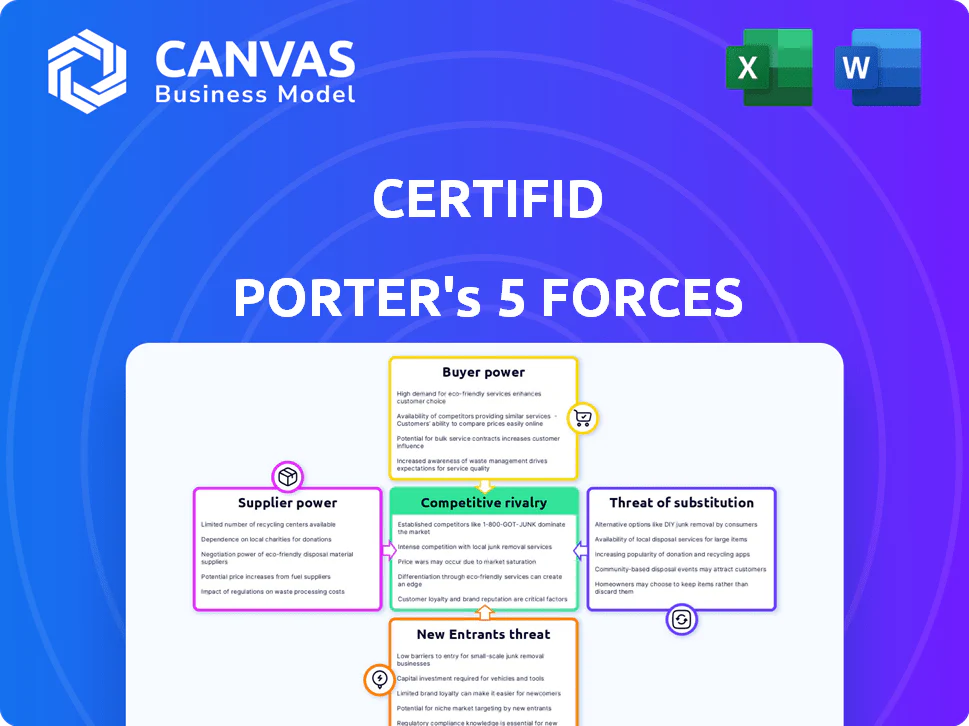
CERTIFID PORTER'S FIVE FORCES TEMPLATE RESEARCH
What is included in the product
 Detailed Word Document
Analyzes CertifID's competitive position, including key threats and opportunities in its landscape.

 Customizable Excel Spreadsheet
Avoid costly errors: instantly assess market pressures with interactive data.
Preview Before You Purchase
CertifID Porter's Five Forces Analysis
This preview reveals the complete Porter's Five Forces analysis. The document you see is identical to the one you'll download immediately after purchase, providing a clear, concise assessment.

Porter's Five Forces Analysis Template

Elevate Your Analysis with the Complete Porter's Five Forces Analysis
CertifID faces moderate competition, with established players and evolving tech. Buyer power is moderate due to the specialized nature of services. Supplier power is also moderate, tied to tech and compliance. Substitutes pose a low threat, but new entrants could disrupt. Rivalry is intensifying.
This brief snapshot only scratches the surface. Unlock the full Porter's Five Forces Analysis to explore CertifID’s competitive dynamics, market pressures, and strategic advantages in detail.
Suppliers Bargaining Power

Limited number of specialized technology providers.
The market for specialized security software and identity verification technology is concentrated, which gives providers leverage. CertifID's reliance on tech means availability and pricing of tools impact its costs and capabilities. For example, in 2024, the cybersecurity market was valued at approximately $200 billion globally. The cost of advanced identity verification solutions is a significant expense.
Importance of data integrity and privacy services.
Suppliers providing essential data integrity and privacy services, such as those aiding in GDPR or HIPAA compliance, wield considerable bargaining power. These services are critical for businesses aiming to protect sensitive data and avoid hefty fines. In 2024, the global cybersecurity market reached over $200 billion, highlighting the value of these specialized providers. This demand gives suppliers leverage in pricing and service terms.

Dependence on specific technology partners for integration.
CertifID's platform relies on integrations with other real estate and financial systems. This dependence on tech partners can affect integration terms and ease. In 2024, 70% of real estate firms used at least three different software systems. This dependence can affect CertifID's operational flexibility.

High switching costs for specialized software.
If CertifID depends on specialized software with high switching costs, suppliers gain leverage. This means that they can potentially dictate terms, impacting CertifID's profitability. Replacing such software can be expensive and time-consuming, involving data transfer and staff retraining. For example, the average cost to replace a core business application can range from $50,000 to $200,000, as per a 2024 survey.
- Software licensing costs have increased by an average of 7% annually since 2020.
- Companies report an average downtime of 2-4 weeks during major software migrations.
- The cost of data migration alone can be between $10,000 and $100,000, depending on the data volume.
Suppliers controlling proprietary technologies.
Suppliers with unique technologies, critical to CertifID's operations, hold considerable bargaining power. They can dictate terms through licensing fees and influence the evolution of CertifID's features. This control can impact CertifID's profitability and competitive edge. Consider the software industry, where proprietary code can command high licensing costs. For example, in 2024, software licensing revenue reached $670 billion globally.
- Exclusive technology access may lead to increased operational costs.
- Licensing fees can directly affect CertifID's profit margins.
- Control over updates can impact CertifID's innovation pace.
- The ability to negotiate favorable terms is crucial.
Tech Supplier Power: Risks for CertifID
Suppliers of critical tech and data services hold significant bargaining power over CertifID, impacting costs and operations. Dependence on specialized software and integration partners, like real estate systems, increases this leverage. In 2024, software licensing revenue hit $670 billion globally, indicating the financial implications.
This power translates to pricing control, potentially affecting CertifID's profit margins and operational flexibility. Switching costs, such as downtime and data migration expenses, further strengthen suppliers' positions. The average cost to replace a core business app ranged from $50,000 to $200,000 in 2024.
Unique technology providers can dictate terms, influencing CertifID's innovation and competitive edge. Exclusive access can lead to higher operational costs. Companies experienced 2-4 weeks of downtime during migrations in 2024.
| Factor | Impact | 2024 Data |
|---|---|---|
| Software Licensing | Increased Costs | $670B Global Revenue |
| Migration Downtime | Operational Delays | 2-4 Weeks |
| App Replacement | Financial Burden | $50K-$200K Cost |
Customers Bargaining Power

Large and diverse customer base.
CertifID's broad customer base, from agents to buyers, dilutes customer power. With a diverse clientele, no single group can heavily influence CertifID's pricing or services. This diversification helps CertifID maintain stability, especially in a market where customer preferences may vary. For example, in 2024, the real estate industry saw a 6% increase in digital transactions, highlighting the importance of catering to a varied customer base.
Importance of preventing financial loss from fraud.
CertifID's customers are driven to avoid wire fraud, given the potential for substantial financial losses. This heightened need for security often makes them less price-sensitive. In 2024, the FBI reported over $3.4 billion in losses from business email compromise and real estate fraud. Customers increasingly rely on effective solutions like CertifID.

Availability of alternative solutions.
Customers can choose from various identity verification and fund transfer methods, increasing their options. Alternatives like traditional methods or fraud prevention software shift power towards customers. In 2024, the identity verification market was valued at $10.7 billion, showing the availability of choices. This competition enhances customer bargaining power, potentially lowering prices or increasing service demands.

Industry regulations and compliance requirements.
Real estate professionals face stringent identity verification and anti-money laundering (AML) regulations. These compliance demands can boost the need for solutions like CertifID. Customers often prioritize solutions that manage regulatory burdens efficiently and cost-effectively. The focus is on finding tools that streamline compliance processes. This includes features that reduce the time and resources spent on regulatory tasks.
- AML fines hit a record $3.1 billion in 2024, according to Fenergo.
- Identity verification spending is projected to reach $16.8 billion by 2025, as per Juniper Research.
- CertifID's competitors include First American and Fidelity National Financial.
- Regulatory compliance costs in real estate can represent up to 10% of operational expenses.
Customer awareness of wire fraud risks.
Customer awareness of wire fraud's dangers is growing. This knowledge allows clients to demand better security from platforms like CertifID. Increased scrutiny gives customers more power over service levels and pricing.
- FBI reported over $330 million in losses due to real estate wire fraud in 2023.
- Around 40% of Americans are familiar with real estate wire fraud.
- Demand for secure platforms like CertifID is up by 25% in 2024.
Customer Power Dynamics in the Digital Age
CertifID's varied customer base reduces customer bargaining power. The need for security makes clients less price-sensitive, as reported by the FBI. Customers have options, like traditional methods, impacting their power. Regulatory needs also influence customer choices.
| Factor | Impact | Data |
|---|---|---|
| Customer Base | Diversified | Real estate digital transactions increased by 6% in 2024 |
| Price Sensitivity | Lower | FBI reported $3.4B losses from fraud in 2024 |
| Alternatives | More Choices | ID verification market at $10.7B in 2024 |
| Regulations | Compliance Driven | AML fines hit $3.1B in 2024 |
Rivalry Among Competitors

Presence of multiple competitors.
The fraud detection and prevention market is crowded, showing strong competition. Numerous companies provide solutions, particularly in real estate. This intense rivalry can drive down prices and increase innovation. For example, in 2024, the fraud detection market was valued at over $20 billion.
Diverse range of alternative solutions.
CertifID faces intense competition due to the array of alternative solutions available. Competitors provide fraud detection software, identity verification services, and secure transaction platforms, each vying for market share. In 2024, the market for fraud detection and identity verification solutions was valued at approximately $30 billion, highlighting the competitive landscape. This diverse offering intensifies the pressure on CertifID.

Innovation in fraud prevention technology.
The fraud prevention sector sees intense rivalry due to rapid tech innovation. AI, machine learning, and biometrics are key competitive factors. In 2024, the global fraud detection and prevention market was valued at $39.5 billion. Firms must continually invest in new tech to stay ahead of evolving threats and rivals.

Customer acquisition costs.
Customer acquisition costs (CAC) are crucial in real estate, intensifying competition. High CAC can strain resources, affecting profitability and market share. Companies invest heavily in marketing to attract clients, driving rivalry. The National Association of Realtors reported an average real estate agent's marketing cost of $4,800 in 2024.
- High CAC can lead to price wars, reducing profit margins.
- Effective marketing strategies are essential for reducing CAC.
- Companies with lower CAC gain a competitive advantage.
- Investment in technology and digital marketing is rising.
Differentiation of services.
In the realm of competitive rivalry, CertifID and its peers vie for market share by differentiating their services. This is achieved through unique features such as insurance coverage, robust recovery services, user-friendly interfaces, and seamless integrations with existing platforms. The effectiveness of this differentiation strategy directly influences the intensity of competition. For instance, a 2024 study showed that companies offering comprehensive insurance experienced a 15% increase in customer acquisition.
- Insurance coverage as a key differentiator.
- Recovery services enhance competitive edge.
- Ease of use and user-friendly interfaces are paramount.
- Integrations with existing platforms streamline processes.
Fraud Detection Market: A $39.5B Battleground
Competitive rivalry in the fraud detection market is fierce, impacting CertifID. Numerous competitors offer similar services, driving innovation and potentially lowering prices. High customer acquisition costs (CAC) further intensify this rivalry, with firms investing heavily in marketing. In 2024, the global fraud detection market reached $39.5 billion, showcasing the intensity.
| Key Competitive Factors | Impact on CertifID | 2024 Market Data |
|---|---|---|
| Numerous competitors | Increased pressure on market share. | Fraud detection market: $39.5B |
| High Customer Acquisition Costs (CAC) | Reduced profitability; need for effective marketing. | Average marketing cost per real estate agent: $4,800 |
| Rapid Technological Innovation | Need for continuous investment in new tech. | Fraud and identity verification market: $30B |
Original: $10.00
-65%$10.00
$3.50CERTIFID PORTER'S FIVE FORCES TEMPLATE RESEARCH
What is included in the product
Detailed Word Document
Analyzes CertifID's competitive position, including key threats and opportunities in its landscape.
Customizable Excel Spreadsheet
Avoid costly errors: instantly assess market pressures with interactive data.
Preview Before You Purchase
CertifID Porter's Five Forces Analysis
This preview reveals the complete Porter's Five Forces analysis. The document you see is identical to the one you'll download immediately after purchase, providing a clear, concise assessment.
Porter's Five Forces Analysis Template
Elevate Your Analysis with the Complete Porter's Five Forces Analysis
CertifID faces moderate competition, with established players and evolving tech. Buyer power is moderate due to the specialized nature of services. Supplier power is also moderate, tied to tech and compliance. Substitutes pose a low threat, but new entrants could disrupt. Rivalry is intensifying.
This brief snapshot only scratches the surface. Unlock the full Porter's Five Forces Analysis to explore CertifID’s competitive dynamics, market pressures, and strategic advantages in detail.
Suppliers Bargaining Power
Limited number of specialized technology providers.
The market for specialized security software and identity verification technology is concentrated, which gives providers leverage. CertifID's reliance on tech means availability and pricing of tools impact its costs and capabilities. For example, in 2024, the cybersecurity market was valued at approximately $200 billion globally. The cost of advanced identity verification solutions is a significant expense.
Importance of data integrity and privacy services.
Suppliers providing essential data integrity and privacy services, such as those aiding in GDPR or HIPAA compliance, wield considerable bargaining power. These services are critical for businesses aiming to protect sensitive data and avoid hefty fines. In 2024, the global cybersecurity market reached over $200 billion, highlighting the value of these specialized providers. This demand gives suppliers leverage in pricing and service terms.
Dependence on specific technology partners for integration.
CertifID's platform relies on integrations with other real estate and financial systems. This dependence on tech partners can affect integration terms and ease. In 2024, 70% of real estate firms used at least three different software systems. This dependence can affect CertifID's operational flexibility.
High switching costs for specialized software.
If CertifID depends on specialized software with high switching costs, suppliers gain leverage. This means that they can potentially dictate terms, impacting CertifID's profitability. Replacing such software can be expensive and time-consuming, involving data transfer and staff retraining. For example, the average cost to replace a core business application can range from $50,000 to $200,000, as per a 2024 survey.
- Software licensing costs have increased by an average of 7% annually since 2020.
- Companies report an average downtime of 2-4 weeks during major software migrations.
- The cost of data migration alone can be between $10,000 and $100,000, depending on the data volume.
Suppliers controlling proprietary technologies.
Suppliers with unique technologies, critical to CertifID's operations, hold considerable bargaining power. They can dictate terms through licensing fees and influence the evolution of CertifID's features. This control can impact CertifID's profitability and competitive edge. Consider the software industry, where proprietary code can command high licensing costs. For example, in 2024, software licensing revenue reached $670 billion globally.
- Exclusive technology access may lead to increased operational costs.
- Licensing fees can directly affect CertifID's profit margins.
- Control over updates can impact CertifID's innovation pace.
- The ability to negotiate favorable terms is crucial.
Tech Supplier Power: Risks for CertifID
Suppliers of critical tech and data services hold significant bargaining power over CertifID, impacting costs and operations. Dependence on specialized software and integration partners, like real estate systems, increases this leverage. In 2024, software licensing revenue hit $670 billion globally, indicating the financial implications.
This power translates to pricing control, potentially affecting CertifID's profit margins and operational flexibility. Switching costs, such as downtime and data migration expenses, further strengthen suppliers' positions. The average cost to replace a core business app ranged from $50,000 to $200,000 in 2024.
Unique technology providers can dictate terms, influencing CertifID's innovation and competitive edge. Exclusive access can lead to higher operational costs. Companies experienced 2-4 weeks of downtime during migrations in 2024.
| Factor | Impact | 2024 Data |
|---|---|---|
| Software Licensing | Increased Costs | $670B Global Revenue |
| Migration Downtime | Operational Delays | 2-4 Weeks |
| App Replacement | Financial Burden | $50K-$200K Cost |
Customers Bargaining Power
Large and diverse customer base.
CertifID's broad customer base, from agents to buyers, dilutes customer power. With a diverse clientele, no single group can heavily influence CertifID's pricing or services. This diversification helps CertifID maintain stability, especially in a market where customer preferences may vary. For example, in 2024, the real estate industry saw a 6% increase in digital transactions, highlighting the importance of catering to a varied customer base.
Importance of preventing financial loss from fraud.
CertifID's customers are driven to avoid wire fraud, given the potential for substantial financial losses. This heightened need for security often makes them less price-sensitive. In 2024, the FBI reported over $3.4 billion in losses from business email compromise and real estate fraud. Customers increasingly rely on effective solutions like CertifID.
Availability of alternative solutions.
Customers can choose from various identity verification and fund transfer methods, increasing their options. Alternatives like traditional methods or fraud prevention software shift power towards customers. In 2024, the identity verification market was valued at $10.7 billion, showing the availability of choices. This competition enhances customer bargaining power, potentially lowering prices or increasing service demands.
Industry regulations and compliance requirements.
Real estate professionals face stringent identity verification and anti-money laundering (AML) regulations. These compliance demands can boost the need for solutions like CertifID. Customers often prioritize solutions that manage regulatory burdens efficiently and cost-effectively. The focus is on finding tools that streamline compliance processes. This includes features that reduce the time and resources spent on regulatory tasks.
- AML fines hit a record $3.1 billion in 2024, according to Fenergo.
- Identity verification spending is projected to reach $16.8 billion by 2025, as per Juniper Research.
- CertifID's competitors include First American and Fidelity National Financial.
- Regulatory compliance costs in real estate can represent up to 10% of operational expenses.
Customer awareness of wire fraud risks.
Customer awareness of wire fraud's dangers is growing. This knowledge allows clients to demand better security from platforms like CertifID. Increased scrutiny gives customers more power over service levels and pricing.
- FBI reported over $330 million in losses due to real estate wire fraud in 2023.
- Around 40% of Americans are familiar with real estate wire fraud.
- Demand for secure platforms like CertifID is up by 25% in 2024.
Customer Power Dynamics in the Digital Age
CertifID's varied customer base reduces customer bargaining power. The need for security makes clients less price-sensitive, as reported by the FBI. Customers have options, like traditional methods, impacting their power. Regulatory needs also influence customer choices.
| Factor | Impact | Data |
|---|---|---|
| Customer Base | Diversified | Real estate digital transactions increased by 6% in 2024 |
| Price Sensitivity | Lower | FBI reported $3.4B losses from fraud in 2024 |
| Alternatives | More Choices | ID verification market at $10.7B in 2024 |
| Regulations | Compliance Driven | AML fines hit $3.1B in 2024 |
Rivalry Among Competitors
Presence of multiple competitors.
The fraud detection and prevention market is crowded, showing strong competition. Numerous companies provide solutions, particularly in real estate. This intense rivalry can drive down prices and increase innovation. For example, in 2024, the fraud detection market was valued at over $20 billion.
Diverse range of alternative solutions.
CertifID faces intense competition due to the array of alternative solutions available. Competitors provide fraud detection software, identity verification services, and secure transaction platforms, each vying for market share. In 2024, the market for fraud detection and identity verification solutions was valued at approximately $30 billion, highlighting the competitive landscape. This diverse offering intensifies the pressure on CertifID.
Innovation in fraud prevention technology.
The fraud prevention sector sees intense rivalry due to rapid tech innovation. AI, machine learning, and biometrics are key competitive factors. In 2024, the global fraud detection and prevention market was valued at $39.5 billion. Firms must continually invest in new tech to stay ahead of evolving threats and rivals.
Customer acquisition costs.
Customer acquisition costs (CAC) are crucial in real estate, intensifying competition. High CAC can strain resources, affecting profitability and market share. Companies invest heavily in marketing to attract clients, driving rivalry. The National Association of Realtors reported an average real estate agent's marketing cost of $4,800 in 2024.
- High CAC can lead to price wars, reducing profit margins.
- Effective marketing strategies are essential for reducing CAC.
- Companies with lower CAC gain a competitive advantage.
- Investment in technology and digital marketing is rising.
Differentiation of services.
In the realm of competitive rivalry, CertifID and its peers vie for market share by differentiating their services. This is achieved through unique features such as insurance coverage, robust recovery services, user-friendly interfaces, and seamless integrations with existing platforms. The effectiveness of this differentiation strategy directly influences the intensity of competition. For instance, a 2024 study showed that companies offering comprehensive insurance experienced a 15% increase in customer acquisition.
- Insurance coverage as a key differentiator.
- Recovery services enhance competitive edge.
- Ease of use and user-friendly interfaces are paramount.
- Integrations with existing platforms streamline processes.
Fraud Detection Market: A $39.5B Battleground
Competitive rivalry in the fraud detection market is fierce, impacting CertifID. Numerous competitors offer similar services, driving innovation and potentially lowering prices. High customer acquisition costs (CAC) further intensify this rivalry, with firms investing heavily in marketing. In 2024, the global fraud detection market reached $39.5 billion, showcasing the intensity.
| Key Competitive Factors | Impact on CertifID | 2024 Market Data |
|---|---|---|
| Numerous competitors | Increased pressure on market share. | Fraud detection market: $39.5B |
| High Customer Acquisition Costs (CAC) | Reduced profitability; need for effective marketing. | Average marketing cost per real estate agent: $4,800 |
| Rapid Technological Innovation | Need for continuous investment in new tech. | Fraud and identity verification market: $30B |
Product Information
Product Information
Shipping & Returns
Shipping & Returns
Description
What is included in the product
Detailed Word Document
Analyzes CertifID's competitive position, including key threats and opportunities in its landscape.
Customizable Excel Spreadsheet
Avoid costly errors: instantly assess market pressures with interactive data.
Preview Before You Purchase
CertifID Porter's Five Forces Analysis
This preview reveals the complete Porter's Five Forces analysis. The document you see is identical to the one you'll download immediately after purchase, providing a clear, concise assessment.
Porter's Five Forces Analysis Template
Elevate Your Analysis with the Complete Porter's Five Forces Analysis
CertifID faces moderate competition, with established players and evolving tech. Buyer power is moderate due to the specialized nature of services. Supplier power is also moderate, tied to tech and compliance. Substitutes pose a low threat, but new entrants could disrupt. Rivalry is intensifying.
This brief snapshot only scratches the surface. Unlock the full Porter's Five Forces Analysis to explore CertifID’s competitive dynamics, market pressures, and strategic advantages in detail.
Suppliers Bargaining Power
Limited number of specialized technology providers.
The market for specialized security software and identity verification technology is concentrated, which gives providers leverage. CertifID's reliance on tech means availability and pricing of tools impact its costs and capabilities. For example, in 2024, the cybersecurity market was valued at approximately $200 billion globally. The cost of advanced identity verification solutions is a significant expense.
Importance of data integrity and privacy services.
Suppliers providing essential data integrity and privacy services, such as those aiding in GDPR or HIPAA compliance, wield considerable bargaining power. These services are critical for businesses aiming to protect sensitive data and avoid hefty fines. In 2024, the global cybersecurity market reached over $200 billion, highlighting the value of these specialized providers. This demand gives suppliers leverage in pricing and service terms.
Dependence on specific technology partners for integration.
CertifID's platform relies on integrations with other real estate and financial systems. This dependence on tech partners can affect integration terms and ease. In 2024, 70% of real estate firms used at least three different software systems. This dependence can affect CertifID's operational flexibility.
High switching costs for specialized software.
If CertifID depends on specialized software with high switching costs, suppliers gain leverage. This means that they can potentially dictate terms, impacting CertifID's profitability. Replacing such software can be expensive and time-consuming, involving data transfer and staff retraining. For example, the average cost to replace a core business application can range from $50,000 to $200,000, as per a 2024 survey.
- Software licensing costs have increased by an average of 7% annually since 2020.
- Companies report an average downtime of 2-4 weeks during major software migrations.
- The cost of data migration alone can be between $10,000 and $100,000, depending on the data volume.
Suppliers controlling proprietary technologies.
Suppliers with unique technologies, critical to CertifID's operations, hold considerable bargaining power. They can dictate terms through licensing fees and influence the evolution of CertifID's features. This control can impact CertifID's profitability and competitive edge. Consider the software industry, where proprietary code can command high licensing costs. For example, in 2024, software licensing revenue reached $670 billion globally.
- Exclusive technology access may lead to increased operational costs.
- Licensing fees can directly affect CertifID's profit margins.
- Control over updates can impact CertifID's innovation pace.
- The ability to negotiate favorable terms is crucial.
Tech Supplier Power: Risks for CertifID
Suppliers of critical tech and data services hold significant bargaining power over CertifID, impacting costs and operations. Dependence on specialized software and integration partners, like real estate systems, increases this leverage. In 2024, software licensing revenue hit $670 billion globally, indicating the financial implications.
This power translates to pricing control, potentially affecting CertifID's profit margins and operational flexibility. Switching costs, such as downtime and data migration expenses, further strengthen suppliers' positions. The average cost to replace a core business app ranged from $50,000 to $200,000 in 2024.
Unique technology providers can dictate terms, influencing CertifID's innovation and competitive edge. Exclusive access can lead to higher operational costs. Companies experienced 2-4 weeks of downtime during migrations in 2024.
| Factor | Impact | 2024 Data |
|---|---|---|
| Software Licensing | Increased Costs | $670B Global Revenue |
| Migration Downtime | Operational Delays | 2-4 Weeks |
| App Replacement | Financial Burden | $50K-$200K Cost |
Customers Bargaining Power
Large and diverse customer base.
CertifID's broad customer base, from agents to buyers, dilutes customer power. With a diverse clientele, no single group can heavily influence CertifID's pricing or services. This diversification helps CertifID maintain stability, especially in a market where customer preferences may vary. For example, in 2024, the real estate industry saw a 6% increase in digital transactions, highlighting the importance of catering to a varied customer base.
Importance of preventing financial loss from fraud.
CertifID's customers are driven to avoid wire fraud, given the potential for substantial financial losses. This heightened need for security often makes them less price-sensitive. In 2024, the FBI reported over $3.4 billion in losses from business email compromise and real estate fraud. Customers increasingly rely on effective solutions like CertifID.
Availability of alternative solutions.
Customers can choose from various identity verification and fund transfer methods, increasing their options. Alternatives like traditional methods or fraud prevention software shift power towards customers. In 2024, the identity verification market was valued at $10.7 billion, showing the availability of choices. This competition enhances customer bargaining power, potentially lowering prices or increasing service demands.
Industry regulations and compliance requirements.
Real estate professionals face stringent identity verification and anti-money laundering (AML) regulations. These compliance demands can boost the need for solutions like CertifID. Customers often prioritize solutions that manage regulatory burdens efficiently and cost-effectively. The focus is on finding tools that streamline compliance processes. This includes features that reduce the time and resources spent on regulatory tasks.
- AML fines hit a record $3.1 billion in 2024, according to Fenergo.
- Identity verification spending is projected to reach $16.8 billion by 2025, as per Juniper Research.
- CertifID's competitors include First American and Fidelity National Financial.
- Regulatory compliance costs in real estate can represent up to 10% of operational expenses.
Customer awareness of wire fraud risks.
Customer awareness of wire fraud's dangers is growing. This knowledge allows clients to demand better security from platforms like CertifID. Increased scrutiny gives customers more power over service levels and pricing.
- FBI reported over $330 million in losses due to real estate wire fraud in 2023.
- Around 40% of Americans are familiar with real estate wire fraud.
- Demand for secure platforms like CertifID is up by 25% in 2024.
Customer Power Dynamics in the Digital Age
CertifID's varied customer base reduces customer bargaining power. The need for security makes clients less price-sensitive, as reported by the FBI. Customers have options, like traditional methods, impacting their power. Regulatory needs also influence customer choices.
| Factor | Impact | Data |
|---|---|---|
| Customer Base | Diversified | Real estate digital transactions increased by 6% in 2024 |
| Price Sensitivity | Lower | FBI reported $3.4B losses from fraud in 2024 |
| Alternatives | More Choices | ID verification market at $10.7B in 2024 |
| Regulations | Compliance Driven | AML fines hit $3.1B in 2024 |
Rivalry Among Competitors
Presence of multiple competitors.
The fraud detection and prevention market is crowded, showing strong competition. Numerous companies provide solutions, particularly in real estate. This intense rivalry can drive down prices and increase innovation. For example, in 2024, the fraud detection market was valued at over $20 billion.
Diverse range of alternative solutions.
CertifID faces intense competition due to the array of alternative solutions available. Competitors provide fraud detection software, identity verification services, and secure transaction platforms, each vying for market share. In 2024, the market for fraud detection and identity verification solutions was valued at approximately $30 billion, highlighting the competitive landscape. This diverse offering intensifies the pressure on CertifID.
Innovation in fraud prevention technology.
The fraud prevention sector sees intense rivalry due to rapid tech innovation. AI, machine learning, and biometrics are key competitive factors. In 2024, the global fraud detection and prevention market was valued at $39.5 billion. Firms must continually invest in new tech to stay ahead of evolving threats and rivals.
Customer acquisition costs.
Customer acquisition costs (CAC) are crucial in real estate, intensifying competition. High CAC can strain resources, affecting profitability and market share. Companies invest heavily in marketing to attract clients, driving rivalry. The National Association of Realtors reported an average real estate agent's marketing cost of $4,800 in 2024.
- High CAC can lead to price wars, reducing profit margins.
- Effective marketing strategies are essential for reducing CAC.
- Companies with lower CAC gain a competitive advantage.
- Investment in technology and digital marketing is rising.
Differentiation of services.
In the realm of competitive rivalry, CertifID and its peers vie for market share by differentiating their services. This is achieved through unique features such as insurance coverage, robust recovery services, user-friendly interfaces, and seamless integrations with existing platforms. The effectiveness of this differentiation strategy directly influences the intensity of competition. For instance, a 2024 study showed that companies offering comprehensive insurance experienced a 15% increase in customer acquisition.
- Insurance coverage as a key differentiator.
- Recovery services enhance competitive edge.
- Ease of use and user-friendly interfaces are paramount.
- Integrations with existing platforms streamline processes.
Fraud Detection Market: A $39.5B Battleground
Competitive rivalry in the fraud detection market is fierce, impacting CertifID. Numerous competitors offer similar services, driving innovation and potentially lowering prices. High customer acquisition costs (CAC) further intensify this rivalry, with firms investing heavily in marketing. In 2024, the global fraud detection market reached $39.5 billion, showcasing the intensity.
| Key Competitive Factors | Impact on CertifID | 2024 Market Data |
|---|---|---|
| Numerous competitors | Increased pressure on market share. | Fraud detection market: $39.5B |
| High Customer Acquisition Costs (CAC) | Reduced profitability; need for effective marketing. | Average marketing cost per real estate agent: $4,800 |
| Rapid Technological Innovation | Need for continuous investment in new tech. | Fraud and identity verification market: $30B |











