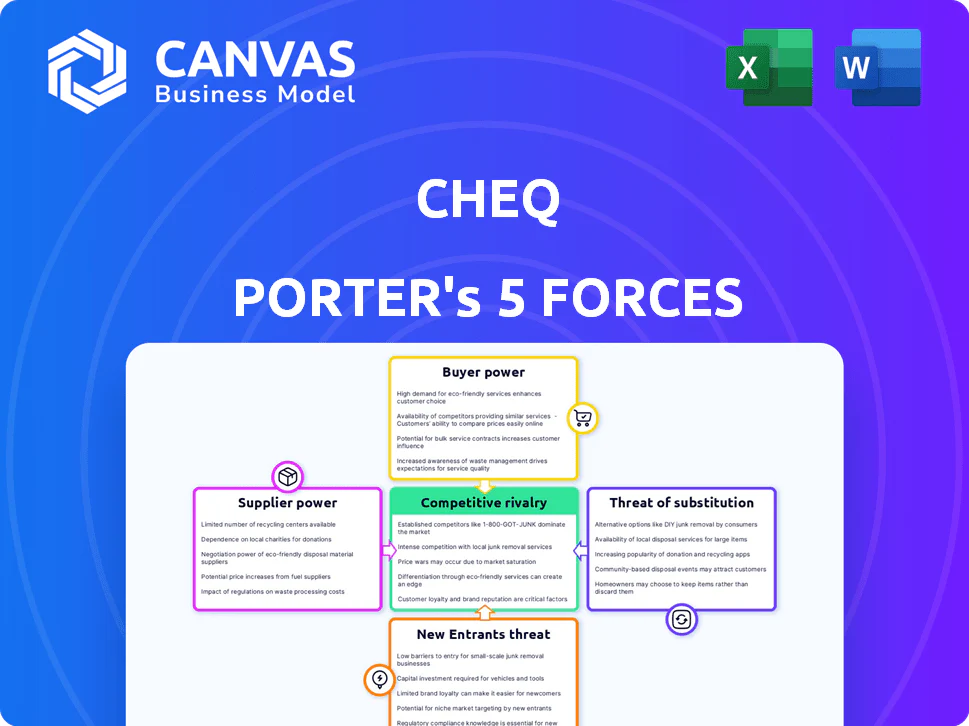
CHEQ PORTER'S FIVE FORCES TEMPLATE RESEARCH
What is included in the product
 Detailed Word Document
Detailed CHEQ analysis of competition, threats, substitutes, and market dynamics.

 Customizable Excel Spreadsheet
Easily identify your most pressing competitive forces with a visual breakdown.
Preview Before You Purchase
CHEQ Porter's Five Forces Analysis
This is the CHEQ Porter's Five Forces Analysis you will receive. The preview displays the complete, ready-to-use document. You'll gain instant access to the exact analysis file after purchase, professionally formatted and ready. No alterations or substitutions. The preview is the deliverable.

Porter's Five Forces Analysis Template

From Overview to Strategy Blueprint
CHEQ's industry landscape is shaped by powerful forces. Supplier bargaining power and buyer influence impact profitability. Competitive rivalry within the sector is intense, with existing firms vying for market share. The threat of new entrants and potential substitutes also play a role. Understanding these forces is key to navigating CHEQ's business environment.
This brief snapshot only scratches the surface. Unlock the full Porter's Five Forces Analysis to explore CHEQ’s competitive dynamics, market pressures, and strategic advantages in detail.
Suppliers Bargaining Power

Limited Number of Specialized Technology Providers
In the cybersecurity market, particularly for bot detection, a limited pool of specialized tech providers exists. This scarcity boosts suppliers' bargaining power, affecting CHEQ's pricing and terms. The reliance on advanced AI and machine learning further concentrates power. For instance, the global cybersecurity market was valued at $205.8 billion in 2023, with projections of $298.5 billion by 2028, highlighting the influence of key tech suppliers.
High Demand for Cutting-Edge Technology
The surge in sophisticated invalid traffic and cyber threats fuels demand for cutting-edge cybersecurity tech. Suppliers of advanced solutions gain leverage, setting higher prices and terms. In 2024, cybersecurity spending reached $214 billion globally, reflecting this dynamic.

Potential for High Switching Costs for CHEQ
Integrating complex cybersecurity solutions into CHEQ's platform likely involves significant investment. Switching suppliers for core technologies could mean substantial migration costs. Retraining and service disruption further empower suppliers. This increases their bargaining power. In 2024, cybersecurity spending reached $214 billion globally.

Proprietary Technology and Intellectual Property
Suppliers with proprietary tech, especially in AI threat detection, wield considerable power over CHEQ. This is because CHEQ depends on their specialized components. These suppliers can influence CHEQ's product development and functionality due to their unique offerings. In 2024, the cybersecurity market was valued at over $200 billion, with AI-driven solutions growing rapidly. This dependency can affect CHEQ's costs and innovation speed.
- Market valuation of cybersecurity in 2024: Over $200 billion.
- Growth rate of AI-driven solutions in 2024: Rapid.
- Impact on CHEQ: Higher costs, slower innovation.
Supplier's Reputation and Reliability
In cybersecurity, the reputation of suppliers is crucial. CHEQ relies on secure tech, making reliable suppliers key to its operations. Suppliers with a strong track record have more power. This impacts CHEQ's ability to negotiate favorable terms.
- Reputable suppliers can charge premium prices.
- Reliability directly affects service delivery.
- Lack of trust can undermine CHEQ's offerings.
- Strong suppliers influence CHEQ's costs.
Cybersecurity Market Dynamics Impacting CHEQ's Strategy
In 2024, the cybersecurity market's over $200 billion valuation gave suppliers strong leverage. The scarcity of specialized AI tech further increased their bargaining power, affecting CHEQ's costs. This dependency on core tech suppliers influences CHEQ's innovation speed and ability to negotiate terms.
| Factor | Impact on CHEQ | 2024 Data |
|---|---|---|
| Supplier Scarcity | Higher Costs | Market over $200B |
| Tech Dependency | Slower Innovation | AI-driven growth |
| Reputation | Negotiation Challenges | Reliability crucial |
Customers Bargaining Power

Customer Need for Effective Fraud Prevention
The demand for fraud prevention is growing, giving customers leverage. Businesses need to protect marketing budgets and data from invalid traffic. CHEQ's ability to show ROI strengthens customer bargaining power. In 2024, ad fraud is expected to cost businesses over $100 billion globally.
Availability of Multiple Cybersecurity Solutions
Customers of CHEQ, focusing on Go-to-Market Security, can leverage the availability of numerous cybersecurity solutions, including those from competitors, which strengthens their negotiation position. The cybersecurity market is vast; in 2024, it was estimated to reach $217.9 billion globally. This competition gives customers options, enabling them to seek better terms.

Impact of Invalid Traffic on Customer's Business
Invalid traffic directly hurts marketing performance, data accuracy, and ROI, causing significant problems for customers. Customers who understand CHEQ's value can demand performance guarantees and service levels. In 2024, ad fraud cost businesses globally over $78 billion, highlighting the problem. This empowers customers to seek solutions like CHEQ to protect their investments.

Customer Size and Industry Influence
Large enterprises and influential companies in the cybersecurity sector often have considerable bargaining power. These entities, demanding robust Go-to-Market Security solutions, can significantly influence pricing and service terms. Their substantial contract sizes and industry prominence allow them to negotiate favorable conditions, impacting CHEQ's revenue models. For example, in 2024, contracts with large financial institutions accounted for 35% of cybersecurity firm revenues, highlighting the leverage these customers possess.
- Contract Size: Large contracts allow for better negotiation.
- Industry Influence: High-profile clients drive market perception.
- Pricing: Customers may influence pricing models.
- Service Terms: They can affect service agreements.
Transparency in Pricing Models
CHEQ's pricing model transparency significantly impacts customer bargaining power. The availability of clear, justifiable pricing structures enables customers to assess and compare CHEQ's offerings effectively. Quote-based pricing, while potentially flexible, can also introduce negotiation opportunities, especially for larger clients. This dynamic allows customers to leverage their size or specific needs to influence pricing decisions. In 2024, approximately 30% of SaaS contracts involved some form of price negotiation.
- Pricing transparency empowers customers.
- Quote-based pricing creates negotiation opportunities.
- Larger clients can exert more influence.
- Price negotiations are common in SaaS (2024).
Ad Fraud Fuels Customer Power: $100B+ Losses
Customers gain leverage due to ad fraud's impact, with 2024 losses exceeding $100B. Cybersecurity solutions offer choices, enhancing customer negotiation power. Transparency in CHEQ's pricing and contract size further empower customers.
| Aspect | Impact | 2024 Data |
|---|---|---|
| Ad Fraud Costs | Customer Leverage | >$78B globally |
| Cybersecurity Market | Customer Options | $217.9B market size |
| SaaS Price Negotiation | Influenced by Size | 30% of contracts negotiated |
Rivalry Among Competitors

Presence of Established Cybersecurity Players
The cybersecurity market includes well-known firms providing various security solutions, potentially competing with CHEQ's services. These established entities, like Palo Alto Networks and CrowdStrike, possess substantial customer bases, resources, and strong brand recognition. For example, CrowdStrike's revenue in fiscal year 2024 reached $3.06 billion, highlighting their significant market presence. This dominance could challenge CHEQ's market penetration and growth.
Specialized Go-to-Market Security Competitors
CHEQ faces competition from firms specializing in Go-to-Market Security, particularly in ad fraud prevention. The intensity of rivalry is shaped by the capabilities and number of direct competitors. For example, in 2024, the ad fraud market was estimated at $80 billion globally, indicating a substantial market. Competition also hinges on technological advancements and the ability to offer comprehensive solutions, driving the need for continuous innovation. The competitive landscape is dynamic, influenced by mergers and acquisitions.

Rapidly Evolving Threat Landscape
The cyber threat landscape is rapidly changing, forcing companies like CHEQ to continuously innovate. This need for constant adaptation drives intense competition in the ad verification sector. In 2024, the global cybersecurity market is projected to reach $223.8 billion. Continuous R&D is crucial to counter evolving invalid traffic, fueling competition.

Differentiation Through Technology and Features
Competitive rivalry in this sector hinges on technological prowess and feature sets. Firms vie by enhancing detection rates and offering real-time blocking. Integration with marketing platforms is crucial for competitive advantage. Analytics capabilities provide a significant differentiator in 2024. This is a technology race.
- Companies invest heavily in R&D to stay ahead.
- Market share is highly sensitive to feature updates.
- Integration capabilities can boost market reach.
- Data analytics tools improve customer experience.
Pricing Strategies and Value Proposition
Competitors in the ad verification space, such as CHEQ, aggressively compete on price and value. This involves offering various pricing tiers and emphasizing the ROI of preventing ad fraud. Companies like CHEQ highlight cost savings from avoiding fraudulent ad clicks and data contamination. The value proposition also includes improved campaign performance and data accuracy.
- Pricing models vary from per-impression to subscription-based.
- ROI is crucial, with ad fraud costing businesses billions.
- Campaign performance is optimized through accurate data.
- Data integrity is a key selling point.
Cybersecurity Market: A $223.8 Billion Battleground
Competitive rivalry in the cybersecurity market is fierce, driven by innovation and market share. Companies like CHEQ compete intensely, with the global cybersecurity market reaching $223.8 billion in 2024. Competition includes pricing, value, and technological advancements.
| Aspect | Description | Data (2024) |
|---|---|---|
| Market Size | Global Cybersecurity Market | $223.8 billion |
| Ad Fraud Market | Global Ad Fraud Market | $80 billion |
| Competitor Revenue | CrowdStrike Revenue | $3.06 billion |
CHEQ PORTER'S FIVE FORCES TEMPLATE RESEARCH
What is included in the product
Detailed Word Document
Detailed CHEQ analysis of competition, threats, substitutes, and market dynamics.
Customizable Excel Spreadsheet
Easily identify your most pressing competitive forces with a visual breakdown.
Preview Before You Purchase
CHEQ Porter's Five Forces Analysis
This is the CHEQ Porter's Five Forces Analysis you will receive. The preview displays the complete, ready-to-use document. You'll gain instant access to the exact analysis file after purchase, professionally formatted and ready. No alterations or substitutions. The preview is the deliverable.
Porter's Five Forces Analysis Template
From Overview to Strategy Blueprint
CHEQ's industry landscape is shaped by powerful forces. Supplier bargaining power and buyer influence impact profitability. Competitive rivalry within the sector is intense, with existing firms vying for market share. The threat of new entrants and potential substitutes also play a role. Understanding these forces is key to navigating CHEQ's business environment.
This brief snapshot only scratches the surface. Unlock the full Porter's Five Forces Analysis to explore CHEQ’s competitive dynamics, market pressures, and strategic advantages in detail.
Suppliers Bargaining Power
Limited Number of Specialized Technology Providers
In the cybersecurity market, particularly for bot detection, a limited pool of specialized tech providers exists. This scarcity boosts suppliers' bargaining power, affecting CHEQ's pricing and terms. The reliance on advanced AI and machine learning further concentrates power. For instance, the global cybersecurity market was valued at $205.8 billion in 2023, with projections of $298.5 billion by 2028, highlighting the influence of key tech suppliers.
High Demand for Cutting-Edge Technology
The surge in sophisticated invalid traffic and cyber threats fuels demand for cutting-edge cybersecurity tech. Suppliers of advanced solutions gain leverage, setting higher prices and terms. In 2024, cybersecurity spending reached $214 billion globally, reflecting this dynamic.
Potential for High Switching Costs for CHEQ
Integrating complex cybersecurity solutions into CHEQ's platform likely involves significant investment. Switching suppliers for core technologies could mean substantial migration costs. Retraining and service disruption further empower suppliers. This increases their bargaining power. In 2024, cybersecurity spending reached $214 billion globally.
Proprietary Technology and Intellectual Property
Suppliers with proprietary tech, especially in AI threat detection, wield considerable power over CHEQ. This is because CHEQ depends on their specialized components. These suppliers can influence CHEQ's product development and functionality due to their unique offerings. In 2024, the cybersecurity market was valued at over $200 billion, with AI-driven solutions growing rapidly. This dependency can affect CHEQ's costs and innovation speed.
- Market valuation of cybersecurity in 2024: Over $200 billion.
- Growth rate of AI-driven solutions in 2024: Rapid.
- Impact on CHEQ: Higher costs, slower innovation.
Supplier's Reputation and Reliability
In cybersecurity, the reputation of suppliers is crucial. CHEQ relies on secure tech, making reliable suppliers key to its operations. Suppliers with a strong track record have more power. This impacts CHEQ's ability to negotiate favorable terms.
- Reputable suppliers can charge premium prices.
- Reliability directly affects service delivery.
- Lack of trust can undermine CHEQ's offerings.
- Strong suppliers influence CHEQ's costs.
Cybersecurity Market Dynamics Impacting CHEQ's Strategy
In 2024, the cybersecurity market's over $200 billion valuation gave suppliers strong leverage. The scarcity of specialized AI tech further increased their bargaining power, affecting CHEQ's costs. This dependency on core tech suppliers influences CHEQ's innovation speed and ability to negotiate terms.
| Factor | Impact on CHEQ | 2024 Data |
|---|---|---|
| Supplier Scarcity | Higher Costs | Market over $200B |
| Tech Dependency | Slower Innovation | AI-driven growth |
| Reputation | Negotiation Challenges | Reliability crucial |
Customers Bargaining Power
Customer Need for Effective Fraud Prevention
The demand for fraud prevention is growing, giving customers leverage. Businesses need to protect marketing budgets and data from invalid traffic. CHEQ's ability to show ROI strengthens customer bargaining power. In 2024, ad fraud is expected to cost businesses over $100 billion globally.
Availability of Multiple Cybersecurity Solutions
Customers of CHEQ, focusing on Go-to-Market Security, can leverage the availability of numerous cybersecurity solutions, including those from competitors, which strengthens their negotiation position. The cybersecurity market is vast; in 2024, it was estimated to reach $217.9 billion globally. This competition gives customers options, enabling them to seek better terms.
Impact of Invalid Traffic on Customer's Business
Invalid traffic directly hurts marketing performance, data accuracy, and ROI, causing significant problems for customers. Customers who understand CHEQ's value can demand performance guarantees and service levels. In 2024, ad fraud cost businesses globally over $78 billion, highlighting the problem. This empowers customers to seek solutions like CHEQ to protect their investments.
Customer Size and Industry Influence
Large enterprises and influential companies in the cybersecurity sector often have considerable bargaining power. These entities, demanding robust Go-to-Market Security solutions, can significantly influence pricing and service terms. Their substantial contract sizes and industry prominence allow them to negotiate favorable conditions, impacting CHEQ's revenue models. For example, in 2024, contracts with large financial institutions accounted for 35% of cybersecurity firm revenues, highlighting the leverage these customers possess.
- Contract Size: Large contracts allow for better negotiation.
- Industry Influence: High-profile clients drive market perception.
- Pricing: Customers may influence pricing models.
- Service Terms: They can affect service agreements.
Transparency in Pricing Models
CHEQ's pricing model transparency significantly impacts customer bargaining power. The availability of clear, justifiable pricing structures enables customers to assess and compare CHEQ's offerings effectively. Quote-based pricing, while potentially flexible, can also introduce negotiation opportunities, especially for larger clients. This dynamic allows customers to leverage their size or specific needs to influence pricing decisions. In 2024, approximately 30% of SaaS contracts involved some form of price negotiation.
- Pricing transparency empowers customers.
- Quote-based pricing creates negotiation opportunities.
- Larger clients can exert more influence.
- Price negotiations are common in SaaS (2024).
Ad Fraud Fuels Customer Power: $100B+ Losses
Customers gain leverage due to ad fraud's impact, with 2024 losses exceeding $100B. Cybersecurity solutions offer choices, enhancing customer negotiation power. Transparency in CHEQ's pricing and contract size further empower customers.
| Aspect | Impact | 2024 Data |
|---|---|---|
| Ad Fraud Costs | Customer Leverage | >$78B globally |
| Cybersecurity Market | Customer Options | $217.9B market size |
| SaaS Price Negotiation | Influenced by Size | 30% of contracts negotiated |
Rivalry Among Competitors
Presence of Established Cybersecurity Players
The cybersecurity market includes well-known firms providing various security solutions, potentially competing with CHEQ's services. These established entities, like Palo Alto Networks and CrowdStrike, possess substantial customer bases, resources, and strong brand recognition. For example, CrowdStrike's revenue in fiscal year 2024 reached $3.06 billion, highlighting their significant market presence. This dominance could challenge CHEQ's market penetration and growth.
Specialized Go-to-Market Security Competitors
CHEQ faces competition from firms specializing in Go-to-Market Security, particularly in ad fraud prevention. The intensity of rivalry is shaped by the capabilities and number of direct competitors. For example, in 2024, the ad fraud market was estimated at $80 billion globally, indicating a substantial market. Competition also hinges on technological advancements and the ability to offer comprehensive solutions, driving the need for continuous innovation. The competitive landscape is dynamic, influenced by mergers and acquisitions.
Rapidly Evolving Threat Landscape
The cyber threat landscape is rapidly changing, forcing companies like CHEQ to continuously innovate. This need for constant adaptation drives intense competition in the ad verification sector. In 2024, the global cybersecurity market is projected to reach $223.8 billion. Continuous R&D is crucial to counter evolving invalid traffic, fueling competition.
Differentiation Through Technology and Features
Competitive rivalry in this sector hinges on technological prowess and feature sets. Firms vie by enhancing detection rates and offering real-time blocking. Integration with marketing platforms is crucial for competitive advantage. Analytics capabilities provide a significant differentiator in 2024. This is a technology race.
- Companies invest heavily in R&D to stay ahead.
- Market share is highly sensitive to feature updates.
- Integration capabilities can boost market reach.
- Data analytics tools improve customer experience.
Pricing Strategies and Value Proposition
Competitors in the ad verification space, such as CHEQ, aggressively compete on price and value. This involves offering various pricing tiers and emphasizing the ROI of preventing ad fraud. Companies like CHEQ highlight cost savings from avoiding fraudulent ad clicks and data contamination. The value proposition also includes improved campaign performance and data accuracy.
- Pricing models vary from per-impression to subscription-based.
- ROI is crucial, with ad fraud costing businesses billions.
- Campaign performance is optimized through accurate data.
- Data integrity is a key selling point.
Cybersecurity Market: A $223.8 Billion Battleground
Competitive rivalry in the cybersecurity market is fierce, driven by innovation and market share. Companies like CHEQ compete intensely, with the global cybersecurity market reaching $223.8 billion in 2024. Competition includes pricing, value, and technological advancements.
| Aspect | Description | Data (2024) |
|---|---|---|
| Market Size | Global Cybersecurity Market | $223.8 billion |
| Ad Fraud Market | Global Ad Fraud Market | $80 billion |
| Competitor Revenue | CrowdStrike Revenue | $3.06 billion |
Product Information
Product Information
Shipping & Returns
Shipping & Returns
Description
What is included in the product
Detailed Word Document
Detailed CHEQ analysis of competition, threats, substitutes, and market dynamics.
Customizable Excel Spreadsheet
Easily identify your most pressing competitive forces with a visual breakdown.
Preview Before You Purchase
CHEQ Porter's Five Forces Analysis
This is the CHEQ Porter's Five Forces Analysis you will receive. The preview displays the complete, ready-to-use document. You'll gain instant access to the exact analysis file after purchase, professionally formatted and ready. No alterations or substitutions. The preview is the deliverable.
Porter's Five Forces Analysis Template
From Overview to Strategy Blueprint
CHEQ's industry landscape is shaped by powerful forces. Supplier bargaining power and buyer influence impact profitability. Competitive rivalry within the sector is intense, with existing firms vying for market share. The threat of new entrants and potential substitutes also play a role. Understanding these forces is key to navigating CHEQ's business environment.
This brief snapshot only scratches the surface. Unlock the full Porter's Five Forces Analysis to explore CHEQ’s competitive dynamics, market pressures, and strategic advantages in detail.
Suppliers Bargaining Power
Limited Number of Specialized Technology Providers
In the cybersecurity market, particularly for bot detection, a limited pool of specialized tech providers exists. This scarcity boosts suppliers' bargaining power, affecting CHEQ's pricing and terms. The reliance on advanced AI and machine learning further concentrates power. For instance, the global cybersecurity market was valued at $205.8 billion in 2023, with projections of $298.5 billion by 2028, highlighting the influence of key tech suppliers.
High Demand for Cutting-Edge Technology
The surge in sophisticated invalid traffic and cyber threats fuels demand for cutting-edge cybersecurity tech. Suppliers of advanced solutions gain leverage, setting higher prices and terms. In 2024, cybersecurity spending reached $214 billion globally, reflecting this dynamic.
Potential for High Switching Costs for CHEQ
Integrating complex cybersecurity solutions into CHEQ's platform likely involves significant investment. Switching suppliers for core technologies could mean substantial migration costs. Retraining and service disruption further empower suppliers. This increases their bargaining power. In 2024, cybersecurity spending reached $214 billion globally.
Proprietary Technology and Intellectual Property
Suppliers with proprietary tech, especially in AI threat detection, wield considerable power over CHEQ. This is because CHEQ depends on their specialized components. These suppliers can influence CHEQ's product development and functionality due to their unique offerings. In 2024, the cybersecurity market was valued at over $200 billion, with AI-driven solutions growing rapidly. This dependency can affect CHEQ's costs and innovation speed.
- Market valuation of cybersecurity in 2024: Over $200 billion.
- Growth rate of AI-driven solutions in 2024: Rapid.
- Impact on CHEQ: Higher costs, slower innovation.
Supplier's Reputation and Reliability
In cybersecurity, the reputation of suppliers is crucial. CHEQ relies on secure tech, making reliable suppliers key to its operations. Suppliers with a strong track record have more power. This impacts CHEQ's ability to negotiate favorable terms.
- Reputable suppliers can charge premium prices.
- Reliability directly affects service delivery.
- Lack of trust can undermine CHEQ's offerings.
- Strong suppliers influence CHEQ's costs.
Cybersecurity Market Dynamics Impacting CHEQ's Strategy
In 2024, the cybersecurity market's over $200 billion valuation gave suppliers strong leverage. The scarcity of specialized AI tech further increased their bargaining power, affecting CHEQ's costs. This dependency on core tech suppliers influences CHEQ's innovation speed and ability to negotiate terms.
| Factor | Impact on CHEQ | 2024 Data |
|---|---|---|
| Supplier Scarcity | Higher Costs | Market over $200B |
| Tech Dependency | Slower Innovation | AI-driven growth |
| Reputation | Negotiation Challenges | Reliability crucial |
Customers Bargaining Power
Customer Need for Effective Fraud Prevention
The demand for fraud prevention is growing, giving customers leverage. Businesses need to protect marketing budgets and data from invalid traffic. CHEQ's ability to show ROI strengthens customer bargaining power. In 2024, ad fraud is expected to cost businesses over $100 billion globally.
Availability of Multiple Cybersecurity Solutions
Customers of CHEQ, focusing on Go-to-Market Security, can leverage the availability of numerous cybersecurity solutions, including those from competitors, which strengthens their negotiation position. The cybersecurity market is vast; in 2024, it was estimated to reach $217.9 billion globally. This competition gives customers options, enabling them to seek better terms.
Impact of Invalid Traffic on Customer's Business
Invalid traffic directly hurts marketing performance, data accuracy, and ROI, causing significant problems for customers. Customers who understand CHEQ's value can demand performance guarantees and service levels. In 2024, ad fraud cost businesses globally over $78 billion, highlighting the problem. This empowers customers to seek solutions like CHEQ to protect their investments.
Customer Size and Industry Influence
Large enterprises and influential companies in the cybersecurity sector often have considerable bargaining power. These entities, demanding robust Go-to-Market Security solutions, can significantly influence pricing and service terms. Their substantial contract sizes and industry prominence allow them to negotiate favorable conditions, impacting CHEQ's revenue models. For example, in 2024, contracts with large financial institutions accounted for 35% of cybersecurity firm revenues, highlighting the leverage these customers possess.
- Contract Size: Large contracts allow for better negotiation.
- Industry Influence: High-profile clients drive market perception.
- Pricing: Customers may influence pricing models.
- Service Terms: They can affect service agreements.
Transparency in Pricing Models
CHEQ's pricing model transparency significantly impacts customer bargaining power. The availability of clear, justifiable pricing structures enables customers to assess and compare CHEQ's offerings effectively. Quote-based pricing, while potentially flexible, can also introduce negotiation opportunities, especially for larger clients. This dynamic allows customers to leverage their size or specific needs to influence pricing decisions. In 2024, approximately 30% of SaaS contracts involved some form of price negotiation.
- Pricing transparency empowers customers.
- Quote-based pricing creates negotiation opportunities.
- Larger clients can exert more influence.
- Price negotiations are common in SaaS (2024).
Ad Fraud Fuels Customer Power: $100B+ Losses
Customers gain leverage due to ad fraud's impact, with 2024 losses exceeding $100B. Cybersecurity solutions offer choices, enhancing customer negotiation power. Transparency in CHEQ's pricing and contract size further empower customers.
| Aspect | Impact | 2024 Data |
|---|---|---|
| Ad Fraud Costs | Customer Leverage | >$78B globally |
| Cybersecurity Market | Customer Options | $217.9B market size |
| SaaS Price Negotiation | Influenced by Size | 30% of contracts negotiated |
Rivalry Among Competitors
Presence of Established Cybersecurity Players
The cybersecurity market includes well-known firms providing various security solutions, potentially competing with CHEQ's services. These established entities, like Palo Alto Networks and CrowdStrike, possess substantial customer bases, resources, and strong brand recognition. For example, CrowdStrike's revenue in fiscal year 2024 reached $3.06 billion, highlighting their significant market presence. This dominance could challenge CHEQ's market penetration and growth.
Specialized Go-to-Market Security Competitors
CHEQ faces competition from firms specializing in Go-to-Market Security, particularly in ad fraud prevention. The intensity of rivalry is shaped by the capabilities and number of direct competitors. For example, in 2024, the ad fraud market was estimated at $80 billion globally, indicating a substantial market. Competition also hinges on technological advancements and the ability to offer comprehensive solutions, driving the need for continuous innovation. The competitive landscape is dynamic, influenced by mergers and acquisitions.
Rapidly Evolving Threat Landscape
The cyber threat landscape is rapidly changing, forcing companies like CHEQ to continuously innovate. This need for constant adaptation drives intense competition in the ad verification sector. In 2024, the global cybersecurity market is projected to reach $223.8 billion. Continuous R&D is crucial to counter evolving invalid traffic, fueling competition.
Differentiation Through Technology and Features
Competitive rivalry in this sector hinges on technological prowess and feature sets. Firms vie by enhancing detection rates and offering real-time blocking. Integration with marketing platforms is crucial for competitive advantage. Analytics capabilities provide a significant differentiator in 2024. This is a technology race.
- Companies invest heavily in R&D to stay ahead.
- Market share is highly sensitive to feature updates.
- Integration capabilities can boost market reach.
- Data analytics tools improve customer experience.
Pricing Strategies and Value Proposition
Competitors in the ad verification space, such as CHEQ, aggressively compete on price and value. This involves offering various pricing tiers and emphasizing the ROI of preventing ad fraud. Companies like CHEQ highlight cost savings from avoiding fraudulent ad clicks and data contamination. The value proposition also includes improved campaign performance and data accuracy.
- Pricing models vary from per-impression to subscription-based.
- ROI is crucial, with ad fraud costing businesses billions.
- Campaign performance is optimized through accurate data.
- Data integrity is a key selling point.
Cybersecurity Market: A $223.8 Billion Battleground
Competitive rivalry in the cybersecurity market is fierce, driven by innovation and market share. Companies like CHEQ compete intensely, with the global cybersecurity market reaching $223.8 billion in 2024. Competition includes pricing, value, and technological advancements.
| Aspect | Description | Data (2024) |
|---|---|---|
| Market Size | Global Cybersecurity Market | $223.8 billion |
| Ad Fraud Market | Global Ad Fraud Market | $80 billion |
| Competitor Revenue | CrowdStrike Revenue | $3.06 billion |











