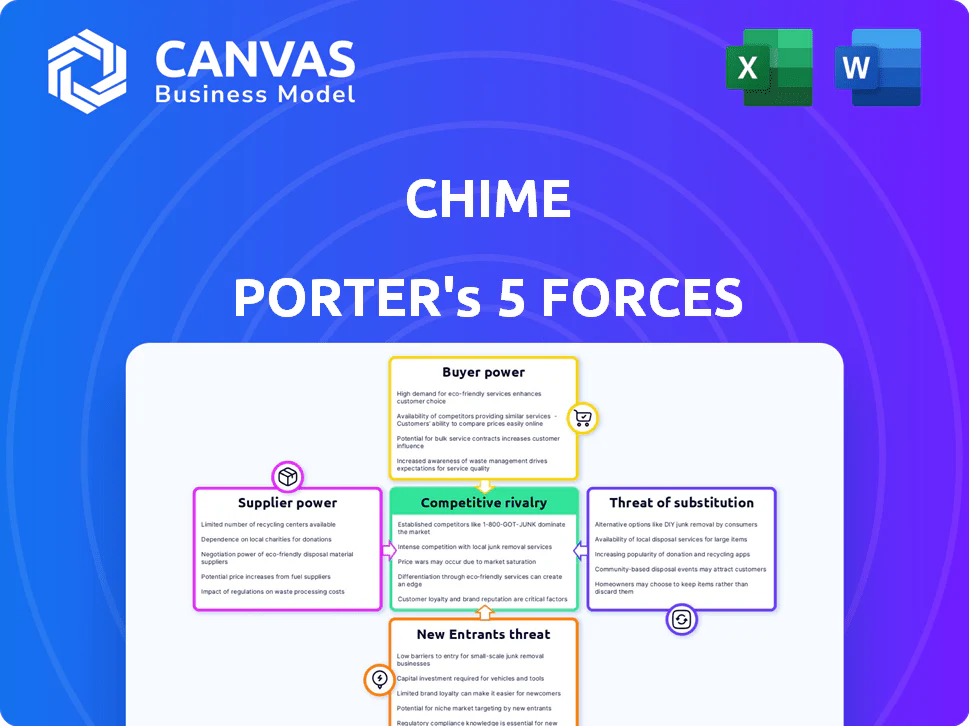
CHIME PORTER'S FIVE FORCES TEMPLATE RESEARCH

Go Beyond the Preview-Access the Full Strategic Report
Chime faces intense buyer power and low switching costs but benefits from strong brand momentum and scalable tech that blunt supplier leverage; new entrant threat is moderate while substitutes and regulatory shifts pose real risks-this snapshot only scratches the surface. Unlock the full Porter's Five Forces Analysis to explore Chime's competitive dynamics, market pressures, and strategic advantages in detail.
Suppliers Bargaining Power

Partner Bank Dependency
Chime depends on partner banks-The Bancorp Bank and Stride Bank-to hold ~$20B in customer deposits (2025) and provide the banking rails; without a charter as of early 2026, partners control account custody and compliance.
If a partner raises fees or tightens underwriting-e.g., a 10-50 bps fee hike-Chime's 2025 net margin (~2.5%) would be materially squeezed, risking profitability.
Payment Network Dominance
Chime relies on interchange fees for ~60% of revenue in FY2025, so Visa and Mastercard-who set processing rules and interchange rates-wield strong supplier power.
These networks capped Chime's negotiability: industry-average interchange fees were ~1.4% in 2025, leaving Chime little leverage to raise margins.

Cloud Infrastructure Costs
Chime runs fully on cloud platforms like Amazon Web Services (AWS), meaning AWS gains pricing leverage since switching costs-data migration, re-architecting, and compliance-are high; in 2025 AWS accounted for over 60% of U.S. cloud IaaS market and typical exit costs can exceed tens of millions for scale players like Chime.

Compliance and KYC Vendors
Chime depends on specialized AML/KYC vendors (e.g., identity verification, transaction monitoring) to meet regulatory standards; a 2025 industry estimate shows banks spend ~0.5-1.5% of revenue on compliance, so vendor fees materially affect Chime's operating costs.
Regulatory fines for lapses can exceed $100M; that tail risk gives vendors leverage over pricing, SLAs, and data access, increasing Chime's supplier bargaining power exposure.
- Third-party reliance raises ops costs (0.5-1.5% revenue)
- Single-vendor failure risk → potential $100M+ fines
- Vendors control pricing, SLAs, data terms
Specialized Fintech Talent
Chime faces strong supplier (talent) bargaining power in 2026: fintech engineers and product managers with mobile-payments and regulatory experience are scarce, and Chime competes with JPMorgan, Goldman Sachs, Stripe, and Plaid for the same hires.
High demand lifts salaries-senior fintech engineers average $220k-$280k total comp in 2025-2026, up ~12% YoY-pushing Chime's hiring costs and R&D spend higher.
Retention pressure forces sign-on bonuses and equity-rich packages, increasing fixed labor burn and raising break-even customer-acquisition costs.
- Senior fintech engineer comp: $220k-$280k (2025-26)
- YoY salary growth ~12% (2025-26)
- Competitors: JPMorgan, Goldman Sachs, Stripe, Plaid
- Higher hiring costs → raised CAC and R&D burn
Suppliers Wield Heavy Leverage: Banks, Interchange, AWS & Talent Drive Costs
Suppliers exert strong power: partner banks hold ~$20B deposits (2025) and control custody; interchange (≈60% revenue) faces industry-average ~1.4% fees (2025); AWS dominates cloud (>60% U.S. IaaS, 2025) with high exit costs; AML/KYC vendors and talent (senior fintech comp $220k-$280k in 2025-26) raise ops and hiring costs.
| Supplier | 2025-26 Fact |
|---|---|
| Partner banks | $20B deposits (2025) |
| Interchange | ≈60% revenue; avg 1.4% (2025) |
| AWS | >60% U.S. IaaS (2025) |
| Talent | Senior comp $220k-$280k (2025-26) |
What is included in the product
 Detailed Word Document
Tailored Porter's Five Forces analysis of Chime that uncovers competitive drivers, customer bargaining power, and entry barriers, highlighting disruptive threats and substitute pressures on its digital banking model.

 Customizable Excel Spreadsheet
One-sheet Porter's Five Forces for Chime-quickly spot weakening competitive threats and identify low-cost defensive moves to protect margins.
Customers Bargaining Power

Low Switching Costs
Customers can open or close a Chime digital account in minutes, and with U.S. neobank churn rates reported around 25% annualized in 2025, funds move fast to rivals like Monzo or Revolut.
High Price Sensitivity
Chime's core users-56% reporting income under $50k in a 2025 survey-are highly fee-sensitive; introducing monthly maintenance fees or cutting the $200 fee-free overdraft (SpotMe) would likely push users to free alternatives like Varo or Cash App, limiting Chime's ability to earn $1-2 monthly per user via traditional fees without risking attrition.

Information Transparency
In 2026, comparison sites and social channels show customers rates and features instantly-search traffic to fintech review sites rose 24% YoY-so users can compare Chime's 0.50% savings APY, early direct deposit timing, and credit-builder tools against rivals in seconds.

Direct Deposit Stickiness
Direct deposit creates stickiness for Chime: 62% of active accounts had direct deposit in FY2025, and users with payroll linked used Two-Day Early Pay at a 3.4x higher retention rate, raising switching friction despite easy app-based account openings.
Chime emphasizes payroll onboarding to lower customer bargaining power, reducing voluntary churn by ~1.8 percentage points and increasing average deposits per direct-deposit account to $3,200 monthly in 2025.
- 62% of accounts had direct deposit (FY2025)
- 2x-3.4x higher retention with Two-Day Early Pay
- Churn cut ~1.8 ppt via payroll linkage
- Avg deposits per DD account: $3,200/mo (2025)
Demand for Integrated Services
Modern consumers expect a single app for credit-building, automated savings, and micro-investing, forcing Chime to widen its product roadmap while keeping operating costs low.
In 2025 Chime reported R&D and product development pressure as active users rose to ~20 million, increasing feature demands and pushing estimated per-user R&D spend toward $18-$25 annually.
This customer expectation acts as bargaining power by directing Chime's R&D allocation and prioritization, limiting pricing power and compressing margins.
- 20M active users (2025)
- R&D pressure: ~$18-$25 per user/year
- Must add credit, savings, investing features
- Limits pricing and compresses margins
Chime: 20M users, high churn but DD stickiness forces low fees and heavy R&D
Customers hold high bargaining power: 25% neobank churn (2025), 62% of Chime accounts had direct deposit (FY2025) boosting stickiness, avg deposits per DD account $3,200/mo, ~20M active users, and R&D spend ~$18-$25/user-forcing Chime to keep fees low while expanding features.
| Metric | 2025 |
|---|---|
| Neobank churn | 25% |
| Direct deposit | 62% |
| Avg deposits per DD acct | $3,200/mo |
| Active users | 20M |
| R&D/user | $18-$25/yr |
What You See Is What You Get
Chime Porter's Five Forces Analysis
This preview shows the exact Chime Porter's Five Forces analysis you'll receive immediately after purchase-no mockups, no placeholders, fully formatted and ready to download.

CHIME PORTER'S FIVE FORCES TEMPLATE RESEARCH
Go Beyond the Preview-Access the Full Strategic Report
Chime faces intense buyer power and low switching costs but benefits from strong brand momentum and scalable tech that blunt supplier leverage; new entrant threat is moderate while substitutes and regulatory shifts pose real risks-this snapshot only scratches the surface. Unlock the full Porter's Five Forces Analysis to explore Chime's competitive dynamics, market pressures, and strategic advantages in detail.
Suppliers Bargaining Power
Partner Bank Dependency
Chime depends on partner banks-The Bancorp Bank and Stride Bank-to hold ~$20B in customer deposits (2025) and provide the banking rails; without a charter as of early 2026, partners control account custody and compliance.
If a partner raises fees or tightens underwriting-e.g., a 10-50 bps fee hike-Chime's 2025 net margin (~2.5%) would be materially squeezed, risking profitability.
Payment Network Dominance
Chime relies on interchange fees for ~60% of revenue in FY2025, so Visa and Mastercard-who set processing rules and interchange rates-wield strong supplier power.
These networks capped Chime's negotiability: industry-average interchange fees were ~1.4% in 2025, leaving Chime little leverage to raise margins.
Cloud Infrastructure Costs
Chime runs fully on cloud platforms like Amazon Web Services (AWS), meaning AWS gains pricing leverage since switching costs-data migration, re-architecting, and compliance-are high; in 2025 AWS accounted for over 60% of U.S. cloud IaaS market and typical exit costs can exceed tens of millions for scale players like Chime.
Compliance and KYC Vendors
Chime depends on specialized AML/KYC vendors (e.g., identity verification, transaction monitoring) to meet regulatory standards; a 2025 industry estimate shows banks spend ~0.5-1.5% of revenue on compliance, so vendor fees materially affect Chime's operating costs.
Regulatory fines for lapses can exceed $100M; that tail risk gives vendors leverage over pricing, SLAs, and data access, increasing Chime's supplier bargaining power exposure.
- Third-party reliance raises ops costs (0.5-1.5% revenue)
- Single-vendor failure risk → potential $100M+ fines
- Vendors control pricing, SLAs, data terms
Specialized Fintech Talent
Chime faces strong supplier (talent) bargaining power in 2026: fintech engineers and product managers with mobile-payments and regulatory experience are scarce, and Chime competes with JPMorgan, Goldman Sachs, Stripe, and Plaid for the same hires.
High demand lifts salaries-senior fintech engineers average $220k-$280k total comp in 2025-2026, up ~12% YoY-pushing Chime's hiring costs and R&D spend higher.
Retention pressure forces sign-on bonuses and equity-rich packages, increasing fixed labor burn and raising break-even customer-acquisition costs.
- Senior fintech engineer comp: $220k-$280k (2025-26)
- YoY salary growth ~12% (2025-26)
- Competitors: JPMorgan, Goldman Sachs, Stripe, Plaid
- Higher hiring costs → raised CAC and R&D burn
Suppliers Wield Heavy Leverage: Banks, Interchange, AWS & Talent Drive Costs
Suppliers exert strong power: partner banks hold ~$20B deposits (2025) and control custody; interchange (≈60% revenue) faces industry-average ~1.4% fees (2025); AWS dominates cloud (>60% U.S. IaaS, 2025) with high exit costs; AML/KYC vendors and talent (senior fintech comp $220k-$280k in 2025-26) raise ops and hiring costs.
| Supplier | 2025-26 Fact |
|---|---|
| Partner banks | $20B deposits (2025) |
| Interchange | ≈60% revenue; avg 1.4% (2025) |
| AWS | >60% U.S. IaaS (2025) |
| Talent | Senior comp $220k-$280k (2025-26) |
What is included in the product
Detailed Word Document
Tailored Porter's Five Forces analysis of Chime that uncovers competitive drivers, customer bargaining power, and entry barriers, highlighting disruptive threats and substitute pressures on its digital banking model.
Customizable Excel Spreadsheet
One-sheet Porter's Five Forces for Chime-quickly spot weakening competitive threats and identify low-cost defensive moves to protect margins.
Customers Bargaining Power
Low Switching Costs
Customers can open or close a Chime digital account in minutes, and with U.S. neobank churn rates reported around 25% annualized in 2025, funds move fast to rivals like Monzo or Revolut.
High Price Sensitivity
Chime's core users-56% reporting income under $50k in a 2025 survey-are highly fee-sensitive; introducing monthly maintenance fees or cutting the $200 fee-free overdraft (SpotMe) would likely push users to free alternatives like Varo or Cash App, limiting Chime's ability to earn $1-2 monthly per user via traditional fees without risking attrition.
Information Transparency
In 2026, comparison sites and social channels show customers rates and features instantly-search traffic to fintech review sites rose 24% YoY-so users can compare Chime's 0.50% savings APY, early direct deposit timing, and credit-builder tools against rivals in seconds.
Direct Deposit Stickiness
Direct deposit creates stickiness for Chime: 62% of active accounts had direct deposit in FY2025, and users with payroll linked used Two-Day Early Pay at a 3.4x higher retention rate, raising switching friction despite easy app-based account openings.
Chime emphasizes payroll onboarding to lower customer bargaining power, reducing voluntary churn by ~1.8 percentage points and increasing average deposits per direct-deposit account to $3,200 monthly in 2025.
- 62% of accounts had direct deposit (FY2025)
- 2x-3.4x higher retention with Two-Day Early Pay
- Churn cut ~1.8 ppt via payroll linkage
- Avg deposits per DD account: $3,200/mo (2025)
Demand for Integrated Services
Modern consumers expect a single app for credit-building, automated savings, and micro-investing, forcing Chime to widen its product roadmap while keeping operating costs low.
In 2025 Chime reported R&D and product development pressure as active users rose to ~20 million, increasing feature demands and pushing estimated per-user R&D spend toward $18-$25 annually.
This customer expectation acts as bargaining power by directing Chime's R&D allocation and prioritization, limiting pricing power and compressing margins.
- 20M active users (2025)
- R&D pressure: ~$18-$25 per user/year
- Must add credit, savings, investing features
- Limits pricing and compresses margins
Chime: 20M users, high churn but DD stickiness forces low fees and heavy R&D
Customers hold high bargaining power: 25% neobank churn (2025), 62% of Chime accounts had direct deposit (FY2025) boosting stickiness, avg deposits per DD account $3,200/mo, ~20M active users, and R&D spend ~$18-$25/user-forcing Chime to keep fees low while expanding features.
| Metric | 2025 |
|---|---|
| Neobank churn | 25% |
| Direct deposit | 62% |
| Avg deposits per DD acct | $3,200/mo |
| Active users | 20M |
| R&D/user | $18-$25/yr |
What You See Is What You Get
Chime Porter's Five Forces Analysis
This preview shows the exact Chime Porter's Five Forces analysis you'll receive immediately after purchase-no mockups, no placeholders, fully formatted and ready to download.
Product Information
Product Information
Shipping & Returns
Shipping & Returns
Description
Go Beyond the Preview-Access the Full Strategic Report
Chime faces intense buyer power and low switching costs but benefits from strong brand momentum and scalable tech that blunt supplier leverage; new entrant threat is moderate while substitutes and regulatory shifts pose real risks-this snapshot only scratches the surface. Unlock the full Porter's Five Forces Analysis to explore Chime's competitive dynamics, market pressures, and strategic advantages in detail.
Suppliers Bargaining Power
Partner Bank Dependency
Chime depends on partner banks-The Bancorp Bank and Stride Bank-to hold ~$20B in customer deposits (2025) and provide the banking rails; without a charter as of early 2026, partners control account custody and compliance.
If a partner raises fees or tightens underwriting-e.g., a 10-50 bps fee hike-Chime's 2025 net margin (~2.5%) would be materially squeezed, risking profitability.
Payment Network Dominance
Chime relies on interchange fees for ~60% of revenue in FY2025, so Visa and Mastercard-who set processing rules and interchange rates-wield strong supplier power.
These networks capped Chime's negotiability: industry-average interchange fees were ~1.4% in 2025, leaving Chime little leverage to raise margins.
Cloud Infrastructure Costs
Chime runs fully on cloud platforms like Amazon Web Services (AWS), meaning AWS gains pricing leverage since switching costs-data migration, re-architecting, and compliance-are high; in 2025 AWS accounted for over 60% of U.S. cloud IaaS market and typical exit costs can exceed tens of millions for scale players like Chime.
Compliance and KYC Vendors
Chime depends on specialized AML/KYC vendors (e.g., identity verification, transaction monitoring) to meet regulatory standards; a 2025 industry estimate shows banks spend ~0.5-1.5% of revenue on compliance, so vendor fees materially affect Chime's operating costs.
Regulatory fines for lapses can exceed $100M; that tail risk gives vendors leverage over pricing, SLAs, and data access, increasing Chime's supplier bargaining power exposure.
- Third-party reliance raises ops costs (0.5-1.5% revenue)
- Single-vendor failure risk → potential $100M+ fines
- Vendors control pricing, SLAs, data terms
Specialized Fintech Talent
Chime faces strong supplier (talent) bargaining power in 2026: fintech engineers and product managers with mobile-payments and regulatory experience are scarce, and Chime competes with JPMorgan, Goldman Sachs, Stripe, and Plaid for the same hires.
High demand lifts salaries-senior fintech engineers average $220k-$280k total comp in 2025-2026, up ~12% YoY-pushing Chime's hiring costs and R&D spend higher.
Retention pressure forces sign-on bonuses and equity-rich packages, increasing fixed labor burn and raising break-even customer-acquisition costs.
- Senior fintech engineer comp: $220k-$280k (2025-26)
- YoY salary growth ~12% (2025-26)
- Competitors: JPMorgan, Goldman Sachs, Stripe, Plaid
- Higher hiring costs → raised CAC and R&D burn
Suppliers Wield Heavy Leverage: Banks, Interchange, AWS & Talent Drive Costs
Suppliers exert strong power: partner banks hold ~$20B deposits (2025) and control custody; interchange (≈60% revenue) faces industry-average ~1.4% fees (2025); AWS dominates cloud (>60% U.S. IaaS, 2025) with high exit costs; AML/KYC vendors and talent (senior fintech comp $220k-$280k in 2025-26) raise ops and hiring costs.
| Supplier | 2025-26 Fact |
|---|---|
| Partner banks | $20B deposits (2025) |
| Interchange | ≈60% revenue; avg 1.4% (2025) |
| AWS | >60% U.S. IaaS (2025) |
| Talent | Senior comp $220k-$280k (2025-26) |
What is included in the product
Detailed Word Document
Tailored Porter's Five Forces analysis of Chime that uncovers competitive drivers, customer bargaining power, and entry barriers, highlighting disruptive threats and substitute pressures on its digital banking model.
Customizable Excel Spreadsheet
One-sheet Porter's Five Forces for Chime-quickly spot weakening competitive threats and identify low-cost defensive moves to protect margins.
Customers Bargaining Power
Low Switching Costs
Customers can open or close a Chime digital account in minutes, and with U.S. neobank churn rates reported around 25% annualized in 2025, funds move fast to rivals like Monzo or Revolut.
High Price Sensitivity
Chime's core users-56% reporting income under $50k in a 2025 survey-are highly fee-sensitive; introducing monthly maintenance fees or cutting the $200 fee-free overdraft (SpotMe) would likely push users to free alternatives like Varo or Cash App, limiting Chime's ability to earn $1-2 monthly per user via traditional fees without risking attrition.
Information Transparency
In 2026, comparison sites and social channels show customers rates and features instantly-search traffic to fintech review sites rose 24% YoY-so users can compare Chime's 0.50% savings APY, early direct deposit timing, and credit-builder tools against rivals in seconds.
Direct Deposit Stickiness
Direct deposit creates stickiness for Chime: 62% of active accounts had direct deposit in FY2025, and users with payroll linked used Two-Day Early Pay at a 3.4x higher retention rate, raising switching friction despite easy app-based account openings.
Chime emphasizes payroll onboarding to lower customer bargaining power, reducing voluntary churn by ~1.8 percentage points and increasing average deposits per direct-deposit account to $3,200 monthly in 2025.
- 62% of accounts had direct deposit (FY2025)
- 2x-3.4x higher retention with Two-Day Early Pay
- Churn cut ~1.8 ppt via payroll linkage
- Avg deposits per DD account: $3,200/mo (2025)
Demand for Integrated Services
Modern consumers expect a single app for credit-building, automated savings, and micro-investing, forcing Chime to widen its product roadmap while keeping operating costs low.
In 2025 Chime reported R&D and product development pressure as active users rose to ~20 million, increasing feature demands and pushing estimated per-user R&D spend toward $18-$25 annually.
This customer expectation acts as bargaining power by directing Chime's R&D allocation and prioritization, limiting pricing power and compressing margins.
- 20M active users (2025)
- R&D pressure: ~$18-$25 per user/year
- Must add credit, savings, investing features
- Limits pricing and compresses margins
Chime: 20M users, high churn but DD stickiness forces low fees and heavy R&D
Customers hold high bargaining power: 25% neobank churn (2025), 62% of Chime accounts had direct deposit (FY2025) boosting stickiness, avg deposits per DD account $3,200/mo, ~20M active users, and R&D spend ~$18-$25/user-forcing Chime to keep fees low while expanding features.
| Metric | 2025 |
|---|---|
| Neobank churn | 25% |
| Direct deposit | 62% |
| Avg deposits per DD acct | $3,200/mo |
| Active users | 20M |
| R&D/user | $18-$25/yr |
What You See Is What You Get
Chime Porter's Five Forces Analysis
This preview shows the exact Chime Porter's Five Forces analysis you'll receive immediately after purchase-no mockups, no placeholders, fully formatted and ready to download.











