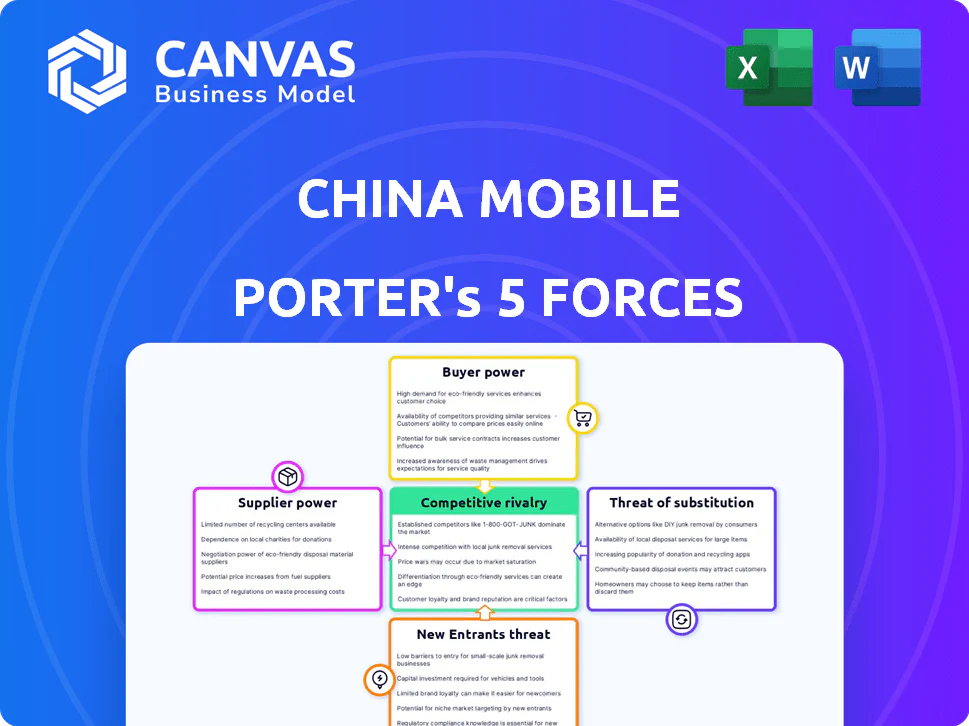
CHINA MOBILE PORTER'S FIVE FORCES TEMPLATE RESEARCH

A Must-Have Tool for Decision-Makers
China Mobile benefits from scale, strong network effects, and government-linked advantages, but faces intense regulatory oversight, rising competition from China Telecom/Unicom and tech OTT players, and evolving substitute threats like private 5G and cloud services; this snapshot highlights key pressures and strategic levers. Unlock the full Porter's Five Forces Analysis to explore force-by-force ratings, visuals, and actionable implications for investment or strategy.
Suppliers Bargaining Power

Concentrated Vendor Base
China Mobile faces moderate-high supplier power: Huawei and ZTE supply core 5G-Advanced gear and early 6G research, and together accounted for an estimated 70-80% of domestic RAN contracts in 2025, limiting alternative vendors for networks serving 1.1 billion+ mobile subscribers.
Semiconductor Dependency
Despite China Mobile's 2025 capex of RMB 198.6 billion for networks and cloud, high-end telecom and AI chips still flow through global suppliers; only a handful (e.g., NVIDIA, Broadcom, Qualcomm) meet performance needs for its massive cloud and MEC (multi-access edge compute) platforms.
These suppliers wield pricing power: a 2025 industry shortage pushed premium ASIC/NPU prices up ~15-22%, forcing China Mobile to absorb higher costs or slow AI rollouts for its 450+ million 5G subscriptions and growing cloud revenue.

Energy Provider Leverage
As China Mobile expands 5G and data centers, reliance on state-owned power utilities gives suppliers strong leverage; in FY2025 China Mobile reported ~RMB 180 billion in network energy-related operating costs, with data center power usage up 22% year-over-year.

Operating System Control
China Mobile's dependence on major OS providers like Huawei's HarmonyOS and Google's Android matters as it scales handset and IoT services; in 2025 China Mobile handled 980 million+ mobile subscribers, so OS shifts affect a huge base.
If OS licensing or architecture changes, service costs and rollout speed can rise-HarmonyOS had ~250 million devices in China by 2024; Android remains dominant globally, so supplier moves can bite margins and UX.
- 980M+ subscribers (2025)
- HarmonyOS ~250M devices (2024)
- OS change → higher licensing/compatibility costs
Spectrum Allocation Control
Government control of spectrum through the Ministry of Industry and Information Technology (MIIT) makes it the effective supplier, determining which frequencies China Mobile can use and at what price, directly shaping network capacity.
MIIT's 2025 auctions allocated 100 MHz of mid-band spectrum to carriers; China Mobile's capital plans reflect this, with RMB 45 billion budgeted for 2025 network expansion tied to those bands.
- MIIT controls spectrum supply and pricing
- 2025: 100 MHz mid-band allocated
- China Mobile 2025 capex ≈ RMB 45 billion linked to spectrum
- Strategy must follow government release schedule
Huawei/ZTE Dominance, Rising ASIC Costs & RMB198.6B Capex Strain China Mobile
Suppliers exert moderate-high power: Huawei/ZTE held ~70-80% domestic RAN share (2025); China Mobile 2025 capex RMB 198.6B, RMB 45B tied to spectrum; premium ASIC/NPU prices rose ~15-22% in 2025; network energy costs ≈RMB 180B; 980M+ subscribers amplify impact.
| Metric | 2025 value |
|---|---|
| RAN share (Huawei+ZTE) | 70-80% |
| Capex | RMB 198.6B |
| Spectrum-linked capex | RMB 45B |
| ASIC/NPU price rise | 15-22% |
| Network energy costs | RMB 180B |
| Subscribers | 980M+ |
What is included in the product
 Detailed Word Document
Tailored exclusively for China Mobile, this Porter's Five Forces overview pinpoints competitive intensity, buyer/supplier leverage, entry barriers, and substitute threats, highlighting regulatory protection, scale advantages, and emerging disruptive technologies impacting pricing and long-term profitability.

 Customizable Excel Spreadsheet
A concise Porter's Five Forces snapshot for China Mobile-ready to drop into decks to clarify competitive intensity and regulatory risk at a glance.
Customers Bargaining Power

High Individual Price Sensitivity
With China's mobile penetration at about 111% in 2025, individual subscribers exert high price pressure-basic voice/data are commoditized so customers chase promotions and bundles, pushing China Mobile to refresh offers; its 2025 ARPU fell to RMB 48.2, so the operator must innovate value-added services and exclusive content to curb churn in a low-growth market.
Number Portability Impact
The rollout and maturation of mobile number portability in China have cut switching frictions; by 2025 over 200 million porting transactions have occurred, raising churn sensitivity for China Mobile (China Mobile Ltd., 2025 revenue RMB 856.7 billion).
Lower switching cost forces China Mobile to retain customers via superior network quality and ecosystem locks; 5G-Advanced uptake (China: ~420 million connections by 2025) raises stakes-any dip in QoS or lagging 5G perks can prompt rapid customer exits.

Enterprise Negotiating Strength
Large corporate and government clients now drive about 28% of China Mobile's 2025 revenue (RMB 375bn of RMB 1.34tn), giving them strong bargaining power via bulk contracts; they demand bespoke private 5G, cloud and IoT bundles at aggressive pricing; because contracts average 5-7 years and exceed RMB 100m, China Mobile concedes on pricing and service-levels to secure and retain these high-value accounts.

Information Transparency
Information transparency now lets Chinese consumers compare plans, speeds, and reviews instantly, cutting China Mobile's (中国移动) information advantage; by 2025, 78% of urban users rely on online comparisons and speed tests (CNNIC/Statista), pressuring hidden premium pricing.
Customers use reviews and speed data to demand new-user promos; China Mobile's postpaid churn rose to 1.4% in FY2025, and average revenue per user (ARPU) fell 3.2% YoY, showing pricing pressure.
- 78% urban users use online comparisons (2025)
- China Mobile FY2025 ARPU -3.2% YoY
- Postpaid churn 1.4% in FY2025
Ecosystem Lock-in Resistance
China Mobile's push to lock in users via services (e.g., mobile payments, streaming) is weakened because 1.36 billion active WeChat users in 2025 and broad Alipay adoption let customers stay platform-agnostic, limiting carrier-created switching costs.
As a result, churn stays modest-China Mobile reported 4.2% postpaid churn in FY2025-since users keep carriers if core social/payment apps work across networks.
- WeChat users 1.36bn (2025)
- Alipay penetration ~80% urban (2025)
- China Mobile postpaid churn 4.2% (FY2025)
High customer power: ARPU down, churn low, 5G 420M, penetration 111%
Customers hold high bargaining power: 2025 ARPU RMB 48.2 (-3.2% YoY), postpaid churn 1.4% (core) / 4.2% overall; mobile penetration 111%; 5G connections ~420M; 200M+ portability transactions; large clients = 28% revenue (RMB 375bn of RMB 1.34tn); WeChat 1.36bn, Alipay ~80% urban.
| Metric | 2025 |
|---|---|
| ARPU | RMB 48.2 |
| Postpaid churn | 1.4% |
| Overall churn | 4.2% |
| Penetration | 111% |
| 5G connections | ~420M |
Same Document Delivered
China Mobile Porter's Five Forces Analysis
This preview shows the exact China Mobile Porter's Five Forces analysis you'll receive immediately after purchase-fully formatted, professionally written, and ready for download with no placeholders or mockups.

Original: $10.00
-65%$10.00
$3.50CHINA MOBILE PORTER'S FIVE FORCES TEMPLATE RESEARCH
A Must-Have Tool for Decision-Makers
China Mobile benefits from scale, strong network effects, and government-linked advantages, but faces intense regulatory oversight, rising competition from China Telecom/Unicom and tech OTT players, and evolving substitute threats like private 5G and cloud services; this snapshot highlights key pressures and strategic levers. Unlock the full Porter's Five Forces Analysis to explore force-by-force ratings, visuals, and actionable implications for investment or strategy.
Suppliers Bargaining Power
Concentrated Vendor Base
China Mobile faces moderate-high supplier power: Huawei and ZTE supply core 5G-Advanced gear and early 6G research, and together accounted for an estimated 70-80% of domestic RAN contracts in 2025, limiting alternative vendors for networks serving 1.1 billion+ mobile subscribers.
Semiconductor Dependency
Despite China Mobile's 2025 capex of RMB 198.6 billion for networks and cloud, high-end telecom and AI chips still flow through global suppliers; only a handful (e.g., NVIDIA, Broadcom, Qualcomm) meet performance needs for its massive cloud and MEC (multi-access edge compute) platforms.
These suppliers wield pricing power: a 2025 industry shortage pushed premium ASIC/NPU prices up ~15-22%, forcing China Mobile to absorb higher costs or slow AI rollouts for its 450+ million 5G subscriptions and growing cloud revenue.
Energy Provider Leverage
As China Mobile expands 5G and data centers, reliance on state-owned power utilities gives suppliers strong leverage; in FY2025 China Mobile reported ~RMB 180 billion in network energy-related operating costs, with data center power usage up 22% year-over-year.
Operating System Control
China Mobile's dependence on major OS providers like Huawei's HarmonyOS and Google's Android matters as it scales handset and IoT services; in 2025 China Mobile handled 980 million+ mobile subscribers, so OS shifts affect a huge base.
If OS licensing or architecture changes, service costs and rollout speed can rise-HarmonyOS had ~250 million devices in China by 2024; Android remains dominant globally, so supplier moves can bite margins and UX.
- 980M+ subscribers (2025)
- HarmonyOS ~250M devices (2024)
- OS change → higher licensing/compatibility costs
Spectrum Allocation Control
Government control of spectrum through the Ministry of Industry and Information Technology (MIIT) makes it the effective supplier, determining which frequencies China Mobile can use and at what price, directly shaping network capacity.
MIIT's 2025 auctions allocated 100 MHz of mid-band spectrum to carriers; China Mobile's capital plans reflect this, with RMB 45 billion budgeted for 2025 network expansion tied to those bands.
- MIIT controls spectrum supply and pricing
- 2025: 100 MHz mid-band allocated
- China Mobile 2025 capex ≈ RMB 45 billion linked to spectrum
- Strategy must follow government release schedule
Huawei/ZTE Dominance, Rising ASIC Costs & RMB198.6B Capex Strain China Mobile
Suppliers exert moderate-high power: Huawei/ZTE held ~70-80% domestic RAN share (2025); China Mobile 2025 capex RMB 198.6B, RMB 45B tied to spectrum; premium ASIC/NPU prices rose ~15-22% in 2025; network energy costs ≈RMB 180B; 980M+ subscribers amplify impact.
| Metric | 2025 value |
|---|---|
| RAN share (Huawei+ZTE) | 70-80% |
| Capex | RMB 198.6B |
| Spectrum-linked capex | RMB 45B |
| ASIC/NPU price rise | 15-22% |
| Network energy costs | RMB 180B |
| Subscribers | 980M+ |
What is included in the product
Detailed Word Document
Tailored exclusively for China Mobile, this Porter's Five Forces overview pinpoints competitive intensity, buyer/supplier leverage, entry barriers, and substitute threats, highlighting regulatory protection, scale advantages, and emerging disruptive technologies impacting pricing and long-term profitability.
Customizable Excel Spreadsheet
A concise Porter's Five Forces snapshot for China Mobile-ready to drop into decks to clarify competitive intensity and regulatory risk at a glance.
Customers Bargaining Power
High Individual Price Sensitivity
With China's mobile penetration at about 111% in 2025, individual subscribers exert high price pressure-basic voice/data are commoditized so customers chase promotions and bundles, pushing China Mobile to refresh offers; its 2025 ARPU fell to RMB 48.2, so the operator must innovate value-added services and exclusive content to curb churn in a low-growth market.
Number Portability Impact
The rollout and maturation of mobile number portability in China have cut switching frictions; by 2025 over 200 million porting transactions have occurred, raising churn sensitivity for China Mobile (China Mobile Ltd., 2025 revenue RMB 856.7 billion).
Lower switching cost forces China Mobile to retain customers via superior network quality and ecosystem locks; 5G-Advanced uptake (China: ~420 million connections by 2025) raises stakes-any dip in QoS or lagging 5G perks can prompt rapid customer exits.
Enterprise Negotiating Strength
Large corporate and government clients now drive about 28% of China Mobile's 2025 revenue (RMB 375bn of RMB 1.34tn), giving them strong bargaining power via bulk contracts; they demand bespoke private 5G, cloud and IoT bundles at aggressive pricing; because contracts average 5-7 years and exceed RMB 100m, China Mobile concedes on pricing and service-levels to secure and retain these high-value accounts.
Information Transparency
Information transparency now lets Chinese consumers compare plans, speeds, and reviews instantly, cutting China Mobile's (中国移动) information advantage; by 2025, 78% of urban users rely on online comparisons and speed tests (CNNIC/Statista), pressuring hidden premium pricing.
Customers use reviews and speed data to demand new-user promos; China Mobile's postpaid churn rose to 1.4% in FY2025, and average revenue per user (ARPU) fell 3.2% YoY, showing pricing pressure.
- 78% urban users use online comparisons (2025)
- China Mobile FY2025 ARPU -3.2% YoY
- Postpaid churn 1.4% in FY2025
Ecosystem Lock-in Resistance
China Mobile's push to lock in users via services (e.g., mobile payments, streaming) is weakened because 1.36 billion active WeChat users in 2025 and broad Alipay adoption let customers stay platform-agnostic, limiting carrier-created switching costs.
As a result, churn stays modest-China Mobile reported 4.2% postpaid churn in FY2025-since users keep carriers if core social/payment apps work across networks.
- WeChat users 1.36bn (2025)
- Alipay penetration ~80% urban (2025)
- China Mobile postpaid churn 4.2% (FY2025)
High customer power: ARPU down, churn low, 5G 420M, penetration 111%
Customers hold high bargaining power: 2025 ARPU RMB 48.2 (-3.2% YoY), postpaid churn 1.4% (core) / 4.2% overall; mobile penetration 111%; 5G connections ~420M; 200M+ portability transactions; large clients = 28% revenue (RMB 375bn of RMB 1.34tn); WeChat 1.36bn, Alipay ~80% urban.
| Metric | 2025 |
|---|---|
| ARPU | RMB 48.2 |
| Postpaid churn | 1.4% |
| Overall churn | 4.2% |
| Penetration | 111% |
| 5G connections | ~420M |
Same Document Delivered
China Mobile Porter's Five Forces Analysis
This preview shows the exact China Mobile Porter's Five Forces analysis you'll receive immediately after purchase-fully formatted, professionally written, and ready for download with no placeholders or mockups.
Product Information
Product Information
Shipping & Returns
Shipping & Returns
Description
A Must-Have Tool for Decision-Makers
China Mobile benefits from scale, strong network effects, and government-linked advantages, but faces intense regulatory oversight, rising competition from China Telecom/Unicom and tech OTT players, and evolving substitute threats like private 5G and cloud services; this snapshot highlights key pressures and strategic levers. Unlock the full Porter's Five Forces Analysis to explore force-by-force ratings, visuals, and actionable implications for investment or strategy.
Suppliers Bargaining Power
Concentrated Vendor Base
China Mobile faces moderate-high supplier power: Huawei and ZTE supply core 5G-Advanced gear and early 6G research, and together accounted for an estimated 70-80% of domestic RAN contracts in 2025, limiting alternative vendors for networks serving 1.1 billion+ mobile subscribers.
Semiconductor Dependency
Despite China Mobile's 2025 capex of RMB 198.6 billion for networks and cloud, high-end telecom and AI chips still flow through global suppliers; only a handful (e.g., NVIDIA, Broadcom, Qualcomm) meet performance needs for its massive cloud and MEC (multi-access edge compute) platforms.
These suppliers wield pricing power: a 2025 industry shortage pushed premium ASIC/NPU prices up ~15-22%, forcing China Mobile to absorb higher costs or slow AI rollouts for its 450+ million 5G subscriptions and growing cloud revenue.
Energy Provider Leverage
As China Mobile expands 5G and data centers, reliance on state-owned power utilities gives suppliers strong leverage; in FY2025 China Mobile reported ~RMB 180 billion in network energy-related operating costs, with data center power usage up 22% year-over-year.
Operating System Control
China Mobile's dependence on major OS providers like Huawei's HarmonyOS and Google's Android matters as it scales handset and IoT services; in 2025 China Mobile handled 980 million+ mobile subscribers, so OS shifts affect a huge base.
If OS licensing or architecture changes, service costs and rollout speed can rise-HarmonyOS had ~250 million devices in China by 2024; Android remains dominant globally, so supplier moves can bite margins and UX.
- 980M+ subscribers (2025)
- HarmonyOS ~250M devices (2024)
- OS change → higher licensing/compatibility costs
Spectrum Allocation Control
Government control of spectrum through the Ministry of Industry and Information Technology (MIIT) makes it the effective supplier, determining which frequencies China Mobile can use and at what price, directly shaping network capacity.
MIIT's 2025 auctions allocated 100 MHz of mid-band spectrum to carriers; China Mobile's capital plans reflect this, with RMB 45 billion budgeted for 2025 network expansion tied to those bands.
- MIIT controls spectrum supply and pricing
- 2025: 100 MHz mid-band allocated
- China Mobile 2025 capex ≈ RMB 45 billion linked to spectrum
- Strategy must follow government release schedule
Huawei/ZTE Dominance, Rising ASIC Costs & RMB198.6B Capex Strain China Mobile
Suppliers exert moderate-high power: Huawei/ZTE held ~70-80% domestic RAN share (2025); China Mobile 2025 capex RMB 198.6B, RMB 45B tied to spectrum; premium ASIC/NPU prices rose ~15-22% in 2025; network energy costs ≈RMB 180B; 980M+ subscribers amplify impact.
| Metric | 2025 value |
|---|---|
| RAN share (Huawei+ZTE) | 70-80% |
| Capex | RMB 198.6B |
| Spectrum-linked capex | RMB 45B |
| ASIC/NPU price rise | 15-22% |
| Network energy costs | RMB 180B |
| Subscribers | 980M+ |
What is included in the product
Detailed Word Document
Tailored exclusively for China Mobile, this Porter's Five Forces overview pinpoints competitive intensity, buyer/supplier leverage, entry barriers, and substitute threats, highlighting regulatory protection, scale advantages, and emerging disruptive technologies impacting pricing and long-term profitability.
Customizable Excel Spreadsheet
A concise Porter's Five Forces snapshot for China Mobile-ready to drop into decks to clarify competitive intensity and regulatory risk at a glance.
Customers Bargaining Power
High Individual Price Sensitivity
With China's mobile penetration at about 111% in 2025, individual subscribers exert high price pressure-basic voice/data are commoditized so customers chase promotions and bundles, pushing China Mobile to refresh offers; its 2025 ARPU fell to RMB 48.2, so the operator must innovate value-added services and exclusive content to curb churn in a low-growth market.
Number Portability Impact
The rollout and maturation of mobile number portability in China have cut switching frictions; by 2025 over 200 million porting transactions have occurred, raising churn sensitivity for China Mobile (China Mobile Ltd., 2025 revenue RMB 856.7 billion).
Lower switching cost forces China Mobile to retain customers via superior network quality and ecosystem locks; 5G-Advanced uptake (China: ~420 million connections by 2025) raises stakes-any dip in QoS or lagging 5G perks can prompt rapid customer exits.
Enterprise Negotiating Strength
Large corporate and government clients now drive about 28% of China Mobile's 2025 revenue (RMB 375bn of RMB 1.34tn), giving them strong bargaining power via bulk contracts; they demand bespoke private 5G, cloud and IoT bundles at aggressive pricing; because contracts average 5-7 years and exceed RMB 100m, China Mobile concedes on pricing and service-levels to secure and retain these high-value accounts.
Information Transparency
Information transparency now lets Chinese consumers compare plans, speeds, and reviews instantly, cutting China Mobile's (中国移动) information advantage; by 2025, 78% of urban users rely on online comparisons and speed tests (CNNIC/Statista), pressuring hidden premium pricing.
Customers use reviews and speed data to demand new-user promos; China Mobile's postpaid churn rose to 1.4% in FY2025, and average revenue per user (ARPU) fell 3.2% YoY, showing pricing pressure.
- 78% urban users use online comparisons (2025)
- China Mobile FY2025 ARPU -3.2% YoY
- Postpaid churn 1.4% in FY2025
Ecosystem Lock-in Resistance
China Mobile's push to lock in users via services (e.g., mobile payments, streaming) is weakened because 1.36 billion active WeChat users in 2025 and broad Alipay adoption let customers stay platform-agnostic, limiting carrier-created switching costs.
As a result, churn stays modest-China Mobile reported 4.2% postpaid churn in FY2025-since users keep carriers if core social/payment apps work across networks.
- WeChat users 1.36bn (2025)
- Alipay penetration ~80% urban (2025)
- China Mobile postpaid churn 4.2% (FY2025)
High customer power: ARPU down, churn low, 5G 420M, penetration 111%
Customers hold high bargaining power: 2025 ARPU RMB 48.2 (-3.2% YoY), postpaid churn 1.4% (core) / 4.2% overall; mobile penetration 111%; 5G connections ~420M; 200M+ portability transactions; large clients = 28% revenue (RMB 375bn of RMB 1.34tn); WeChat 1.36bn, Alipay ~80% urban.
| Metric | 2025 |
|---|---|
| ARPU | RMB 48.2 |
| Postpaid churn | 1.4% |
| Overall churn | 4.2% |
| Penetration | 111% |
| 5G connections | ~420M |
Same Document Delivered
China Mobile Porter's Five Forces Analysis
This preview shows the exact China Mobile Porter's Five Forces analysis you'll receive immediately after purchase-fully formatted, professionally written, and ready for download with no placeholders or mockups.











