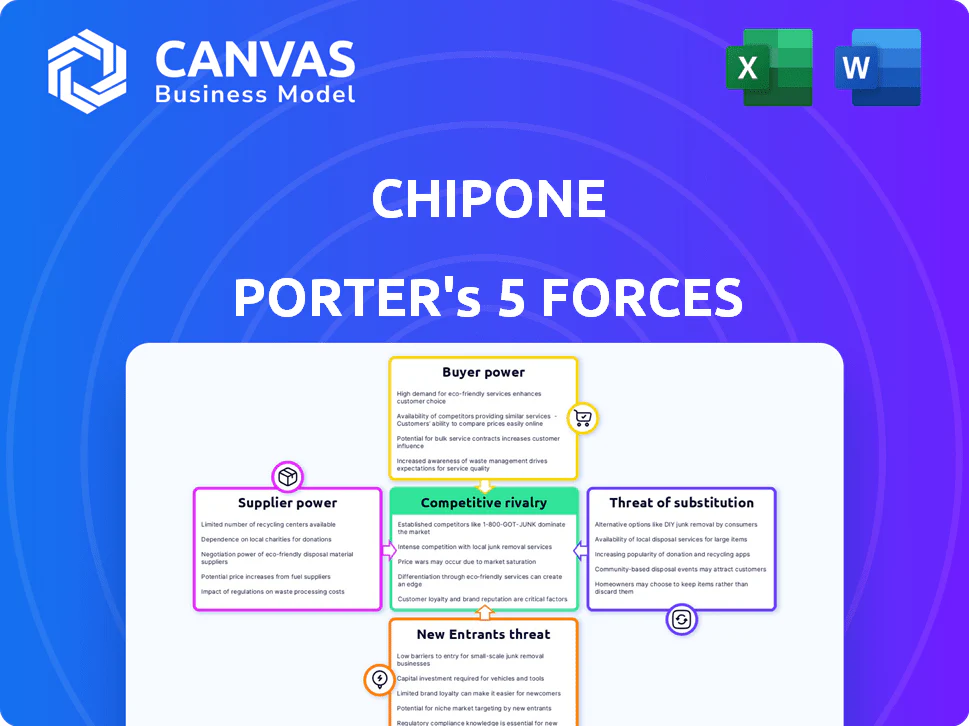
CHIPONE PORTER'S FIVE FORCES TEMPLATE RESEARCH
What is included in the product
 Detailed Word Document
Evaluates control held by suppliers and buyers, and their influence on pricing and profitability.

 Customizable Excel Spreadsheet
Instantly see the strategic landscape with a vivid, interactive data visualization.
Full Version Awaits
Chipone Porter's Five Forces Analysis
This preview details the Chipone Porter's Five Forces Analysis in its entirety. The document you see reflects the complete, professional analysis you'll instantly receive post-purchase. It's fully formatted, thoroughly researched, and ready for your immediate use. No hidden content or modifications are necessary; it's exactly as displayed. This is the final, deliverable document.

Porter's Five Forces Analysis Template

Don't Miss the Bigger Picture
Chipone's competitive landscape is complex, shaped by supplier power in the display driver IC market. Buyer power, particularly from major display manufacturers, also significantly impacts profitability. The threat of new entrants, especially from Chinese competitors, is increasing. Substitute products, like AMOLED displays, pose a growing challenge. Intense rivalry among existing players adds further pressure.
This brief snapshot only scratches the surface. Unlock the full Porter's Five Forces Analysis to explore Chipone’s competitive dynamics, market pressures, and strategic advantages in detail.
Suppliers Bargaining Power

Limited Number of Wafer Manufacturers
The bargaining power of suppliers is high for Chipone. The semiconductor industry has a limited number of wafer manufacturers, with TSMC controlling over half the market share in 2024. Chipone, being fabless, depends on these suppliers for its chip production. This dependence gives suppliers significant leverage over pricing and terms.
Proprietary Technologies Held by Suppliers
Key suppliers with proprietary tech, like ASML, wield significant power in the semiconductor industry. Switching suppliers is hard and expensive for chip designers like Chipone. ASML, for instance, controls a large share of the EUV lithography market, critical for advanced chip manufacturing. In 2024, ASML's net sales were approximately €27.6 billion, highlighting their market dominance and bargaining power.

High Switching Costs for Chipone
Chipone faces high switching costs when changing suppliers of wafers and other critical technologies. Switching requires qualifying new materials, redesigning processes, and potential production downtime. These factors limit Chipone's ability to negotiate better terms, increasing supplier power.

Supplier Integration in the Value Chain
Some semiconductor suppliers have integrated operations, giving them significant pricing and supply control, which can affect Chipone's costs and production. Chipone relies on various manufacturers for wafer fabrication, packaging, and testing, establishing a network of relationships. The integrated suppliers' power could lead to higher input costs or supply disruptions for Chipone. For example, in 2024, the global semiconductor market was valued at over $500 billion, with a few key players controlling a large portion of the supply chain.
- Integrated suppliers can dictate pricing and terms.
- Chipone's reliance on external manufacturers increases vulnerability.
- Supply chain disruptions can impact production timelines.
- Market concentration gives suppliers leverage.
Demand-Supply Dynamics in the Semiconductor Market
The semiconductor market's demand-supply dynamics greatly impact supplier power. When demand is high and supply is limited, suppliers, such as TSMC, gain leverage in pricing and terms. Chipone's procurement strategy is subject to these market shifts. In 2024, the global semiconductor revenue is projected to reach $588.36 billion, reflecting ongoing market volatility.
- Chip shortages in recent years amplified supplier power.
- TSMC and Samsung control a significant portion of the market.
- Chipone's pricing is influenced by supply-chain negotiations.
- Market fluctuations impact Chipone's profit margins.
Chipone's Supplier Challenges: Market Dynamics
Chipone faces high supplier power, particularly from wafer manufacturers like TSMC, which controlled over half the market in 2024. Key suppliers with proprietary tech, such as ASML, further strengthen this power. Switching costs and market concentration amplify the impact, potentially leading to higher costs and supply disruptions.
| Aspect | Impact on Chipone | 2024 Data |
|---|---|---|
| Supplier Concentration | Higher input costs, supply risks | TSMC: ~50% market share; ASML: €27.6B in net sales |
| Switching Costs | Reduced negotiation power | High costs for new material qualification |
| Market Dynamics | Pricing influenced by suppliers | Global market: ~$588.36B revenue |
Customers Bargaining Power

Concentrated Customer Base
Chipone's customer base is concentrated, with key players like BOE, TCL, and Samsung accounting for a large portion of sales. This concentration gives these customers significant bargaining power. In 2024, the top five customers likely contributed over 60% of Chipone's revenue. Losing a major client could severely affect Chipone's financial performance.
Customers' Price Sensitivity
In the consumer electronics sector, Chipone faces customers who are highly price-sensitive. This is particularly true in 2024, with the global smartphone market showing a slight decline in sales. This price sensitivity directly impacts Chipone's pricing strategies. The pressure from consumers often leads to their direct customers demanding lower prices. Chipone must manage these pressures to maintain profitability, as seen in the industry's average profit margins, which remained competitive in 2024.

Customers' Ability to Source from Multiple Suppliers
Chipone's customers, including major display manufacturers, can choose from various display IC suppliers. This includes competitors like Himax Technologies and Novatek Microelectronics. This choice gives customers significant bargaining power. In 2024, Himax's revenue was $1.05 billion, showing a competitive market. Customers leverage this to negotiate favorable terms.

Customers' Technical Expertise and Product Requirements
Chipone's major clients, primarily large display panel manufacturers, possess deep technical knowledge. This allows them to rigorously assess and compare different IC offerings. Their expertise strengthens their ability to negotiate favorable terms and influence product development. This includes the ability to negotiate lower prices, which impacts Chipone's revenue.
- In 2024, the display panel market saw increased price pressure, reflecting customers' bargaining power.
- Specific pricing data for Chipone's ICs in 2024 is proprietary, but industry trends suggest a focus on cost reduction.
- Major display panel manufacturers have the resources to invest in alternative IC suppliers, further enhancing their negotiation leverage.
Customers' Potential for Vertical Integration
Customers in the display industry, particularly large ones, could develop their own ICs, increasing their bargaining power. This potential for vertical integration or strategic partnerships poses a subtle threat to existing suppliers like Chipone. For example, companies such as BOE and Samsung Display have invested heavily in display technology, potentially including IC development. These moves could allow these companies to reduce reliance on external suppliers.
- BOE's 2023 revenue reached approximately $25.5 billion.
- Samsung Display's 2023 revenue was estimated at $20.5 billion.
- The display driver IC market size in 2024 is projected to be around $5.5 billion.
Chipone's Pricing Pressures: Customer Power & Market Dynamics
Chipone's customers, like BOE and Samsung, wield considerable bargaining power, especially in 2024. Their concentration and market knowledge enable them to negotiate favorable terms, impacting Chipone's pricing. The display IC market's competitive landscape, with players like Himax, intensifies this pressure.
| Factor | Impact | 2024 Data |
|---|---|---|
| Customer Concentration | High bargaining power | Top 5 customers >60% of revenue |
| Price Sensitivity | Pressure on pricing | Smartphone market decline in sales |
| Supplier Alternatives | Negotiating leverage | Himax revenue: $1.05B |
Rivalry Among Competitors

Presence of Established Global and Domestic Competitors
Chipone faces intense competition from global and domestic rivals. Key global competitors include Himax Technologies and Synaptics. Domestically, Chipone competes with NationalChip and other Chinese firms. This competition is amplified due to diverse players in the market. According to 2024 data, the display driver IC market saw significant price pressures.
Rapid Technological Advancements and Innovation
The display IC market experiences rapid technological advancements. Continuous innovation is crucial for higher resolutions, faster refresh rates, and new display technologies. This requires significant R&D investment. The OLED market is projected to reach $44.15 billion by 2029. Intense rivalry exists to lead in technology.

Price Competition
Given the price sensitivity in markets like smartphones, price competition among display IC suppliers can be intense. Competitors might use aggressive pricing to capture market share. This can squeeze Chipone's profit margins. For instance, in 2024, the average selling price (ASP) of display driver ICs decreased by about 5-7% due to competitive pressure.

Product Differentiation and Specialization
The competitive landscape in the display driver IC market is intense, but firms like Chipone attempt to stand out through product differentiation and specialization. They develop solutions for specific applications, such as automotive displays. Chipone's approach to offer diverse display technologies helps manage competitive pressures. For instance, in 2024, the automotive display market is projected to reach $12 billion.
- Chipone focuses on display tech.
- Automotive displays are a key area.
- Market differentiation is crucial.
- The automotive display market is big.
Market Share and Leadership Positions
Market share competition is fierce, with companies striving for leadership. Chipone holds leading positions in China's LED display driver chips, LCD DDIC, TDDI, and panel power management chips. Sustaining these positions demands relentless efforts against robust rivals. For example, in 2024, Chipone's revenue was $1.5 billion.
- Chipone's 2024 revenue: $1.5 billion
- Focus on LED display driver chips, LCD DDIC, TDDI, and panel power management chips
- Intense competition in the market
- Emphasis on maintaining and expanding market positions
Chipone Navigates Competitive Display IC Market
Chipone faces intense competition from global and domestic rivals, like Himax and NationalChip. Price wars and rapid tech changes pressure margins; ASPs fell 5-7% in 2024. Chipone differentiates via specialization, such as automotive displays, projected at $12B in 2024.
| Metric | 2024 Data |
|---|---|
| Chipone Revenue | $1.5 Billion |
| ASP Decline (Display ICs) | 5-7% |
| Automotive Display Market (Projected) | $12 Billion |
Original: $10.00
-65%$10.00
$3.50CHIPONE PORTER'S FIVE FORCES TEMPLATE RESEARCH
What is included in the product
Detailed Word Document
Evaluates control held by suppliers and buyers, and their influence on pricing and profitability.
Customizable Excel Spreadsheet
Instantly see the strategic landscape with a vivid, interactive data visualization.
Full Version Awaits
Chipone Porter's Five Forces Analysis
This preview details the Chipone Porter's Five Forces Analysis in its entirety. The document you see reflects the complete, professional analysis you'll instantly receive post-purchase. It's fully formatted, thoroughly researched, and ready for your immediate use. No hidden content or modifications are necessary; it's exactly as displayed. This is the final, deliverable document.
Porter's Five Forces Analysis Template
Don't Miss the Bigger Picture
Chipone's competitive landscape is complex, shaped by supplier power in the display driver IC market. Buyer power, particularly from major display manufacturers, also significantly impacts profitability. The threat of new entrants, especially from Chinese competitors, is increasing. Substitute products, like AMOLED displays, pose a growing challenge. Intense rivalry among existing players adds further pressure.
This brief snapshot only scratches the surface. Unlock the full Porter's Five Forces Analysis to explore Chipone’s competitive dynamics, market pressures, and strategic advantages in detail.
Suppliers Bargaining Power
Limited Number of Wafer Manufacturers
The bargaining power of suppliers is high for Chipone. The semiconductor industry has a limited number of wafer manufacturers, with TSMC controlling over half the market share in 2024. Chipone, being fabless, depends on these suppliers for its chip production. This dependence gives suppliers significant leverage over pricing and terms.
Proprietary Technologies Held by Suppliers
Key suppliers with proprietary tech, like ASML, wield significant power in the semiconductor industry. Switching suppliers is hard and expensive for chip designers like Chipone. ASML, for instance, controls a large share of the EUV lithography market, critical for advanced chip manufacturing. In 2024, ASML's net sales were approximately €27.6 billion, highlighting their market dominance and bargaining power.
High Switching Costs for Chipone
Chipone faces high switching costs when changing suppliers of wafers and other critical technologies. Switching requires qualifying new materials, redesigning processes, and potential production downtime. These factors limit Chipone's ability to negotiate better terms, increasing supplier power.
Supplier Integration in the Value Chain
Some semiconductor suppliers have integrated operations, giving them significant pricing and supply control, which can affect Chipone's costs and production. Chipone relies on various manufacturers for wafer fabrication, packaging, and testing, establishing a network of relationships. The integrated suppliers' power could lead to higher input costs or supply disruptions for Chipone. For example, in 2024, the global semiconductor market was valued at over $500 billion, with a few key players controlling a large portion of the supply chain.
- Integrated suppliers can dictate pricing and terms.
- Chipone's reliance on external manufacturers increases vulnerability.
- Supply chain disruptions can impact production timelines.
- Market concentration gives suppliers leverage.
Demand-Supply Dynamics in the Semiconductor Market
The semiconductor market's demand-supply dynamics greatly impact supplier power. When demand is high and supply is limited, suppliers, such as TSMC, gain leverage in pricing and terms. Chipone's procurement strategy is subject to these market shifts. In 2024, the global semiconductor revenue is projected to reach $588.36 billion, reflecting ongoing market volatility.
- Chip shortages in recent years amplified supplier power.
- TSMC and Samsung control a significant portion of the market.
- Chipone's pricing is influenced by supply-chain negotiations.
- Market fluctuations impact Chipone's profit margins.
Chipone's Supplier Challenges: Market Dynamics
Chipone faces high supplier power, particularly from wafer manufacturers like TSMC, which controlled over half the market in 2024. Key suppliers with proprietary tech, such as ASML, further strengthen this power. Switching costs and market concentration amplify the impact, potentially leading to higher costs and supply disruptions.
| Aspect | Impact on Chipone | 2024 Data |
|---|---|---|
| Supplier Concentration | Higher input costs, supply risks | TSMC: ~50% market share; ASML: €27.6B in net sales |
| Switching Costs | Reduced negotiation power | High costs for new material qualification |
| Market Dynamics | Pricing influenced by suppliers | Global market: ~$588.36B revenue |
Customers Bargaining Power
Concentrated Customer Base
Chipone's customer base is concentrated, with key players like BOE, TCL, and Samsung accounting for a large portion of sales. This concentration gives these customers significant bargaining power. In 2024, the top five customers likely contributed over 60% of Chipone's revenue. Losing a major client could severely affect Chipone's financial performance.
Customers' Price Sensitivity
In the consumer electronics sector, Chipone faces customers who are highly price-sensitive. This is particularly true in 2024, with the global smartphone market showing a slight decline in sales. This price sensitivity directly impacts Chipone's pricing strategies. The pressure from consumers often leads to their direct customers demanding lower prices. Chipone must manage these pressures to maintain profitability, as seen in the industry's average profit margins, which remained competitive in 2024.
Customers' Ability to Source from Multiple Suppliers
Chipone's customers, including major display manufacturers, can choose from various display IC suppliers. This includes competitors like Himax Technologies and Novatek Microelectronics. This choice gives customers significant bargaining power. In 2024, Himax's revenue was $1.05 billion, showing a competitive market. Customers leverage this to negotiate favorable terms.
Customers' Technical Expertise and Product Requirements
Chipone's major clients, primarily large display panel manufacturers, possess deep technical knowledge. This allows them to rigorously assess and compare different IC offerings. Their expertise strengthens their ability to negotiate favorable terms and influence product development. This includes the ability to negotiate lower prices, which impacts Chipone's revenue.
- In 2024, the display panel market saw increased price pressure, reflecting customers' bargaining power.
- Specific pricing data for Chipone's ICs in 2024 is proprietary, but industry trends suggest a focus on cost reduction.
- Major display panel manufacturers have the resources to invest in alternative IC suppliers, further enhancing their negotiation leverage.
Customers' Potential for Vertical Integration
Customers in the display industry, particularly large ones, could develop their own ICs, increasing their bargaining power. This potential for vertical integration or strategic partnerships poses a subtle threat to existing suppliers like Chipone. For example, companies such as BOE and Samsung Display have invested heavily in display technology, potentially including IC development. These moves could allow these companies to reduce reliance on external suppliers.
- BOE's 2023 revenue reached approximately $25.5 billion.
- Samsung Display's 2023 revenue was estimated at $20.5 billion.
- The display driver IC market size in 2024 is projected to be around $5.5 billion.
Chipone's Pricing Pressures: Customer Power & Market Dynamics
Chipone's customers, like BOE and Samsung, wield considerable bargaining power, especially in 2024. Their concentration and market knowledge enable them to negotiate favorable terms, impacting Chipone's pricing. The display IC market's competitive landscape, with players like Himax, intensifies this pressure.
| Factor | Impact | 2024 Data |
|---|---|---|
| Customer Concentration | High bargaining power | Top 5 customers >60% of revenue |
| Price Sensitivity | Pressure on pricing | Smartphone market decline in sales |
| Supplier Alternatives | Negotiating leverage | Himax revenue: $1.05B |
Rivalry Among Competitors
Presence of Established Global and Domestic Competitors
Chipone faces intense competition from global and domestic rivals. Key global competitors include Himax Technologies and Synaptics. Domestically, Chipone competes with NationalChip and other Chinese firms. This competition is amplified due to diverse players in the market. According to 2024 data, the display driver IC market saw significant price pressures.
Rapid Technological Advancements and Innovation
The display IC market experiences rapid technological advancements. Continuous innovation is crucial for higher resolutions, faster refresh rates, and new display technologies. This requires significant R&D investment. The OLED market is projected to reach $44.15 billion by 2029. Intense rivalry exists to lead in technology.
Price Competition
Given the price sensitivity in markets like smartphones, price competition among display IC suppliers can be intense. Competitors might use aggressive pricing to capture market share. This can squeeze Chipone's profit margins. For instance, in 2024, the average selling price (ASP) of display driver ICs decreased by about 5-7% due to competitive pressure.
Product Differentiation and Specialization
The competitive landscape in the display driver IC market is intense, but firms like Chipone attempt to stand out through product differentiation and specialization. They develop solutions for specific applications, such as automotive displays. Chipone's approach to offer diverse display technologies helps manage competitive pressures. For instance, in 2024, the automotive display market is projected to reach $12 billion.
- Chipone focuses on display tech.
- Automotive displays are a key area.
- Market differentiation is crucial.
- The automotive display market is big.
Market Share and Leadership Positions
Market share competition is fierce, with companies striving for leadership. Chipone holds leading positions in China's LED display driver chips, LCD DDIC, TDDI, and panel power management chips. Sustaining these positions demands relentless efforts against robust rivals. For example, in 2024, Chipone's revenue was $1.5 billion.
- Chipone's 2024 revenue: $1.5 billion
- Focus on LED display driver chips, LCD DDIC, TDDI, and panel power management chips
- Intense competition in the market
- Emphasis on maintaining and expanding market positions
Chipone Navigates Competitive Display IC Market
Chipone faces intense competition from global and domestic rivals, like Himax and NationalChip. Price wars and rapid tech changes pressure margins; ASPs fell 5-7% in 2024. Chipone differentiates via specialization, such as automotive displays, projected at $12B in 2024.
| Metric | 2024 Data |
|---|---|
| Chipone Revenue | $1.5 Billion |
| ASP Decline (Display ICs) | 5-7% |
| Automotive Display Market (Projected) | $12 Billion |
Product Information
Product Information
Shipping & Returns
Shipping & Returns
Description
What is included in the product
Detailed Word Document
Evaluates control held by suppliers and buyers, and their influence on pricing and profitability.
Customizable Excel Spreadsheet
Instantly see the strategic landscape with a vivid, interactive data visualization.
Full Version Awaits
Chipone Porter's Five Forces Analysis
This preview details the Chipone Porter's Five Forces Analysis in its entirety. The document you see reflects the complete, professional analysis you'll instantly receive post-purchase. It's fully formatted, thoroughly researched, and ready for your immediate use. No hidden content or modifications are necessary; it's exactly as displayed. This is the final, deliverable document.
Porter's Five Forces Analysis Template
Don't Miss the Bigger Picture
Chipone's competitive landscape is complex, shaped by supplier power in the display driver IC market. Buyer power, particularly from major display manufacturers, also significantly impacts profitability. The threat of new entrants, especially from Chinese competitors, is increasing. Substitute products, like AMOLED displays, pose a growing challenge. Intense rivalry among existing players adds further pressure.
This brief snapshot only scratches the surface. Unlock the full Porter's Five Forces Analysis to explore Chipone’s competitive dynamics, market pressures, and strategic advantages in detail.
Suppliers Bargaining Power
Limited Number of Wafer Manufacturers
The bargaining power of suppliers is high for Chipone. The semiconductor industry has a limited number of wafer manufacturers, with TSMC controlling over half the market share in 2024. Chipone, being fabless, depends on these suppliers for its chip production. This dependence gives suppliers significant leverage over pricing and terms.
Proprietary Technologies Held by Suppliers
Key suppliers with proprietary tech, like ASML, wield significant power in the semiconductor industry. Switching suppliers is hard and expensive for chip designers like Chipone. ASML, for instance, controls a large share of the EUV lithography market, critical for advanced chip manufacturing. In 2024, ASML's net sales were approximately €27.6 billion, highlighting their market dominance and bargaining power.
High Switching Costs for Chipone
Chipone faces high switching costs when changing suppliers of wafers and other critical technologies. Switching requires qualifying new materials, redesigning processes, and potential production downtime. These factors limit Chipone's ability to negotiate better terms, increasing supplier power.
Supplier Integration in the Value Chain
Some semiconductor suppliers have integrated operations, giving them significant pricing and supply control, which can affect Chipone's costs and production. Chipone relies on various manufacturers for wafer fabrication, packaging, and testing, establishing a network of relationships. The integrated suppliers' power could lead to higher input costs or supply disruptions for Chipone. For example, in 2024, the global semiconductor market was valued at over $500 billion, with a few key players controlling a large portion of the supply chain.
- Integrated suppliers can dictate pricing and terms.
- Chipone's reliance on external manufacturers increases vulnerability.
- Supply chain disruptions can impact production timelines.
- Market concentration gives suppliers leverage.
Demand-Supply Dynamics in the Semiconductor Market
The semiconductor market's demand-supply dynamics greatly impact supplier power. When demand is high and supply is limited, suppliers, such as TSMC, gain leverage in pricing and terms. Chipone's procurement strategy is subject to these market shifts. In 2024, the global semiconductor revenue is projected to reach $588.36 billion, reflecting ongoing market volatility.
- Chip shortages in recent years amplified supplier power.
- TSMC and Samsung control a significant portion of the market.
- Chipone's pricing is influenced by supply-chain negotiations.
- Market fluctuations impact Chipone's profit margins.
Chipone's Supplier Challenges: Market Dynamics
Chipone faces high supplier power, particularly from wafer manufacturers like TSMC, which controlled over half the market in 2024. Key suppliers with proprietary tech, such as ASML, further strengthen this power. Switching costs and market concentration amplify the impact, potentially leading to higher costs and supply disruptions.
| Aspect | Impact on Chipone | 2024 Data |
|---|---|---|
| Supplier Concentration | Higher input costs, supply risks | TSMC: ~50% market share; ASML: €27.6B in net sales |
| Switching Costs | Reduced negotiation power | High costs for new material qualification |
| Market Dynamics | Pricing influenced by suppliers | Global market: ~$588.36B revenue |
Customers Bargaining Power
Concentrated Customer Base
Chipone's customer base is concentrated, with key players like BOE, TCL, and Samsung accounting for a large portion of sales. This concentration gives these customers significant bargaining power. In 2024, the top five customers likely contributed over 60% of Chipone's revenue. Losing a major client could severely affect Chipone's financial performance.
Customers' Price Sensitivity
In the consumer electronics sector, Chipone faces customers who are highly price-sensitive. This is particularly true in 2024, with the global smartphone market showing a slight decline in sales. This price sensitivity directly impacts Chipone's pricing strategies. The pressure from consumers often leads to their direct customers demanding lower prices. Chipone must manage these pressures to maintain profitability, as seen in the industry's average profit margins, which remained competitive in 2024.
Customers' Ability to Source from Multiple Suppliers
Chipone's customers, including major display manufacturers, can choose from various display IC suppliers. This includes competitors like Himax Technologies and Novatek Microelectronics. This choice gives customers significant bargaining power. In 2024, Himax's revenue was $1.05 billion, showing a competitive market. Customers leverage this to negotiate favorable terms.
Customers' Technical Expertise and Product Requirements
Chipone's major clients, primarily large display panel manufacturers, possess deep technical knowledge. This allows them to rigorously assess and compare different IC offerings. Their expertise strengthens their ability to negotiate favorable terms and influence product development. This includes the ability to negotiate lower prices, which impacts Chipone's revenue.
- In 2024, the display panel market saw increased price pressure, reflecting customers' bargaining power.
- Specific pricing data for Chipone's ICs in 2024 is proprietary, but industry trends suggest a focus on cost reduction.
- Major display panel manufacturers have the resources to invest in alternative IC suppliers, further enhancing their negotiation leverage.
Customers' Potential for Vertical Integration
Customers in the display industry, particularly large ones, could develop their own ICs, increasing their bargaining power. This potential for vertical integration or strategic partnerships poses a subtle threat to existing suppliers like Chipone. For example, companies such as BOE and Samsung Display have invested heavily in display technology, potentially including IC development. These moves could allow these companies to reduce reliance on external suppliers.
- BOE's 2023 revenue reached approximately $25.5 billion.
- Samsung Display's 2023 revenue was estimated at $20.5 billion.
- The display driver IC market size in 2024 is projected to be around $5.5 billion.
Chipone's Pricing Pressures: Customer Power & Market Dynamics
Chipone's customers, like BOE and Samsung, wield considerable bargaining power, especially in 2024. Their concentration and market knowledge enable them to negotiate favorable terms, impacting Chipone's pricing. The display IC market's competitive landscape, with players like Himax, intensifies this pressure.
| Factor | Impact | 2024 Data |
|---|---|---|
| Customer Concentration | High bargaining power | Top 5 customers >60% of revenue |
| Price Sensitivity | Pressure on pricing | Smartphone market decline in sales |
| Supplier Alternatives | Negotiating leverage | Himax revenue: $1.05B |
Rivalry Among Competitors
Presence of Established Global and Domestic Competitors
Chipone faces intense competition from global and domestic rivals. Key global competitors include Himax Technologies and Synaptics. Domestically, Chipone competes with NationalChip and other Chinese firms. This competition is amplified due to diverse players in the market. According to 2024 data, the display driver IC market saw significant price pressures.
Rapid Technological Advancements and Innovation
The display IC market experiences rapid technological advancements. Continuous innovation is crucial for higher resolutions, faster refresh rates, and new display technologies. This requires significant R&D investment. The OLED market is projected to reach $44.15 billion by 2029. Intense rivalry exists to lead in technology.
Price Competition
Given the price sensitivity in markets like smartphones, price competition among display IC suppliers can be intense. Competitors might use aggressive pricing to capture market share. This can squeeze Chipone's profit margins. For instance, in 2024, the average selling price (ASP) of display driver ICs decreased by about 5-7% due to competitive pressure.
Product Differentiation and Specialization
The competitive landscape in the display driver IC market is intense, but firms like Chipone attempt to stand out through product differentiation and specialization. They develop solutions for specific applications, such as automotive displays. Chipone's approach to offer diverse display technologies helps manage competitive pressures. For instance, in 2024, the automotive display market is projected to reach $12 billion.
- Chipone focuses on display tech.
- Automotive displays are a key area.
- Market differentiation is crucial.
- The automotive display market is big.
Market Share and Leadership Positions
Market share competition is fierce, with companies striving for leadership. Chipone holds leading positions in China's LED display driver chips, LCD DDIC, TDDI, and panel power management chips. Sustaining these positions demands relentless efforts against robust rivals. For example, in 2024, Chipone's revenue was $1.5 billion.
- Chipone's 2024 revenue: $1.5 billion
- Focus on LED display driver chips, LCD DDIC, TDDI, and panel power management chips
- Intense competition in the market
- Emphasis on maintaining and expanding market positions
Chipone Navigates Competitive Display IC Market
Chipone faces intense competition from global and domestic rivals, like Himax and NationalChip. Price wars and rapid tech changes pressure margins; ASPs fell 5-7% in 2024. Chipone differentiates via specialization, such as automotive displays, projected at $12B in 2024.
| Metric | 2024 Data |
|---|---|
| Chipone Revenue | $1.5 Billion |
| ASP Decline (Display ICs) | 5-7% |
| Automotive Display Market (Projected) | $12 Billion |











