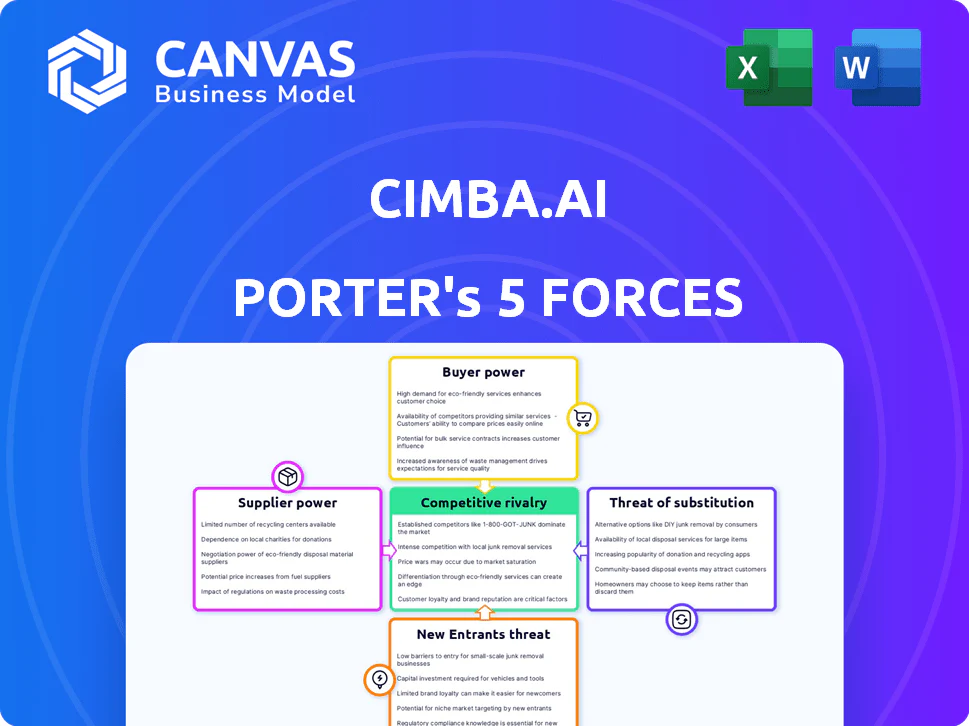
CIMBA.AI PORTER'S FIVE FORCES TEMPLATE RESEARCH
What is included in the product
 Detailed Word Document
Tailored exclusively for Cimba.ai, analyzing its position within its competitive landscape.

 Customizable Excel Spreadsheet
Instantly pinpoint strategic pressure with its interactive chart, enhancing decision-making.
Preview the Actual Deliverable
Cimba.ai Porter's Five Forces Analysis
This is the actual Cimba.ai Porter's Five Forces Analysis you'll receive. It's a complete, in-depth evaluation of the forces shaping the industry, including Rivalry, Supplier Power, Buyer Power, Threats of Substitution, and Threats of New Entry. Each force is meticulously examined. This preview allows you to see the quality and detail before purchase, ensuring full transparency. The final document is ready to download immediately after purchase.

Porter's Five Forces Analysis Template

A Must-Have Tool for Decision-Makers
Cimba.ai's industry faces moderate rivalry, influenced by diverse competitors. Buyer power is low, given specialized AI offerings. Supplier power is moderate, with key tech component dependencies. The threat of new entrants is moderate, balanced by existing market barriers. Substitute products pose a limited, but growing, threat.
The complete report reveals the real forces shaping Cimba.ai’s industry—from supplier influence to threat of new entrants. Gain actionable insights to drive smarter decision-making.
Suppliers Bargaining Power

Reliance on foundational AI models
Cimba.ai's dependence on external LLMs grants suppliers, like OpenAI or Google, some leverage. This is because Cimba.ai's costs and capabilities are influenced by these providers. In 2024, the LLM market's growth was substantial, with investments exceeding $20 billion, which may shift the power dynamics. The emergence of new models and rapid advancements could further alter this landscape.
Dependency on cloud infrastructure
Cimba.ai, as an AI firm, depends on cloud infrastructure for operations. Cloud providers like AWS, Google Cloud, and Azure have strong market positions. This gives them significant bargaining power over pricing and service terms. In 2024, AWS held about 32% of the cloud market, Google Cloud 11%, and Azure 25%.

Access to specialized hardware
Cimba.ai's reliance on specialized hardware, like high-performance GPUs, is key. The limited suppliers of these components, such as NVIDIA, give them strong bargaining power. This can affect Cimba.ai's costs and ability to grow. In 2024, NVIDIA's market share in the AI chip sector was around 80%, highlighting their dominance.

Availability of skilled AI talent
Cimba.ai's ability to build and sustain its AI agent infrastructure hinges on securing top-tier AI talent. The high demand for skilled AI researchers and engineers, coupled with a constrained supply, strengthens their bargaining power. This can lead to increased operational costs for Cimba.ai due to competitive salaries and benefits packages. For example, the average AI engineer salary in the US reached $175,000 in 2024, reflecting this trend.
- High demand for AI specialists pushes up salaries.
- Limited supply of skilled AI professionals.
- Impact on Cimba.ai's operational expenses.
- Salary data indicates the cost of talent.
Proprietary datasets and data providers
Cimba.ai's reliance on external data sources to enhance its AI models introduces a potential supplier bargaining power dynamic. Suppliers of unique, high-quality datasets, essential for specific industry applications, could wield influence. This is especially true if their data offers a competitive edge in model training. For example, the global market for big data analytics is projected to reach $684.12 billion by 2028.
- Data exclusivity grants suppliers pricing power.
- The value of specialized datasets increases bargaining power.
- High-quality data is crucial for accurate AI model training.
- Market competition among data providers influences bargaining.
Cimba.ai's Supplier Challenges: Costs, Power, and Key Players
Cimba.ai faces supplier power from LLM providers, cloud services, hardware, talent, and data sources. Limited suppliers of key resources like NVIDIA (80% AI chip market share in 2024) and specialized datasets give them leverage. This affects Cimba.ai's costs and operations, with AI engineer salaries around $175,000 in 2024.
| Resource | Supplier | Impact on Cimba.ai |
|---|---|---|
| LLMs | OpenAI, Google | Cost, capability |
| Cloud | AWS (32%), Azure (25%) | Pricing, terms |
| Hardware | NVIDIA (80% AI chips) | Cost, growth |
| Talent | AI engineers | Operational costs |
| Data | Specialized providers | Model accuracy |
Customers Bargaining Power

Availability of alternative AI solutions
Customers have numerous AI solution options, including competitors and general platforms. This abundance empowers them to compare and negotiate. The AI market saw over $100 billion in investments in 2024, showing ample alternatives. This competition drives down prices and boosts customer influence.
Switching costs
Switching costs play a crucial role in customer bargaining power within the AI landscape. Integrating an AI agent infrastructure like Cimba.ai into existing systems involves effort and cost. High switching costs, like those associated with data migration, reduce customer leverage. For instance, the average cost to migrate enterprise data in 2024 was roughly $150,000, potentially locking customers into a platform.

Customer knowledge and customization demands
As AI knowledge grows, customers seek tailored AI agents. Enterprises, with their volume potential, gain bargaining power. In 2024, the AI market saw significant demand for customized solutions. For instance, 68% of businesses now prioritize AI customization. This trend highlights the increasing customer influence in shaping AI offerings.

Potential for in-house development
Large customers, especially those like Google or Microsoft, possess the resources to develop AI solutions internally, increasing their bargaining power. This threat of in-house development allows them to negotiate better pricing and terms with external vendors like Cimba.ai. For instance, in 2024, companies invested approximately $100 billion in AI research and development, showcasing their commitment to internal innovation. This capability gives them leverage to demand customized solutions or lower costs.
- Vertical integration reduces reliance on external vendors.
- Customers can build AI solutions if external options are not optimal.
- This leverage influences pricing and service terms.
- Businesses invested $100B in AI in 2024.
Price sensitivity
Customers' price sensitivity significantly impacts Cimba.ai. Businesses carefully assess the ROI of AI solutions, comparing prices from various providers. In 2024, the market saw a 15% increase in companies actively comparing AI pricing. This scrutiny can pressure Cimba.ai's pricing, potentially affecting profitability.
- ROI focus drives price comparisons.
- Competitive pricing landscape.
- Profitability impact.
AI Market Dynamics: Customer Power in 2024
Customer bargaining power in the AI market is strong due to numerous options and price sensitivity. High switching costs can reduce this power, while customization demands increase it. Large companies developing AI internally further enhance their leverage. In 2024, the AI market had significant investment, influencing customer influence.
| Factor | Impact | 2024 Data |
|---|---|---|
| Options | Increased customer choice | $100B+ AI investments |
| Switching Costs | Reduced customer power | $150K avg. data migration cost |
| Customization | Enhanced customer influence | 68% prioritize AI customization |
Rivalry Among Competitors

Number and diversity of competitors
The AI agent market is intensifying with numerous players. Giants like Google and Microsoft compete with AI startups. This boosts rivalry as firms chase market share. For instance, in 2024, over 5,000 AI startups secured funding. This indicates fierce competition for funding and customers.
Market growth rate
The AI agent market is booming, with an expected compound annual growth rate (CAGR) of 36.8% from 2024 to 2030. This rapid expansion draws in competitors, intensifying rivalry. Companies fiercely compete for market share in this high-growth sector. The need to capture growth can lead to aggressive strategies.

Differentiation of offerings
Cimba.ai strives to stand out with adaptive AI, data-focused operations, and custom, self-training agents. Its ability to differentiate directly affects the intensity of competitive rivalry. Competitors like DataRobot and H2O.ai, also offer AI platforms, creating a competitive landscape. The success of Cimba.ai's differentiation strategy will determine its market position. DataRobot's revenue in 2023 was $300 million.

Brand identity and customer loyalty
In a competitive landscape, brand identity and customer loyalty significantly shape rivalry. Strong brands often benefit from existing customer trust and market recognition. To succeed, Cimba.ai must focus on building a compelling brand and providing exceptional value. This strategy helps in attracting and retaining customers amidst established competitors.
- Customer loyalty programs can boost retention rates by 25% in competitive markets.
- Brand recognition can account for up to 20% of a company's market share in the tech industry.
- Companies with strong brand identities often experience a 15% higher profit margin.
- Around 60% of consumers prefer to buy from brands they recognize.
Exit barriers
High exit barriers significantly impact competitive rivalry within the AI market. Companies often face substantial hurdles when considering leaving, due to major investments in specialized technology and the skilled personnel. This situation fosters heightened competition, as businesses persist in battling for market share even when profitability is strained. For instance, in 2024, AI startups that raised over $100 million in funding faced pressure to stay competitive, regardless of short-term financial performance. This dynamic intensifies rivalry among existing players.
- High capital investments in AI infrastructure.
- Specialized talent pools difficult to downsize.
- The strategic importance of AI for core business.
- Long-term contracts and commitments.
AI Agent Market: Fierce Competition Ahead!
Competitive rivalry in the AI agent market is intense, fueled by rapid growth and numerous players. This includes established tech giants and emerging startups competing for market share and funding. Cimba.ai's ability to differentiate itself is crucial given the competitive landscape, with brand identity and customer loyalty playing significant roles.
| Factor | Impact | Data |
|---|---|---|
| Market Growth | Attracts Competitors | 36.8% CAGR (2024-2030) |
| Differentiation | Key to Success | DataRobot's 2023 revenue: $300M |
| Customer Loyalty | Boosts Retention | Loyalty programs can increase retention by 25% |
Original: $10.00
-65%$10.00
$3.50CIMBA.AI PORTER'S FIVE FORCES TEMPLATE RESEARCH
What is included in the product
Detailed Word Document
Tailored exclusively for Cimba.ai, analyzing its position within its competitive landscape.
Customizable Excel Spreadsheet
Instantly pinpoint strategic pressure with its interactive chart, enhancing decision-making.
Preview the Actual Deliverable
Cimba.ai Porter's Five Forces Analysis
This is the actual Cimba.ai Porter's Five Forces Analysis you'll receive. It's a complete, in-depth evaluation of the forces shaping the industry, including Rivalry, Supplier Power, Buyer Power, Threats of Substitution, and Threats of New Entry. Each force is meticulously examined. This preview allows you to see the quality and detail before purchase, ensuring full transparency. The final document is ready to download immediately after purchase.
Porter's Five Forces Analysis Template
A Must-Have Tool for Decision-Makers
Cimba.ai's industry faces moderate rivalry, influenced by diverse competitors. Buyer power is low, given specialized AI offerings. Supplier power is moderate, with key tech component dependencies. The threat of new entrants is moderate, balanced by existing market barriers. Substitute products pose a limited, but growing, threat.
The complete report reveals the real forces shaping Cimba.ai’s industry—from supplier influence to threat of new entrants. Gain actionable insights to drive smarter decision-making.
Suppliers Bargaining Power
Reliance on foundational AI models
Cimba.ai's dependence on external LLMs grants suppliers, like OpenAI or Google, some leverage. This is because Cimba.ai's costs and capabilities are influenced by these providers. In 2024, the LLM market's growth was substantial, with investments exceeding $20 billion, which may shift the power dynamics. The emergence of new models and rapid advancements could further alter this landscape.
Dependency on cloud infrastructure
Cimba.ai, as an AI firm, depends on cloud infrastructure for operations. Cloud providers like AWS, Google Cloud, and Azure have strong market positions. This gives them significant bargaining power over pricing and service terms. In 2024, AWS held about 32% of the cloud market, Google Cloud 11%, and Azure 25%.
Access to specialized hardware
Cimba.ai's reliance on specialized hardware, like high-performance GPUs, is key. The limited suppliers of these components, such as NVIDIA, give them strong bargaining power. This can affect Cimba.ai's costs and ability to grow. In 2024, NVIDIA's market share in the AI chip sector was around 80%, highlighting their dominance.
Availability of skilled AI talent
Cimba.ai's ability to build and sustain its AI agent infrastructure hinges on securing top-tier AI talent. The high demand for skilled AI researchers and engineers, coupled with a constrained supply, strengthens their bargaining power. This can lead to increased operational costs for Cimba.ai due to competitive salaries and benefits packages. For example, the average AI engineer salary in the US reached $175,000 in 2024, reflecting this trend.
- High demand for AI specialists pushes up salaries.
- Limited supply of skilled AI professionals.
- Impact on Cimba.ai's operational expenses.
- Salary data indicates the cost of talent.
Proprietary datasets and data providers
Cimba.ai's reliance on external data sources to enhance its AI models introduces a potential supplier bargaining power dynamic. Suppliers of unique, high-quality datasets, essential for specific industry applications, could wield influence. This is especially true if their data offers a competitive edge in model training. For example, the global market for big data analytics is projected to reach $684.12 billion by 2028.
- Data exclusivity grants suppliers pricing power.
- The value of specialized datasets increases bargaining power.
- High-quality data is crucial for accurate AI model training.
- Market competition among data providers influences bargaining.
Cimba.ai's Supplier Challenges: Costs, Power, and Key Players
Cimba.ai faces supplier power from LLM providers, cloud services, hardware, talent, and data sources. Limited suppliers of key resources like NVIDIA (80% AI chip market share in 2024) and specialized datasets give them leverage. This affects Cimba.ai's costs and operations, with AI engineer salaries around $175,000 in 2024.
| Resource | Supplier | Impact on Cimba.ai |
|---|---|---|
| LLMs | OpenAI, Google | Cost, capability |
| Cloud | AWS (32%), Azure (25%) | Pricing, terms |
| Hardware | NVIDIA (80% AI chips) | Cost, growth |
| Talent | AI engineers | Operational costs |
| Data | Specialized providers | Model accuracy |
Customers Bargaining Power
Availability of alternative AI solutions
Customers have numerous AI solution options, including competitors and general platforms. This abundance empowers them to compare and negotiate. The AI market saw over $100 billion in investments in 2024, showing ample alternatives. This competition drives down prices and boosts customer influence.
Switching costs
Switching costs play a crucial role in customer bargaining power within the AI landscape. Integrating an AI agent infrastructure like Cimba.ai into existing systems involves effort and cost. High switching costs, like those associated with data migration, reduce customer leverage. For instance, the average cost to migrate enterprise data in 2024 was roughly $150,000, potentially locking customers into a platform.
Customer knowledge and customization demands
As AI knowledge grows, customers seek tailored AI agents. Enterprises, with their volume potential, gain bargaining power. In 2024, the AI market saw significant demand for customized solutions. For instance, 68% of businesses now prioritize AI customization. This trend highlights the increasing customer influence in shaping AI offerings.
Potential for in-house development
Large customers, especially those like Google or Microsoft, possess the resources to develop AI solutions internally, increasing their bargaining power. This threat of in-house development allows them to negotiate better pricing and terms with external vendors like Cimba.ai. For instance, in 2024, companies invested approximately $100 billion in AI research and development, showcasing their commitment to internal innovation. This capability gives them leverage to demand customized solutions or lower costs.
- Vertical integration reduces reliance on external vendors.
- Customers can build AI solutions if external options are not optimal.
- This leverage influences pricing and service terms.
- Businesses invested $100B in AI in 2024.
Price sensitivity
Customers' price sensitivity significantly impacts Cimba.ai. Businesses carefully assess the ROI of AI solutions, comparing prices from various providers. In 2024, the market saw a 15% increase in companies actively comparing AI pricing. This scrutiny can pressure Cimba.ai's pricing, potentially affecting profitability.
- ROI focus drives price comparisons.
- Competitive pricing landscape.
- Profitability impact.
AI Market Dynamics: Customer Power in 2024
Customer bargaining power in the AI market is strong due to numerous options and price sensitivity. High switching costs can reduce this power, while customization demands increase it. Large companies developing AI internally further enhance their leverage. In 2024, the AI market had significant investment, influencing customer influence.
| Factor | Impact | 2024 Data |
|---|---|---|
| Options | Increased customer choice | $100B+ AI investments |
| Switching Costs | Reduced customer power | $150K avg. data migration cost |
| Customization | Enhanced customer influence | 68% prioritize AI customization |
Rivalry Among Competitors
Number and diversity of competitors
The AI agent market is intensifying with numerous players. Giants like Google and Microsoft compete with AI startups. This boosts rivalry as firms chase market share. For instance, in 2024, over 5,000 AI startups secured funding. This indicates fierce competition for funding and customers.
Market growth rate
The AI agent market is booming, with an expected compound annual growth rate (CAGR) of 36.8% from 2024 to 2030. This rapid expansion draws in competitors, intensifying rivalry. Companies fiercely compete for market share in this high-growth sector. The need to capture growth can lead to aggressive strategies.
Differentiation of offerings
Cimba.ai strives to stand out with adaptive AI, data-focused operations, and custom, self-training agents. Its ability to differentiate directly affects the intensity of competitive rivalry. Competitors like DataRobot and H2O.ai, also offer AI platforms, creating a competitive landscape. The success of Cimba.ai's differentiation strategy will determine its market position. DataRobot's revenue in 2023 was $300 million.
Brand identity and customer loyalty
In a competitive landscape, brand identity and customer loyalty significantly shape rivalry. Strong brands often benefit from existing customer trust and market recognition. To succeed, Cimba.ai must focus on building a compelling brand and providing exceptional value. This strategy helps in attracting and retaining customers amidst established competitors.
- Customer loyalty programs can boost retention rates by 25% in competitive markets.
- Brand recognition can account for up to 20% of a company's market share in the tech industry.
- Companies with strong brand identities often experience a 15% higher profit margin.
- Around 60% of consumers prefer to buy from brands they recognize.
Exit barriers
High exit barriers significantly impact competitive rivalry within the AI market. Companies often face substantial hurdles when considering leaving, due to major investments in specialized technology and the skilled personnel. This situation fosters heightened competition, as businesses persist in battling for market share even when profitability is strained. For instance, in 2024, AI startups that raised over $100 million in funding faced pressure to stay competitive, regardless of short-term financial performance. This dynamic intensifies rivalry among existing players.
- High capital investments in AI infrastructure.
- Specialized talent pools difficult to downsize.
- The strategic importance of AI for core business.
- Long-term contracts and commitments.
AI Agent Market: Fierce Competition Ahead!
Competitive rivalry in the AI agent market is intense, fueled by rapid growth and numerous players. This includes established tech giants and emerging startups competing for market share and funding. Cimba.ai's ability to differentiate itself is crucial given the competitive landscape, with brand identity and customer loyalty playing significant roles.
| Factor | Impact | Data |
|---|---|---|
| Market Growth | Attracts Competitors | 36.8% CAGR (2024-2030) |
| Differentiation | Key to Success | DataRobot's 2023 revenue: $300M |
| Customer Loyalty | Boosts Retention | Loyalty programs can increase retention by 25% |
Product Information
Product Information
Shipping & Returns
Shipping & Returns
Description
What is included in the product
Detailed Word Document
Tailored exclusively for Cimba.ai, analyzing its position within its competitive landscape.
Customizable Excel Spreadsheet
Instantly pinpoint strategic pressure with its interactive chart, enhancing decision-making.
Preview the Actual Deliverable
Cimba.ai Porter's Five Forces Analysis
This is the actual Cimba.ai Porter's Five Forces Analysis you'll receive. It's a complete, in-depth evaluation of the forces shaping the industry, including Rivalry, Supplier Power, Buyer Power, Threats of Substitution, and Threats of New Entry. Each force is meticulously examined. This preview allows you to see the quality and detail before purchase, ensuring full transparency. The final document is ready to download immediately after purchase.
Porter's Five Forces Analysis Template
A Must-Have Tool for Decision-Makers
Cimba.ai's industry faces moderate rivalry, influenced by diverse competitors. Buyer power is low, given specialized AI offerings. Supplier power is moderate, with key tech component dependencies. The threat of new entrants is moderate, balanced by existing market barriers. Substitute products pose a limited, but growing, threat.
The complete report reveals the real forces shaping Cimba.ai’s industry—from supplier influence to threat of new entrants. Gain actionable insights to drive smarter decision-making.
Suppliers Bargaining Power
Reliance on foundational AI models
Cimba.ai's dependence on external LLMs grants suppliers, like OpenAI or Google, some leverage. This is because Cimba.ai's costs and capabilities are influenced by these providers. In 2024, the LLM market's growth was substantial, with investments exceeding $20 billion, which may shift the power dynamics. The emergence of new models and rapid advancements could further alter this landscape.
Dependency on cloud infrastructure
Cimba.ai, as an AI firm, depends on cloud infrastructure for operations. Cloud providers like AWS, Google Cloud, and Azure have strong market positions. This gives them significant bargaining power over pricing and service terms. In 2024, AWS held about 32% of the cloud market, Google Cloud 11%, and Azure 25%.
Access to specialized hardware
Cimba.ai's reliance on specialized hardware, like high-performance GPUs, is key. The limited suppliers of these components, such as NVIDIA, give them strong bargaining power. This can affect Cimba.ai's costs and ability to grow. In 2024, NVIDIA's market share in the AI chip sector was around 80%, highlighting their dominance.
Availability of skilled AI talent
Cimba.ai's ability to build and sustain its AI agent infrastructure hinges on securing top-tier AI talent. The high demand for skilled AI researchers and engineers, coupled with a constrained supply, strengthens their bargaining power. This can lead to increased operational costs for Cimba.ai due to competitive salaries and benefits packages. For example, the average AI engineer salary in the US reached $175,000 in 2024, reflecting this trend.
- High demand for AI specialists pushes up salaries.
- Limited supply of skilled AI professionals.
- Impact on Cimba.ai's operational expenses.
- Salary data indicates the cost of talent.
Proprietary datasets and data providers
Cimba.ai's reliance on external data sources to enhance its AI models introduces a potential supplier bargaining power dynamic. Suppliers of unique, high-quality datasets, essential for specific industry applications, could wield influence. This is especially true if their data offers a competitive edge in model training. For example, the global market for big data analytics is projected to reach $684.12 billion by 2028.
- Data exclusivity grants suppliers pricing power.
- The value of specialized datasets increases bargaining power.
- High-quality data is crucial for accurate AI model training.
- Market competition among data providers influences bargaining.
Cimba.ai's Supplier Challenges: Costs, Power, and Key Players
Cimba.ai faces supplier power from LLM providers, cloud services, hardware, talent, and data sources. Limited suppliers of key resources like NVIDIA (80% AI chip market share in 2024) and specialized datasets give them leverage. This affects Cimba.ai's costs and operations, with AI engineer salaries around $175,000 in 2024.
| Resource | Supplier | Impact on Cimba.ai |
|---|---|---|
| LLMs | OpenAI, Google | Cost, capability |
| Cloud | AWS (32%), Azure (25%) | Pricing, terms |
| Hardware | NVIDIA (80% AI chips) | Cost, growth |
| Talent | AI engineers | Operational costs |
| Data | Specialized providers | Model accuracy |
Customers Bargaining Power
Availability of alternative AI solutions
Customers have numerous AI solution options, including competitors and general platforms. This abundance empowers them to compare and negotiate. The AI market saw over $100 billion in investments in 2024, showing ample alternatives. This competition drives down prices and boosts customer influence.
Switching costs
Switching costs play a crucial role in customer bargaining power within the AI landscape. Integrating an AI agent infrastructure like Cimba.ai into existing systems involves effort and cost. High switching costs, like those associated with data migration, reduce customer leverage. For instance, the average cost to migrate enterprise data in 2024 was roughly $150,000, potentially locking customers into a platform.
Customer knowledge and customization demands
As AI knowledge grows, customers seek tailored AI agents. Enterprises, with their volume potential, gain bargaining power. In 2024, the AI market saw significant demand for customized solutions. For instance, 68% of businesses now prioritize AI customization. This trend highlights the increasing customer influence in shaping AI offerings.
Potential for in-house development
Large customers, especially those like Google or Microsoft, possess the resources to develop AI solutions internally, increasing their bargaining power. This threat of in-house development allows them to negotiate better pricing and terms with external vendors like Cimba.ai. For instance, in 2024, companies invested approximately $100 billion in AI research and development, showcasing their commitment to internal innovation. This capability gives them leverage to demand customized solutions or lower costs.
- Vertical integration reduces reliance on external vendors.
- Customers can build AI solutions if external options are not optimal.
- This leverage influences pricing and service terms.
- Businesses invested $100B in AI in 2024.
Price sensitivity
Customers' price sensitivity significantly impacts Cimba.ai. Businesses carefully assess the ROI of AI solutions, comparing prices from various providers. In 2024, the market saw a 15% increase in companies actively comparing AI pricing. This scrutiny can pressure Cimba.ai's pricing, potentially affecting profitability.
- ROI focus drives price comparisons.
- Competitive pricing landscape.
- Profitability impact.
AI Market Dynamics: Customer Power in 2024
Customer bargaining power in the AI market is strong due to numerous options and price sensitivity. High switching costs can reduce this power, while customization demands increase it. Large companies developing AI internally further enhance their leverage. In 2024, the AI market had significant investment, influencing customer influence.
| Factor | Impact | 2024 Data |
|---|---|---|
| Options | Increased customer choice | $100B+ AI investments |
| Switching Costs | Reduced customer power | $150K avg. data migration cost |
| Customization | Enhanced customer influence | 68% prioritize AI customization |
Rivalry Among Competitors
Number and diversity of competitors
The AI agent market is intensifying with numerous players. Giants like Google and Microsoft compete with AI startups. This boosts rivalry as firms chase market share. For instance, in 2024, over 5,000 AI startups secured funding. This indicates fierce competition for funding and customers.
Market growth rate
The AI agent market is booming, with an expected compound annual growth rate (CAGR) of 36.8% from 2024 to 2030. This rapid expansion draws in competitors, intensifying rivalry. Companies fiercely compete for market share in this high-growth sector. The need to capture growth can lead to aggressive strategies.
Differentiation of offerings
Cimba.ai strives to stand out with adaptive AI, data-focused operations, and custom, self-training agents. Its ability to differentiate directly affects the intensity of competitive rivalry. Competitors like DataRobot and H2O.ai, also offer AI platforms, creating a competitive landscape. The success of Cimba.ai's differentiation strategy will determine its market position. DataRobot's revenue in 2023 was $300 million.
Brand identity and customer loyalty
In a competitive landscape, brand identity and customer loyalty significantly shape rivalry. Strong brands often benefit from existing customer trust and market recognition. To succeed, Cimba.ai must focus on building a compelling brand and providing exceptional value. This strategy helps in attracting and retaining customers amidst established competitors.
- Customer loyalty programs can boost retention rates by 25% in competitive markets.
- Brand recognition can account for up to 20% of a company's market share in the tech industry.
- Companies with strong brand identities often experience a 15% higher profit margin.
- Around 60% of consumers prefer to buy from brands they recognize.
Exit barriers
High exit barriers significantly impact competitive rivalry within the AI market. Companies often face substantial hurdles when considering leaving, due to major investments in specialized technology and the skilled personnel. This situation fosters heightened competition, as businesses persist in battling for market share even when profitability is strained. For instance, in 2024, AI startups that raised over $100 million in funding faced pressure to stay competitive, regardless of short-term financial performance. This dynamic intensifies rivalry among existing players.
- High capital investments in AI infrastructure.
- Specialized talent pools difficult to downsize.
- The strategic importance of AI for core business.
- Long-term contracts and commitments.
AI Agent Market: Fierce Competition Ahead!
Competitive rivalry in the AI agent market is intense, fueled by rapid growth and numerous players. This includes established tech giants and emerging startups competing for market share and funding. Cimba.ai's ability to differentiate itself is crucial given the competitive landscape, with brand identity and customer loyalty playing significant roles.
| Factor | Impact | Data |
|---|---|---|
| Market Growth | Attracts Competitors | 36.8% CAGR (2024-2030) |
| Differentiation | Key to Success | DataRobot's 2023 revenue: $300M |
| Customer Loyalty | Boosts Retention | Loyalty programs can increase retention by 25% |











