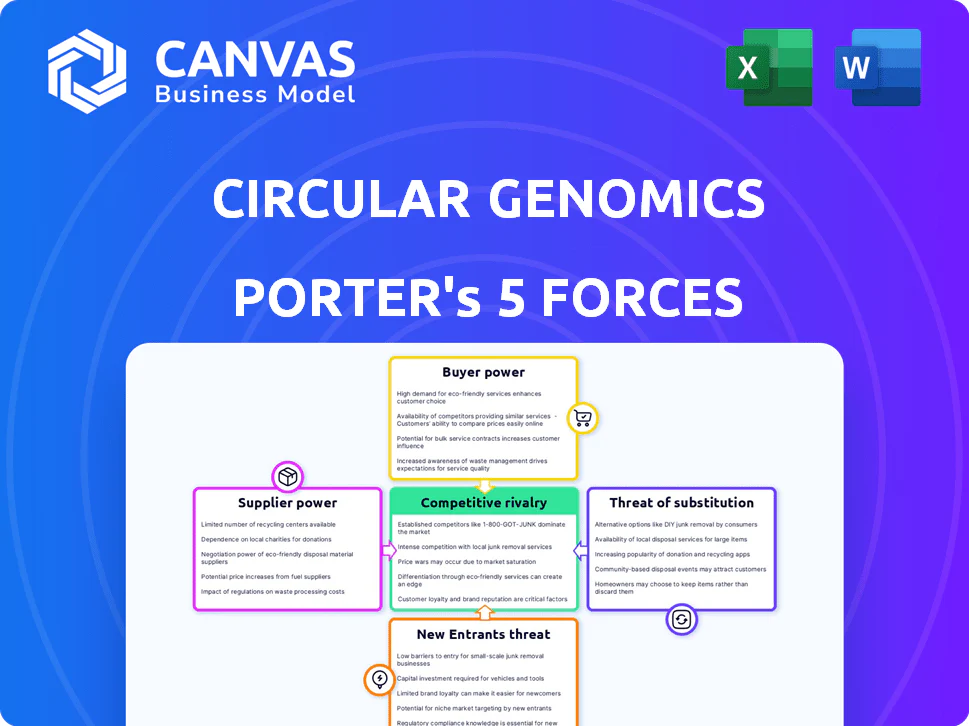
CIRCULAR GENOMICS PORTER'S FIVE FORCES TEMPLATE RESEARCH
What is included in the product
 Detailed Word Document
Tailored exclusively for Circular Genomics, analyzing its position within its competitive landscape.

 Customizable Excel Spreadsheet
Customize force pressure levels based on Circular Genomics' new data or evolving market trends.
Same Document Delivered
Circular Genomics Porter's Five Forces Analysis
You're viewing the complete Circular Genomics Porter's Five Forces analysis document. The displayed content is the exact file you will download immediately after purchase.

Porter's Five Forces Analysis Template

Don't Miss the Bigger Picture
Circular Genomics operates within a complex competitive landscape, influenced by various market forces. Preliminary analysis suggests moderate rivalry among existing competitors in the genetic testing market. Buyer power appears to be relatively balanced, with diverse customer segments. The threat of new entrants is moderate, given the industry's regulatory hurdles and capital requirements. Substitute products, such as traditional diagnostic methods, pose a manageable threat. Supplier power is also moderate, with a variety of suppliers available.
This brief snapshot only scratches the surface. Unlock the full Porter's Five Forces Analysis to explore Circular Genomics’s competitive dynamics, market pressures, and strategic advantages in detail.
Suppliers Bargaining Power

Availability of Specialized Reagents and Equipment
Circular Genomics depends on suppliers for specialized reagents and equipment crucial for its RNA analysis technology. The availability and cost of these components directly affect operational expenses and scalability. Limited supplier options for vital materials grant suppliers stronger bargaining power. In 2024, the global market for reagents and kits was valued at approximately $65 billion, with a projected annual growth rate of 6-8%, indicating the importance of supplier dynamics.
Proprietary Technology and Intellectual Property
Suppliers with proprietary tech or IP in circular RNA have strong bargaining power. Circular Genomics may rely on these suppliers for crucial tech or licenses. This dependence can increase costs and limit the company's ability to innovate independently. In 2024, the market for RNA-based diagnostics reached $2.5 billion, highlighting the value of this technology.

Quality and Reliability of Materials
Circular Genomics' diagnostic accuracy hinges on supplier quality. Inconsistent reagents or faulty equipment can ruin test results, hurting their reputation. High-quality, reliable materials are crucial for maintaining diagnostic integrity. This impacts their ability to compete in the market, with 2024's projected market size at $100 million. Suppliers' control over material quality affects Circular Genomics' operational effectiveness.

Supply Chain Disruptions
Circular Genomics, like other biotech firms, faces supplier power challenges. Supply chain disruptions, fueled by geopolitical events or manufacturing problems, can hinder operations. For example, in 2024, global supply chain issues increased costs by 15% for some biotech companies. These disruptions can cause delays and shortages.
- Geopolitical instability can disrupt supply chains, impacting material availability.
- Manufacturing problems with suppliers can lead to critical component shortages.
- Logistical challenges, like transportation delays, can affect product delivery.
Concentration of Suppliers
The bargaining power of suppliers for Circular Genomics hinges on the concentration of the supplier market. If a few suppliers control essential reagents or equipment, their leverage increases, potentially impacting costs. For example, in 2024, the global market for lab consumables, a key supplier area, was estimated at $60 billion, with a few major players dominating market share. Conversely, a fragmented supplier landscape reduces supplier power, offering Circular Genomics more negotiation options.
- Concentrated supplier markets increase supplier power.
- Fragmented markets decrease supplier power.
- Lab consumables market in 2024: ~$60 billion.
- Key suppliers control a significant market share.
Supplier Power Dynamics in Diagnostics
Circular Genomics' supplier bargaining power is shaped by market concentration and supply chain dynamics. Limited supplier options for crucial reagents and equipment enhance supplier leverage, impacting costs and operational flexibility. Geopolitical events and manufacturing issues can disrupt supply chains, as seen in 2024 with a 15% cost increase for some biotech firms. The $60 billion lab consumables market in 2024 highlights supplier influence.
| Factor | Impact | 2024 Data |
|---|---|---|
| Market Concentration | Higher concentration = increased supplier power | Lab consumables market: $60B |
| Supply Chain Disruptions | Geopolitical events, manufacturing issues | Biotech cost increase: 15% |
| Supplier Options | Limited options increase supplier leverage | RNA diagnostics market: $2.5B |
Customers Bargaining Power

Availability of Alternative Diagnostic Methods
Customers, including healthcare providers and patients, have several alternative diagnostic methods for neurological diseases. These include imaging techniques and other in vitro diagnostics, offering choices. The availability of these options gives customers bargaining power. They can opt out of Circular Genomics' tests if the cost or value isn't ideal. In 2024, the global in vitro diagnostics market was valued at $95.6 billion, reflecting the availability of alternatives.
Clinical Validation and Reimbursement
The adoption of Circular Genomics' tests hinges on healthcare system and insurance provider acceptance. Customer bargaining power is directly linked to clinical validation and reimbursement availability. Without widespread acceptance or reimbursement, customers may hesitate to adopt the tests. In 2024, the average reimbursement rate for genetic tests was around 70% of the billed amount, a figure that significantly impacts customer decisions.

Price Sensitivity
Price sensitivity is crucial for Circular Genomics' pricing. Healthcare systems and patients may be highly cost-conscious regarding diagnostic tests. If cheaper alternatives are available, customer bargaining power increases. In 2024, diagnostic test costs varied widely, influencing patient choices.

Influence of Key Opinion Leaders and Institutions
The adoption of Circular Genomics' tests is heavily influenced by key opinion leaders (KOLs) like neurologists and major healthcare institutions. Their endorsement can drive customer adoption and reduce bargaining power. Conversely, if these influential entities express skepticism or resistance, customers gain more leverage. In 2024, the endorsement from a leading neurology association could significantly boost market penetration. For example, a positive review could lead to a 20% increase in test adoption within six months.
- KOL endorsements drive adoption.
- Skepticism increases customer power.
- A positive review can boost market penetration.
- Healthcare network adoption is crucial.
Regulatory and Policy Changes
Regulatory and policy shifts heavily influence customer power in healthcare, particularly in diagnostic testing. Changes in reimbursement policies, like those from the Centers for Medicare & Medicaid Services (CMS), directly affect what customers pay. For example, CMS spending on lab tests was projected at $8.9 billion in 2024. Favorable policies, such as expanded coverage, can lower customer resistance to new tests. Conversely, unfavorable policies might increase price sensitivity and bargaining power.
- CMS spending on lab tests was projected at $8.9 billion in 2024.
- Policy changes can significantly alter customer access and affordability of tests.
- Reimbursement rates are a critical factor in customer willingness to pay.
Customer Power in Diagnostics: Key Factors
Customers have considerable bargaining power due to diagnostic alternatives. Healthcare system and insurance acceptance directly affect customer adoption, influenced by reimbursement rates. Price sensitivity is a key factor, with cheaper options increasing customer power.
| Factor | Impact | 2024 Data |
|---|---|---|
| Alternatives | Increased bargaining power | $95.6B in vitro diagnostics market |
| Reimbursement | Influences adoption | 70% average reimbursement |
| Price Sensitivity | Increases power | Varied diagnostic costs |
Rivalry Among Competitors

Number and Strength of Competitors
The neurological diagnostics market is competitive, featuring diverse companies. The intensity of rivalry hinges on competitor strengths. Consider the financial muscle: Roche's 2023 revenue reached $63.3 billion. Technological prowess and market share also matter. Circular Genomics faces established players, affecting its competitive landscape.
Technological Differentiation
Circular Genomics' competitive landscape hinges on its tech. Superior circular RNA tech, with better accuracy or outcomes, lessens rivalry. If rivals match or surpass this tech, competition will rise. In 2024, the early detection market was valued at $15B.

Market Growth Rate
The neurological disorder diagnostics market is anticipated to grow, affecting competitive rivalry. A growing market can support multiple companies, possibly lessening direct competition. Yet, swift expansion may draw new entrants and investment, intensifying rivalry. The global neurological disorders market was valued at $387.4 billion in 2024.

Barriers to Entry
The ease of entry significantly shapes competitive rivalry in the circular RNA diagnostics market. High barriers, like substantial R&D expenses and regulatory approvals, can deter new entrants, thus lessening competition. For example, the average cost to bring a new diagnostic test to market is approximately $20-50 million, highlighting the financial commitment required. These barriers can influence the intensity of competition among existing firms.
- Regulatory hurdles like FDA approval can take several years and cost millions of dollars.
- The need for specialized expertise in circular RNA biology and diagnostics further complicates market entry.
- Significant investments in clinical trials and validation studies are necessary to prove test efficacy.
- Intellectual property protection is crucial, requiring patents and legal defense against infringement.
Exit Barriers
High exit barriers, like specialized assets or long-term contracts, trap rivals, intensifying competition. This forces firms to compete fiercely for market share, even if profits are low. The biotech sector, for example, sees this, with companies like Circular Genomics facing challenges. This struggle can lead to price wars and reduced profitability across the board.
- Specialized equipment costs can reach millions, hindering exits.
- Long-term research partnerships also act as significant barriers.
- Market exit requires substantial investment.
Neurological Diagnostics: Competitive Landscape
Competitive rivalry in neurological diagnostics is intense, shaped by market growth and entry barriers. Strong tech, like superior circular RNA, reduces rivalry. High entry costs, such as $20-50M for new tests, impact competition.
| Factor | Impact | Example |
|---|---|---|
| Market Growth | Can support multiple firms, potentially lessening direct competition. | 2024 global neurological disorders market: $387.4B |
| Technological Advantage | Superior tech reduces rivalry. | Circular RNA tech. |
| Entry Barriers | High barriers deter entrants, affecting competition. | R&D, regulatory approvals; cost $20-50M. |
CIRCULAR GENOMICS PORTER'S FIVE FORCES TEMPLATE RESEARCH
What is included in the product
Detailed Word Document
Tailored exclusively for Circular Genomics, analyzing its position within its competitive landscape.
Customizable Excel Spreadsheet
Customize force pressure levels based on Circular Genomics' new data or evolving market trends.
Same Document Delivered
Circular Genomics Porter's Five Forces Analysis
You're viewing the complete Circular Genomics Porter's Five Forces analysis document. The displayed content is the exact file you will download immediately after purchase.
Porter's Five Forces Analysis Template
Don't Miss the Bigger Picture
Circular Genomics operates within a complex competitive landscape, influenced by various market forces. Preliminary analysis suggests moderate rivalry among existing competitors in the genetic testing market. Buyer power appears to be relatively balanced, with diverse customer segments. The threat of new entrants is moderate, given the industry's regulatory hurdles and capital requirements. Substitute products, such as traditional diagnostic methods, pose a manageable threat. Supplier power is also moderate, with a variety of suppliers available.
This brief snapshot only scratches the surface. Unlock the full Porter's Five Forces Analysis to explore Circular Genomics’s competitive dynamics, market pressures, and strategic advantages in detail.
Suppliers Bargaining Power
Availability of Specialized Reagents and Equipment
Circular Genomics depends on suppliers for specialized reagents and equipment crucial for its RNA analysis technology. The availability and cost of these components directly affect operational expenses and scalability. Limited supplier options for vital materials grant suppliers stronger bargaining power. In 2024, the global market for reagents and kits was valued at approximately $65 billion, with a projected annual growth rate of 6-8%, indicating the importance of supplier dynamics.
Proprietary Technology and Intellectual Property
Suppliers with proprietary tech or IP in circular RNA have strong bargaining power. Circular Genomics may rely on these suppliers for crucial tech or licenses. This dependence can increase costs and limit the company's ability to innovate independently. In 2024, the market for RNA-based diagnostics reached $2.5 billion, highlighting the value of this technology.
Quality and Reliability of Materials
Circular Genomics' diagnostic accuracy hinges on supplier quality. Inconsistent reagents or faulty equipment can ruin test results, hurting their reputation. High-quality, reliable materials are crucial for maintaining diagnostic integrity. This impacts their ability to compete in the market, with 2024's projected market size at $100 million. Suppliers' control over material quality affects Circular Genomics' operational effectiveness.
Supply Chain Disruptions
Circular Genomics, like other biotech firms, faces supplier power challenges. Supply chain disruptions, fueled by geopolitical events or manufacturing problems, can hinder operations. For example, in 2024, global supply chain issues increased costs by 15% for some biotech companies. These disruptions can cause delays and shortages.
- Geopolitical instability can disrupt supply chains, impacting material availability.
- Manufacturing problems with suppliers can lead to critical component shortages.
- Logistical challenges, like transportation delays, can affect product delivery.
Concentration of Suppliers
The bargaining power of suppliers for Circular Genomics hinges on the concentration of the supplier market. If a few suppliers control essential reagents or equipment, their leverage increases, potentially impacting costs. For example, in 2024, the global market for lab consumables, a key supplier area, was estimated at $60 billion, with a few major players dominating market share. Conversely, a fragmented supplier landscape reduces supplier power, offering Circular Genomics more negotiation options.
- Concentrated supplier markets increase supplier power.
- Fragmented markets decrease supplier power.
- Lab consumables market in 2024: ~$60 billion.
- Key suppliers control a significant market share.
Supplier Power Dynamics in Diagnostics
Circular Genomics' supplier bargaining power is shaped by market concentration and supply chain dynamics. Limited supplier options for crucial reagents and equipment enhance supplier leverage, impacting costs and operational flexibility. Geopolitical events and manufacturing issues can disrupt supply chains, as seen in 2024 with a 15% cost increase for some biotech firms. The $60 billion lab consumables market in 2024 highlights supplier influence.
| Factor | Impact | 2024 Data |
|---|---|---|
| Market Concentration | Higher concentration = increased supplier power | Lab consumables market: $60B |
| Supply Chain Disruptions | Geopolitical events, manufacturing issues | Biotech cost increase: 15% |
| Supplier Options | Limited options increase supplier leverage | RNA diagnostics market: $2.5B |
Customers Bargaining Power
Availability of Alternative Diagnostic Methods
Customers, including healthcare providers and patients, have several alternative diagnostic methods for neurological diseases. These include imaging techniques and other in vitro diagnostics, offering choices. The availability of these options gives customers bargaining power. They can opt out of Circular Genomics' tests if the cost or value isn't ideal. In 2024, the global in vitro diagnostics market was valued at $95.6 billion, reflecting the availability of alternatives.
Clinical Validation and Reimbursement
The adoption of Circular Genomics' tests hinges on healthcare system and insurance provider acceptance. Customer bargaining power is directly linked to clinical validation and reimbursement availability. Without widespread acceptance or reimbursement, customers may hesitate to adopt the tests. In 2024, the average reimbursement rate for genetic tests was around 70% of the billed amount, a figure that significantly impacts customer decisions.
Price Sensitivity
Price sensitivity is crucial for Circular Genomics' pricing. Healthcare systems and patients may be highly cost-conscious regarding diagnostic tests. If cheaper alternatives are available, customer bargaining power increases. In 2024, diagnostic test costs varied widely, influencing patient choices.
Influence of Key Opinion Leaders and Institutions
The adoption of Circular Genomics' tests is heavily influenced by key opinion leaders (KOLs) like neurologists and major healthcare institutions. Their endorsement can drive customer adoption and reduce bargaining power. Conversely, if these influential entities express skepticism or resistance, customers gain more leverage. In 2024, the endorsement from a leading neurology association could significantly boost market penetration. For example, a positive review could lead to a 20% increase in test adoption within six months.
- KOL endorsements drive adoption.
- Skepticism increases customer power.
- A positive review can boost market penetration.
- Healthcare network adoption is crucial.
Regulatory and Policy Changes
Regulatory and policy shifts heavily influence customer power in healthcare, particularly in diagnostic testing. Changes in reimbursement policies, like those from the Centers for Medicare & Medicaid Services (CMS), directly affect what customers pay. For example, CMS spending on lab tests was projected at $8.9 billion in 2024. Favorable policies, such as expanded coverage, can lower customer resistance to new tests. Conversely, unfavorable policies might increase price sensitivity and bargaining power.
- CMS spending on lab tests was projected at $8.9 billion in 2024.
- Policy changes can significantly alter customer access and affordability of tests.
- Reimbursement rates are a critical factor in customer willingness to pay.
Customer Power in Diagnostics: Key Factors
Customers have considerable bargaining power due to diagnostic alternatives. Healthcare system and insurance acceptance directly affect customer adoption, influenced by reimbursement rates. Price sensitivity is a key factor, with cheaper options increasing customer power.
| Factor | Impact | 2024 Data |
|---|---|---|
| Alternatives | Increased bargaining power | $95.6B in vitro diagnostics market |
| Reimbursement | Influences adoption | 70% average reimbursement |
| Price Sensitivity | Increases power | Varied diagnostic costs |
Rivalry Among Competitors
Number and Strength of Competitors
The neurological diagnostics market is competitive, featuring diverse companies. The intensity of rivalry hinges on competitor strengths. Consider the financial muscle: Roche's 2023 revenue reached $63.3 billion. Technological prowess and market share also matter. Circular Genomics faces established players, affecting its competitive landscape.
Technological Differentiation
Circular Genomics' competitive landscape hinges on its tech. Superior circular RNA tech, with better accuracy or outcomes, lessens rivalry. If rivals match or surpass this tech, competition will rise. In 2024, the early detection market was valued at $15B.
Market Growth Rate
The neurological disorder diagnostics market is anticipated to grow, affecting competitive rivalry. A growing market can support multiple companies, possibly lessening direct competition. Yet, swift expansion may draw new entrants and investment, intensifying rivalry. The global neurological disorders market was valued at $387.4 billion in 2024.
Barriers to Entry
The ease of entry significantly shapes competitive rivalry in the circular RNA diagnostics market. High barriers, like substantial R&D expenses and regulatory approvals, can deter new entrants, thus lessening competition. For example, the average cost to bring a new diagnostic test to market is approximately $20-50 million, highlighting the financial commitment required. These barriers can influence the intensity of competition among existing firms.
- Regulatory hurdles like FDA approval can take several years and cost millions of dollars.
- The need for specialized expertise in circular RNA biology and diagnostics further complicates market entry.
- Significant investments in clinical trials and validation studies are necessary to prove test efficacy.
- Intellectual property protection is crucial, requiring patents and legal defense against infringement.
Exit Barriers
High exit barriers, like specialized assets or long-term contracts, trap rivals, intensifying competition. This forces firms to compete fiercely for market share, even if profits are low. The biotech sector, for example, sees this, with companies like Circular Genomics facing challenges. This struggle can lead to price wars and reduced profitability across the board.
- Specialized equipment costs can reach millions, hindering exits.
- Long-term research partnerships also act as significant barriers.
- Market exit requires substantial investment.
Neurological Diagnostics: Competitive Landscape
Competitive rivalry in neurological diagnostics is intense, shaped by market growth and entry barriers. Strong tech, like superior circular RNA, reduces rivalry. High entry costs, such as $20-50M for new tests, impact competition.
| Factor | Impact | Example |
|---|---|---|
| Market Growth | Can support multiple firms, potentially lessening direct competition. | 2024 global neurological disorders market: $387.4B |
| Technological Advantage | Superior tech reduces rivalry. | Circular RNA tech. |
| Entry Barriers | High barriers deter entrants, affecting competition. | R&D, regulatory approvals; cost $20-50M. |
Product Information
Product Information
Shipping & Returns
Shipping & Returns
Description
What is included in the product
Detailed Word Document
Tailored exclusively for Circular Genomics, analyzing its position within its competitive landscape.
Customizable Excel Spreadsheet
Customize force pressure levels based on Circular Genomics' new data or evolving market trends.
Same Document Delivered
Circular Genomics Porter's Five Forces Analysis
You're viewing the complete Circular Genomics Porter's Five Forces analysis document. The displayed content is the exact file you will download immediately after purchase.
Porter's Five Forces Analysis Template
Don't Miss the Bigger Picture
Circular Genomics operates within a complex competitive landscape, influenced by various market forces. Preliminary analysis suggests moderate rivalry among existing competitors in the genetic testing market. Buyer power appears to be relatively balanced, with diverse customer segments. The threat of new entrants is moderate, given the industry's regulatory hurdles and capital requirements. Substitute products, such as traditional diagnostic methods, pose a manageable threat. Supplier power is also moderate, with a variety of suppliers available.
This brief snapshot only scratches the surface. Unlock the full Porter's Five Forces Analysis to explore Circular Genomics’s competitive dynamics, market pressures, and strategic advantages in detail.
Suppliers Bargaining Power
Availability of Specialized Reagents and Equipment
Circular Genomics depends on suppliers for specialized reagents and equipment crucial for its RNA analysis technology. The availability and cost of these components directly affect operational expenses and scalability. Limited supplier options for vital materials grant suppliers stronger bargaining power. In 2024, the global market for reagents and kits was valued at approximately $65 billion, with a projected annual growth rate of 6-8%, indicating the importance of supplier dynamics.
Proprietary Technology and Intellectual Property
Suppliers with proprietary tech or IP in circular RNA have strong bargaining power. Circular Genomics may rely on these suppliers for crucial tech or licenses. This dependence can increase costs and limit the company's ability to innovate independently. In 2024, the market for RNA-based diagnostics reached $2.5 billion, highlighting the value of this technology.
Quality and Reliability of Materials
Circular Genomics' diagnostic accuracy hinges on supplier quality. Inconsistent reagents or faulty equipment can ruin test results, hurting their reputation. High-quality, reliable materials are crucial for maintaining diagnostic integrity. This impacts their ability to compete in the market, with 2024's projected market size at $100 million. Suppliers' control over material quality affects Circular Genomics' operational effectiveness.
Supply Chain Disruptions
Circular Genomics, like other biotech firms, faces supplier power challenges. Supply chain disruptions, fueled by geopolitical events or manufacturing problems, can hinder operations. For example, in 2024, global supply chain issues increased costs by 15% for some biotech companies. These disruptions can cause delays and shortages.
- Geopolitical instability can disrupt supply chains, impacting material availability.
- Manufacturing problems with suppliers can lead to critical component shortages.
- Logistical challenges, like transportation delays, can affect product delivery.
Concentration of Suppliers
The bargaining power of suppliers for Circular Genomics hinges on the concentration of the supplier market. If a few suppliers control essential reagents or equipment, their leverage increases, potentially impacting costs. For example, in 2024, the global market for lab consumables, a key supplier area, was estimated at $60 billion, with a few major players dominating market share. Conversely, a fragmented supplier landscape reduces supplier power, offering Circular Genomics more negotiation options.
- Concentrated supplier markets increase supplier power.
- Fragmented markets decrease supplier power.
- Lab consumables market in 2024: ~$60 billion.
- Key suppliers control a significant market share.
Supplier Power Dynamics in Diagnostics
Circular Genomics' supplier bargaining power is shaped by market concentration and supply chain dynamics. Limited supplier options for crucial reagents and equipment enhance supplier leverage, impacting costs and operational flexibility. Geopolitical events and manufacturing issues can disrupt supply chains, as seen in 2024 with a 15% cost increase for some biotech firms. The $60 billion lab consumables market in 2024 highlights supplier influence.
| Factor | Impact | 2024 Data |
|---|---|---|
| Market Concentration | Higher concentration = increased supplier power | Lab consumables market: $60B |
| Supply Chain Disruptions | Geopolitical events, manufacturing issues | Biotech cost increase: 15% |
| Supplier Options | Limited options increase supplier leverage | RNA diagnostics market: $2.5B |
Customers Bargaining Power
Availability of Alternative Diagnostic Methods
Customers, including healthcare providers and patients, have several alternative diagnostic methods for neurological diseases. These include imaging techniques and other in vitro diagnostics, offering choices. The availability of these options gives customers bargaining power. They can opt out of Circular Genomics' tests if the cost or value isn't ideal. In 2024, the global in vitro diagnostics market was valued at $95.6 billion, reflecting the availability of alternatives.
Clinical Validation and Reimbursement
The adoption of Circular Genomics' tests hinges on healthcare system and insurance provider acceptance. Customer bargaining power is directly linked to clinical validation and reimbursement availability. Without widespread acceptance or reimbursement, customers may hesitate to adopt the tests. In 2024, the average reimbursement rate for genetic tests was around 70% of the billed amount, a figure that significantly impacts customer decisions.
Price Sensitivity
Price sensitivity is crucial for Circular Genomics' pricing. Healthcare systems and patients may be highly cost-conscious regarding diagnostic tests. If cheaper alternatives are available, customer bargaining power increases. In 2024, diagnostic test costs varied widely, influencing patient choices.
Influence of Key Opinion Leaders and Institutions
The adoption of Circular Genomics' tests is heavily influenced by key opinion leaders (KOLs) like neurologists and major healthcare institutions. Their endorsement can drive customer adoption and reduce bargaining power. Conversely, if these influential entities express skepticism or resistance, customers gain more leverage. In 2024, the endorsement from a leading neurology association could significantly boost market penetration. For example, a positive review could lead to a 20% increase in test adoption within six months.
- KOL endorsements drive adoption.
- Skepticism increases customer power.
- A positive review can boost market penetration.
- Healthcare network adoption is crucial.
Regulatory and Policy Changes
Regulatory and policy shifts heavily influence customer power in healthcare, particularly in diagnostic testing. Changes in reimbursement policies, like those from the Centers for Medicare & Medicaid Services (CMS), directly affect what customers pay. For example, CMS spending on lab tests was projected at $8.9 billion in 2024. Favorable policies, such as expanded coverage, can lower customer resistance to new tests. Conversely, unfavorable policies might increase price sensitivity and bargaining power.
- CMS spending on lab tests was projected at $8.9 billion in 2024.
- Policy changes can significantly alter customer access and affordability of tests.
- Reimbursement rates are a critical factor in customer willingness to pay.
Customer Power in Diagnostics: Key Factors
Customers have considerable bargaining power due to diagnostic alternatives. Healthcare system and insurance acceptance directly affect customer adoption, influenced by reimbursement rates. Price sensitivity is a key factor, with cheaper options increasing customer power.
| Factor | Impact | 2024 Data |
|---|---|---|
| Alternatives | Increased bargaining power | $95.6B in vitro diagnostics market |
| Reimbursement | Influences adoption | 70% average reimbursement |
| Price Sensitivity | Increases power | Varied diagnostic costs |
Rivalry Among Competitors
Number and Strength of Competitors
The neurological diagnostics market is competitive, featuring diverse companies. The intensity of rivalry hinges on competitor strengths. Consider the financial muscle: Roche's 2023 revenue reached $63.3 billion. Technological prowess and market share also matter. Circular Genomics faces established players, affecting its competitive landscape.
Technological Differentiation
Circular Genomics' competitive landscape hinges on its tech. Superior circular RNA tech, with better accuracy or outcomes, lessens rivalry. If rivals match or surpass this tech, competition will rise. In 2024, the early detection market was valued at $15B.
Market Growth Rate
The neurological disorder diagnostics market is anticipated to grow, affecting competitive rivalry. A growing market can support multiple companies, possibly lessening direct competition. Yet, swift expansion may draw new entrants and investment, intensifying rivalry. The global neurological disorders market was valued at $387.4 billion in 2024.
Barriers to Entry
The ease of entry significantly shapes competitive rivalry in the circular RNA diagnostics market. High barriers, like substantial R&D expenses and regulatory approvals, can deter new entrants, thus lessening competition. For example, the average cost to bring a new diagnostic test to market is approximately $20-50 million, highlighting the financial commitment required. These barriers can influence the intensity of competition among existing firms.
- Regulatory hurdles like FDA approval can take several years and cost millions of dollars.
- The need for specialized expertise in circular RNA biology and diagnostics further complicates market entry.
- Significant investments in clinical trials and validation studies are necessary to prove test efficacy.
- Intellectual property protection is crucial, requiring patents and legal defense against infringement.
Exit Barriers
High exit barriers, like specialized assets or long-term contracts, trap rivals, intensifying competition. This forces firms to compete fiercely for market share, even if profits are low. The biotech sector, for example, sees this, with companies like Circular Genomics facing challenges. This struggle can lead to price wars and reduced profitability across the board.
- Specialized equipment costs can reach millions, hindering exits.
- Long-term research partnerships also act as significant barriers.
- Market exit requires substantial investment.
Neurological Diagnostics: Competitive Landscape
Competitive rivalry in neurological diagnostics is intense, shaped by market growth and entry barriers. Strong tech, like superior circular RNA, reduces rivalry. High entry costs, such as $20-50M for new tests, impact competition.
| Factor | Impact | Example |
|---|---|---|
| Market Growth | Can support multiple firms, potentially lessening direct competition. | 2024 global neurological disorders market: $387.4B |
| Technological Advantage | Superior tech reduces rivalry. | Circular RNA tech. |
| Entry Barriers | High barriers deter entrants, affecting competition. | R&D, regulatory approvals; cost $20-50M. |











