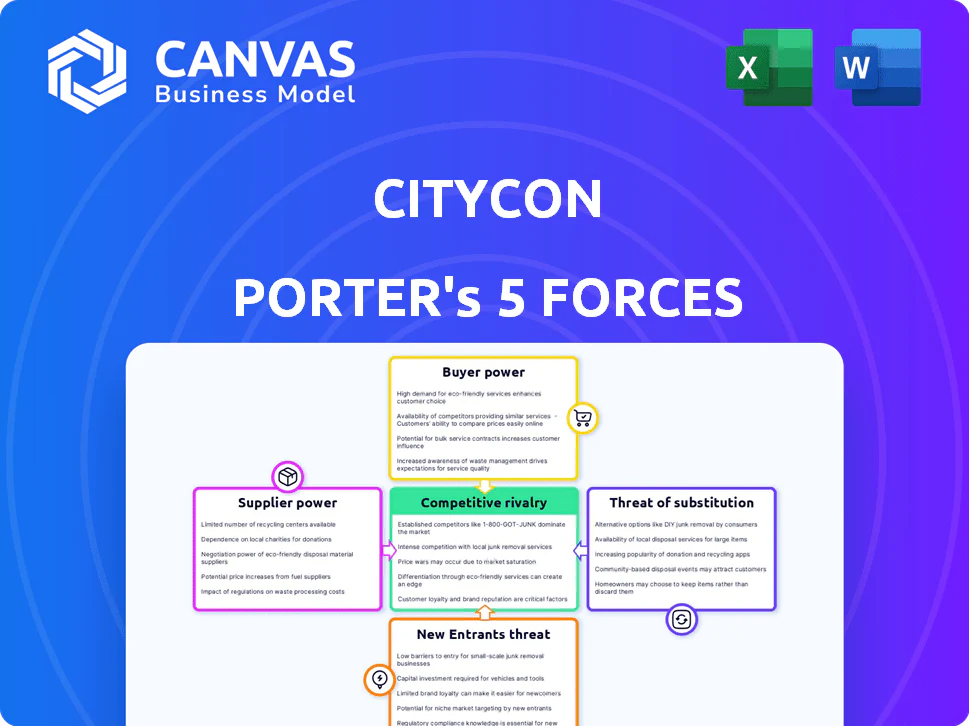
CITYCON PORTER'S FIVE FORCES TEMPLATE RESEARCH
What is included in the product
 Detailed Word Document
Tailored exclusively for Citycon, analyzing its position within its competitive landscape.

 Customizable Excel Spreadsheet
Customize pressure levels based on new data or evolving market trends.
Preview Before You Purchase
Citycon Porter's Five Forces Analysis
This preview details a Citycon Porter's Five Forces Analysis. It provides an insightful look at the company's competitive landscape. You'll see the analysis of each force and its impact. The final document's formatting and content are as displayed. What you see here is what you get immediately after purchase.

Porter's Five Forces Analysis Template

From Overview to Strategy Blueprint
Citycon's Porter's Five Forces reveal complex industry dynamics. Competitive rivalry is intense, shaped by evolving retail landscapes. Bargaining power of buyers impacts margins, necessitating strong tenant relationships. Substitute threats, like online retail, require constant adaptation. Supplier power, particularly from construction and development, adds cost pressure. New entrants pose a moderate threat, dependent on market access.
This brief snapshot only scratches the surface. Unlock the full Porter's Five Forces Analysis to explore Citycon’s competitive dynamics, market pressures, and strategic advantages in detail.
Suppliers Bargaining Power

Dependence on Construction and Maintenance Services
Citycon's dependence on construction and maintenance services is significant, especially in the Nordic region. They require these services for new developments, renovations, and property upkeep. In 2024, construction costs in the Nordics saw a rise, impacting project budgets. This can affect Citycon's operational expenses and development schedules.
Key Material Costs
Citycon's building costs are sensitive to supplier pricing. Fluctuations in steel, concrete, and timber prices directly impact construction and renovation budgets. For instance, in 2024, construction material costs rose by an average of 5-7% across Europe. This increase can strain Citycon's project finances, even with established supplier relationships.

Technology and Digital Service Providers
Citycon's reliance on tech suppliers is growing, especially for smart building systems and digital platforms. The bargaining power of these suppliers fluctuates with the uniqueness and demand of their services. For instance, the global smart building market was valued at $80.6 billion in 2023, projected to reach $168.6 billion by 2029. Citycon must navigate this landscape, balancing its needs with supplier dynamics.

Energy Providers
Citycon's large properties mean substantial energy needs, making them reliant on energy suppliers. These suppliers, particularly in the Nordic region, wield considerable pricing power. Citycon's 2024 Sustainability Accounts underscore their efforts in energy efficiency, aiming to lessen supplier influence. However, the ongoing need for electricity and heating maintains supplier leverage.
- Energy costs form a significant operational expense.
- Nordic energy markets have specific supplier dynamics.
- Sustainability efforts are a key mitigation strategy.
- Energy efficiency investments offer long-term benefits.
Specialized Service Providers
Citycon relies on specialized service providers such as security, cleaning, and waste management to maintain its properties. The bargaining power of these suppliers is influenced by the competition within the local market. For example, Citycon has partnerships with companies like Europress Group for waste management and RTK-Palvelu for cleaning services. These relationships impact Citycon's operational costs and service quality. The company's strategy involves managing these supplier relationships effectively.
- In 2024, Citycon's operational expenses included significant costs for these services, reflecting their importance.
- The availability of alternative suppliers in the local market directly affects Citycon's negotiation leverage.
- Efficient waste management is crucial for meeting environmental standards and reducing costs.
- Citycon's financial reports detail the expenditures related to these essential services.
Supplier Dynamics: Impact on Real Estate Costs
Citycon faces supplier power in construction, tech, and energy. Construction material costs rose 5-7% in 2024 across Europe. The smart building market, valued at $80.6B in 2023, affects tech supplier dynamics. Energy costs and specialized services also impact operational expenses.
| Supplier Type | Impact on Citycon | 2024 Data |
|---|---|---|
| Construction | Cost of projects, development | Material cost increase: 5-7% |
| Tech | Smart building systems, digital platforms | Smart building market: $80.6B (2023) |
| Energy | Operational expenses | Significant cost component |
Customers Bargaining Power

Tenant Concentration
Tenant concentration affects customer bargaining power at Citycon. Large tenants can wield more influence in lease talks. Citycon's focus on essential retail, like groceries, offers some stability. In 2024, Citycon's largest tenants include Kesko and S Group. These anchor tenants have significant negotiating power.
Tenant Mix and Desirability
Citycon's attractive locations and tenant mix affect customer attraction and retention. A strong mix lowers tenant bargaining power. Citycon focuses on urban hubs with diverse offerings. In 2024, Citycon's occupancy rate was 94.6%, showing strong tenant demand. Its strategy aims to boost footfall and tenant appeal.

Customer Footfall and Sales Performance
Citycon's tenants' success hinges on customer footfall and sales. This directly impacts Citycon's bargaining power. Positive trends, like the 2024 rise in like-for-like footfall and tenant sales, boost Citycon's negotiation position. Strong sales figures provide a solid foundation for lease agreements.

Lease Agreement Terms
Lease agreement terms, like rent and duration, are negotiated. Tenants gain leverage in competitive markets. Citycon's 2024 average rent rose, driven by indexation. This influences customer bargaining power. Understanding these dynamics is key for financial decisions.
- Negotiation of lease terms impacts tenant costs.
- Market competition can shift bargaining power.
- Citycon's 2024 rent increase was partly due to indexation.
- These factors influence investment risk and return.
Tenant Operating Costs
Tenants' operating costs significantly affect their ability to pay rent, influencing their bargaining power. These costs include rent, maintenance, and energy expenses. Citycon's energy-efficient initiatives directly impact these expenses, potentially lowering them. This helps maintain tenant profitability and supports their capacity to meet rent obligations. Reduced operational costs can enhance tenant satisfaction and retention.
- In 2024, Citycon reported a 12% decrease in energy consumption across its portfolio due to efficiency measures.
- Average rent per square meter in Citycon's shopping centers was approximately €25 in 2024.
- Maintenance fees typically range from €5 to €10 per square meter annually, varying by property.
- Energy costs represent about 10-15% of total operating costs for retail tenants.
Tenant Power Dynamics: Key Factors & 2024 Data
Citycon's customer bargaining power is influenced by tenant concentration and lease terms. Large tenants like Kesko and S Group have significant leverage. Market conditions and operating costs also affect tenant negotiation strength. In 2024, average rent was about €25/sqm.
| Factor | Impact | 2024 Data |
|---|---|---|
| Tenant Concentration | Higher concentration increases power | Kesko, S Group as key tenants |
| Lease Terms | Negotiated rent, duration | Rent rose due to indexation |
| Operating Costs | Affects ability to pay | Energy consumption down 12% |
Rivalry Among Competitors

Presence of Other Property Owners and Developers
Citycon faces rivalry from Nordic real estate competitors. These include shopping center owners, managers, and developers. Competition intensity differs based on location and property type. For example, in 2024, retail sales in Citycon's shopping centers reached €2.8 billion. This demonstrates the scale of competitive activity.
Availability of Competing Properties
Citycon faces rivalry from other shopping centers and mixed-use developments. In 2024, competition intensified, impacting occupancy rates. Citycon's focus on urban hubs with good transport, like Helsinki's Kamppi, helps differentiate. This strategy aims to attract both tenants and customers despite the rivalry.

Differentiation through Mixed-Use Strategy
Citycon's mixed-use strategy, blending retail with residential and office spaces, differentiates it from competitors. This approach creates unique destinations, enhancing customer appeal. In 2024, Citycon's strategy increased foot traffic and revenue. This strategy can be a strong competitive advantage, especially in urban areas.

Geographic Market Concentration
Citycon's geographic market concentration is primarily in the Nordics and the Baltics. Its portfolio is heavily weighted in Finland, Norway, and Sweden. Competition intensity varies by country and city, impacting asset performance.
- Finland represents the largest portion of Citycon's portfolio.
- Norway and Sweden are key markets, with a growing presence in Estonia and Denmark.
- Competition is most fierce in major urban centers where multiple shopping centers compete for customers.
- Local market dynamics, including consumer spending and retail trends, influence Citycon's competitive position.
Market Conditions and Economic Climate
Market conditions significantly shape competitive rivalry, with economic growth, consumer spending, and real estate investment trends playing key roles. In 2024, the Nordic real estate market showed increased transaction volumes, indicating strong interest in specific segments. However, rising interest rates and inflation continue to impact investor confidence, influencing the intensity of competition among real estate companies like Citycon. These economic pressures require strategic agility.
- Nordic real estate transaction volumes increased in 2024.
- Rising interest rates and inflation impact investor confidence.
- Specific real estate segments attract strong interest.
- Economic pressures necessitate strategic adaptability.
Citycon's €2.8B Retail Sales Amidst Fierce Competition
Competitive rivalry for Citycon is high, especially in urban areas. Competitors include other shopping centers and mixed-use developments. In 2024, Citycon's retail sales reached €2.8 billion, highlighting the competition's scale.
| Metric | 2024 Value | Notes |
|---|---|---|
| Retail Sales | €2.8B | Citycon's shopping centers |
| Transaction Volumes | Increased | Nordic real estate |
| Occupancy Rates | Impacted | Competition intensity |
Original: $10.00
-65%$10.00
$3.50CITYCON PORTER'S FIVE FORCES TEMPLATE RESEARCH
What is included in the product
Detailed Word Document
Tailored exclusively for Citycon, analyzing its position within its competitive landscape.
Customizable Excel Spreadsheet
Customize pressure levels based on new data or evolving market trends.
Preview Before You Purchase
Citycon Porter's Five Forces Analysis
This preview details a Citycon Porter's Five Forces Analysis. It provides an insightful look at the company's competitive landscape. You'll see the analysis of each force and its impact. The final document's formatting and content are as displayed. What you see here is what you get immediately after purchase.
Porter's Five Forces Analysis Template
From Overview to Strategy Blueprint
Citycon's Porter's Five Forces reveal complex industry dynamics. Competitive rivalry is intense, shaped by evolving retail landscapes. Bargaining power of buyers impacts margins, necessitating strong tenant relationships. Substitute threats, like online retail, require constant adaptation. Supplier power, particularly from construction and development, adds cost pressure. New entrants pose a moderate threat, dependent on market access.
This brief snapshot only scratches the surface. Unlock the full Porter's Five Forces Analysis to explore Citycon’s competitive dynamics, market pressures, and strategic advantages in detail.
Suppliers Bargaining Power
Dependence on Construction and Maintenance Services
Citycon's dependence on construction and maintenance services is significant, especially in the Nordic region. They require these services for new developments, renovations, and property upkeep. In 2024, construction costs in the Nordics saw a rise, impacting project budgets. This can affect Citycon's operational expenses and development schedules.
Key Material Costs
Citycon's building costs are sensitive to supplier pricing. Fluctuations in steel, concrete, and timber prices directly impact construction and renovation budgets. For instance, in 2024, construction material costs rose by an average of 5-7% across Europe. This increase can strain Citycon's project finances, even with established supplier relationships.
Technology and Digital Service Providers
Citycon's reliance on tech suppliers is growing, especially for smart building systems and digital platforms. The bargaining power of these suppliers fluctuates with the uniqueness and demand of their services. For instance, the global smart building market was valued at $80.6 billion in 2023, projected to reach $168.6 billion by 2029. Citycon must navigate this landscape, balancing its needs with supplier dynamics.
Energy Providers
Citycon's large properties mean substantial energy needs, making them reliant on energy suppliers. These suppliers, particularly in the Nordic region, wield considerable pricing power. Citycon's 2024 Sustainability Accounts underscore their efforts in energy efficiency, aiming to lessen supplier influence. However, the ongoing need for electricity and heating maintains supplier leverage.
- Energy costs form a significant operational expense.
- Nordic energy markets have specific supplier dynamics.
- Sustainability efforts are a key mitigation strategy.
- Energy efficiency investments offer long-term benefits.
Specialized Service Providers
Citycon relies on specialized service providers such as security, cleaning, and waste management to maintain its properties. The bargaining power of these suppliers is influenced by the competition within the local market. For example, Citycon has partnerships with companies like Europress Group for waste management and RTK-Palvelu for cleaning services. These relationships impact Citycon's operational costs and service quality. The company's strategy involves managing these supplier relationships effectively.
- In 2024, Citycon's operational expenses included significant costs for these services, reflecting their importance.
- The availability of alternative suppliers in the local market directly affects Citycon's negotiation leverage.
- Efficient waste management is crucial for meeting environmental standards and reducing costs.
- Citycon's financial reports detail the expenditures related to these essential services.
Supplier Dynamics: Impact on Real Estate Costs
Citycon faces supplier power in construction, tech, and energy. Construction material costs rose 5-7% in 2024 across Europe. The smart building market, valued at $80.6B in 2023, affects tech supplier dynamics. Energy costs and specialized services also impact operational expenses.
| Supplier Type | Impact on Citycon | 2024 Data |
|---|---|---|
| Construction | Cost of projects, development | Material cost increase: 5-7% |
| Tech | Smart building systems, digital platforms | Smart building market: $80.6B (2023) |
| Energy | Operational expenses | Significant cost component |
Customers Bargaining Power
Tenant Concentration
Tenant concentration affects customer bargaining power at Citycon. Large tenants can wield more influence in lease talks. Citycon's focus on essential retail, like groceries, offers some stability. In 2024, Citycon's largest tenants include Kesko and S Group. These anchor tenants have significant negotiating power.
Tenant Mix and Desirability
Citycon's attractive locations and tenant mix affect customer attraction and retention. A strong mix lowers tenant bargaining power. Citycon focuses on urban hubs with diverse offerings. In 2024, Citycon's occupancy rate was 94.6%, showing strong tenant demand. Its strategy aims to boost footfall and tenant appeal.
Customer Footfall and Sales Performance
Citycon's tenants' success hinges on customer footfall and sales. This directly impacts Citycon's bargaining power. Positive trends, like the 2024 rise in like-for-like footfall and tenant sales, boost Citycon's negotiation position. Strong sales figures provide a solid foundation for lease agreements.
Lease Agreement Terms
Lease agreement terms, like rent and duration, are negotiated. Tenants gain leverage in competitive markets. Citycon's 2024 average rent rose, driven by indexation. This influences customer bargaining power. Understanding these dynamics is key for financial decisions.
- Negotiation of lease terms impacts tenant costs.
- Market competition can shift bargaining power.
- Citycon's 2024 rent increase was partly due to indexation.
- These factors influence investment risk and return.
Tenant Operating Costs
Tenants' operating costs significantly affect their ability to pay rent, influencing their bargaining power. These costs include rent, maintenance, and energy expenses. Citycon's energy-efficient initiatives directly impact these expenses, potentially lowering them. This helps maintain tenant profitability and supports their capacity to meet rent obligations. Reduced operational costs can enhance tenant satisfaction and retention.
- In 2024, Citycon reported a 12% decrease in energy consumption across its portfolio due to efficiency measures.
- Average rent per square meter in Citycon's shopping centers was approximately €25 in 2024.
- Maintenance fees typically range from €5 to €10 per square meter annually, varying by property.
- Energy costs represent about 10-15% of total operating costs for retail tenants.
Tenant Power Dynamics: Key Factors & 2024 Data
Citycon's customer bargaining power is influenced by tenant concentration and lease terms. Large tenants like Kesko and S Group have significant leverage. Market conditions and operating costs also affect tenant negotiation strength. In 2024, average rent was about €25/sqm.
| Factor | Impact | 2024 Data |
|---|---|---|
| Tenant Concentration | Higher concentration increases power | Kesko, S Group as key tenants |
| Lease Terms | Negotiated rent, duration | Rent rose due to indexation |
| Operating Costs | Affects ability to pay | Energy consumption down 12% |
Rivalry Among Competitors
Presence of Other Property Owners and Developers
Citycon faces rivalry from Nordic real estate competitors. These include shopping center owners, managers, and developers. Competition intensity differs based on location and property type. For example, in 2024, retail sales in Citycon's shopping centers reached €2.8 billion. This demonstrates the scale of competitive activity.
Availability of Competing Properties
Citycon faces rivalry from other shopping centers and mixed-use developments. In 2024, competition intensified, impacting occupancy rates. Citycon's focus on urban hubs with good transport, like Helsinki's Kamppi, helps differentiate. This strategy aims to attract both tenants and customers despite the rivalry.
Differentiation through Mixed-Use Strategy
Citycon's mixed-use strategy, blending retail with residential and office spaces, differentiates it from competitors. This approach creates unique destinations, enhancing customer appeal. In 2024, Citycon's strategy increased foot traffic and revenue. This strategy can be a strong competitive advantage, especially in urban areas.
Geographic Market Concentration
Citycon's geographic market concentration is primarily in the Nordics and the Baltics. Its portfolio is heavily weighted in Finland, Norway, and Sweden. Competition intensity varies by country and city, impacting asset performance.
- Finland represents the largest portion of Citycon's portfolio.
- Norway and Sweden are key markets, with a growing presence in Estonia and Denmark.
- Competition is most fierce in major urban centers where multiple shopping centers compete for customers.
- Local market dynamics, including consumer spending and retail trends, influence Citycon's competitive position.
Market Conditions and Economic Climate
Market conditions significantly shape competitive rivalry, with economic growth, consumer spending, and real estate investment trends playing key roles. In 2024, the Nordic real estate market showed increased transaction volumes, indicating strong interest in specific segments. However, rising interest rates and inflation continue to impact investor confidence, influencing the intensity of competition among real estate companies like Citycon. These economic pressures require strategic agility.
- Nordic real estate transaction volumes increased in 2024.
- Rising interest rates and inflation impact investor confidence.
- Specific real estate segments attract strong interest.
- Economic pressures necessitate strategic adaptability.
Citycon's €2.8B Retail Sales Amidst Fierce Competition
Competitive rivalry for Citycon is high, especially in urban areas. Competitors include other shopping centers and mixed-use developments. In 2024, Citycon's retail sales reached €2.8 billion, highlighting the competition's scale.
| Metric | 2024 Value | Notes |
|---|---|---|
| Retail Sales | €2.8B | Citycon's shopping centers |
| Transaction Volumes | Increased | Nordic real estate |
| Occupancy Rates | Impacted | Competition intensity |
Product Information
Product Information
Shipping & Returns
Shipping & Returns
Description
What is included in the product
Detailed Word Document
Tailored exclusively for Citycon, analyzing its position within its competitive landscape.
Customizable Excel Spreadsheet
Customize pressure levels based on new data or evolving market trends.
Preview Before You Purchase
Citycon Porter's Five Forces Analysis
This preview details a Citycon Porter's Five Forces Analysis. It provides an insightful look at the company's competitive landscape. You'll see the analysis of each force and its impact. The final document's formatting and content are as displayed. What you see here is what you get immediately after purchase.
Porter's Five Forces Analysis Template
From Overview to Strategy Blueprint
Citycon's Porter's Five Forces reveal complex industry dynamics. Competitive rivalry is intense, shaped by evolving retail landscapes. Bargaining power of buyers impacts margins, necessitating strong tenant relationships. Substitute threats, like online retail, require constant adaptation. Supplier power, particularly from construction and development, adds cost pressure. New entrants pose a moderate threat, dependent on market access.
This brief snapshot only scratches the surface. Unlock the full Porter's Five Forces Analysis to explore Citycon’s competitive dynamics, market pressures, and strategic advantages in detail.
Suppliers Bargaining Power
Dependence on Construction and Maintenance Services
Citycon's dependence on construction and maintenance services is significant, especially in the Nordic region. They require these services for new developments, renovations, and property upkeep. In 2024, construction costs in the Nordics saw a rise, impacting project budgets. This can affect Citycon's operational expenses and development schedules.
Key Material Costs
Citycon's building costs are sensitive to supplier pricing. Fluctuations in steel, concrete, and timber prices directly impact construction and renovation budgets. For instance, in 2024, construction material costs rose by an average of 5-7% across Europe. This increase can strain Citycon's project finances, even with established supplier relationships.
Technology and Digital Service Providers
Citycon's reliance on tech suppliers is growing, especially for smart building systems and digital platforms. The bargaining power of these suppliers fluctuates with the uniqueness and demand of their services. For instance, the global smart building market was valued at $80.6 billion in 2023, projected to reach $168.6 billion by 2029. Citycon must navigate this landscape, balancing its needs with supplier dynamics.
Energy Providers
Citycon's large properties mean substantial energy needs, making them reliant on energy suppliers. These suppliers, particularly in the Nordic region, wield considerable pricing power. Citycon's 2024 Sustainability Accounts underscore their efforts in energy efficiency, aiming to lessen supplier influence. However, the ongoing need for electricity and heating maintains supplier leverage.
- Energy costs form a significant operational expense.
- Nordic energy markets have specific supplier dynamics.
- Sustainability efforts are a key mitigation strategy.
- Energy efficiency investments offer long-term benefits.
Specialized Service Providers
Citycon relies on specialized service providers such as security, cleaning, and waste management to maintain its properties. The bargaining power of these suppliers is influenced by the competition within the local market. For example, Citycon has partnerships with companies like Europress Group for waste management and RTK-Palvelu for cleaning services. These relationships impact Citycon's operational costs and service quality. The company's strategy involves managing these supplier relationships effectively.
- In 2024, Citycon's operational expenses included significant costs for these services, reflecting their importance.
- The availability of alternative suppliers in the local market directly affects Citycon's negotiation leverage.
- Efficient waste management is crucial for meeting environmental standards and reducing costs.
- Citycon's financial reports detail the expenditures related to these essential services.
Supplier Dynamics: Impact on Real Estate Costs
Citycon faces supplier power in construction, tech, and energy. Construction material costs rose 5-7% in 2024 across Europe. The smart building market, valued at $80.6B in 2023, affects tech supplier dynamics. Energy costs and specialized services also impact operational expenses.
| Supplier Type | Impact on Citycon | 2024 Data |
|---|---|---|
| Construction | Cost of projects, development | Material cost increase: 5-7% |
| Tech | Smart building systems, digital platforms | Smart building market: $80.6B (2023) |
| Energy | Operational expenses | Significant cost component |
Customers Bargaining Power
Tenant Concentration
Tenant concentration affects customer bargaining power at Citycon. Large tenants can wield more influence in lease talks. Citycon's focus on essential retail, like groceries, offers some stability. In 2024, Citycon's largest tenants include Kesko and S Group. These anchor tenants have significant negotiating power.
Tenant Mix and Desirability
Citycon's attractive locations and tenant mix affect customer attraction and retention. A strong mix lowers tenant bargaining power. Citycon focuses on urban hubs with diverse offerings. In 2024, Citycon's occupancy rate was 94.6%, showing strong tenant demand. Its strategy aims to boost footfall and tenant appeal.
Customer Footfall and Sales Performance
Citycon's tenants' success hinges on customer footfall and sales. This directly impacts Citycon's bargaining power. Positive trends, like the 2024 rise in like-for-like footfall and tenant sales, boost Citycon's negotiation position. Strong sales figures provide a solid foundation for lease agreements.
Lease Agreement Terms
Lease agreement terms, like rent and duration, are negotiated. Tenants gain leverage in competitive markets. Citycon's 2024 average rent rose, driven by indexation. This influences customer bargaining power. Understanding these dynamics is key for financial decisions.
- Negotiation of lease terms impacts tenant costs.
- Market competition can shift bargaining power.
- Citycon's 2024 rent increase was partly due to indexation.
- These factors influence investment risk and return.
Tenant Operating Costs
Tenants' operating costs significantly affect their ability to pay rent, influencing their bargaining power. These costs include rent, maintenance, and energy expenses. Citycon's energy-efficient initiatives directly impact these expenses, potentially lowering them. This helps maintain tenant profitability and supports their capacity to meet rent obligations. Reduced operational costs can enhance tenant satisfaction and retention.
- In 2024, Citycon reported a 12% decrease in energy consumption across its portfolio due to efficiency measures.
- Average rent per square meter in Citycon's shopping centers was approximately €25 in 2024.
- Maintenance fees typically range from €5 to €10 per square meter annually, varying by property.
- Energy costs represent about 10-15% of total operating costs for retail tenants.
Tenant Power Dynamics: Key Factors & 2024 Data
Citycon's customer bargaining power is influenced by tenant concentration and lease terms. Large tenants like Kesko and S Group have significant leverage. Market conditions and operating costs also affect tenant negotiation strength. In 2024, average rent was about €25/sqm.
| Factor | Impact | 2024 Data |
|---|---|---|
| Tenant Concentration | Higher concentration increases power | Kesko, S Group as key tenants |
| Lease Terms | Negotiated rent, duration | Rent rose due to indexation |
| Operating Costs | Affects ability to pay | Energy consumption down 12% |
Rivalry Among Competitors
Presence of Other Property Owners and Developers
Citycon faces rivalry from Nordic real estate competitors. These include shopping center owners, managers, and developers. Competition intensity differs based on location and property type. For example, in 2024, retail sales in Citycon's shopping centers reached €2.8 billion. This demonstrates the scale of competitive activity.
Availability of Competing Properties
Citycon faces rivalry from other shopping centers and mixed-use developments. In 2024, competition intensified, impacting occupancy rates. Citycon's focus on urban hubs with good transport, like Helsinki's Kamppi, helps differentiate. This strategy aims to attract both tenants and customers despite the rivalry.
Differentiation through Mixed-Use Strategy
Citycon's mixed-use strategy, blending retail with residential and office spaces, differentiates it from competitors. This approach creates unique destinations, enhancing customer appeal. In 2024, Citycon's strategy increased foot traffic and revenue. This strategy can be a strong competitive advantage, especially in urban areas.
Geographic Market Concentration
Citycon's geographic market concentration is primarily in the Nordics and the Baltics. Its portfolio is heavily weighted in Finland, Norway, and Sweden. Competition intensity varies by country and city, impacting asset performance.
- Finland represents the largest portion of Citycon's portfolio.
- Norway and Sweden are key markets, with a growing presence in Estonia and Denmark.
- Competition is most fierce in major urban centers where multiple shopping centers compete for customers.
- Local market dynamics, including consumer spending and retail trends, influence Citycon's competitive position.
Market Conditions and Economic Climate
Market conditions significantly shape competitive rivalry, with economic growth, consumer spending, and real estate investment trends playing key roles. In 2024, the Nordic real estate market showed increased transaction volumes, indicating strong interest in specific segments. However, rising interest rates and inflation continue to impact investor confidence, influencing the intensity of competition among real estate companies like Citycon. These economic pressures require strategic agility.
- Nordic real estate transaction volumes increased in 2024.
- Rising interest rates and inflation impact investor confidence.
- Specific real estate segments attract strong interest.
- Economic pressures necessitate strategic adaptability.
Citycon's €2.8B Retail Sales Amidst Fierce Competition
Competitive rivalry for Citycon is high, especially in urban areas. Competitors include other shopping centers and mixed-use developments. In 2024, Citycon's retail sales reached €2.8 billion, highlighting the competition's scale.
| Metric | 2024 Value | Notes |
|---|---|---|
| Retail Sales | €2.8B | Citycon's shopping centers |
| Transaction Volumes | Increased | Nordic real estate |
| Occupancy Rates | Impacted | Competition intensity |











