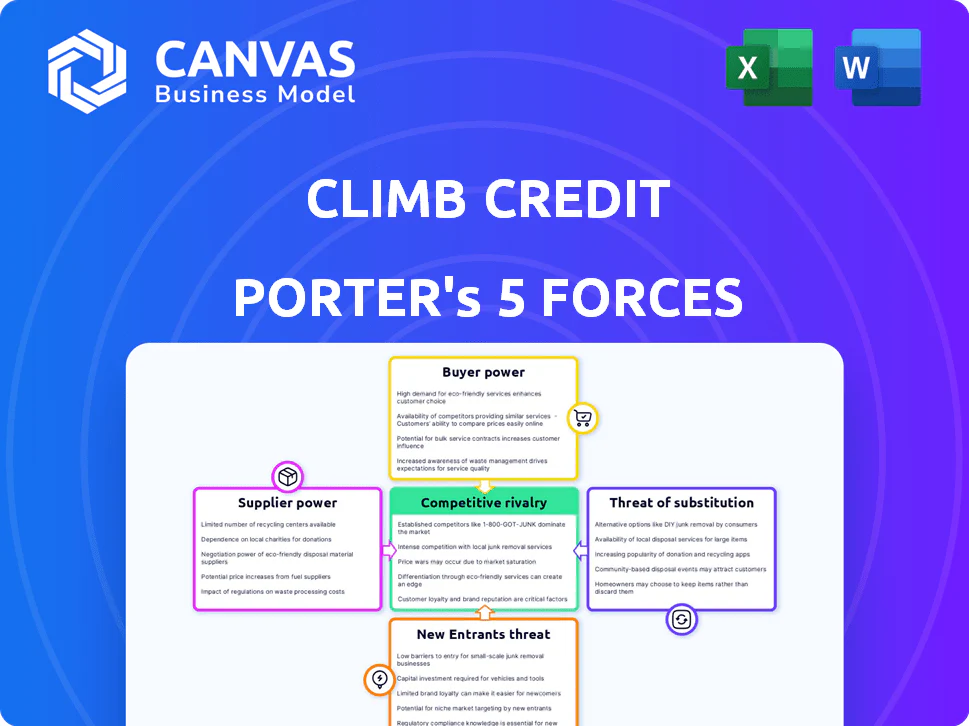
CLIMB CREDIT PORTER'S FIVE FORCES TEMPLATE RESEARCH
What is included in the product
 Detailed Word Document
Tailored exclusively for Climb Credit, analyzing its position within its competitive landscape.

 Customizable Excel Spreadsheet
Instantly update your analysis with an integrated, interactive forces chart.
Full Version Awaits
Climb Credit Porter's Five Forces Analysis
This preview showcases the comprehensive Porter's Five Forces analysis for Climb Credit that you'll receive immediately after your purchase.
It's the complete analysis – no hidden content or different versions. You'll receive this exact, fully realized document.
We present the final product here, eliminating any guesswork about the quality or depth.
The document you are currently viewing is the same one you'll get instantly after purchase.
It's a ready-to-use analysis – no additional formatting or steps are needed from your end.

Porter's Five Forces Analysis Template

From Overview to Strategy Blueprint
Climb Credit operates in an educational lending space shaped by intense competition and regulatory scrutiny. Buyer power varies depending on the specific program and borrower demographics. Substitute threats from alternative funding sources are a constant consideration. New entrants face significant barriers to entry, including compliance and brand recognition. Supplier power, primarily from educational institutions, also plays a role.
The complete report reveals the real forces shaping Climb Credit’s industry—from supplier influence to threat of new entrants. Gain actionable insights to drive smarter decision-making.
Suppliers Bargaining Power

Access to Capital
Climb Credit's capacity to provide loans hinges on securing capital. Suppliers like investors and banks wield substantial influence, setting terms, interest rates, and fund availability. For example, in 2024, interest rates influenced loan accessibility. Market shifts or supplier risk aversion can directly affect Climb Credit.
Partner Schools and Bootcamps
Climb Credit's partnerships with schools give the schools some leverage. Schools offering in-demand programs can negotiate better terms. In 2024, high-demand bootcamps saw a 10-15% increase in revenue. This allows them to influence financing options.

Data Providers
Climb Credit depends on data providers like credit bureaus for risk assessment. These suppliers hold power due to the quality and uniqueness of their data. In 2024, the credit data market was valued at over $20 billion. Data costs directly affect Climb Credit's operational expenses and underwriting strategies.

Technology Providers
Climb Credit's reliance on technology gives providers significant bargaining power. Specialized loan management software and secure online application systems are critical. The cost and dependability of these technologies directly impact Climb Credit's operations. This can influence the platform's efficiency and profitability. The global fintech market was valued at $112.5 billion in 2020 and is expected to reach $698.4 billion by 2030.
- Loan origination and servicing software providers hold considerable influence.
- Data security infrastructure vendors are crucial for protecting sensitive financial information.
- Integration depth impacts switching costs, increasing supplier power.
- Technology costs directly affect Climb Credit's operational expenses.
Regulatory Bodies
Regulatory bodies, like the Department of Education, hold substantial power over Climb Credit. Government policies, such as those affecting interest rates or loan forgiveness programs, can dramatically alter Climb Credit's profitability. Stricter consumer protection regulations increase operational costs, influencing the company's strategic decisions. The student loan market is significantly influenced by these external forces, shaping its competitive landscape.
- Federal student loan interest rates, which directly affect private lenders like Climb Credit, were around 5.5% to 7.9% in 2024.
- Changes in federal regulations can lead to increased compliance costs, potentially impacting Climb Credit's profit margins.
- Data from 2023 showed that the student loan debt in the US was approximately $1.7 trillion, highlighting the market's size.
Supplier Power Dynamics at Play
Suppliers' power affects Climb Credit's operations and profitability. Investors and banks set financial terms, impacting loan accessibility. Data providers and tech vendors also have leverage due to data quality and tech's importance. Regulatory bodies heavily influence the company's strategic decisions.
| Supplier Type | Influence Factor | 2024 Impact |
|---|---|---|
| Capital Providers (Banks, Investors) | Sets terms, interest rates, fund availability | Interest rates influenced loan access; prime rate ~8.5% |
| Data Providers (Credit Bureaus) | Data quality and uniqueness | Data market valued over $20B; costs affected operations |
| Technology Vendors | Loan management software, security | Tech costs impacted efficiency; fintech market growth projected |
Customers Bargaining Power

Student Borrowers
Student borrowers have some bargaining power due to diverse financing choices. Federal loans, private loans, and alternative lenders offer options. Factors like credit and program uniqueness affect their power. For 2024, the average federal student loan debt stood at about $37,700. Limited options for career programs may reduce borrower power with lenders like Climb Credit.
Schools and Bootcamps (as indirect customers)
Climb Credit's indirect customers include schools and bootcamps that partner to offer financing. These institutions negotiate terms, with those having strong reputations holding more leverage. In 2024, schools with high job placement saw increased demand for financial aid. This impacts Climb Credit's profitability. Competition among lenders also influences these negotiations.

Sensitivity to Interest Rates and Fees
Borrowers, like those using Climb Credit, are highly sensitive to interest rates and fees, which directly impact the total cost of their loans. Transparency in pricing is crucial, as borrowers often compare offers from different lenders. For example, in 2024, average student loan interest rates ranged from 5.5% to 8%, underscoring the financial impact. High rates or hidden fees can significantly reduce borrower demand, affecting Climb Credit's profitability.

Availability of Alternatives
The availability of alternative financing options significantly impacts Climb Credit's customer bargaining power. Students can explore income-share agreements, institutional payment plans, and loans from other private lenders. The existence of these alternatives provides students with leverage. According to a 2024 report, the market share of ISAs has grown by 15%.
- Income-Share Agreements (ISAs)
- Institutional Payment Plans
- Private Loans from Other Lenders
- Federal Student Loans
Perceived Value and Outcomes
Borrowers' perception of value heavily influences their willingness to take on loans from Climb Credit. If programs lead to good jobs, borrowers might accept less favorable terms; however, if outcomes are uncertain, borrower power strengthens. For example, the average annual salary for graduates of programs Climb Credit finances was $65,000 in 2024. This figure directly impacts borrower behavior. Increased borrower power can lead to demands for better loan terms, potentially squeezing Climb Credit's profitability.
- Average Salary: $65,000 (2024) for graduates.
- Borrower Influence: High when outcomes are uncertain.
- Loan Terms: Affected by perceived program value.
- Profitability: Can be squeezed by increased borrower power.
Student Loans: Navigating Rates and Options
Student borrowers wield bargaining power due to varied financing options like federal and private loans. Schools also influence terms, especially those with strong reputations. Borrowers are sensitive to interest rates, with average 2024 rates ranging from 5.5% to 8%.
| Factor | Impact | 2024 Data |
|---|---|---|
| Loan Alternatives | Increases Borrower Power | ISA market share grew 15% |
| Program Value | Influences Loan Acceptance | Avg. Salary: $65,000 |
| Interest Rates | Affects Demand | Rates: 5.5%-8% |
Rivalry Among Competitors

Presence of Other Private Lenders
The private student loan landscape includes major banks and online platforms. Sallie Mae, Discover, and Citizens Bank are key competitors. In 2024, the private student loan market reached approximately $100 billion. Climb Credit competes with these lenders, some with wider offerings and bigger marketing spends.
Focus on Career-Focused Programs
Climb Credit targets career-focused programs, shaping its competitive arena. Competitors, including other lenders and institutions, vie for partnerships and student financing. For example, in 2024, the student loan market saw over $1.7 trillion in outstanding debt, intensifying competition. This niche focus means Climb Credit faces rivals specializing in similar programs.

Differentiation through Partnerships and Underwriting
Climb Credit distinguishes itself by partnering with schools based on program outcomes and using alternative data in underwriting. Competitors' ability to replicate this model influences rivalry intensity. The intensity of competition is heightened if rivals can offer similar value. In 2024, the student loan market saw $1.5 trillion in outstanding debt.

Pricing and Terms Competition
Competition in interest rates, fees, and repayment terms is fierce among lenders. To attract borrowers, Climb Credit must offer competitive terms, impacting profit margins. Economic conditions and regulations significantly shape pricing strategies in the lending sector. The average interest rate for personal loans in 2024 was around 12.3%.
- Interest rates are a primary battleground, with lenders vying for the lowest rates.
- Fees, such as origination fees, add to the competitive landscape.
- Repayment terms influence borrower choices and lender profitability.
- Regulatory compliance adds complexity to pricing strategies.
Marketing and Brand Recognition
Building brand awareness and trust among prospective students and partner schools is crucial for Climb Credit's success. Competitors with strong brand recognition and effective marketing strategies pose a significant challenge to Climb Credit's market position. Climb Credit must effectively communicate its value proposition to stand out. Reaching the target audience amid competing lenders requires strategic marketing.
- In 2024, the student loan market saw over $1.7 trillion in outstanding debt.
- Effective marketing spend by competitors directly impacts market share.
- Strong brand recognition can lead to a 10-15% increase in loan applications.
- Climb Credit's marketing ROI needs to be competitive.
Student Loan Showdown: $100 Billion Market Battle
Rivalry in the private student loan market is intense, fueled by major players and niche competitors. Climb Credit faces competition from established banks and online platforms. Interest rates, fees, and marketing efforts are key battlegrounds. In 2024, the private student loan market reached approximately $100 billion.
| Factor | Impact | Data (2024) |
|---|---|---|
| Market Size | Competition Level | $100B private student loan market |
| Interest Rates | Borrower Choice | Avg. personal loan rate ~12.3% |
| Outstanding Debt | Market Saturation | Over $1.7T in student debt |
Original: $10.00
-65%$10.00
$3.50CLIMB CREDIT PORTER'S FIVE FORCES TEMPLATE RESEARCH
What is included in the product
Detailed Word Document
Tailored exclusively for Climb Credit, analyzing its position within its competitive landscape.
Customizable Excel Spreadsheet
Instantly update your analysis with an integrated, interactive forces chart.
Full Version Awaits
Climb Credit Porter's Five Forces Analysis
This preview showcases the comprehensive Porter's Five Forces analysis for Climb Credit that you'll receive immediately after your purchase.
It's the complete analysis – no hidden content or different versions. You'll receive this exact, fully realized document.
We present the final product here, eliminating any guesswork about the quality or depth.
The document you are currently viewing is the same one you'll get instantly after purchase.
It's a ready-to-use analysis – no additional formatting or steps are needed from your end.
Porter's Five Forces Analysis Template
From Overview to Strategy Blueprint
Climb Credit operates in an educational lending space shaped by intense competition and regulatory scrutiny. Buyer power varies depending on the specific program and borrower demographics. Substitute threats from alternative funding sources are a constant consideration. New entrants face significant barriers to entry, including compliance and brand recognition. Supplier power, primarily from educational institutions, also plays a role.
The complete report reveals the real forces shaping Climb Credit’s industry—from supplier influence to threat of new entrants. Gain actionable insights to drive smarter decision-making.
Suppliers Bargaining Power
Access to Capital
Climb Credit's capacity to provide loans hinges on securing capital. Suppliers like investors and banks wield substantial influence, setting terms, interest rates, and fund availability. For example, in 2024, interest rates influenced loan accessibility. Market shifts or supplier risk aversion can directly affect Climb Credit.
Partner Schools and Bootcamps
Climb Credit's partnerships with schools give the schools some leverage. Schools offering in-demand programs can negotiate better terms. In 2024, high-demand bootcamps saw a 10-15% increase in revenue. This allows them to influence financing options.
Data Providers
Climb Credit depends on data providers like credit bureaus for risk assessment. These suppliers hold power due to the quality and uniqueness of their data. In 2024, the credit data market was valued at over $20 billion. Data costs directly affect Climb Credit's operational expenses and underwriting strategies.
Technology Providers
Climb Credit's reliance on technology gives providers significant bargaining power. Specialized loan management software and secure online application systems are critical. The cost and dependability of these technologies directly impact Climb Credit's operations. This can influence the platform's efficiency and profitability. The global fintech market was valued at $112.5 billion in 2020 and is expected to reach $698.4 billion by 2030.
- Loan origination and servicing software providers hold considerable influence.
- Data security infrastructure vendors are crucial for protecting sensitive financial information.
- Integration depth impacts switching costs, increasing supplier power.
- Technology costs directly affect Climb Credit's operational expenses.
Regulatory Bodies
Regulatory bodies, like the Department of Education, hold substantial power over Climb Credit. Government policies, such as those affecting interest rates or loan forgiveness programs, can dramatically alter Climb Credit's profitability. Stricter consumer protection regulations increase operational costs, influencing the company's strategic decisions. The student loan market is significantly influenced by these external forces, shaping its competitive landscape.
- Federal student loan interest rates, which directly affect private lenders like Climb Credit, were around 5.5% to 7.9% in 2024.
- Changes in federal regulations can lead to increased compliance costs, potentially impacting Climb Credit's profit margins.
- Data from 2023 showed that the student loan debt in the US was approximately $1.7 trillion, highlighting the market's size.
Supplier Power Dynamics at Play
Suppliers' power affects Climb Credit's operations and profitability. Investors and banks set financial terms, impacting loan accessibility. Data providers and tech vendors also have leverage due to data quality and tech's importance. Regulatory bodies heavily influence the company's strategic decisions.
| Supplier Type | Influence Factor | 2024 Impact |
|---|---|---|
| Capital Providers (Banks, Investors) | Sets terms, interest rates, fund availability | Interest rates influenced loan access; prime rate ~8.5% |
| Data Providers (Credit Bureaus) | Data quality and uniqueness | Data market valued over $20B; costs affected operations |
| Technology Vendors | Loan management software, security | Tech costs impacted efficiency; fintech market growth projected |
Customers Bargaining Power
Student Borrowers
Student borrowers have some bargaining power due to diverse financing choices. Federal loans, private loans, and alternative lenders offer options. Factors like credit and program uniqueness affect their power. For 2024, the average federal student loan debt stood at about $37,700. Limited options for career programs may reduce borrower power with lenders like Climb Credit.
Schools and Bootcamps (as indirect customers)
Climb Credit's indirect customers include schools and bootcamps that partner to offer financing. These institutions negotiate terms, with those having strong reputations holding more leverage. In 2024, schools with high job placement saw increased demand for financial aid. This impacts Climb Credit's profitability. Competition among lenders also influences these negotiations.
Sensitivity to Interest Rates and Fees
Borrowers, like those using Climb Credit, are highly sensitive to interest rates and fees, which directly impact the total cost of their loans. Transparency in pricing is crucial, as borrowers often compare offers from different lenders. For example, in 2024, average student loan interest rates ranged from 5.5% to 8%, underscoring the financial impact. High rates or hidden fees can significantly reduce borrower demand, affecting Climb Credit's profitability.
Availability of Alternatives
The availability of alternative financing options significantly impacts Climb Credit's customer bargaining power. Students can explore income-share agreements, institutional payment plans, and loans from other private lenders. The existence of these alternatives provides students with leverage. According to a 2024 report, the market share of ISAs has grown by 15%.
- Income-Share Agreements (ISAs)
- Institutional Payment Plans
- Private Loans from Other Lenders
- Federal Student Loans
Perceived Value and Outcomes
Borrowers' perception of value heavily influences their willingness to take on loans from Climb Credit. If programs lead to good jobs, borrowers might accept less favorable terms; however, if outcomes are uncertain, borrower power strengthens. For example, the average annual salary for graduates of programs Climb Credit finances was $65,000 in 2024. This figure directly impacts borrower behavior. Increased borrower power can lead to demands for better loan terms, potentially squeezing Climb Credit's profitability.
- Average Salary: $65,000 (2024) for graduates.
- Borrower Influence: High when outcomes are uncertain.
- Loan Terms: Affected by perceived program value.
- Profitability: Can be squeezed by increased borrower power.
Student Loans: Navigating Rates and Options
Student borrowers wield bargaining power due to varied financing options like federal and private loans. Schools also influence terms, especially those with strong reputations. Borrowers are sensitive to interest rates, with average 2024 rates ranging from 5.5% to 8%.
| Factor | Impact | 2024 Data |
|---|---|---|
| Loan Alternatives | Increases Borrower Power | ISA market share grew 15% |
| Program Value | Influences Loan Acceptance | Avg. Salary: $65,000 |
| Interest Rates | Affects Demand | Rates: 5.5%-8% |
Rivalry Among Competitors
Presence of Other Private Lenders
The private student loan landscape includes major banks and online platforms. Sallie Mae, Discover, and Citizens Bank are key competitors. In 2024, the private student loan market reached approximately $100 billion. Climb Credit competes with these lenders, some with wider offerings and bigger marketing spends.
Focus on Career-Focused Programs
Climb Credit targets career-focused programs, shaping its competitive arena. Competitors, including other lenders and institutions, vie for partnerships and student financing. For example, in 2024, the student loan market saw over $1.7 trillion in outstanding debt, intensifying competition. This niche focus means Climb Credit faces rivals specializing in similar programs.
Differentiation through Partnerships and Underwriting
Climb Credit distinguishes itself by partnering with schools based on program outcomes and using alternative data in underwriting. Competitors' ability to replicate this model influences rivalry intensity. The intensity of competition is heightened if rivals can offer similar value. In 2024, the student loan market saw $1.5 trillion in outstanding debt.
Pricing and Terms Competition
Competition in interest rates, fees, and repayment terms is fierce among lenders. To attract borrowers, Climb Credit must offer competitive terms, impacting profit margins. Economic conditions and regulations significantly shape pricing strategies in the lending sector. The average interest rate for personal loans in 2024 was around 12.3%.
- Interest rates are a primary battleground, with lenders vying for the lowest rates.
- Fees, such as origination fees, add to the competitive landscape.
- Repayment terms influence borrower choices and lender profitability.
- Regulatory compliance adds complexity to pricing strategies.
Marketing and Brand Recognition
Building brand awareness and trust among prospective students and partner schools is crucial for Climb Credit's success. Competitors with strong brand recognition and effective marketing strategies pose a significant challenge to Climb Credit's market position. Climb Credit must effectively communicate its value proposition to stand out. Reaching the target audience amid competing lenders requires strategic marketing.
- In 2024, the student loan market saw over $1.7 trillion in outstanding debt.
- Effective marketing spend by competitors directly impacts market share.
- Strong brand recognition can lead to a 10-15% increase in loan applications.
- Climb Credit's marketing ROI needs to be competitive.
Student Loan Showdown: $100 Billion Market Battle
Rivalry in the private student loan market is intense, fueled by major players and niche competitors. Climb Credit faces competition from established banks and online platforms. Interest rates, fees, and marketing efforts are key battlegrounds. In 2024, the private student loan market reached approximately $100 billion.
| Factor | Impact | Data (2024) |
|---|---|---|
| Market Size | Competition Level | $100B private student loan market |
| Interest Rates | Borrower Choice | Avg. personal loan rate ~12.3% |
| Outstanding Debt | Market Saturation | Over $1.7T in student debt |
Product Information
Product Information
Shipping & Returns
Shipping & Returns
Description
What is included in the product
Detailed Word Document
Tailored exclusively for Climb Credit, analyzing its position within its competitive landscape.
Customizable Excel Spreadsheet
Instantly update your analysis with an integrated, interactive forces chart.
Full Version Awaits
Climb Credit Porter's Five Forces Analysis
This preview showcases the comprehensive Porter's Five Forces analysis for Climb Credit that you'll receive immediately after your purchase.
It's the complete analysis – no hidden content or different versions. You'll receive this exact, fully realized document.
We present the final product here, eliminating any guesswork about the quality or depth.
The document you are currently viewing is the same one you'll get instantly after purchase.
It's a ready-to-use analysis – no additional formatting or steps are needed from your end.
Porter's Five Forces Analysis Template
From Overview to Strategy Blueprint
Climb Credit operates in an educational lending space shaped by intense competition and regulatory scrutiny. Buyer power varies depending on the specific program and borrower demographics. Substitute threats from alternative funding sources are a constant consideration. New entrants face significant barriers to entry, including compliance and brand recognition. Supplier power, primarily from educational institutions, also plays a role.
The complete report reveals the real forces shaping Climb Credit’s industry—from supplier influence to threat of new entrants. Gain actionable insights to drive smarter decision-making.
Suppliers Bargaining Power
Access to Capital
Climb Credit's capacity to provide loans hinges on securing capital. Suppliers like investors and banks wield substantial influence, setting terms, interest rates, and fund availability. For example, in 2024, interest rates influenced loan accessibility. Market shifts or supplier risk aversion can directly affect Climb Credit.
Partner Schools and Bootcamps
Climb Credit's partnerships with schools give the schools some leverage. Schools offering in-demand programs can negotiate better terms. In 2024, high-demand bootcamps saw a 10-15% increase in revenue. This allows them to influence financing options.
Data Providers
Climb Credit depends on data providers like credit bureaus for risk assessment. These suppliers hold power due to the quality and uniqueness of their data. In 2024, the credit data market was valued at over $20 billion. Data costs directly affect Climb Credit's operational expenses and underwriting strategies.
Technology Providers
Climb Credit's reliance on technology gives providers significant bargaining power. Specialized loan management software and secure online application systems are critical. The cost and dependability of these technologies directly impact Climb Credit's operations. This can influence the platform's efficiency and profitability. The global fintech market was valued at $112.5 billion in 2020 and is expected to reach $698.4 billion by 2030.
- Loan origination and servicing software providers hold considerable influence.
- Data security infrastructure vendors are crucial for protecting sensitive financial information.
- Integration depth impacts switching costs, increasing supplier power.
- Technology costs directly affect Climb Credit's operational expenses.
Regulatory Bodies
Regulatory bodies, like the Department of Education, hold substantial power over Climb Credit. Government policies, such as those affecting interest rates or loan forgiveness programs, can dramatically alter Climb Credit's profitability. Stricter consumer protection regulations increase operational costs, influencing the company's strategic decisions. The student loan market is significantly influenced by these external forces, shaping its competitive landscape.
- Federal student loan interest rates, which directly affect private lenders like Climb Credit, were around 5.5% to 7.9% in 2024.
- Changes in federal regulations can lead to increased compliance costs, potentially impacting Climb Credit's profit margins.
- Data from 2023 showed that the student loan debt in the US was approximately $1.7 trillion, highlighting the market's size.
Supplier Power Dynamics at Play
Suppliers' power affects Climb Credit's operations and profitability. Investors and banks set financial terms, impacting loan accessibility. Data providers and tech vendors also have leverage due to data quality and tech's importance. Regulatory bodies heavily influence the company's strategic decisions.
| Supplier Type | Influence Factor | 2024 Impact |
|---|---|---|
| Capital Providers (Banks, Investors) | Sets terms, interest rates, fund availability | Interest rates influenced loan access; prime rate ~8.5% |
| Data Providers (Credit Bureaus) | Data quality and uniqueness | Data market valued over $20B; costs affected operations |
| Technology Vendors | Loan management software, security | Tech costs impacted efficiency; fintech market growth projected |
Customers Bargaining Power
Student Borrowers
Student borrowers have some bargaining power due to diverse financing choices. Federal loans, private loans, and alternative lenders offer options. Factors like credit and program uniqueness affect their power. For 2024, the average federal student loan debt stood at about $37,700. Limited options for career programs may reduce borrower power with lenders like Climb Credit.
Schools and Bootcamps (as indirect customers)
Climb Credit's indirect customers include schools and bootcamps that partner to offer financing. These institutions negotiate terms, with those having strong reputations holding more leverage. In 2024, schools with high job placement saw increased demand for financial aid. This impacts Climb Credit's profitability. Competition among lenders also influences these negotiations.
Sensitivity to Interest Rates and Fees
Borrowers, like those using Climb Credit, are highly sensitive to interest rates and fees, which directly impact the total cost of their loans. Transparency in pricing is crucial, as borrowers often compare offers from different lenders. For example, in 2024, average student loan interest rates ranged from 5.5% to 8%, underscoring the financial impact. High rates or hidden fees can significantly reduce borrower demand, affecting Climb Credit's profitability.
Availability of Alternatives
The availability of alternative financing options significantly impacts Climb Credit's customer bargaining power. Students can explore income-share agreements, institutional payment plans, and loans from other private lenders. The existence of these alternatives provides students with leverage. According to a 2024 report, the market share of ISAs has grown by 15%.
- Income-Share Agreements (ISAs)
- Institutional Payment Plans
- Private Loans from Other Lenders
- Federal Student Loans
Perceived Value and Outcomes
Borrowers' perception of value heavily influences their willingness to take on loans from Climb Credit. If programs lead to good jobs, borrowers might accept less favorable terms; however, if outcomes are uncertain, borrower power strengthens. For example, the average annual salary for graduates of programs Climb Credit finances was $65,000 in 2024. This figure directly impacts borrower behavior. Increased borrower power can lead to demands for better loan terms, potentially squeezing Climb Credit's profitability.
- Average Salary: $65,000 (2024) for graduates.
- Borrower Influence: High when outcomes are uncertain.
- Loan Terms: Affected by perceived program value.
- Profitability: Can be squeezed by increased borrower power.
Student Loans: Navigating Rates and Options
Student borrowers wield bargaining power due to varied financing options like federal and private loans. Schools also influence terms, especially those with strong reputations. Borrowers are sensitive to interest rates, with average 2024 rates ranging from 5.5% to 8%.
| Factor | Impact | 2024 Data |
|---|---|---|
| Loan Alternatives | Increases Borrower Power | ISA market share grew 15% |
| Program Value | Influences Loan Acceptance | Avg. Salary: $65,000 |
| Interest Rates | Affects Demand | Rates: 5.5%-8% |
Rivalry Among Competitors
Presence of Other Private Lenders
The private student loan landscape includes major banks and online platforms. Sallie Mae, Discover, and Citizens Bank are key competitors. In 2024, the private student loan market reached approximately $100 billion. Climb Credit competes with these lenders, some with wider offerings and bigger marketing spends.
Focus on Career-Focused Programs
Climb Credit targets career-focused programs, shaping its competitive arena. Competitors, including other lenders and institutions, vie for partnerships and student financing. For example, in 2024, the student loan market saw over $1.7 trillion in outstanding debt, intensifying competition. This niche focus means Climb Credit faces rivals specializing in similar programs.
Differentiation through Partnerships and Underwriting
Climb Credit distinguishes itself by partnering with schools based on program outcomes and using alternative data in underwriting. Competitors' ability to replicate this model influences rivalry intensity. The intensity of competition is heightened if rivals can offer similar value. In 2024, the student loan market saw $1.5 trillion in outstanding debt.
Pricing and Terms Competition
Competition in interest rates, fees, and repayment terms is fierce among lenders. To attract borrowers, Climb Credit must offer competitive terms, impacting profit margins. Economic conditions and regulations significantly shape pricing strategies in the lending sector. The average interest rate for personal loans in 2024 was around 12.3%.
- Interest rates are a primary battleground, with lenders vying for the lowest rates.
- Fees, such as origination fees, add to the competitive landscape.
- Repayment terms influence borrower choices and lender profitability.
- Regulatory compliance adds complexity to pricing strategies.
Marketing and Brand Recognition
Building brand awareness and trust among prospective students and partner schools is crucial for Climb Credit's success. Competitors with strong brand recognition and effective marketing strategies pose a significant challenge to Climb Credit's market position. Climb Credit must effectively communicate its value proposition to stand out. Reaching the target audience amid competing lenders requires strategic marketing.
- In 2024, the student loan market saw over $1.7 trillion in outstanding debt.
- Effective marketing spend by competitors directly impacts market share.
- Strong brand recognition can lead to a 10-15% increase in loan applications.
- Climb Credit's marketing ROI needs to be competitive.
Student Loan Showdown: $100 Billion Market Battle
Rivalry in the private student loan market is intense, fueled by major players and niche competitors. Climb Credit faces competition from established banks and online platforms. Interest rates, fees, and marketing efforts are key battlegrounds. In 2024, the private student loan market reached approximately $100 billion.
| Factor | Impact | Data (2024) |
|---|---|---|
| Market Size | Competition Level | $100B private student loan market |
| Interest Rates | Borrower Choice | Avg. personal loan rate ~12.3% |
| Outstanding Debt | Market Saturation | Over $1.7T in student debt |











