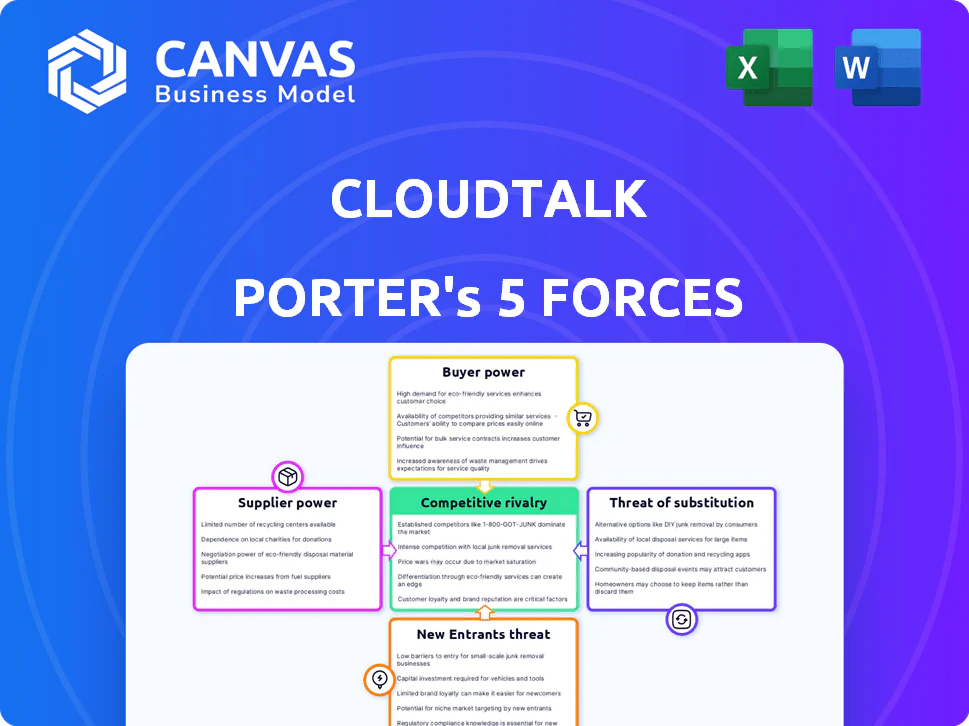
CLOUDTALK PORTER'S FIVE FORCES TEMPLATE RESEARCH
What is included in the product
 Detailed Word Document
Tailored exclusively for CloudTalk, analyzing its position within its competitive landscape.

 Customizable Excel Spreadsheet
Quickly identify and address competitive threats and opportunities.
Same Document Delivered
CloudTalk Porter's Five Forces Analysis
This CloudTalk Porter's Five Forces analysis preview accurately reflects the complete document you'll receive. The document you are seeing is the full version. Your purchased copy will be ready to download instantly, containing the same analysis. No changes or alterations are present between the preview and the final deliverable. This comprehensive, professionally crafted analysis is ready for immediate use.

Porter's Five Forces Analysis Template

Go Beyond the Preview—Access the Full Strategic Report
CloudTalk's industry landscape is shaped by the interplay of Porter's Five Forces, impacting its competitive position. The threat of new entrants in the UCaaS market is moderate, while buyer power fluctuates with customer size. Bargaining power of suppliers is low due to diverse technology providers. The threat of substitutes like email & SMS is significant. Competitive rivalry is high, featuring established & emerging players.
Ready to move beyond the basics? Get a full strategic breakdown of CloudTalk’s market position, competitive intensity, and external threats—all in one powerful analysis.
Suppliers Bargaining Power

Reliance on core technology providers
CloudTalk's reliance on core tech suppliers, such as AWS, directly affects its operations. In 2024, AWS held about 32% of the cloud infrastructure market. High dependency could increase supplier power. This impacts CloudTalk's costs and stability.
Availability of alternative technologies
The availability of alternatives, such as various cloud hosting and communication tech, reduces supplier power. CloudTalk can switch providers if needed, though migration poses challenges. In 2024, the cloud computing market grew, with AWS, Azure, and Google Cloud as major players. This competitive landscape offers CloudTalk options.

Importance of integrations
CloudTalk's value increases with integrations with CRM and helpdesk platforms. Suppliers of these platforms like HubSpot, Salesforce, and Zendesk hold some power. In 2024, HubSpot reported $2.2 billion in revenue, while Salesforce's revenue was over $34.5 billion. Seamless integration is key for CloudTalk's customers, making these partnerships vital.

Cost of switching suppliers
CloudTalk faces challenges in switching suppliers, especially for essential infrastructure and integrations. These switches involve considerable costs and effort, thus increasing the leverage of existing suppliers. For instance, in 2024, the average cost to migrate cloud services was estimated at around $50,000 per application, according to a report by Gartner. This can significantly affect CloudTalk's ability to negotiate favorable terms.
- High Switching Costs: Changing core infrastructure or integrations is expensive.
- Supplier Leverage: Existing suppliers gain more bargaining power.
- Financial Impact: Migration costs can strain budgets.
- Market Data: Cloud migration costs averaged $50,000 per app in 2024.
Uniqueness of supplier offerings
If CloudTalk relies on unique AI technology, suppliers of that tech gain power. The company's dependence on specific AI models or services strengthens supplier influence. For instance, in 2024, the AI market grew rapidly, with investments in AI startups reaching billions, potentially increasing supplier leverage. CloudTalk's reliance on cutting-edge AI could mean fewer, more powerful suppliers.
- AI market investments in 2024 reached billions, indicating supplier influence.
- CloudTalk's dependence on specific AI models strengthens supplier power.
- The uniqueness of supplier offerings directly impacts CloudTalk's features.
- Specialized technology suppliers may control critical features.
CloudTalk's Supplier Power: Key Factors & Data
CloudTalk's supplier power hinges on infrastructure, integrations, and AI tech. High switching costs and reliance on key suppliers like AWS, which held 32% of the cloud market in 2024, increase supplier leverage. Conversely, the availability of alternatives and competitive markets can reduce this power. In 2024, the average cloud migration cost was around $50,000 per application.
| Factor | Impact on CloudTalk | 2024 Data Point |
|---|---|---|
| Cloud Infrastructure | AWS dependency impacts costs | AWS held 32% of cloud market |
| Integration Suppliers | HubSpot, Salesforce power | Salesforce revenue over $34.5B |
| Switching Costs | Increases supplier leverage | Cloud migration cost $50K/app |
Customers Bargaining Power

Availability of alternatives
Customers wield substantial power due to abundant alternatives in business phone systems. The VoIP market, valued at $35.89 billion in 2024, offers diverse choices. This includes platforms like RingCentral and 8x8. Dissatisfied customers can easily switch, pressuring CloudTalk on pricing and features.
Switching costs for customers
Switching costs for CloudTalk customers can influence their bargaining power. Migrating communication systems involves effort, potentially reducing bargaining power. Larger businesses with complex setups face higher switching costs. The global cloud communications market was valued at $60.9 billion in 2024, showing growth.

Price sensitivity
Businesses, especially SMEs, are often price-sensitive, making them cost-conscious. CloudTalk's tiered pricing and competitor options heighten this sensitivity. In 2024, the average SMB customer churn rate due to price was around 10-15%. This leads to price comparison and negotiation.

Customer concentration
Customer concentration significantly impacts CloudTalk's bargaining power. If a few major clients generate most revenue, they wield substantial influence. CloudTalk's wide customer base, serving over 4,000 businesses across 100+ countries, dilutes individual customer power. This diversification strengthens CloudTalk's position, as losing one client has a lesser financial impact.
- CloudTalk serves over 4,000 businesses.
- CloudTalk operates in 100+ countries.
- Customer diversification reduces individual customer power.
Customer knowledge and access to information
Customers' ability to research and compare cloud phone systems online significantly boosts their bargaining power. This transparency enables them to easily assess features, pricing, and reviews. According to 2024 data, the cloud communications market is highly competitive, with numerous providers offering similar services. This competition gives customers leverage to negotiate better terms.
- Online reviews and comparison sites provide detailed insights.
- Customers can readily switch providers.
- Price wars among providers are common.
- Customers can negotiate discounts and customized plans.
CloudTalk's Customer Power Dynamics: Market, Costs, and Base
CloudTalk faces strong customer bargaining power, amplified by the competitive VoIP market, valued at $35.89 billion in 2024. Switching costs and price sensitivity, particularly for SMBs, also influence this dynamic. However, CloudTalk's diverse customer base, serving over 4,000 businesses globally, mitigates some customer power.
| Factor | Impact | Data (2024) |
|---|---|---|
| Market Competition | High | VoIP market: $35.89B |
| Switching Costs | Variable | SMB churn: 10-15% due to price |
| Customer Base | Diversified | 4,000+ businesses served |
Rivalry Among Competitors

Number and diversity of competitors
The cloud-based business phone system market is very competitive, featuring many players. CloudTalk faces over 140 competitors in the contact center category, intensifying rivalry. This crowded landscape includes both major and niche providers. The diversity of competitors increases competitive pressures significantly. Intense competition can lower profit margins and increase marketing spend.
Market growth rate
The cloud communication market's growth can lessen rivalry, offering opportunities for multiple firms. The market, valued at USD 28.2 billion in 2024, is projected to reach USD 67.3 billion by 2029. Rapid feature evolution, especially with AI integration, intensifies competition. This dynamic environment challenges companies like CloudTalk to innovate to stay competitive.

Product differentiation
Product differentiation is essential in the cloud communications market. While basic features are standard, companies like CloudTalk distinguish themselves. CloudTalk focuses on AI and CRM integrations. This strategy helps them stand out in a crowded market, where differentiation is key for success.

Switching costs for customers
Switching costs in the cloud communications market are moderate. This means customers can change providers without facing huge financial or operational hurdles, which increases competition. A study from 2024 showed that about 20% of businesses switch their cloud service providers annually, highlighting the ease of movement. The lower the switching costs, the more intense the rivalry.
- Ease of switching providers fuels competition.
- About 20% of businesses switch cloud providers yearly.
- Moderate switching costs intensify rivalry.
Brand identity and loyalty
In the competitive landscape, brand identity and customer loyalty significantly influence success. CloudTalk's emphasis on customer experience and positive reviews aims to build loyalty. However, the availability of numerous alternatives can dilute customer commitment. The cloud communications market is expected to reach $71.3 billion in 2024.
- Positive reviews can boost loyalty, but many competitors exist.
- Market size is substantial, indicating high stakes for brand building.
- Alternatives pressure CloudTalk to continuously improve.
CloudTalk's Competitive Landscape: A USD 67.3 Billion Battle
CloudTalk faces intense competition from over 140 rivals in the cloud-based phone system market, which was valued at USD 28.2 billion in 2024. The market's projected growth to USD 67.3 billion by 2029 suggests ongoing rivalry. Differentiation through AI and CRM integration is crucial for competitiveness, while moderate switching costs intensify the competition.
| Aspect | Details | Impact on Rivalry |
|---|---|---|
| Market Size (2024) | USD 28.2 billion | High stakes; motivates aggressive competition |
| Projected Market Growth (2029) | USD 67.3 billion | Encourages new entrants and intensifies competition |
| Switching Costs | Moderate; ~20% switch annually | High; easy customer movement |
CLOUDTALK PORTER'S FIVE FORCES TEMPLATE RESEARCH
What is included in the product
Detailed Word Document
Tailored exclusively for CloudTalk, analyzing its position within its competitive landscape.
Customizable Excel Spreadsheet
Quickly identify and address competitive threats and opportunities.
Same Document Delivered
CloudTalk Porter's Five Forces Analysis
This CloudTalk Porter's Five Forces analysis preview accurately reflects the complete document you'll receive. The document you are seeing is the full version. Your purchased copy will be ready to download instantly, containing the same analysis. No changes or alterations are present between the preview and the final deliverable. This comprehensive, professionally crafted analysis is ready for immediate use.
Porter's Five Forces Analysis Template
Go Beyond the Preview—Access the Full Strategic Report
CloudTalk's industry landscape is shaped by the interplay of Porter's Five Forces, impacting its competitive position. The threat of new entrants in the UCaaS market is moderate, while buyer power fluctuates with customer size. Bargaining power of suppliers is low due to diverse technology providers. The threat of substitutes like email & SMS is significant. Competitive rivalry is high, featuring established & emerging players.
Ready to move beyond the basics? Get a full strategic breakdown of CloudTalk’s market position, competitive intensity, and external threats—all in one powerful analysis.
Suppliers Bargaining Power
Reliance on core technology providers
CloudTalk's reliance on core tech suppliers, such as AWS, directly affects its operations. In 2024, AWS held about 32% of the cloud infrastructure market. High dependency could increase supplier power. This impacts CloudTalk's costs and stability.
Availability of alternative technologies
The availability of alternatives, such as various cloud hosting and communication tech, reduces supplier power. CloudTalk can switch providers if needed, though migration poses challenges. In 2024, the cloud computing market grew, with AWS, Azure, and Google Cloud as major players. This competitive landscape offers CloudTalk options.
Importance of integrations
CloudTalk's value increases with integrations with CRM and helpdesk platforms. Suppliers of these platforms like HubSpot, Salesforce, and Zendesk hold some power. In 2024, HubSpot reported $2.2 billion in revenue, while Salesforce's revenue was over $34.5 billion. Seamless integration is key for CloudTalk's customers, making these partnerships vital.
Cost of switching suppliers
CloudTalk faces challenges in switching suppliers, especially for essential infrastructure and integrations. These switches involve considerable costs and effort, thus increasing the leverage of existing suppliers. For instance, in 2024, the average cost to migrate cloud services was estimated at around $50,000 per application, according to a report by Gartner. This can significantly affect CloudTalk's ability to negotiate favorable terms.
- High Switching Costs: Changing core infrastructure or integrations is expensive.
- Supplier Leverage: Existing suppliers gain more bargaining power.
- Financial Impact: Migration costs can strain budgets.
- Market Data: Cloud migration costs averaged $50,000 per app in 2024.
Uniqueness of supplier offerings
If CloudTalk relies on unique AI technology, suppliers of that tech gain power. The company's dependence on specific AI models or services strengthens supplier influence. For instance, in 2024, the AI market grew rapidly, with investments in AI startups reaching billions, potentially increasing supplier leverage. CloudTalk's reliance on cutting-edge AI could mean fewer, more powerful suppliers.
- AI market investments in 2024 reached billions, indicating supplier influence.
- CloudTalk's dependence on specific AI models strengthens supplier power.
- The uniqueness of supplier offerings directly impacts CloudTalk's features.
- Specialized technology suppliers may control critical features.
CloudTalk's Supplier Power: Key Factors & Data
CloudTalk's supplier power hinges on infrastructure, integrations, and AI tech. High switching costs and reliance on key suppliers like AWS, which held 32% of the cloud market in 2024, increase supplier leverage. Conversely, the availability of alternatives and competitive markets can reduce this power. In 2024, the average cloud migration cost was around $50,000 per application.
| Factor | Impact on CloudTalk | 2024 Data Point |
|---|---|---|
| Cloud Infrastructure | AWS dependency impacts costs | AWS held 32% of cloud market |
| Integration Suppliers | HubSpot, Salesforce power | Salesforce revenue over $34.5B |
| Switching Costs | Increases supplier leverage | Cloud migration cost $50K/app |
Customers Bargaining Power
Availability of alternatives
Customers wield substantial power due to abundant alternatives in business phone systems. The VoIP market, valued at $35.89 billion in 2024, offers diverse choices. This includes platforms like RingCentral and 8x8. Dissatisfied customers can easily switch, pressuring CloudTalk on pricing and features.
Switching costs for customers
Switching costs for CloudTalk customers can influence their bargaining power. Migrating communication systems involves effort, potentially reducing bargaining power. Larger businesses with complex setups face higher switching costs. The global cloud communications market was valued at $60.9 billion in 2024, showing growth.
Price sensitivity
Businesses, especially SMEs, are often price-sensitive, making them cost-conscious. CloudTalk's tiered pricing and competitor options heighten this sensitivity. In 2024, the average SMB customer churn rate due to price was around 10-15%. This leads to price comparison and negotiation.
Customer concentration
Customer concentration significantly impacts CloudTalk's bargaining power. If a few major clients generate most revenue, they wield substantial influence. CloudTalk's wide customer base, serving over 4,000 businesses across 100+ countries, dilutes individual customer power. This diversification strengthens CloudTalk's position, as losing one client has a lesser financial impact.
- CloudTalk serves over 4,000 businesses.
- CloudTalk operates in 100+ countries.
- Customer diversification reduces individual customer power.
Customer knowledge and access to information
Customers' ability to research and compare cloud phone systems online significantly boosts their bargaining power. This transparency enables them to easily assess features, pricing, and reviews. According to 2024 data, the cloud communications market is highly competitive, with numerous providers offering similar services. This competition gives customers leverage to negotiate better terms.
- Online reviews and comparison sites provide detailed insights.
- Customers can readily switch providers.
- Price wars among providers are common.
- Customers can negotiate discounts and customized plans.
CloudTalk's Customer Power Dynamics: Market, Costs, and Base
CloudTalk faces strong customer bargaining power, amplified by the competitive VoIP market, valued at $35.89 billion in 2024. Switching costs and price sensitivity, particularly for SMBs, also influence this dynamic. However, CloudTalk's diverse customer base, serving over 4,000 businesses globally, mitigates some customer power.
| Factor | Impact | Data (2024) |
|---|---|---|
| Market Competition | High | VoIP market: $35.89B |
| Switching Costs | Variable | SMB churn: 10-15% due to price |
| Customer Base | Diversified | 4,000+ businesses served |
Rivalry Among Competitors
Number and diversity of competitors
The cloud-based business phone system market is very competitive, featuring many players. CloudTalk faces over 140 competitors in the contact center category, intensifying rivalry. This crowded landscape includes both major and niche providers. The diversity of competitors increases competitive pressures significantly. Intense competition can lower profit margins and increase marketing spend.
Market growth rate
The cloud communication market's growth can lessen rivalry, offering opportunities for multiple firms. The market, valued at USD 28.2 billion in 2024, is projected to reach USD 67.3 billion by 2029. Rapid feature evolution, especially with AI integration, intensifies competition. This dynamic environment challenges companies like CloudTalk to innovate to stay competitive.
Product differentiation
Product differentiation is essential in the cloud communications market. While basic features are standard, companies like CloudTalk distinguish themselves. CloudTalk focuses on AI and CRM integrations. This strategy helps them stand out in a crowded market, where differentiation is key for success.
Switching costs for customers
Switching costs in the cloud communications market are moderate. This means customers can change providers without facing huge financial or operational hurdles, which increases competition. A study from 2024 showed that about 20% of businesses switch their cloud service providers annually, highlighting the ease of movement. The lower the switching costs, the more intense the rivalry.
- Ease of switching providers fuels competition.
- About 20% of businesses switch cloud providers yearly.
- Moderate switching costs intensify rivalry.
Brand identity and loyalty
In the competitive landscape, brand identity and customer loyalty significantly influence success. CloudTalk's emphasis on customer experience and positive reviews aims to build loyalty. However, the availability of numerous alternatives can dilute customer commitment. The cloud communications market is expected to reach $71.3 billion in 2024.
- Positive reviews can boost loyalty, but many competitors exist.
- Market size is substantial, indicating high stakes for brand building.
- Alternatives pressure CloudTalk to continuously improve.
CloudTalk's Competitive Landscape: A USD 67.3 Billion Battle
CloudTalk faces intense competition from over 140 rivals in the cloud-based phone system market, which was valued at USD 28.2 billion in 2024. The market's projected growth to USD 67.3 billion by 2029 suggests ongoing rivalry. Differentiation through AI and CRM integration is crucial for competitiveness, while moderate switching costs intensify the competition.
| Aspect | Details | Impact on Rivalry |
|---|---|---|
| Market Size (2024) | USD 28.2 billion | High stakes; motivates aggressive competition |
| Projected Market Growth (2029) | USD 67.3 billion | Encourages new entrants and intensifies competition |
| Switching Costs | Moderate; ~20% switch annually | High; easy customer movement |
Product Information
Product Information
Shipping & Returns
Shipping & Returns
Description
What is included in the product
Detailed Word Document
Tailored exclusively for CloudTalk, analyzing its position within its competitive landscape.
Customizable Excel Spreadsheet
Quickly identify and address competitive threats and opportunities.
Same Document Delivered
CloudTalk Porter's Five Forces Analysis
This CloudTalk Porter's Five Forces analysis preview accurately reflects the complete document you'll receive. The document you are seeing is the full version. Your purchased copy will be ready to download instantly, containing the same analysis. No changes or alterations are present between the preview and the final deliverable. This comprehensive, professionally crafted analysis is ready for immediate use.
Porter's Five Forces Analysis Template
Go Beyond the Preview—Access the Full Strategic Report
CloudTalk's industry landscape is shaped by the interplay of Porter's Five Forces, impacting its competitive position. The threat of new entrants in the UCaaS market is moderate, while buyer power fluctuates with customer size. Bargaining power of suppliers is low due to diverse technology providers. The threat of substitutes like email & SMS is significant. Competitive rivalry is high, featuring established & emerging players.
Ready to move beyond the basics? Get a full strategic breakdown of CloudTalk’s market position, competitive intensity, and external threats—all in one powerful analysis.
Suppliers Bargaining Power
Reliance on core technology providers
CloudTalk's reliance on core tech suppliers, such as AWS, directly affects its operations. In 2024, AWS held about 32% of the cloud infrastructure market. High dependency could increase supplier power. This impacts CloudTalk's costs and stability.
Availability of alternative technologies
The availability of alternatives, such as various cloud hosting and communication tech, reduces supplier power. CloudTalk can switch providers if needed, though migration poses challenges. In 2024, the cloud computing market grew, with AWS, Azure, and Google Cloud as major players. This competitive landscape offers CloudTalk options.
Importance of integrations
CloudTalk's value increases with integrations with CRM and helpdesk platforms. Suppliers of these platforms like HubSpot, Salesforce, and Zendesk hold some power. In 2024, HubSpot reported $2.2 billion in revenue, while Salesforce's revenue was over $34.5 billion. Seamless integration is key for CloudTalk's customers, making these partnerships vital.
Cost of switching suppliers
CloudTalk faces challenges in switching suppliers, especially for essential infrastructure and integrations. These switches involve considerable costs and effort, thus increasing the leverage of existing suppliers. For instance, in 2024, the average cost to migrate cloud services was estimated at around $50,000 per application, according to a report by Gartner. This can significantly affect CloudTalk's ability to negotiate favorable terms.
- High Switching Costs: Changing core infrastructure or integrations is expensive.
- Supplier Leverage: Existing suppliers gain more bargaining power.
- Financial Impact: Migration costs can strain budgets.
- Market Data: Cloud migration costs averaged $50,000 per app in 2024.
Uniqueness of supplier offerings
If CloudTalk relies on unique AI technology, suppliers of that tech gain power. The company's dependence on specific AI models or services strengthens supplier influence. For instance, in 2024, the AI market grew rapidly, with investments in AI startups reaching billions, potentially increasing supplier leverage. CloudTalk's reliance on cutting-edge AI could mean fewer, more powerful suppliers.
- AI market investments in 2024 reached billions, indicating supplier influence.
- CloudTalk's dependence on specific AI models strengthens supplier power.
- The uniqueness of supplier offerings directly impacts CloudTalk's features.
- Specialized technology suppliers may control critical features.
CloudTalk's Supplier Power: Key Factors & Data
CloudTalk's supplier power hinges on infrastructure, integrations, and AI tech. High switching costs and reliance on key suppliers like AWS, which held 32% of the cloud market in 2024, increase supplier leverage. Conversely, the availability of alternatives and competitive markets can reduce this power. In 2024, the average cloud migration cost was around $50,000 per application.
| Factor | Impact on CloudTalk | 2024 Data Point |
|---|---|---|
| Cloud Infrastructure | AWS dependency impacts costs | AWS held 32% of cloud market |
| Integration Suppliers | HubSpot, Salesforce power | Salesforce revenue over $34.5B |
| Switching Costs | Increases supplier leverage | Cloud migration cost $50K/app |
Customers Bargaining Power
Availability of alternatives
Customers wield substantial power due to abundant alternatives in business phone systems. The VoIP market, valued at $35.89 billion in 2024, offers diverse choices. This includes platforms like RingCentral and 8x8. Dissatisfied customers can easily switch, pressuring CloudTalk on pricing and features.
Switching costs for customers
Switching costs for CloudTalk customers can influence their bargaining power. Migrating communication systems involves effort, potentially reducing bargaining power. Larger businesses with complex setups face higher switching costs. The global cloud communications market was valued at $60.9 billion in 2024, showing growth.
Price sensitivity
Businesses, especially SMEs, are often price-sensitive, making them cost-conscious. CloudTalk's tiered pricing and competitor options heighten this sensitivity. In 2024, the average SMB customer churn rate due to price was around 10-15%. This leads to price comparison and negotiation.
Customer concentration
Customer concentration significantly impacts CloudTalk's bargaining power. If a few major clients generate most revenue, they wield substantial influence. CloudTalk's wide customer base, serving over 4,000 businesses across 100+ countries, dilutes individual customer power. This diversification strengthens CloudTalk's position, as losing one client has a lesser financial impact.
- CloudTalk serves over 4,000 businesses.
- CloudTalk operates in 100+ countries.
- Customer diversification reduces individual customer power.
Customer knowledge and access to information
Customers' ability to research and compare cloud phone systems online significantly boosts their bargaining power. This transparency enables them to easily assess features, pricing, and reviews. According to 2024 data, the cloud communications market is highly competitive, with numerous providers offering similar services. This competition gives customers leverage to negotiate better terms.
- Online reviews and comparison sites provide detailed insights.
- Customers can readily switch providers.
- Price wars among providers are common.
- Customers can negotiate discounts and customized plans.
CloudTalk's Customer Power Dynamics: Market, Costs, and Base
CloudTalk faces strong customer bargaining power, amplified by the competitive VoIP market, valued at $35.89 billion in 2024. Switching costs and price sensitivity, particularly for SMBs, also influence this dynamic. However, CloudTalk's diverse customer base, serving over 4,000 businesses globally, mitigates some customer power.
| Factor | Impact | Data (2024) |
|---|---|---|
| Market Competition | High | VoIP market: $35.89B |
| Switching Costs | Variable | SMB churn: 10-15% due to price |
| Customer Base | Diversified | 4,000+ businesses served |
Rivalry Among Competitors
Number and diversity of competitors
The cloud-based business phone system market is very competitive, featuring many players. CloudTalk faces over 140 competitors in the contact center category, intensifying rivalry. This crowded landscape includes both major and niche providers. The diversity of competitors increases competitive pressures significantly. Intense competition can lower profit margins and increase marketing spend.
Market growth rate
The cloud communication market's growth can lessen rivalry, offering opportunities for multiple firms. The market, valued at USD 28.2 billion in 2024, is projected to reach USD 67.3 billion by 2029. Rapid feature evolution, especially with AI integration, intensifies competition. This dynamic environment challenges companies like CloudTalk to innovate to stay competitive.
Product differentiation
Product differentiation is essential in the cloud communications market. While basic features are standard, companies like CloudTalk distinguish themselves. CloudTalk focuses on AI and CRM integrations. This strategy helps them stand out in a crowded market, where differentiation is key for success.
Switching costs for customers
Switching costs in the cloud communications market are moderate. This means customers can change providers without facing huge financial or operational hurdles, which increases competition. A study from 2024 showed that about 20% of businesses switch their cloud service providers annually, highlighting the ease of movement. The lower the switching costs, the more intense the rivalry.
- Ease of switching providers fuels competition.
- About 20% of businesses switch cloud providers yearly.
- Moderate switching costs intensify rivalry.
Brand identity and loyalty
In the competitive landscape, brand identity and customer loyalty significantly influence success. CloudTalk's emphasis on customer experience and positive reviews aims to build loyalty. However, the availability of numerous alternatives can dilute customer commitment. The cloud communications market is expected to reach $71.3 billion in 2024.
- Positive reviews can boost loyalty, but many competitors exist.
- Market size is substantial, indicating high stakes for brand building.
- Alternatives pressure CloudTalk to continuously improve.
CloudTalk's Competitive Landscape: A USD 67.3 Billion Battle
CloudTalk faces intense competition from over 140 rivals in the cloud-based phone system market, which was valued at USD 28.2 billion in 2024. The market's projected growth to USD 67.3 billion by 2029 suggests ongoing rivalry. Differentiation through AI and CRM integration is crucial for competitiveness, while moderate switching costs intensify the competition.
| Aspect | Details | Impact on Rivalry |
|---|---|---|
| Market Size (2024) | USD 28.2 billion | High stakes; motivates aggressive competition |
| Projected Market Growth (2029) | USD 67.3 billion | Encourages new entrants and intensifies competition |
| Switching Costs | Moderate; ~20% switch annually | High; easy customer movement |











