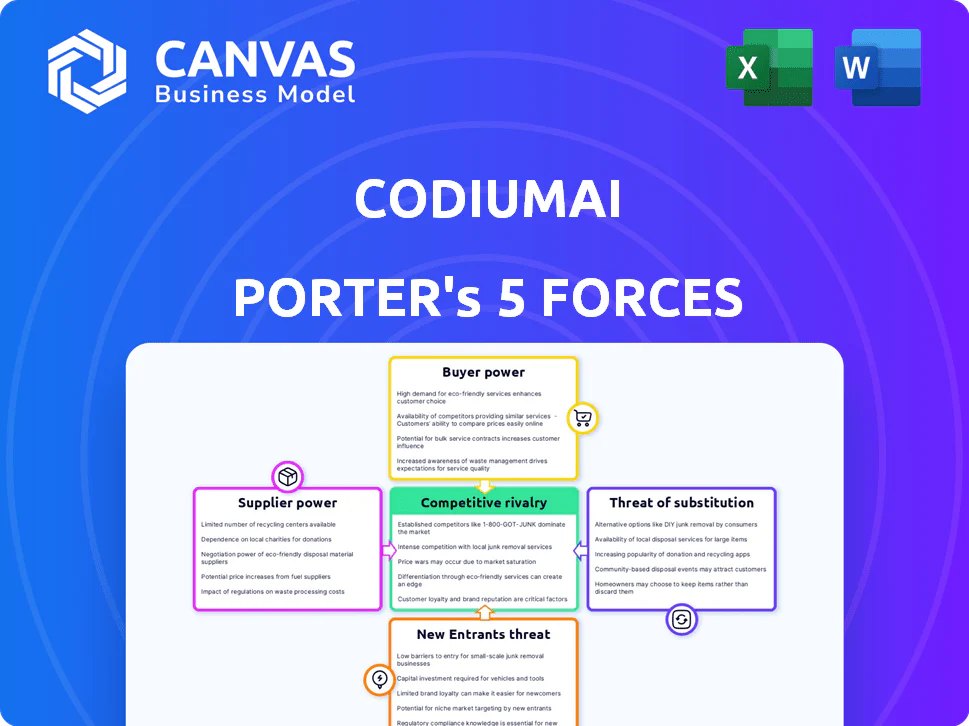
CODIUMAI PORTER'S FIVE FORCES TEMPLATE RESEARCH
What is included in the product
 Detailed Word Document
Detailed analysis of each competitive force, supported by industry data and strategic commentary.

 Customizable Excel Spreadsheet
Instantly visualize market dynamics with an interactive spider chart—no more guessing!
What You See Is What You Get
CodiumAI Porter's Five Forces Analysis
This is the complete Porter's Five Forces analysis you'll receive. The preview accurately reflects the final, ready-to-download document.

Porter's Five Forces Analysis Template

Don't Miss the Bigger Picture
CodiumAI's industry landscape is shaped by dynamic competitive forces. Understanding supplier power, buyer influence, and the threat of substitutes is critical. Analyzing the intensity of rivalry and potential new entrants informs strategic positioning. This preliminary overview only touches the surface.
Our full Porter's Five Forces report goes deeper—offering a data-driven framework to understand CodiumAI's real business risks and market opportunities.
Suppliers Bargaining Power

Dependency on AI Models and Infrastructure
CodiumAI's dependence on AI models and infrastructure significantly influences its supplier bargaining power. Major cloud providers like AWS, Google Cloud, and Microsoft Azure, along with specialized chip developers such as NVIDIA, hold substantial leverage. In 2024, the AI chip market, dominated by NVIDIA, saw revenues surge, reflecting this power dynamic. This control impacts CodiumAI's costs and operational flexibility.
Availability of Quality Data
Access to large, high-quality datasets is pivotal for AI model training, with providers of specialized code datasets wielding considerable bargaining power. This influence impacts costs and access terms, as seen in 2024 where premium code datasets cost up to $10,000 per license. Suppliers can control the quality and availability of data, affecting the development timeline of AI projects. This leverage is especially potent in the rapidly evolving AI landscape.

Talent Pool for AI Expertise
The bargaining power of suppliers in the AI talent market is substantial. High demand for AI experts drives up salaries; in 2024, the average AI engineer salary in the US was around $160,000. This impacts CodiumAI's operational costs. Companies compete fiercely for this talent, increasing benefits packages.

Proprietary AI Algorithms and Software
Suppliers of proprietary AI algorithms and software hold considerable bargaining power. This is due to the specialized nature of their offerings, making direct substitutes scarce. Switching to alternative solutions can be costly and time-consuming for businesses. For example, the global AI market was valued at $196.63 billion in 2023 and is projected to reach $1.811.8 billion by 2030. This growth highlights the increasing reliance on AI suppliers.
- Market Growth: The global AI market is expected to grow substantially.
- Dependency: Businesses increasingly depend on AI suppliers.
- Switching Costs: High costs deter switching to alternative suppliers.
- Scarcity: Unique AI algorithms are difficult to replace.
Potential for Vertical Integration by Suppliers
If key AI infrastructure or model suppliers launch their own AI code integrity platforms, they could directly compete with CodiumAI, boosting their influence. For instance, NVIDIA, a major GPU supplier, could expand into AI code integrity, altering market dynamics. This shift could affect pricing and access to crucial resources for companies like CodiumAI. Such moves might also limit CodiumAI's market share and negotiation leverage.
- NVIDIA's 2024 revenue reached $26.97 billion, showing its financial capacity to enter new markets.
- The AI software market is projected to reach $126 billion by 2025, highlighting significant growth potential.
- Major tech companies' vertical integration strategies could disrupt the AI code integrity sector.
- CodiumAI’s ability to adapt to these competitive pressures is crucial for its survival.
Supplier Power Dynamics: Costs & Talent
CodiumAI faces strong supplier bargaining power from cloud providers, data suppliers, and AI talent, impacting costs. The AI chip market, dominated by NVIDIA, saw substantial revenue in 2024. Proprietary AI algorithms also enhance supplier leverage due to their scarcity.
| Supplier Type | Impact | 2024 Data Point |
|---|---|---|
| Cloud Providers | Cost, Flexibility | AWS, Azure revenue billions |
| Data Suppliers | Cost, Access | Premium data sets at $10,000 |
| AI Talent | Operational Costs | Avg. AI Engineer salary $160,000 |
Customers Bargaining Power

Availability of Alternative Tools
Customers benefit from numerous AI coding tools. Competitors and open-source options give buyers leverage. This allows them to negotiate prices and features. For example, the global AI market was valued at $136.55 billion in 2023, and is projected to reach $1.81 trillion by 2030.
Switching Costs
Switching costs, such as the effort to integrate a new code integrity platform, influence customer bargaining power. These costs, encompassing time, training, and potential workflow disruptions, can make it less appealing for customers to switch from CodiumAI. For example, in 2024, integrating a new platform might take developers an average of 40-60 hours. This reduces customer power by creating a disincentive to change.

Customer Knowledge and Customization Demands
As AI code tool users gain expertise, they can specify needs, driving customization. For example, in 2024, 60% of businesses sought AI solutions tailored to their processes. This shift empowers customers to negotiate features and pricing, increasing their influence.

Size and Concentration of Customers
Large enterprises, representing significant revenue for CodiumAI, can wield substantial bargaining power. Their high-volume business allows them to negotiate favorable terms. For example, in 2024, the top 10 clients in the software industry accounted for roughly 40% of total revenue. Such concentration enhances customer leverage. This can pressure CodiumAI to lower prices or offer more services.
- Concentrated Customer Base: A few large clients dominate CodiumAI's revenue.
- Price Sensitivity: Large clients are very price-conscious.
- Negotiating Strength: They have strong negotiating positions.
- Impact on Profitability: This affects pricing strategies.
Sensitivity to Pricing
Customers' sensitivity to pricing significantly impacts CodiumAI. Individual developers and smaller businesses are often price-sensitive. The availability of free or cheaper AI code tools intensifies this pressure on CodiumAI's pricing strategies. The market landscape necessitates competitive pricing to attract and retain customers.
- In 2024, the AI code assistant market saw a 20% increase in users opting for free or open-source tools.
- CodiumAI's pricing model must be competitive to capture a share of the $1 billion market for AI-powered developer tools projected by the end of 2024.
- Price sensitivity is heightened in regions with lower average developer salaries, like India, where free tools are widely adopted.
AI Coding Tools: Customer Power Dynamics
Customer bargaining power in the AI coding tools market is influenced by several factors. The availability of competing and open-source options gives customers leverage in price and feature negotiations. Switching costs, such as integration efforts, can reduce customer power.
| Factor | Impact | Example (2024) |
|---|---|---|
| Market Competition | Increased customer choices | 20% growth in free/open-source tool users |
| Switching Costs | Reduced customer mobility | 40-60 hours for platform integration |
| Customer Expertise | More feature negotiation | 60% of businesses sought tailored AI solutions |
Rivalry Among Competitors

Number and Diversity of Competitors
The AI code tools market is highly competitive, attracting many companies. CodiumAI faces rivals like Codeium and CodeGPT, offering comparable AI coding solutions. In 2024, the market saw over $100 million in investments for AI-powered coding tools, indicating strong competition.
Rate of Technological Advancement
The AI sector, including CodiumAI, faces swift technological progress. Competitors quickly introduce new AI models and features. This necessitates CodiumAI's constant investment in R&D to stay ahead. In 2024, AI R&D spending hit $200 billion globally.

Differentiation of Offerings
In the competitive landscape, differentiating offerings is crucial. CodiumAI, for instance, could emphasize its unique code integrity analysis and test generation capabilities. By seamlessly integrating into developer workflows, the company can stand out. The global market for AI in software development is projected to reach $25.9 billion by 2024.

Pricing Pressure
In markets with several competitors, pricing can become a battlefield. Companies might experience pricing pressure, which often results in price wars. For example, in 2024, the average price of a new smartphone decreased by 7% due to intense competition. This can lead to innovative pricing strategies like freemium models to attract customers.
- Price wars can erode profit margins.
- Freemium models are used to lure in users.
- Competition forces companies to be efficient.
- Lower prices benefit consumers.
Market Growth Rate
The AI code tools market is experiencing substantial growth. This rapid expansion fuels intense competition among companies. Such growth allows firms to capture a larger market share. The global AI market is estimated to reach $200 billion by the end of 2024.
- Market growth attracts new entrants, increasing rivalry.
- Established firms compete aggressively to maintain or expand their market positions.
- High growth rates create opportunities for strategic alliances and acquisitions.
- Competition drives innovation and product development.
AI Code Tools: Fierce Competition & Growth
The AI code tools market showcases intense competition. CodiumAI competes with rivals like Codeium and CodeGPT, fueled by over $100M in 2024 investments. Rapid tech advancements force continuous R&D spending, which reached $200B globally in 2024. Differentiation and pricing strategies are crucial, as the market is projected to reach $25.9B by year-end.
| Aspect | Impact | 2024 Data |
|---|---|---|
| Competition Intensity | High | $100M+ investment |
| Tech Advancement | Rapid | $200B AI R&D |
| Market Growth | Significant | $25.9B market size |
Original: $10.00
-65%$10.00
$3.50CODIUMAI PORTER'S FIVE FORCES TEMPLATE RESEARCH
What is included in the product
Detailed Word Document
Detailed analysis of each competitive force, supported by industry data and strategic commentary.
Customizable Excel Spreadsheet
Instantly visualize market dynamics with an interactive spider chart—no more guessing!
What You See Is What You Get
CodiumAI Porter's Five Forces Analysis
This is the complete Porter's Five Forces analysis you'll receive. The preview accurately reflects the final, ready-to-download document.
Porter's Five Forces Analysis Template
Don't Miss the Bigger Picture
CodiumAI's industry landscape is shaped by dynamic competitive forces. Understanding supplier power, buyer influence, and the threat of substitutes is critical. Analyzing the intensity of rivalry and potential new entrants informs strategic positioning. This preliminary overview only touches the surface.
Our full Porter's Five Forces report goes deeper—offering a data-driven framework to understand CodiumAI's real business risks and market opportunities.
Suppliers Bargaining Power
Dependency on AI Models and Infrastructure
CodiumAI's dependence on AI models and infrastructure significantly influences its supplier bargaining power. Major cloud providers like AWS, Google Cloud, and Microsoft Azure, along with specialized chip developers such as NVIDIA, hold substantial leverage. In 2024, the AI chip market, dominated by NVIDIA, saw revenues surge, reflecting this power dynamic. This control impacts CodiumAI's costs and operational flexibility.
Availability of Quality Data
Access to large, high-quality datasets is pivotal for AI model training, with providers of specialized code datasets wielding considerable bargaining power. This influence impacts costs and access terms, as seen in 2024 where premium code datasets cost up to $10,000 per license. Suppliers can control the quality and availability of data, affecting the development timeline of AI projects. This leverage is especially potent in the rapidly evolving AI landscape.
Talent Pool for AI Expertise
The bargaining power of suppliers in the AI talent market is substantial. High demand for AI experts drives up salaries; in 2024, the average AI engineer salary in the US was around $160,000. This impacts CodiumAI's operational costs. Companies compete fiercely for this talent, increasing benefits packages.
Proprietary AI Algorithms and Software
Suppliers of proprietary AI algorithms and software hold considerable bargaining power. This is due to the specialized nature of their offerings, making direct substitutes scarce. Switching to alternative solutions can be costly and time-consuming for businesses. For example, the global AI market was valued at $196.63 billion in 2023 and is projected to reach $1.811.8 billion by 2030. This growth highlights the increasing reliance on AI suppliers.
- Market Growth: The global AI market is expected to grow substantially.
- Dependency: Businesses increasingly depend on AI suppliers.
- Switching Costs: High costs deter switching to alternative suppliers.
- Scarcity: Unique AI algorithms are difficult to replace.
Potential for Vertical Integration by Suppliers
If key AI infrastructure or model suppliers launch their own AI code integrity platforms, they could directly compete with CodiumAI, boosting their influence. For instance, NVIDIA, a major GPU supplier, could expand into AI code integrity, altering market dynamics. This shift could affect pricing and access to crucial resources for companies like CodiumAI. Such moves might also limit CodiumAI's market share and negotiation leverage.
- NVIDIA's 2024 revenue reached $26.97 billion, showing its financial capacity to enter new markets.
- The AI software market is projected to reach $126 billion by 2025, highlighting significant growth potential.
- Major tech companies' vertical integration strategies could disrupt the AI code integrity sector.
- CodiumAI’s ability to adapt to these competitive pressures is crucial for its survival.
Supplier Power Dynamics: Costs & Talent
CodiumAI faces strong supplier bargaining power from cloud providers, data suppliers, and AI talent, impacting costs. The AI chip market, dominated by NVIDIA, saw substantial revenue in 2024. Proprietary AI algorithms also enhance supplier leverage due to their scarcity.
| Supplier Type | Impact | 2024 Data Point |
|---|---|---|
| Cloud Providers | Cost, Flexibility | AWS, Azure revenue billions |
| Data Suppliers | Cost, Access | Premium data sets at $10,000 |
| AI Talent | Operational Costs | Avg. AI Engineer salary $160,000 |
Customers Bargaining Power
Availability of Alternative Tools
Customers benefit from numerous AI coding tools. Competitors and open-source options give buyers leverage. This allows them to negotiate prices and features. For example, the global AI market was valued at $136.55 billion in 2023, and is projected to reach $1.81 trillion by 2030.
Switching Costs
Switching costs, such as the effort to integrate a new code integrity platform, influence customer bargaining power. These costs, encompassing time, training, and potential workflow disruptions, can make it less appealing for customers to switch from CodiumAI. For example, in 2024, integrating a new platform might take developers an average of 40-60 hours. This reduces customer power by creating a disincentive to change.
Customer Knowledge and Customization Demands
As AI code tool users gain expertise, they can specify needs, driving customization. For example, in 2024, 60% of businesses sought AI solutions tailored to their processes. This shift empowers customers to negotiate features and pricing, increasing their influence.
Size and Concentration of Customers
Large enterprises, representing significant revenue for CodiumAI, can wield substantial bargaining power. Their high-volume business allows them to negotiate favorable terms. For example, in 2024, the top 10 clients in the software industry accounted for roughly 40% of total revenue. Such concentration enhances customer leverage. This can pressure CodiumAI to lower prices or offer more services.
- Concentrated Customer Base: A few large clients dominate CodiumAI's revenue.
- Price Sensitivity: Large clients are very price-conscious.
- Negotiating Strength: They have strong negotiating positions.
- Impact on Profitability: This affects pricing strategies.
Sensitivity to Pricing
Customers' sensitivity to pricing significantly impacts CodiumAI. Individual developers and smaller businesses are often price-sensitive. The availability of free or cheaper AI code tools intensifies this pressure on CodiumAI's pricing strategies. The market landscape necessitates competitive pricing to attract and retain customers.
- In 2024, the AI code assistant market saw a 20% increase in users opting for free or open-source tools.
- CodiumAI's pricing model must be competitive to capture a share of the $1 billion market for AI-powered developer tools projected by the end of 2024.
- Price sensitivity is heightened in regions with lower average developer salaries, like India, where free tools are widely adopted.
AI Coding Tools: Customer Power Dynamics
Customer bargaining power in the AI coding tools market is influenced by several factors. The availability of competing and open-source options gives customers leverage in price and feature negotiations. Switching costs, such as integration efforts, can reduce customer power.
| Factor | Impact | Example (2024) |
|---|---|---|
| Market Competition | Increased customer choices | 20% growth in free/open-source tool users |
| Switching Costs | Reduced customer mobility | 40-60 hours for platform integration |
| Customer Expertise | More feature negotiation | 60% of businesses sought tailored AI solutions |
Rivalry Among Competitors
Number and Diversity of Competitors
The AI code tools market is highly competitive, attracting many companies. CodiumAI faces rivals like Codeium and CodeGPT, offering comparable AI coding solutions. In 2024, the market saw over $100 million in investments for AI-powered coding tools, indicating strong competition.
Rate of Technological Advancement
The AI sector, including CodiumAI, faces swift technological progress. Competitors quickly introduce new AI models and features. This necessitates CodiumAI's constant investment in R&D to stay ahead. In 2024, AI R&D spending hit $200 billion globally.
Differentiation of Offerings
In the competitive landscape, differentiating offerings is crucial. CodiumAI, for instance, could emphasize its unique code integrity analysis and test generation capabilities. By seamlessly integrating into developer workflows, the company can stand out. The global market for AI in software development is projected to reach $25.9 billion by 2024.
Pricing Pressure
In markets with several competitors, pricing can become a battlefield. Companies might experience pricing pressure, which often results in price wars. For example, in 2024, the average price of a new smartphone decreased by 7% due to intense competition. This can lead to innovative pricing strategies like freemium models to attract customers.
- Price wars can erode profit margins.
- Freemium models are used to lure in users.
- Competition forces companies to be efficient.
- Lower prices benefit consumers.
Market Growth Rate
The AI code tools market is experiencing substantial growth. This rapid expansion fuels intense competition among companies. Such growth allows firms to capture a larger market share. The global AI market is estimated to reach $200 billion by the end of 2024.
- Market growth attracts new entrants, increasing rivalry.
- Established firms compete aggressively to maintain or expand their market positions.
- High growth rates create opportunities for strategic alliances and acquisitions.
- Competition drives innovation and product development.
AI Code Tools: Fierce Competition & Growth
The AI code tools market showcases intense competition. CodiumAI competes with rivals like Codeium and CodeGPT, fueled by over $100M in 2024 investments. Rapid tech advancements force continuous R&D spending, which reached $200B globally in 2024. Differentiation and pricing strategies are crucial, as the market is projected to reach $25.9B by year-end.
| Aspect | Impact | 2024 Data |
|---|---|---|
| Competition Intensity | High | $100M+ investment |
| Tech Advancement | Rapid | $200B AI R&D |
| Market Growth | Significant | $25.9B market size |
Product Information
Product Information
Shipping & Returns
Shipping & Returns
Description
What is included in the product
Detailed Word Document
Detailed analysis of each competitive force, supported by industry data and strategic commentary.
Customizable Excel Spreadsheet
Instantly visualize market dynamics with an interactive spider chart—no more guessing!
What You See Is What You Get
CodiumAI Porter's Five Forces Analysis
This is the complete Porter's Five Forces analysis you'll receive. The preview accurately reflects the final, ready-to-download document.
Porter's Five Forces Analysis Template
Don't Miss the Bigger Picture
CodiumAI's industry landscape is shaped by dynamic competitive forces. Understanding supplier power, buyer influence, and the threat of substitutes is critical. Analyzing the intensity of rivalry and potential new entrants informs strategic positioning. This preliminary overview only touches the surface.
Our full Porter's Five Forces report goes deeper—offering a data-driven framework to understand CodiumAI's real business risks and market opportunities.
Suppliers Bargaining Power
Dependency on AI Models and Infrastructure
CodiumAI's dependence on AI models and infrastructure significantly influences its supplier bargaining power. Major cloud providers like AWS, Google Cloud, and Microsoft Azure, along with specialized chip developers such as NVIDIA, hold substantial leverage. In 2024, the AI chip market, dominated by NVIDIA, saw revenues surge, reflecting this power dynamic. This control impacts CodiumAI's costs and operational flexibility.
Availability of Quality Data
Access to large, high-quality datasets is pivotal for AI model training, with providers of specialized code datasets wielding considerable bargaining power. This influence impacts costs and access terms, as seen in 2024 where premium code datasets cost up to $10,000 per license. Suppliers can control the quality and availability of data, affecting the development timeline of AI projects. This leverage is especially potent in the rapidly evolving AI landscape.
Talent Pool for AI Expertise
The bargaining power of suppliers in the AI talent market is substantial. High demand for AI experts drives up salaries; in 2024, the average AI engineer salary in the US was around $160,000. This impacts CodiumAI's operational costs. Companies compete fiercely for this talent, increasing benefits packages.
Proprietary AI Algorithms and Software
Suppliers of proprietary AI algorithms and software hold considerable bargaining power. This is due to the specialized nature of their offerings, making direct substitutes scarce. Switching to alternative solutions can be costly and time-consuming for businesses. For example, the global AI market was valued at $196.63 billion in 2023 and is projected to reach $1.811.8 billion by 2030. This growth highlights the increasing reliance on AI suppliers.
- Market Growth: The global AI market is expected to grow substantially.
- Dependency: Businesses increasingly depend on AI suppliers.
- Switching Costs: High costs deter switching to alternative suppliers.
- Scarcity: Unique AI algorithms are difficult to replace.
Potential for Vertical Integration by Suppliers
If key AI infrastructure or model suppliers launch their own AI code integrity platforms, they could directly compete with CodiumAI, boosting their influence. For instance, NVIDIA, a major GPU supplier, could expand into AI code integrity, altering market dynamics. This shift could affect pricing and access to crucial resources for companies like CodiumAI. Such moves might also limit CodiumAI's market share and negotiation leverage.
- NVIDIA's 2024 revenue reached $26.97 billion, showing its financial capacity to enter new markets.
- The AI software market is projected to reach $126 billion by 2025, highlighting significant growth potential.
- Major tech companies' vertical integration strategies could disrupt the AI code integrity sector.
- CodiumAI’s ability to adapt to these competitive pressures is crucial for its survival.
Supplier Power Dynamics: Costs & Talent
CodiumAI faces strong supplier bargaining power from cloud providers, data suppliers, and AI talent, impacting costs. The AI chip market, dominated by NVIDIA, saw substantial revenue in 2024. Proprietary AI algorithms also enhance supplier leverage due to their scarcity.
| Supplier Type | Impact | 2024 Data Point |
|---|---|---|
| Cloud Providers | Cost, Flexibility | AWS, Azure revenue billions |
| Data Suppliers | Cost, Access | Premium data sets at $10,000 |
| AI Talent | Operational Costs | Avg. AI Engineer salary $160,000 |
Customers Bargaining Power
Availability of Alternative Tools
Customers benefit from numerous AI coding tools. Competitors and open-source options give buyers leverage. This allows them to negotiate prices and features. For example, the global AI market was valued at $136.55 billion in 2023, and is projected to reach $1.81 trillion by 2030.
Switching Costs
Switching costs, such as the effort to integrate a new code integrity platform, influence customer bargaining power. These costs, encompassing time, training, and potential workflow disruptions, can make it less appealing for customers to switch from CodiumAI. For example, in 2024, integrating a new platform might take developers an average of 40-60 hours. This reduces customer power by creating a disincentive to change.
Customer Knowledge and Customization Demands
As AI code tool users gain expertise, they can specify needs, driving customization. For example, in 2024, 60% of businesses sought AI solutions tailored to their processes. This shift empowers customers to negotiate features and pricing, increasing their influence.
Size and Concentration of Customers
Large enterprises, representing significant revenue for CodiumAI, can wield substantial bargaining power. Their high-volume business allows them to negotiate favorable terms. For example, in 2024, the top 10 clients in the software industry accounted for roughly 40% of total revenue. Such concentration enhances customer leverage. This can pressure CodiumAI to lower prices or offer more services.
- Concentrated Customer Base: A few large clients dominate CodiumAI's revenue.
- Price Sensitivity: Large clients are very price-conscious.
- Negotiating Strength: They have strong negotiating positions.
- Impact on Profitability: This affects pricing strategies.
Sensitivity to Pricing
Customers' sensitivity to pricing significantly impacts CodiumAI. Individual developers and smaller businesses are often price-sensitive. The availability of free or cheaper AI code tools intensifies this pressure on CodiumAI's pricing strategies. The market landscape necessitates competitive pricing to attract and retain customers.
- In 2024, the AI code assistant market saw a 20% increase in users opting for free or open-source tools.
- CodiumAI's pricing model must be competitive to capture a share of the $1 billion market for AI-powered developer tools projected by the end of 2024.
- Price sensitivity is heightened in regions with lower average developer salaries, like India, where free tools are widely adopted.
AI Coding Tools: Customer Power Dynamics
Customer bargaining power in the AI coding tools market is influenced by several factors. The availability of competing and open-source options gives customers leverage in price and feature negotiations. Switching costs, such as integration efforts, can reduce customer power.
| Factor | Impact | Example (2024) |
|---|---|---|
| Market Competition | Increased customer choices | 20% growth in free/open-source tool users |
| Switching Costs | Reduced customer mobility | 40-60 hours for platform integration |
| Customer Expertise | More feature negotiation | 60% of businesses sought tailored AI solutions |
Rivalry Among Competitors
Number and Diversity of Competitors
The AI code tools market is highly competitive, attracting many companies. CodiumAI faces rivals like Codeium and CodeGPT, offering comparable AI coding solutions. In 2024, the market saw over $100 million in investments for AI-powered coding tools, indicating strong competition.
Rate of Technological Advancement
The AI sector, including CodiumAI, faces swift technological progress. Competitors quickly introduce new AI models and features. This necessitates CodiumAI's constant investment in R&D to stay ahead. In 2024, AI R&D spending hit $200 billion globally.
Differentiation of Offerings
In the competitive landscape, differentiating offerings is crucial. CodiumAI, for instance, could emphasize its unique code integrity analysis and test generation capabilities. By seamlessly integrating into developer workflows, the company can stand out. The global market for AI in software development is projected to reach $25.9 billion by 2024.
Pricing Pressure
In markets with several competitors, pricing can become a battlefield. Companies might experience pricing pressure, which often results in price wars. For example, in 2024, the average price of a new smartphone decreased by 7% due to intense competition. This can lead to innovative pricing strategies like freemium models to attract customers.
- Price wars can erode profit margins.
- Freemium models are used to lure in users.
- Competition forces companies to be efficient.
- Lower prices benefit consumers.
Market Growth Rate
The AI code tools market is experiencing substantial growth. This rapid expansion fuels intense competition among companies. Such growth allows firms to capture a larger market share. The global AI market is estimated to reach $200 billion by the end of 2024.
- Market growth attracts new entrants, increasing rivalry.
- Established firms compete aggressively to maintain or expand their market positions.
- High growth rates create opportunities for strategic alliances and acquisitions.
- Competition drives innovation and product development.
AI Code Tools: Fierce Competition & Growth
The AI code tools market showcases intense competition. CodiumAI competes with rivals like Codeium and CodeGPT, fueled by over $100M in 2024 investments. Rapid tech advancements force continuous R&D spending, which reached $200B globally in 2024. Differentiation and pricing strategies are crucial, as the market is projected to reach $25.9B by year-end.
| Aspect | Impact | 2024 Data |
|---|---|---|
| Competition Intensity | High | $100M+ investment |
| Tech Advancement | Rapid | $200B AI R&D |
| Market Growth | Significant | $25.9B market size |











